tow Seat Cordoba 2007 User Guide
[x] Cancel search | Manufacturer: SEAT, Model Year: 2007, Model line: Cordoba, Model: Seat Cordoba 2007Pages: 256, PDF Size: 7.75 MB
Page 93 of 256
Lights and visibility91
Safety First
Operating instructions
Tips and Maintenance
Te c h n i c a l D a t a
Switching main beam on and off
– Turn the light switch to position
.
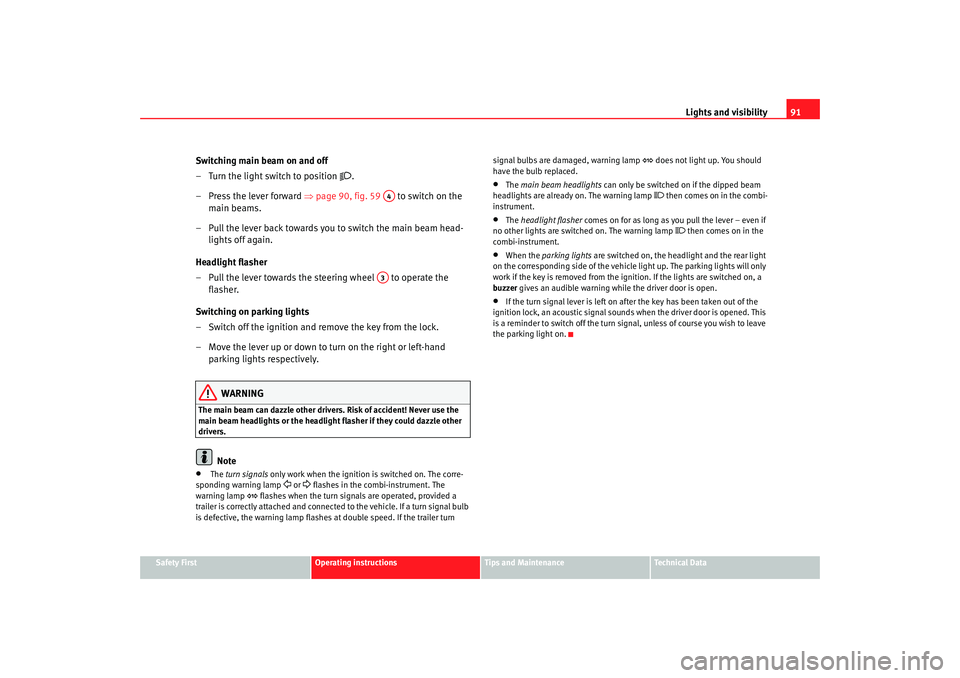
– Press the lever forward ⇒ page 90, fig. 59 to switch on the
main beams.
– Pull the lever back towards you to switch the main beam head- lights off again.
Headlight flasher
– Pull the lever towards the steering wheel to operate the flasher.
Switching on parking lights
– Switch off the ignition and remove the key from the lock.
– Move the lever up or down to turn on the right or left-hand parking lights respectively.
WARNING
The main beam can dazzle other driver s. Risk of accident! Never use the
main beam headlights or the headli ght flasher if they could dazzle other
drivers.
Note
•
The turn signals only work when the ignition is switched on. The corre-
sponding warning lamp
or flashes in the combi-instrument. The
warning lamp
flashes when the turn signals are operated, provided a
trailer is correctly attached and connected to the vehicle. If a turn signal bulb
is defective, the warning lamp flashes at double speed. If the trailer turn signal bulbs are damaged, warning lamp
does not light up. You should
have the bulb replaced.
•
The main beam headlights can only be switched on if the dipped beam
headlights are alrea dy on. The warning lamp
then comes on in the combi-
instrument.
•
The headlight flasher comes on for as long as you pull the lever – even if
no other lights are switched on. The warning lamp
then comes on in the
combi-instrument.
•
When the parking lights are switched on, the headlight and the rear light
on the corresponding side of the vehicle light up. The parking lights will only
work if the key is removed from the ignition. If the lights are switched on, a
buzzer gives an audible warning while the driver door is open.
•
If the turn signal lever is left on after the key has been taken out of the
ignition lock, an acoustic signal sounds when the driver door is opened. This
is a reminder to switch off the turn signal, unless of course you wish to leave
the parking light on.
A4A3
cordoba_ingles_0706 Seite 91 Montag, 28. August 2006 1:18 13
Page 95 of 256
Lights and visibility93
Safety First
Operating instructions
Tips and Maintenance
Te c h n i c a l D a t a
Glove box light*The light in the glove box on the front passenger side will only light up if the
lights are switched on and the glove box is open.Luggage compartment lighting*The luggage compartment lighting is located in the upper section, on the
back of the stowage tray.
The light is activated when the tailgate is open, even when the ignition and
lights are turned off. For this reason ensure that the tailgate is always
closed.
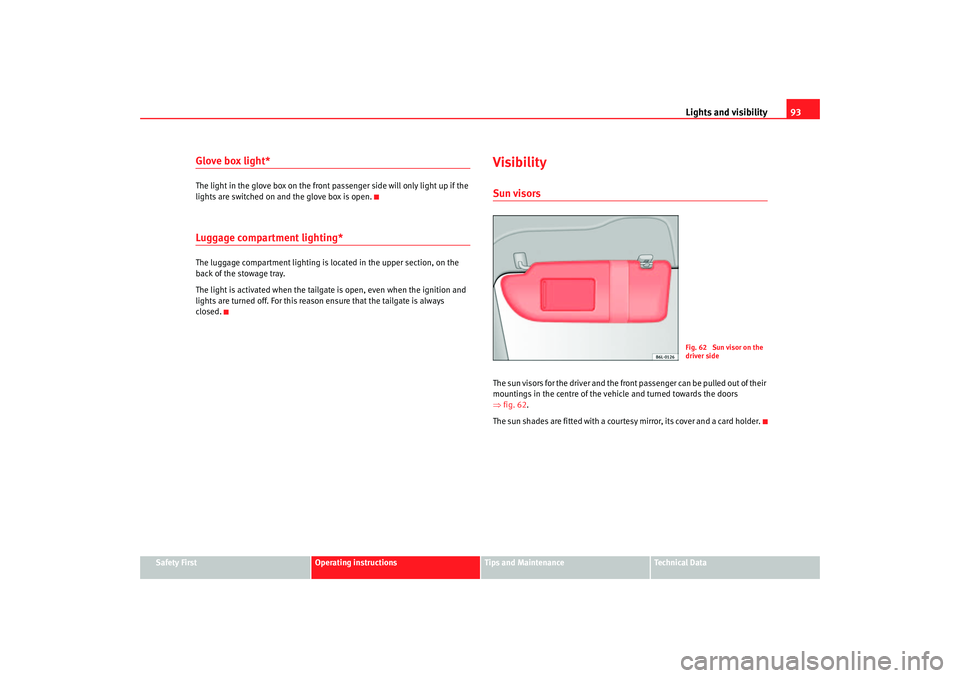
VisibilitySun visorsThe sun visors for the driver and the front passenger can be pulled out of their
mountings in the centre of the vehicle and turned towards the doors
⇒fig. 62 .
The sun shades are fitted with a courtesy mirror, its cover and a card holder.
Fig. 62 Sun visor on the
driver side
cordoba_ingles_0706 Seite 93 Montag, 28. August 2006 1:18 13
Page 96 of 256
Lights and visibility
94Windscreen washersFront windscreen wipers
The windscreen wiper lever controls the windscreen wipers
and the automatic wash and wipe.
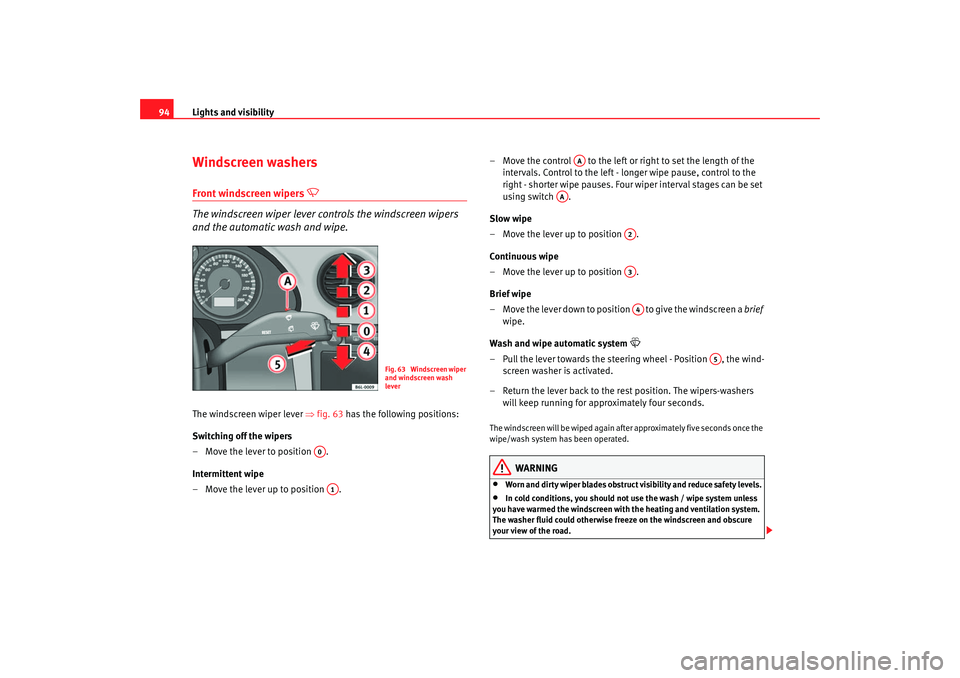
The windscreen wiper lever ⇒fig. 63 has the following positions:
Switching off the wipers
– Move the lever to position .
Intermittent wipe
– Move the lever up to position . – Move the control to the left or right to set the length of the
intervals. Control to the left - longer wipe pause, control to the
right - shor ter wipe pauses. Four wiper inter val stages can be set
using switch .
Slow wipe
– Move the lever up to position .
Continuous wipe
– Move the lever up to position .
Brief wipe
– Move the lever down to position to give the windscreen a brief
wipe.
Wash and wipe automatic system
– Pull the lever towards the steeri ng wheel - Position , the wind-
screen washer is activated.
– Return the lever back to the rest position. The wipers-washers will keep running for approximately four seconds.The windscreen will be wiped again after approximately five seconds once the
wipe/wash system has been operated.
WARNING
•
Worn and dirty wiper blades obstruct visibility and reduce safety levels.
•
In cold conditions, you should not use the wash / wipe system unless
you have warmed the windscreen with the heating and ventilation system.
The washer fluid could otherwise fr eeze on the windscreen and obscure
your view of the road.
Fig. 63 Windscreen wiper
and windscreen wash
lever
A0A1
AA
AA
A2A3A4
A5
cordoba_ingles_0706 Seite 94 Montag, 28. August 2006 1:18 13
Page 98 of 256
Lights and visibility
96
Note•
Do not put stickers on the windscreen in front of the sensor. This may
cause sensor disruption or faults.
Headlight washer system
The headlight washers clean the headlight lenses.The headlight washers are activated automatically when the windscreen
washer is used and the windscreen wiper lever is pulled towards the steering
wheel for at least 1.5 seconds – provided the dipped headlights or main
beams are switched on. Clean off stubborn dirt (insects, etc.) from the head-
lights at regular intervals, for in stance when filling the fuel tank.
Note
•
To ensure that the headlight washers work properly in winter, keep the
nozzle holders in the bumper free of snow and remove any ice with a de-icer
spray.
•
To remove water, the windscreen wiper s will be activated from time to
time, the headlight wipers will be activated every three cycles.
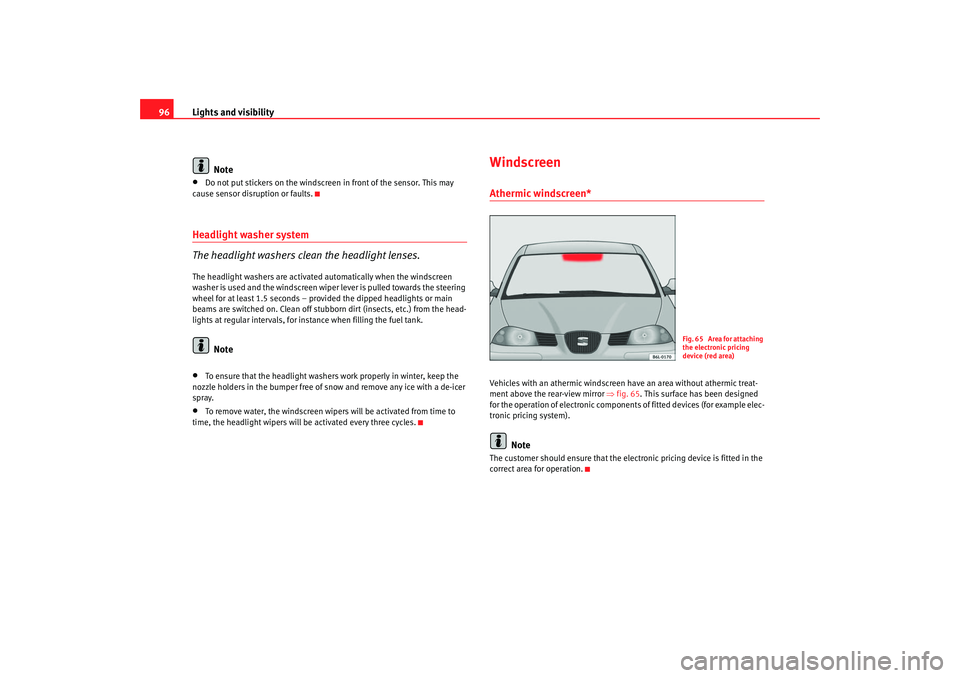
WindscreenAthermic windscreen* Vehicles with an athermic windscreen have an area w ithout athermic treat-
ment above the rear-view mirror ⇒fig. 65. This surface has been designed
for the operation of electronic components of fitted devices (for example elec-
tronic pricing system).
Note
The customer should ensure that the electr onic pricing device is fitted in the
correct area for operation.
Fig. 65 Area for attaching
the electronic pricing
device (red area)
cordoba_ingles_0706 Seite 96 Montag, 28. August 2006 1:18 13
Page 100 of 256
Lights and visibility
98
Note•
The automatic anti-dazzle function will only work properly if the sun
blind* for the rear window is retracted and there are no other objects
preventing light from reac hing the interior mirror.
•
If you have to stick any type of sticker on the windscreen, do not do so in
front of the sensors. Doing so could pr event the anti-dazzle function from
working well or even from working at all.
Folding in the wing mirrorsThe wing mirrors of the vehicle may be folded in. For this, press the mirror
housing towards the vehicle.
Note
Before washing the vehicle with an automatic car wash, fold in the mirrors to
avoid damage.
Electric wing mirrors*
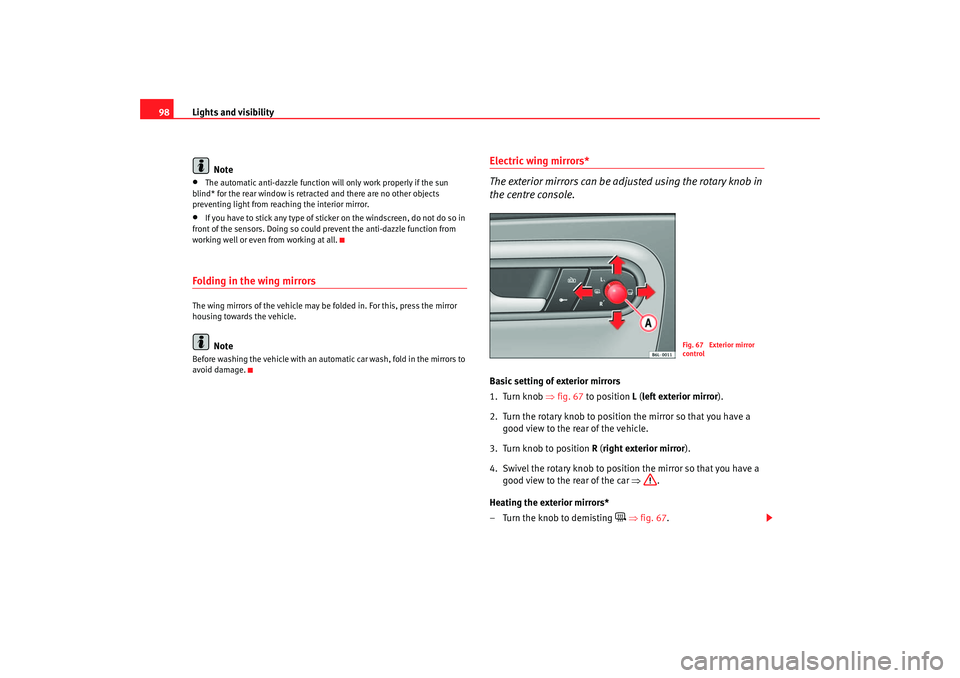
The exterior mirrors can be adjusted using the rotary knob in
the centre console.Basic setting of exterior mirrors
1. Turn knob ⇒fig. 67 to position L ( left exterior mirror ).
2. Turn the rotary knob to position the mirror so that you have a good view to the rear of the vehicle.
3. Turn knob to position R (right exterior mirror ).
4. Swivel the rotary knob to position the mirror so that you have a good view to the rear of the car ⇒.
Heating the exterior mirrors*
– Turn the knob to demisting
⇒ fig. 67 .
Fig. 67 Exterior mirror
control
cordoba_ingles_0706 Seite 98 Montag, 28. August 2006 1:18 13
Page 102 of 256
Seats and stowage
100Seats and stowageThe importance of correct seat adjustmentProper seat adjustment optimi ses the level of protection
offered by seat belts and airbags.Your vehicle has five passenger places, two individual front seats and three
places on the rear seat. Each seat is equipped with a three-point seat belt.
The driver seat and front passenger seat can be adjusted in many ways to suit
the physical requirements of the vehicl e occupants. The correct seat position
is very important for:•
fast and easy operation of all controls on the instrument panel,
•
relaxed posture that does not cause drowsiness,
•
safe driving ⇒page 7,
•
and to ensure that the seat belts and airbag system provide maximum
protection ⇒page 16.
WARNING
•
If the driver and passengers assume improper sitting positions, they
may sustain critical injuries.
•
Never transport more people than there are seats available in the
vehicle.
•
Every occupant in the vehicle must properly fasten and wear the seat
belt belonging to his or her seat. Children must be protected with an appro-
priate child restraint system ⇒page 41, “Child safety”.
•
The front seats and all head restraints must always be adjusted to body
size and the seat belt must always be properly adjusted to provide you and
your passengers with optimum protection.
•
Always keep your feet in the foot well when the vehicle is moving; never
rest them on the dash panel, out of the window or on the seat. This also
applies to passengers. An incorrect sitting position exposes you to an
increased risk of injury in the event of a braking manoeuvre or an accident.
If the airbag is triggered, you could sustain severe injuries due to an incor-
rect sitting position.
•
It is important for the driver and front passenger to maintain a distance
of at least 25 cm from the steering wh eel or dash panel. Failure to respect
the minimum distance means that the airbag will not protect you. Risk of
fatal injury. The distance between the driver and the steering wheel or
between the front passenger and the dash panel should always be as great
as possible.
•
Adjust the driver or front passenger seat only when the vehicle is
stationary. Otherwise your seat could move unexpectedly while the vehicle
is moving. This could increase the risk of an accident and therefore injury.
In addition, while adjusting your seat, you will assume an incorrect sitting
position. Risk of fatal accidents.
•
Special guidelines apply to installing a child seat on the front
passenger seat. When installing a chil d seat, observe the warning note in
the ⇒page 41, “Child safety”.WARNING (continued)
cordoba_ingles_0706 Seite 100 Montag, 28. August 2006 1:18 13
Page 103 of 256
Seats and stowage101
Safety First
Operating instructions
Tips and Maintenance
Te c h n i c a l D a t a
Head restraintsCorrect adjustment of head restraints
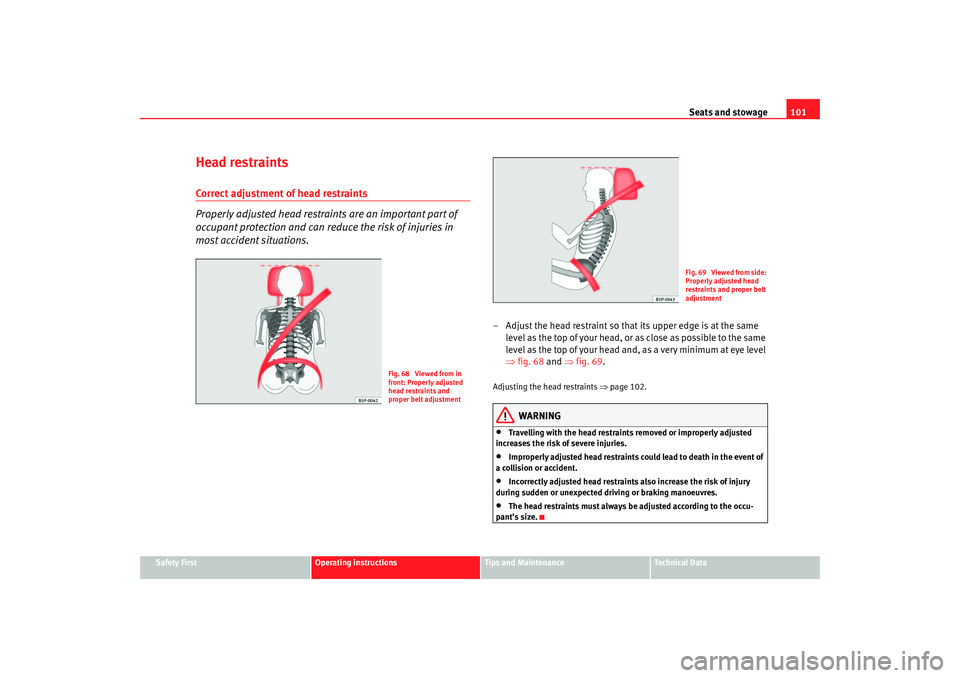
Properly adjusted head restraints are an important part of
occupant protection and can redu ce the risk of injuries in
most accident situations.
– Adjust the head restraint so that its upper edge is at the same
level as the top of your head, or as close as possible to the same
level as the top of your head and, as a very minimum at eye level
⇒fig. 68 and ⇒ fig. 69.Adjusting the head restraints ⇒page 102.
WARNING
•
Travelling with the head restrain ts removed or improperly adjusted
increases the risk of severe injuries.
•
Improperly adjusted head restraints could lead to death in the event of
a collision or accident.
•
Incorrectly adjusted head restraints also increase the risk of injury
during sudden or unexpected driving or braking manoeuvres.
•
The head restraints must always be adjusted according to the occu-
pant’s size.
Fig. 68 Viewed from in
front: Properly adjusted
head restraints and
proper belt adjustment
Fig. 69 Viewed from side:
Properly adjusted head
restraints and proper belt
adjustment
cordoba_ingles_0706 Seite 101 Montag, 28. August 2006 1:18 13
Page 104 of 256
Seats and stowage
102Removing or adjust ing head restraints
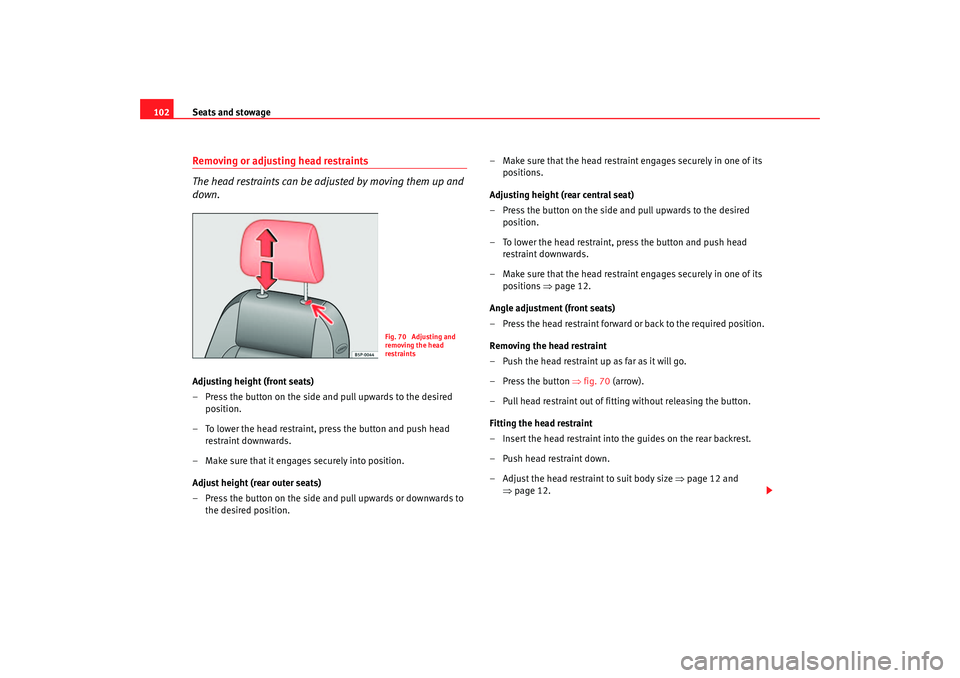
The head restraints can be adjusted by moving them up and
down.Adjusting height (front seats)
– Press the button on the side and pull upwards to the desired position.
– To lower the head restraint, press the button and push head restraint downwards.
– Make sure that it engages securely into position.
Adjust height (rear outer seats)
– Press the button on the side and pull upwards or downwards to the desired position. – Make sure that the head restrain
t engages securely in one of its
positions.
Adjusting height (rear central seat)
– Press the button on the side and pull upwards to the desired position.
– To lower the head restraint, press the button and push head restraint downwards.
– Make sure that the head restrain t engages securely in one of its
positions ⇒page 12.
Angle adjustment (front seats)
– Press the head restraint forward or back to the required position.
Removing the head restraint
– Push the head restraint up as far as it will go.
– Press the button ⇒fig. 70 (arrow).
– Pull head restraint out of fitting without releasing the button.
Fitting the head restraint
– Insert the head restraint into the guides on the rear backrest.
– Push head restraint down.
– Adjust the head restraint to suit body size ⇒page 12 and
⇒ page 12.
Fig. 70 Adjusting and
removing the head
restraints
cordoba_ingles_0706 Seite 102 Montag, 28. August 2006 1:18 13
Page 105 of 256
Seats and stowage103
Safety First
Operating instructions
Tips and Maintenance
Te c h n i c a l D a t a
WARNING
•
Never drive if the head restraints have been removed. Risk of injury.
•
Never drive if the head restraints are in an unsuitable position, there is
a risk of serious injury.
•
After refitting the head restraint, you must always adjust it properly for
height to achieve optimal protection.
•
Please observe the safety warnings ⇒page 101, “Correct adjustment
of head restraints”.Note
•
To fit and remove the rear head restraints, gently tilt the seat back
forwards.
•
When fitting the head restraints again, insert the tubes as far as possible
into the guides without pressing the button.
Front seatsAdjustment of the front seats
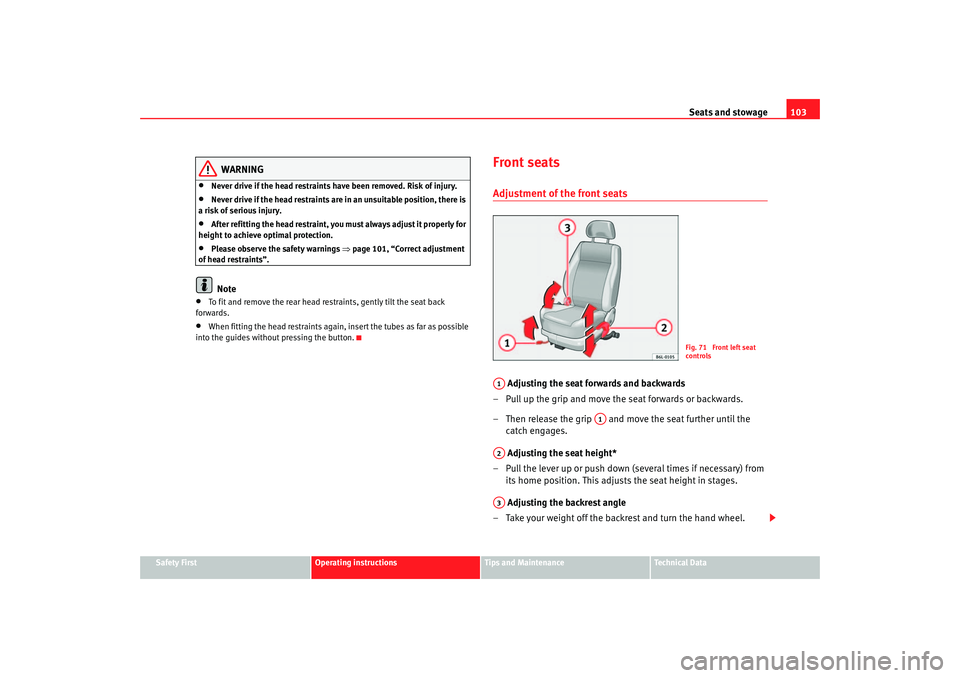
Adjusting the seat forwards and backwards
– Pull up the grip and move the seat forwards or backwards.
– Then release the grip and mo ve the seat further until the
catch engages.
Adjusting the seat height*
– Pull the lever up or push down (several times if necessary) from its home position. This adjust s the seat height in stages.
Adjusting the backrest angle
– Take your weight off the backrest and turn the hand wheel.
Fig. 71 Front left seat
controls
A1
A1
A2A3
cordoba_ingles_0706 Seite 103 Montag, 28. August 2006 1:18 13
Page 106 of 256
Seats and stowage
104
WARNING
•
Never adjust the driver or front passenger seat while the vehicle is in
motion. While adjusting your seat, you will assume an incorrect sitting
position. Risk of fatal accidents. Adju st the driver or front passenger seat
only when the vehicle is stationary.
•
To reduce the risk of injury to the driver and front passenger during
sudden braking manoeuvres or an accident, never drive with the backrest
tilted far to the rear. The maximum protection of the seat belt can be
achieved only when the backrests are in an upright position and the driver
and front passenger have properly adjusted their seat belts. The further
the backrests are tilted to the rear, the greater the risk of injury due to
improper positioning of the belt web!
•
Exercise caution when adjusting the seat height or forwards/back-
wards position. Injuries can be caused if the backrest is tilted without due
care and attention.
Heated seats*
The front seat cushions and backrests can be heated electri-
cally.
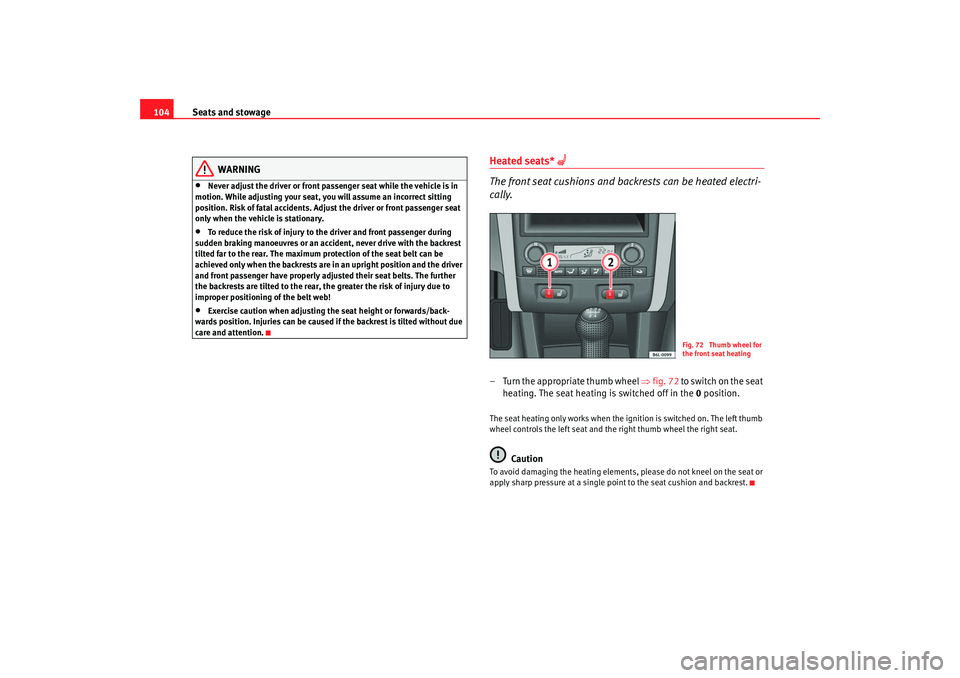
– Turn the appropriate thumb wheel ⇒fig. 72 t o s wi t ch o n t h e s e a t
heating. The seat heating is switched off in the 0 position.The seat heating only works when the ignition is switched on. The left thumb
wheel controls the left seat and the right thumb wheel the right seat.
Caution
To avoid damaging the heating elements, please do not kneel on the seat or
apply sharp pressure at a single point to the seat cushion and backrest.
Fig. 72 Thumb wheel for
the front seat heating
cordoba_ingles_0706 Seite 104 Montag, 28. August 2006 1:18 13