ECU Seat Exeo 2008 User Guide
[x] Cancel search | Manufacturer: SEAT, Model Year: 2008, Model line: Exeo, Model: Seat Exeo 2008Pages: 303, PDF Size: 10.02 MB
Page 25 of 303
Seat belts23
Safety First
Operating instructions
Practical tips
Te c h n i c a l D a t a
– Adjust the seat and head restraint correctly.
– To fasten the belt, take hold of the latch plate and pull it slowly
across your chest and lap.
– Insert the latch plate into the buckle for the appropriate seat and push it down until it is securely locked with a click ⇒page 22,
fig. 11 .
– Pull the belt to ensure that the latch plate is securely engaged in the buckle.The seat belts are equipped with an automatic retractor on the shoulder
strap. Full freedom of movement is permitted when the shoulder belt is pulled
slowly. However, during sudden braking, during travel in mountains or bends
and during acceleration, the automati c retractor on the shoulder belt is
locked.
The automatic belt retractors on the front seats are fitted with belt tension
devices ⇒page 26.
WARNING
•
An incorrectly worn seat belt web can cause severe injuries in the event
of an accident.
•
The seat belts offer best protection only when the backrests are in an
upright position and the seat belt s have been fastened properly.
•
Never put the latch plate in the buckle of another seat. If you do this, the
seat belt will not protect you properly and the risk of injury is increased.
•
If an occupant is incorrectly belted in, the belt cannot protect him or her
properly. An incorrectly positioned belt web can cause extremely severe
injuries.
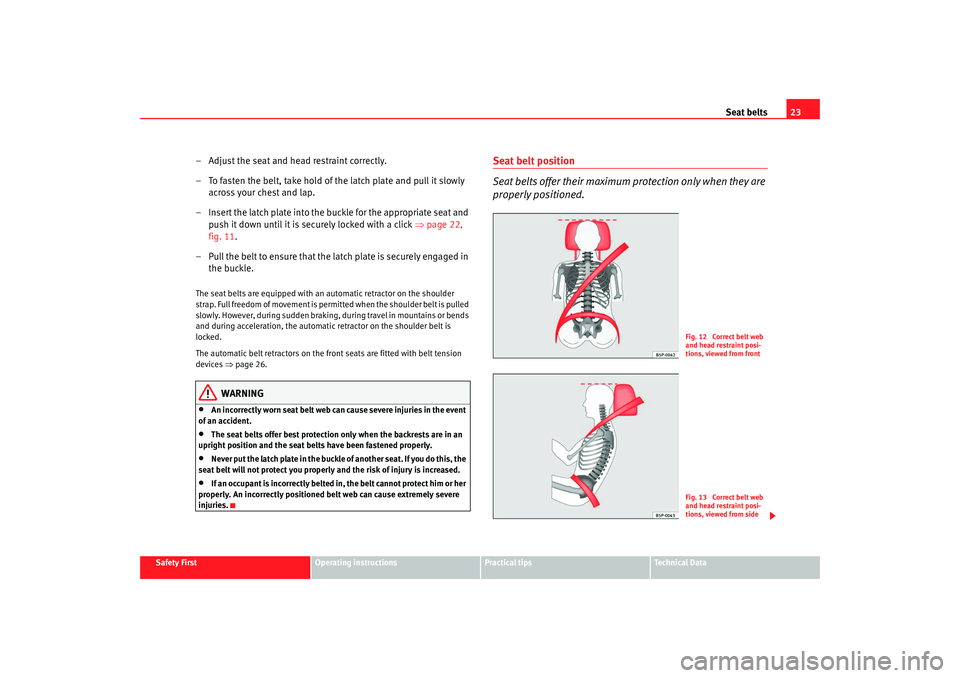
Seat belt position
Seat belts offer their maximum pr otection only when they are
properly positioned.
Fig. 12 Correct belt web
and head restraint posi-
tions, viewed from frontFig. 13 Correct belt web
and head restraint posi-
tions, viewed from side
Exeo_EN.book Seite 23 Freitag, 17. Oktober 2008 11:24 11
Page 26 of 303
Seat belts
24The following features are available to adjust the seat belt in the shoulder
region:•
belt height ad justment for the front seats.
•
front seat height adjustment*.
WARNING
•
An incorrectly worn seat belt web c an cause severe injuries in the event
of an accident.
•
The shoulder part of the seat belt mu st lie on the centre of the shoulder,
never across the neck. The seat belt must lie flat and snugly on the torso
⇒ page 23, fig. 12 .
•
The lap part of the seat belt must lie across the pelvis, never across the
stomach. The seat belt must lie flat and snugly on the pelvis ⇒page 23,
fig. 13. Pull the belt tight if necessary to take up any slack.
•
Read and observe the warnings ⇒ page 21.
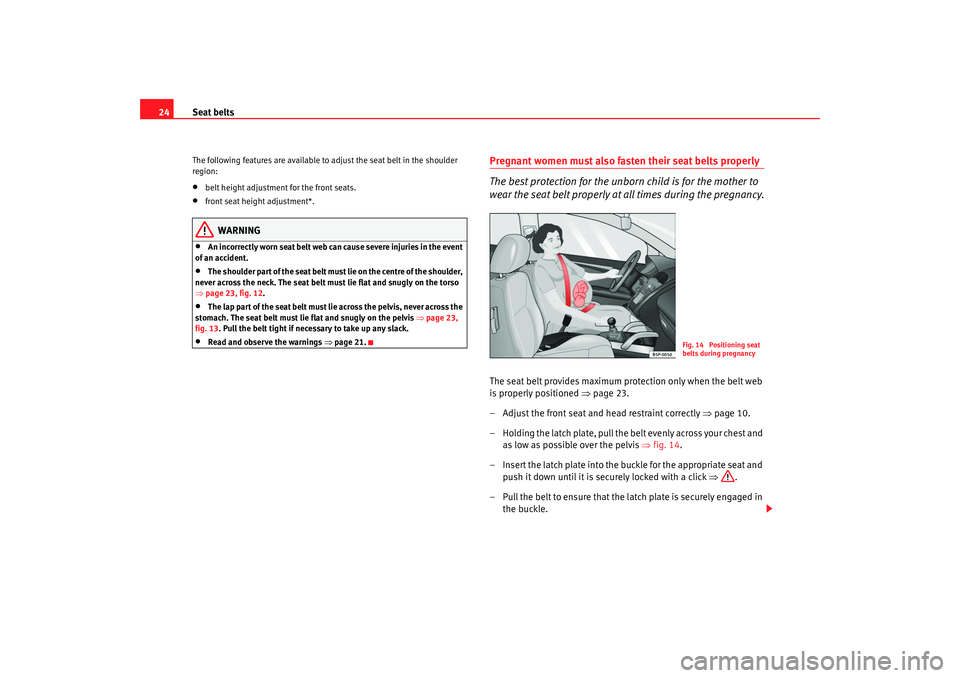
Pregnant women must also fasten their seat belts properly
The best protection for the unborn child is for the mother to
wear the seat belt properly at all times during the pregnancy.The seat belt provides maximum protection only when the belt web
is properly positioned ⇒page 23.
– Adjust the front seat and head restraint correctly ⇒page 10.
– Holding the latch plate, pull the belt evenly across your chest and as low as possible over the pelvis ⇒fig. 14 .
– Insert the latch plate into the buckle for the appropriate seat and push it down until it is securely locked with a click ⇒.
– Pull the belt to ensure that the latch plate is securely engaged in the buckle.
Fig. 14 Positioning seat
belts during pregnancy
Exeo_EN.book Seite 24 Freitag, 17. Oktober 2008 11:24 11
Page 28 of 303

Seat belts
26
– Take hold of the top guide fitting and slide it up or down so that the shoulder part of the seat be lt is positioned roughly midway
over the shoulder, although it must never rest against the neck
⇒ page 25, fig. 16 ⇒ in “Seat belt position” on page 23.
– After adjusting, pull the belt sh arply to check that the catch on
the guide fitting is engaged securely.
NoteIt is also possible to adjust the height of the front seats to obtain the best
position for the front seat belts.Incorrectly fastened seat belts
Incorrectly worn seat belts can cause severe injuries.Seat belts can provide optimal protection only if the belt web is
properly worn. The seat belts must be fastened exactly in the order
described in this chapter. An incorrect sitting position impairs
substantially the protection a seat belt offers and can lead to severe
or fatal injuries. The risk of severe or fatal injuries is especially
increased when a deploying airbag strikes an occupant who has
assumed an incorrect sitting position . As driver, you are responsible
for all vehicle occupants, especially children. Therefore:
– Never allow anyone to wear the seat belt incorrectly while the vehicle is moving ⇒.
WARNING
•
An incorrectly worn seat belt incr eases the risk of severe injuries.
•
Before every trip, instruct your passengers to adjust their seat belts
properly and to wear them during the trip.
•
Read and always observe information and warnings concerning the use
of seat belts ⇒page 21.
Belt tension devicesFunction of the belt tension device
During a frontal collision, the se at belts on the front seats are
retracted automatically.The seat belts for the front occupants are equipped with belt tension devices.
Sensors will trigger the belt tension devices during severe head-on, lateral
and rear collisions only if the seat belt is being worn. This retracts and
tightens the seat belts, reducing the forward motion of the occupants.
The belt tension device ca n be triggered only once.
The belt tension devices will not be triggered in the event of a light frontal,
side or rear collision, if the vehicle overturns or in situations where no large
forces act on the front, side or rear of the vehicle.
Note
•
If the belt tension devices are triggered, a fine dust is produced. This is
normal and it is not an indication of fire in the vehicle.
•
The relevant safety requirements must be observed when the vehicle or
components of the system are scrapped. A qualified workshop is familiar with
these regulations and will be pleased to pass on the information to you.
A2
WARNING (continued)
Exeo_EN.book Seite 26 Freitag, 17. Oktober 2008 11:24 11
Page 31 of 303
Airbag system29
Safety First
Operating instructions
Practical tips
Te c h n i c a l D a t a
•
Always properly adjust the front seats.
The danger of fitting a child seat on the front passenger seat
Rear-facing child seats must never be used on the front
passenger seat when the front passenger airbag is enabled.An enabled front airbag on the front passenger side is potentially a major
danger to a child. The front passenger seat is life threatening to a child if
he/she is transported in a rear-facing child seat. You should always transport
all children up to 12 years of age on the rear seat.
If a rear-facing child seat is secured to the front passenger seat, an inflating
airbag can strike it with such great force that critical or fatal injuries may
result.
Therefore we strongly recommend you to transport children on the rear seats.
That is the safest place for children in the vehicle. Alternatively, the front
passenger airbag can be disabled with a key-operated switch ⇒page 44.
When transporting children, use a child seat appropriate to the age and size
of each child ⇒ page 46.
For those vehicles that do not include a key lock switch to turn the airbag off,
an Authorised Service Centre must be consulted.
WARNING
•
If a child seat is secured to the front passenger seat, the risk to the child
of sustaining critical or fatal injuries in the event of an accident increases.
•
Never secure a rear-facing child seat to the front passenger seat if the
front passenger airbag is enabled. The child can suffer critical or fatal inju-
ries when the front passenger airbag is triggered.
•
An inflating front passenger airbag can strike the rear-facing child seat
and hurl it with great force against the door, the roof or the backrest.
•
If, under special circumstances, it is necessary to transport a child in a
rear-facing child seat on the front passenger seat, it is absolutely essential
that you observe the following safety measures:
−Disable the front passenger airbag ⇒page 44, “Deactivating
airbags*”.
− The child seat must be approved by the child seat manufacturer for
use on a front passenger seat with front or side airbag.
− Follow the installation instructions given by the child seat manufac-
turer and observe the safety instructions ⇒page 46, “Child safety”.
− Before properly installing the child seat, push the front passenger
seat completely backwards so that the greatest possible distance to
the front passenger airbag is ensured.
− Ensure that no objects prevent the front passenger seat from being
pushed completely back.
− The backrest of the front passenger seat must be in an upright
position.
Warning lamp for airbag and belt tension device system
This warning lamp monitors the airbag and belt tension
device system.The warning lamp monitors all airbags and belt tension devices in the
vehicle, including control units and wiring connections.
WARNING (continued)
WARNING (continued)
Exeo_EN.book Seite 29 Freitag, 17. Oktober 2008 11:24 11
Page 37 of 303
Airbag system35
Safety First
Operating instructions
Practical tips
Te c h n i c a l D a t a
Safety notes on the frontal airbag system
If you use airbags correctly, they can considerably reduce the
risk of injury in many kinds of accident.
WARNING
•
It is important for the driver and front passenger to keep a distance of
at least 25 cm from the steering wheel or dash panel. If the minimum
distance is not observed then the airbags do not correctly protect the
vehicle occupants; risk of fatal injuries! In addition, the front seats and
head restraints must always be positioned correctly for the height of the
occupant.
•
If you are not wearing a seat belt, if you lean forward or to the side while
travelling or assume an incorrect sitting position, there is a substantially
increased risk of injury. This increased risk of injury will be further
increased if you are struck by an inflating airbag.
•
Never let a child travel on the front seat without an appropriate restraint
system. If the airbag is triggered in an accident, children can sustain
serious or fatal injuries from the airbag as it inflates ⇒page 46, “Child
safety”.
•
The deployment space between the front passengers and the airbags
must not in any case be occupied by other passenger, pets and objects.
•
The airbags provide protection for just one accident; replace them once
they have deployed.
•
It is also important not to attach any objects such as cup holders or
telephone mountings to the surfaces covering the airbag units.
•
Do not attempt to modify components of the airbag system in any
way.
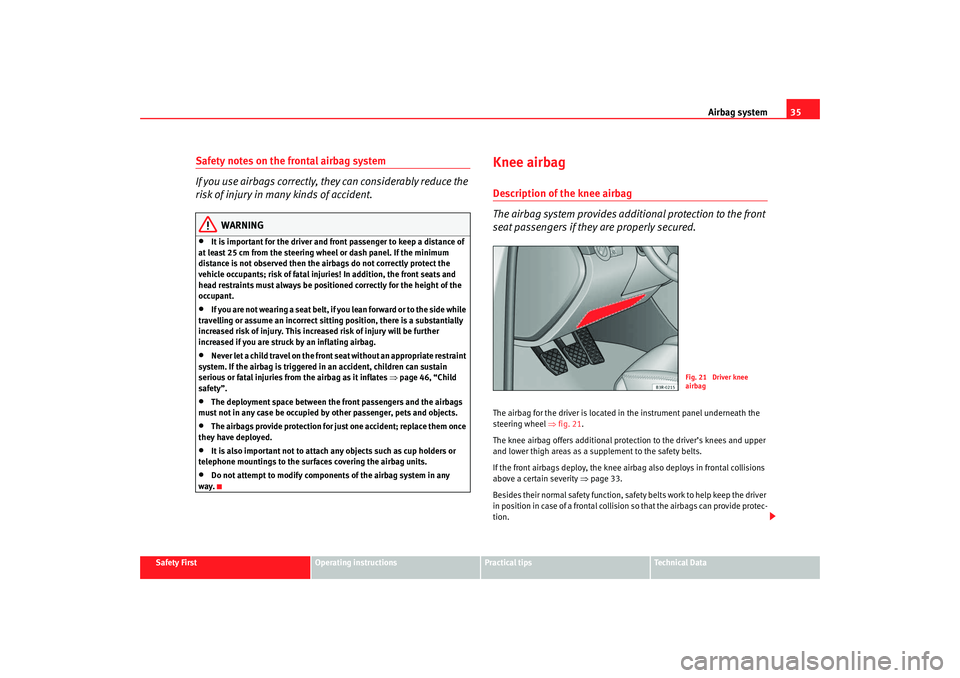
Knee airbagDescription of the knee airbag
The airbag system provides additional protection to the front
seat passengers if they are properly secured.The airbag for the driver is located in the instrument panel underneath the
steering wheel ⇒ fig. 21.
The knee airbag offers additional protection to the driver’s knees and upper
and lower thigh areas as a supplement to the safety belts.
If the front airbags deploy, the knee airbag also deploys in frontal collisions
above a certain severity ⇒page 33.
Besides their normal safety function, safety belts work to help keep the driver
in position in case of a frontal collision so that the airbags can provide protec-
tion.
Fig. 21 Driver knee
airbag
Exeo_EN.book Seite 35 Freitag, 17. Oktober 2008 11:24 11
Page 49 of 303
Child safety47
Safety First
Operating instructions
Practical tips
Te c h n i c a l D a t a
“Deactivating airbags*”. If the passe
nger seat has a height adjustment
option, move it to the highest position.
•
For those vehicles that do not include a key lock switch to turn the
airbag off, an Authorised Service Centre must be consulted.
•
All passengers, especially children, must assume the proper sitting
position and be properly belted in while travelling.
•
Never hold children or babies on your lap, this can result in potentially
fatal injuries to the child!
•
Never allow a child to be transported in a vehicle without being properly
secured, or to stand up or kneel on a seat while travelling. In an accident,
the child could be flung through the vehicle, causing possibly fatal injuries
to themselves and to the other passengers.
•
If children assume an improper sitting position when the car is moving,
they expose themselves to greater ri sk of injury in the event of sudden
braking manoeuvre or in an accident. This is particularly important if the
child is travelling on the front passenger seat and the airbag system is trig-
gered in an accident; as this could cause serious injury or even death.
•
A suitable child seat can protect your child!
•
Never leave an unsupervised child alone on a child seat or in the
vehicle.
•
Depending on weather conditions, it may become extremely hot or cold
inside the vehicle. This can be fatal.
•
Children who are less than 1.5 metres tall must not wear a normal seat
belt without a child restraint system, as this could cause injuries to the
abdominal and neck areas during a sudden braking manoeuvre or in an
accident.
•
Do not allow the belt webbing to become twisted or jammed, or to rub
on any sharp edges.
•
Incorrectly worn seat belts can cause injuries even in a minor collision
or in sudden braking manoeuvres.
•
The seat belt provides maximum protection only when the belt web is
properly positioned ⇒page 22, “Seat belts”.
•
Only one child may occupy a child seat ⇒page 48, “Child seats”.
WARNING (continued)
WARNING (continued)
Exeo_EN.book Seite 47 Freitag, 17. Oktober 2008 11:24 11
Page 53 of 303
Child safety51
Safety First
Operating instructions
Practical tips
Te c h n i c a l D a t a
Securing child seatsWays to secure a child seat
A child seat can be secured differently on th e rear seat and on the front passenger seat.You can secure a child seat to the rear seat or front passenger seat in the
following ways:•
Child seats in groups 0 to 3 can be secured with a seat belt.
•
Seats for children aged 0, 0+ and 1 with the “ISOFIX” system can be
secured without fastening seat belts, using the “ISOFIX” and/or Top Tether
securing rings ⇒page 52.
U: Suitable for universal approved rest raining systems for use in this age
category (universal retention systems are those fitted using the adult
seat belt).
*: Move the passenger seat as far to rear as possible, as high as possible and always deactivate the airbag.
L: Suitable for retention system s using the “ISOFIX” anchors.
WARNING
•
When travelling, children must be secured in the vehicle with a
restraint system suitable for age, weight and size.
•
Never install a child seat facing backwards (or rear-facing) on the front
passenger seat unless the front passenger airbag has been disabled. This
could cause fatal injuries to the child! However, if it is necessary, in excep- tional cases, to transport a child in the front passenger seat, the front
passenger airbag must always be disabled
⇒page 44, “Deactivating
airbags*” and move the seat to its h ighest position, in case it has this
adjustment.
•
Read and always observe information and warnings concerning the use
of child seats ⇒ in “Safety notes on using child seats” on page 46.
Category
Weight Seat locations
Front passenger Rear outerRear centre
Group 0 <10 kgU*U/L U
Group 0+ <13 kgU*U/L U
Group 1 9-18 kgU*U/L U
Group 2 / 3 15-36 kgU*UUWARNING (continued)
Exeo_EN.book Seite 51 Freitag, 17. Oktober 2008 11:24 11
Page 54 of 303
Child safety
52Child seat mounting using the “ISOFIX” and/or Top Tether system
The Children restraint systems may be fitted with the “ISOFIX”
system and/or Top Tether (placed on the luggage compart-
ment cover) to the rear seat in a safe and quick way. The
passenger seat* is not equipped with Top Tether and so, the
“ISOFIX” system can only be used.
Following the instructions given by the child seat manufacturer
when installing and removing the seat.
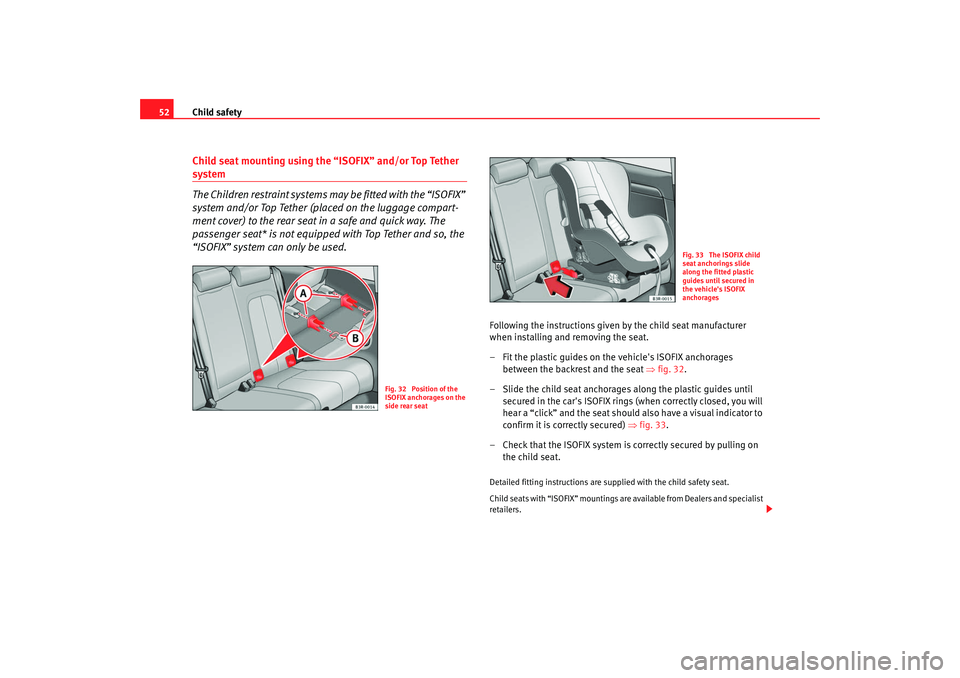
– Fit the plastic guides on the vehicle's ISOFIX anchorages
between the backrest and the seat ⇒fig. 32.
– Slide the child seat anchorages along the plastic guides until secured in the car's ISOFIX rings (when correctly closed, you will
hear a “click” and the seat should also have a visual indicator to
confirm it is correctly secured) ⇒fig. 33 .
– Check that the ISOFIX system is correctly secured by pulling on the child seat.Detailed fitting instructions are supplied with the child safety seat.
Child seats with “ISOFIX” mountings are available from Dealers and specialist
retailers.
Fig. 32 Position of the
ISOFIX anchorages on the
side rear seat
Fig. 33 The ISOFIX child
seat anchorings slide
along the fitted plastic
guides until secured in
the vehicle's ISOFIX
anchorages
Exeo_EN.book Seite 52 Freitag, 17. Oktober 2008 11:24 11
Page 55 of 303
Child safety53
Safety First
Operating instructions
Practical tips
Te c h n i c a l D a t a
WARNING
The retainers employed for this child safety seat are specially designed for
the “ISOFIX” system. Never secure othe r child seats, seat belts or other
items into the retainers. If you do, you increase the risk of sustaining
severe or fatal injuries.Top Tether retainer straps
Some child restraint seats have a third anchoring point Top
Tether, apart from both “ISOFIX” anchoring points, which
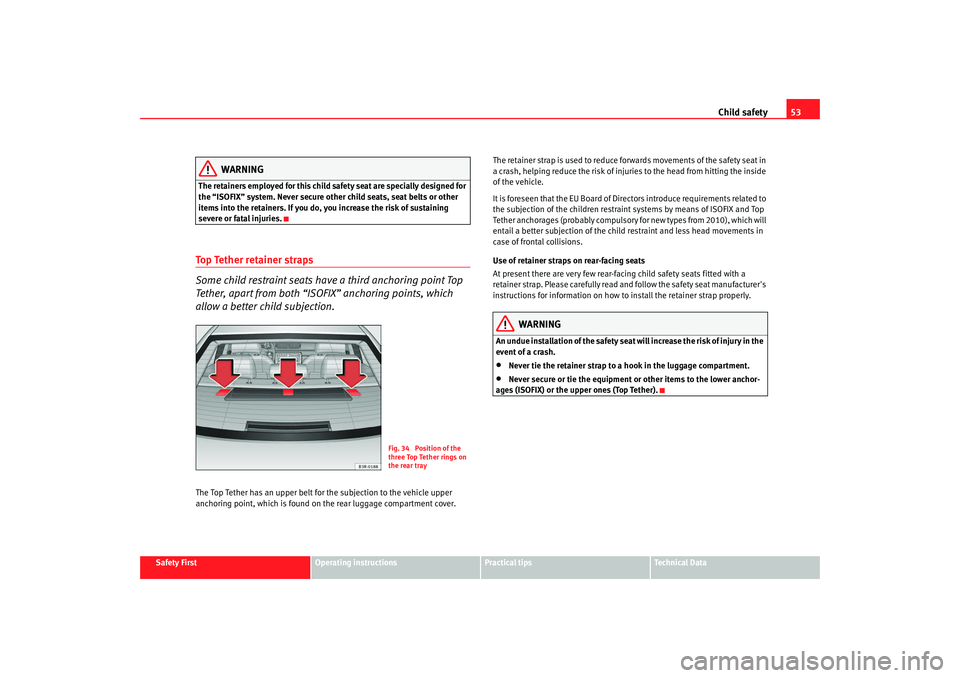
allow a better child subjection.The Top Tether has an upper belt for the subjection to the vehicle upper
anchoring point, which is found on the rear luggage compartment cover. The retainer strap is used to reduce forwards movements of the safety seat in
a crash, helping reduce the risk of injuries to the head from hitting the inside
of the vehicle.
It is foreseen that the EU Board of Dire
ctors introduce requirements related to
the subjection of the children restra int systems by means of ISOFIX and Top
Tether anchorages (probably compulsory for new types from 2010), which will
entail a better subjection of the child restraint and less head movements in
case of frontal collisions.
Use of retainer straps on rear-facing seats
At present there are very few rear-facing child safety seats fitted with a
retainer strap. Please carefully read and follow the safety seat manufacturer's
instructions for information on how to install the retainer strap properly.
WARNING
An undue installation of the safety seat will increase the risk of injury in the
event of a crash.•
Never tie the retainer strap to a hook in the luggage compartment.
•
Never secure or tie the equipment or other items to the lower anchor-
ages (ISOFIX) or the upper ones (Top Tether).
Fig. 34 Position of the
three Top Tether rings on
the rear tray
Exeo_EN.book Seite 53 Freitag, 17. Oktober 2008 11:24 11
Page 56 of 303
Child safety
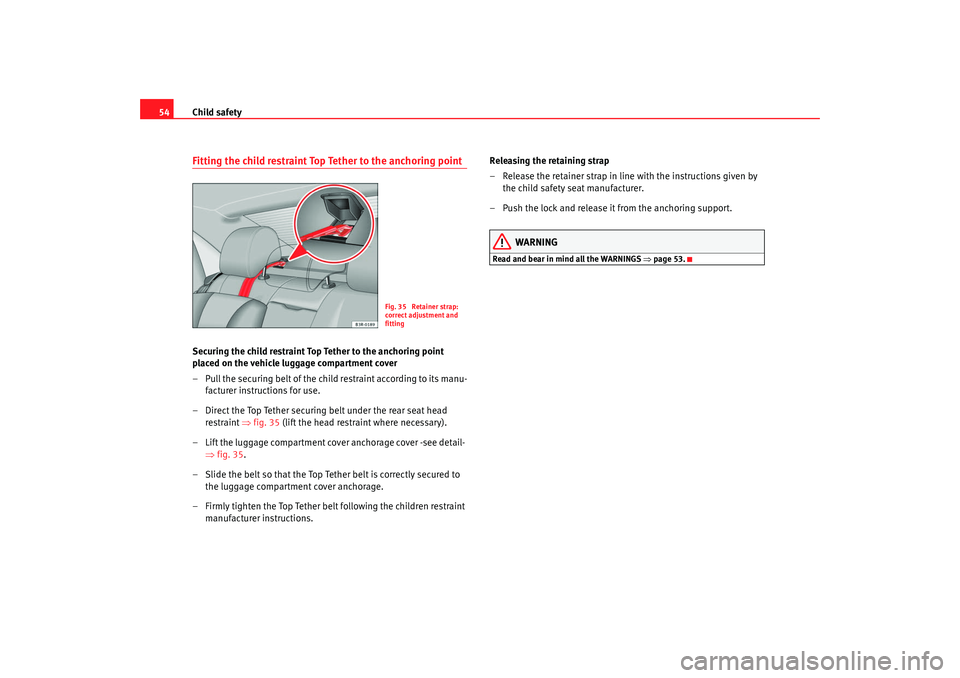
54Fitting the child restraint Top Tether to the anchoring pointSecuring the child restraint Top Tether to the anchoring point
placed on the vehicle luggage compartment cover
– Pull the securing belt of the child restraint according to its manu-
facturer instructions for use.
– Direct the Top Tether securing belt under the rear seat head restraint ⇒fig. 35 (lift the head restraint where necessary).
– Lift the luggage compartment cover anchorage cover -see detail- ⇒fig. 35 .
– Slide the belt so that the Top Te ther belt is correctly secured to
the luggage compartment cover anchorage.
– Firmly tighten the Top Tether belt following the children restraint manufacturer instructions. Releasing the retaining strap
– Release the retainer strap in line with the instructions given by
the child safety seat manufacturer.
– Push the lock and release it from the anchoring support.
WARNING
Read and bear in mind all the WARNINGS ⇒page 53.
Fig. 35 Retainer strap:
correct adjustment and
fitting
Exeo_EN.book Seite 54 Freitag, 17. Oktober 2008 11:24 11