ECU Seat Exeo 2008 Owner's Guide
[x] Cancel search | Manufacturer: SEAT, Model Year: 2008, Model line: Exeo, Model: Seat Exeo 2008Pages: 303, PDF Size: 10.02 MB
Page 98 of 303
Unlocking and locking
96Central lockingDescription
The central locking system enables you to lock and unlock all
the doors, the boot lid and the tank flap together.The central locking system on your vehicle locks and unlocks all the doors
and the tank flap simultaneously. The tailgate is unlocked when the vehicle
is opened. However, the handle must be used to open it. The vehicle can be
locked and unlocked using the remote control ⇒page 102 or by turning the
key in the lock in the driver's door.
The windows can also be centrally opened or closed using the central locking
system ⇒page 107. The sun roof* can be closed but not opened using the
central locking system.
The central locking system is combined with an anti-theft security system. If
the vehicle is locked with the key from the outside, the interior opening levers
stop working, which make it difficult fo r unauthorised people to get into the
vehicle.
Should the central locking system fail to work, you can still normally enable
all the locks individually. The fuel tank flap can be released manually if neces-
sary. For manual release of the tank flap ⇒page 209.
Automatic locking function (Auto Lock)*
The Auto Lock* function locks the doors and the boot lid when the vehicle
exceeds a speed of about 15 km/h.
The vehicle is unlocked again automatically when the ignition key is
removed. Alternatively, the driver can also unlock the vehicle using the
central locking switch
or by opening one of the doors.
WARNING
Do not leave anyone (especially children) inside the car if it is locked from
the outside and the anti-theft security system is enabled, as the doors and
windows cannot then be opened from the inside. Locked doors could delay
assistance in an emergency, potentially putting lives at risk.
Note
•
Should the central locking system fail to work, you can still lock and
unlock the driver's door and the tailgate using the key. For manual release of
the tank flap ⇒page 209. Locking the doors manually if central locking fails
to work ⇒page 99.
•
The anti-theft mechanism and the anti-theft alarm* cannot be enabled if
the central locking is not working.
•
Never leave any valuable items in the vehicle unattended. Even a locked
vehicle is not a safe.
Exeo_EN.book Seite 96 Freitag, 17. Oktober 2008 11:24 11
Page 99 of 303
Unlocking and locking97
Safety First
Operating instructions
Practical tips
Te c h n i c a l D a t a
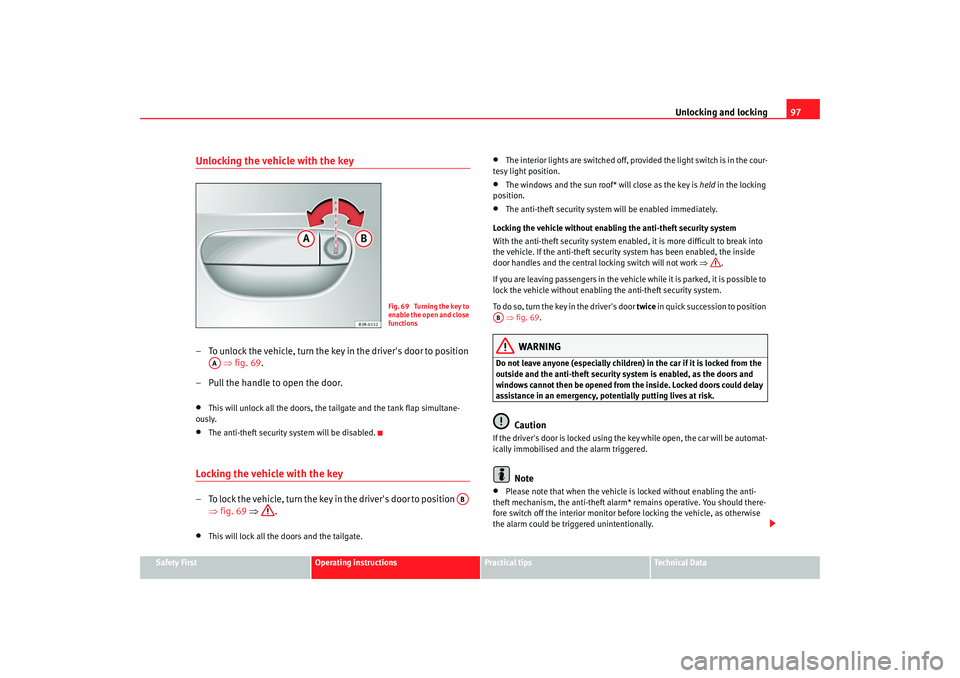
Unlocking the vehicle with the key– To unlock the vehicle, turn the key in the driver's door to position
⇒ fig. 69 .
– Pull the handle to open the door.•
This will unlock all the doors, the tailgate and the tank flap simultane-
ously.
•
The anti-theft security system will be disabled.
Locking the vehicle with the key– To lock the vehicle, turn the key in the driver's door to position
⇒ fig. 69 ⇒ .•
This will lock all the doors and the tailgate.
•
The interior lights are switched off, provided the light switch is in the cour-
tesy light position.
•
The windows and the sun roof* will close as the key is held in the locking
position.
•
The anti-theft security system will be enabled immediately.
Locking the vehicle without enabling the anti-theft security system
With the anti-theft security system enabled, it is more difficult to break into
the vehicle. If the anti-theft security system has been enabled, the inside
door handles and the central locking switch will not work ⇒.
If you are leaving passengers in the vehicle while it is parked, it is possible to
lock the vehicle without enabling the anti-theft security system.
To do so, turn the key in the driver's door twice in quick succession to position
⇒ fig. 69 .
WARNING
Do not leave anyone (especially children) in the car if it is locked from the
outside and the anti-theft security system is enabled, as the doors and
windows cannot then be opened from the inside. Locked doors could delay
assistance in an emergency, potentially putting lives at risk.
Caution
If the driver's door is locked using the key while open, the car will be automat-
ically immobilised and the alarm triggered.
Note
•
Please note that when the vehicle is locked without enabling the anti-
theft mechanism, the anti-theft alarm* remains operative. You should there-
fore switch off the interior monitor be fore locking the vehicle, as otherwise
the alarm could be triggered unintentionally.
Fig. 69 Turning the key to
enable the open and close
functions
AA
AB
AB
Exeo_EN.book Seite 97 Freitag, 17. Oktober 2008 11:24 11
Page 100 of 303
Unlocking and locking
98•
The driver's door cannot be locked using the central locking system when
it is still open. The door must be lo cked separately after it has been closed.
This helps to prevent you from being locked out of the vehicle.
Central locking switch
The central locking system can be enabled from inside the
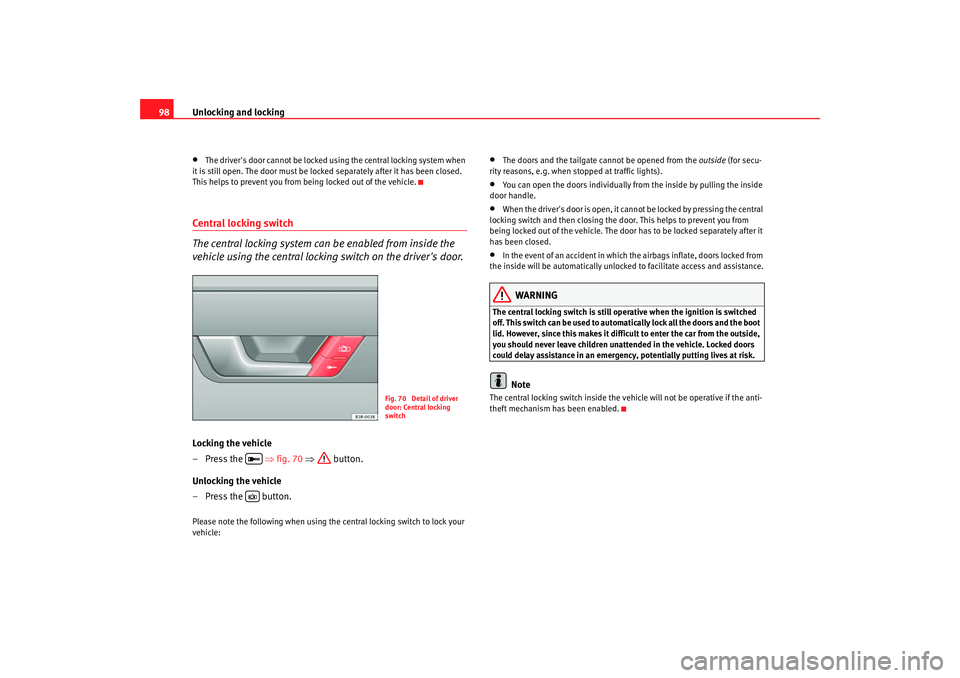
vehicle using the central locking switch on the driver's door.Locking the vehicle
– Press the ⇒fig. 70 ⇒ button.
Unlocking the vehicle
– Press the button.Please note the following when using the central lock ing switch to lock your
vehicle:
•
The doors and the tailgate ca nnot be opened from the outside (for secu-
rity reasons, e.g. when stopped at traffic lights).
•
You can open the doors individually from the inside by pulling the inside
door handle.
•
When the driver's door is open, it cannot be locked by pressing the central
locking switch and then closing the door. This helps to prevent you from
being locked out of the vehicle. The door has to be locked separately after it
has been closed.
•
In the event of an accident in which the airbags inflate, doors locked from
the inside will be automatically unlocked to facilitate access and assistance.
WARNING
The central locking switch is still op erative when the ignition is switched
off. This switch can be used to autom atically lock all the doors and the boot
lid. However, since this makes it difficu lt to enter the car from the outside,
you should never leave children unattended in the vehicle. Locked doors
could delay assistance in an emergency, potentially putting lives at risk.
Note
The central locking switch inside the vehicle will not be operative if the anti-
theft mechanism has been enabled.
Fig. 70 Detail of driver
door: Central locking
switch
Exeo_EN.book Seite 98 Freitag, 17. Oktober 2008 11:24 11
Page 101 of 303
Unlocking and locking99
Safety First
Operating instructions
Practical tips
Te c h n i c a l D a t a
Security central locking
The security central locking feature allows you to only unlock
the driver's door and the tank flap. All other doors and the
boot lid remain locked.Unlocking the driver's door and tank flap
–Turn the key once to the unlock position, or press the unlock
button on the remote control once.
Unlocking all the doors, the boot lid and the tank flap
simultaneously.
–Turn the key twice wi t h i n fi v e s e co n d s, o r p r ess t h e unl o ck b u t to n
on the remote control twice within five seconds.The security system and the anti-theft alarm* are immediately disabled even
if you only unlock the driver's door, without unlocking the other doors.
Locking the doors manually if the central locking fails to work
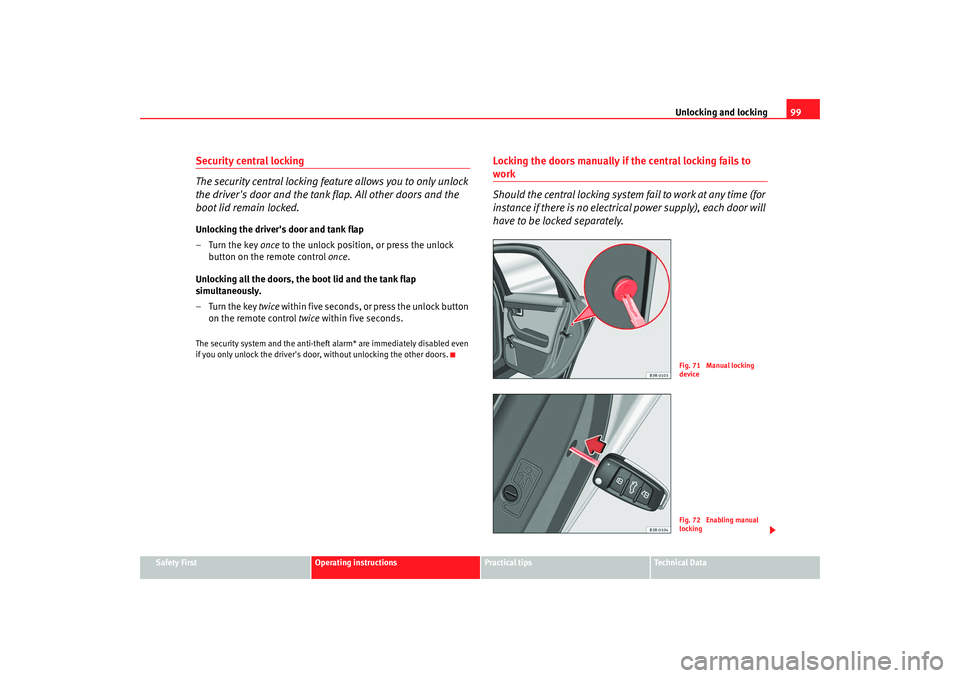
Should the central locking system fail to work at any time (for
instance if there is no electrical power supply), each door will
have to be locked separately.
Fig. 71 Manual locking
deviceFig. 72 Enabling manual
locking
Exeo_EN.book Seite 99 Freitag, 17. Oktober 2008 11:24 11
Page 105 of 303
Unlocking and locking103
Safety First
Operating instructions
Practical tips
Te c h n i c a l D a t a
Locking the vehicle
– Press button for about 1 second.
Opening the tailgate
– Press button and hold for at least one second.The indicators will flash twice as confirmation when you unlock the car. The
vehicle will be locked again automatically if you do not open one of the doors
or the tailgate within 60 seconds after unlocking the car with button . This
function prevents the vehicle from remaining unlocked if the unlocking
button is pressed by mistake.
On vehicles with the security central locking* feature, you can unlock just the
driver's door and the tank flap by pressing button once, or the whole
vehicle by pressing the button twice.
The indicators flash once when the vehicle is locked to confirm that the doors
and tailgate are properly locked.
Moreover, apart from unlocking the vehicle, the seat* and mirror* memory
programmed in the key is activated. The dr iver's seat and exterior mirrors will
be automatically adjusted to the positions stored in the memory.
The interior lights will automatically light up when the vehicle is unlocked and
go out when the vehicle is locked, provided that the switch is in the courtesy
light position.
WARNING
Do not leave anyone (especially children) in the car if it is locked from the
outside and the anti- theft security system is enabled, as the doors and
windows cannot then be opened from the inside. Locked doors could delay
assistance in an emergency, potentially putting lives at risk.
Note
•
The remote control should only be us ed when the doors and the tailgate
are closed.
•
The remote control should not be used when the vehicle is out of sight.
•
The anti-theft alarm* can be accidentally triggered and the vehicle locked
if you press the locking button on th e remote control inside the vehicle
before inserting the key in the ignition. If this should happen by mistake,
press the unlock button .
Re-synchronising
Should the remote control fail to lock or unlock the vehicle,
the system must be re-synchronised.– If the vehicle is locked, use the key to unlock the driver's door.
– Press the unlock button on the remote control.
– Insert the key into the ignition and switch on the ignition.
– Switch off the ignition and remove the key.
– Press the unlock or the lock button .
AB
AC
AA
AA
Exeo_EN.book Seite 103 Freitag, 17. Oktober 2008 11:24 11
Page 107 of 303
Unlocking and locking105
Safety First
Operating instructions
Practical tips
Te c h n i c a l D a t a
•
The alarm is triggered immediately if one of the battery cables is discon-
nected while the alarm system is enabled.
Interior monitoring*
The interior monitor triggers an alarm if it detects movement
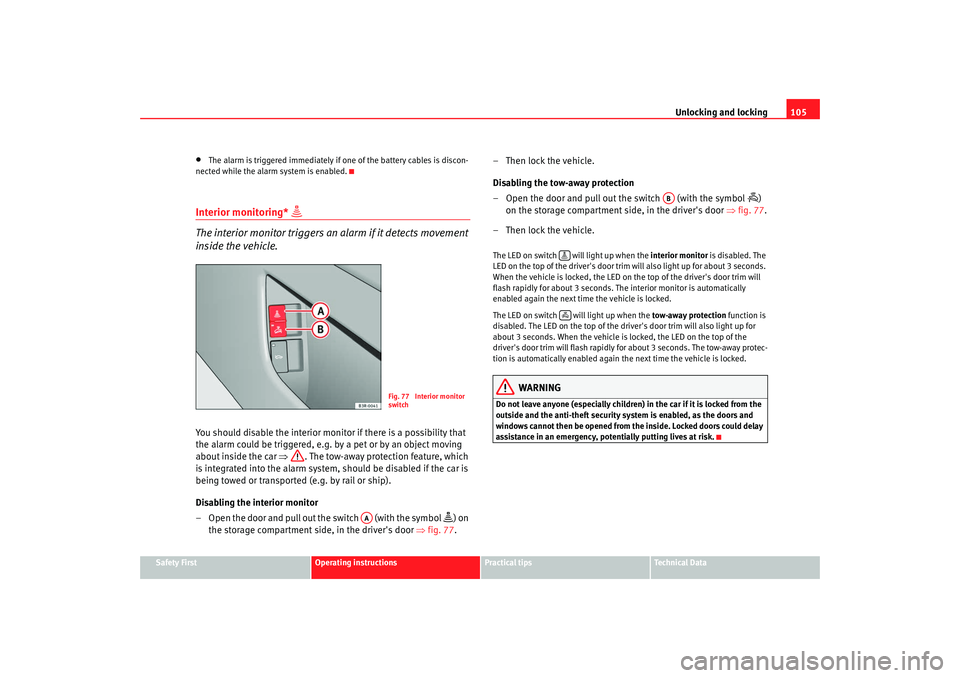
inside the vehicle.You should disable the interior monitor if there is a possibility that
the alarm could be triggered, e.g. by a pet or by an object moving
about inside the car ⇒. The tow-away protection feature, which
is integrated into the alarm system, should be disabled if the car is
being towed or transported (e.g. by rail or ship).
Disabling the interior monitor
– Open the door and pull out th e switch (with the symbol
) on
the storage compartment side, in the driver's door ⇒fig. 77 . – Then lock the vehicle.
Disabling the tow-away protection
– Open the door and pull out th
e switch (with the symbol
)
on the storage compartment side, in the driver's door ⇒fig. 77 .
– Then lock the vehicle.
The LED on switch will light up when the interior monitor is disabled. The
LED on the top of the driver's door trim will also light up for about 3 seconds.
When the vehicle is locked, the LED on the top of the driver's door trim will
flash rapidly for about 3 seconds. The interior monitor is automatically
enabled again the next time the vehicle is locked.
The LED on switch will light up when the tow-away protection function is
disabled. The LED on the top of the driver 's door trim will also light up for
about 3 seconds. When the vehicle is locked, the LED on the top of the
driver's door trim will flash rapidly for about 3 seconds. The tow-away protec-
tion is automatically enabled again the next time the vehicle is locked.
WARNING
Do not leave anyone (especially children) in the car if it is locked from the
outside and the anti-theft security system is enabled, as the doors and
windows cannot then be opened from the inside. Locked doors could delay
assistance in an emergency, potentially putting lives at risk.
Fig. 77 Interior monitor
switch
AA
AB
Exeo_EN.book Seite 105 Freitag, 17. Oktober 2008 11:24 11
Page 141 of 303
Seats and stowage139
Safety First
Operating instructions
Practical tips
Te c h n i c a l D a t a
Please note that the armrest can restrict the driver's movements when it is
lowered. The armrest should therefore be raised when driving in city traffic.
Luggage compartmentLoading the luggage compartment
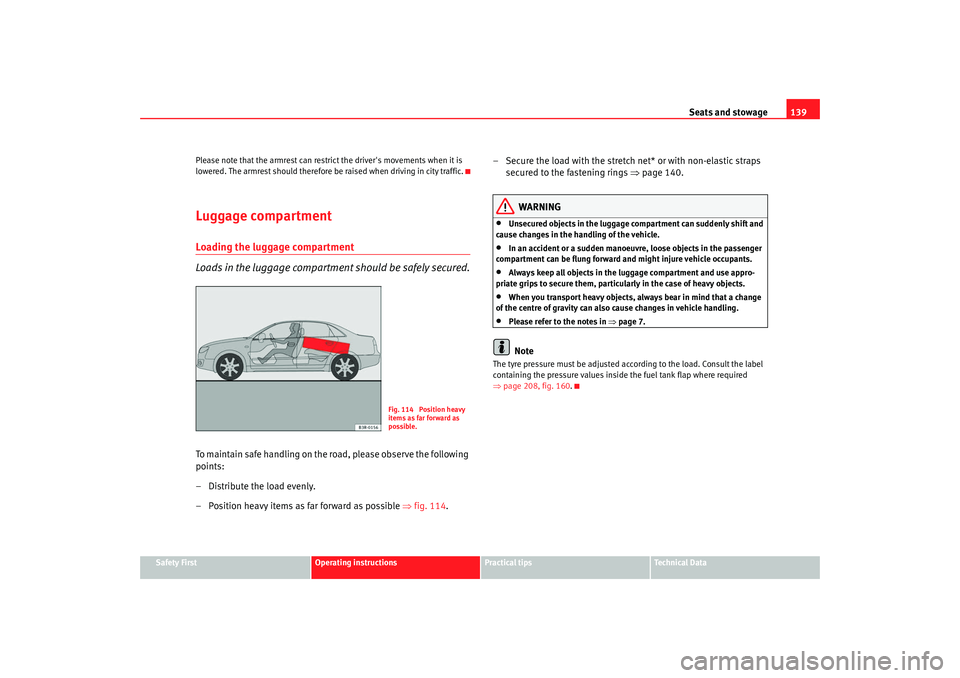
Loads in the luggage compartment should be safely secured.To maintain safe handling on the road, please observe the following
points:
– Distribute the load evenly.
– Position heavy items as far forward as possible ⇒
fig. 114.– Secure the load with the stretch net* or with non-elastic straps
secured to the fastening rings ⇒page 140.
WARNING
•
Unsecured objects in the luggage compartment can suddenly shift and
cause changes in the ha ndling of the vehicle.
•
In an accident or a sudden manoeuvre, loose objects in the passenger
compartment can be flung forward and might injure vehicle occupants.
•
Always keep all objects in the luggage compartment and use appro-
priate grips to secure them, particularly in the case of heavy objects.
•
When you transport heavy objects, always bear in mind that a change
of the centre of gravity can also cause changes in vehicle handling.
•
Please refer to the notes in ⇒page 7.Note
The tyre pressure must be adjusted according to the load. Consult the label
containing the pressure values inside the fuel tank flap where required
⇒ page 208, fig. 160 .
Fig. 114 Position heavy
items as far forward as
possible.
Exeo_EN.book Seite 139 Freitag, 17. Oktober 2008 11:24 11
Page 142 of 303
Seats and stowage
140Fastening rings
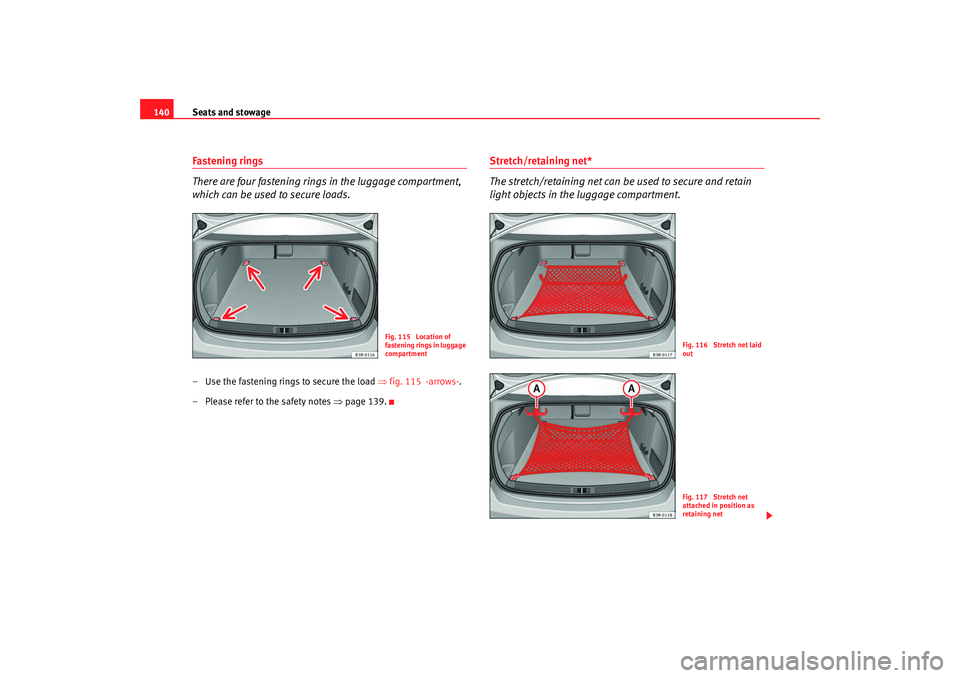
There are four fastening rings in the luggage compartment,
which can be used to secure loads.– Use the fastening rings to secure the load ⇒fig. 115 -arrows- .
– Please refer to the safety notes ⇒page 139.
Stretch/retaining net*
The stretch/retaining net can be used to secure and retain
light objects in the luggage compartment.
Fig. 115 Location of
fastening rings in luggage
compartment
Fig. 116 Stretch net laid
outFig. 117 Stretch net
attached in position as
retaining net
Exeo_EN.book Seite 140 Freitag, 17. Oktober 2008 11:24 11
Page 143 of 303
Seats and stowage141
Safety First
Operating instructions
Practical tips
Te c h n i c a l D a t a
Stretch net
– Secure the stretch net in the four fastening rings ⇒page 140,
fig. 116.
Retaining net
– Secure the hooks of the retaining net to the fastening rings at the bottom of the luggage compartment panel ⇒page 140,
fig. 117.
– Take hold of the handles and pull down the retaining hooks ⇒page 140, fig. 117 at the top of the luggage compartment.
Pull up the net and attach the loops onto the retaining hooks.You can also use the hooks to secure light items of luggage, such as shop-
ping bags and handbags, etc.
The hooks will fold up again by themselves when not in use.
WARNING
The retaining net should only be used to hold objects weighing up to 5 kg.
Heavier objects cannot be safely secured (injury risk).
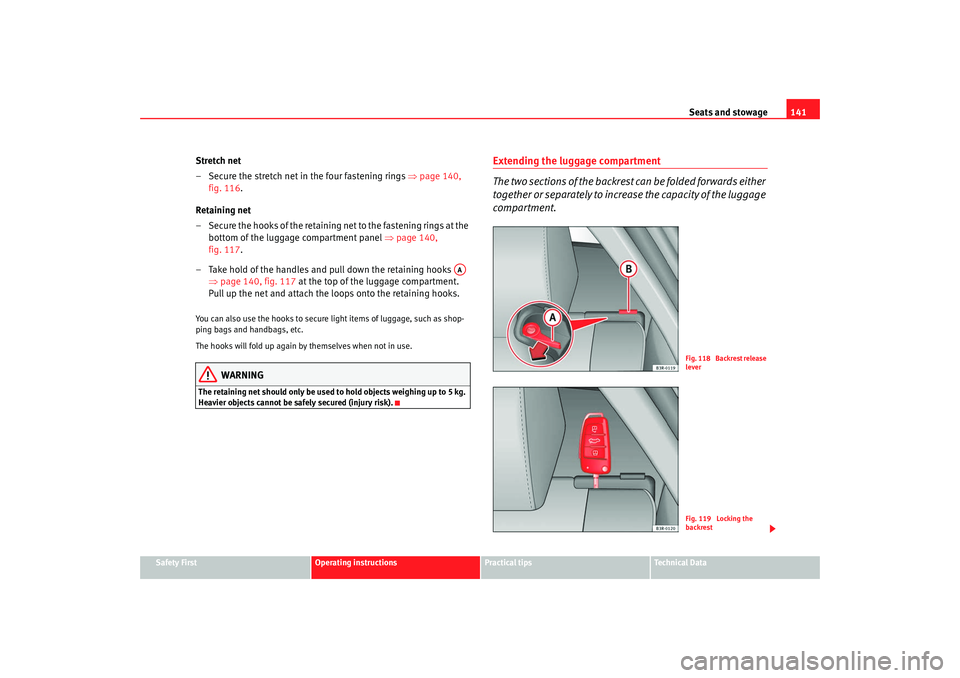
Extending the luggage compartment
The two sections of the backrest can be folded forwards either
together or separately to increase the capacity of the luggage
compartment.
AA
Fig. 118 Backrest release
leverFig. 119 Locking the
backrest
Exeo_EN.book Seite 141 Freitag, 17. Oktober 2008 11:24 11
Page 144 of 303
Seats and stowage
142
Folding the backrest forwards
– Press the release lever ⇒ page 141, fig. 118 in the direction
indicated (arrow).
– Fold down the backrest.
Returning the backrest to its upright position
– Push the backrest up until it engages securely ⇒. The red
marking on the tab should no longer be visible when the
backrest is properly secured.
Locking the backrest
– Turn the key clockwise in the lock on the backrest release lever.
Unlocking the backrest
– Turn the key anti-clockwise in the lock on the backrest release lever ⇒page 141, fig. 119 .When the backrest is properly engage d in its upright position, the release
lever can be locked and unlocked with the key. This prevents unauthorised
access to the luggage compartment from inside the vehicle.
WARNING
•
Make sure that the rear backrest is securely locked in position so that
the seat belt can provide proper protection on the centre rear seat.
•
The rear backrest must always be securely latched so that objects
stored in the luggage compartment will not fly forward during sudden
braking.
Caution
When returning the backrest to an upright position, make sure that the seat
belts for the outer rear seats are in their guides, so that they cannot be caught
up and damaged in the catches for the backrest.Storage shelf
The storage shelf behind the rear backrest should only be
used to store light items of clothing.
WARNING
Do not store any heavy or hard objects on the storage shelf. These could
cause injury if the brakes are applied suddenly.
Caution
Please note that hard objects could chafe against the wires of the heating
element in the rear window and cause damage.
Note
Make sure that the slots between the rear window and the storage shelf are
kept clear to ensure unimpaired ventilation.
AA
AB
Exeo_EN.book Seite 142 Freitag, 17. Oktober 2008 11:24 11