child seat Seat Exeo 2008 Owner's Guide
[x] Cancel search | Manufacturer: SEAT, Model Year: 2008, Model line: Exeo, Model: Seat Exeo 2008Pages: 303, PDF Size: 10.02 MB
Page 51 of 303
Child safety49
Safety First
Operating instructions
Practical tips
Te c h n i c a l D a t a
Group 1 child seats
A suitable child seat and a correctly adjusted seat belt can
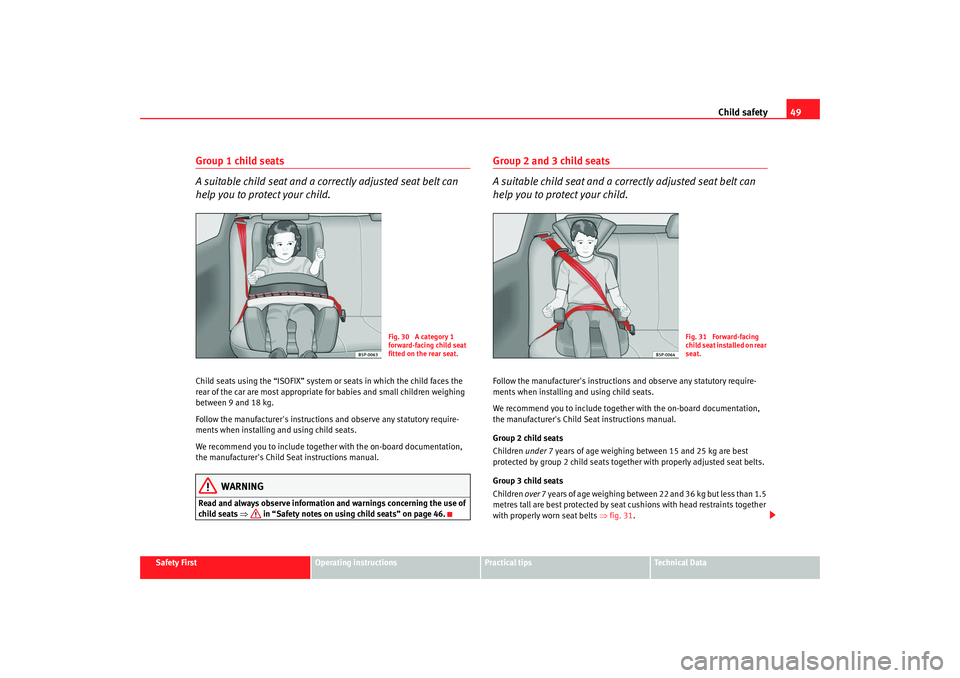
help you to protect your child.Child seats using the “ISOFIX” system or seats in which the child faces the
rear of the car are most appropriate for babies and small children weighing
between 9 and 18 kg.
Follow the manufacturer's instructions and observe any statutory require-
ments when installing and using child seats.
We recommend you to include togeth er with the on-board documentation,
the manufacturer's Child Se at instructions manual.
WARNING
Read and always observe information and warnings concerning the use of
child seats ⇒ in “Safety notes on using child seats” on page 46.
Group 2 and 3 child seats
A suitable child seat and a corr ectly adjusted seat belt can
help you to protect your child.Follow the manufacturer's instructio ns and observe any statutory require-
ments when installing and using child seats.
We recommend you to include together with the on-board documentation,
the manufacturer's Child Se at instructions manual.
Group 2 child seats
Children under 7 years of age weighing between 15 and 25 kg are best
protected by group 2 child seats together with properly adjusted seat belts.
Group 3 child seats
Children over 7 years of age weighing between 22 and 36 kg but less than 1.5
metres tall are best protected by seat cushions with head restraints together
with properly worn seat belts ⇒fig. 31 .
Fig. 30 A category 1
forward-facing child seat
fitted on the rear seat.
Fig. 31 Forward-facing
child seat installed on rear
seat.
Exeo_EN.book Seite 49 Freitag, 17. Oktober 2008 11:24 11
Page 52 of 303
Child safety
50
WARNING
•
The shoulder part of th e seat belt must lie approximately on the centre
of the shoulder, never across the neck or the arm. The seat belt must lie
close to the upper part of the body. The lap belt part must lie across the
pelvis, not across the stomach, and always fit closely. Pull the belt tight if
necessary to take up any slack ⇒page 22, “Seat belts”.
•
Read and always observe information and warnings concerning the use
of child seats ⇒ in “Safety notes on using child seats” on page 46.
Exeo_EN.book Seite 50 Freitag, 17. Oktober 2008 11:24 11
Page 53 of 303
Child safety51
Safety First
Operating instructions
Practical tips
Te c h n i c a l D a t a
Securing child seatsWays to secure a child seat
A child seat can be secured differently on th e rear seat and on the front passenger seat.You can secure a child seat to the rear seat or front passenger seat in the
following ways:•
Child seats in groups 0 to 3 can be secured with a seat belt.
•
Seats for children aged 0, 0+ and 1 with the “ISOFIX” system can be
secured without fastening seat belts, using the “ISOFIX” and/or Top Tether
securing rings ⇒page 52.
U: Suitable for universal approved rest raining systems for use in this age
category (universal retention systems are those fitted using the adult
seat belt).
*: Move the passenger seat as far to rear as possible, as high as possible and always deactivate the airbag.
L: Suitable for retention system s using the “ISOFIX” anchors.
WARNING
•
When travelling, children must be secured in the vehicle with a
restraint system suitable for age, weight and size.
•
Never install a child seat facing backwards (or rear-facing) on the front
passenger seat unless the front passenger airbag has been disabled. This
could cause fatal injuries to the child! However, if it is necessary, in excep- tional cases, to transport a child in the front passenger seat, the front
passenger airbag must always be disabled
⇒page 44, “Deactivating
airbags*” and move the seat to its h ighest position, in case it has this
adjustment.
•
Read and always observe information and warnings concerning the use
of child seats ⇒ in “Safety notes on using child seats” on page 46.
Category
Weight Seat locations
Front passenger Rear outerRear centre
Group 0 <10 kgU*U/L U
Group 0+ <13 kgU*U/L U
Group 1 9-18 kgU*U/L U
Group 2 / 3 15-36 kgU*UUWARNING (continued)
Exeo_EN.book Seite 51 Freitag, 17. Oktober 2008 11:24 11
Page 54 of 303
Child safety
52Child seat mounting using the “ISOFIX” and/or Top Tether system
The Children restraint systems may be fitted with the “ISOFIX”
system and/or Top Tether (placed on the luggage compart-
ment cover) to the rear seat in a safe and quick way. The
passenger seat* is not equipped with Top Tether and so, the
“ISOFIX” system can only be used.
Following the instructions given by the child seat manufacturer
when installing and removing the seat.
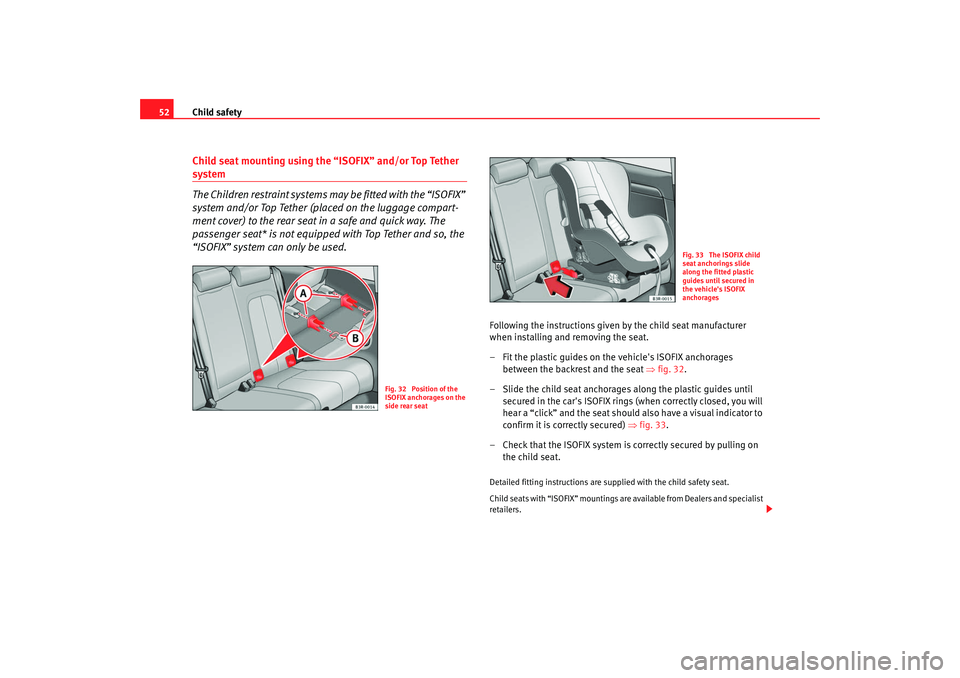
– Fit the plastic guides on the vehicle's ISOFIX anchorages
between the backrest and the seat ⇒fig. 32.
– Slide the child seat anchorages along the plastic guides until secured in the car's ISOFIX rings (when correctly closed, you will
hear a “click” and the seat should also have a visual indicator to
confirm it is correctly secured) ⇒fig. 33 .
– Check that the ISOFIX system is correctly secured by pulling on the child seat.Detailed fitting instructions are supplied with the child safety seat.
Child seats with “ISOFIX” mountings are available from Dealers and specialist
retailers.
Fig. 32 Position of the
ISOFIX anchorages on the
side rear seat
Fig. 33 The ISOFIX child
seat anchorings slide
along the fitted plastic
guides until secured in
the vehicle's ISOFIX
anchorages
Exeo_EN.book Seite 52 Freitag, 17. Oktober 2008 11:24 11
Page 55 of 303
Child safety53
Safety First
Operating instructions
Practical tips
Te c h n i c a l D a t a
WARNING
The retainers employed for this child safety seat are specially designed for
the “ISOFIX” system. Never secure othe r child seats, seat belts or other
items into the retainers. If you do, you increase the risk of sustaining
severe or fatal injuries.Top Tether retainer straps
Some child restraint seats have a third anchoring point Top
Tether, apart from both “ISOFIX” anchoring points, which
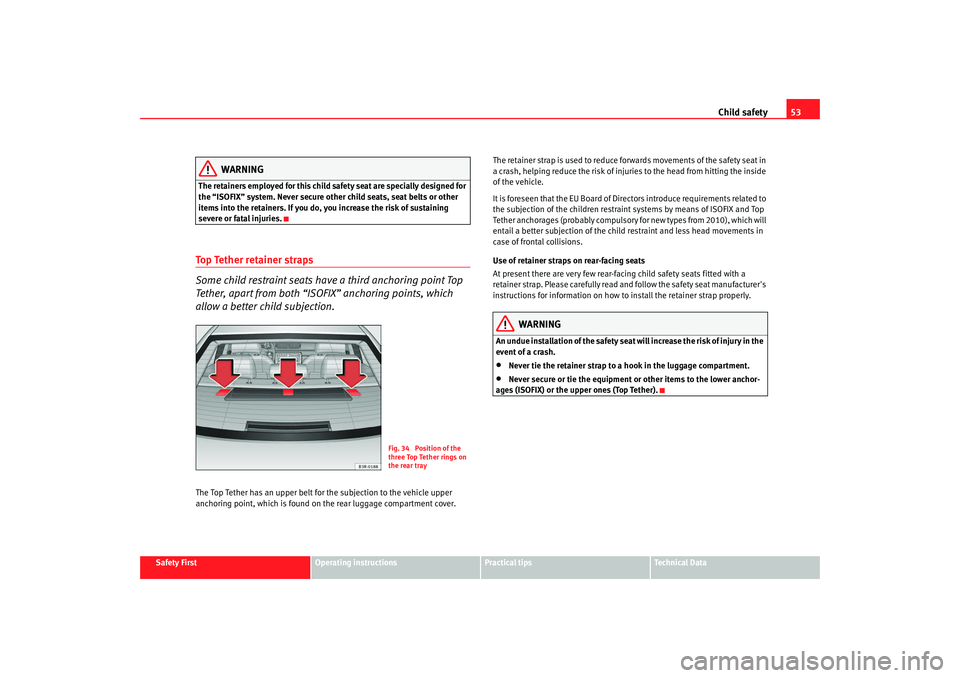
allow a better child subjection.The Top Tether has an upper belt for the subjection to the vehicle upper
anchoring point, which is found on the rear luggage compartment cover. The retainer strap is used to reduce forwards movements of the safety seat in
a crash, helping reduce the risk of injuries to the head from hitting the inside
of the vehicle.
It is foreseen that the EU Board of Dire
ctors introduce requirements related to
the subjection of the children restra int systems by means of ISOFIX and Top
Tether anchorages (probably compulsory for new types from 2010), which will
entail a better subjection of the child restraint and less head movements in
case of frontal collisions.
Use of retainer straps on rear-facing seats
At present there are very few rear-facing child safety seats fitted with a
retainer strap. Please carefully read and follow the safety seat manufacturer's
instructions for information on how to install the retainer strap properly.
WARNING
An undue installation of the safety seat will increase the risk of injury in the
event of a crash.•
Never tie the retainer strap to a hook in the luggage compartment.
•
Never secure or tie the equipment or other items to the lower anchor-
ages (ISOFIX) or the upper ones (Top Tether).
Fig. 34 Position of the
three Top Tether rings on
the rear tray
Exeo_EN.book Seite 53 Freitag, 17. Oktober 2008 11:24 11
Page 56 of 303
Child safety
54Fitting the child restraint Top Tether to the anchoring pointSecuring the child restraint Top Tether to the anchoring point
placed on the vehicle luggage compartment cover
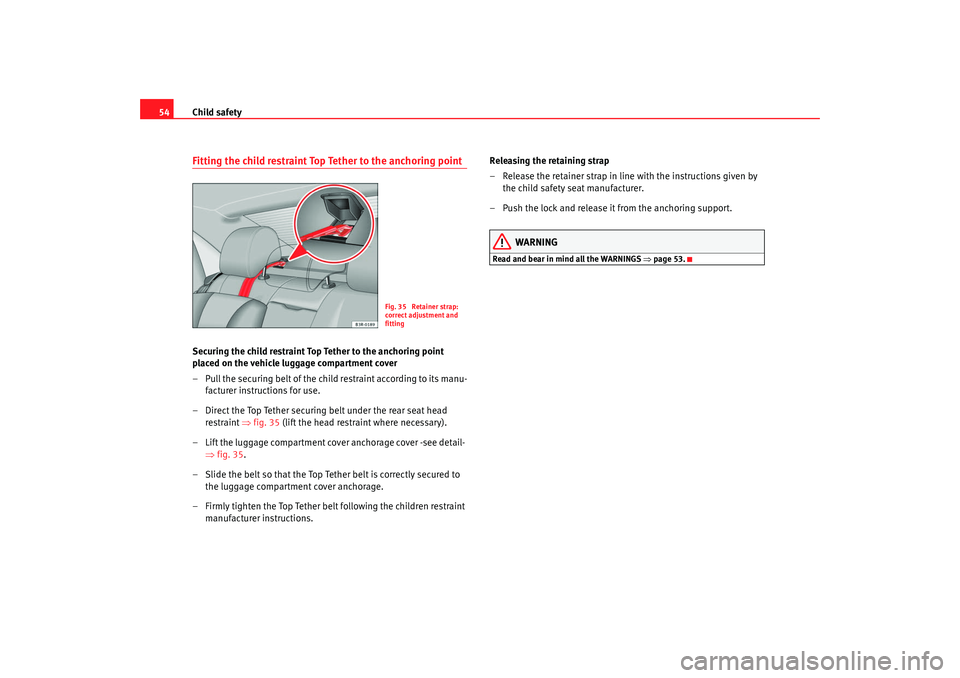
– Pull the securing belt of the child restraint according to its manu-
facturer instructions for use.
– Direct the Top Tether securing belt under the rear seat head restraint ⇒fig. 35 (lift the head restraint where necessary).
– Lift the luggage compartment cover anchorage cover -see detail- ⇒fig. 35 .
– Slide the belt so that the Top Te ther belt is correctly secured to
the luggage compartment cover anchorage.
– Firmly tighten the Top Tether belt following the children restraint manufacturer instructions. Releasing the retaining strap
– Release the retainer strap in line with the instructions given by
the child safety seat manufacturer.
– Push the lock and release it from the anchoring support.
WARNING
Read and bear in mind all the WARNINGS ⇒page 53.
Fig. 35 Retainer strap:
correct adjustment and
fitting
Exeo_EN.book Seite 54 Freitag, 17. Oktober 2008 11:24 11
Page 105 of 303
Unlocking and locking103
Safety First
Operating instructions
Practical tips
Te c h n i c a l D a t a
Locking the vehicle
– Press button for about 1 second.
Opening the tailgate
– Press button and hold for at least one second.The indicators will flash twice as confirmation when you unlock the car. The
vehicle will be locked again automatically if you do not open one of the doors
or the tailgate within 60 seconds after unlocking the car with button . This
function prevents the vehicle from remaining unlocked if the unlocking
button is pressed by mistake.
On vehicles with the security central locking* feature, you can unlock just the
driver's door and the tank flap by pressing button once, or the whole
vehicle by pressing the button twice.
The indicators flash once when the vehicle is locked to confirm that the doors
and tailgate are properly locked.
Moreover, apart from unlocking the vehicle, the seat* and mirror* memory
programmed in the key is activated. The dr iver's seat and exterior mirrors will
be automatically adjusted to the positions stored in the memory.
The interior lights will automatically light up when the vehicle is unlocked and
go out when the vehicle is locked, provided that the switch is in the courtesy
light position.
WARNING
Do not leave anyone (especially children) in the car if it is locked from the
outside and the anti- theft security system is enabled, as the doors and
windows cannot then be opened from the inside. Locked doors could delay
assistance in an emergency, potentially putting lives at risk.
Note
•
The remote control should only be us ed when the doors and the tailgate
are closed.
•
The remote control should not be used when the vehicle is out of sight.
•
The anti-theft alarm* can be accidentally triggered and the vehicle locked
if you press the locking button on th e remote control inside the vehicle
before inserting the key in the ignition. If this should happen by mistake,
press the unlock button .
Re-synchronising
Should the remote control fail to lock or unlock the vehicle,
the system must be re-synchronised.– If the vehicle is locked, use the key to unlock the driver's door.
– Press the unlock button on the remote control.
– Insert the key into the ignition and switch on the ignition.
– Switch off the ignition and remove the key.
– Press the unlock or the lock button .
AB
AC
AA
AA
Exeo_EN.book Seite 103 Freitag, 17. Oktober 2008 11:24 11
Page 135 of 303
Seats and stowage133
Safety First
Operating instructions
Practical tips
Te c h n i c a l D a t a
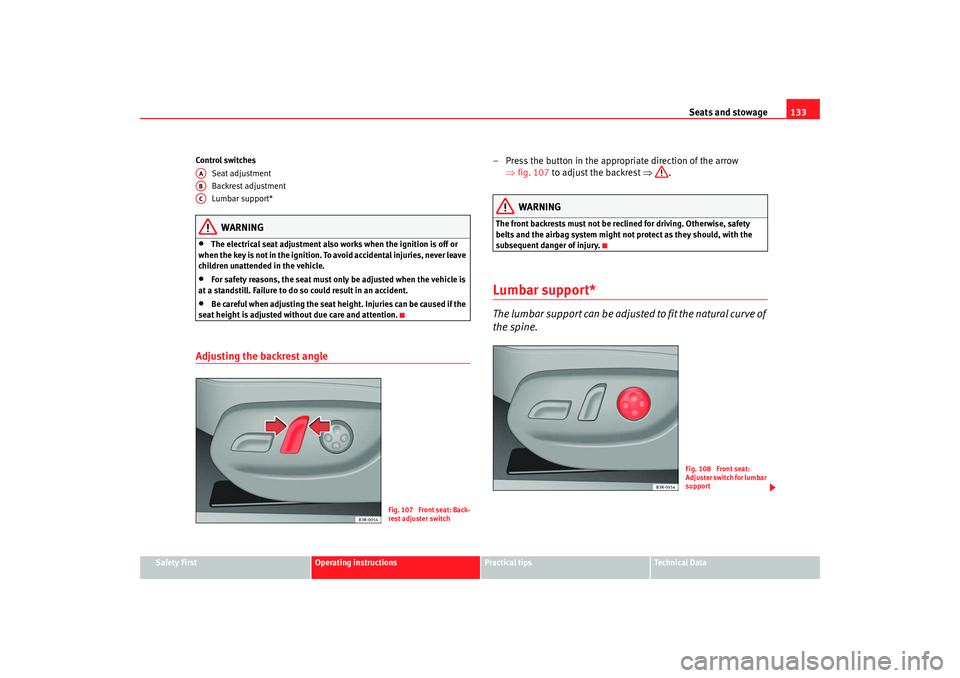
Control switches
Seat adjustment
Backrest adjustment
Lumbar support*
WARNING
•
The electrical seat adjustment also works when the ignition is off or
when the key is not in th e ignition. To avoid accidental injuries, never leave
children unattended in the vehicle.
•
For safety reasons, the seat must on ly be adjusted when the vehicle is
at a standstill. Failure to do so could result in an accident.
•
Be careful when adjusting the seat h eight. Injuries can be caused if the
seat height is adjusted with out due care and attention.
Adjusting the backrest angle
– Press the button in the appropriate direction of the arrow
⇒fig. 107 to adjust the backrest ⇒.
WARNING
The front backrests must not be reclin ed for driving. Otherwise, safety
belts and the airbag system might no t protect as they should, with the
subsequent danger of injury.Lumbar support*The lumbar support can be adjust ed to fit the natural curve of
the spine.
AAABAC
Fig. 107 Front seat: Back-
rest adjuster switch
Fig. 108 Front seat:
Adjuster switch for lumbar
support
Exeo_EN.book Seite 133 Freitag, 17. Oktober 2008 11:24 11
Page 166 of 303

Driving
164Switching on the ignition/pre-heating glow plugs
If the key is difficult to turn in the lock, move the steering wheel (to take the
load off the steering lock mechanism) until the key turns freely. In the case of
vehicles with a diesel engine, the key is turned to this position to preheat the
glow plugs.
Starting the engine
The engine is started in this position . Electrical components with a high
power consumption are switched off temporarily.
After the engine has started, the ignition key returns to position by itself.
The ignition key has to be turned back to position before re-starting the
engine. The starter inhibitor in the ignition lock prevents the starter motor
from engaging when the engine is running, as this could cause damage.
Switching off the ignition
Turn the ignition key to this position.
WARNING
•
Never remove the ignition key until the vehicle is stationary! Otherwise
the steering lock could engage suddenly, which could cause an accident.
•
Always take the key with you when leaving the vehicle, even if you only
intend to be gone for a short time. This is particularly important if there are
children in the car, as they might otherwise be able to start the engine or
use power-operated equipment (e.g. the electric windows), which could
lead to injuries.Note
•
If the battery has been disconnected and then reconnected, it will be
necessary to leave the key in position for about 5 seconds before starting
the engine.
Starting and stopping the engineStarting the engine
The engine can only be started with an original SEAT key.Vehicles with a petrol engine:
– Use the foot brake.
– Manual gearbox: Push the clutch pedal all the way down.
– Move the gear lever into the neutral position ⇒.
– Turn the ignition key to position without pressing the acceler- ator.
– Release the ignition key as soon as the engine starts (the starter motor must not be allowed to run on with the engine).
A1
A2
A1
A0
A0
A1
Fig. 140 Ignition key
positions
A2
Exeo_EN.book Seite 164 Freitag, 17. Oktober 2008 11:24 11
Page 169 of 303

Driving167
Safety First
Operating instructions
Practical tips
Te c h n i c a l D a t a
If you drive by mistake with the handbrake still applied, you will hear a
warning buzzer and the display will show the message:
Handbrake applied
The handbrake warning is enabled after driving for 3 seconds at a speed
above 5 km/h.
The handbrake warning lamp
lights up when the handbrake is applied
with the ignition on.
WARNING
Please note that the handbrake should be released all the way. If it is only
partially released, this will cause rear brakes overheating, which can
impair the function of the brake system and could lead to an accident.
Caution
After the vehicle has been stopped, always apply the hand brake and engage
a gear.Parking
The following points will ensure there is no risk of the car
rolling away accidentally after it is parked.– Use the foot brake to stop the vehicle.
– Apply handbrake firmly.
– Switch the engine off.
– Engage the first gear ⇒.
When parking on slopes:
Turn the steering wheel so that the, if the vehicle moves, it will do so towards
the curb.
WARNING
•
Do not leave anyone (especially chil dren) in the vehicle when it is
locked. Locked doors could delay assistance in an emergency, potentially
putting lives at risk.
•
Never leave children unsupervised in the vehicle. They could release
e.g. the handbrake or gear lever, moving the vehicle and causing an
accident.
Parking aidGeneral notesVarious systems are available to help you when parking or manoeuvring in
tight spaces, dependi ng on the equipment fitted on your vehicle.
The SEAT parking system gives an acoustic warning if there are any obstacles
behind your car ⇒ page 168.
When you are parking, SEAT parking system plus warns you acoustically and
optically about obstacles in front of and behind the vehicle ⇒ page 168.
Note
To ensure the acoustic parking aid works properly, the sensors must be kept
clean and free of snow and ice.
Exeo_EN.book Seite 167 Freitag, 17. Oktober 2008 11:24 11