fuel Seat Exeo 2008 Service Manual
[x] Cancel search | Manufacturer: SEAT, Model Year: 2008, Model line: Exeo, Model: Seat Exeo 2008Pages: 303, PDF Size: 10.02 MB
Page 275 of 303
If and when273
Safety First
Operating instructions
Practical tips
Te c h n i c a l D a t a
WARNING
•
Please note the safety warnings referring to working in the engine
compartment ⇒page 213.
•
The battery providing assistance must have the same voltage as the flat
battery (12V) and approximately the same capacity (see imprint on
battery). Failure to comply could result in an explosion.
•
Never use jump leads when one of the batteries is frozen. Danger of
explosion! Even after the battery has thawed, battery acid could leak and
cause chemical burns. If a battery freezes, it should be replaced.
•
Keep sparks, flames and lighted cigarettes away from batteries, danger
of explosion. Failure to comply could result in an explosion.
•
Observe the instructions provided by the manufacturer of the jump
leads.
•
Do not connect the negative cable from the other vehicle directly to the
negative terminal of the flat battery. The gas emitted from the battery could
be ignited by sparks. Danger of explosion.
•
Do not attach the negative cable from the other vehicle to parts of the
fuel system or to the brake line.
•
The non-insulated parts of the battery clamps must not be allowed to
touch. The jump lead attached to the positive battery terminal must not
touch metal parts of the vehicle, this can cause a short circuit.
•
Position the leads in such a way that they cannot come into contact
with any moving parts in the engine compartment.
•
Do not bend over the batteries. This could result in chemical burns.Note
The vehicles must not touch each other, otherwise electricity could flow as
soon as the positive terminals are connected.
Exeo_EN.book Seite 273 Freitag, 17. Oktober 2008 11:24 11
Page 276 of 303
If and when
274To w i n g a n d t o w - s t a r t i n gTo w - s t a r t i n g
The use of jump leads is preferable to tow-starting.We recommend that you do not t o w - s t a r t yo u r v e h i c l e . J u m p - s ta r t i n g
is preferable ⇒page 271.
However, if your vehicle has to be tow-started:
– Engage the 2
nd or the 3
rd gear.
– Keep the clutch pressed down.
– Switch the ignition on.
– Once both vehicles are moving, release the clutch.
– As soon as the engine starts, press the clutch and move the gear lever into neutral. This helps to prevent driving into the towing
vehicle.
WARNING
The risk of accidents is high when tow-starting. The vehicle being towed
can easily collide with the towing vehicle.
Caution
When tow-starting, fuel could enter the catalytic converter and damage it.
CommentsPlease observe the following points if you use a tow-rope:
Notes for the driver of the towing vehicle
– Drive slowly at first until the tow-rope is taut. Then accelerate gradually.
– Begin and change gears cautiously. If you are driving an auto- matic vehicle, accelerate gently.
– Remember that the brake servo and power steering are not working in the vehicle you are towing. Brake earlier than you
would normally, but with a more gentle pressure on the brake.
Notes for the driver of the towed vehicle
– Ensure that the tow-rope remains taut at all times when towing.Tow-rope or tow-bar
It is easier and safer to tow a vehicle with a tow-bar. You should only use a
tow-rope if you do not have a tow-bar.
A tow-rope should be slightly elastic to reduce the loading on both vehicles.
It is advisable to use a tow-rope made of synthetic fibre or similarly elastic
material.
Attach the tow-rope or the tow-bar only to the towing eyes provided or a
towing bracket.
Driving style
Towing requires some experience, espec ially when using a tow-rope. Both
drivers should be familiar with the te chnique required for towing. Inexperi-
enced drivers should not attempt to tow-start or tow away another vehicle.
Exeo_EN.book Seite 274 Freitag, 17. Oktober 2008 11:24 11
Page 279 of 303
General notes on the technical data 277
Safety First
Operating instructions
Practical tips
Te c h n i c a l D a t a
Te c h n i c a l D a t aGeneral notes on the technical dataOutstanding informationImportant considerations
All data in the official vehicle documents take precedence over this data.All data provided in this manual are valid for the standard model in Spain. The
vehicle data card included in the Maintenance Programme or the vehicle
registration documents sh ows which engine is installed in the vehicle. The figures may be different depending on
if additional equipment is fitted,
for different models, for special vehicles and for other countries.
Abbreviations used in this paragraph of the Technical Data Abbreviation MeaningkW Kilowatt, engine power measurement.
bhp Brake horse power, formerly used to denote engine power
at rpm Revolutions per minute - engine speed. Nm Newton metres, unit of engine torque.
l/100 km Fuel consumption in litres per 100 km. g/km Carbon dioxide emissions in grams per km travelled.CO
2
Carbon dioxide
CN Cetane number, indication of the diesel combustion power.
RON Research octane number, indication of the knock resistance of petrol.
Exeo_EN.book Seite 277 Freitag, 17. Oktober 2008 11:24 11
Page 281 of 303
General notes on the technical data 279
Safety First
Operating instructions
Practical tips
Te c h n i c a l D a t a
Data on fuel consumptionFuel consumption
The consumption and emission details shown on the vehi cle data sticker differ from one vehicle to another.The fuel consumption and CO
2 emissions of the vehicle can be found on the
vehicle data sticker.
The fuel consumption and emissions figures given are based on the vehicle
weight category, which is determine d according to the engine/gearbox
combination and the equipment fitted. The consumption and emission figures are calculated in accordance with the
EC test requirements 1999/100/EC. The
se test requirements specify a real-
istic test method based on normal everyday driving.
The following test conditions are applied:
Note
•
Actual consumption may vary from quoted test values, depending on
personal driving style, road and traffic conditions, the weather and the
vehicle condition. Urban cycle
The urban cycle starts with an engine cold start. City driving is then simulated.
Extra urban cycle In the extra urban cycle simulation the vehicle frequently accelerates and brakes in all gears, as in normal everyday driving.
The
road speed ranges from 0 to 120 km/h.
Total consumption The average total consumption is calculated with a weightin
g of around 37% for the urban cycle and 63% for the extra urban
cycle.
CO2 emissions The exhaust gases are collected during both driving cycles to calculate carbon dioxide emissions. The gas composition is then
analysed to evaluate the CO
2 content and other emissions.
Exeo_EN.book Seite 279 Freitag, 17. Oktober 2008 11:24 11
Page 282 of 303

General notes on the technical data
280WeightsKerb weight refers to the basic model with a fuel tank filled to 90% capacity
and without optional extras. The figure quoted includes 75 kg to allow for the
weight of the driver.
For special versions and optional equipment fittings or for the addition of
accessories, the weight of the vehicle will increase ⇒.
WARNING
•
Please note that the centre of gravity may shift when transporting
heavy objects; this may affect the vehi cle's handling and lead to an acci-
dent. Always adjust your speed and dr iving style to suit road conditions
and requirements.
•
Never exceed the gross axle weight rating or the gross vehicle weight
rating. If the allowed axle load or the allowed total weight is exceeded, the
driving characteristics of the vehicle may change, leading to accidents,
injuries and damage to the vehicle.
To w i n g a t r a i l e rTrailer weightsTrailer weights
The trailer weights and drawbar loads approved are selected in intensive
trials according to precisely defined criteria. The approved trailer weights are
valid for vehicles in the EU for maximum speeds of 80 km/h (in certain
circumstances up to 100 km/h). The figu res may be different in other coun-
tries. All data in the official vehicl e documents take precedence over these
data ⇒ . Drawbar load
The
maximum permitted weight exerted by the trailer drawbar on the ball joint
of the towing bracket must not exceed 75 kg.
In the interest of road safety, we recommend that you always tow
approaching the maximum drawbar load. The response of the trailer on the
road will be poor if th e drawbar load is too small.
If the maximum permissible drawbar load cannot be met (e.g. with small,
empty and light-weight single axle trailers or tandem axle trailers with an axle
base of less than 1 metre), at least 4% of the actual trailer weight is a legal
stipulation for a drawbar load.
WARNING
•
For safety reasons, do not exceed the 80 km/h limit. This is also valid in
countries where higher speeds are permitted.
•
Never exceed the maximum trailer weights or the draw bar loading. If
the permissible axle load or the perm issible total weight is exceeded, the
driving characteristics of the vehicle may change, leading to accidents,
injuries and damage to the vehicle.
WheelsTyre pressure, snow chains, wheel boltsTyre pressures
The sticker with the tyre pressure values can be found on the inside of the
tank flap. The tyre pressure values given there are for cold tyres. The slightly
raised pressures of warm tyres must not be reduced ⇒.
Exeo_EN.book Seite 280 Freitag, 17. Oktober 2008 11:24 11
Page 285 of 303

Technical Data283
Safety First
Operating instructions
Practical tips
Te c h n i c a l D a t a
Petrol engine 1.6l 75 kW (102 HP)General engine data
Performance figures
WeightsPower output in kW (bhp)
rpm 75 (102) / 5600
Maximum torque in Nm at 1/min 148 / 3800
No. of cylinders/ cubic capacity in cm
3
4 / 1595
Compression 10,3 +/- 0,3
Fuel Super 95 RON
a)/Normal 91 RON
b)
a)Research- Octane- Number = Measure of the antidetonator petrol power.b)Slight power lossMaximum speed in km/h 190
Acceleration from 0-80 km/h in sec. 8,6
Acceleration from 0-100 km/h in sec. 12,6
Gross vehicle weight in kg 1870
Weight in working order (with driver) in kg 1385
Front gross axle weight in kg 990
Rear gross axle weight in kg 1010
Permitted roof load in kg 75
Exeo_EN.book Seite 283 Freitag, 17. Oktober 2008 11:24 11
Page 286 of 303
Technical Data
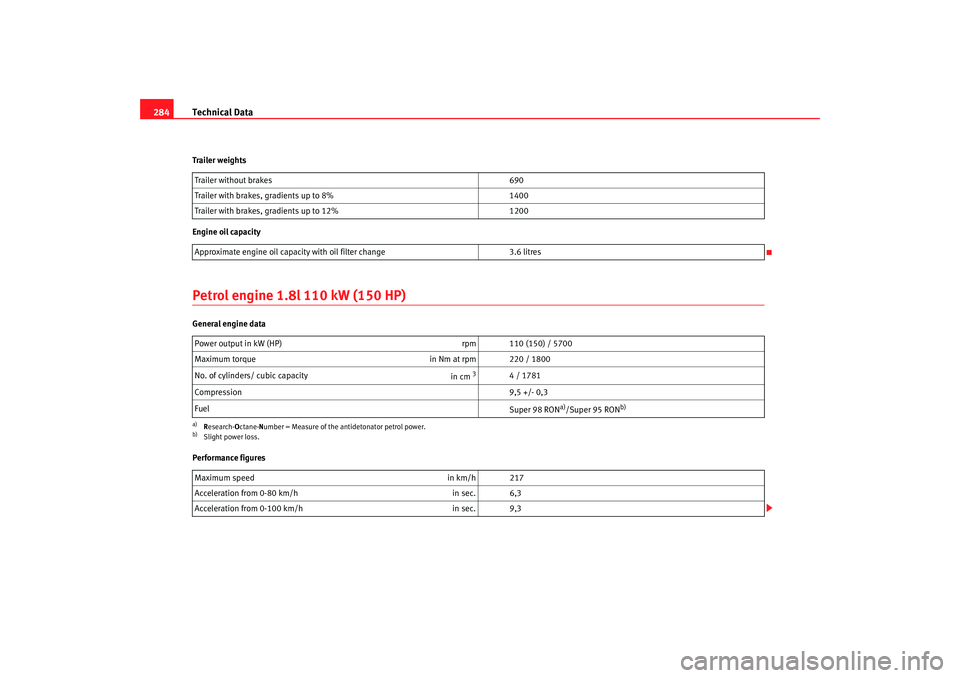
284Trailer weights
Engine oil capacityPetrol engine 1.8l 110 kW (150 HP)General engine data
Performance figures Trailer without brakes
690
Trailer with brakes, gradients up to 8% 1400
Trailer with brakes, gradients up to 12% 1200
Approximate engine oil capacity with oil filter change 3.6 litres
Power output in kW (HP) rpm 110 (150) / 5700
Maximum torque in Nm at rpm 220 / 1800
No. of cylinders/ cubic capacity in cm
3
4 / 1781
Compression 9,5 +/- 0,3
Fuel Super 98 RON
a)/Super 95 RON
b)
a)Research- Octane- Number = Measure of the antidetonator petrol power.b)Slight power loss.Maximum speed in km/h 217
Acceleration from 0-80 km/h in sec. 6,3
Acceleration from 0-100 km/h in sec. 9,3
Exeo_EN.book Seite 284 Freitag, 17. Oktober 2008 11:24 11
Page 287 of 303

Technical Data285
Safety First
Operating instructions
Practical tips
Te c h n i c a l D a t a
Weights
Trailer weights
Engine oil capacity
Petrol engine 2.0l 147 kW (200 HP)General engine data
Gross vehicle weight
in kg 1960
Weight in working order (with driver) in kg 1475
Front gross axle weight in kg 1065
Rear gross axle weight in kg 1025
Permitted roof load in kg 75
Trailer without brakes 730
Trailer with brakes, gradients up to 8% 1600
Trailer with brakes, gradients up to 12% 1400
Approximate engine oil capacity with oil filter change 4.4 litres
Power output in kW (HP) rpm 147 (200) / 5100
Maximum torque in Nm at rpm 280 / 1800
No. of cylinders/ cubic capacity in cm
3
4 / 1984
Compression 10,3 +/- 0,3
Fuel Super 98 RON
a)/Super 95 RON
b)
a)Research- Octane- Number = Measure of the antidetonator petrol power.b)Slight power loss.
Exeo_EN.book Seite 285 Freitag, 17. Oktober 2008 11:24 11
Page 289 of 303
Technical Data287
Safety First
Operating instructions
Practical tips
Te c h n i c a l D a t a
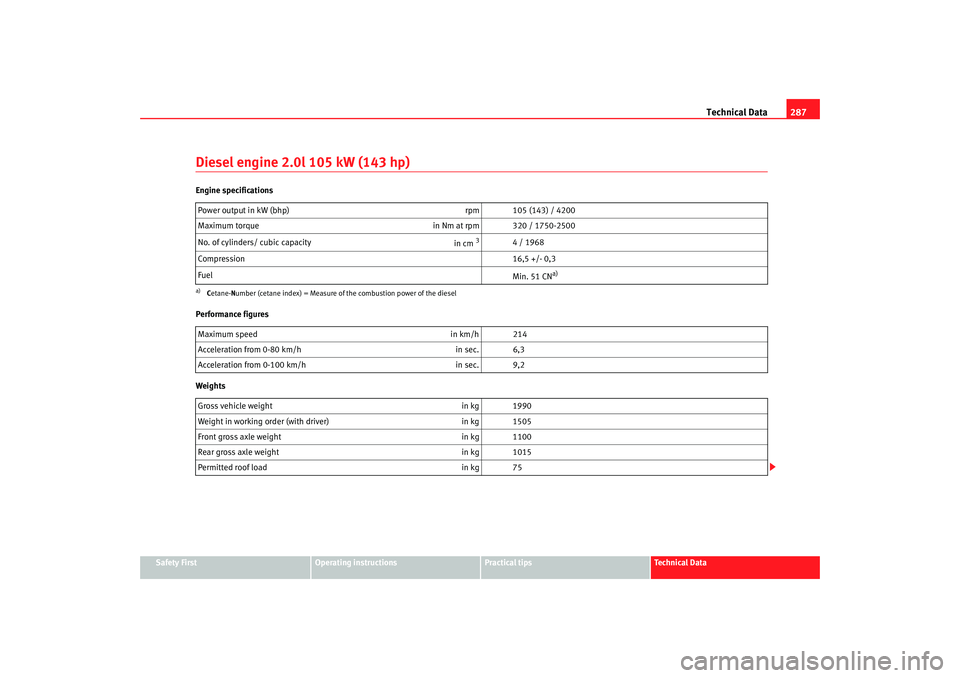
Diesel engine 2.0l 105 kW (143 hp)Engine specifications
Performance figures
WeightsPower output in kW (bhp)
rpm 105 (143) / 4200
Maximum torque in Nm at rpm 320 / 1750-2500
No. of cylinders/ cubic capacity in cm
3
4 / 1968
Compression 16,5 +/- 0,3
Fuel Min. 51 CN
a)
a)Cetane- Number (cetane index) = Measure of the combustion power of the dieselMaximum speed in km/h 214
Acceleration from 0-80 km/h in sec. 6,3
Acceleration from 0-100 km/h in sec. 9,2
Gross vehicle weight in kg 1990
Weight in working order (with driver) in kg 1505
Front gross axle weight in kg 1100
Rear gross axle weight in kg 1015
Permitted roof load in kg 75
Exeo_EN.book Seite 287 Freitag, 17. Oktober 2008 11:24 11
Page 290 of 303

Technical Data
288Trailer weights
Engine oil capacityDiesel engine 2.0l 125 kW (170 hp)Engine specifications
Performance figures Trailer without brakes
750
Trailer with brakes, gradients up to 8% 1800
Trailer with brakes, gradients up to 12% 1600
Approximate engine oil capacity with oil filter change 4.6 litres
Power output in kW (bhp) rpm 125 (170) / 4200
Maximum torque in Nm at rpm 350 / 1750-2500
No. of cylinders/ cubic capacity in cm
3
4 / 1968
Compression 16,5 +/- 0,3
Fuel Min. 51 CN
a)
a)Cetane- Number (cetane index) = Measure of the combustion power of the dieselMaximum speed in km/h 229
Acceleration from 0-80 km/h in sec. 5,9
Acceleration from 0-100 km/h in sec. 8,4
Exeo_EN.book Seite 288 Freitag, 17. Oktober 2008 11:24 11