wheel Seat Exeo 2008 Workshop Manual
[x] Cancel search | Manufacturer: SEAT, Model Year: 2008, Model line: Exeo, Model: Seat Exeo 2008Pages: 303, PDF Size: 10.02 MB
Page 236 of 303

Wheels and tyres
234
For the sake of the environmentOld tyres must be disposed of according to the laws in the country concerned.
Note
•
For technical reasons, it is not generally possible to use the wheels from
other vehicles. This can also apply to wheels of the same model. The use of
wheels or tyres which have not been approved by SEAT for use with your
model may invalidate the vehicle's type approval for use on public roads.
•
If the spare tyre is not the same as the tyres that are mounted on the
vehicle - for example with winter tyres - you should only use the spare tyre for
a short period of time and drive with extra care. Refit the normal road wheel
as soon as possible.
Wheel bolts
Wheel bolts must be tightened to the correct torque.The design of wheel bolts is matched to the rims. If different wheel rims are
fitted, the correct wheel bolts with the right length and correctly shaped bolt
heads must be used. This ensures that wheels are fitted securely and that the
brake system functions correctly.
In certain circumstances, you may not use wheel bolts from a different car -
even if it is the same model ⇒page 206.
After the wheels have been changed, the tightening torque of the wheel bolts
should be checked as soon as possible with a torque wrench ⇒. The tight-
ening torque for steel and alloy wheels is 120 Nm.
WARNING
If the wheel bolts are not tightened correctly, the wheel could become
loose while driving. Risk of accident.•
The wheel bolts must be clean and turn easily. Never apply grease or oil
to them.
•
Use only wheel bolts which belong to the wheel.
•
If the torque of the wheel bolts is too low, they could loosen whilst the
vehicle is in motion. Risk of accident! If the tightening torque is too high,
the wheel bolts and threads can be damaged.Caution
The prescribed torque for wheel bolts for steel and alloy wheels is 120 Nm.Winter tyres
Winter tyres will improve the vehicles handling on snow and
ice.In winter conditions winter tyres will considerably improve the vehicles
handling. The design of summer ty res (width, rubber compound, tread
pattern) gives less grip on ice and snow.
Winter tyres must be inflated to a pressure 0.2 bar higher than the pressures
specified for summer tyres (see sticker on tank flap).
Winter tyres must be fitted on all four wheels.
Information on permitted winter tyre sizes can be found in the vehicle's regis-
tration documents. Use only radial winter tyres. All tyre sizes listed in the
vehicle documentation also apply to winter tyres.
Exeo_EN.book Seite 234 Freitag, 17. Oktober 2008 11:24 11
Page 237 of 303
Wheels and tyres235
Safety First
Operating instructions
Practical tips
Te c h n i c a l D a t a
Winter tyres lose their effectiveness when the tread is worn down to a depth
of 4 mm.
The speed rating code
⇒page 233, “New tyres and wheels” determines the
following speed limits for winter tyres: ⇒
Q max. 160 km/h
S max. 180 km/h
T max. 190 km/h
H max. 210 km/h
In some countries, vehicles which can exceed the speed rating of the fitted
tyre must have an appropriate sticker in the driver's field of view. These
stickers are available from your Authorised Service Centre. The legal require-
ments of each country must be followed.
Do not have winter tyres fitted for u nnecessarily long periods. Vehicles with
summer tyres handle better when the roads are free of snow and ice.
If you have a flat tyre, please refer to the notes on the spare wheel
⇒ page 233, “New tyres and wheels”.
WARNING
The maximum speed for the winter tyre s must not be exceeded. Otherwise,
this could lead to tyre damage and thus, an accident risk.
For the sake of the environment
Fit your summer tyres in good time. They are quieter, do not wear so quickly
and reduce fuel consumption.
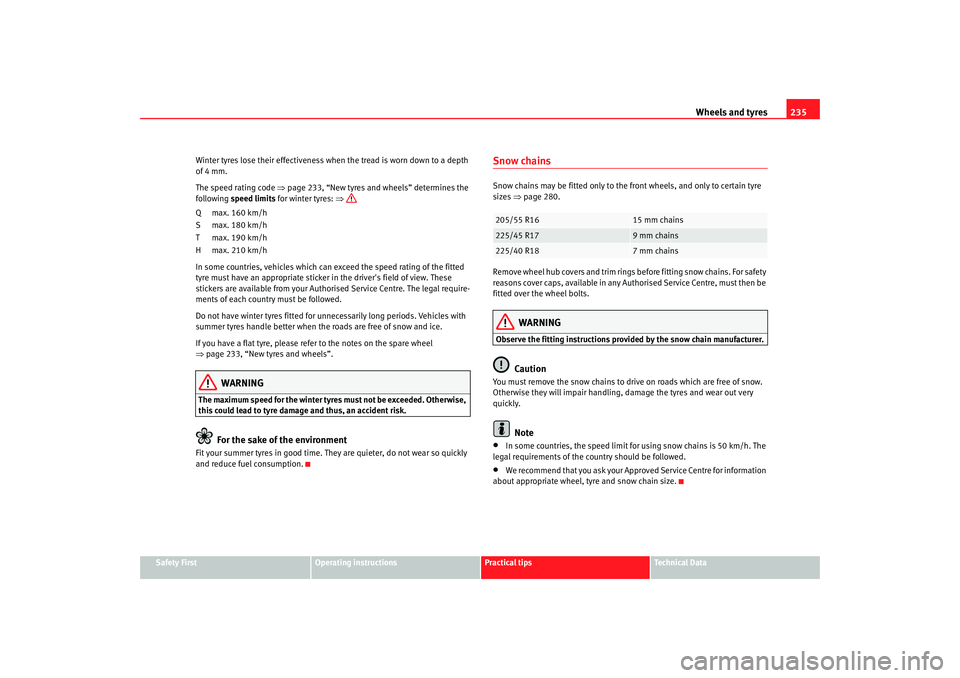
Snow chainsSnow chains may be fitted only to the front wheels, and only to certain tyre
sizes ⇒page 280.
Remove wheel hub covers and trim rings before fitting snow chains. For safety
reasons cover caps, available in any Authorised Service Centre, must then be
fitted over the wheel bolts.
WARNING
Observe the fitting instructions provided by the snow chain manufacturer.
Caution
You must remove the snow chains to drive on roads which are free of snow.
Otherwise they will impair handling, damage the tyres and wear out very
quickly.
Note
•
In some countries, the speed limit for using snow chains is 50 km/h. The
legal requirements of the country should be followed.
•
We recommend that you ask your Appr oved Service Centre for information
about appropriate wheel, tyre and snow chain size.205/55 R16
15 mm chains
225/45 R17
9 mm chains
225/40 R18
7 mm chains
Exeo_EN.book Seite 235 Freitag, 17. Oktober 2008 11:24 11
Page 238 of 303
If and when
236If and whenTools, tyre repair kit and spare wheelTools
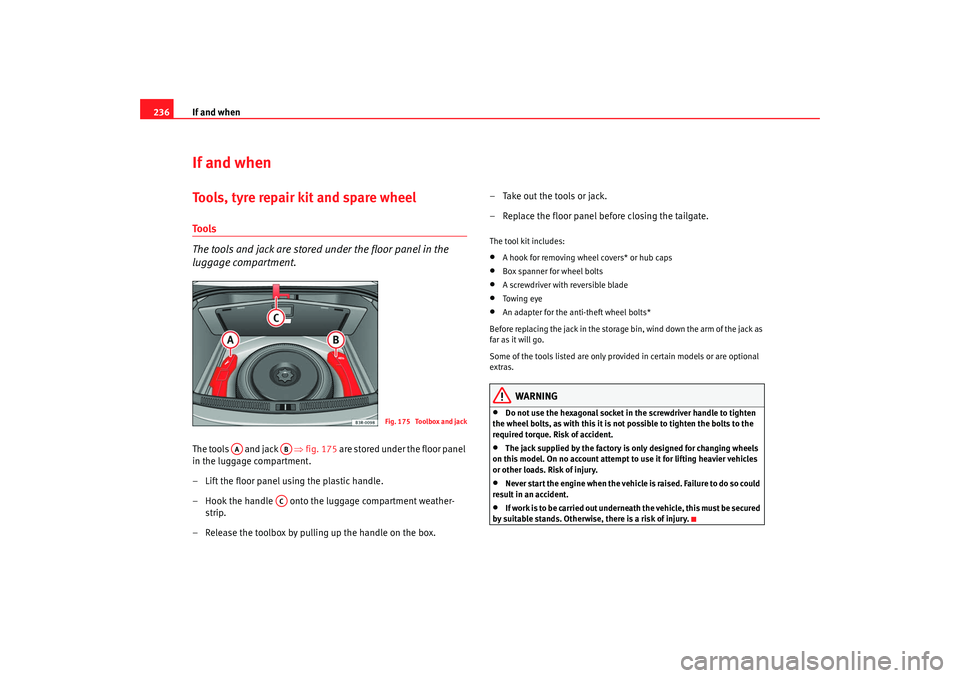
The tools and jack are stored under the floor panel in the
luggage compartment.The tools and jack ⇒fig. 175 are stored under the floor panel
in the luggage compartment.
– Lift the floor panel using the plastic handle.
– Hook the handle onto the luggage compartment weather- strip.
– Release the toolbox by pulling up the handle on the box. – Take out the tools or jack.
– Replace the floor panel before closing the tailgate.
The tool kit includes:•
A hook for removing wheel covers* or hub caps
•
Box spanner for wheel bolts
•
A screwdriver with reversible blade
•
Towing eye
•
An adapter for the anti-theft wheel bolts*
Before replacing the jack in the storage bin, wind down the arm of the jack as
far as it will go.
Some of the tools listed are only provid ed in certain models or are optional
extras.
WARNING
•
Do not use the hexagonal socket in the screwdriver handle to tighten
the wheel bolts, as with this it is not possible to tighten the bolts to the
required torque. Risk of accident.
•
The jack supplied by the factory is only designed for changing wheels
on this model. On no account attempt to use it for lifting heavier vehicles
or other loads. Risk of injury.
•
Never start the engine when the vehicle is raised. Failure to do so could
result in an accident.
•
I f wo r k is t o b e ca r r i e d o u t un d e r n ea th the vehicle, this must be secured
by suitable stands. Otherwise, there is a risk of injury.
Fig. 175 Toolbox and jac
k
AA
ABAC
Exeo_EN.book Seite 236 Freitag, 17. Oktober 2008 11:24 11
Page 239 of 303
If and when237
Safety First
Operating instructions
Practical tips
Te c h n i c a l D a t a
Tyre mobili ty system
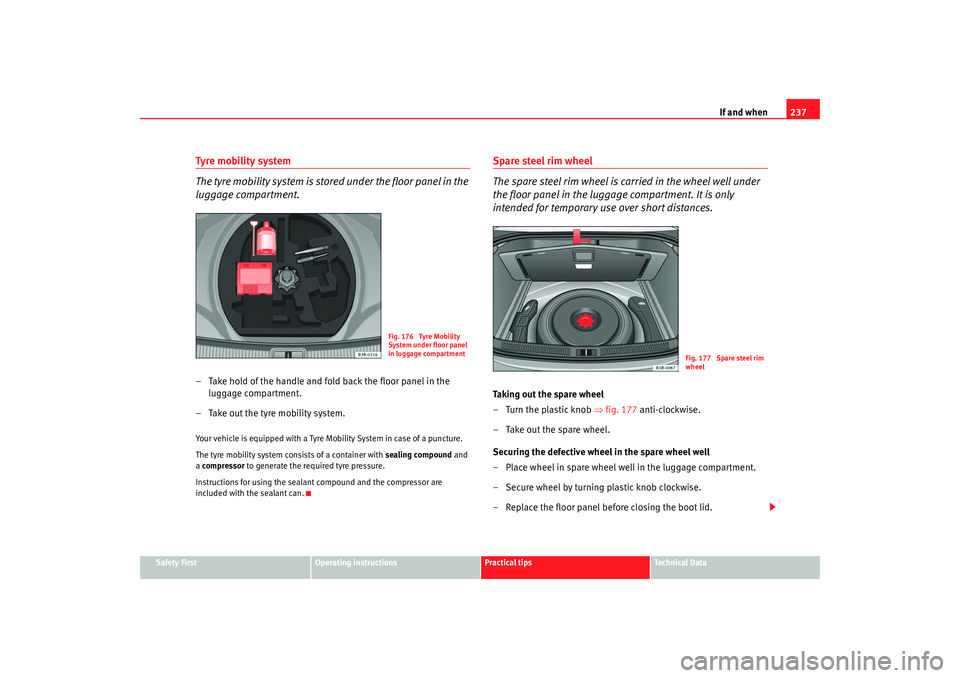
The tyre mobility system is stored under the floor panel in the
luggage compartment.– Take hold of the handle and fold back the floor panel in the
luggage compartment.
– Take out the tyre mobility system.Your vehicle is equipped with a Tyre Mobility System in case of a puncture.
The tyre mobility system consists of a container with sealing compound and
a compressor to generate the required tyre pressure.
Instructions for using the sealant compound and the compressor are
included with the sealant can.
Spare steel rim wheel
The spare steel rim wheel is carried in the wheel well under
the floor panel in the luggage compartment. It is only
intended for temporary use over short distances.Taking out the spare wheel
– Turn the plastic knob ⇒fig. 177 anti-clockwise.
– Take out the spare wheel.
Securing the defective wheel in the spare wheel well
– Place wheel in spare wheel well in the luggage compartment.
– Secure wheel by turning plastic knob clockwise.
– Replace the floor panel before closing the boot lid.
Fig. 176 Tyre Mobility
System under floor panel
in luggage compartment
Fig. 177 Spare steel rim
wheel
Exeo_EN.book Seite 237 Freitag, 17. Oktober 2008 11:24 11
Page 240 of 303

If and when
238Your vehicle can be equipped with a steel spare wheel at the factory. The
spare wheel does not usually meet the same performance standards as the
wheels fitted on the vehicle because of the wheel/tyre dimensions, rubber
composition, tread pattern, etc. Theref ore, note the following restrictions:•
The spare steel rim wheel is designed on ly for your vehicle model. Do not
attempt to mount the wheel on any vehicle but your own.
•
Your vehicle will have different driving characteristics when the spare
steel rim wheel is mounted ⇒.
•
The spare wheel is only intended for temporary use after having a flat tyre.
Replace the spare wheel with a normal wheel that has the proper tyre dimen-
sions as soon as possible.
•
If the size of the spare steel rim wheel is different to that of the other
wheels, it is unlikely that snow chains suitable for the other wheels will fit it.
WARNING
•
After mounting the spare steel rim wheel, the tyre pressure must be
checked and corrected as soon as possible. The inflating pressure must
adapt to the vehicle load (consult th e table containing the inflation pres-
sures). Otherwise there is danger of causing an accident. Use the highest
tyre pressure as indicated in the table.
•
Do not drive faster than 80 km/h, as higher speeds can cause an acci-
dent.
•
Avoid heavy acceleration, hard braking and fast cornering, as this could
cause an accident.
Changing a wheelPreparation work
What you must do before changing a wheel.– If you have a flat tyre or puncture, park the car as far away from the flow of traffic as possible. Choose a location that is as level
as possible.
– All passengers should leave the vehicle. They should wait in a
safe place (e.g. behind the roadside crash barrier).
–Apply the handbrake firmly.
– Engage 1st gear.
– When towing a trailer: Unhitch the trailer from your vehicle.
–Take the tools and the spare wheel ⇒ page 236 out of the
luggage compartment.
WARNING
If you have a puncture in heavy traffic, switch on the hazard warning lights
and place the warning triangle in a visible location. This is for your own
safety and also warns other road users.
Caution
If you have to change the tyre on a gradient, block the wheel opposite the
wheel being changed by placing a stone or similar object under it to prevent
the vehicle from rolling away.
Exeo_EN.book Seite 238 Freitag, 17. Oktober 2008 11:24 11
Page 241 of 303
If and when239
Safety First
Operating instructions
Practical tips
Te c h n i c a l D a t a
Note
Please observe legal requirements when doing so.Changing a wheel
Change the wheel as described below.– Remove the wheel cover.
– Loosen the wheel bolts ⇒ page 240.
– Raise the car with the jack ⇒ page 241.
– Ta k e o f f the wheel with the flat tyre and then put on the spare
wheel ⇒page 242.
– Lower the vehicle.
– Tighten the wheel bolts firmly in diagonal sequence with the box
spanner ⇒page 240.
–Replace the cover.After changing a wheel
After changing the wheel, there are still tasks to complete.– Place the wheel with the defective tyre in the spare wheel well
and secure it.
– Put the tools and jack back in the luggage compartment. –The
inflation pressure of the newly fitted spare tyre must be
checked as soon as possible.
– Have the tightening torque of the wheel bolts checked as soon
as possible with a torque wrench. It must be 120 Nm (always
cold)
– Have the flat tyre replaced as quickly as possible.
Note
•
If you notice that the wheel bolts are rusty and difficult to turn when
changing a wheel, they must be replaced before having the tightening torque
checked.
•
For your safety, drive at moderate speeds until the wheel bolt torque has
been checked.
Exeo_EN.book Seite 239 Freitag, 17. Oktober 2008 11:24 11
Page 242 of 303
If and when
240Loosening and tightening the wheel bolts
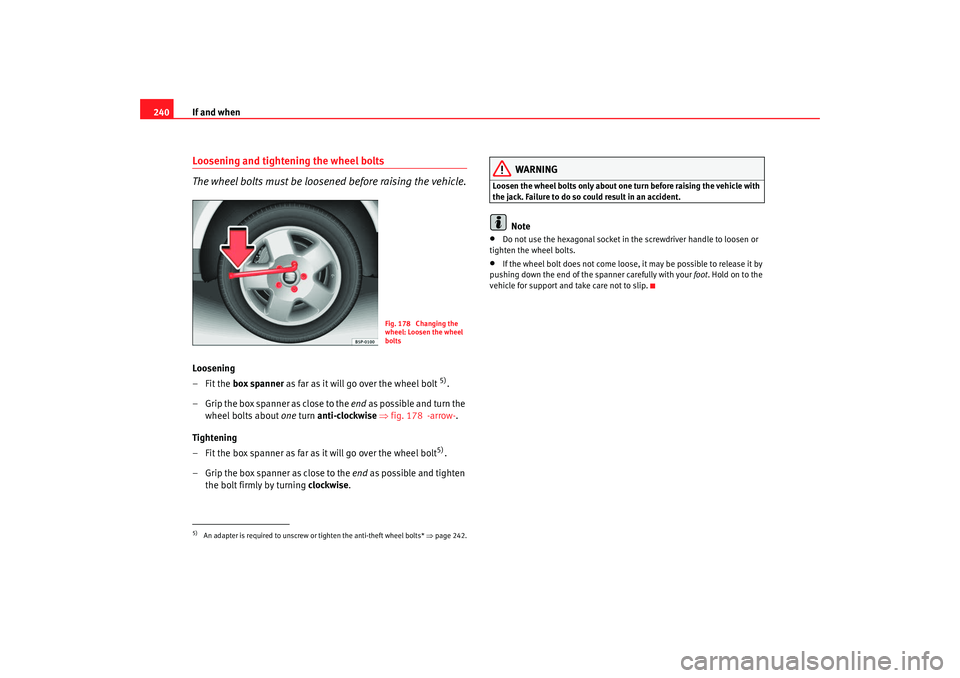
The wheel bolts must be loosened before raising the vehicle.Loosening
–Fit the box spanner as far as it will go over the wheel bolt
5).
– Grip the box spanner as close to the end as p ossible a nd tu rn the
wheel bolts about one turn anti-clockwise ⇒ fig. 178 -arrow- .
Tightening
– Fit the box spanner as far as it will go over the wheel bolt5).
– Grip the box spanner as close to the end as possible and tighten
the bolt firmly by turning clockwise.
WARNING
Loosen the wheel bolts only about one tu rn before raising the vehicle with
the jack. Failure to do so could result in an accident.
Note
•
Do not use the hexagonal socket in the screwdriver handle to loosen or
tighten the wheel bolts.
•
If the wheel bolt does not come loose, it may be possible to release it by
pushing down the end of the spanner carefully with your foot. Hold on to the
vehicle for support and take care not to slip.
5)An adapter is required to unscrew or tighten the anti-theft wheel bolts* ⇒page 242.
Fig. 178 Changing the
wheel: Loosen the wheel
bolts
Exeo_EN.book Seite 240 Freitag, 17. Oktober 2008 11:24 11
Page 243 of 303

If and when241
Safety First
Operating instructions
Practical tips
Te c h n i c a l D a t a
Raising the vehicle
In order to remove the wheel, the vehicle must be raised with
a jack.
– Position the vehicle jack under the door sill at the jacking point
closest to the wheel being changed ⇒fig. 179 -arrows- .
–Wind up the jack under the jacking point until the claw of the jack
is directly below the vertical rib under the door sill.
– Align the jack so that the arm of the jack fits on the rib under the door sill ⇒fig. 180 and the movable base plate of the jack
is flat on the ground.
– Raise the vehicle until the defect ive wheel is just clear of the
ground.Recesses at the front and rear of the door sills mark the jacking points
⇒ fig. 179 -arrows- . There is only one jacking point for each wheel. Do not fit
the jack anywhere else.
The distance from the jacking points to the wheel arches is approximately 15
cm at the front and 25 cm at the rear.
An unstable surface under the jack may cause the vehicle to slip off the jack.
Therefore, the jack must be fitted on solid ground offering good support. Use
a large, stable base if necessary. On a hard, slippery surface (such as tiles)
use a rubber mat or similar to prevent the jack from slipping.
WARNING
•
Take all precautions so that the base of the jack does not slip. Failure to
do so could result in an accident.
•
The vehicle can be damaged if the jack is not applied at the correct
jacking points. There is also a risk of injury since the jack can slip off
suddenly if it is not properly engaged.
Fig. 179 Changing the
wheel: The jacking pointsFig. 180 Changing the
wheel: Jack
AA
AB
Exeo_EN.book Seite 241 Freitag, 17. Oktober 2008 11:24 11
Page 244 of 303
If and when
242Removing and fitting the wheel
For removal and fitting the wheel, the following tasks must be
completed.After loosening the wheel bolts and raising the vehicle with the jack,
cange the wheel as described below:
Removing a wheel
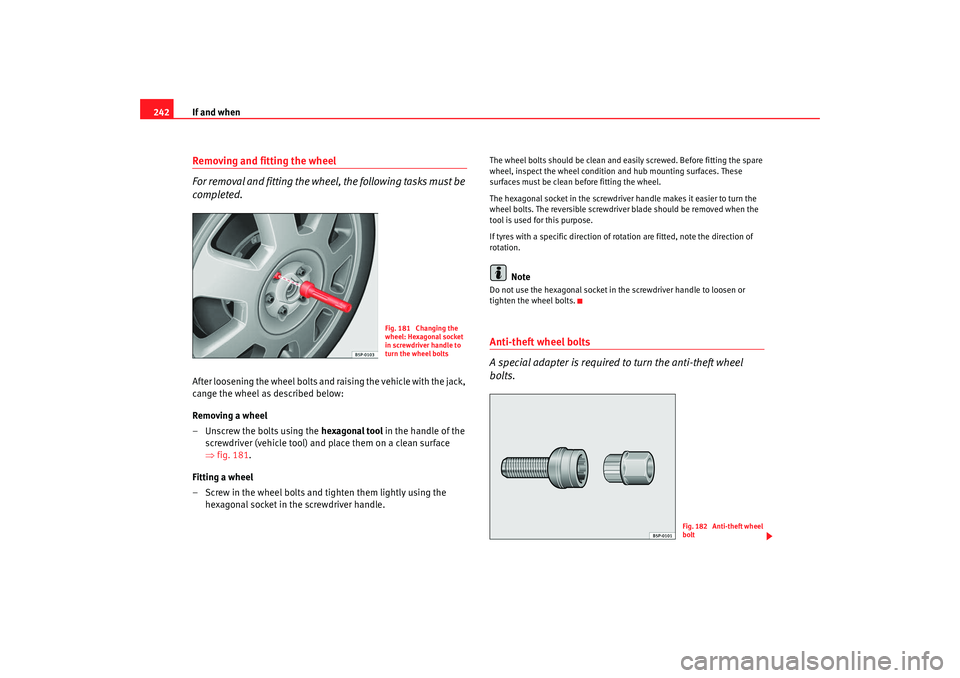
– Unscrew the bolts using the hexagonal tool in the handle of the
screwdriver (vehicle tool) and place them on a clean surface
⇒ fig. 181.
Fitting a wheel
– Screw in the wheel bolts and tighten them lightly using the hexagonal socket in the screwdriver handle.
The wheel bolts should be clean and easily screwed. Before fitting the spare
wheel, inspect the wheel condition and hub mounting surfaces. These
surfaces must be clean before fitting the wheel.
The hexagonal socket in the screwdriver handle makes it easier to turn the
wheel bolts. The reversible screwdriver blade should be removed when the
tool is used for this purpose.
If tyres with a specific di rection of rotation are fitt ed, note the direction of
rotation.
Note
Do not use the hexagonal socket in the screwdriver handle to loosen or
tighten the wheel bolts.Anti-theft wheel bolts
A special adapter is required to turn the anti-theft wheel
bolts.
Fig. 181 Changing the
wheel: Hexagonal socket
in screwdriver handle to
turn the wheel bolts
Fig. 182 Anti-theft wheel
bolt
Exeo_EN.book Seite 242 Freitag, 17. Oktober 2008 11:24 11
Page 245 of 303

If and when243
Safety First
Operating instructions
Practical tips
Te c h n i c a l D a t a
– Insert the adapter onto the wheel bolt and push it on as far as it
will go ⇒page 242, fig. 182 .
– Fit the box spanner as far as it will go over the adapter.
– Loosen or tighten the wheel bolt as appropriate.Error code
The code number of the anti-t heft wheel bolt is stamped onto the front part of
the adaptor.
The code number should be noted and kept in a safe place, as it is only by
using the code number that a duplicat e adaptor can be obtained from an
Authorised Service Centre.Tyres with directional tread pattern
Tyres with directional tread pattern must be fitted so that they
rotate in the correct direction.A directional tread pattern can be identified by arrows on the sidewall that
point in the direction of rotation. Always note the direction of rotation indi-
cated when fitting the wheel. This is important so that these tyres can give
maximum grip and avoid excessive noise, tread wear and aquaplaning.
If, in an emergency, you have to fit th e spare wheel so it rotates in the wrong
direction, you must drive extremely care fully. The tyre will not give optimum
performance. This is particularly important when driving on wet roads.
To benefit from the advantages of tyres with this type of tread pattern, the
defective tyre should be replaced as soon as possible so that all tyres again
rotate in the correct direction.
Tyre repair* (Tyre-Mobility-System)General information and safety notes
Repaired tyres are only suitable for temporary use over a
short period.Your vehicle is equipped with a tyre repair kit: the Tyre Mobility System.
In the event of a puncture you will find the TMS, which consists of a sealing
compound and a compressor, located under the floor panel in the luggage
compartment.
The Tyre Mobility System will reliably seal tyres damaged by foreign bodies,
provided that the cuts or punctu res are no larger than approx. 4 mm in diam-
eter.
It is not necessary to remove the foreign body from the tyre.
Fig. 183 The Tyre
Mobility System is not
suitable for repairing this
type of damage to tyres.
Exeo_EN.book Seite 243 Freitag, 17. Oktober 2008 11:24 11