engine Seat Exeo 2008 Repair Manual
[x] Cancel search | Manufacturer: SEAT, Model Year: 2008, Model line: Exeo, Model: Seat Exeo 2008Pages: 303, PDF Size: 10.02 MB
Page 224 of 303
Checking and refilling levels
222•
To prevent smearing on the windscreen, the wiper blades should be
cleaned regularly using a window cleaner solution. If the wiper blades are
very dirty (e.g. insects etc.), they should be cleaned using a sponge or
cloth. Failure to do so co uld result in an accident.
•
For safety reasons, the wiper blades should be changed once or twice a
year.Caution
•
Damaged or dirty windscreen wipers could scratch the windscreen.
•
Never use fuel, nail varnish remover, paint thinner or similar products to
clean the windows. This could damage the windscreen wiper blades.
•
Never move the windscreen wiper or windscreen wiper arm manually. This
could cause damage.
•
Do not pull the windscreen wipers forward unless they are in the service
position. Otherwise the bonnet could be damaged.Note
•
The wiper arms can be moved to the service position only when the
bonnet is properly closed.
Brake fluidChecking the brake fluid level
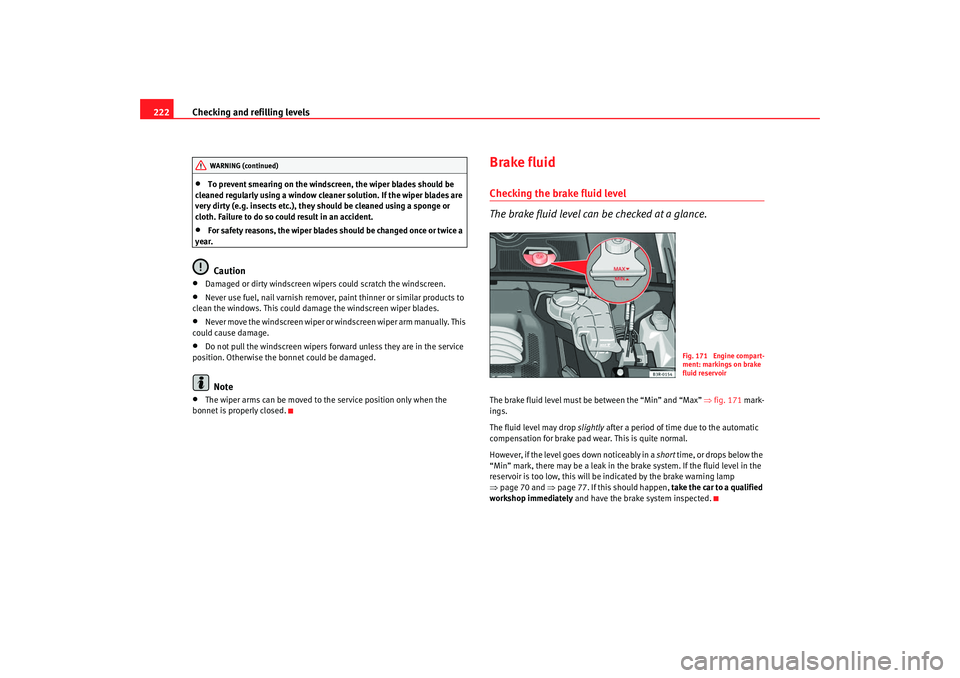
The brake fluid level can be checked at a glance.The brake fluid level must be between the “Min” and “Max” ⇒fig. 171 mark-
ings.
The fluid level may drop slightly after a period of time due to the automatic
compensation for brake pad wear. This is quite normal.
However, if the level goes down noticeably in a short time, or drops below the
“Min” mark, there may be a leak in the brake system. If the fluid level in the
reservoir is too low, this will be indicated by the brake warning lamp
⇒ page 70 and ⇒ page 77. If this should happen, take the car to a qualified
workshop immediately and have the brake system inspected.
WARNING (continued)
Fig. 171 Engine compart-
ment: markings on brake
fluid reservoir
Exeo_EN.book Seite 222 Freitag, 17. Oktober 2008 11:24 11
Page 226 of 303

Checking and refilling levels
224Winter operations
The battery is drained more in cold weather, which means that the starting
power is reduced. For this reason, have the battery checked and charged if
necessary before the start of winter.
Replacing the battery
A replacement battery must have the same capacity, voltage and current
rating. It must also have the same dimensions as the original, factory-fitted
battery and have sealed caps. The SEAT batteries which have been specially
developed fulfil the maintenance, performance and safety specifications for
your vehicle.
We recommend you use maintenance-free batteries.
WARNING
•
All work on batteries requires speciali st knowledge. If work is required
on the battery, this should be pe rformed by a Technical Service or
specialist garage. Danger of caustic burns and explosion!
•
The battery must not be opened. Never try to change the battery's
liquid level. Explosive gas is released from the battery that could lead to an
explosion.Caution
•
The battery holder and clamps must always be correctly secured.
•
Before starting any work on the battery, always observe the warnings
listed below ⇒.For the sake of the environment
Batteries contain toxic substances including sulphuric acid and lead.
Therefore, they must be disposed in line with environmental regulations and
must not be disposed of with ordinary household waste. Make sure discon-
nected batteries cannot tip over . Sulphuric acid could be spilt!
Important safety warnings for handling a car batteryThe battery is located at the back of the engine compartment ⇒page 282.
WARNING
Always be aware of the danger of injury and chemical burns as well as the
risk of accident or fire when work ing on the battery and the electrical
system:•
Wear eye protection. Protect your eyes, skin and clothing from acid and
particles containing lead.
•
Battery acid is very corrosive and caustic. Wear protective gloves and
eye protection. Do not tilt the batter ies. This could spill acid through the
vents. Rinse battery acid from eyes immediately for several minutes with
clear water. Then seek medical care immediately. Neutralize any acid
splashes on the skin or clothing with a soapy solution, and rinse off with
plenty of water. If acid is swallowed by mistake, consult a doctor immedi-
ately.
•
Fires, sparks, naked lights and smoking are prohibited. When handling
cables and electrical equipment, avoid causing sparks and electrostatic
charge. Never short the battery terminals. High-energy sparks can cause
injury.
Wear eye protection
Battery acid is very corrosive and caustic. Wear protec-
tive gloves and eye protection!
Fires, sparks, naked lights and smoking are prohibited!
A highly explosive mixture of gases is released when the
battery is under charge.
Keep children away from acid and batteries!
Exeo_EN.book Seite 224 Freitag, 17. Oktober 2008 11:24 11
Page 227 of 303

Checking and refilling levels225
Safety First
Operating instructions
Practical tips
Te c h n i c a l D a t a
•
A highly explosive mixture of gases is released when the battery is
under charge. The batteries should be charged in a well-ventilated room
only.
•
Keep children away from acid and batteries.
•
Before working on the electrical system, you must switch off the
engine, the ignition and all consumers. The negative cable on the battery
must be disconnected. When a light bulb is changed, you need only switch
off the light.
•
Deactivate the anti-theft alarm by unlocking the vehicle before you
disconnect the battery! The alar m will otherwise be triggered.
•
When disconnecting the battery from the vehicle electrical system,
disconnect first the negative cable and then the positive cable.
•
Switch off all electrical consumers before reconnecting the battery.
Reconnect first the positive cable and then the negative cable. Never
reverse the polarity of the connections. This could cause an electrical fire.
•
Never charge a frozen battery, or one which has thawed. This could
result in explosions and chemical burns. Always replace a battery which
has frozen. A flat battery can freeze at temperatures around 0°
•
Ensure that the vent hose is always connected to the battery.
•
Never use a defective battery. This may be fatally explosive. Replace a
damaged battery immediately.Caution
•
Never disconnect the battery if the ignition is switched on or if the engine
is running. This could damage the electrical system or electronic compo-
nents.
•
Do not expose the battery to direct sunlight over a long period of time, as
the intense ultraviolet radiation can damage the battery housing.
•
If the vehicle is left standing in cold conditions for a long period, protect
the battery from frost. If it “freezes” it will be damaged.
Charging the battery
A fully-charged battery is important for reliable starting.– Note the warnings ⇒ in “Important safety warnings for
handling a car battery” on page 224 and ⇒.
– Switch off the ignition and all electrical equipment.
– Only if “fast-charging”: both battery cables must be discon- nected (first the “negative” cabl e, then the “positive” cable).
– Connect the charger cables to the battery terminals, noting the colour code (red is used for “positive”, black or brown for “nega-
tive”).
– Now connect the battery charger to the power point and switch on.
– After charging the battery: switch off the battery charger and disconnect the power point cable.
– Finally disconnect the charger cables from the battery.
– If necessary, reconnect both battery cables to the battery (first the “positive” cable, then the “negative” cable).When charging with a low current (for instance with a small battery charger)
the battery does not normally have to be disconnected. However, both
battery cables must be disconnected before “ fast-charging” the battery with
a high current. However, always follow th e instructions given by the manufac-
turer of the battery charger.
Fast-charging a battery is dangerous ⇒ in “Important safety warnings for
handling a car battery” on page 224, since it requires a special charger and
WARNING (continued)
Exeo_EN.book Seite 225 Freitag, 17. Oktober 2008 11:24 11
Page 231 of 303
Wheels and tyres229
Safety First
Operating instructions
Practical tips
Te c h n i c a l D a t a
Significant tyre pressure lossThe tyre symbol
is displayed and indicates that the tyre pressure for a least
one tyre is insufficient.
- Stop the vehicle.
- Switch the engine off.
- Check the tyre(s).
- Change the wheel if necessary.
Tyre pressure monitoring (RKA+)*
The type pressure monitor display on the instrument panel
indicates that the pressure is too low.The tyre pressure monitoring system makes use of the ABS sensors to
compare the rolling circumference and the frequency characteristics of the wheels. If the rolling cir
cumference or frequency characteristic changes on
one or more wheels, the tyre pressure warning lamp
will light up. The fault
will also be indicated by a warning buzzer. The position of the affected tyre
will also be shown (if only one tyre is affected) on the centre display of the
instrument panel.
The rolling circumference and frequency characteristics can change if:
•
the tyre pressure is too low.
•
the tyre has suffered structural damage.
•
the wheels or the inflation pressures have been changed without initial-
ising the system (see Adjusting the tyre pressure settings).
•
there is a greater load on the wheels of one axle (e.g. if you are carrying
more passengers or luggage).
•
the road surface under the left wheels is different to the road surface
under the right wheels for a long period.
•
when driving with snow chains.
Adjusting the tyre pressure settings (initialising the tyre pressure
monitoring system)
After any incident regarding the wheels of your vehicle, e.g. after modify the
tyre pressure ⇒page 230 or after changing of swapping around wheels ⇒
page 180 - with the vehicle at a standstill and the engine running - press
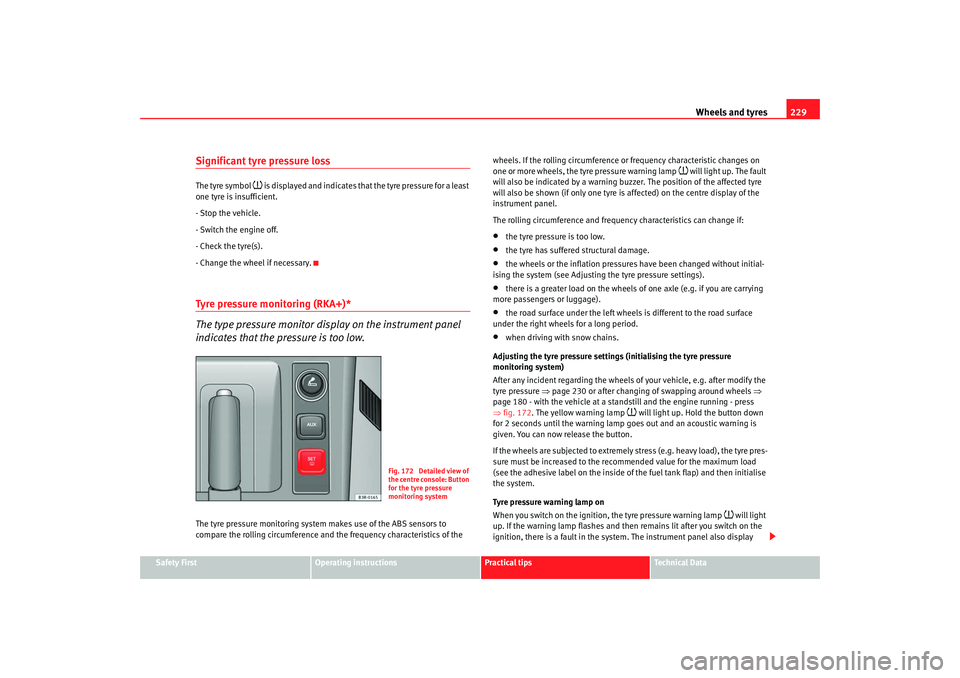
⇒ fig. 172 . The yellow warning lamp
will light up. Hold the button down
for 2 seconds until the warning lamp goes out and an acoustic warning is
given. You can now release the button.
If the wheels are subjected to extremely stress (e.g. heavy load), the tyre pres-
sure must be increased to the recommended value for the maximum load
(see the adhesive label on the inside of the fuel tank flap) and then initialise
the system.
Tyre pressure warning lamp on
When you switch on the ignition, the tyre pressure warning lamp
will light
up. If the warning lamp flashes and then remains lit after you switch on the
ignition, there is a fault in the system. The instrument panel also display
Fig. 172 Detailed view of
the centre console: Button
for the tyre pressure
monitoring system
Exeo_EN.book Seite 229 Freitag, 17. Oktober 2008 11:24 11
Page 238 of 303
If and when
236If and whenTools, tyre repair kit and spare wheelTools
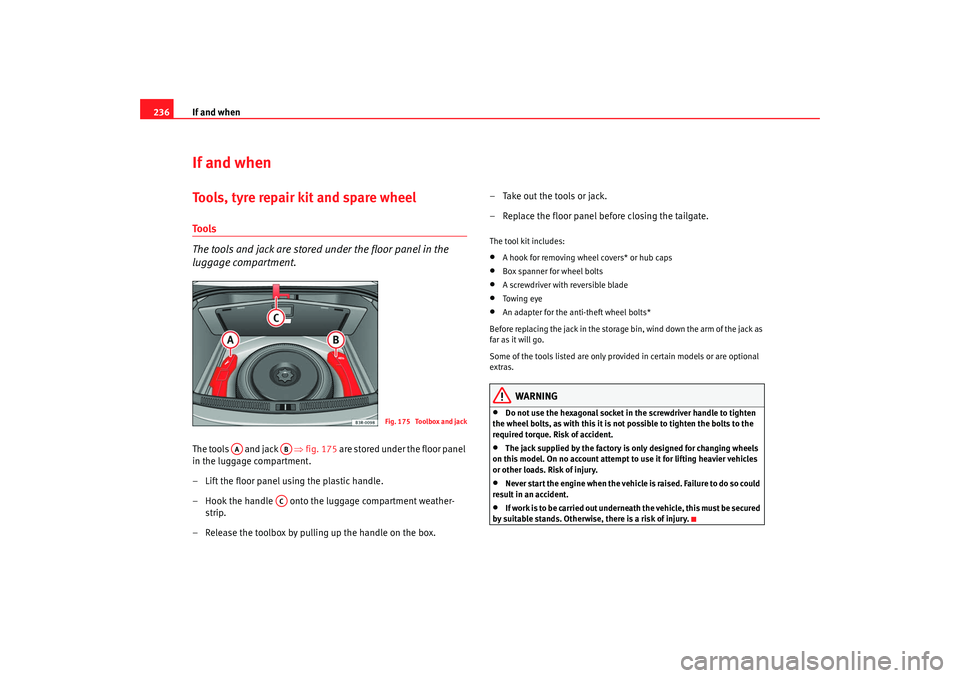
The tools and jack are stored under the floor panel in the
luggage compartment.The tools and jack ⇒fig. 175 are stored under the floor panel
in the luggage compartment.
– Lift the floor panel using the plastic handle.
– Hook the handle onto the luggage compartment weather- strip.
– Release the toolbox by pulling up the handle on the box. – Take out the tools or jack.
– Replace the floor panel before closing the tailgate.
The tool kit includes:•
A hook for removing wheel covers* or hub caps
•
Box spanner for wheel bolts
•
A screwdriver with reversible blade
•
Towing eye
•
An adapter for the anti-theft wheel bolts*
Before replacing the jack in the storage bin, wind down the arm of the jack as
far as it will go.
Some of the tools listed are only provid ed in certain models or are optional
extras.
WARNING
•
Do not use the hexagonal socket in the screwdriver handle to tighten
the wheel bolts, as with this it is not possible to tighten the bolts to the
required torque. Risk of accident.
•
The jack supplied by the factory is only designed for changing wheels
on this model. On no account attempt to use it for lifting heavier vehicles
or other loads. Risk of injury.
•
Never start the engine when the vehicle is raised. Failure to do so could
result in an accident.
•
I f wo r k is t o b e ca r r i e d o u t un d e r n ea th the vehicle, this must be secured
by suitable stands. Otherwise, there is a risk of injury.
Fig. 175 Toolbox and jac
k
AA
ABAC
Exeo_EN.book Seite 236 Freitag, 17. Oktober 2008 11:24 11
Page 251 of 303
If and when249
Safety First
Operating instructions
Practical tips
Te c h n i c a l D a t a
Some of the electrical items listed in
the table are only fitted on certain
models or are optional extras.
The electric windows and electric seat adjusters are protected by circuit
breakers. These reset automatically after a few seconds when the overload
(caused for example by frozen windows) has been corrected.
Note
Please note that the above list contains all data at the time of going to press,
so it is subject to modifications. If discrepancies should occur, please refer to
the sticker on the inside of the fuse cover for the correct information for your
model.BulbsGeneral notesYou can change the following bulbs for exterior lights yourself:•
Main headlights: all (exc ept for xenon headlights)
•
Rear lights: All bulbs
•
Bulb for side indicator The following bulbs can only be changed by a
qualified workshop:
•
Main headlights: Xenon* bulb ⇒page 256
•
Front fog lights: Bulb
As a rule, you require a certain degree of practical skill to change defective
bulbs. This applies in particular to those bulbs which are only accessible from
the engine compartment.
If in doubt, we recommend that you have defective bulbs changed by a qual-
ified workshop or qualified mechanic.
If you do decide to change bulbs in the engine compartment yourself, be
aware of the safety risks involved ⇒page 213 ⇒ in “Types of bulbs”.
Changing bulbs Halogen headlightsTypes of bulbsYou must only replace a bulb with a bu lb of the same type. The name can be
found on the base of the bulb.
WARNING
•
Take particular care when working on components in the engine
compartment if the engine is warm - risk of burns!
40
Horn
25
41
Va ca n t
30
42
Electronic stabilisation programme (ESP)
25
43
Engine management
15
44
Seat heating
35
No.
Consumer
Amps
Bulb
Typ e
Dipped-beam headlights (halogen)
12 V/55 W (H7, H7 LL)
Main beam headlights
12 V/55 W (H1)
Indicator light
12 V/21 W (PY21W)
Side lights
12 V/5 W (W5W LL)
Exeo_EN.book Seite 249 Freitag, 17. Oktober 2008 11:24 11
Page 259 of 303

If and when257
Safety First
Operating instructions
Practical tips
Te c h n i c a l D a t a
WARNING
•
Take particular care when working on components in the engine
compartment if the engine is warm - risk of burns!
•
Bulbs are highly sensitive to pressure. The glass can break when you
touch the bulb, causing injury.
•
The high voltage element of gas discharge lamps* (xenon light) must
be handled correctly. Otherwise, there is a risk of death.
•
When changing bulbs, please take care not to injure yourself on sharp
parts in the headlight housing.Caution
•
Remove the ignition key before workin g on the electric system. If not, a
short circuit could occur.
•
Switch off the lights or parking lights before you change a bulb.For the sake of the environment
Please ask your specialist retailer how to dispose of used bulbs in the proper
manner.
Note
•
Depending on the weather conditions (cold, humidity), the front head-
lights and front lights, the rear pilots and the indicators could steam up. This phenomenon has no influence on the life
expectancy of the vehicle lights. If
headlamps are switched on, the area where the light shaft is projected, is
demisted in little time. However, the edges may be steamed up on the inte-
rior.
•
Please check at regular intervals that all lighting (especially the exterior
lighting) on your vehicle is functioning pr operly. This is not only in the interest
of your own safety, but also in that of all other road users.
•
Before changing a bulb, make sure you have the correct new bulb.
•
Do not touch the glass part of the bulb with your bare hands, use a cloth
or paper towel instead. Otherwise, the fingerprints left on the glass will
vaporise as a result of the heat generated by the bulb, be deposited on the
reflector and impair its surface.
Removing the air duct
The air duct has to be removed to gain access to the bulbs for
the right-side headlight.
Bulb
Typ e
Xenon bulbs
12 V/35 W (D1S)
DRL (day light)
12 V/21 W (P21W SLL)
Indicator light
12 V/21 W (PY21W)
Side lights
12 V/5 W (W5W blue LL)
Fig. 199 Air duct on right
side of vehicle
Exeo_EN.book Seite 257 Freitag, 17. Oktober 2008 11:24 11
Page 273 of 303
If and when271
Safety First
Operating instructions
Practical tips
Te c h n i c a l D a t a
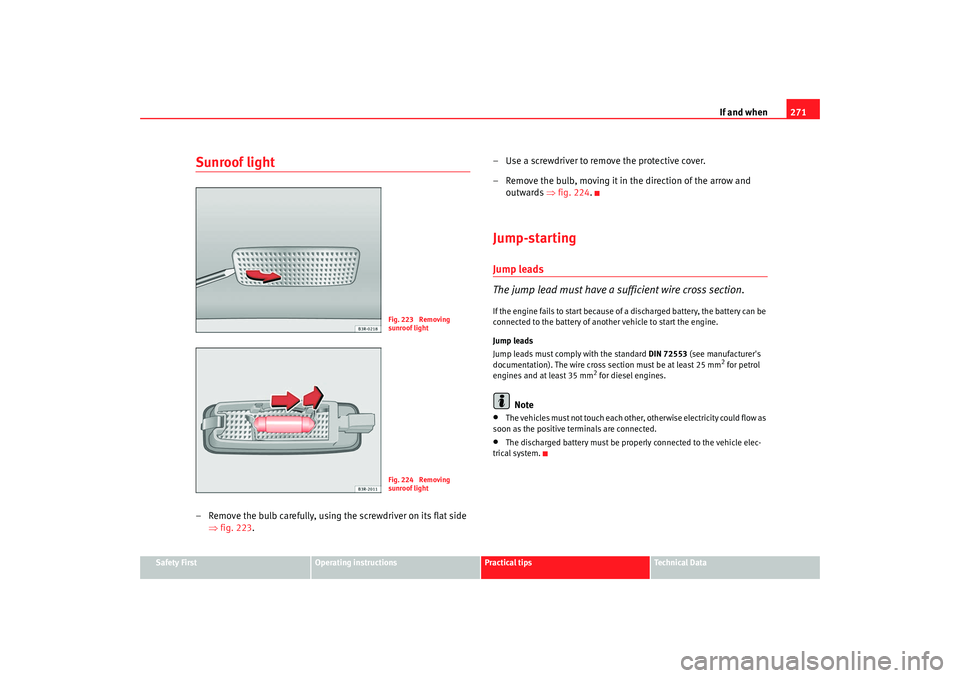
Sunroof light– Remove the bulb carefully, using the screwdriver on its flat side
⇒fig. 223 . – Use a screwdriver to remove the protective cover.
– Remove the bulb, moving it in
the direction of the arrow and
outwards ⇒fig. 224.
Jump-startingJump leads
The jump lead must have a sufficient wire cross section.If the engine fails to start because of a discharged battery, the battery can be
connected to the battery of another vehicle to start the engine.
Jump leads
Jump leads must comply with the standard DIN 72553 (see manufacturer's
documentation). The wire cross section must be at least 25 mm
2 for petrol
engines and at least 35 mm
2 for diesel engines.
Note
•
The vehicles must not touch each othe r, otherwise electricity could flow as
soon as the positive terminals are connected.
•
The discharged battery must be properly connected to the vehicle elec-
trical system.
Fig. 223 Removing
sunroof lightFig. 224 Removing
sunroof light
Exeo_EN.book Seite 271 Freitag, 17. Oktober 2008 11:24 11
Page 274 of 303

If and when
272How to jump start: description⇒ fig. 225 shows the flat battery and the charged battery.
Jump lead terminal connections
– Switch off the ignition on both vehicles ⇒.
1. Connect one end of the red jump lead to the positive ⇒fig. 225
terminal of the vehicle with the flat battery ⇒.
2. Connect the other end of the red jump lead to the positive terminal in the vehicle providing assistance.
3. Connect one end of the black jump lead to the negative terminal on the battery of the vehicle providing assistance. 4. Connect the other end of the black jump lead to a solid metal
component which is bolted on to the engine block, or onto the
engine block itself of the vehicle with the flat battery. Do not
connect it to a point near the battery ⇒.
5. Position the leads in such a way that they cannot come into contact with any moving parts in the engine compartment.
Starting
6. Start the engine of the vehicle with the boosting battery and let it run at idling speed.
7. Start the engine of the car with the flat battery and wait one or two minutes until the engine is “running”.
Removing the jump leads
8. Before you remove the jump leads, switch off the headlights (if they are switched on).
9. Turn on the heater blower and rear window heater in the vehicle with the flat battery. This helps minimise voltage peaks which are
generated when the leads are disconnected.
10. When the engine is running, disconnect the leads in reverse order to the deta ils given above.
Connect the battery clamps so they have good metal-to-metal contact with
the battery terminals.
If the engine fails to start, switch off the starter after about 10 seconds and
try again after about half a minute.
Fig. 225 How to connect
the jump leads
AA
AB
A+
A+
A-
AX
Exeo_EN.book Seite 272 Freitag, 17. Oktober 2008 11:24 11
Page 275 of 303
If and when273
Safety First
Operating instructions
Practical tips
Te c h n i c a l D a t a
WARNING
•
Please note the safety warnings referring to working in the engine
compartment ⇒page 213.
•
The battery providing assistance must have the same voltage as the flat
battery (12V) and approximately the same capacity (see imprint on
battery). Failure to comply could result in an explosion.
•
Never use jump leads when one of the batteries is frozen. Danger of
explosion! Even after the battery has thawed, battery acid could leak and
cause chemical burns. If a battery freezes, it should be replaced.
•
Keep sparks, flames and lighted cigarettes away from batteries, danger
of explosion. Failure to comply could result in an explosion.
•
Observe the instructions provided by the manufacturer of the jump
leads.
•
Do not connect the negative cable from the other vehicle directly to the
negative terminal of the flat battery. The gas emitted from the battery could
be ignited by sparks. Danger of explosion.
•
Do not attach the negative cable from the other vehicle to parts of the
fuel system or to the brake line.
•
The non-insulated parts of the battery clamps must not be allowed to
touch. The jump lead attached to the positive battery terminal must not
touch metal parts of the vehicle, this can cause a short circuit.
•
Position the leads in such a way that they cannot come into contact
with any moving parts in the engine compartment.
•
Do not bend over the batteries. This could result in chemical burns.Note
The vehicles must not touch each other, otherwise electricity could flow as
soon as the positive terminals are connected.
Exeo_EN.book Seite 273 Freitag, 17. Oktober 2008 11:24 11