brake fluid Seat Exeo ST 2009 User Guide
[x] Cancel search | Manufacturer: SEAT, Model Year: 2009, Model line: Exeo ST, Model: Seat Exeo ST 2009Pages: 316, PDF Size: 8.83 MB
Page 239 of 316
Checking and refilling levels237
Safety First
Controls and equipment
Practical tips
Technical Data
Removing the wiper blade
– Lift the wiper arm away from the glass ⇒ page 236, fig. 185.
– Slide the blade adapter in the di rection of the arrow and remove
the blade ⇒ page 236, fig. 185 .
Fitting the wiper blade
– With one hand, hold the top end of the wiper arm.
– Place the blade as shown in the ⇒ page 236, fig. 186 and slide
the adapter along until it engages.Check the condition of the wiper blad e regularly. Change as required.
If the windscreen wiper scrapes, i t s h o u l d b e r e p la ce d i f d a m a ge d , o r c l ea n e d
if soiled.
If this is not sufficient, refer to a qualified workshop.
WARNING
Do not drive unless you have good visibility through all windows!•Clean the windscreen wiper blades and all windows regularly.•The wiper blades should be changed once or twice a year.Caution
•A damaged or dirty window wiper could scratch the rear window.•Never use fuel, nail varnish remover, paint thinner or similar products to
clean the window.•Never move the windscreen wiper by hand. This could cause damage.
Brake fluidChecking the brake fluid level
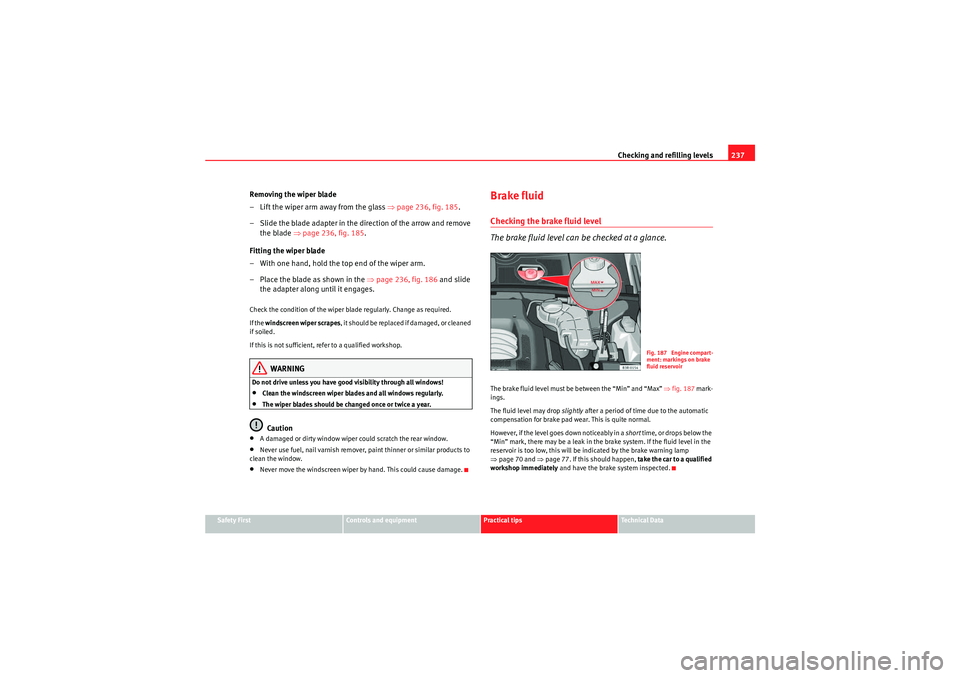
The brake fluid level can be checked at a glance.The brake fluid level must be between the “Min” and “Max” ⇒fig. 187 mark-
ings.
The fluid level may drop slightly after a period of time due to the automatic
compensation for brake pad wear. This is quite normal.
H owe ve r, if th e le ve l goes d own not icea bly i n a short time, or drops below the
“Min” mark, there may be a leak in the brake system. If the fluid level in the
reservoir is too low, this will be indicated by the brake warning lamp
⇒ page 70 and ⇒page 77. If this should happen, take the car to a qualified
workshop immediately and have the brake system inspected.
Fig. 187 Engine compart-
ment: markings on brake
fluid reservoir
ExeoST_EN.book Seite 237 Donnerstag, 3. September 2009 12:24 12
Page 240 of 316

Checking and refilling levels
238Topping up and changing the brake fluid
It is best to have the brake fluid changed by a professional.Brake fluid absorbs damp. Therefore, in the course of time it will absorb water
from the ambient air. If the water content in the brake fluid is too high, the
brake system could corrode. In addition, the boiling point of the brake fluid
will be considerably reduced. This could adversely affect the braking ability in
certain circumstances.
For this reason the brake fluid must be changed periodically.
Your vehicle's Service Schedule will tell you when the brake fluid has to be
renewed.
We recommend you have the brake fluid changed as part of a regular Inspec-
tion Service at your garage. They are familiar with the procedure and have the
necessary special tools and spare parts as well as the proper facilities for
disposing of the old fluid.
Use only the genuine brake fluid specified by the factory Specialist garages
know that the brake fluid -DOT 4- is factory approved. The brake fluid must be
new.
WARNING
•Therefore, it must always be kept cl osed in its original container. Keep
out of the reach of children. Failure to comply could result in poisoning.•Heavy use of the brakes may cause a vapour lock if the brake fluid is left
in the system for too long. This would seriously affect the efficiency of the
brakes and the safety of the car, leading to the risk of accident.Caution
Please note that brake fluid will attack the paintwork on contact.
For the sake of the environment
If the fluid has to be drained out of the brake system, use an appropriate
container to catch the used brake fluid and dispose of it in the proper
manner.BatteryGeneral notes
All work on batteries requires specialist knowledge.The battery is virtually maintenance-free and is checked in the Inspection
Services.
We recommend that you replace a battery once it is older than 5 years.
Disconnecting the battery
If the battery is disconnected, some of the vehicle's functions will become
inoperative (e.g. electric windows). These functions will require resetting
after the battery is reconnected. For this reason, the battery should only be
disconnected from the vehicle's electrical system when absolutely necessary.
Long periods of non-use
The battery will gradually lose its charge because certain electrical equip-
ment continues to draw current even when the ignition is off. If you park the
vehicle for long periods of time in winter you should take the battery out of
the vehicle and keep it in a frost-proof room. Store the battery in a place
where it cannot “freeze up” and become damaged. At warm outside temper-
atures it is sufficient to disconnect the negative terminal of the battery. Even
when the battery is not connected you should charge it from time to time.
ExeoST_EN.book Seite 238 Donnerstag, 3. September 2009 12:24 12
Page 248 of 316
Wheels and tyres
246Wear indicators
The original tyres on your vehicle have 1.6 mm high “tread wear indicators”
⇒ page 245, fig. 189 , running across the tread. Depending on the make,
there will be six to eight of them evenly spaced around the tyre. Markings on
the tyre sidewall (for instance the letters “TWI” or other symbols) indicate the
positions of the tread wear indicators. The minimum tread depth required by
law is 1.6 mm (measured in the tread grooves next to the tread wear indica-
tors). Worn tyres must be replaced. Different figures may apply in export
countries ⇒.
Tyre pressure
Under-inflation or over-inflation will reduce the life of the tyres considerably
and also impair the car's handling. The inflation pressures are listed on a
sticker on the inside of the fuel tank flap.
Correct inflation pressures are very important, especially at high speeds. The
pressure should therefore be checked at least once a month and before
starting any long journey.
Tyre pressure monitoring (RKA+)*
Monitoring of the tyre pressures is based on the tyre pressures you have
stored. The tyre pressure monitoring system cannot function as intended if
you store tyre pressure settings for a normal load, but then drive with the
vehicle fully laden. The tyre pressure must be adapted to the actual load and
stored accordingly in the tyre pressure monitoring system ⇒ page 244.
Driving style
Fast cornering, heavy acceleration and hard braking all increase tyre wear.
Changing wheels around
If the front tyres are worn considerably more than the rear ones it is advisable
to change them around as shown ⇒page 245, fig. 190. All the tyres will then
last for about the same time. Wheel balance
The wheels on new vehicles are balanced. However, various factors encoun-
tered in normal driving can cause them to become unbalanced, which results
in steering vibration.
Unbalanced wheels should be rebalanced, as they otherwise cause excessive
wear on steering, suspension and tyres. A wheel must also be rebalanced
when a new tyre is fitted.
Incorrect wheel alignment
Incorrect wheel alignment causes excessive tyre wear, impairing the safety of
the vehicle. If tyres show excessive wear, you should have the wheel align-
ment checked by an Authorised Service Centre.
WARNING
There is a serious danger of accidents if a tyre bursts during driving!•The tyres must be replaced at the latest when the tread is worn down to
the tread wear indicators. Failure to do so could result in an accident. Worn
tyres do not grip well at high speeds on wet roads. There is also a greater
risk of “aquaplaning” •At continuously high speeds, a tyre with insufficient pressure flexes
more. This causes it to overheat. This can cause tread separation and tyre
blow-out. Risk of accident. Always observe the recommended tyre pres-
sures.•I f t y r e s s h o w e x ce s s i v e w e a r, y o u s h o u l d h a v e t h e r u n n i n g g e a r ch e cke d
by an Authorised Service Centre.•Keep chemicals such as oil, fuel and brake fluid away from tyres.•Damaged wheels and tyres must be replaced immediately!For the sake of the environment
Under-inflated tyres will increase fuel consumption.
ExeoST_EN.book Seite 246 Donnerstag, 3. September 2009 12:24 12
Page 297 of 316
Technical Data295
Safety First
Controls and equipment
Practical tips
Technical Data
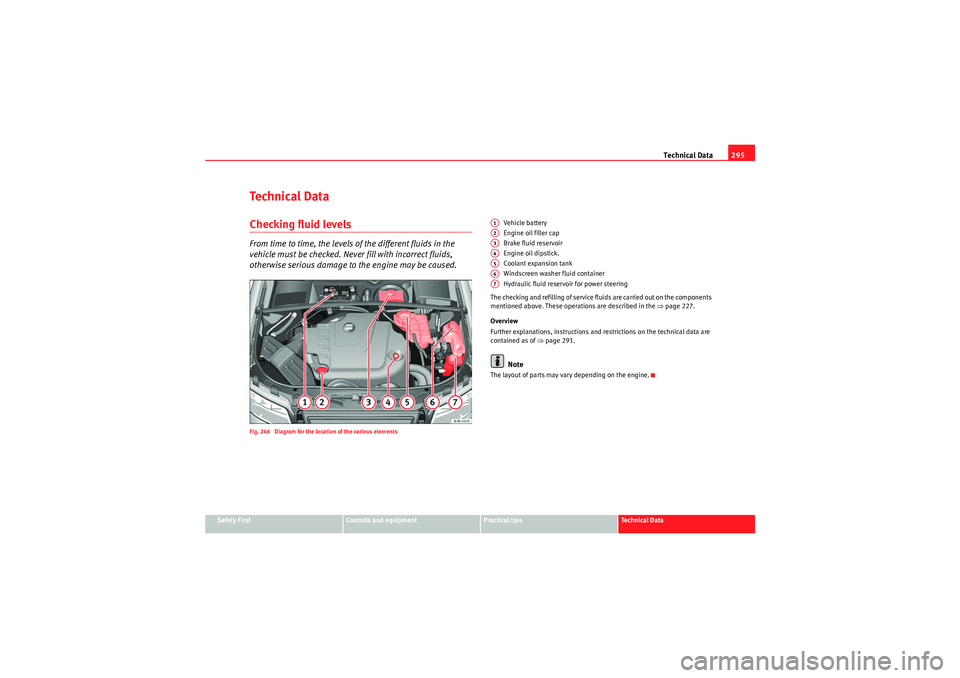
Te c h n i c a l D a t aChecking fluid levelsFrom time to time, the levels of the different fluids in the
vehicle must be checked. Never fill with incorrect fluids,
otherwise serious damage to the engine may be caused.Fig. 246 Diagram for the location of the various elements
Vehicle battery
Engine oil filler cap
Brake fluid reservoir
Engine oil dipstick.
Coolant expansion tank
Windscreen washer fluid container
Hydraulic fluid reservoir for power steering
The checking and refilling of service fluids are carried out on the components
mentioned above. These operations are described in the ⇒page 227.
Overview
Further explanations, instructions and restrictions on the technical data are
contained as of ⇒page 291.Note
The layout of parts may vary depending on the engine.A1A2A3A4A5A6A7
ExeoST_EN.book Seite 295 Donnerstag, 3. September 2009 12:24 12
Page 308 of 316
Index
306Brakes . . . . . . . . . . . . . . . . . . . . . . . . . . . . . . . . 195
Brake assist system . . . . . . . . . . . . . . . . . . 190
Brake fluid . . . . . . . . . . . . . . . . . . . . . . . . . . 237
Worn brake pads . . . . . . . . . . . . . . . . . . . . . . 80
Braking distance . . . . . . . . . . . . . . . . . . . . . . . . 195
Bulb change general notes . . . . . . . . . . . . . . . . . . . . . . . 264CCar keys . . . . . . . . . . . . . . . . . . . . . . . . . . . . . . . . 96
Catalytic converter . . . . . . . . . . . . . . . . . . . . . . 196
CD-ROM player . . . . . . . . . . . . . . . . . . . . . . . . . 149
Central locking . . . . . . . . . . . . . . . . . . . . . . . . . . 98Manual locking . . . . . . . . . . . . . . . . . . . . . . 102
Sunroof: opening and closing . . . . . . . . . . 113
Central locking system Anti-theft security system . . . . . . . . . . . . . . 100
Locking . . . . . . . . . . . . . . . . . . . . . . . . . . . . . 99
Locking and unlocking the vehicle from inside100
Opening and closing the windows . . . . . . 111
Security central locking . . . . . . . . . . . . . . . 101
Switch on the driver's door . . . . . . . . . . . . . 100
Tailgate . . . . . . . . . . . . . . . . . . . . . . . . . . . . 103
Unlocking . . . . . . . . . . . . . . . . . . . . . . . . . . . . 99
Cetane number . . . . . . . . . . . . . . . . . . . . . . . . . 224
Changing the main headlight bulb Main headlight . . . . . . . . . . . . . . . . . . . . . . 268
Changing the main headlight bulbs Dipped beam headlight . . . . . . . . . . . . . . . 269 Changing the rear lights
luggage compartment lights . . . . . . . . . . . 283
Changing windscreen wiper blades . . . . . . . . . 235
Chassis number . . . . . . . . . . . . . . . . . . . . . . . . 292
Child safety . . . . . . . . . . . . . . . . . . . . . . . . . . . . . 46
Child safety seat ISOFIX system . . . . . . . . . . . . . . . . . . . . . . . . 52
Child seat . . . . . . . . . . . . . . . . . . . . . . . . . . . . . . . 48 Categorisation in groups . . . . . . . . . . . . . . . 48
Group 1 . . . . . . . . . . . . . . . . . . . . . . . . . . . . . 49
Group 2 . . . . . . . . . . . . . . . . . . . . . . . . . . . . . 49
Group 3 . . . . . . . . . . . . . . . . . . . . . . . . . . . . . 49
Groups 0 and 0+ . . . . . . . . . . . . . . . . . . . . . . 48
Safety notes . . . . . . . . . . . . . . . . . . . . . . . . . . 46
Securing . . . . . . . . . . . . . . . . . . . . . . . . . . . . . 51
Child seats on the front passenger seat . . . . . . . . . . . . . 29
Childproof lock Rear doors . . . . . . . . . . . . . . . . . . . . . . . . . . 104
Cigarette lighter . . . . . . . . . . . . . . . . . . . . . . . . 155
Cleaning alloy wheel rims . . . . . . . . . . . . . . . . 216
Cleaning chrome . . . . . . . . . . . . . . . . . . . . . . . . 215
Cleaning engine compartment . . . . . . . . . . . . . 217
Cleaning steel wheel rims . . . . . . . . . . . . . . . . 216
Cleaning windows . . . . . . . . . . . . . . . . . . . . . . . 214
Climate control Air distribution . . . . . . . . . . . . . . . . . . . . . . 167
Air outlets . . . . . . . . . . . . . . . . . . . . . . . . . . 167
Air purity sensor . . . . . . . . . . . . . . . . . . . . . 165
Air recirculation . . . . . . . . . . . . . . . . . . . . . . 164
Air recirculation (automatic) . . . . . . . . . . . . 165 Automatic mode . . . . . . . . . . . . . . . . . . . . . 163
Blower . . . . . . . . . . . . . . . . . . . . . . . . . . . . . 166
Controls . . . . . . . . . . . . . . . . . . . . . . . . . . . . 162
ECON Mode (economy) . . . . . . . . . . . . . . . . 164
Economical use . . . . . . . . . . . . . . . . . . . . . . 168
Key settings . . . . . . . . . . . . . . . . . . . . . . . . . 168
Temperature selection . . . . . . . . . . . . . . . . 163
Clock, setting . . . . . . . . . . . . . . . . . . . . . . . . . . . 61
Cloth seat covers cleaning . . . . . . . . . . . . . . . . 218
Coat hooks . . . . . . . . . . . . . . . . . . . . . . . . . . . . 158
Cockpit . . . . . . . . . . . . . . . . . . . . . . . . . . . . . . . . . 57 Overview . . . . . . . . . . . . . . . . . . . . . . . . . . . . 57
Compartments . . . . . . . . . . . . . . . . . . . . . . . . . . 156 In the door trim . . . . . . . . . . . . . . . . . . . . . . 158
In the front seats . . . . . . . . . . . . . . . . . . . . . 159
Cool box in glove compartment . . . . . . . . . . . . 157
Cooling system Coolant temperature gauge . . . . . . . . . . . . . 60
Malfunction . . . . . . . . . . . . . . . . . . . . . . . . . . 78
Cruise control . . . . . . . . . . . . . . . . . . . . . . . . . . 178
Cruise control system Adjust stored speed . . . . . . . . . . . . . . . . . . 179
Disabling . . . . . . . . . . . . . . . . . . . . . . . . . . . 180
Disabling temporarily . . . . . . . . . . . . . . . . . 180
Setting speed . . . . . . . . . . . . . . . . . . . . . . . 179
Curtain airbags . . . . . . . . . . . . . . . . . . . . . . . . . . 41 Description . . . . . . . . . . . . . . . . . . . . . . . . . . 41
Function . . . . . . . . . . . . . . . . . . . . . . . . . . . . . 42
Safety notes . . . . . . . . . . . . . . . . . . . . . . . . . . 42
ExeoST_EN.book Seite 306 Donnerstag, 3. September 2009 12:24 12
Page 315 of 316
Index313
Vehicle paintwork
Products for vehicle maintenance . . . . . . . 211
Waxing . . . . . . . . . . . . . . . . . . . . . . . . . . . . . 213
Vehicle washing . . . . . . . . . . . . . . . . . . . . . . . . . 212
Ventilation slits . . . . . . . . . . . . . . . . . . . . . . . . . . 17WWarning lamp . . . . . . . . . . . . . . . . . . . . . . . . . . . . 29 Alternator . . . . . . . . . . . . . . . . . . . . . . . . . . . . 69
Warning lamps Airbag . . . . . . . . . . . . . . . . . . . . . . . . . . . . . . . 66
Anti-lock brake system . . . . . . . . . . . . . . . . . 67
Electronic differential lock . . . . . . . . . . . . . . 67
Electronic stabilisation programme . . . . . . . 68
Engine management (EPC) . . . . . . . . . . . . . . 69
Exhaust emission control system . . . . . . . . . 66
Handbrake . . . . . . . . . . . . . . . . . . . . . . . . . . . 70
Red symbols in central display . . . . . . . . . . . 77
Seat belt warning lamp . . . . . . . . . . . . . . . . . 68
Yellow symbols in central display . . . . . . . . 79
Warning lamps - overview . . . . . . . . . . . . . . . . . . 65
Washer fluid level . . . . . . . . . . . . . . . . . . . . . . . . 81
Washing by hand . . . . . . . . . . . . . . . . . . . . . . . . 212
Washing with high pressure cleaners . . . . . . . 213
Wear indicators . . . . . . . . . . . . . . . . . . . . . . . . . 246
Wheel bolts . . . . . . . . . . . . . . . . . . . . . . . . . . . . 294 Torque . . . . . . . . . . . . . . . . . . . . . . . . . . . . . 249
Wheels . . . . . . . . . . . . . . . . . . . . . . . . . . . 242, 294 Changing a wheel . . . . . . . . . . . . . . . . . . . . 254
Why assume the correct sitting position? . . . . . 28 Why should head restraints be correctly adjusted?
13
Why wear seat belts? . . . . . . . . . . . . . . . . . . . 19, 28
Why wear seatbelts? . . . . . . . . . . . . . . . . . . . . . . 18
Windows Defrosting . . . . . . . . . . . . . . . . . . . . . . . . . . 164
Windscreen washer system . . . . . . . . . . . . . . . 234
Windscreen wiper blades Cleaning . . . . . . . . . . . . . . . . . . . . . . . . . . . . 215
Windscreen wipers . . . . . . . . . . . . . . . . . . . . . . 128 Changing blades . . . . . . . . . . . . . . . . . . . . . 235
Changing the rear blade . . . . . . . . . . . . . . . 236
Rain sensor . . . . . . . . . . . . . . . . . . . . . . . . . 128
Washer jets . . . . . . . . . . . . . . . . . . . . . . . . . 128
Winter Battery . . . . . . . . . . . . . . . . . . . . . . . . . . . . . 238
Winter conditions Defrost function . . . . . . . . . . . . . . . . . . . . . . 164
Winter driving Diesel engine . . . . . . . . . . . . . . . . . . . . . . . . 225
Winter operations Battery . . . . . . . . . . . . . . . . . . . . . . . . . . . . . 239
Winter tyres . . . . . . . . . . . . . . . . . . . . . . . . . . . . 249
Wiper and washer system . . . . . . . . . . . . . . . . . 128
Wooden trim cleaning . . . . . . . . . . . . . . . . . . . . 218
ExeoST_EN.book Seite 313 Donnerstag, 3. September 2009 12:24 12