technical specifications Seat Exeo ST 2010 Owner's manual
[x] Cancel search | Manufacturer: SEAT, Model Year: 2010, Model line: Exeo ST, Model: Seat Exeo ST 2010Pages: 325, PDF Size: 9.34 MB
Page 263 of 325

If and when261
Safety First
Operating Instructions
Practical Tips
Technical Specifications
Anti-theft wheel bolts*
A special adapter is required to turn the anti-theft wheel
bolts.– Insert the adapter onto the wheel bolt and push it on as far as it
will go ⇒ fig. 197.
– Fit the box spanner as far as it will go over the adapter.
– Loosen or tighten the wheel bolt as appropriate.Code
The code number of the anti-theft wheel bolt is stamped onto the front part of
the adaptor.
The code number should be noted and kept in a safe place, as it is only by
using the code number that a duplicate adaptor can be obtained from an
Authorised Service Centre.
Tyres with directional tread pattern
Tyres with directional tread pattern must be fitted so that they
rotate in the correct direction.A directional tread pattern can be identified by arrows on the sidewall that
point in the direction of rotation. Always note the direction of rotation indi-
cated when fitting the wheel. This is important so that these tyres can give
maximum grip and avoid excessive noise, tread wear and aquaplaning.
If, in an emergency, you have to fit the spare wheel so it rotates in the wrong
direction, you must drive extremely carefully. The tyre will not give optimum
performance. This is particularly important when driving on wet roads.
To benefit from the advantages of tyres with this type of tread pattern, the
defective tyre should be replaced as soon as possible so that all tyres again
rotate in the correct direction.
Fig. 197 Anti-theft wheel
bolt
ExeoST_EN.book Seite 261 Freitag, 3. September 2010 11:41 11
Page 265 of 325
If and when263
Safety First
Operating Instructions
Practical Tips
Technical Specifications
•If you do come into contact with the sealant immediately rinse the eyes
or skin affected with clean water.•Change clothing immediately if it becomes soiled with the tyre sealant.•Make sure you do not breathe in the fumes!•If any of the tyre sealant is accidentally ingested, immediately rinse the
mouth thoroughly and drink lots of water.
−Do not induce vomiting. Seek medical assistance if needed.•If any allergic reactions should occur get medical help immediately.•Keep the sealant away from children.For the sake of the environment
If you have to dispose of a sealant can, go to a specialised waste ser vice or to
a SEAT Technical Service, where the product can be recycled in an appropriate
waste container.
Note
•If sealant should leak out, leave it to dry. When it has dried, you can pull
it off like a piece of foil.•Observe the expiry date stated on the sealing compound can. Have the
sealing compound exchanged by a qualified workshop.
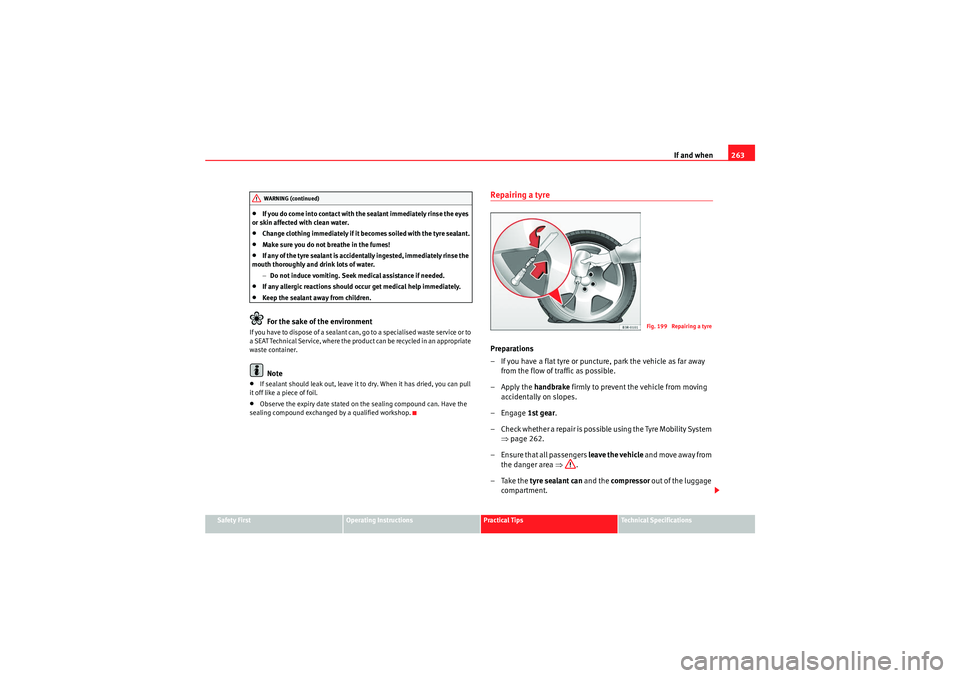
Repairing a tyrePreparations
– If you have a flat tyre or puncture, park the vehicle as far away from the flow of traffic as possible.
–Apply the handbrake firmly to prevent the vehicle from moving
accidentally on slopes.
– Engage 1st gear .
– Check whether a repair is possibl e using the Tyre Mobility System
⇒ page 262.
– Ensure that all passengers leave the vehicle and move away from
the danger area ⇒ .
–Take the tyre sealant can and the compressor out of the luggage
compartment.
WARNING (continued)
Fig. 199 Repairing a tyre
ExeoST_EN.book Seite 263 Freitag, 3. September 2010 11:41 11
Page 267 of 325

If and when265
Safety First
Operating Instructions
Practical Tips
Technical Specifications
Note
•Do not use the compressor for longer than 6 minutes. Otherwise, it might
overheat. When the compressor has cooled down, you can use it again.•If tyre sealant should leak out, leave it to dry and then pull it off like foil.•After carrying out a tyre repair remember to buy a new tyre sealant can at
a qualified workshop. This will ensure that the Tyre Mobility System is opera-
tive again.•Please observe legal requirements when doing so.FusesChanging fuses
If a fuse has blown, it must be replaced.
– Switch off the ignition and its failed electrical component.
– Remove the fuse cover using a screwdriver ⇒fig. 200 .
– Identify the fuse corresponding to the damaged electric consumer ⇒page 266, “Fuse assignment”.
– Take the plastic clip from inside the fuse cover, fit it onto the blown fuse, and pull the fuse out.
– Replace the blown fuse (which will have a melted metal strip) with a new fuse of the same amp rating.
–Fit the fuse cover back on.The individual electrical circuits are protected by fuses. The fuses are located
behind a cover at the left-hand end of the dash panel.
Two spare fuses and a sticker identifying the fuses are provided on the inside
of the fuse cover. There is also a crank handle for operating the sunroof* by
hand (if the electrical system fails).
Fig. 200 Left side of dash
panel: Fuse box cover
Fig. 201 Schematic
drawing of fuse box at the
left-hand end of dash
panel: Fuses (without fuse
cover)
ExeoST_EN.book Seite 265 Freitag, 3. September 2010 11:41 11
Page 269 of 325

If and when267
Safety First
Operating Instructions
Practical Tips
Technical Specifications
Some of the electrical items listed in the table are only fitted on certain
models or are optional extras.
The electric windows and electric seat adjusters are protected by circuit
breakers
. These reset automatically after a few seconds when the overload
(caused for example by frozen windows) has been corrected.
Note
Please note that the above list contains all data at the time of going to press,
so it is subject to modifications. If discrepancies should occur, please refer to
the sticker on the inside of the fuse cover for the correct information for your
model.
BulbsGeneral informationYou can change the following bulbs for exterior lights yourself:•Main headlights: all bulbs (except xenon headlights)•Tail lights: all bulbs•Side turn signal bulb
The following bulbs can only be changed by a qualified workshop:•Main headlights: Xenon* bulb ⇒page 274•Front fog light bulbs
As a rule, you require a certain degree of practical skill to change defective
bulbs. This applies in particular to those bulbs which are only accessible from
the engine compartment.
If in doubt, we recommend that you have defective bulbs changed by a qual-
ified workshop or qualified mechanic.
If you do decide to change bulbs in the engine compartment yourself, be
aware of the safety risks involved ⇒page 229 ⇒ in “Types of bulbs”.Changing bulbs. Halogen headlightsTypes of bulbsYou must only replace a bulb with a bulb of the same type. The name can be
found on the base of the bulb holder.
33
Lighter
20
34
Lambda probe heater
5
35
Luggage compartment power socket*
20
36
Wiper system
30
37
Pump for windscreen washer and headlight washer
system
30
38
Luggage compartment illumination, alarm
15
39
Radio, amplifier
20
40
Horn
25
41
230 volt socket
30
42
Electronic Stability Programme (ESP)
25
43
Engine management
15
44
Seat heating
35
No.
Consumer
Amps
ExeoST_EN.book Seite 267 Freitag, 3. September 2010 11:41 11
Page 271 of 325
If and when269
Safety First
Operating Instructions
Practical Tips
Technical Specifications
–Unscrew bolts ⇒ page 268, fig. 202.
– Detach air duct from guide and take it out.Fitting the air duct
Once the bulb(s) for the right-side headlight have been
changed, the air duct must be re-installed.– Place the air duct in the correct position.
– First turn the two screws in lightly, then tighten both screws.
– Push the air duct into guide .
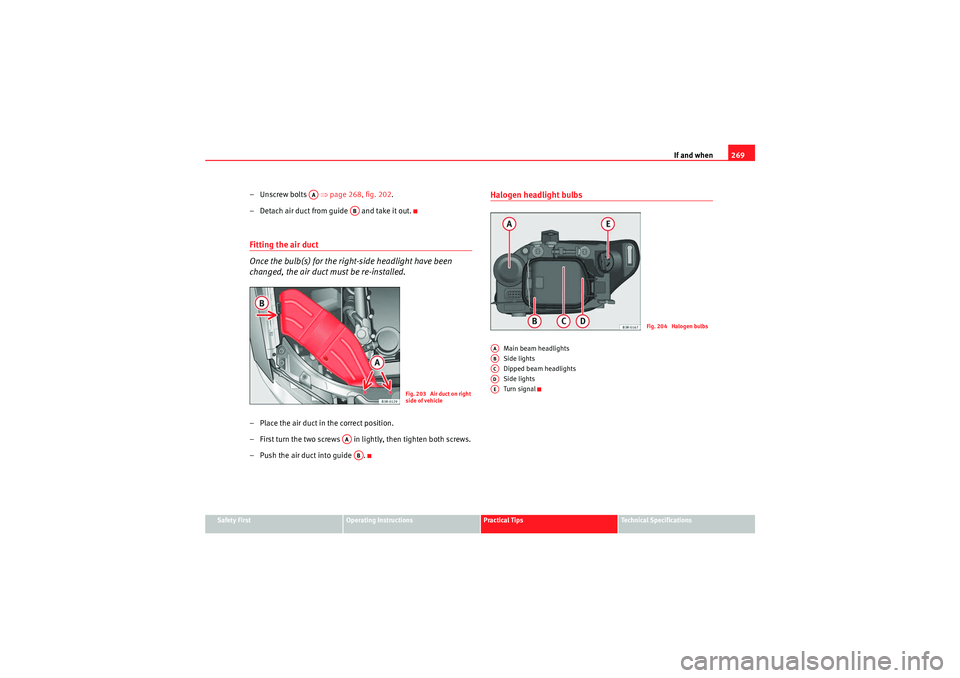
Halogen headlight bulbs
Main beam headlights
Side lights
Dipped beam headlights
Side lights
Turn signal
AA
AB
Fig. 203 Air duct on right
side of vehicle
AAAB
Fig. 204 Halogen bulbs
AAABACADAE
ExeoST_EN.book Seite 269 Freitag, 3. September 2010 11:41 11
Page 273 of 325
If and when271
Safety First
Operating Instructions
Practical Tips
Technical Specifications
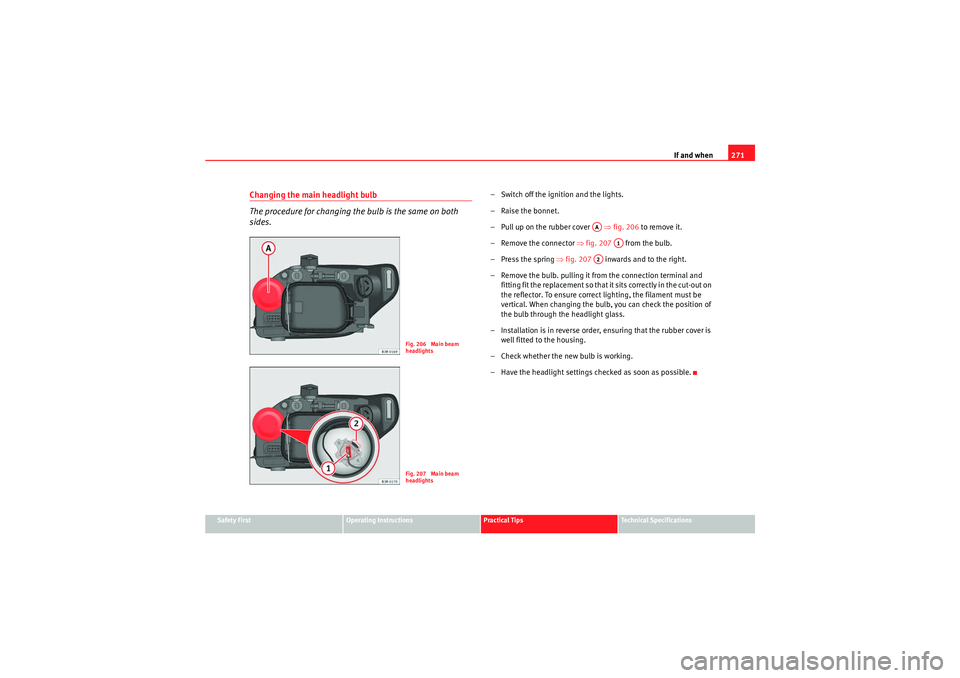
Changing the main headlight bulb
The procedure for changing the bulb is the same on both
sides.
– Switch off the ignition and the lights.
– Raise the bonnet.
– Pull up on the rubber cover ⇒fig. 206 to remove it.
– Remove the connector ⇒fig. 207 from the bulb.
– Press the spring ⇒fig. 207 inwards and to the right.
– Remove the bulb. pulling it from the connection terminal and fitting fit the replacement so that it sits correctly in the cut-out on
the reflector. To ensure correct lighting, the filament must be
vertical. When changing the bulb, you can check the position of
the bulb through the headlight glass.
– Installation is in reverse order, ensuring that the rubber cover is well fitted to the housing.
– Check whether the new bulb is working.
– Have the headlight settings checked as soon as possible.
Fig. 206 Main beam
headlightsFig. 207 Main beam
headlights
AA
A1
A2
ExeoST_EN.book Seite 271 Freitag, 3. September 2010 11:41 11
Page 275 of 325
If and when273
Safety First
Operating Instructions
Practical Tips
Technical Specifications
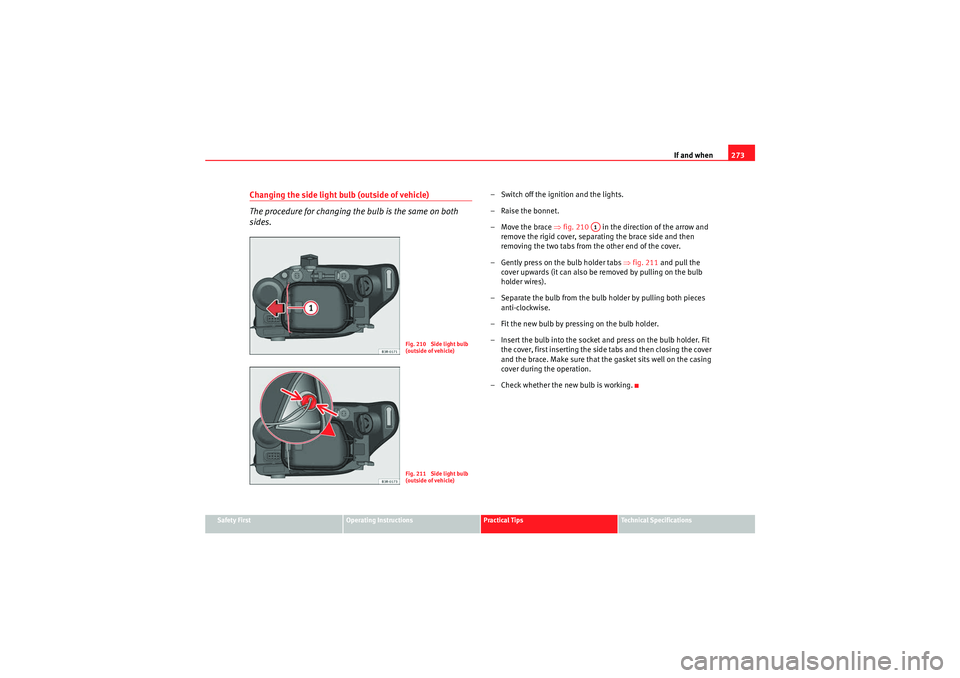
Changing the side light bulb (outside of vehicle)
The procedure for changing the bulb is the same on both
sides.
– Switch off the ignition and the lights.
– Raise the bonnet.
– Move the brace ⇒fig. 210 in the direction of the arrow and
remove the rigid cover, separating the brace side and then
removing the two tabs from the other end of the cover.
– Gently press on the bulb holder tabs ⇒fig. 211 and pull the
cover upwards (it can also be removed by pulling on the bulb
holder wires).
– Separate the bulb from the bulb holder by pulling both pieces anti-clockwise.
– Fit the new bulb by pressing on the bulb holder.
– Insert the bulb into the socket and press on the bulb holder. Fit the cover, first inserting the side tabs and then closing the cover
and the brace. Make sure that the gasket sits well on the casing
cover during the operation.
– Check whether the new bulb is working.
Fig. 210 Side light bulb
(outside of vehicle)Fig. 211 Side light bulb
(outside of vehicle)
A1
ExeoST_EN.book Seite 273 Freitag, 3. September 2010 11:41 11
Page 277 of 325

If and when275
Safety First
Operating Instructions
Practical Tips
Technical Specifications
WARNING
•Take particular care when working on components in the engine
compartment if the engine is warm - risk of burns!•Bulbs are highly sensitive to pressure. The glass can break when you
touch the bulb, causing injury.•The high voltage element of gas discharge bulbs* (xenon light) must be
handled correctly. Otherwise, there is a risk of death.•When changing bulbs, please take care not to injure yourself on sharp
parts in the headlight housing.Caution
•Remove the ignition key before working on the electric system. If not, a
short circuit could occur.•Switch off the lights or parking lights before you change a bulb.For the sake of the environment
Please ask your specialist retailer how to dispose of used bulbs in the proper
manner.
Note
•Depending on weather conditions (cold or wet), the front lights, the fog
lights, the tail lights and the turn signals may be temporarily misted. This has no influence on the useful life of the lighting system. By switching on the
lights, the area through which the beam of light is projected will quickly be
demisted. However, the edges may continue to be misted.
•Please check at regular intervals that all lighting (especially the exterior
lighting) on your vehicle is functioning pr operly. This is not only in the interest
of your own safety, but also in that of all other road users.•Before changing a bulb, make sure you have the correct new bulb.•Do not touch the glass part of the bulb with your bare hands, use a cloth
or paper towel instead. Otherwise, the fingerprints left on the glass will
vaporise as a result of the heat generated by the bulb, be deposited on the
reflector and impair its surface.Removing the air duct
The air duct has to be removed to gain access to the bulbs for
the right-side headlight.
Bulb
Type
Xenon bulbs
12 V/35 W (D1S)
DRL (day light)
12 V/21 W (P21W SLL)
Turn signal
12 V/21 W (PY21W)
Side lights
12 V/5 W (W5W blue LL)
Fig. 214 Air duct on right
side of vehicle
ExeoST_EN.book Seite 275 Freitag, 3. September 2010 11:41 11
Page 279 of 325
If and when277
Safety First
Operating Instructions
Practical Tips
Technical Specifications
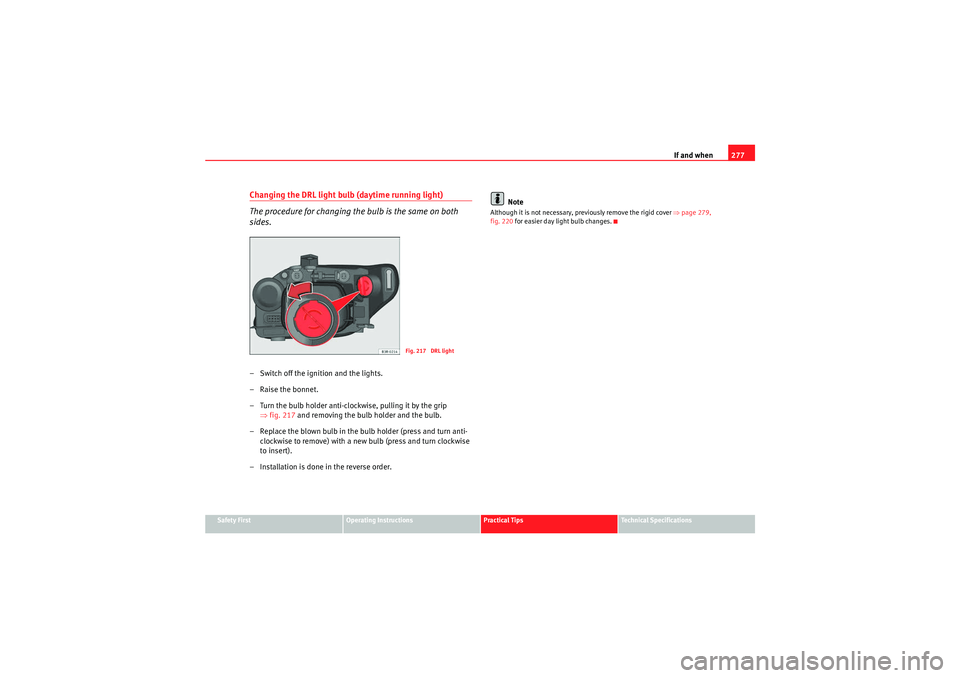
Changing the DRL light bulb (daytime running light)
The procedure for changing the bulb is the same on both
sides.– Switch off the ignition and the lights.
– Raise the bonnet.
– Turn the bulb holder anti-clockwise, pulling it by the grip
⇒fig. 217 and removing the bulb holder and the bulb.
– Replace the blown bulb in the bulb holder (press and turn anti- clockwise to remove) with a new bulb (press and turn clockwise
to insert).
– Installation is done in the reverse order. Note
Although it is not necessary, previously remove the rigid cover
⇒page 279,
fig. 220 for easier day light bulb changes.
Fig. 217 DRL light
ExeoST_EN.book Seite 277 Freitag, 3. September 2010 11:41 11
Page 281 of 325
If and when279
Safety First
Operating Instructions
Practical Tips
Technical Specifications
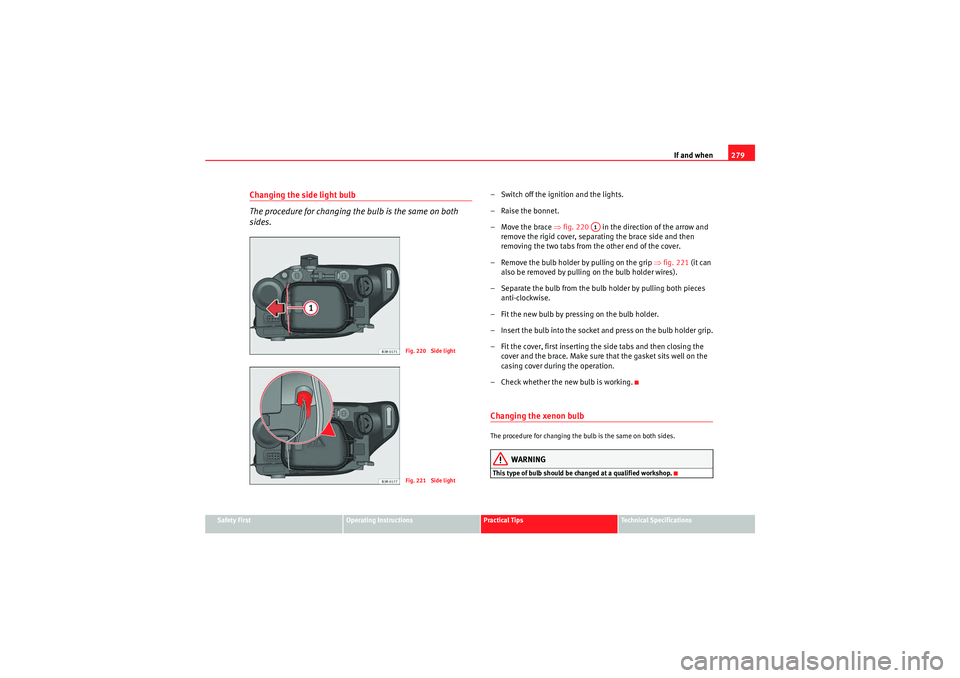
Changing the side light bulb
The procedure for changing the bulb is the same on both
sides.
– Switch off the ignition and the lights.
– Raise the bonnet.
– Move the brace ⇒fig. 220 in the direction of the arrow and
remove the rigid cover, separating the brace side and then
removing the two tabs from the other end of the cover.
– Remove the bulb holder by pulling on the grip ⇒fig. 221 (it can
also be removed by pulling on the bulb holder wires).
– Separate the bulb from the bulb holder by pulling both pieces anti-clockwise.
– Fit the new bulb by pressing on the bulb holder.
– Insert the bulb into the socket and press on the bulb holder grip.
– Fit the cover, first inserting the side tabs and then closing the cover and the brace. Make sure that the gasket sits well on the
casing cover during the operation.
– Check whether the new bulb is working.Changing the xenon bulbThe procedure for changing the bulb is the same on both sides.
WARNING
This type of bulb should be changed at a qualified workshop.
Fig. 220 Side lightFig. 221 Side light
A1
ExeoST_EN.book Seite 279 Freitag, 3. September 2010 11:41 11