ignition Seat Exeo ST 2011 Manual Online
[x] Cancel search | Manufacturer: SEAT, Model Year: 2011, Model line: Exeo ST, Model: Seat Exeo ST 2011Pages: 319, PDF Size: 5.12 MB
Page 241 of 319
239
Checking and refilling levels
WARNING (Continued)
● A highly explosive mixture of gases is released when the battery is
under charge. The batteries should be charged in a well-ventilated room
only.
● Keep children away from acid and batteries.
● Before working on the electrical system, you must switch off the en-
gine, the ignition and all consumers. The negative cable on the battery
must be disconnected. When a light bulb is changed, you need only
switch off the light.
● Deactivate the anti-theft alarm by unlocking the vehicle before you
disconnect the battery! The alarm will otherwise be triggered.
● When disconnecting the battery from the vehicle electrical system,
disconnect first the negative cable and then the positive cable.
● Switch off all electrical consumers before reconnecting the battery.
Reconnect first the positive cable and then the negative cable. Never re-
verse the polarity of the connections. This could cause an electrical fire.
● Never charge a frozen battery, or one which has thawed. This could
result in explosions and chemical burns. Always replace a battery which
has frozen. A flat battery can freeze at temperatures around 0 °C.
● Ensure that the vent hose is always connected to the battery.
● Never use a defective battery. This could cause an explosion. Replace
a damaged battery immediately.
CAUTION
● Never disconnect the battery if the ignition is switched on or if the en-
gine is running. This could damage the electrical system or electronic com-
ponents.
● Do not expose the battery to direct sunlight over a long period of time,
as the intense ultraviolet radiation can damage the battery housing.
● If the vehicle is left standing in cold conditions for a long period, protect
the battery from freezing. If it freezes it will be damaged. Charging the battery
A fully-charged battery is important for reliable starting.
– Note the warnings ⇒
in Important safety warnings for han-
dling a vehicle battery on page 238 and ⇒ .
– Switch off the ignition and all electrical equipment.
– Only if fast-charging: both battery cables must be disconnected
(first the negative cable, then the positive cable).
– Connect the charger cables to the battery terminals, noting the
colour code (red = positive; black or brown = negative).
– Now connect the battery charger to the power socket and switch
on.
– After charging the battery: switch off the battery charger and
disconnect the power point cable.
– Finally disconnect the charger cables from the battery.
– If necessary, reconnect both battery cables to the battery (first
the positive cable, then the negative cable).
When charging with a low current (for instance with a small battery charger)
the battery does not normally have to be disconnected. However, both bat-
tery cables must be disconnected before fast-charging the battery with a
high current. However, always follow the instructions given by the manufac-
turer of the battery charger.
The fast-charging procedure for a battery is dangerous ⇒
in Important
safety warnings for handling a vehicle battery on page 238, as it requires a
special charger and the corresponding level of knowledge. We therefore rec-
ommend that this work should only be performed by a qualified workshop.
Safety FirstOperating InstructionsPractical TipsTechnical Specifications
Page 246 of 319
244Wheels and tyres
Tyre pressure warning lamp on
When you switch on the ignition, the tyre pressure warning lamp will
light up for about 2 seconds. There is a fault in the system if the indicator
stays on permanently after switching on the ignition. The instrument panel
also display TMPS (Tyre Pressure Monitoring System). Please contact the
nearest qualified workshop as soon as possible.
The tyre pressure warning lamp lights up if the tyre pressure on one or
more wheels is significantly lower than the tyre pressure setting which was
confirmed by the driver ⇒
.
WARNING
● If the tyre pressure warning lamp lights up you must slow down
immediately and avoid any severe braking or steering manoeuvres. Stop
the vehicle as soon as possible and check the tyres and their pressure.
● The driver is responsible for maintaining correct tyre pressures.
Therefore, the tyre pressure must be regularly checked.
● Under certain conditions (e.g. driving at high speeds, on ice and snow
or on poor road surfaces) the tyre pressure warning lamp may not light
up immediately or not at all.
● Please ask your Dealer or qualified workshop whether run-flat tyres
can be used on your vehicle. Fitting this type of tyre in an undue manner
could lead to your driving licence being taken away from you. Further-
more, it may led to damage to the vehicle or, under certain circumstan-
ces, may cause accidents.
● If you change normal tyres for run-flat tyres or vice versa, the control
unit must be reprogrammed by the Dealer or a qualified workshop.
Note
If you did not press the button for the tyre pressure monitoring system to
confirm a new tyre pressure setting after making changes to the tyre pres-
sures or changing one or more wheels, the warning lamp may light up
although the tyre pressures are correct. In this case, stop the vehicle as
soon as possible and, after examining the tyres, press the button for the
tyre pressure monitoring system.
Page 264 of 319
262If and when
Fuses
Changing fuses
If a fuse has blown, it must be replaced.
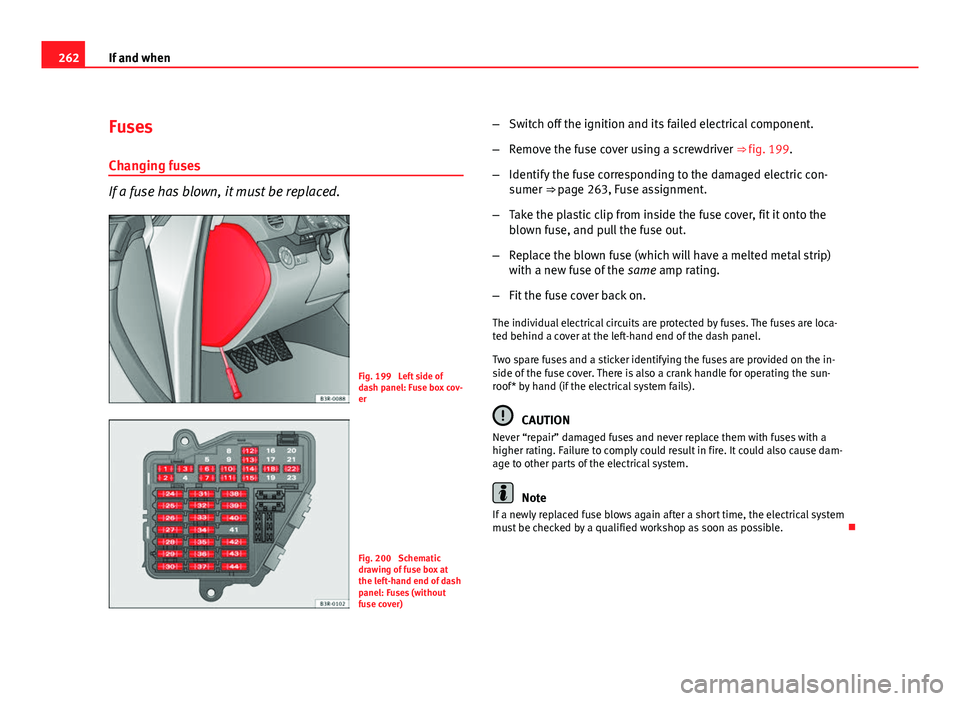
Fig. 199 Left side of
dash panel: Fuse box cov-
er
Fig. 200 Schematic
drawing of fuse box at
the left-hand end of dash
panel: Fuses (without
fuse cover) –
Switch off the ignition and its failed electrical component.
– Remove the fuse cover using a screwdriver ⇒ fig. 199.
– Identify the fuse corresponding to the damaged electric con-
sumer ⇒ page 263, Fuse assignment.
– Take the plastic clip from inside the fuse cover, fit it onto the
blown fuse, and pull the fuse out.
– Replace the blown fuse (which will have a melted metal strip)
with a new fuse of the same amp rating.
– Fit the fuse cover back on.
The individual electrical circuits are protected by fuses. The fuses are loca-
ted behind a cover at the left-hand end of the dash panel.
Two spare fuses and a sticker identifying the fuses are provided on the in-
side of the fuse cover. There is also a crank handle for operating the sun-
roof* by hand (if the electrical system fails).
CAUTION
Never “repair” damaged fuses and never replace them with fuses with a
higher rating. Failure to comply could result in fire. It could also cause dam-
age to other parts of the electrical system.
Note
If a newly replaced fuse blows again after a short time, the electrical system
must be checked by a qualified workshop as soon as possible.
Page 267 of 319
265
If and when
Changing bulbs. Halogen headlights Types of bulbs
You must only replace a bulb with a bulb of the same type. The name can be
found on the base of the bulb holder.
BulbTypeDipped beam headlights (halogen)12 V/55 W (H7 LL)Main beam headlights12 V/55 W (H1)Turn signal12 V/21 W (PY21W)Side lights12 V/5 W (W5W LL)
WARNING
● Take particular care when working on components in the engine com-
partment if the engine is warm - risk of burns!
● Bulbs are highly sensitive to pressure. The glass can break when you
touch the bulb, causing injury.
● The high voltage element of gas discharge bulbs* (xenon light) must
be handled correctly. Otherwise, there is a risk of death.
● When changing bulbs, please take care not to injure yourself on sharp
parts in the headlight housing.
CAUTION
● Remove the ignition key before working on the electric system. If not, a
short circuit could occur.
● Switch off the lights or parking lights before you change a bulb.
For the sake of the environment
Please ask your specialist retailer how to dispose of used bulbs in the prop-
er manner.
Note
● Depending on weather conditions (cold or wet), the front lights, the fog
lights, the tail lights and the turn signals may be temporarily misted. This
has no influence on the useful life of the lighting system. By switching on
the lights, the area through which the beam of light is projected will quickly
be demisted. However, the edges may continue to be misted.
● Please check at regular intervals that all lighting (especially the exterior
lighting) on your vehicle is functioning properly. This is not only in the inter-
est of your own safety, but also in that of all other road users.
● Before changing a bulb, make sure you have the correct new bulb.
● Do not touch the glass part of the bulb with your bare hands, use a cloth
or paper towel instead. Otherwise, the fingerprints left on the glass will va-
porise as a result of the heat generated by the bulb, be deposited on the
reflector and impair its surface.
Safety FirstOperating InstructionsPractical TipsTechnical Specifications
Page 269 of 319
267
If and when
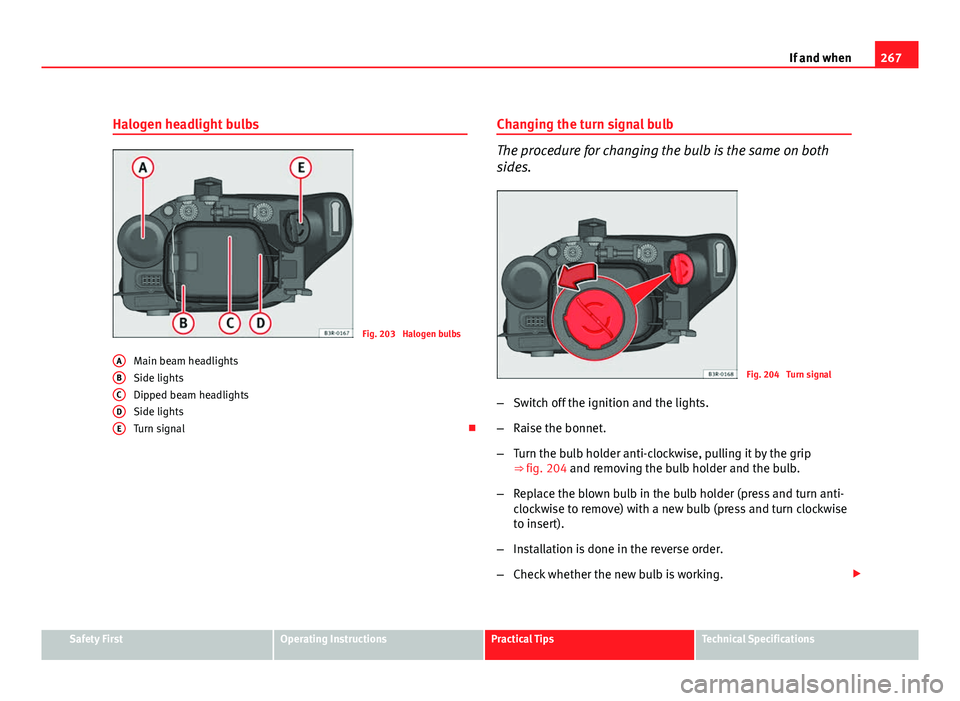
Halogen headlight bulbs
Fig. 203 Halogen bulbs
Main beam headlights
Side lights
Dipped beam headlights
Side lights
Turn signal
A
BCDE
Changing the turn signal bulb
The procedure for changing the bulb is the same on both
sides.
Fig. 204 Turn signal
– Switch off the ignition and the lights.
– Raise the bonnet.
– Turn the bulb holder anti-clockwise, pulling it by the grip
⇒ fig. 204 and removing the bulb holder and the bulb.
– Replace the blown bulb in the bulb holder (press and turn anti-
clockwise to remove) with a new bulb (press and turn clockwise
to insert).
– Installation is done in the reverse order.
– Check whether the new bulb is working.
Safety FirstOperating InstructionsPractical TipsTechnical Specifications
Page 270 of 319
268If and when
Note
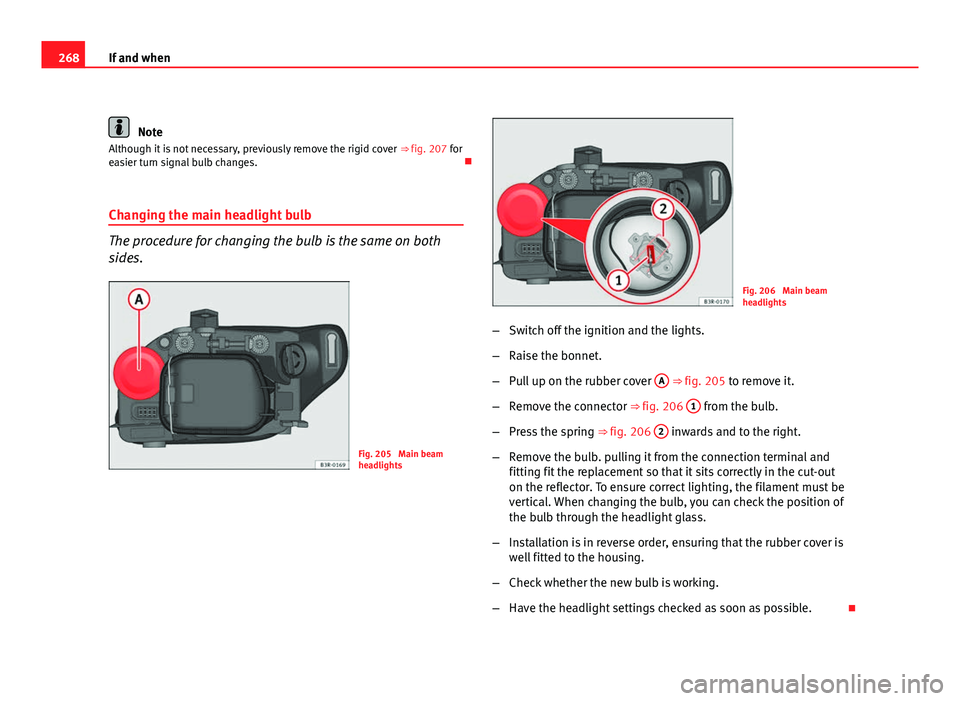
Although it is not necessary, previously remove the rigid cover ⇒ fig. 207 for
easier turn signal bulb changes.
Changing the main headlight bulb
The procedure for changing the bulb is the same on both
sides.
Fig. 205 Main beam
headlights
Fig. 206 Main beam
headlights
– Switch off the ignition and the lights.
– Raise the bonnet.
– Pull up on the rubber cover A
⇒ fig. 205 to remove it.
– Remove the connector ⇒ fig. 206 1
from the bulb.
– Press the spring ⇒ fig. 206 2
inwards and to the right.
– Remove the bulb. pulling it from the connection terminal and
fitting fit the replacement so that it sits correctly in the cut-out
on the reflector. To ensure correct lighting, the filament must be
vertical. When changing the bulb, you can check the position of
the bulb through the headlight glass.
– Installation is in reverse order, ensuring that the rubber cover is
well fitted to the housing.
– Check whether the new bulb is working.
– Have the headlight settings checked as soon as possible.
Page 271 of 319
269
If and when
Changing the dipped beam headlight bulb
The procedure for changing the bulb is the same on both
sides.
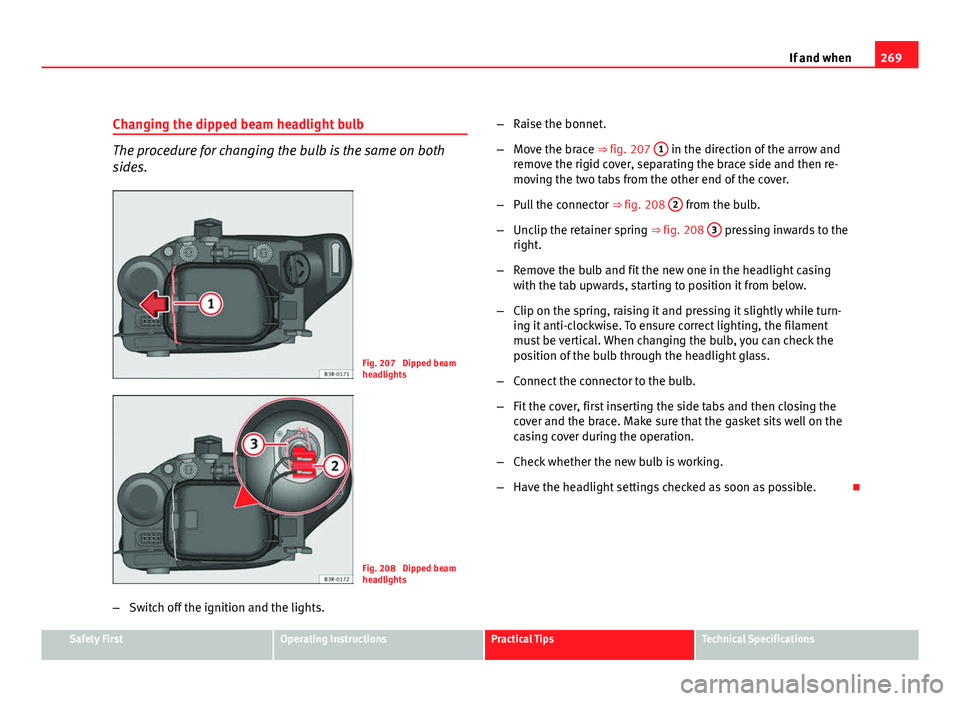
Fig. 207 Dipped beam
headlights
Fig. 208 Dipped beam
headlights
– Switch off the ignition and the lights. –
Raise the bonnet.
– Move the brace ⇒ fig. 207 1
in the direction of the arrow and
remove the rigid cover, separating the brace side and then re-
moving the two tabs from the other end of the cover.
– Pull the connector ⇒ fig. 208 2
from the bulb.
– Unclip the retainer spring ⇒ fig. 208 3
pressing inwards to the
right.
– Remove the bulb and fit the new one in the headlight casing
with the tab upwards, starting to position it from below.
– Clip on the spring, raising it and pressing it slightly while turn-
ing it anti-clockwise. To ensure correct lighting, the filament
must be vertical. When changing the bulb, you can check the
position of the bulb through the headlight glass.
– Connect the connector to the bulb.
– Fit the cover, first inserting the side tabs and then closing the
cover and the brace. Make sure that the gasket sits well on the
casing cover during the operation.
– Check whether the new bulb is working.
– Have the headlight settings checked as soon as possible.
Safety FirstOperating InstructionsPractical TipsTechnical Specifications
Page 272 of 319
270If and when
Changing the side light bulb (outside of vehicle)
The procedure for changing the bulb is the same on both
sides.
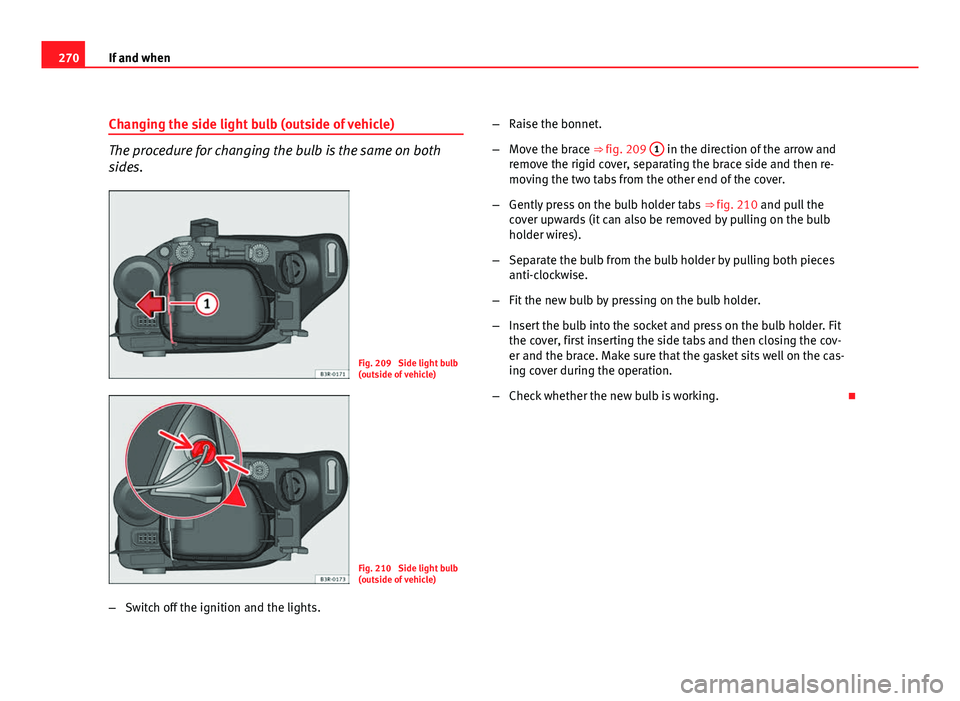
Fig. 209 Side light bulb
(outside of vehicle)
Fig. 210 Side light bulb
(outside of vehicle)
– Switch off the ignition and the lights. –
Raise the bonnet.
– Move the brace ⇒ fig. 209 1
in the direction of the arrow and
remove the rigid cover, separating the brace side and then re-
moving the two tabs from the other end of the cover.
– Gently press on the bulb holder tabs ⇒ fig. 210 and pull the
cover upwards (it can also be removed by pulling on the bulb
holder wires).
– Separate the bulb from the bulb holder by pulling both pieces
anti-clockwise.
– Fit the new bulb by pressing on the bulb holder.
– Insert the bulb into the socket and press on the bulb holder. Fit
the cover, first inserting the side tabs and then closing the cov-
er and the brace. Make sure that the gasket sits well on the cas-
ing cover during the operation.
– Check whether the new bulb is working.
Page 273 of 319
271
If and when
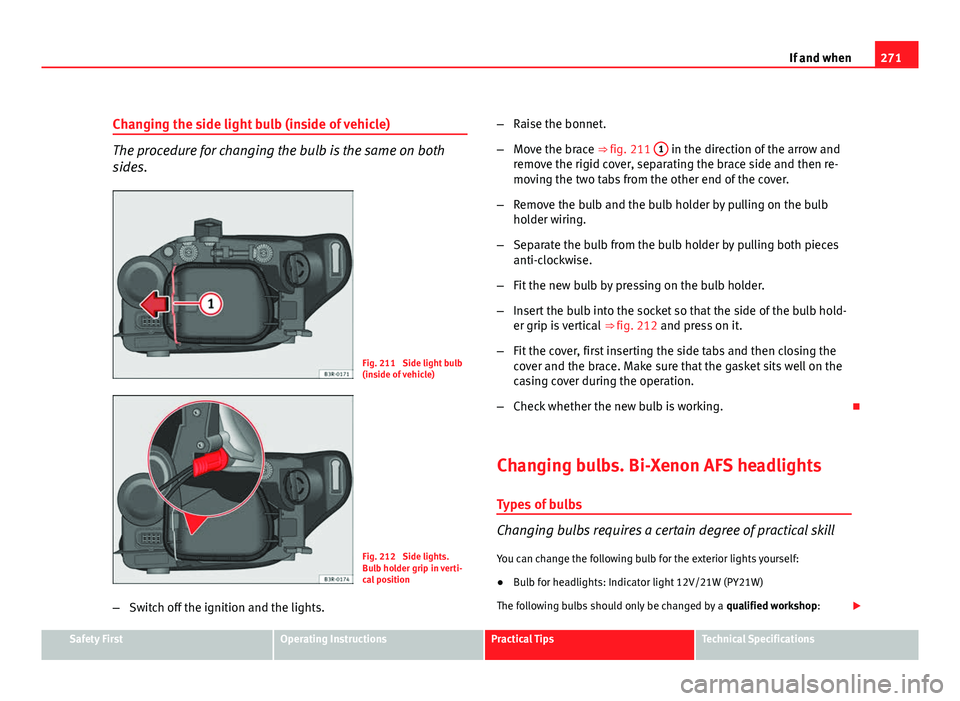
Changing the side light bulb (inside of vehicle)
The procedure for changing the bulb is the same on both
sides.
Fig. 211 Side light bulb
(inside of vehicle)
Fig. 212 Side lights.
Bulb holder grip in verti-
cal position
– Switch off the ignition and the lights. –
Raise the bonnet.
– Move the brace ⇒ fig. 211 1
in the direction of the arrow and
remove the rigid cover, separating the brace side and then re-
moving the two tabs from the other end of the cover.
– Remove the bulb and the bulb holder by pulling on the bulb
holder wiring.
– Separate the bulb from the bulb holder by pulling both pieces
anti-clockwise.
– Fit the new bulb by pressing on the bulb holder.
– Insert the bulb into the socket so that the side of the bulb hold-
er grip is vertical ⇒ fig. 212 and press on it.
– Fit the cover, first inserting the side tabs and then closing the
cover and the brace. Make sure that the gasket sits well on the
casing cover during the operation.
– Check whether the new bulb is working.
Changing bulbs. Bi-Xenon AFS headlights Types of bulbs
Changing bulbs requires a certain degree of practical skill
You can change the following bulb for the exterior lights yourself:
● Bulb for headlights: Indicator light 12V/21W (PY21W)
The following bulbs should only be changed by a qualified workshop:
Safety FirstOperating InstructionsPractical TipsTechnical Specifications
Page 274 of 319
272If and when
● Main headlight lamps: Xenon ⇒
lights.
● Sources of the DRL (daylight) light unit and position.
WARNING
● Take particular care when working on components in the engine com-
partment if the engine is warm - risk of burns!
● Bulbs are highly sensitive to pressure. The glass can break when you
touch the bulb, causing injury.
● The high voltage element of gas discharge bulbs* (xenon light) must
be handled correctly. Otherwise, there is a risk of death.
● When changing bulbs, please take care not to injure yourself on sharp
parts in the headlight housing.
CAUTION
● Remove the ignition key before working on the electric system. If not, a
short circuit could occur.
● Switch off the lights or parking lights before you change a bulb.
For the sake of the environment
Please ask your specialist retailer how to dispose of used bulbs in the prop-
er manner.
Note
● Depending on weather conditions (cold or wet), the front lights, the fog
lights, the tail lights and the turn signals may be temporarily misted. This
has no influence on the useful life of the lighting system. By switching on
the lights, the area through which the beam of light is projected will quickly
be demisted. However, the edges may continue to be misted.
● Please check at regular intervals that all lighting (especially the exterior
lighting) on your vehicle is functioning properly. This is not only in the inter-
est of your own safety, but also in that of all other road users. ●
Before changing a bulb, make sure you have the correct new bulb.
● Do not touch the glass part of the bulb with your bare hands, use a cloth
or paper towel instead. Otherwise, the fingerprints left on the glass will va-
porise as a result of the heat generated by the bulb, be deposited on the
reflector and impair its surface.
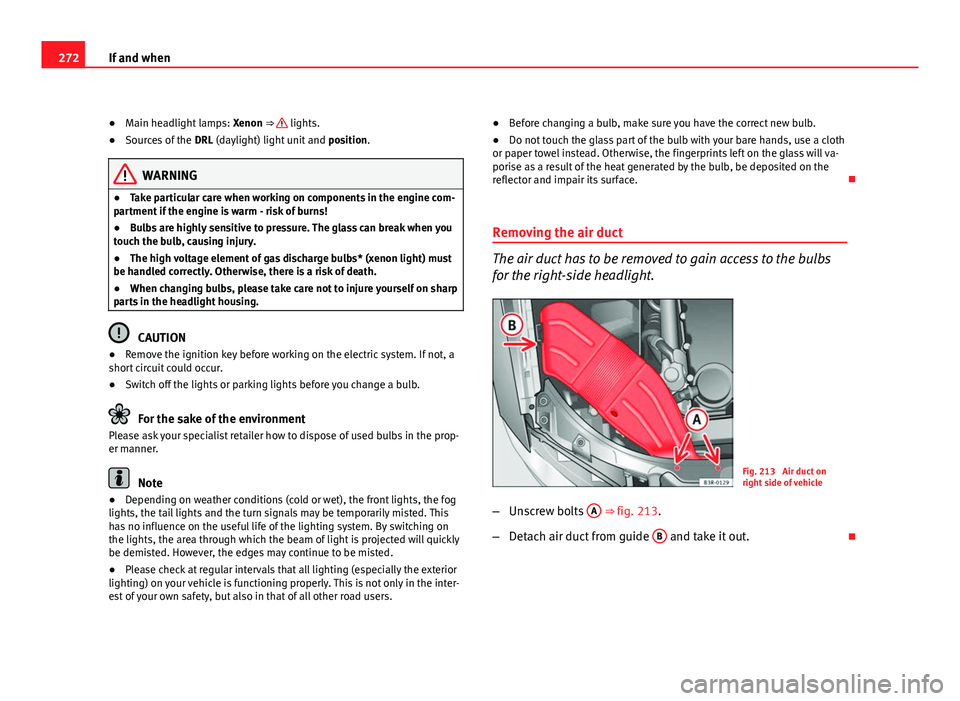
Removing the air duct
The air duct has to be removed to gain access to the bulbs
for the right-side headlight.
Fig. 213 Air duct on
right side of vehicle
– Unscrew bolts A
⇒ fig. 213.
– Detach air duct from guide B
and take it out.