engine oil Seat Ibiza 5D 2005 User Guide
[x] Cancel search | Manufacturer: SEAT, Model Year: 2005, Model line: Ibiza 5D, Model: Seat Ibiza 5D 2005Pages: 252, PDF Size: 7.56 MB
Page 161 of 252
Cleaning and caring for your vehicle159
Safety First
Operating instructions
Tips and Maintenance
Te c h n i c a l D a t a
Cleaning the engine compartment
Take special care when cleaning the engine compartment.Anti-corrosion treatment
The engine compartment and the surface of the power unit are given anti-
corrosion treatment at the factory.
Good corrosion protection is particularly important in winter when the car is
frequently driven on salted roads. To prevent the salt corroding the vehicle,
the entire engine compartment should be thoroughly cleaned before and
after the salting period.
Your Authorised Service Centre is able to provide the correct cleaning and
preserving products and has the necessary equipment. For this reason, we
recommend having this work performed by them.
The anti-corrosion protection is usua lly removed if the engine compartment
is cleaned with grease removing solution s, or if you have the engine cleaned.
If this job is carried out, you should ensure that all surfaces, seams, joints and
components in the engine compartmen t are given anti-corrosion treatment
afterwards.
WARNING
•
When working in the engine compartment, always observe the safety
warnings ⇒ page 169.
•
Switch off the engine, apply the parking brake firmly and always
remove the key from the ignition before you open the bonnet.
•
Allow the engine to cool before you clean the engine compartment.
•
Do not clean the underside of vehicle, wheel arches without protecting
your hands and arms. You may cut your self on sharp-edged metal parts.
Failure to comply could result in injury.
•
Moisture, ice and salt on the brakes may affect braking efficiency. Risk
of accident. If possible, avoid sudden braking immediately after washing
the vehicle.
•
Never touch the radiator fan. It is temperature-controlled and could
start automatically, even when the key is removed from the ignition!For the sake of the environment
Fuel, grease and oil deposits could be removed when the engine is washed.
The polluted water must be cleaned in an oil separator. For this reason,
engine washing should be carried out only by a qualified workshop or a suit-
able filling station.Care of the vehicle interiorCleaning plastic parts and the dash panel– Use a clean, damp cloth to clean plastic parts and the dash panel.
– If this does not provide satisfactory results, use a special solvent-free plastic cleaning product.
WARNING
Never clean the dash panel and surface of the airbag module with cleansers
containing solvents. Solvents cause the surface to become porous. If the
airbag inflates, disintegrating plastic parts can cause substantial injuries.
WARNING (continued)
ibiza_ingles Seite 159 Mittwoch, 5. Oktober 2005 5:17 17
Page 171 of 252
Checking and refilling levels169
Safety First
Operating instructions
Tips and Maintenance
Te c h n i c a l D a t a
Winter driving
Diesel can thicken in winter.Winter-grade diesel
When using “summer-grade diesel fuel”, difficulties may be experienced at
temperatures below 0
° because the fuel thickens due to paraffin separation.
For this reason, “winter-grade diesel fuel” is available in some countries
during the cold months. It can be used at temperatures as low as -22
° C.
In countries with different climatic cond itions the diesel fuel sold generally
has different temperature characteristics. Check with an Authorised Service
Centre or filling stations in the country concerned regarding the type of diesel
fuels available.
Filter pre-heater
Your vehicle is fitted with a filter fuel pre-heater, making it well equipped for
operation in winter. This ensures that the fuel system remains operational to
approx. -24
°C, provided you use winter-grade diesel which is safe to -15
°C .
However, if the fuel has waxed to such an extent that the engine will not start
at temperatures of under -24
° C, simply place the vehicle in a warm room for
a while.
Caution
Do not mix fuel additives (“thinners”, or similar additives) with diesel fuel.
Working in the engine compartmentSafety instructions on working in the engine compartment
Any work carried out in the engine compartment or on the
engine must be carried out cautiously.Before starting any work on the engine or in the engine compart-
ment:
1. Switch off the engine and remove the key from the ignition.
2. Apply the handbrake.
3. Move the gear stick to neutral or the selector lever to position P.
4. Wait for the engine to cool down.
5. Keep children away from the vehicle.
6. Raise the bonnet ⇒page 171.You should not do any work in the engine compartment unless you know
exactly how to carry out the jobs and have the correct tools! Have the work
carried out by a qualified workshop if you are uncertain.
All service fluids and consumables, e.g. coolant, engine oil, spark plugs and
batteries, are being constantly developed. SEAT provides a constant flow of
information to the Authorised Service Centres concerning modifications. For
this reason we recommend that you have service fluids and consumables
replaced by an Authorised Service Centre. Please observe the relevant
instructions ⇒page 162. The engine compartment of any motor vehicle is a
hazardous area ⇒ .
ibiza_ingles Seite 169 Mittwoch, 5. Oktober 2005 5:17 17
Page 173 of 252
Checking and refilling levels171
Safety First
Operating instructions
Tips and Maintenance
Te c h n i c a l D a t a
For the sake of the environment
Service fluids leaks are harmful to the environment. For this reason you
should make regular checks on the ground underneath your vehicle. If you
find spots of oil or other fluids, have your vehicle inspected in a qualified
workshop.Opening the bonnet
The bonnet is released from inside the vehicle.Before opening the bonnet ensure that the windscreen wipers are in
rest position.
– To release the bonnet, pull the lever under the dashboard ⇒fig. 120 in the direction indicated (arrow). The bonnet will be
released by a spring action ⇒. – Lift the bonnet using the rele
ase lever (arrow) and open the
bonnet.
– Release the bonnet stay and secure it in fixture designed for this in the bonnet.
WARNING
Hot coolant can scald!•
Never open the bonnet if you see steam, smoke or coolant escaping
from the engine compartment.
•
Wait until no more steam, smoke or coolant is emitted from the bonnet,
then carefully open the bonnet.
•
When working in the engine compartm ent, always observe the safety
warnings ⇒page 169
Closing the bonnet– Raise the bonnet slightly
– Release the bonnet stay and replace it in its support.
– At a height of about 30 cm let it fall so it is locked.If the bonnet does not close, do not pr ess downwards. Open it once more and
let it fall as before.
WARNING
If the bonnet is not closed properly, it could open while you are driving and
completely obscure your view of the road. Risk of accident.
Fig. 120 Arrester hook
for bonnet.
ibiza_ingles Seite 171 Mittwoch, 5. Oktober 2005 5:17 17
Page 174 of 252
Checking and refilling levels
172•
After closing the bonnet, always check that it is properly secured. The
bonnet must be flush with the surrounding body panels.
•
If you notice that the bonnet latch is not secured when the vehicle is
moving, stop the vehicle immediately and close the bonnet properly. Risk
of accident.
Engine oilEngine oil specifications
The engine used must conform to exact specifications.Specifications
The engine comes with a special, high quality, multi grade oil that can be
used in all seasons of the year except for those regions affected by extreme
cold.
As the use of good qualit y oil is necessary for the correct operation and long
service life of the engine, when it be comes necessary to replenish or change
the oil, always use an oil that complies to the VW standards.
If it is not possible to find oil conforming to the VW standards then oil
conforming to the ACEA or API standards with an appropriate viscosity at
atmospheric temperature should be used instead. The use of this type of oil
may have some repercussions on the performance of the engine for example,
long starting time, increased consumption and a higher emission level.
If a top up is required then different oils may be mixed as long as they all
conform to the VW standards.
The specifications (VW standards) set out in the following page should
appear on the container of the service oil; the container will display together the different standards for petrol and diesel engines, the oil can be used for
both types of engines.
WARNING (continued)
ibiza_ingles Seite 172 Mittwoch, 5. Oktober 2005 5:17 17
Page 175 of 252
Checking and refilling levels173
Safety First
Operating instructions
Tips and Maintenance
Te c h n i c a l D a t a
Oil properties
Viscosity
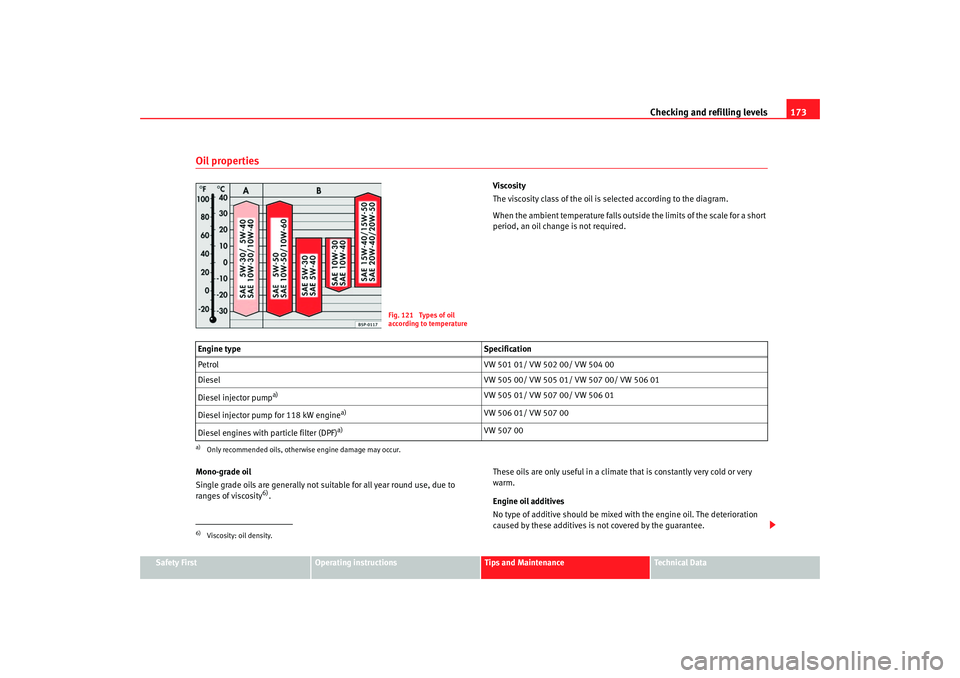
The viscosity class of the oil is selected according to the diagram.
When the ambient temperature falls outside the limits of the scale for a short
period, an oil change is not required.
Mono-grade oil
Single grade oils are generally not suitable for all year round use, due to
ranges of viscosity
6). These oils are only useful in a climate that is constantly very cold or very
warm.
Engine oil additives
No type of additive should be mixed with the engine oil. The deterioration
caused by these additives is not covered by the guarantee.
Fig. 121 Types of oil
according to temperature
Engine type
Specification
Petrol VW 501 01/ VW 502 00/ VW 504 00
Diesel VW 505 00/ VW 505 01/ VW 507 00/ VW 506 01
Diesel injector pump
a)
a)Only recommended oils, otherw ise engine damage may occur.
VW 505 01/ VW 507 00/ VW 506 01
Diesel injector pump for 118 kW engine
a)
VW 506 01/ VW 507 00
Diesel engines with particle filter (DPF)
a)
VW 507 00
6)Viscosity: oil density.
ibiza_ingles Seite 173 Mittwoch, 5. Oktober 2005 5:17 17
Page 176 of 252
Checking and refilling levels
174
NoteBefore a long trip, we recommend findin g an engine oil that conforms to the
corresponding VW specifications and keeping it in the vehicle. This way, the
correct engine oil will always be available for a top-up if needed.Checking the engine oil level
The engine oil dipstick indicates the level of the oil.Before opening the bonnet, read and observe the warnings ⇒ in
“Safety instructions on working in the engine compartment” on
page 169 .
– Park the vehicle on an even surface.
– After stopping the engine, wait a few minutes for the oil to drain back into the sump. –Raise the bonnet ⇒
page 171.
– Pull out the dipstick.
– Wipe the dipstick with a cloth and insert it again, pushing it in as far as it will go.
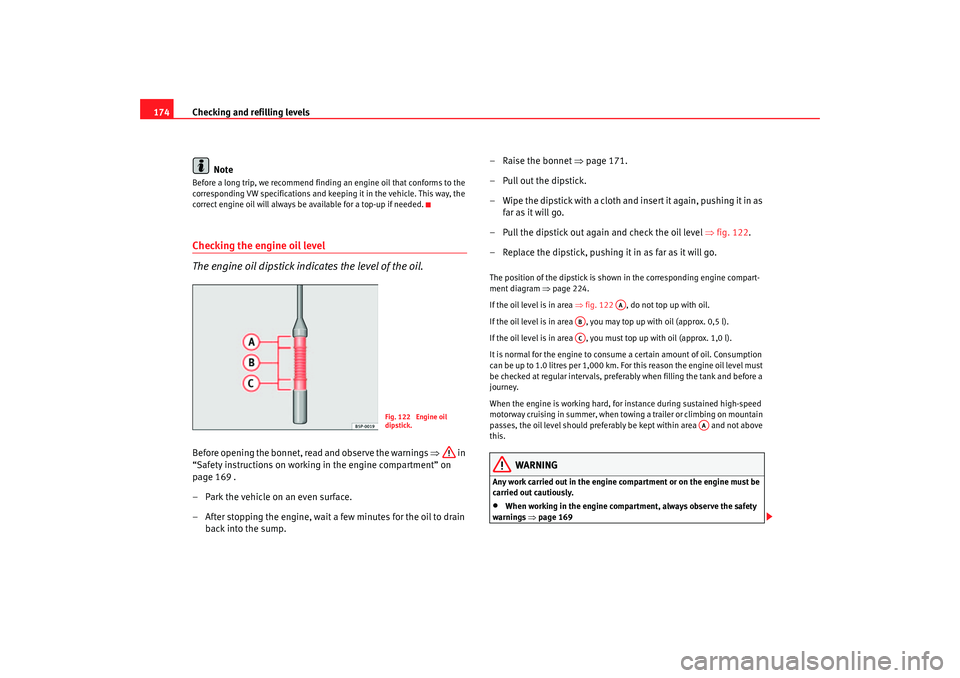
– Pull the dipstick out again and check the oil level ⇒fig. 122 .
– Replace the dipstick, pushing it in as far as it will go.
The position of the dipstick is show n in the corresponding engine compart-
ment diagram ⇒page 224.
If the oil level is in area ⇒fig. 122 , do not top up with oil.
If the oil level is in area , you may top up with oil (approx. 0,5 l).
If the oil level is in area , you mu st top up with oil (approx. 1,0 l).
It is normal for the engine to consum e a certain amount of oil. Consumption
can be up to 1.0 litres per 1,000 km. For this reason the engine oil level must
be checked at regular intervals, preferably when filling the tank and before a
journey.
When the engine is working hard, for instance during sustained high-speed
motorway cruising in summer, when towing a trailer or climbing on mountain
passes, the oil level should preferably be kept within area and not above
this.
WARNING
Any work carried out in the engine compartment or on the engine must be
carried out cautiously.•
When working in the engine compartment, always observe the safety
warnings ⇒page 169
Fig. 122 Engine oil
dipstick.
AA
ABAC
AA
ibiza_ingles Seite 174 Mittwoch, 5. Oktober 2005 5:17 17
Page 177 of 252
Checking and refilling levels175
Safety First
Operating instructions
Tips and Maintenance
Te c h n i c a l D a t a
Caution
If the oil level is above the area do not start the engine. This could result
in damage to the engine and catalytic converter. Contact an Authorised
Service Centre.Topping up engine oil
Top up gradually with small quantities of oil.Before opening the bonnet, read and observe the warnings ⇒ in
“Safety instructions on working in the engine compartment” on
page 169 .
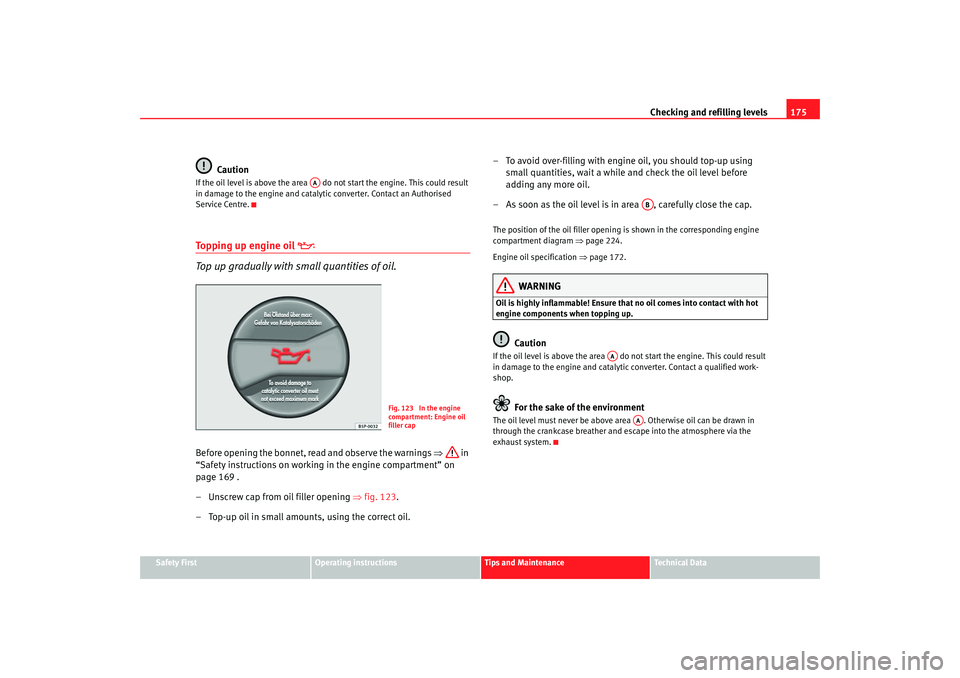
– Unscrew cap from oil filler opening ⇒ fig. 123.
– Top-up oil in small amounts, using the correct oil. – To avoid over-filling with engine oil, you should top-up using
small quantities, wait a while and check the oil level before
adding any more oil.
– As soon as the oil level is in area , carefully close the cap.
The position of the oil filler openi ng is shown in the corresponding engine
compartment diagram ⇒page 224.
Engine oil specification ⇒page 172.
WARNING
Oil is highly inflammable! Ensure that no oil comes into contact with hot
engine components when topping up.
Caution
If the oil level is above the area do not start the engine. This could result
in damage to the engine and catalytic converter. Contact a qualified work-
shop.
For the sake of the environment
The oil level must never be above area . Otherwise oil can be drawn in
through the crankcase breather and escape into the atmosphere via the
exhaust system.
AA
Fig. 123 In the engine
compartment: Engine oil
filler cap
AB
AA
AA
ibiza_ingles Seite 175 Mittwoch, 5. Oktober 2005 5:17 17
Page 178 of 252
Checking and refilling levels
176Changing engine oil
The engine oil must be changed at the intervals given in the
service schedule.We recommend that you have the engine oil changed by an Authorised
Service Centre.
The two different oil change intervals are shown in the ⇒Booklet “Service
schedule”.
WARNING
Only change the oil yourself if you have the specialist knowledge required!•
Before opening the bonnet, read and observe the warnings
⇒ page 169, “Safety instructions on working in the engine compartment”
.
•
Wait for the engine to cool down. Hot oil may cause burn injuries.
•
Wear eye protection to avoid injuries caused by splashes of oil.
•
When removing the oil drain plug with your fingers, keep your arm hori-
zontal to help prevent oil from running down your arm.
•
Wash your skin thoroughly if it comes into contact with engine oil.
•
Engine oil is poisonous! Used oil must be stored in a safe place out of
the reach of children until it is disposed of.Caution
No additives should be used with engine oil. This could result in engine
damage. Any damage caused by the use of such additives would not be
covered by the factory warranty.
For the sake of the environment
•
Because of the disposal problems, the necessary special tools and
specialist knowledge required, we recommend that you have the engine oil
and filter changed by an Authorised Service Centre.
•
Never pour oil down drains or into the ground.
•
Use a suitable container when draining the used oil. It has the be large
enough to hold all the engine oil
CoolantCoolant specifications
Coolant is a mixture of water and at least 40% coolant addi-
tive.The cooling system must be filled with a mixture of water and at least 40 % of
our coolant additive G 12+ or an additi ve with the specification TT-VW 774 F
(it is dyed purple). This mixture gives the necessary frost protection down to
-25
°C and protects the alloy parts of the cooling system against corrosion. It
also prevents scaling and raises the boiling point of the coolant.
The concentration of coolant must always be at least 40% - even if frost
protection is not required.
If greater frost protection is required in very cold climates, the proportion of
the antifreeze additive G 12+ can be increased. However, the percentage of
coolant additives should not exceed 60%, as this would reduce the frost
protection. It would also reduce the cooling effect. A mixture with 60%
coolant additive will give frost protection to approx. -40
°C.
ibiza_ingles Seite 176 Mittwoch, 5. Oktober 2005 5:17 17
Page 184 of 252
Checking and refilling levels
182Brake fluidChecking the brake fluid level
The brake fluid is checked at the intervals given in the service
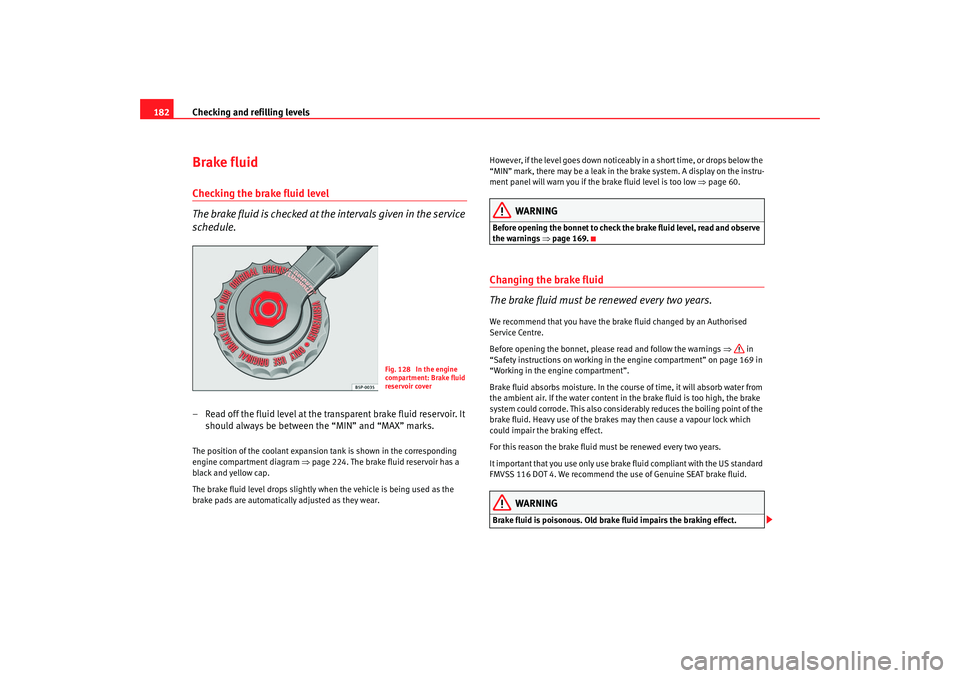
schedule.– Read off the fluid level at the transparent brake fluid reservoir. It
should always be between the “MIN” and “MAX” marks.The position of the coolant expansion tank is shown in the corresponding
engine compartment diagram ⇒page 224. The brake fluid reservoir has a
black and yellow cap.
The brake fluid level drops slightly when the vehicle is being used as the
brake pads are automatically adjusted as they wear. However, if the level goes down noticeab
ly in a short time, or drops below the
“MIN” mark, there may be a leak in the brake system. A display on the instru-
ment panel will warn you if the brake fluid level is too low ⇒page 60.
WARNING
Before opening the bonnet to check the brake fluid level, read and observe
the warnings ⇒page 169.Changing the brake fluid
The brake fluid must be renewed every two years.We recommend that you have the brake fluid changed by an Authorised
Service Centre.
Before opening the bonnet, please read and follow the warnings ⇒ in
“Safety instructions on working in the engine compartment” on page 169 in
“Working in the engine compartment”.
Brake fluid absorbs moisture. In the cour se of time, it will absorb water from
the ambient air. If the water content in the brake fluid is too high, the brake
system could corrode. This also consider ably reduces the boiling point of the
brake fluid. Heavy use of the brakes may then cause a vapour lock which
could impair the braking effect.
For this reason the brake fluid must be renewed every two years.
It important that you use only use brake fluid compliant with the US standard
FMVSS 116 DOT 4. We recommend the use of Genuine SEAT brake fluid.
WARNING
Brake fluid is poisonous. Old brake fluid impairs the braking effect.
Fig. 128 In the engine
compartment: Brake fluid
reservoir cover
ibiza_ingles Seite 182 Mittwoch, 5. Oktober 2005 5:17 17
Page 201 of 252
If and when199
Safety First
Operating instructions
Tips and Maintenance
Te c h n i c a l D a t a
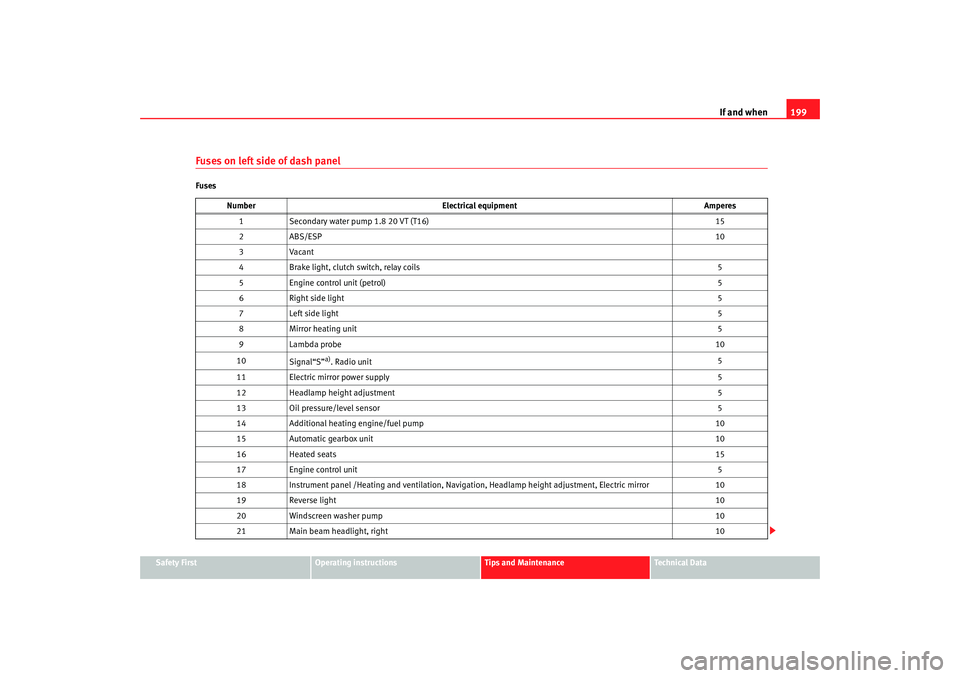
Fuses on left side of dash panelFuses
Number Electrical equipment Amperes
1 Secondary water pump 1.8 20 VT (T16) 15
2A BS/E S P 10
3 Vacant
4 Brake light, clutch switch, relay coils 5
5 Engine control unit (petrol) 5
6 Right side light 5
7 Left side light 5
8 Mirror heating unit 5
9 Lambda probe 10
10 Signal“S”
a). Radio unit 5
11 Electric mirror power supply 5
12 Headlamp height adjustment 5
13 Oil pressure/level sensor 5
14 Additional heating engine/fuel pump 10
15 Automatic gearbox unit 10
16 Heated seats 15
17 Engine control unit 5
18 Instrument panel /Heating and ventilation, Navigation, Headlamp height adjustment, Electric mirror 10
19 Reverse light 10
20 Windscreen washer pump 10
21 Main beam headlight, right 10
ibiza_ingles Seite 199 Mittwoch, 5. Oktober 2005 5:17 17