ECO mode Seat Ibiza 5D 2005 Owner's manual
[x] Cancel search | Manufacturer: SEAT, Model Year: 2005, Model line: Ibiza 5D, Model: Seat Ibiza 5D 2005Pages: 252, PDF Size: 7.56 MB
Page 60 of 252
Cockpit
58Display field for selector lever position*The position of the automatic gearbox selector lever is shown on the display
⇒ page 130.Mileage display or Service Interval DisplayDistance display
The upper counter in the display registers the total distance covered by the
vehicle.
The lower counter registers the short journeys. The last digit indicates steps
of 100 metres. The trip recorder counter may be reset by the reset button
⇒ page 52, fig. 32 . Service interval display
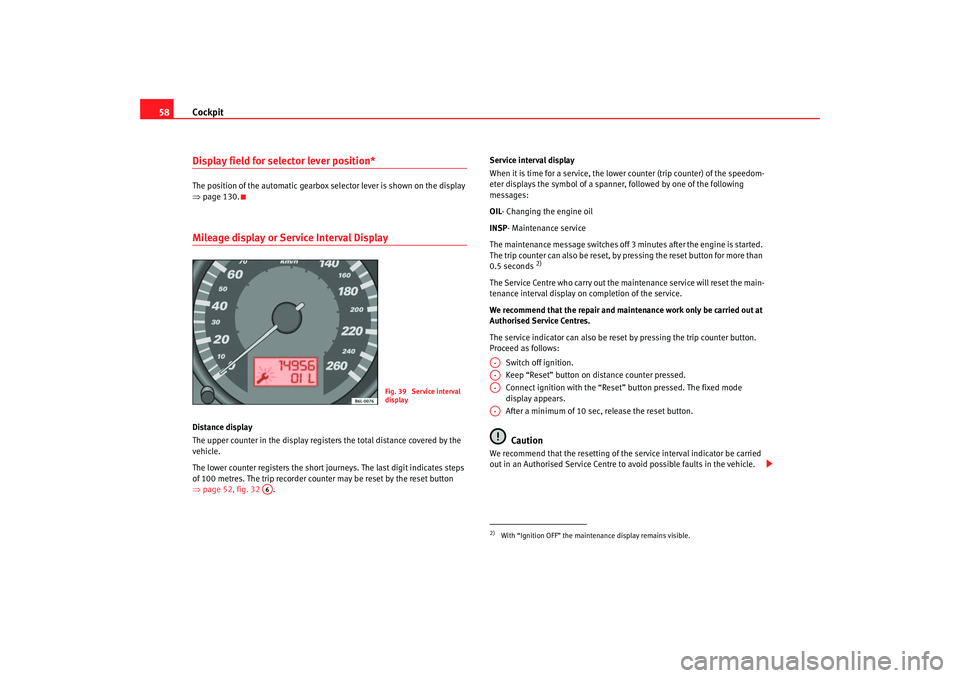
When it is time for a service, the lower counter (trip counter) of the speedom-
eter displays the symbol of a spanner, followed by one of the following
messages:
OIL
- Changing the engine oil
INSP- Maintenance service
The maintenance message switches off 3 minutes after the engine is started.
The trip counter can also be reset, by pressing the reset button for more than
0.5 seconds
2)
The Service Centre who carry out the maintenance service will reset the main-
tenance interval display on completion of the service.
We recommend that the repair and main tenance work only be carried out at
Authorised Service Centres.
The service indicator can also be reset by pressing the trip counter button.
Proceed as follows:
Switch off ignition.
Keep “Reset” button on distance counter pressed.
Connect ignition with the “Reset” button pressed. The fixed mode
display appears.
After a minimum of 10 sec, release the reset button.
Caution
We recommend that the resetting of the service interval indicator be carried
out in an Authorised Service Centre to avoid possible faults in the vehicle.
Fig. 39 Service interval
display
A6
2)With “Ignition OFF” the mainte nance display remains visible.A-A-A-A-
ibiza_ingles Seite 58 Mittwoch, 5. Oktober 2005 5:17 17
Page 120 of 252
Air conditioning
118Cooling system
When the cooling system is switched on, not only the temperature, but also
the air humidity in the vehicle interior is reduced. This improves comfort for
the vehicle occupants and prevents misting of the windows when the outside
air humidity is high.
If the cooling system cannot be switched on this may be due to the following
reasons:•
the engine is not running.
•
The blower is switched off.
•
The outside temperature is lower than approx. +5°C.
•
the cooling system compressor has been temporarily switched off
because the engine coolant temperature is too high.
•
The air conditioner fuse is faulty.
•
Another fault in the vehicle. Have the air conditioner checked by a quali-
fied workshop.
Air recirculation
Air recirculation mode prevents fumes or unpleasant smells
from entering the vehicle.When air recirculation mode is switched on (button ⇒page 117, fig. 89
with warning lamp) strong odours in the outside air do not enter the vehicle
interior, for example when passing through a tunnel or in queuing traffic.
When the outside temperature is low, using air recirculation mode provides
more effective heating by heating air from the vehicle interior instead of cold
air from outside.
When the outside temperature is high, using air recirculation mode provides
more effective cooling by cooling air from the vehicle interior instead of warm
air from outside. For reasons of safety, air recirculation is
not possible when the control for air
distribution is set to the windscreen setting
.
WARNING
In air recirculation mode, no ambient air enters the vehicle interior. If the
air conditioning system is switched off, the windows can quickly mist over.
Therefore, you should never leave the air recirculation mode switched on
for longer periods, as this increases the risk of an accident.
Note
When reverse gear is engaged the air recirculation connects automatically to
prevent the entrance of exhaust fumes in the vehicle on travelling backwards.
The control light on the button does not light up.Economic use of the air conditioningWhen the air conditioning is switched on, the compressor consumes engine
power and has an effect on fuel consumption. Observe the following points
in order to have the equipment operating for a short a time as possible.•
If the vehicle interior has overheated due to excessive solar radiation, it is
best to open the windows or doors to allow the hot air to escape.
•
When travelling the air conditioning should not be switched on if the
windows or sun roof are open.*
ibiza_ingles Seite 118 Mittwoch, 5. Oktober 2005 5:17 17
Page 121 of 252
Air conditioning119
Safety First
Operating instructions
Tips and Maintenance
Te c h n i c a l D a t a
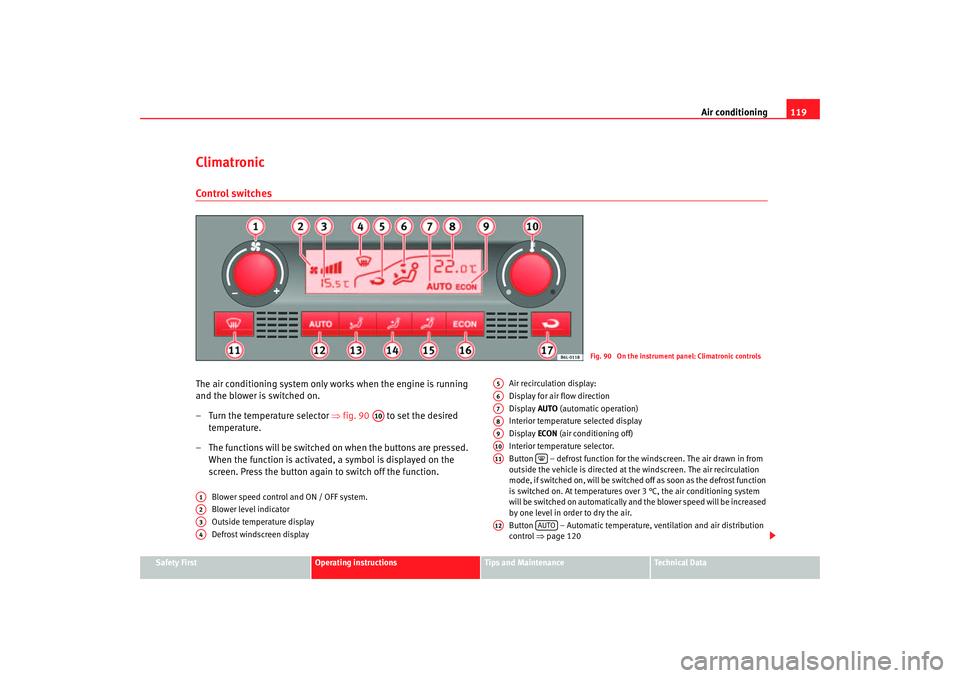
ClimatronicControl switchesThe air conditioning system only works when the engine is running
and the blower is switched on.
– Turn the temperature selector ⇒ fig. 90 to set the desired
temperature.
– The functions will be switched on when the buttons are pressed. When the function is activated, a symbol is displayed on the
screen. Press the button again to switch off the function.
Blower speed control and ON / OFF system.
Blower level indicator
Outside temperature display
Defrost windscreen display Air recirculation display:
Display for air flow direction
Di
sp lay AU TO (auto
mati
c operation)
Interior temperature selected display
Di sp lay ECON (air c
onditio
ning off)
Interior temperature selector.
Button – defrost function for the windscreen. The air drawn in from
outside the vehicle is directed at the windscreen. The air recirculation
mode, if switched on, will be switched off as soon as the defrost function
is switched on. At temperatures over 3 °C, the air conditioning system
will be switched on automatically and the blower speed will be increased
by one level in order to dry the air.
Button – Automatic temperature, ventilation and air distribution
control ⇒page 120
Fig. 90 On the instrument panel: Climatronic controls
A10
A1A2A3A4
A5A6A7A8A9A10A11
A12
AUTO
ibiza_ingles Seite 119 Mittwoch, 5. Oktober 2005 5:17 17
Page 122 of 252
Air conditioning
120
Button – Air distribution to footwell
Button – Air distribution to the upper body.
Button – Air distribution to head
Button – To connect economic mode. When the button light is on,
the air conditioning is disconnected to save fuel.
Button – Manual air recirculation modeWARNING
For your safety, the windows should never be fogged up or covered with
snow or ice. This is essential to ensure good visibility. Please familiarize
yourself with the correct operation of the heating and ventilation system,
including the demist/defrost functions for the windows.
Note
Please observe the general notes .Automatic mode
In automatic mode air temperature, flow, and distribution are
automatically regulated so that a specified temperature is
attained as quickly as possible and then maintained.Switching on automatic mode
– Press the button . The display is visible ⇒page 119,
fig. 90 .
– Turn the temperature selector to set the desired temperature
inside the vehicle. We recommend 22°C (72°F).
A comfortable interior climate is quickly reached when a temperature of
+22° C (72° F) is set in automatic mode. It can be changed as necessary to
suit individual preferences or particular circumstances. It is possible to select
interior temperatures from +18° C (64° F) to +29° C (86° F). If a lower or higher
temperature is selected, LO or HI is displayed on the screen. These are
approximate temperatures and the actual temperature may be slightly higher
or lower depending on the outside conditions.
Climatronic maintains a constant temperature level fully automatically. The
temperature of the air supplied to the interior, the blower speed and the air
distribution are regulated automatically. The system also allows for the effect
of strong sunlight, so there is no need for manual adjustment. Therefore,
automatic mode provides the best comfort for the vehicle occupants in virtu-
ally all conditions throughout the year.
Automatic mode is switched off whenever an adjustment is made using the
buttons for the air distribution, blower or . The temperature continues
to be regulated.Manual mode
In manual mode you can adjust the air temperature, flow, and
distribution yourself.Switching on manual mode
– Press one of the buttons ⇒page 119, fig. 90 to , or turn
the blower control . The display is switched off .Temperature
It is possible to select interior temperatures from +18° C (64° F) to +29° C
(86° F). These are approximate temperatures and the actual temperature may
be slightly higher or lower depending on the outside conditions.
A13
A14
A15
A16
ECON
A17
AUTO
A7
ECON
A13
A15
A1
A7
ibiza_ingles Seite 120 Mittwoch, 5. Oktober 2005 5:17 17
Page 123 of 252
Air conditioning121
Safety First
Operating instructions
Tips and Maintenance
Te c h n i c a l D a t a
If a temperature below 18°
C (64° F) is selected, the display switches to LO. In
this setting the system runs at maximum cooling output and the temperature
is not regulated.
If a temperature above 29°C (86 F) is selected the display switches to HI. In
this setting the system runs at maximum heating output and the temperature
is not controlled.
Blower
The blower can be infinitely adjusted with the blower control . Always have
the blower running at a low setting to ensure a constant flow of fresh air into
the vehicle. If the blower is switched off (no level displayed ) and the
control is turned further to the left, the Cl imatronic is switched off. In this case
OFF appears on the screen.
Air distribution
The air distribution is adjusted using the buttons , and . It is also
possible to open and close some of the air outlets separately.
Switching the cooling system on and off
Pressing the button switches off the cooling system to save fuel. The
temperature continues to be regulated. The set temperature can then only be
reached if it is higher than the outside temperature.
Air recirculation mode
Air recirculation mode prevents fumes or unpleasant smells
from entering the vehicle.– Press the button to switch air recirculation mode on or off. This is ON if the symbol
⇒ page 119, fig. 90 is displayed
on the screen.
Air recirculation mode prevents strong odours in the ambient air from
entering the vehicle interior, for example when passing through a tunnel or in
queuing traffic.
When the outside temperature is low, using air recirculation mode provides
more effective heating by heating air from the vehicle interior instead of cold
air from outside.
When the outside temperature is high, using air recirculation mode provides
more effective cooling by cooling air from the vehicle interior instead of warm
air from outside.
For reasons of safety, air recirculation is not possible when the control for air
distribution is set to the windscreen setting
.
WARNING
In air recirculation mode, no ambient air enters the vehicle interior. If the
air conditioning system is switched off, the windows can quickly mist over.
Therefore, you should never leave the air recirculation mode switched on
for longer periods, as this increases the risk of an accident.
Note
When reverse gear is engaged the air recirculation connects automatically to
prevent the entrance of exhaust fumes in the vehicle on travelling backwards.
In this case the symbol for air recirculation is not displayed.General notesThe pollution filter
The pollution filter (a combined particle filter and active carbon filter) serves
as a barrier against impurities in the ambient air, including dust and pollen.
A1A2
ECON
A5
ibiza_ingles Seite 121 Mittwoch, 5. Oktober 2005 5:17 17
Page 124 of 252
Air conditioning
122For the air conditioning system to work with maximum efficiency, the pollu-
tion filter must be replaced at the intervals specified in the Service Schedule.
If the filter loses efficiency prematurely due to use in areas with very high
levels of air pollution, the pollution filter must be changed more frequently
than stated in the Service Schedule.
Caution
•
If you suspect that the air conditioner is damaged, switch off the air condi-
tioner with button to prevent further damage and have it checked by a
qualified workshop.
•
Repairs to the air conditioning system require specialist knowledge and
special tools. Therefore, we recommend that you take the vehicle to a quali-
fied workshop should problems occur.Note
•
If the humidity and temperature outside the vehicle are high, condensa-
tion can drip off the evaporator in the cooling system and form a pool under-
neath the vehicle, this is completely normal and there is no need to suspect
a leak.
•
Keep the air intake slots in front of the windscreen free of snow, ice and
leaves to ensure heating and cooling is not impaired, and to prevent the
windows misting over.
•
The air from the vents flows through the passenger compartment and is
extracted by slots designed for this purpose. Do not cover these slots with
articles of clothing or other objects.
•
The air conditioning system operates most effectively with the windows
and the sliding/tilting roof* closed. However, if the sun has heated up the
vehicle, the air inside can be cooled more quickly by opening the windows for
a short period.
•
Do not smoke while air recirculation mode is on, as smoke drawn into the
air conditioning system leaves a residue on the evaporator, producing a
permanent unpleasant odour.
•
At low outside temperatures the compressor switches off automatically.
The button cannot be switched on either.
•
It is advidable to connect the air cond itioning at least once a month, to
lubricate the system gaskets and prevent leaks. If a decrease in the cooling
capacity is detected, an Authorised Service Centre should be consulted to
check the system.
•
For correct operation of the system, do not block the grille between the button and the button
.
•
When the engine is under extreme strain, switch off the compressor for a
moment.
ECON
AUTO
AUTO
ibiza_ingles Seite 122 Mittwoch, 5. Oktober 2005 5:17 17
Page 131 of 252
Driving129
Safety First
Operating instructions
Tips and Maintenance
Te c h n i c a l D a t a
Caution
If the engine has been driven hard for a long period, the engine could over-
heat when it is switched off. Risk of engine damage. For this reason, you
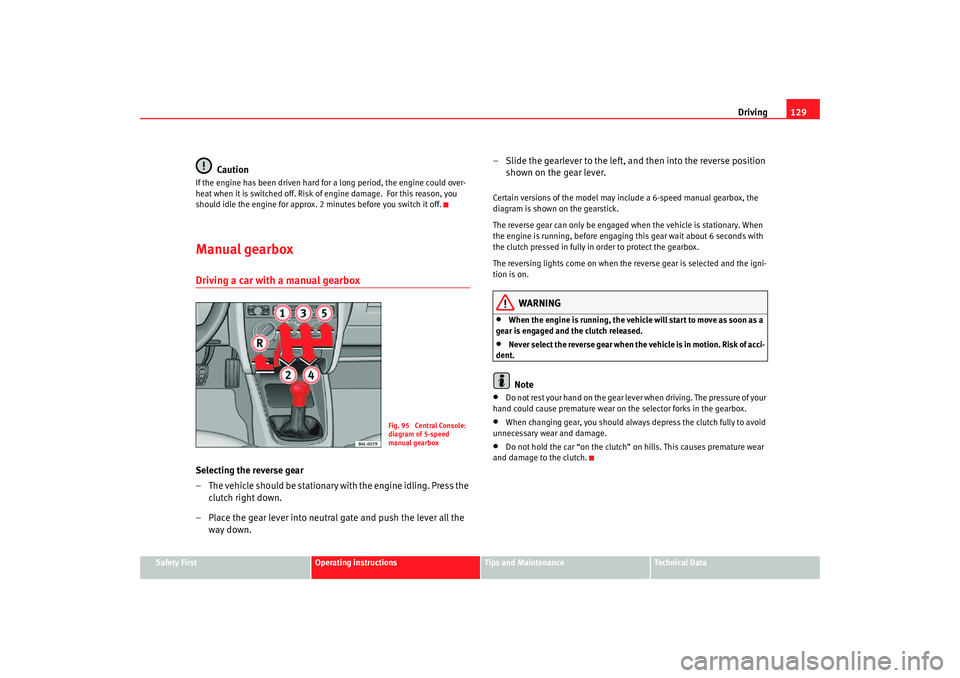
should idle the engine for approx. 2 minutes before you switch it off.Manual gearboxDriving a car with a manual gearboxSelecting the reverse gear
– The vehicle should be stationary with the engine idling. Press the
clutch right down.
– Place the gear lever into neutral gate and push the lever all the way down. – Slide the gearlever to the left, an
d then into the reverse position
shown on the gear lever.
Certain versions of the model may include a 6-speed manual gearbox, the
diagram is shown on the gearstick.
The reverse gear can only be engaged when the vehicle is stationary. When
the engine is running, before engaging this gear wait about 6 seconds with
the clutch pressed in fully in order to protect the gearbox.
The reversing lights come on when the reverse gear is selected and the igni-
tion is on.
WARNING
•
When the engine is running, the vehicle will start to move as soon as a
gear is engaged and the clutch released.
•
Never select the reverse gear when the vehicle is in motion. Risk of acci-
dent.Note
•
Do not rest your hand on the gear lever when driving. The pressure of your
hand could cause premature wear on the selector forks in the gearbox.
•
When changing gear, you should always depress the clutch fully to avoid
unnecessary wear and damage.
•
Do not hold the car “on the clutch” on hills. This causes premature wear
and damage to the clutch.
Fig. 95 Central Console:
diagram of 5-speed
manual gearbox
ibiza_ingles Seite 129 Mittwoch, 5. Oktober 2005 5:17 17
Page 152 of 252
Driving and the environment
150Connectors
Your vehicle is fitted with a 12-pin connector for the electrical connection
between the trailer and the vehicle.
If the trailer has a 7-pin plug you will need to use an adapter cable. This is
available from any Technical Service.
Trailer weight / draw bar loading
Never exceed the authorised towing limit. If you do not load the trailer up to
the maximum permitted tr ailer weight, you can then climb correspondingly
steeper gradients.
The maximum trailer weights listed are only applicable for altitudes up to
1,000 m above sea level. With increasing altitude the engine power and
therefore the vehicle's climbing ability are impaired because of the reduced
air density. The maximum trailer weight has to be reduced accordingly. The
weight of the vehicle and trailer combination must be reduced by 10% for
every further 1,000m (or part thereof). The gross combination weight is the
actual weight of the laden vehicle plus the actual weight of the laden trailer.
Where possible, operate the trailer with the maximum permitted draw bar
weight on the ball joint of the towing bracket, but do not exceed the specified
limit.
The figures for trailer weights and draw bar weights that are given on the
data plate of the towing bracket are for certification purposes only. The
correct figures for your specific model, which may be lower than these figures
for the towing bracket, are given in the registration documents and
⇒ Section “Technical data”.
Distributing the load
Distribute loads in the trailer so that heavy objects are as near to the axle as
possible. Loads carried in the trailer must be secured to prevent them
moving. Tyre pressure
Set tyre pressure to the maximum permissible pressure shown on the sticker
on the inside of the fuel tank flap. Set the tyre pressure of the trailer tyres in
accordance with the trailer manufacturer's recommendations.
Exterior mirrors
Check whether you can see enough of the road behind the trailer with the
standard mirrors. If this is not the case you should have additional mirrors
fitted. Both exterior mirrors shoul
d be mounted on hinged extension
brackets. Adjust the mirrors to give sufficient vision to the rear.
WARNING
Never transport people in a trailer. This could result in fatal accidents.
Note
•
Towing a trailer places additional demands on the vehicle. We recom-
mend additional services between the normal inspection intervals if the
vehicle is used frequently for towing a trailer.
•
Find out whether special regulations apply to towing a trailer in your
country.
Ball coupling of towing bracket*
The ball coupling of the towing bracket is located in the tool
boxThe ball coupling is provided with inst ructions on fitting and removing the
ball coupling of the towing bracket.
ibiza_ingles Seite 150 Mittwoch, 5. Oktober 2005 5:17 17
Page 190 of 252
Checking and refilling levels
188
WARNING
There is a serious danger of accidents if a tyre bursts during driving!•
The tyres must be replaced at the latest when the tread is worn down to
the tread wear indicators. Failure to do so could result in an accident. Worn
tyres do not grip well at high speeds on wet roads. There is also a greater
risk of “aquaplaning”.
•
At continuously high speeds, a tyre with insufficient pressure flexes
more. This causes it to overheat. This can cause tread separation and tyre
blow-out. Risk of accident. Always observe the recommended tyre pres-
sures.
•
If tyres show excessive wear, you should have the running gear checked
by an Authorised Service Centre.
•
Keep chemicals such as oil, fuel and brake fluid away from tyres.
•
Damaged wheels and tyres must be replaced immediately!For the sake of the environment
Under-inflated tyres will increase fuel consumption.New tyres and wheels
New tyres and wheels have to be run-in.The tyres and wheel rims are an essential part of the vehicles design. The
tyres and rims approved by SEAT are specially matched to the characteristics
of the vehicle and make a major contribution to good road holding and safe
handling ⇒.
Tyres should be replaced at least in pairs and not individually (i.e. both front
tyres or both rear tyres together). A kn owledge of tyre designations makes it easier to choose the correct tyres. Radial tyres have the tyre designations
marked on the sidewall, for example:
195/65 R15 91T
This contains the following information:
195 Tyre width in mm
65 Height/width ratio in %
R Tyre construction: Radial
15 Rim diameter in inches
91 Load rating code
T Speed rating
The tyres could also have the following information:
•
A direction of rotation symbol
•
“Reinforced” denotes heavy-duty tyres.
The manufacturing date is also indicate d on the tyre sidewall (possibly only
on the inner side of the wheel).
“DOT ... 1103 ...” means, for example, that the tyre was produced in the 11th
week of 2003.
We recommend that work on tyres and wheels is carried out by an Authorised
Service Centre. They are familiar with the procedure and have the necessary
special tools and spare parts as well as the proper facilities for disposing of
the old tyres.
Any Authorised Service Centre has full information on the technical require-
ments when installing or changing tyres, wheels or wheel trims.
WARNING
•
We recommend that you use only use wheels and tyres which have been
approved by SEAT for your model. Failure to do so could impair vehicle
handling. Risk of accident.
ibiza_ingles Seite 188 Mittwoch, 5. Oktober 2005 5:17 17
Page 191 of 252
Checking and refilling levels189
Safety First
Operating instructions
Tips and Maintenance
Te c h n i c a l D a t a
•
Avoid running the vehicle on tyres th at are more than six years old. If
you have no alternative, you should drive slowly and with extra care at all
times.
•
Never use old tyres or those with an unknown “history of use”.
•
If wheel trims are retrofitted, you must ensure that the flow of air to the
brakes is not restricted. This could cause them to overheat.
•
All four wheels must be fitted with radial tyres of the same type, size
(rolling circumference) and the same tread pattern.For the sake of the environment
Old tyres must be disposed of according to the laws in the country concerned.
Note
•
For technical reasons, it is not generally possible to use the wheels from
other vehicles. This can also apply to wheels of the same model. The use of
wheels or tyres which have not been approved by SEAT for use with your
model may invalidate the vehicle's type approval for use on public roads.
•
If the spare tyre is not the same as the tyres that are mounted on the
vehicle - for example with winter tyres - you should only use the spare tyre for
a short period of time and drive with extra care. Refit the normal road wheel
as soon as possible.
Wheel bolts
Wheel bolts must be tightened to the correct torque.The design of wheel bolts is matched to the rims. If different wheel rims are
fitted, the correct wheel bolts with the right length and correctly shaped bolt heads must be used. This ensures that wheels are fitted securely and that the
brake system functions correctly.
In certain circumstances, you may not use wheel bolts from a different car -
even if it is the same model
⇒page 162.
WARNING
If the wheel bolts are not tightened correctly, the wheel could become
loose while driving. Risk of accident.•
The wheel bolts must be clean and turn easily. Never apply grease or oil
to them.
•
Use only wheel bolts which belong to the wheel.
•
If the prescribed torque of the wheel bolts is too low, they could loosen
whilst the vehicle is in motion. Risk of accident! If the tightening torque is
too high, the wheel bolts and threads could be damaged.Caution
The prescribed torque for wheel bolts for steel and alloy wheels is 120 Nm.Winter tyres
Winter tyres will improve the vehicles handling on snow and
ice.In winter conditions winter tyres will considerably improve the vehicles
handling. The design of summer tyre s (width, rubber compound, tread
pattern) gives less grip on ice and snow.
Winter tyres must be inflated to a pressure 0.2 bar higher than the pressures
specified for summer tyres (see sticker on tank flap).
Winter tyres must be fitted on all four wheels.
WARNING (continued)
ibiza_ingles Seite 189 Mittwoch, 5. Oktober 2005 5:17 17