ESP Seat Ibiza 5D 2007 User Guide
[x] Cancel search | Manufacturer: SEAT, Model Year: 2007, Model line: Ibiza 5D, Model: Seat Ibiza 5D 2007Pages: 272, PDF Size: 8.32 MB
Page 45 of 272
Child safety43
Safety First
Operating instructions
Tips and Maintenance
Te c h n i c a l D a t a
Safety notes on using child seats
Proper use of child seats substantially reduces the risk of
injury in an accident!As the driver, you are responsible for any children you transport in
your vehicle.
– Protect your children by properly using appropriate child seats
⇒page 44.
– Always ensure that the belt webbing is properly positioned according to the instructions prov ided by the manufacturer of the
child seat.
– When travelling, do not allow children to distract you from traffic.
– Take breaks regularly during long trips. Take a break at least every two hours.
WARNING
•
Never install a child seat facing backwards (or rear-facing) on the front
passenger seat unless the front passenger airbag has been disabled. This
could lead to a risk of pote ntially fatal injuries to the child! However, if it is
necessary, in exceptional cases, to transport a child in the front passenger
seat, the front passenger airbag must always be disabled ⇒page 40,
“Deactivating airbags*”. If the passe nger seat has a height adjustment
option, move it to the highest position.
•
For those vehicles that do not include a key lock switch to turn the
airbag off, an Authorised Service Centre must be consulted.
•
All passengers, especially children, must assume the proper sitting
position and be properly belted in while travelling.
•
Never hold children or babies on your lap, this can result in potentially
fatal injuries to the child!
•
Never allow a child to be transported in a vehicle without being properly
secured, or to stand up or kneel on a seat while travelling. In an accident,
the child could be flung through the vehicle, causing possibly fatal injuries
to themselves and other occupants.
•
If children assume an improper sitting position when the car is moving,
they expose themselves to greater risk of injury during a sudden braking
manoeuvre or in an accident. This is particularly the case if the child is trav-
elling on the front passenger seat and the airbag system is triggered in an
accident; this could have consequences including serious injury or death.
•
A suitable child seat can protect your child!
•
Never leave a child unsupervised in a child seat or alone in the vehicle.
•
Depending on weather conditions, it may become extremely hot or cold
inside the vehicle. This can be fatal.
•
Children who are less than 1.5 metres tall must not wear a normal seat
belt without a child restraint system, as this could cause injuries to the
abdominal and neck areas during a sudden braking manoeuvre or in an
accident.
•
Do not allow the belt webbing to become twisted or jammed, or to rub
on any sharp edges.
•
Incorrectly worn seat belts can cause injuries even in a minor collision
or sudden braking manoeuvres.
•
The seat belt provides maximum protection only when the belt web is
properly positioned ⇒page 20, “Seat belts”.
•
Only one child may occupy a child seat ⇒page 44, “Child seats”.WARNING (continued)
IBI_ANG_0707 Seite 43 Montag, 6. August 2007 3:59 15
Page 55 of 272
Cockpit53
Safety First
Operating instructions
Tips and Maintenance
Te c h n i c a l D a t a
Rev counter
The rev. counter displays the engine speed in revolutions per
minute.The start of the red zone on the dial ⇒ page 52, fig. 32 indicates the
maximum engine speed which may be used briefly when the engine is warm
and after it has been run in properly. However, it is advisable to change up a
gear or move the selector lever to D (or li ft your foot off the accelerator) before
the needle reaches the red zone.
Caution
The rev counter needle must never enter the red zone on the scale. Risk of
engine damage.
For the sake of the environment
Changing up a gear early will help you to save fuel and minimise engine
noise.
Engine coolant temperature display
This gauge shows the engine coolant temperature.
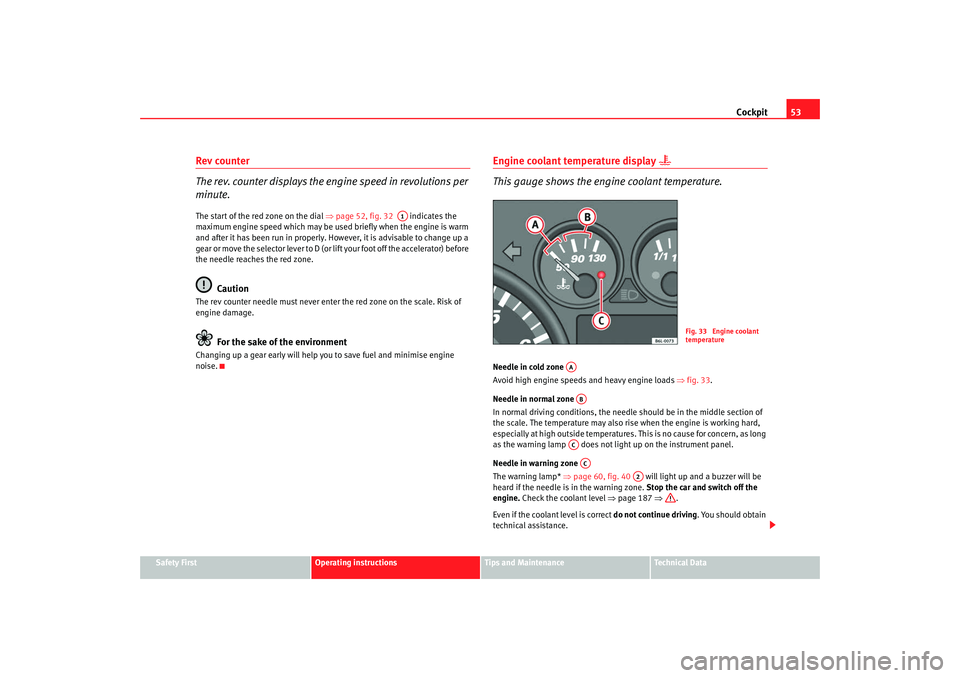
Needle in cold zone
Avoid high engine speeds and heavy engine loads ⇒fig. 33.
Needle in normal zone
In normal driving conditions, the needle should be in the middle section of
the scale. The temperature may also rise when the engine is working hard,
especially at high outside temperatures. This is no cause for concern, as long
as the warning lamp does not li ght up on the instrument panel.
Needle in warning zone
The warning lamp* ⇒page 60, fig. 40 will light up and a buzzer will be
heard if the needle is in the warning zone. Stop the car and switch off the
engine. Check the coolant level ⇒ page 187 ⇒.
Even if the coolant level is correct do not continue driving. You should obtain
technical assistance.
A1
Fig. 33 Engine coolant
temperature
AAABACAC
A2
IBI_ANG_0707 Seite 53 Montag, 6. August 2007 3:59 15
Page 63 of 272
Cockpit61
Safety First
Operating instructions
Tips and Maintenance
Te c h n i c a l D a t a
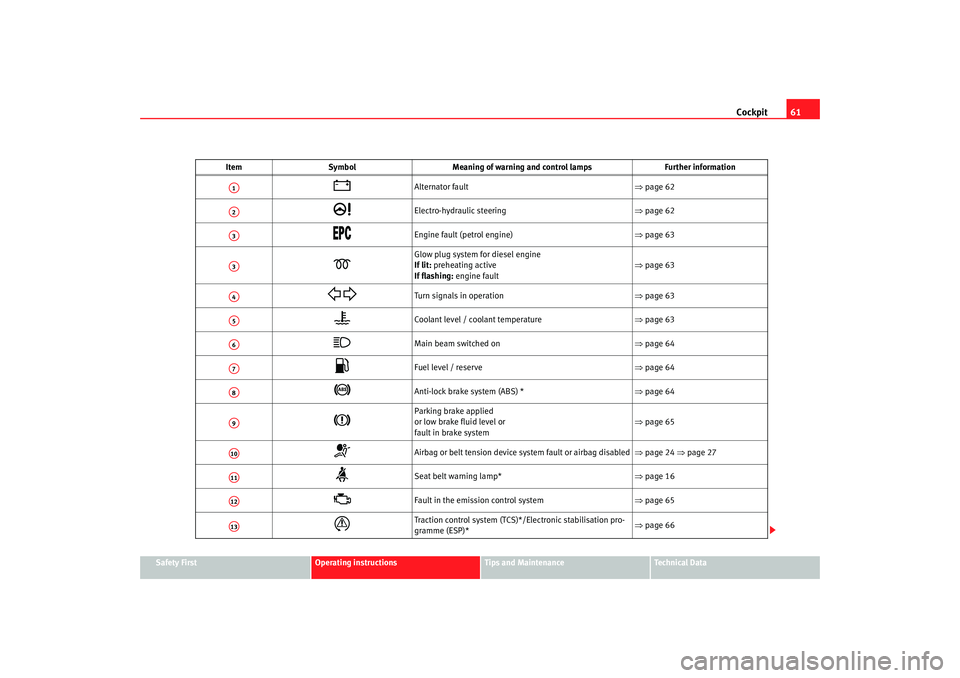
Item
Symbol Meaning of warning and control lamps Further information
Alternator fault ⇒page 62
Electro-hydraulic steering ⇒page 62
Engine fault (petrol engine) ⇒page 63
Glow plug system for diesel engine
If lit: preheating active
If flashing: engine fault ⇒
page 63
Turn signals in operation ⇒page 63
Coolant level / coolant temperature ⇒page 63
Main beam switched on ⇒page 64
Fuel level / reserve ⇒page 64
Anti-lock brake system (ABS) * ⇒page 64
Parking brake applied
or low brake fluid level or
fault in brake system ⇒
page 65
Airbag or belt tension device system fault or airbag disabled ⇒page 24 ⇒page 27
Seat belt warning lamp* ⇒page 16
Fault in the emission control system ⇒page 65
Traction control system (TCS)*/Electronic stabilisation pro-
gramme (ESP)* ⇒
page 66
A1A2A3A3A4A5A6A7A8A9A10A11A12A13
IBI_ANG_0707 Seite 61 Montag, 6. August 2007 3:59 15
Page 66 of 272
Cockpit
64Coolant temperature too high
First look at the coolant temperature gauge. The coolant temperature is too
high if the needle is over the warning area on the dial. Stop the vehicle,
switch off the engine and wait for it to cool down. Check the coolant level.
If the coolant level is correct, the overheating may be caused by a malfunction
of the radiator fan. Check the radiator fan fuse and have it replaced if neces-
sary ⇒page 213.
If the warning lamp lights up again after driving on for a short distance, stop
the vehicle and switch off the engine. Contact an Authorised Service Centre
or a qualified workshop.
Coolant level too low
First look at the coolant temperature gauge. If the needle is in the normal
range, top up with coolant at the earliest opportunity ⇒.
WARNING
•
If your vehicle is immobilised for any technical reasons, move it to a
safe distance from traffic. Turn off the engine, turn on the hazard lights and
place the warning triangle.
•
Never open the bonnet if you can see or hear steam or coolant escaping
from the engine compartment. Risk of scalding. Wait until you can no
longer see or hear escaping steam or coolant.
•
The engine compartment of any motor vehicle is a dangerous area!
Before carrying out any work in the engine compartment, switch off the
engine and allow it to cool down. Alwa ys note the corresponding warnings
⇒ page 180.
Main beam headlights
This warning lamp lights up when the main beams are on.The warning lamp
lights up when the main beams are on or when the
headlight flasher is operated.
Further information ⇒page 93.
Fuel level / reserve
This symbol lights up to indicate that the fuel tank is down to
the reserve level.This lights when only 7 litres of fuel remain in the tank. Also, an audible
warning is given. This serves as a reminder to fill up with fuel at the earliest
opportunity ⇒page 177.Anti-lock brake system (ABS)
A warning lamp system monitors the ABS.
The warning lamp
should light up for a few seconds when the ignition is
switched on. It goes out again after the system has run through an automatic
test sequence.
There is a fault in the ABS if:
•
The warning lamp
does not light up when the ignition is switched on.
•
The warning lamp does not go out again after a few seconds.
•
The warning lamp lights up when the vehicle is moving.
IBI_ANG_0707 Seite 64 Montag, 6. August 2007 3:59 15
Page 67 of 272
Cockpit65
Safety First
Operating instructions
Tips and Maintenance
Te c h n i c a l D a t a
The vehicle can still be braked in the normal way (except that the ABS control
function will not function). Please take
the vehicle to a qualified workshop as
soon as possible. For further information on the ABS see the ⇒page 148.
If a fault occurs in the ABS, the ESP* warning lamp will also light up.
Brake system fault
If the ABS warning lamp
lights up together with the brake warning lamp
, this indicates not only a fault in the ABS function, but also a possible fault
in the brake system ⇒.
WARNING
•
Before opening the bonnet, read and observe the warnings on
⇒ page 180, “Working in the engine compartment”.
•
If the brake warning lamp
should light up together with the ABS
warning lamp
, stop the vehicle immediately and check the brake fluid
level in the reservoir ⇒page 192, “Brake fluid”. If the fluid level has
dropped below the “MIN” mark you must not drive on. Risk of accident.
Obtain technical assistance.
•
If the brake fluid level is correct, the fault in the brake system may have
been caused by a failure of the ABS system. This could cause the rear
wheels to lock quickly when you brake. This could cause the rear to break
away. Risk of skidding. Stop the vehicle and seek technical assistance.
Brake system* / handbrake
The warning lamp lights up if the handbrake is applied, if the
brake fluid level falls too low or if there is a fault in the brake
system.
This warning lamp
lights up if
•
If the handbrake is on
•
If the brake fluid level is too low ⇒page 192
•
If there is a fault in the brake system
This warning lamp can light up together with the anti-lock brake system
warning lamp.
WARNING
•
If the brake warning lamp does not go out, or if it lights up when
driving, the brake fluid level ⇒page 192, “Brake fluid” in the reservoir is
too low. Risk of accident. Stop the vehicle and do not drive on. Obtain tech-
nical assistance.
•
If the brake warning lamp
lights up together with the ABS warning
lamp
, the control function of the ABS could be out of action. This could
cause the rear wheels to lock quickly when you brake. This could cause the
rear to break away. Risk of skidding. Stop the vehicle and seek technical
assistance.
Emission control system*
This warning lamp monitors the exhaust system.
Warning lamp
flashes:
When there is misfiring that can damage the catalytic converter. Reduce
speed and drive carefully to the nearest qualified workshop to have the
engine checked.
Warning lamp is lit:
If a fault has developed during driving which has reduced the quality of the
exhaust gas (e.g. lambda probe fault). Reduce speed and drive carefully to
the nearest qualified workshop to have the engine checked.
IBI_ANG_0707 Seite 65 Montag, 6. August 2007 3:59 15
Page 68 of 272
Cockpit
66Traction control system (TCS)*
The traction control system prevents the driven wheels from
spinning when the vehicle is acceleratingThe warning lamp lights up when the ignition is switched on and should turn
out after about 2 seconds.
When the TCS is operating while drivi ng, the warning lamp flashes. If the
system is deactivated or if there is any fault in the same, the warning lamp will
remain lit.
It will also come on if a fault should occur in the ABS because the TCS oper-
ates in conjunction with the ABS. For further information see ⇒page 147,
“Brakes”.Electronic stabilisation programme (ESP)*
This warning lamp monitors the electronic stabilisation
programme.
This programme includes the ABS, EDL and TCS.
The warning lamp
has the following functions:
•
It will light for about 2 seconds when the ignition is switched on while a
test of the function is carried out.
•
It flashes when the ESP is activated when driving.
•
It will light up continuously if there is a malfunction in the ESP.
•
It will light up continuously if the ESP is switched off.
•
It will also come on if a fault should occur in the ABS because the ESP
operates in conjunction with the ABS.
If the ESP warning lamp
lights up and stays on after the engine is started,
this may mean that the control system has temporarily switched off the ESP. In this case the ESP can be reactivated by switching the ignition off and then
on again. If the warning lamp goes out, this means the system is fully
functional.
Soot accumulation in the diesel engine particulate filter *
If the indicator lights
you may help the filter clear itself by driving in the
appropriate manner.
To do this, drive about 15 minutes in 4th or 5th gear (automatic gearbox: S
gear range) at a speed of 60 km/h, with the engine running at approximately
2000 rpm. In this way, the pollen build up in the filter is burned. When
cleaning is successful, the indicator turns off.
If the indicator
is not deactivated, bring the vehicle to a specialised work-
shop to repair the fault.
WARNING
•
Always drive according to the road weather conditions, the terrain and
traffic. Driving recommendations should never lead to illegal maneouvers
in surrounding traffic.
•
The diesel engine particulate filter may reach extremely high tempera-
tures; it should not enter into contact with flammable materials under-
neath the vehicle. Failure to comply could result in fire.Caution
Vehicles equipped with a diesel engine particulate filter must not be refueled
using biodiesel (RME), given that the fuel system may be damaged.
IBI_ANG_0707 Seite 66 Montag, 6. August 2007 3:59 15
Page 69 of 272
Cockpit67
Safety First
Operating instructions
Tips and Maintenance
Te c h n i c a l D a t a
Electronic immobiliser
Inside the key there is a chip that deac tivates the electronic immobiliser auto-
matically when the key is inserted into the ignition. The immobiliser will be
activated again automatically as soon as you pull the key out of the ignition
lock.
The engine can, however, be started if the appropriate coded SEAT genuine
key is used.
Note
The vehicle cannot be operated properly if you do not have a genuine SEAT
key.Engine oil pressure
This warning lamp indicates that the engine oil pressure is
too low.If this warning symbol starts to flash, and is accompanied by three audible
warnings , switch off the engine and check the oil level. If the oil level is too
low, add more engine oil ⇒page 183.
If the symbol flashes although the oil level is correct, do not drive on. The
engine must not even run at idle speed. Obtain technical assistance.
Trailer turn signals
This warning lamp also flashe s when the turn signals are
operated while towing a caravan or trailer.The warning lamp
flashes when the turn signals are operated, provided a
trailer is correctly attached and connected to the vehicle.
The warning lamp will not flash if one of the turn signals on the trailer fails.
Differential lock fault (EDL)*
EDL operates along with the ABS in vehicles equipped with an
Electronic Stabilisation Program (ESP)*A malfunction in the EDL is indicated by the ABS warning lamp
. Please
take the vehicle to a qualified workshop as soon as possible. For further infor-
mation on the EDL ⇒page 150, “Electronic diff erential lock (EDL)*”
IBI_ANG_0707 Seite 67 Montag, 6. August 2007 3:59 15
Page 72 of 272
Unlocking and locking
70Unlocking and lockingDoorsLocking and unlocking the vehicle
From the outside of the vehicle, the driver's door may be
locked or unlocked using the key.When opened , the latch will rise up (for vehicles without central locking)
For vehicles equipped with electric windows and central locking, if the key is
maintained in the opening position all of the electric side windows will open.
When locking the latch will descend (for vehicles without central locking)
In some vehicle models equipped with electric windows and central locking,
if the key is maintained in the locking position on the driver side, any side
windows left open, as well as the electric sunroof, will close.
For vehicles without central locking, the passenger door and the rear doors
may be locked from the outside without using a key. Just press the button
down and close the door.
The latch on the driver’s door may not be pushed down while the door is open
(only in vehicles without central locking) . This avoids accidentally leaving the
keys in the ignition.
From inside all the doors may be locked by pushing the security buttons down
(in vehicles withou t central locking).
WARNING
•
Exercise extreme caution when closing the windows and the sunroof
from the outside of the vehicle.
•
Closing from the outside without ta king care or observing all the
vehicle may cause bruising for other people especially children.
•
When locking a vehicle, never leave children unaccompanied inside, as
it will be difficult to provide assistance if required.
•
When the doors are locked, any intrusion is impeded, for example while
stopped at a red light.
Ce ntral l ocking *Description
The central locking system enables you to lock and unlock all
the doors and the tailgate from one point.Central locking can be activated us ing any of the following options:•
the key, by inserting it into the driver's door cylinder and rotating manu-
ally,
•
the central locking button , (electronic control) in the passenger compart-
ment ⇒page 73,
•
the radio frequency remote control , using the buttons on the key
⇒ page 78.
Various functions are available to improve the vehicle security:
- Locking system “Safe”
- Selective unlocking system*WARNING (continued)
IBI_ANG_0707 Seite 70 Montag, 6. August 2007 3:59 15
Page 95 of 272
Lights and visibility93
Safety First
Operating instructions
Tips and Maintenance
Te c h n i c a l D a t a
7. Always take the vehicle key wi th you when you leave the vehicle.You should switch on the hazard warning lights to warn other road users, for
instance when:•
reaching the tail end of a traffic jam
•
there is an emergency
•
your vehicle breaks down due to a technical defect
•
you are towing another vehicle or your vehicle is being towed.
All turn signals flash simultaneously when the hazard warning lights are
switched on. That is that the two turn signal indicator lamps
and the
indicator lamp in the switch
will flash at the same time. The hazard
warning lights also work when the ignition is switched off.
WARNING
•
The risk of an accident increases if your vehicle breaks down. Always
use the hazard warning lights and a warning triangle to draw the attention
of other road users to your stationary vehicle.
•
Never park where the catalytic converter could come into contact with
inflammable materials under the vehicle, for example dry grass or spilt
petrol. This could start a fire!Note
•
The battery will run down if the hazard warning lights are left on for a long
time, even if the ignition is switched off.
•
The use of the hazard warning lights d escribed here is subject to the rele-
vant statutory requirements.
Turn signal and main beam headlight lever
The turn signal and main beam lever also operates the
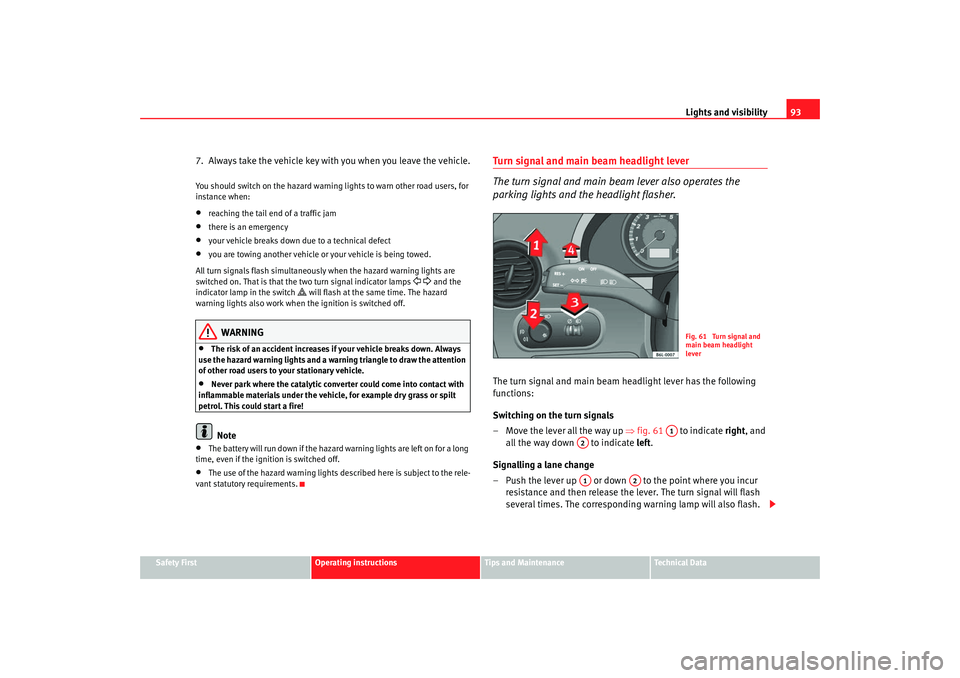
parking lights and the headlight flasher.The turn signal and main beam headlight lever has the following
functions:
Switching on the turn signals
– Move the lever all the way up ⇒fig. 61 to indicate right, and
all the way down to indicate left.
Signalling a lane change
– Push the lever up or down to the point where you incur resistance and then release the lever. The turn signal will flash
several times. The corresponding warning lamp will also flash.
Fig. 61 Turn signal and
main beam headlight
lever
A1
A2A1
A2
IBI_ANG_0707 Seite 93 Montag, 6. August 2007 3:59 15
Page 96 of 272
Lights and visibility
94
Switching main beam on and off
– Turn the light switch to position
.
– Press the lever forward ⇒page 93, fig. 61 to switch on the
main beams.
– Pull the lever back towards you to switch the main beam head- lights off again.
Headlight flasher
– Pull the lever towards the steering wheel to operate the flasher.
Switching on parking lights
– Switch off the ignition and remove the key from the lock.
– Move the lever up or down to turn on the right or left-hand parking lights respectively.
WARNING
The main beam can dazzle other drivers. Risk of accident! Never use the
main beam headlights or the headlight flasher if they could dazzle other
drivers.
Note
•
The turn signals only work when the ignition is switched on. The corre-
sponding warning lamp
or flashes in the combi-instrument. The
warning lamp
flashes when the turn signals are operated, provided a
trailer is correctly attached and connected to the vehicle. If a turn signal bulb
is defective, the warning lamp flashes at double speed. If the trailer turn signal bulbs are damaged, warning lamp
does not light up. You should
have the bulb replaced.
•
The main beam headlights can only be switched on if the dipped beam
headlights are already on. The warning lamp
then comes on in the combi-
instrument.
•
The headlight flasher comes on for as long as you pull the lever – even if
no other lights are switch ed on. The warning lamp
then comes on in the
combi-instrument.
•
When the parking lights are switched on, the headlight and the rear light
on the corresponding side of the vehicle light up. The parking lights will only
work if the key is removed from the igni tion. If the lights are switched on, a
buzzer gives an audible warning while the driver door is open.
•
If the turn signal lever is left on after the key has been taken out of the
ignition lock, an acoustic signal sounds when the driver door is opened. This
is a reminder to switch off the turn signal, unless of course you wish to leave
the parking light on.
A4A3
IBI_ANG_0707 Seite 94 Montag, 6. August 2007 3:59 15