light Seat Ibiza 5D 2007 Workshop Manual
[x] Cancel search | Manufacturer: SEAT, Model Year: 2007, Model line: Ibiza 5D, Model: Seat Ibiza 5D 2007Pages: 272, PDF Size: 8.32 MB
Page 126 of 272
Heating, Ventilation and Air conditioning
124
– Turn the temperature control switch until the desired interior temperature is obtained.
– Turn the blower switch to one of the settings 1-4.
– Set the air distribution control to the air flow configuration desired: (towards the windsc reen), (towards the chest),
(towards the foot rest) and (towards the windscreen and
foot rest areas).Heating
Maximum heat output, which is needed to defrost the windows quickly, is
only available when the engine has reached its operating temperature.
Coolant system
When the cooling system is switched on, not only the temperature, but also
the air humidity in the vehicle interior is reduced. This improves comfort for
the vehicle occupants and prevents misting of the windows when the outside
air humidity is high.
If the cooling system cannot be switched on this may be due to the following
reasons:•
the engine is not running.
•
The blower is switched off.
•
The outside temperature is lower than +5°C.
•
the cooling system compressor has been temporarily switched off
because the engine coolant temperature is too high.
•
The air conditioning fuse is faulty.
•
Another fault in the vehicle. Have the air conditioning checked by a qual-
ified workshop.
Air recirculation
Air recirculation mode prevents fumes or unpleasant smells
from entering the vehicle.When air recirculation mode is switched on (button ⇒page 123, fig. 95
with warning lamp) strong odours in the outside air do not enter the vehicle
interior, for example when passing through a tunnel or in queuing traffic.
When the outside temperature is low, us ing air recirculation mode provides
more effective heating by heating air from the vehicle interior instead of cold
air from outside.
When the outside temperature is high, using air recirculation mode provides
more effective cooling by cooling air fr om the vehicle interior instead of warm
air from outside.
For reasons of safety, air recirculation is not possible when the control for air
distribution is set to the windscreen setting
.
WARNING
In air recirculation mode, no ambient air enters the vehicle interior. If the
air conditioning system is switched off, the windows can quickly mist over.
Therefore, you should never leave the air recirculation mode switched on
for longer periods, as this increases the risk of an accident.
Note
•
When reverse gear is engaged the air recirculation connects automatically
to prevent the entrance of exhaust fumes in the vehicle on travelling back-
wards. The control light on th e button does not light up.
•
If the temperature control is turned to the coldest setting (blue point) and
the switch is activated, the “Air recirculation” function is automatically
activated in order to cool the passenger compartment rapidly using a
minimum of energy and the function indicator will light.
AC
IBI_ANG_0707 Seite 124 Montag, 6. August 2007 3:59 15
Page 128 of 272
Heating, Ventilation and Air conditioning
126
– Turn the temperature selector ⇒page 125, fig. 96 to set the
desired temperature.
– The functions will be switched on when the buttons are pressed. When the function is activated, a symbol is displayed on the
screen. Press the button again to switch off the function.
Blower speed control and ON / OFF system.
Blower level indicator
Outside temperature display
Defrost windscreen display
Air recirculation display:
Display for air flow direction
D isplay AUTO (aut omatic operation)
Interior temperature selected display
D isplay ECON (air conditioning off)
Interior temperature selector.
Button – defrost function for the windscreen. The air drawn in from
outside the vehicle is directed at the windscreen. The air recirculation
mode, if switched on, will be switched off as soon as the defrost function
is switched on. At temperatures over 3°C, the air conditioning system will
be switched on automatically and the blower speed will be increased by
one level in order to dry the air.
Button – Automatic temperature, ventilation and air distribution
control ⇒page 126
Button – Air distribution to footwell
Button – Air distribution to the upper body.
Button – Air distribution to head.
Button – To connect economic mode. When the button light is on,
the air conditioning is disconnected to save fuel.
Button – Manual air recirculation mode.
WARNING
For your safety, the windows should never be fogged up or covered with
snow or ice. This is essential to ensure good visibility. Please familiarise
yourself with the correct operation of the heating and ventilation system,
including the demist/defrost functions for the windows.
Note
Please observe the general notes.Automatic mode
In automatic mode air temperature, flow, and distribution are
automatically regulated so that a specified temperature is
attained as quickly as possible and then maintained.Switching on automatic mode
– Press the button . The display is visible ⇒page 125,
fig. 96 .
– Turn the temperature selector to set the desired temperature inside the vehicle. We recommend 22°C (72°F).A comfortable interior climate is quickly reached when a temperature of
+22°C (72°F) is set in automatic mode. It can be changed as necessary to suit
individual preferences or particular cir cumstances. It is possible to select
interior temperatures from +18°C (64°F) to +29°C (86°F). If a lower or higher
temperature is selected, LO or HI is displayed on the screen. These are
approximate temperatures and the actual temperature may be slightly higher
or lower depending on the outside conditions.
A10
A1A2A3A4A5A6A7A8A9A10A11
A12
AUTO
A13
A14
A15
A16
ECON
A17
AUTO
A7
IBI_ANG_0707 Seite 126 Montag, 6. August 2007 3:59 15
Page 129 of 272
Heating, Ventilation and Air conditioning 127
Safety First
Operating instructions
Tips and Maintenance
Te c h n i c a l D a t a
Climatronic maintains a constant tem
perature level fully automatically. The
temperature of the air supplied to the interior, the blower speed and the air
distribution are regulated automatically. The system also allows for the effect
of strong sunlight, so there is no ne ed for manual adjustment. Therefore,
automatic mode provides the best comfort for the vehicle occupants in virtu-
ally all conditions throughout the year.
Automatic mode is switched off whenever an adjustment is made using the
buttons for the air distribution, blower or . The temperature continues
to be regulated.
Manual mode
In manual mode you can adjust the air temperature, flow, and
distribution yourself.Switching on manual mode
– Press one of the buttons ⇒page 125, fig. 96 to , or turn
the blower control . The display is switched off .Temperature
It is possible to select interior te mperatures from +18°C (64°F) to +29°C
(86°F). These are approximate temperat ures and the actual temperature may
be slightly higher or lower depending on the outside conditions.
If a temperature below 18°C (64°F) is selected, the display switches to LO. In
this setting the system runs at maximum cooling output and the temperature
is not regulated.
If a temperature above 29°C (86°F) is selected the display indicates HI. In this
setting the system runs at maximum heating output and the temperature is
not controlled. Blower
The blower can be infinitely adjusted with the blower control . Always have
the blower running at a low setting to ensure a constant flow of fresh air into
the vehicle. If the blower is switched off (no level displayed ) and the
control is turned further to the left, the Climatronic is switched off. Then
OFF
is displayed on the screen.
Air distribution
The air distribution is adjusted using the buttons , and . It is also
possible to open and close some of the air outlets separately.
Switching the air conditioning system on and off
Pressing the button switches off the air cooling system to save fuel.
The temperature continues to be regulated. The set temperature can then
only be reached if it is higher than the outside temperature.
Air recirculation mode
Air recirculation mode prevents fumes or unpleasant smells
from entering the vehicle.– Press the button to switch air recirculation mode on or off.
This is ON if the symbol
⇒ page 125, fig. 96 is displayed
on the screen.
Air recirculation mode prevents strong odours in the ambient air from
entering the vehicle interior, for example when passing through a tunnel or in
queuing traffic.
When the outside temperature is low, using air recirculation mode provides
more effective heating by heating air from the vehicle interior instead of cold
air from outside.
ECON
A13
A15
A1
A7
A1A2
ECON
A5
IBI_ANG_0707 Seite 127 Montag, 6. August 2007 3:59 15
Page 133 of 272
Driving131
Safety First
Operating instructions
Tips and Maintenance
Te c h n i c a l D a t a
•
Adjust the driver seat or steering wheel so that there is a distance of at
least 25 cm between the steering wheel and your breast bone ⇒page 130,
fig. 98 . If you fail to observe the minimum distance, the airbag will not
protect you. Risk of fatal injury.
•
If your physical constitution prevents you from maintaining the
minimum distance of 25 cm, contact an Authorised Service Centre. The
Authorised Service Centre will help you decide if special specific modifica-
tions are necessary.
•
If you adjust the steering wheel so th at it points towards your face, the
driver airbag will not protect you prop erly in the event of an accident. Make
sure that the steering wheel points towards your chest.
•
When driving, always hold the steering wheel with both hands on the
outside of the ring at the 9 o'clock and 3 o'clock positions. Never hold the
steering wheel at the 12 o'clock position, or in any other manner (e.g. in
the centre of the steering wheel, or on the inside of the rim). In such cases,
you could receive severe injuries to the arms, hands and head.
SafetyElectronic stabilisation programme (ESP)*
ESP helps make driving safer in certain situations.The Electronic Stabilisation Program (ESP ) contains the electronic differential
lock (EDL) and the traction control system (TCS). The ESP function works in
conjunction with the ABS. Both warning la mps will light up if the ESP or ABS
systems are faulty.
The ESP is started automatically when the engine is started.
In specific circumstances where you requ ire less traction, you can switch off
the ESP by pressing button ⇒fig. 99 .
For example:•
When driving with snow chains,
•
when driving in deep snow or on loose surfaces,
WARNING (continued)
Fig. 99 Detail of the
centre console: ESP
button
IBI_ANG_0707 Seite 131 Montag, 6. August 2007 3:59 15
Page 134 of 272
Driving
132•
when rocking the vehicle backwards and forwards to free it from mud, for
example.
You should press the button to switch the ESP back on when you no longer
need wheel spin.
The TCS and EDL are also switched off if the ESP is switched off. That is to say,
these systems are not available while ESP is not activated.
When does the button light up or flash?
•
It lights up when the ignition is switched on and should go out again after
about 2 seconds.
•
It will start flashing to indicate that ESP is counteracting an unstable
driving condition.
•
It will light up continuously if there is a malfunction in the ESP.
•
It will light up continuously if the ESP is switched off.
WARNING
•
The electronic stabilisation programme (ESP) cannot defy the laws of
physics. This should be kept in mind, particularly on slippery and wet
roads and when towing a trailer.
•
Always adapt your driving style to suit the condition of the roads and
the traffic situation. Do not let the extra safety afforded by ESP tempt you
into taking any risks when driv ing, this can cause accidents.
•
Please refer to the corresponding warning notes on ESP in ⇒page 147,
“Intelligent technology”.
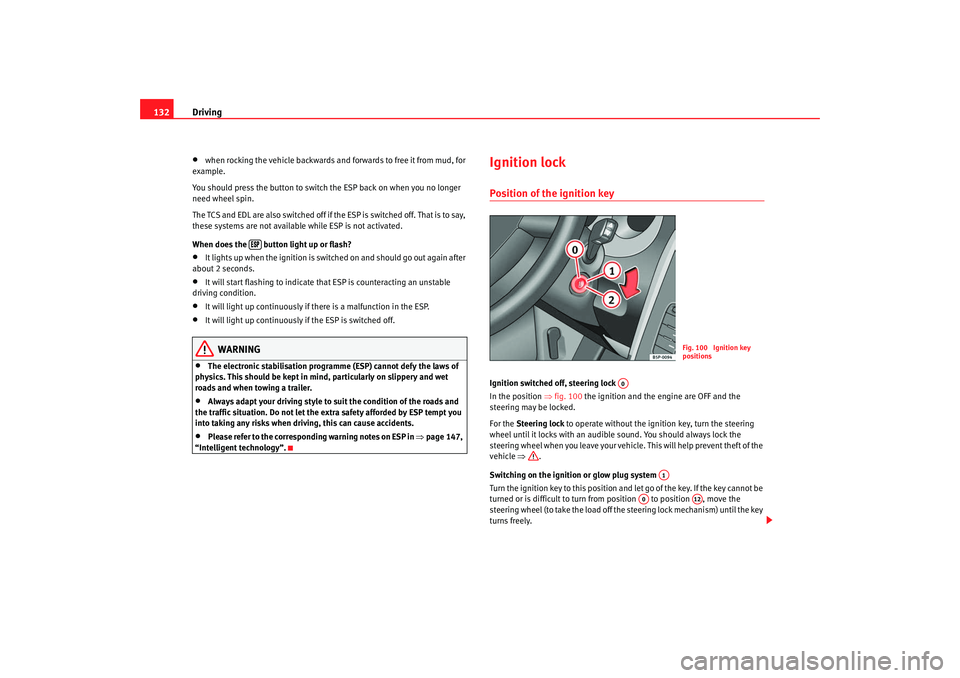
Ignition lockPosition of the ignition keyIgnition switched off, steering lock
In the position ⇒fig. 100 the ignition and the engine are OFF and the
steering may be locked.
For the Steering lock to operate without the ignition key, turn the steering
wheel until it locks with an audible sound. You should always lock the
steering wheel when you leave your vehicle. This will help prevent theft of the
vehicle ⇒.
Switching on the ignition or glow plug system
Turn the ignition key to this position an d let go of the key. If the key cannot be
turned or is difficult to turn from position to position , move the
steering wheel (to take the load off the steering lock mechanism) until the key
turns freely.
Fig. 100 Ignition key
positions
A0
A1
A0
A12
IBI_ANG_0707 Seite 132 Montag, 6. August 2007 3:59 15
Page 136 of 272
Driving
134
– Let go of the ignition key as soon as the engine starts; the starter motor must not be allowed to run on with the engine.After starting a very hot engine, you may need to press the accelerator briefly.
When starting from cold, the engine ma y be a little noisy for the first few
seconds until oil pressure has built up in the hydraulic valve compensators.
This is quite normal, and no cause for concern.
If the engine does not start immediately, switch off the starter after about
10 seconds and try again after about half a minute. If the engine still does not
start, the fuel pump fuse should be checked ⇒page 213, “Fuses”.
WARNING
•
Never start or run the engine in un ventilated or closed rooms. The
exhaust fumes contain carbon mono xide, an odourless and colourless
poisonous gas. Risk of fatal accidents. Carbon monoxide can cause loss of
consciousness. It can also cause death.
•
Never leave the vehicle unattended if the engine is running.
•
Never use “cold start sprays”, they could explode or cause the engine
to run at high revs. Risk of injury.Caution
•
When the engine is cold, you should av oid high engine speeds, driving at
full throttle and over-loading the engine. Risk of engine damage.
•
The vehicle should not be pushed or towed for more than approximately
50 metres to start the engine. Fuel could enter the catalytic converter and
damage it.
•
Before attempting to push-start or tow a vehicle to start it, you should first
try to start it using the battery of another vehicle. Note and follow the instruc-
tions ⇒page 230, “Jump-starting”.
For the sake of the environment
Do not warm-up the engine by running th e engine with the vehicle stationary.
You should drive off as soon as you start the engine. This helps the engine
reach operating temperature faster and reduces emissions.Starting diesel engines
The engine can only be started using a genuine SEAT key with
the correct code.– Move the gear lever to the ne utral position and depress the
clutch pedal fully and hold it in this position, the starter will then
only have to turn the engine.
– Turn the ignition key to the starting position.
– Turn the ignition key to position ⇒page 132, fig. 100 . The
indication lamp
will light for engine pre-heating.
– When the warning lamp goes out, turn the key to position to start the engine. Do not press the accelerator.
– Let go of the ignition key as soon as the engine starts, the starter motor must not be allowed to run on with the engine.
When starting from cold, the engine may be a little noisy for the first few
seconds until oil pressure has built up in the hydraulic valve compensators.
This is quite normal, and no cause for concern.
If there are problems starting the engine, see ⇒page 230.
A1A2
IBI_ANG_0707 Seite 134 Montag, 6. August 2007 3:59 15
Page 138 of 272
Driving
136
CautionIf the engine has been driven hard for a long period, the engine could over-
heat when it is switched off. Risk of engine damage. For this reason, you
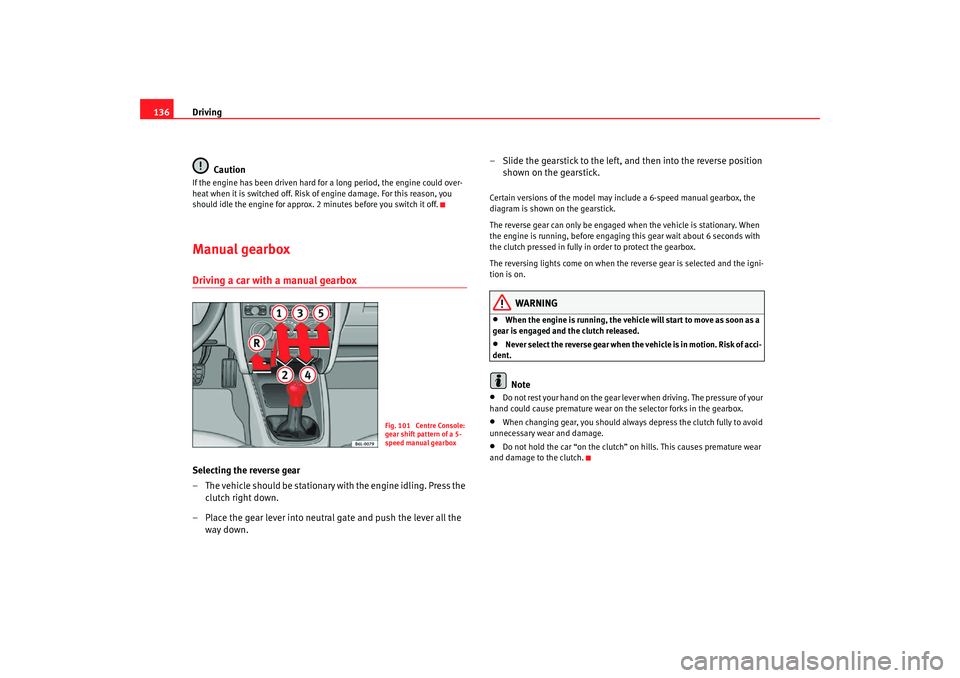
should idle the engine for approx. 2 m inutes before you switch it off.Manual gearboxDriving a car with a manual gearboxSelecting the reverse gear
– The vehicle should be stationary with the engine idling. Press the
clutch right down.
– Place the gear lever into neutral gate and push the lever all the way down. – Slide the gearstick to the left, and then into the reverse position
shown on the gearstick.
Certain versions of the model may include a 6-speed manual gearbox, the
diagram is shown on the gearstick.
The reverse gear can only be engaged when the vehicle is stationary. When
the engine is running, before engaging this gear wait about 6 seconds with
the clutch pressed in fully in order to protect the gearbox.
The reversing lights come on when the reverse gear is selected and the igni-
tion is on.
WARNING
•
When the engine is running, the vehicle will start to move as soon as a
gear is engaged and the clutch released.
•
Never select the reverse gear when the vehicle is in motion. Risk of acci-
dent.Note
•
Do not rest your hand on the gear lever when driving. The pressure of your
hand could cause premature wear on the selector forks in the gearbox.
•
When changing gear, you should always depress the clutch fully to avoid
unnecessary wear and damage.
•
Do not hold the car “on the clutch” on hills. This causes premature wear
and damage to the clutch.
Fig. 101 Centre Console:
gear shift pattern of a 5-
speed manual gearbox
IBI_ANG_0707 Seite 136 Montag, 6. August 2007 3:59 15
Page 140 of 272
Driving
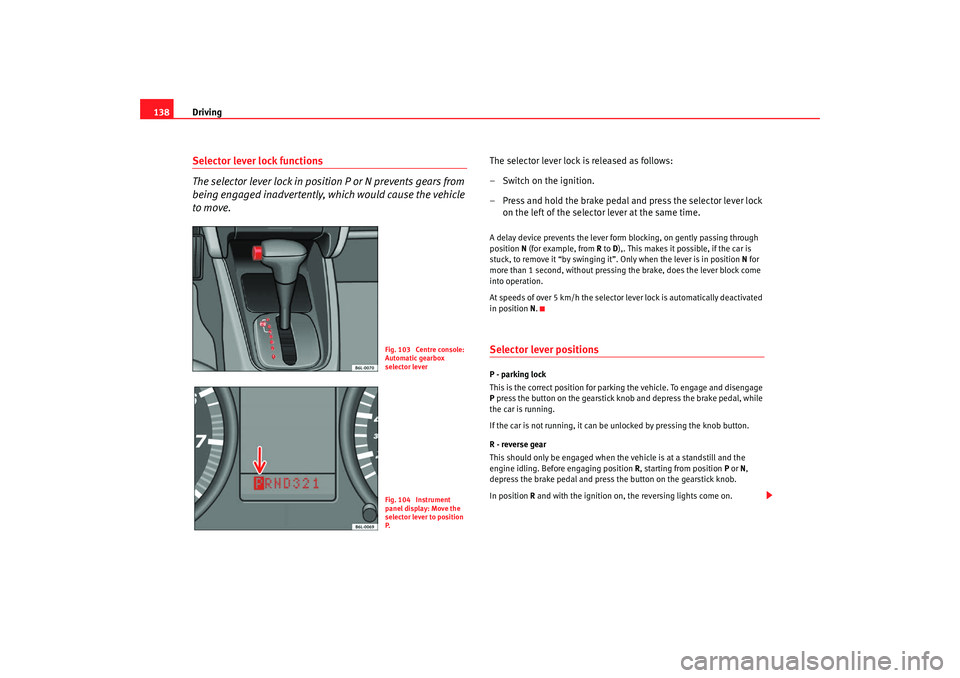
138Selector lever lock functions
The selector lever lock in positi on P or N prevents gears from
being engaged inadvertently, which would cause the vehicle
to move.
The selector lever lock is released as follows:
– Switch on the ignition.
– Press and hold the brake pedal and press the selector lever lock
on the left of the selector lever at the same time.A delay device prevents the lever form blocking, on gently passing through
position N (for example, from R to D),. This makes it possible, if the car is
stuck, to remove it “by swinging it”. Only when the lever is in position N for
more than 1 second, without pressing th e brake, does the lever block come
into operation.
At speeds of over 5 km/h the selector lever lock is automatically deactivated
in position N.Selector lever positionsP - parking lock
This is the correct position for parki ng the vehicle. To engage and disengage
P press the button on the gearstick knob and depress the brake pedal, while
the car is running.
If the car is not running, it can be unlocked by pressing the knob button.
R - reverse gear
This should only be engaged when the vehicle is at a standstill and the
engine idling. Before engaging position R, starting from position P or N,
depress the brake pedal and press the button on the gearstick knob.
In position R and with the ignition on, th e reversing lights come on.
Fig. 103 Centre console:
Automatic gearbox
selector leverFig. 104 Instrument
panel display: Move the
selector lever to position
P.
IBI_ANG_0707 Seite 138 Montag, 6. August 2007 3:59 15
Page 142 of 272
Driving
140If, while driving, the selector lever accidentally moves to position N, first
release the accelerator pedal and wait until the engine slows to idling before
selecting a forward gear ⇒.
Starting
Select a range ( R, D, 3, 2, 1). Wait until the change has taken place and the
power transmission of the drive wheels has stabilised (slight pressure is
noticeable). Then depress the accelerator.
Stopping
In the case of a temporary stop, for example at a traffic light, it is not neces-
sary to move to position N, it is sufficient to brake using the brake pedal. The
engine should only run at idle speed.
Parking
On slopes, first pull handbrake on firmly and then connect block. This
prevents overloading of the locking mechanism, making the subsequent
deactivation easier ⇒ .
Emergency start
For vehicles fitted with an automatic gearbox the engine can not be started by
towing or pushing the vehicle ⇒ page 233.
If the vehicle battery is flat, a battery from another car can be used to jump-
start the car using a set of jump leads ⇒page 133.
To w i n g
If the vehicle requires towing at any time, observe the instructions of
⇒ page 233, “Towing and tow-starting”.
Back-up programme
In the event of a malfunction of the gearbox electronics, emergency
programmes are activated, according to the type of fault.•
The gearbox continues to connect gears automatically, but the operations
are jerky. Consult the Authorised Service Centre.
•
The gearbox does not automatically engage gears.
In this case they can be changed manually. 3rd gear is only available in posi-
tions D, 3 and 2 of the selector lever.
In positions 1 and R of the selector lever 1st gear and reverse gear are avail-
able respectively as normal.
As the torque converter is required to work more, especially due to the lack of
2nd gear, it is possible that the gearbox oil may overheat. In this case, consult
the Authorised Service Centre as soon as possible.
WARNING
•
In all the ranges the vehicle must always be held with the foot brake
when the engine is running. This is because an automatic gearbox still
transmits power even at idling speed , and the vehicle tends to “creep”.
•
If, when the car is at a standstill and the engine is idling, a range is
connected, take care not to accelerate accidentally (for example, when
working in the engine compartment), as the car will start to move immedi-
ately.
•
Before working on a running engine, place the selector lever in position
P and apply the handbrake.
•
To prevent the vehicle from moving out of control, the handbrake
should always be applied when the vehicle is at a standstill. In addition
move the selector lever to position P.
IBI_ANG_0707 Seite 140 Montag, 6. August 2007 3:59 15
Page 143 of 272
Driving141
Safety First
Operating instructions
Tips and Maintenance
Te c h n i c a l D a t a
HandbrakeUsing the handbrake
The handbrake should be applied firmly to prevent the
vehicle from accidentally rolling away.Always apply the handbrake when you leave your vehicle and when
you park.
Applying the handbrake
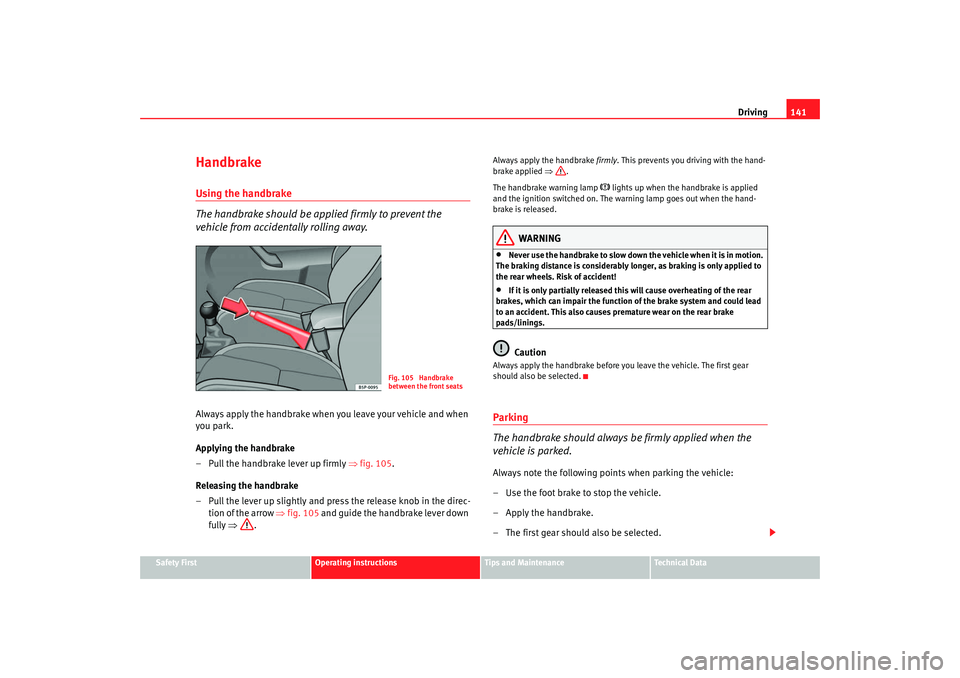
– Pull the handbrake lever up firmly ⇒ fig. 105.
Releasing the handbrake
– Pull the lever up slightly and press the release knob in the direc- tion of the arrow ⇒fig. 105 and guide the handbrake lever down
fully ⇒ .
Always apply the handbrake firmly. This prevents you driving with the hand-
brake applied ⇒.
The handbrake warning lamp
lights up when the handbrake is applied
and the ignition switched on. The wa rning lamp goes out when the hand-
brake is released.
WARNING
•
Never use the handbrake to slow down the vehicle when it is in motion.
The braking distance is considerably longer, as braking is only applied to
the rear wheels. Ri sk of accident!
•
If it is only partially released this will cause overheating of the rear
brakes, which can impair the function of the brake system and could lead
to an accident. This also causes premature wear on the rear brake
pads/linings.Caution
Always apply the handbrake before you leave the vehicle. The first gear
should also be selected.Parking
The handbrake should always be firmly applied when the
vehicle is parked.Always note the following points when parking the vehicle:
– Use the foot brake to stop the vehicle.
–Apply the handbrake.
– The first gear should also be selected.
Fig. 105 Handbrake
between the front seats
IBI_ANG_0707 Seite 141 Montag, 6. August 2007 3:59 15