warning Seat Ibiza 5D 2008 Owners Manual
[x] Cancel search | Manufacturer: SEAT, Model Year: 2008, Model line: Ibiza 5D, Model: Seat Ibiza 5D 2008Pages: 260, PDF Size: 8.11 MB
Page 124 of 260
Heating, Ventilation and Air conditioning
122
– Turn the fan control to one of the two levels depending on the
speed required.
– Rotate the temperature control to the desired level of comfort.
– Close outlets .
– Open and turn outlets towards side windows.
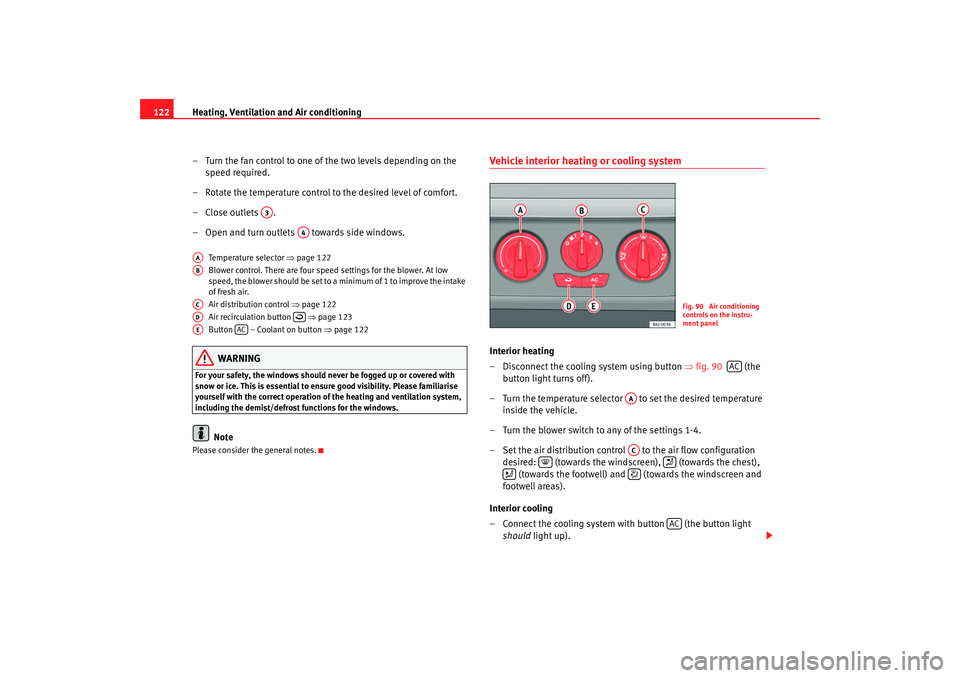
Temperature selector ⇒page 122
Blower control. There are four speed settings for the blower. At low
speed, the blower should be set to a minimum of 1 to improve the intake
of fresh air.
Air distribution control ⇒page 122
Air recirculation button ⇒page 123
Button – Coolant on button ⇒page 122WARNING
For your safety, the windows should never be fogged up or covered with
snow or ice. This is essential to ensure good visibility. Please familiarise
yourself with the correct operation of the heating and ventilation system,
including the demist/defrost functions for the windows.
Note
Please consider the general notes.
Vehicle interior heating or cooling system Interior heating
– Disconnect the cooling system using button ⇒fig. 90 (the
button light turns off).
– Turn the temperature selector to set the desired temperature inside the vehicle.
– Turn the blower switch to any of the settings 1-4.
– Set the air distribution control to the air flow configuration desired: (towards the windscreen), (towards the chest), (towards the footwell) and (towards the windscreen and
footwell areas).
Interior cooling
– Connect the cooling system with button (the button light
should light up).
A3
A4
AAABACAD
AE
AC
Fig. 90 Air conditioning
controls on the instru-
ment panel
AC
AAAC
AC
Ibiza250_angles Seite 122 Dienstag, 5. August 2008 1:11 13
Page 125 of 260
Heating, Ventilation and Air conditioning 123
Safety First
Operating instructions
Practical tips
Te c h n i c a l D a t a
– Turn the temperature control switch until the desired interior
temperature is reached.
– Turn the blower switch to any of the settings 1-4.
– Set the air distribution control to the air flow configuration desired: (towards the windsc reen), (towards the chest),
(towards the footwell) and (towards the windscreen and
footwell areas).Heating
Maximum heat output, which is needed to defrost the windows quickly, is
only available when the engine has reached its operating temperature.
Coolant system
When the air conditioning is switched on, the temperature and the air
humidity go down. This way, if the outside humidity is extreme, the air condi-
tioning prevents the misting of the windows and therefore, comfort is
improved.
If the air conditioning does not work, this may be due to the following
reasons:•
The engine is stationary.
•
The fan blower is switched off.
•
The outside temperature is below +3°C
•
The cooling system compressor has been temporarily switched off
because of an increased engine coolant temperature.
•
The air conditioning fuse is faulty.
•
Another fault in the vehicle. Have the air conditioning checked by a qual-
ified workshop.
Air recirculation
Air recirculation mode prevents fumes or unpleasant smells
from coming from the outside.When air recirculation mode is switched on (button ⇒page 122, fig. 90
with warning lamp) strong odours in th e outside air do not enter the vehicle
interior, for example when passing through a tunnel or in a traffic jam.
When the outside temperature is low, air recirculation mode improves
heating performance by heating air from the interior instead of cold air from
the outside.
When the outside temperature is high, air recirculation mode improves
cooling performance by cooling air from the interior instead of warm air from
outside.
For safety reasons, the air recirculation should not be switched on when the
air distribution control is being adjusted to the windscreen setting
.
WARNING
In air recirculation mode, no cold air from the outside enters the vehicle
interior. If the air conditioning syst em is switched off, the windows can
quickly mist over. Therefore, never leave the air recirculation mode
switched on for a long time (risk of accident).
Note
•
When engaging reverse gear, the air recirculation is connected automati-
cally to prevent the entrance of exhaust fumes in the vehicle on travelling
backwards. The control light on the button does not light up.
•
If the temperature control is turned to the coldest setting (blue point) and
the switch is activated, the “Air recirculation” function is automatically
activated in order to cool the vehicle rapidly using less energy; its function
indicator will light.
AC
Ibiza250_angles Seite 123 Dienstag, 5. August 2008 1:11 13
Page 127 of 260
Heating, Ventilation and Air conditioning 125
Safety First
Operating instructions
Practical tips
Te c h n i c a l D a t a
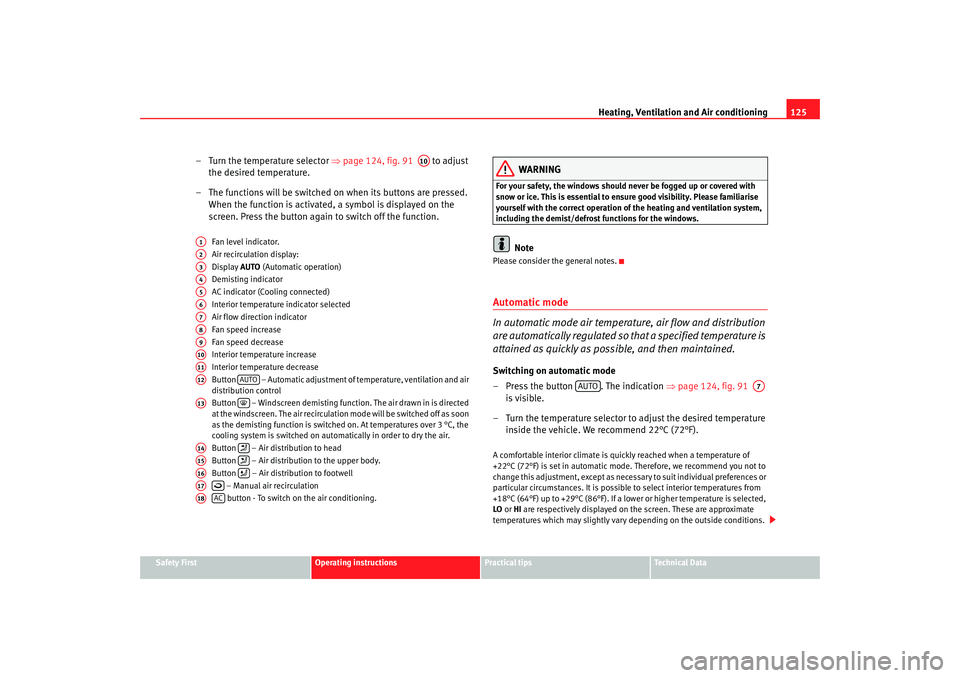
– Turn the temperature selector ⇒page 124, fig. 91 to adjust
the desired temperature.
– The functions will be switched on when its buttons are pressed. When the function is activated, a symbol is displayed on the
screen. Press the button again to switch off the function.
Fan level indicator.
Air recirculation display:
Display AUTO (Automatic operation)
Demisting indicator
AC indicator (Cooling connected)
Interior temperature indicator selected
Air flow direction indicator
Fan speed increase
Fan speed decrease
Interior temperature increase
Interior temperature decrease
Button – Automatic adjustment of temperature, ventilation and air
distribution control
Button – Windscreen demisting functi on. The air drawn in is directed
at the windscreen. The air recirculation mode will be switched off as soon
as the demisting function is switched on. At temperatures over 3 °C, the
cooling system is switched on automatically in order to dry the air.
Button – Air distribution to head
Button – Air distribution to the upper body.
Button – Air distribution to footwell
– Manual air recirculation button - To switch on the air conditioning.
WARNING
For your safety, the windows should never be fogged up or covered with
snow or ice. This is essential to ensure good visibility. Please familiarise
yourself with the correct operation of the heating and ventilation system,
including the demist/defrost functions for the windows.
Note
Please consider the general notes.Automatic mode
In automatic mode air temperatur e, air flow and distribution
are automatically regulated so that a specified temperature is
attained as quickly as possible, and then maintained.Switching on automatic mode
– Press the button . The indication ⇒page 124, fig. 91
is visible.
– Turn the temperature selector to adjust the desired temperature inside the vehicle. We recommend 22°C (72°F).A comfortable interior climate is quickly reached when a temperature of
+22°C (72°F) is set in automatic mode . Therefore, we recommend you not to
change this adjustment, except as necessary to suit individual preferences or
particular circumstances. It is possible to select interior temperatures from
+18°C (64°F) up to +29°C (86°F). If a lo wer or higher temperature is selected,
LO or HI are respectively displayed on the screen. These are approximate
temperatures which may slightly vary depending on the outside conditions.
A10
A1A2A3A4A5A6A7A8A9A10A11A12
AUTO
A13
A14
A15
A16
A17
A18
AC
AUTO
A7
Ibiza250_angles Seite 125 Dienstag, 5. August 2008 1:11 13
Page 129 of 260
Heating, Ventilation and Air conditioning 127
Safety First
Operating instructions
Practical tips
Te c h n i c a l D a t a
When the outside temperature is high, air recirculation mode improves
cooling performance by cooling air from the interior instead of warm air from
outside.
For safety reasons, the air recirculation
should not be switched on when the
air distribution control is being ad justed to the windscreen setting
.
WARNING
In air recirculation mode, no cold ai r from the outside enters the vehicle
interior. If the air conditioning system is switched off, the windows can
quickly mist over. Therefore, never leave the air recirculation mode
switched on for a long time (risk of accident).
Note
When engaging reverse gear, the air recirculation is connected automatically
to prevent the entrance of exhaust fumes in the vehicle on travelling back-
wards. In this case the symbol for air recirculation is not displayed.General notesThe impurity filter
The impurity filter (a combined particle filter and active carbon filter) serves
as a barrier against impurities in the ambient air, including dust and pollen.
For the air conditioning system to work with maximum efficiency, the pollen
filter must be replaced at the specified intervals in the Maintenance Program.
If the filter loses efficiency prematurely due to use in areas reaching very high
pollution levels, the pollen filter must be changed more frequently than
stated in the Service Schedule.
Caution
•
If you suspect that the air conditioning is damaged, switch it off with the
button to prevent further damage and have it checked by a qualified
workshop.
•
Repairs to the air conditioning system require specialist knowledge and
special tools. Therefore, we recommend you to take the vehicle to a qualified
workshop.Note
•
If the humidity and temperature outside the vehicle are high, condensa-
tion can drip off the evaporator in the cooling system and so forming a puddle
underneath the vehicle. This is completely normal and there is no need to
suspect a leak.
•
Keep the air intake slots in front of the windscreen free of snow, ice and
leaves to ensure heating and cooling are not impaired, and to prevent the
windows from misting over.
•
The air from the vents flows through the vehicle interior and is extracted
by slots designed for this purpose. Therefore, do not cover these slots with
items of clothing or other objects.
•
The air conditioning system operates most effectively with the windows
and the sliding/tilting roof* closed. However, if the vehicle has been over-
heated by sun, the air in side can be cooled quicklier by opening the windows
for a short time.
•
Do not smoke while air recirculation mode is on, as smoke drawn into the
air conditioning system leaves a residue on the evaporator, producing a
permanent unpleasant odour.
•
At low outside temperatures the comp ressor switches off automatically.
The button cannot be switched on either.
•
It is advisable to connect the air conditioning at least once a month, to
lubricate the system gasket s and prevent leaks. If a decrease in the cooling
capacity is detected, an Authorised Service Centre should be consulted to
check the system.
AC
AUTO
Ibiza250_angles Seite 127 Dienstag, 5. August 2008 1:11 13
Page 131 of 260
Driving129
Safety First
Operating instructions
Practical tips
Te c h n i c a l D a t a
DrivingAddressAdjusting the steering wheel position
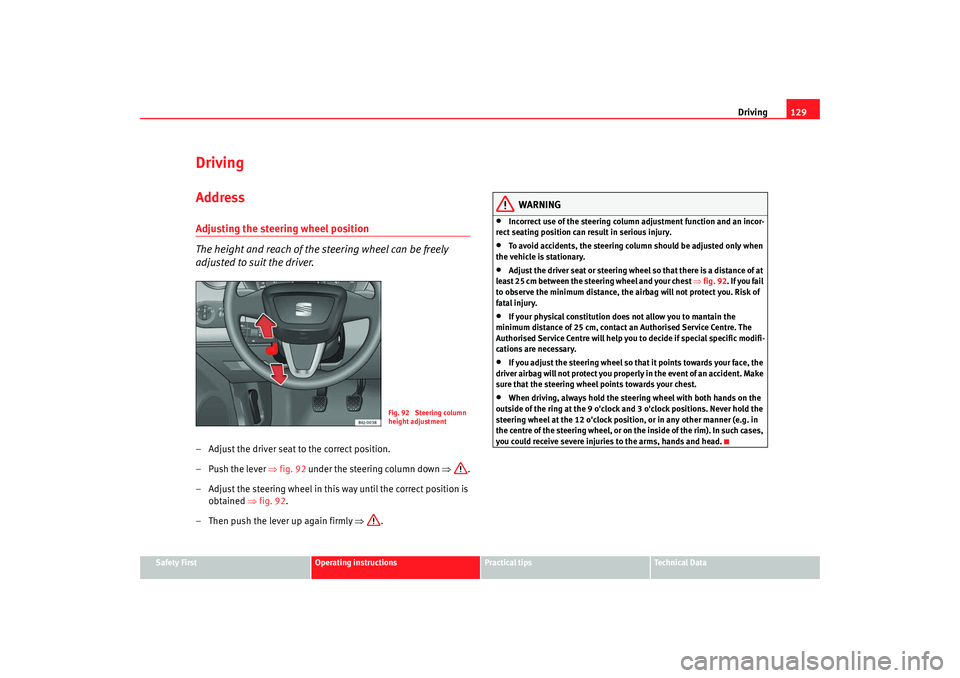
The height and reach of the steering wheel can be freely
adjusted to suit the driver.– Adjust the driver seat to the correct position.
–Push the lever ⇒fig. 92 under the steering column down ⇒ .
– Adjust the steering wheel in this way until the correct position is obtained ⇒fig. 92 .
– Then push the lever up again firmly ⇒.
WARNING
•
Incorrect use of the steering column adjustment function and an incor-
rect seating position can result in serious injury.
•
To avoid accidents, the steering column should be adjusted only when
the vehicle is stationary.
•
Adjust the driver seat or steering wheel so that there is a distance of at
least 25 cm between the steering wheel and your chest ⇒fig. 92 . If you fail
to observe the minimum distance, the airbag will not protect you. Risk of
fatal injury.
•
If your physical constitution do es not allow you to mantain the
minimum distance of 25 cm, contact an Authorised Service Centre. The
Authorised Service Centre will help you to decide if special specific modifi-
cations are necessary.
•
If you adjust the steering wheel so that it points towards your face, the
driver airbag will not protect you properly in the event of an accident. Make
sure that the steering wheel points towards your chest.
•
When driving, always hold the st eering wheel with both hands on the
outside of the ring at the 9 o'clock and 3 o'clock positions. Never hold the
steering wheel at the 12 o'clock positi on, or in any other manner (e.g. in
the centre of the steering wheel, or on the inside of the rim). In such cases,
you could receive severe injuries to the arms, hands and head.
Fig. 92 Steering column
height adjustment
Ibiza250_angles Seite 129 Dienstag, 5. August 2008 1:11 13
Page 132 of 260
Driving
130SafetyElectronic stabilisation programme (ESP)*
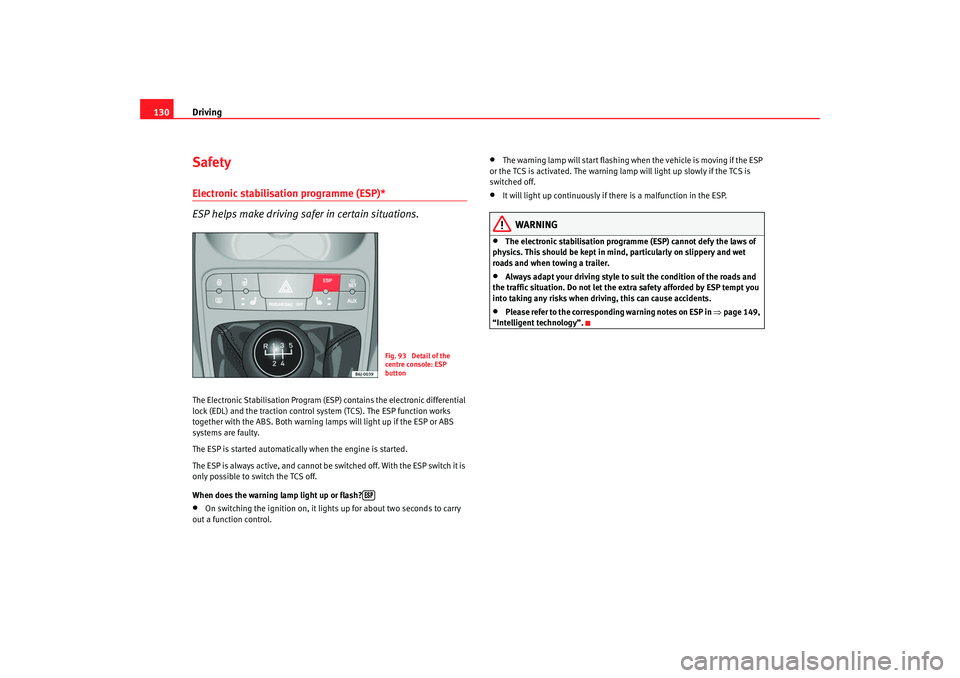
ESP helps make driving safer in certain situations.The Electronic Stabilisation Program (ESP ) contains the electronic differential
lock (EDL) and the traction control system (TCS). The ESP function works
together with the ABS. Both warning lamps will light up if the ESP or ABS
systems are faulty.
The ESP is started automatically when the engine is started.
The ESP is always active, and cannot be switched off. With the ESP switch it is
only possible to switch the TCS off.
When does the warning lamp light up or flash?•
On switching the ignition on, it lights up for about two seconds to carry
out a function control.
•
The warning lamp will start flashing wh en the vehicle is moving if the ESP
or the TCS is activated. The warning lamp will light up slowly if the TCS is
switched off.
•
It will light up continuously if there is a malfunction in the ESP.
WARNING
•
The electronic stabilisation programme (ESP) cannot defy the laws of
physics. This should be kept in mind, particularly on slippery and wet
roads and when towing a trailer.
•
Always adapt your driving style to su it the condition of the roads and
the traffic situation. Do not let the extra safety afforded by ESP tempt you
into taking any risks when driving, this can cause accidents.
•
Please refer to the corresponding warning notes on ESP in ⇒page 149,
“Intelligent technology”.
Fig. 93 Detail of the
centre console: ESP
button
Ibiza250_angles Seite 130 Dienstag, 5. August 2008 1:11 13
Page 133 of 260
Driving131
Safety First
Operating instructions
Practical tips
Te c h n i c a l D a t a
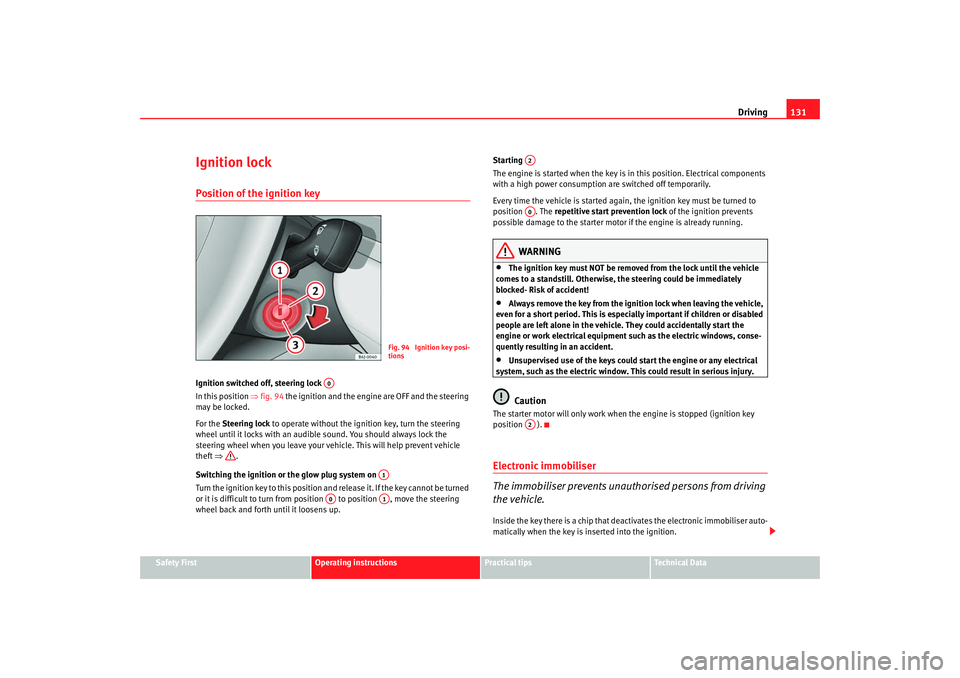
Ignition lockPosition of the ignition keyIgnition switched off, steering lock
In this position ⇒fig. 94 the ignition and the engine are OFF and the steering
may be locked.
For the Steering lock to operate without the ignition key, turn the steering
wheel until it locks with an audible sound. You should always lock the
steering wheel when you leave your vehicle. This will help prevent vehicle
theft ⇒ .
Switching the ignition or the glow plug system on
Turn the ignition key to this position an d release it. If the key cannot be turned
or it is difficult to turn from position to position , move the steering
wheel back and forth until it loosens up. Starting
The engine is started when the key is in this position. Electrical components
with a high power consumption are switched off temporarily.
Every time the vehicle is started again,
the ignition key must be turned to
position . The repetitive start prevention lock of the ignition prevents
possible damage to the starter motor if the engine is already running.
WARNING
•
The ignition key must NOT be removed from the lock until the vehicle
comes to a standstill. Otherwise, the steering could be immediately
blocked- Risk of accident!
•
Always remove the key from the ignition lock when leaving the vehicle,
even for a short period. This is especially important if children or disabled
people are left alone in the vehicle. They could accidentally start the
engine or work electrical equipment su ch as the electric windows, conse-
quently resulting in an accident.
•
Unsupervised use of the keys could start the engine or any electrical
system, such as the electric window. This could result in serious injury.Caution
The starter motor will only work when the engine is stopped (ignition key
position ).Electronic immobiliser
The immobiliser prevents unauthorised persons from driving
the vehicle.Inside the key there is a chip that deactivates the electronic immobiliser auto-
matically when the key is inserted into the ignition.
Fig. 94 Ignition key posi-
tions
A0
A1
A0
A1
A2A0A2
Ibiza250_angles Seite 131 Dienstag, 5. August 2008 1:11 13
Page 134 of 260
Driving
132The immobiliser will be activated again au tomatically as soon as you pull the
key out of the ignition lock.
The engine can only be started using a genuine SEAT key with its correct code.
Note
A perfect operation of the vehicle is ensured if genuine SEAT keys are used.Starting and stopping the engineStarting petrol engines
The engine can only be started using a genuine SEAT key with
its correct code.– Move the gear lever to the neutral position and depress the
clutch pedal thoroughly and hold it in this position for the starter
to turn the engine on.
– Turn the ignition key to the starting position ⇒page 131.
– Let go of the ignition key as soon as the engine starts; the starter motor must not run on with the engine.After starting a very hot engine, you may need to slightly press down the
accelerator.
When starting a very cold engine, it ma y be a little noisy for the first few
seconds until oil pressure has built up in the hydraulic valve compensators.
This is quite normal, and no cause for concern. If the engine does not start immediately, switch the starter off after
10 seconds and try again after half a minute. If the engine still does not start,
the fuel pump fuse should be checked
⇒page 211, “Fuses”.
WARNING
•
Never start or run the engine in unventilated or closed rooms. The
exhaust fumes contain carbon monoxide, an odourless and colourless
poisonous gas. Risk of fatal accidents. Carbon monoxide can cause loss of
consciousness. It can also cause death.
•
Never leave the vehicle unattended if the engine is running.
•
Never use “cold start sprays”, they could explode or cause the engine
to run at high revs. Risk of injury.Caution
•
When the engine is cold, you should av oid high engine speeds, driving at
full throttle and over-loading the engine. Risk of engine damage.
•
The vehicle should not be pushed or towed more than 50 metres to start
the engine. Unburnt fuel could enter the catalytic converter and damage it.
•
Before attempting to push-start or tow a vehicle in order to start it, you
should first try to start it using the battery of another vehicle. Note and follow
the instructions ⇒page 226, “Jump-starting”.For the sake of the environment
Do not warm-up the engine by running th e engine with the vehicle stationary.
You should drive off as soon as you start the engine. This helps the engine
reach operating temperature faster and reduces emissions.
Ibiza250_angles Seite 132 Dienstag, 5. August 2008 1:11 13
Page 135 of 260
Driving133
Safety First
Operating instructions
Practical tips
Te c h n i c a l D a t a
Starting diesel engines
The engine can only be started using a genuine SEAT key with
its correct code.– Move the gear lever to the ne utral position and depress the
clutch pedal thoroughly and hold it in this position for the starter
to turn the engine on.
– Turn the ignition key to the starting position.
– Turn the ignition key to position ⇒page 131, fig. 94 . The
indication lamp
will light for engine pre-heating.
– When the warning lamp turns off, turn the key to position to start the engine. Do not press the accelerator.
– Let go of the ignition key as soon as the engine starts, the starter motor must not be allowed to run on with the engine.
When starting a very cold engine, it may be a little noisy for the first few
seconds until oil pressure has built up in the hydraulic valve compensators.
This is quite normal, and no cause for concern.
If there are problems starting the engine, see ⇒page 226.
Glow plug system for the diesel engine
To avoid unnecessary discharging of th e battery, do not use any other major
electrical equipment while the glow plugs are pre-heating.
Start the engine as soon as the glow plug warning lamp turns off.
Starting the engine after the fuel tank has been completely run dry
If the fuel tank has been completely ru n dry, it may take longer than normal
(up to one minute) to start the engine af ter refuelling with diesel fuel. This is
because the system must eliminate air first.
WARNING
•
Never start or run the engine in unventilated or closed rooms. The
exhaust fumes contain carbon mono xide, an odourless and colourless
poisonous gas. Risk of fatal accidents. Carbon monoxide can cause loss of
consciousness. It can also cause death.
•
Never leave the vehicle unattended if the engine is running.
•
Never use “cold start sprays”, they could explode or cause the engine
to run at high revs. Risk of injury.Caution
•
When the engine is cold, you should avoid high engine speeds, driving at
full throttle and over-loading the engine. Risk of engine damage.
•
The vehicle should not be pushed or towed more than 50 metres to start
the engine. Unburnt fuel could enter th e catalytic converter and damage it.
•
Before attempting to push-start or tow a vehicle in order to start it, you
should first try to start it using the batt ery of another vehicle. Note and follow
the instructions ⇒page 226, “Jump-starting”.For the sake of the environment
Do not warm-up the engine by running th e engine with the vehicle stationary.
You should drive off as soon as you start the engine. This helps the engine
reach operating temperature faster and reduces emissions.Switching the engine off– Stop the engine.
– Turn the ignition key to position ⇒page 131, fig. 94 .
A1
A2
A0
Ibiza250_angles Seite 133 Dienstag, 5. August 2008 1:11 13
Page 136 of 260
Driving
134After switching the engine off, the radiator fan may run on for up to 10
minutes. It is also possible that the fan turns itself on once more if the coolant
temperature increases due to the heat accumulated in the engine compart-
ment or due to its prolonged exposure to solar radiation.
WARNING
•
Never switch the engine off until the vehicle is completely stationary.
•
The brake servo works only when the engine is running. With the
engine switched off, more strength is needed to brake. As normal brake
operation cannot be performed, risk of accidents and serious injury may
exist.
•
The steering lock can be immediately blocked once the key is removed
from the ignition lock. The vehicle cannot be steered. Risk of accident.Caution
If the engine has been driven hard for a long period, the engine could over-
heat when it is switched off. Risk of engine damage. For this reason, you
should idle the engine for approx. 2 m inutes before you switch it off.
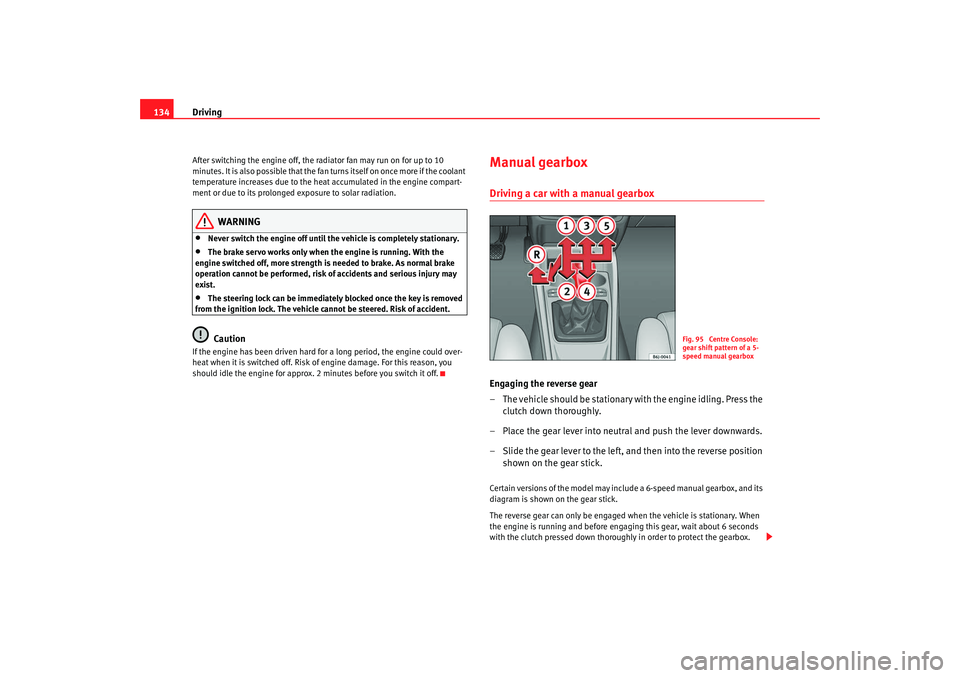
Manual gearboxDriving a car with a manual gearboxEngaging the reverse gear
– The vehicle should be stationary with the engine idling. Press the
clutch down thoroughly.
– Place the gear lever into neutral and push the lever downwards.
– Slide the gear lever to the left, and then into the reverse position shown on the gear stick.Certain versions of the model may include a 6-speed manual gearbox, and its
diagram is shown on the gear stick.
The reverse gear can only be engaged when the vehicle is stationary. When
the engine is running and before engagi ng this gear, wait about 6 seconds
with the clutch pressed down thoroughly in order to protect the gearbox.
Fig. 95 Centre Console:
gear shift pattern of a 5-
speed manual gearbox
Ibiza250_angles Seite 134 Dienstag, 5. August 2008 1:11 13