lock Seat Ibiza 5D 2008 Workshop Manual
[x] Cancel search | Manufacturer: SEAT, Model Year: 2008, Model line: Ibiza 5D, Model: Seat Ibiza 5D 2008Pages: 260, PDF Size: 8.11 MB
Page 152 of 260
Intelligent technology
150Do not let the extra safety features tempt you into taking any risks when
driving.Anti-lock brake system and traction control
ABSAnti-lock brake system (ABS)
The anti-lock brake system prevents the wheels locking
during braking.The anti-lock brake system (ABS) is an important part of the vehicle's active
safety system.
How the ABS works
If one of the wheels is turns too slowly in relation to the road speed, and is
close to locking, the system will reduce the braking pressure for this wheel.
The driver is made aware of this control process by a pulsating of the brake
pedal and audible noise. This is a deliberate warning to the driver that one or
more of the wheels is tending to lock and the ABS control function has inter-
vened. In this situation it is important to keep the brake pedal fully depressed
so the ABS can regulate the brake application. Do not “pump”.
If you brake hard on a slippery road surface, the best possible control is
retained as the wheels do not lock.
However, ABS will not necessarily guarantee shorter braking distances in all
conditions. The braking distance could even be longer if you brake on gravel
or on fresh snow covering a slippery surface.
WARNING
•
The anti-lock brake system cannot defy the laws of physics. Slippery
and wet roads are dangerous even with ABS! If you notice that the ABS is
working (to counteract locked wheels under braking), you should reduce
speed immediately to suit the road and traffic conditions. Do not let the
extra safety features tempt you into taking any risks when driving.
•
The effectiveness of ABS is also determined by the tyres fitted
⇒ page 197.
•
If the running gear or brakes are mo dified, the effectiveness of the ABS
could be severely limited.
Traction control system (TCS)*
The traction control system prevents the drive wheels from
spinning when the car is acce lerating. The system always
includes ABSDescription and operation of the traction control system during acceleration
(TCS)
TCS reduces engine power to help prevent the drive wheels of front-wheel
drive vehicles losing traction during acceleration. The system works in the
entire speed range in conjunction with ABS. If a malfunction should occur in
the ABS, the TCS will also be out of action.
TCS helps the vehicle to start moving, accelerate and climb a gradient in slip-
pery conditions where this may otherwise be difficult or even impossible.
The TCS is switched on automatically when the engine is started. If necessary,
it may be turned on or off by briefly pushing the ESP button on the centre
console.
When the TCS is switched off, the warning lamp flashes slowly. The TCS
should normally be left switched on at all times. Only in exceptional circum-
WARNING (continued)
Ibiza250_angles Seite 150 Dienstag, 5. August 2008 1:11 13
Page 154 of 260
Intelligent technology
152
Caution•
In order to ensure that ESP functions correctly, all four wheels must be
fitted with the same tyres. Any differences in the rolling radius of the tyres can
cause the system to reduce engine power when this is not desired.
•
Modifications to the vehicle (e.g. to the engine, the brake system, running
gear or any components affecting the wheels and tyres) could affect the effi-
ciency of the ABS, EDL, ESP and TCS.
Anti-lock brake system (ABS)The anti-lock brake system prevents the wheels locking during braking
⇒ page 150.Electronic differential lock (EDL)*
The electronic differential lock helps prevent the loss of trac-
tion caused if one of the driven wheels starts spinning.EDL helps the vehicle to start moving, accelerate and climb a gradient in slip-
pery conditions where this may otherwise be difficult or even impossible.
The system will control the revolutions of the drive wheels using the ABS
sensors (in case of an EDL fault the warning lamp for ABS lights up)
⇒page 61.
At speeds of up to approximately 80 km/h, it is able to balance out differ-
ences in the speed of the driven wheel s of approximately 100 rpm caused by
a slippery road surface on one side of the vehicle. It does this by braking the
wheel which has lost traction and distributing more driving force to the other
driven wheel via the differential. To prevent the disc brake of the braking wheel from overheating, the EDL cuts
out automatically if subjected to excessive loads. The vehicle will continue to
function normally without EDL. For this
reason, the driver is not informed that
the EDL has been switched off.
The EDL will switch on again automatically when the brake has cooled down.
WARNING
•
When accelerating on a slippery surface, for example on ice and snow,
press the accelerator carefully. Despite EDL, the driven wheels may start to
sp in. This could impair the vehicle' s stability.
•
Always adapt your driving style to su it road conditions and the traffic
situation. Do not let the extra safety afforded by EDL tempt you into taking
any risks when driving, this can cause accidents.Caution
Modifications to the vehi cle (e.g. to the engine, the brake system, running
gear or any components affecting the wheels and tyres) could affect the effi-
ciency of the EDL. ⇒page 173The traction control system (TCS)The traction control system prevents the drive wheels from spinning when the
car is accelerating ⇒page 150.
Ibiza250_angles Seite 152 Dienstag, 5. August 2008 1:11 13
Page 156 of 260
Driving and the environment
154If you drive with wet brakes, for example, after crossing areas of water, in
heavy rainfall or even after washing the car, the effect of the brakes is less-
ened as the brake discs are wet or even frozen (in winter): The brakes should
be “dried” by pressing the pedal to restore full braking effect.
WARNING
Longer braking distances and faults in the brake system increase the risk
of accidents.•
New brake pads must be run in and do not have the correct friction
during the first 200 km. However, the reduced braking capacity may be
compensated by pressing on the brake pedal a little harder. This also
applies when new brake pads are fitted.
•
If brakes are wet or frozen, or if you are driving on roads which have
been gritted with salt, braking power may set in later than normal.
•
On steep slopes, if brakes are excessively used, they will overheat.
Before driving down a long steep slope, it is advisable to reduce speed and
change down into a lower gear (or move the selector lever to a lower gear if
your vehicle has automatic transmission). This makes use of engine
braking and relieves the brakes.
•
Never let the brakes “slip” by applying light pressure. Continuous
braking will cause the brakes to overheat and the braking distance will
increase. Apply and then release the brakes alternately.
•
Never let the vehicle run with the engine switched off. The braking
distance is increased considerably when the brake servo is not active.
•
Very heavy use of the brakes may cause a vapour lock if the brake fluid
is left in the system for too long. This impairs the braking effect.
•
Non-standard or damaged front spoilers could restrict the airflow to the
brakes and cause them to overheat. Observe the relevant instructions
before purchasing accessories ⇒ page 173, “Technical modifications”.
•
If a brake circuit fails, the braking distance will be increased consider-
ably. Contact a qualified workshop immediately and avoid unnecessary
journeys.
Exhaust gas purification systemCatalytic converter*To conserve the useful life of the catalytic converter
– Always use unleaded petrol.
– Do not let the fuel get too low in the tank.
– For engine oil changes, do not top the reservoir up ⇒page 187,
“Topping up engine oil ”.
– Never tow the vehicle to start it, use jump leads if necessary ⇒page 226.If you notice misfiring, uneven running or loss of power when the vehicle is
moving, reduce speed immediately and have the vehicle inspected at the
nearest qualified workshop. In general, the exhaust warning lamp will light
up when any of the described symptoms occur ⇒page 57. If this happens,
unburnt fuel can enter the exhaust system and escape into the environment.
The catalytic converter can also be damaged by overheating.
WARNING
The catalytic converter reaches very high temperatures! Fire hazard!•
Never park where the catalytic convert er could come into contact with
dry grass or inflammable materials under the vehicle.
•
Do not apply additional underseal or anti-corrosion coatings to the
exhaust pipes, catalytic converter or the heat shields on the exhaust
system. These materials could catch fire when the vehicle is being driven.
Ibiza250_angles Seite 154 Dienstag, 5. August 2008 1:11 13
Page 165 of 260
Driving and the environment163
Safety First
Operating instructions
Practical tips
Te c h n i c a l D a t a
an unfavourable road, weather or wind conditions. This applies especially
when driving downhill.
You should always reduce speed immediat
ely if the trailer shows the slightest
sign of snaking . Never try to stop the “snaking” by increasing speed.
Always brake in due course. If the trailer has an overrun brake, apply the
brakes gently at first and then, firmly. This will prevent the jerking that can be
caused by the trailer wheels locking. Se lect a low gear in due course before
going down a steep downhill. This enables you to use the engine braking to
slow down the vehicle.
Reheating
At very high temperatures and during prolonged ascents, driving in a low gear
and high engine speed, always monitor the temperature indicator for the
coolant ⇒page 49.
Electronic Stabilisation Program*
The ESP* system helps to stabilise the trailer in case of skiding or rocking.
Ibiza250_angles Seite 163 Dienstag, 5. August 2008 1:11 13
Page 170 of 260
Your vehicle maintenance and cleaning
168If possible, use a de-icing spray to remove ice. If you use an ice scraper, push
it in one direction only without swinging it.
Use window cleaner or a silicone remove r to clean rubber, oil, grease and sili-
cone deposits off.
Wax deposits can be removed with a spec ial cleaner available in your Author-
ised Service Centre. Wax deposits on the windscreen could cause the wiper
blades to judder. If a window cleanser, specifically for removing wax, is added
to the windscreen washer fluid prevents wiper blades from juddering. Wax
deposits are not removed.
Caution
•
Never use warm or hot water to remove snow and ice from windows and
mirrors. This could cause the glass to crack!
•
The heating element for the rear window is located on the inner side of the
window. To prevent damage, do not put stickers on the heating elements
inside the window.
Cleaning windscreen wiper bladesClean wiper blades are essential to provide clear vision.
1. Use a soft cloth to remove dust and dirt from the windscreen wiper blades.
2. Use window cleanser to clean the windscreen wiper blades. Use a sponge or a cloth to remove stubborn stains.
Rubber seals maintenance
If rubber seals are well looked after, they will not freeze so
quickly.1. Use a soft cloth to remove dust and dirt from the rubber seals.
2. Apply a specialist care product to the rubber seals.The strips on the doors, windows, bonnet and rear lid will remain pliable and
last longer if they are treated with a suit able care product (for example sili-
cone spray).
Caring for rubber seals will also prevent premature ageing and leaks. The
doors will be easier to open. If rubber seals are well looked after, they will not
freeze so quickly in winter.Door lock cylinders
The door lock cylinders can freeze up in winter.To de-ice the lock cylinders you should only use spray with lubricating and
anti-corrosive properties.Cleaning chrome parts1. Clean chrome parts with a damp cloth.
2. Polish chrome parts with a soft, dry cloth.
Ibiza250_angles Seite 168 Dienstag, 5. August 2008 1:11 13
Page 180 of 260
Checking and refilling levels
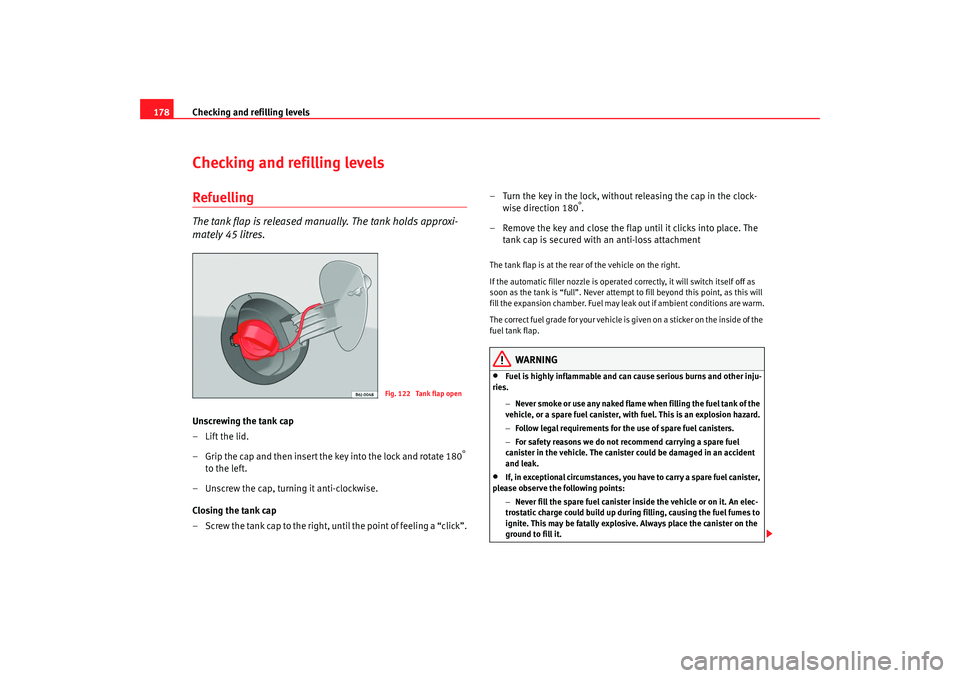
178Checking and refilling levelsRefuellingThe tank flap is released manually. The tank holds approxi-
mately 45 litres.Unscrewing the tank cap
–Lift the lid.
– Grip the cap and then insert the key into the lock and rotate 180
°
to the left.
– Unscrew the cap, turning it anti-clockwise.
Closing the tank cap
– Screw the tank cap to the right, until the point of feeling a “click”. – Turn the key in the lock, without releasing the cap in the clock-
wise direction 180
°.
– Remove the key and close the flap until it clicks into place. The tank cap is secured with an anti-loss attachment
The tank flap is at the rear of the vehicle on the right.
If the automatic filler nozzle is operated correctly, it will switch itself off as
soon as the tank is “full”. Never attempt to fill beyond this point, as this will
fill the expansion chamber. Fuel may leak out if ambient conditions are warm.
The correct fuel grade for your vehicle is given on a sticker on the inside of the
fuel tank flap.
WARNING
•
Fuel is highly inflammable and can cause serious burns and other inju-
ries.
−Never smoke or use any naked flame when filling the fuel tank of the
vehicle, or a spare fuel canister, with fuel. This is an explosion hazard.
− Follow legal requirements for the use of spare fuel canisters.
− For safety reasons we do not recommend carrying a spare fuel
canister in the vehicle. The canister could be damaged in an accident
and leak.
•
If, in exceptional circumstances, you have to carry a spare fuel canister,
please observe the following points:
−Never fill the spare fuel canister inside the vehicle or on it. An elec-
trostatic charge could build up during filling, causing the fuel fumes to
ignite. This may be fatally explosive. Always place the canister on the
ground to fill it.
Fig. 122 Tank flap open
Ibiza250_angles Seite 178 Dienstag, 5. August 2008 1:11 13
Page 184 of 260
Checking and refilling levels
182•
Avoid causing short-circuits in the electrical system, particularly at the
points where the jump leads are attached ⇒page 227. The battery could
explode.
•
Never touch the radiator fan. It is temperature controlled and could
start automatically, even when the engine has been switched off and the
key removed from the ignition!
•
Do not unscrew the cap on the expansion tank when the engine is hot.
If the coolant is hot, the cooling system will be pressurised!
•
Protect face, hands and arms by covering the cap with a large, thick
cloth to protect against escaping coolant and steam.
•
Always make sure you have not left any objects, such as cleaning cloths
and tools, in the engine compartment.
•
If you have to work underneath the vehicle, you must use suitable
stands additionally to support the vehicle, there is a risk of accident!. A
hydraulic jack is insufficient for securing the vehicle and there is a risk of
injury.
•
If any work has to be performed when the engine is started or with the
engine running, there is an additional, potentially fatal, safety risk from the
rotating parts, such as the drive belts, alternator, radiator fan, etc., and
from the high-voltage ignition syst em. You should also observe the
following points:
−Never touch the electrical wiri ng of the ignition system.
− Ensure that jewellery, loose clothing and long hair do not get
trapped in rotating engine parts. Danger of death. Before starting any
work remove jewellery, tie back and cover hair, and wear tight-fitting
clothes.
− Always think carefully about pressing the accelerator if a gear is
engaged in either an automatic or manual gearbox. The vehicle could
move, even if the handbrake is applied. Danger of death.
•
If work has to be carried out on the fuel system or on electrical compo-
nents, you must observe the following safety notes in addition to the above
warnings:
−Always disconnect the battery. The vehicle must be unlocked when
this is done, otherwise the alarm will be triggered.
− Do not smoke.
− Never work near naked flames.
− Always have a fire extinguisher on hand.Caution
When changing or topping up service fluids, make absolutely certain that you
fill the fluids into the correct reservoirs. Failure to observe this point will result
in serious malfunctions and engine damage!
For the sake of the environment
Service fluids leaks are harmful to th e environment. For this reason you
should make regular checks on the ground underneath your vehicle. If you
find spots of oil or other fluids, have your vehicle inspected in a qualified
workshop.
WARNING (continued)
WARNING (continued)
Ibiza250_angles Seite 182 Dienstag, 5. August 2008 1:11 13
Page 185 of 260
Checking and refilling levels183
Safety First
Operating instructions
Practical tips
Te c h n i c a l D a t a
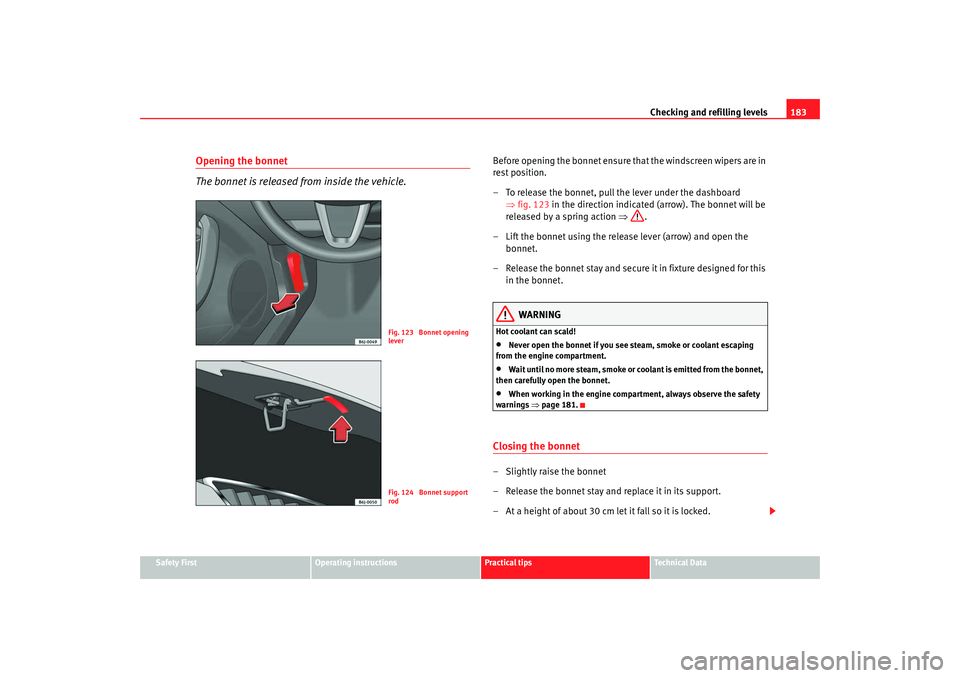
Opening the bonnet
The bonnet is released from inside the vehicle.
Before opening the bonnet ensure that the windscreen wipers are in
rest position.
– To release the bonnet, pull the lever under the dashboard
⇒fig. 123 in the direction indicated (arrow). The bonnet will be
released by a spring action ⇒.
– Lift the bonnet using the rele ase lever (arrow) and open the
bonnet.
– Release the bonnet stay and secure it in fixture designed for this in the bonnet.
WARNING
Hot coolant can scald!•
Never open the bonnet if you see steam, smoke or coolant escaping
from the engine compartment.
•
Wait until no more steam, smoke or coolant is emitted from the bonnet,
then carefully open the bonnet.
•
When working in the engine compartm ent, always observe the safety
warnings ⇒page 181.
Closing the bonnet– Slightly raise the bonnet
– Release the bonnet stay and replace it in its support.
– At a height of about 30 cm let it fall so it is locked.
Fig. 123 Bonnet opening
leverFig. 124 Bonnet support
rod
Ibiza250_angles Seite 183 Dienstag, 5. August 2008 1:11 13
Page 193 of 260
Checking and refilling levels191
Safety First
Operating instructions
Practical tips
Te c h n i c a l D a t a
WARNING
Any work carried out in the engine compartment or on the engine must be
carried out cautiously.•
When working in the engine compartment, always observe the safety
warnings ⇒ page 181.Caution
•
Never put radiator anti-freeze or other additives into the windscreen
washer fluid.
•
Always use approved windscreen cleansing products diluted as per
instructions. If you use other washer fluids or soap solutions, the tiny holes
in the fan-shaped nozzles could become blocked.
Changing windscreen wiper blades
If the windscreen wiper blades are in perfect condition, you
will benefit from an improved visibility. Damaged wiper
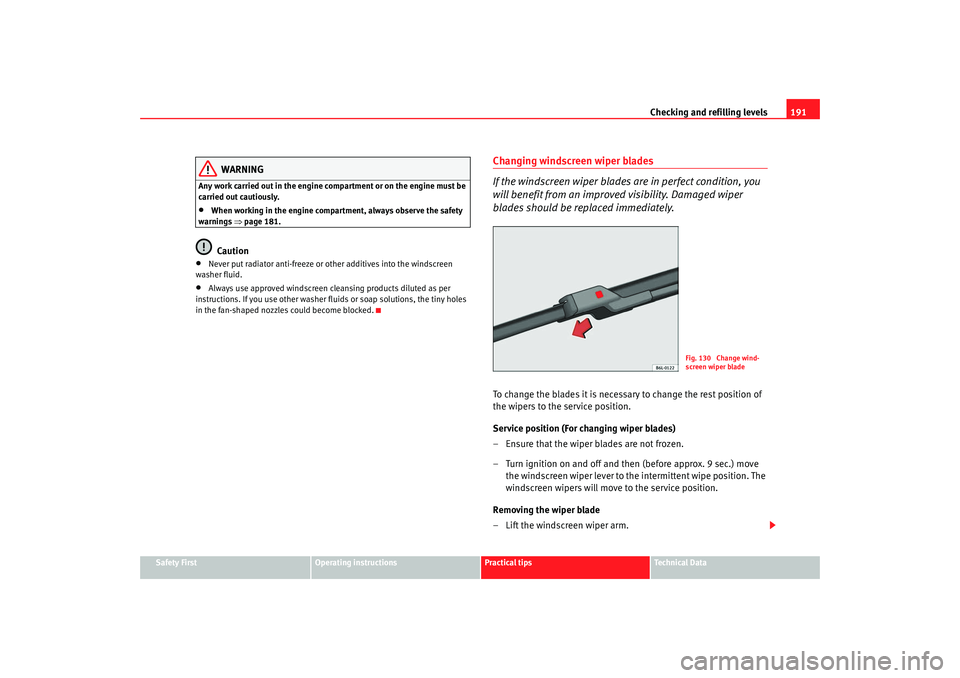
blades should be replaced immediately.To change the blades it is necessary to change the rest position of
the wipers to the service position.
Service position (For changing wiper blades)
– Ensure that the wiper blades are not frozen.
– Turn ignition on and off and then (before approx. 9 sec.) move the windscreen wiper lever to the intermittent wipe position. The
windscreen wipers will move to the service position.
Removing the wiper blade
– Lift the windscreen wiper arm.
Fig. 130 Change wind-
screen wiper blade
Ibiza250_angles Seite 191 Dienstag, 5. August 2008 1:11 13
Page 196 of 260
Checking and refilling levels
194However, if the level goes down noticeably in a short time, or drops below the
“MIN” mark, there may be a leak in the brake system. A display on the instru-
ment panel will warn you if the brake fluid level is too low ⇒page 57.
WARNING
Before opening the bonnet to check the brake fluid level, please read and
observe the warnings ⇒ page 181.Changing the brake fluid
The Maintenance Program indicates the brake fluid change
intervals.We recommend that you have the brake fluid changed by an Authorised
Service Centre.
Before opening the bonnet, please read and observe the warnings ⇒ in
“Safety instructions on working in the engine compartment” on page 181 in
“Working in the engine compartment”.
Brake fluid absorbs moisture. In the cour se of time, it will absorb water from
the ambient air. If the water content in the brake fluid is too high, the brake
system could corrode. This also considerably reduces the boiling point of the
brake fluid. Heavy use of the brakes may then cause a vapour lock which
could impair the braking effect.
It is important that you use only brake fluid compliant with the US standard
FMVSS 116 DOT 4. We recommend the use of Genuine SEAT brake fluid.
WARNING
Brake fluid is poisonous. Old brake fluid impairs the braking effect.
•
Before opening the bonnet to check the brake fluid level, please read
and observe the warnings ⇒page 181.
•
Brake fluid should be stored in the closed original container in a safe
place out of reach of children. There is a toxic risk.
•
Complete the brake fluid change according to the Maintenance
Program. Heavy use of the brakes may cause a vapour lock if the brake fluid
is left in the system for too long. Th is would seriously affect the efficiency
of the brakes and the safety of the vehicle. This may cause an accident.Caution
Brake fluid could damage the paintwork. Wipe off any brake fluid from the
paintwork immediately.
For the sake of the environment
Brake fluid must be drained and disposed of in the proper manner observing
environmental regulations.
WARNING (continued)
Ibiza250_angles Seite 194 Dienstag, 5. August 2008 1:11 13