roof Seat Ibiza 5D 2008 Owner's manual
[x] Cancel search | Manufacturer: SEAT, Model Year: 2008, Model line: Ibiza 5D, Model: Seat Ibiza 5D 2008Pages: 260, PDF Size: 8.11 MB
Page 5 of 260
Contents3
ContentsManual structure
. . . . . . . . . . . . . . . . . . . .
Content
. . . . . . . . . . . . . . . . . . . . . . . . . . . . . . . .
Safety First
. . . . . . . . . . . . . . . . . . . . . . . . . . .
Safe driving
. . . . . . . . . . . . . . . . . . . . . . . . . . . . . .
Brief introduction . . . . . . . . . . . . . . . . . . . . . . . .
Proper sitting position for occupants . . . . . . . . .
Pedal area . . . . . . . . . . . . . . . . . . . . . . . . . . . . . .
Stowing luggage . . . . . . . . . . . . . . . . . . . . . . . . .
Seat belts
. . . . . . . . . . . . . . . . . . . . . . . . . . . . . . . .
Brief Introduction . . . . . . . . . . . . . . . . . . . . . . . .
Why wear seat belts? . . . . . . . . . . . . . . . . . . . . . .
Seat belts . . . . . . . . . . . . . . . . . . . . . . . . . . . . . . .
Belt tension devices* . . . . . . . . . . . . . . . . . . . . .
Airbag system
. . . . . . . . . . . . . . . . . . . . . . . . . . . .
Brief introduction . . . . . . . . . . . . . . . . . . . . . . . .
Front airbags . . . . . . . . . . . . . . . . . . . . . . . . . . . .
Side airbags . . . . . . . . . . . . . . . . . . . . . . . . . . . . .
Curtain airbags . . . . . . . . . . . . . . . . . . . . . . . . . .
Deactivating airbags* . . . . . . . . . . . . . . . . . . . . .
Child safety
. . . . . . . . . . . . . . . . . . . . . . . . . . . . . .
Brief introduction . . . . . . . . . . . . . . . . . . . . . . . .
Child seats . . . . . . . . . . . . . . . . . . . . . . . . . . . . . .
Securing child seats . . . . . . . . . . . . . . . . . . . . . .
Operating instructions
. . . . . . . . . . . .
Cockpit
. . . . . . . . . . . . . . . . . . . . . . . . . . . . . . . . . . .
Overview . . . . . . . . . . . . . . . . . . . . . . . . . . . . . . .
Instruments . . . . . . . . . . . . . . . . . . . . . . . . . . . . .
Digital display in the instrument panel . . . . . . .
Warning lamps . . . . . . . . . . . . . . . . . . . . . . . . . . .
Steering column controls*
. . . . . . . . . . . . . . . .
General information . . . . . . . . . . . . . . . . . . . . . .
Audio Control . . . . . . . . . . . . . . . . . . . . . . . . . . . .
Audio + Telephone Control . . . . . . . . . . . . . . . . .
Unlocking and locking
. . . . . . . . . . . . . . . . . . . .
Central locking . . . . . . . . . . . . . . . . . . . . . . . . . . .
Keys . . . . . . . . . . . . . . . . . . . . . . . . . . . . . . . . . . .
Radio frequency remote control . . . . . . . . . . . . .
Anti-theft alarm system* . . . . . . . . . . . . . . . . . . .
Tailgate . . . . . . . . . . . . . . . . . . . . . . . . . . . . . . . . .
Windows . . . . . . . . . . . . . . . . . . . . . . . . . . . . . . .
Panoramic tilting roof* . . . . . . . . . . . . . . . . . . . .
Lights and visibility
. . . . . . . . . . . . . . . . . . . . . . .
Lights . . . . . . . . . . . . . . . . . . . . . . . . . . . . . . . . . .
Interior lights . . . . . . . . . . . . . . . . . . . . . . . . . . . .
Visibility . . . . . . . . . . . . . . . . . . . . . . . . . . . . . . . .
Windscreen washers . . . . . . . . . . . . . . . . . . . . . .
Rearview mirrors . . . . . . . . . . . . . . . . . . . . . . . . .
Seats and stowage
. . . . . . . . . . . . . . . . . . . . . . .
The importance of correct seat adjustment . . . .
Head restraints . . . . . . . . . . . . . . . . . . . . . . . . . .
Front seats . . . . . . . . . . . . . . . . . . . . . . . . . . . . . .
Rear seat bench . . . . . . . . . . . . . . . . . . . . . . . . . .
Stowage compartments . . . . . . . . . . . . . . . . . . .
Ashtrays, cigarette lighter and power point . . . First-aid kit, warning triangle, fire extinguisher*
Boot . . . . . . . . . . . . . . . . . . . . . . . . . . . . . . . . . . .
Heating, Ventilation and Air conditioning
. .
Heating . . . . . . . . . . . . . . . . . . . . . . . . . . . . . . . . .
Air conditioning* . . . . . . . . . . . . . . . . . . . . . . . . .
Climatronic . . . . . . . . . . . . . . . . . . . . . . . . . . . . . .
General notes . . . . . . . . . . . . . . . . . . . . . . . . . . .
Driving
. . . . . . . . . . . . . . . . . . . . . . . . . . . . . . . . . . .
Address . . . . . . . . . . . . . . . . . . . . . . . . . . . . . . . .
Safety . . . . . . . . . . . . . . . . . . . . . . . . . . . . . . . . . .
Ignition lock . . . . . . . . . . . . . . . . . . . . . . . . . . . . .
Starting and stopping the engine . . . . . . . . . . .
Manual gearbox . . . . . . . . . . . . . . . . . . . . . . . . . .
Automatic gearbox* . . . . . . . . . . . . . . . . . . . . . .
Handbrake . . . . . . . . . . . . . . . . . . . . . . . . . . . . . .
Acoustic parking aid system* . . . . . . . . . . . . . . .
Cruise control system (CCS)* . . . . . . . . . . . . . . .
Practical tips
. . . . . . . . . . . . . . . . . . . . . . . . .
Intelligent technology
. . . . . . . . . . . . . . . . . . . . .
Brakes . . . . . . . . . . . . . . . . . . . . . . . . . . . . . . . . .
Anti-lock brake system and traction control ABS
Electronic stabilisation programme (ESP)* . . . .
Driving and the environment
. . . . . . . . . . . . . .
Running-in . . . . . . . . . . . . . . . . . . . . . . . . . . . . . .
Exhaust gas purification system . . . . . . . . . . . . .
Economical and environmentally-friendly driving
Driving abroad . . . . . . . . . . . . . . . . . . . . . . . . . . .
Trailer towing . . . . . . . . . . . . . . . . . . . . . . . . . . . .
5
6
7
7
7
9
14
15
16
16
18
21
25
26
26
29
31
35
38
40
40
42
45 49
49
49
51
52
57
68
68
68
70
72
72
77
78
79
82
84
87
89
89
95
96
97
100
103
103
104
106
108
109
113 115
115
118
118
121
124
127
129
129
130
131
132
134
135
142
144
145
149
149
149
150
151
153
153
154
155
157
161
Ibiza250_angles Seite 3 Dienstag, 5. August 2008 1:11 13
Page 6 of 260
Contents
4Your vehicle maintenance and cleaning
. . . .
General notes . . . . . . . . . . . . . . . . . . . . . . . . . . .
Vehicle exterior maintenance . . . . . . . . . . . . . . .
Vehicle interior maintenance . . . . . . . . . . . . . . .
Accessories, parts replacement and
modifications
. . . . . . . . . . . . . . . . . . . . . . . . . . . .
Accessories and spare parts . . . . . . . . . . . . . . . .
Technical modifications . . . . . . . . . . . . . . . . . . .
Roof aerial* . . . . . . . . . . . . . . . . . . . . . . . . . . . . .
Mobile telephones and two-way radios . . . . . . .
Fitting a towing bracket* . . . . . . . . . . . . . . . . . . .
Checking and refilling levels
. . . . . . . . . . . . . .
Refuelling . . . . . . . . . . . . . . . . . . . . . . . . . . . . . . .
Petrol . . . . . . . . . . . . . . . . . . . . . . . . . . . . . . . . . .
Diesel . . . . . . . . . . . . . . . . . . . . . . . . . . . . . . . . . .
Working in the engine compartment . . . . . . . . .
Engine oil . . . . . . . . . . . . . . . . . . . . . . . . . . . . . . .
Coolant . . . . . . . . . . . . . . . . . . . . . . . . . . . . . . . . .
Washer fluid and windscreen wiper blades . . . .
Brake fluid . . . . . . . . . . . . . . . . . . . . . . . . . . . . . .
Battery . . . . . . . . . . . . . . . . . . . . . . . . . . . . . . . . .
Wheels . . . . . . . . . . . . . . . . . . . . . . . . . . . . . . . . .
If and when
. . . . . . . . . . . . . . . . . . . . . . . . . . . . . .
Vehicle tools, spare wheel . . . . . . . . . . . . . . . . .
Wheel change . . . . . . . . . . . . . . . . . . . . . . . . . . .
Tyre repair kit (Tyre-Mobility-System)* . . . . . . . .
Fuses . . . . . . . . . . . . . . . . . . . . . . . . . . . . . . . . . .
Bulb change . . . . . . . . . . . . . . . . . . . . . . . . . . . . .
Jump-starting . . . . . . . . . . . . . . . . . . . . . . . . . . . .
Towing and tow-starting . . . . . . . . . . . . . . . . . . .
Te c h n i c a l D a t a
. . . . . . . . . . . . . . . . . . . . . . .
General notes on the technical data
. . . . . . .
Outstanding information . . . . . . . . . . . . . . . . . .
Data on fuel consumption . . . . . . . . . . . . . . . . . Towing a trailer . . . . . . . . . . . . . . . . . . . . . . . . . .
Wheels . . . . . . . . . . . . . . . . . . . . . . . . . . . . . . . . .
Techn ical Data
. . . . . . . . . . . . . . . . . . . . . . . . . . . .
Checking fluid levels . . . . . . . . . . . . . . . . . . . . . .
Petrol engine 1.2 51kW (70 CV) . . . . . . . . . . . . .
Petrol engine 1.4l 63 kW (85 bhp) . . . . . . . . . . .
Petrol engine 1.6l 77 kW (105 bhp) . . . . . . . . . .
Diesel engine 1.4 litre TDI 59 kW (80 bhp) . . . .
Diesel engine 1.9l TDI 66 kW (90 bhp) . . . . . . .
Diesel engine 1.9l TDI 77 kW (105 bhp) . . . . . .
Dimensions and capacities . . . . . . . . . . . . . . . .
Index
. . . . . . . . . . . . . . . . . . . . . . . . . . . . . . . . . .
164
164
165
171
173
173
173
174
174
176
178
178
179
180
181
184
188
190
193
195
197
203
203
204
209
211
218
226
229
233
233
233
235 236
236
238
238
239
240
241
243
244
245
247
249
Ibiza250_angles Seite 4 Dienstag, 5. August 2008 1:11 13
Page 29 of 260
Airbag system27
Safety First
Operating instructions
Practical tips
Te c h n i c a l D a t a
•
Always properly adjust the front seats.
The danger of fitting a child seat on the front passenger seat
Rear-facing child seats must never be used on the front
passenger seat when the front passenger airbag is enabled.An enabled front airbag on the front passenger side is potentially a major
danger to a child. The front passenger seat is life threatening to a child if
he/she is transported in a rear-facing child seat. You should always transport
all children up to 12 years of age on the rear seat.
If a rear-facing child seat is secured to the front passenger seat, an inflating
airbag can strike it with such great force that critical or fatal injuries may
result.
Therefore we strongly recommend you to transport children on the rear seats.
That is the safest place for children in the vehicle. Alternatively, the front
passenger airbag can be disabled with a key-operated switch ⇒page 38.
When transporting children, use a child seat appropriate to the age and size
of each child.
For those vehicles that do not include a key lock switch to turn the airbag off,
an Authorised Service Centre must be consulted.
WARNING
•
If a child seat is secured to the front passenger seat, the risk to the child
of sustaining critical or fatal injuries in the event of an accident increases.
•
Never secure a rear-facing child seat to the front passenger seat if the
front passenger airbag is enabled. The child can suffer critical or fatal inju-
ries when the front passenger airbag is triggered.
•
An inflating front passenger airbag can strike the rear-facing child seat
and hurl it with great force against the door, the roof or the backrest.
•
If, under special circumstances, it is necessary to transport a child in a
rear-facing child seat on the front passenger seat, it is absolutely essential
that you observe the following safety measures:
−Disable the front passenger airbag ⇒page 38, “Deactivating
airbags*”.
− The child seat must be approved by the child seat manufacturer for
use on a front passenger seat with front or side airbag.
− Follow the installation instructio ns of the child seat manufacturer
and absolutely observe all warnings.
− Before properly installing the child seat, push the front passenger
seat completely backwards so that the greatest possible distance to
the front passenger airbag is ensured.
− Ensure that no objects prevent the front passenger seat from being
pushed completely back.
− The backrest of the front passenger seat must be in an upright
position.
Warning lamp for airbag and belt tension device system
This warning lamp monitors the airbag and belt tension
device system.The warning lamp monitors all airbags and belt tension devices in the
vehicle, including control units and wiring connections.
WARNING (continued)
WARNING (continued)
Ibiza250_angles Seite 27 Dienstag, 5. August 2008 1:11 13
Page 38 of 260
Airbag system
36Function of curtain airbags
Fully inflated airbags reduce the ri sk of head or chest injury in
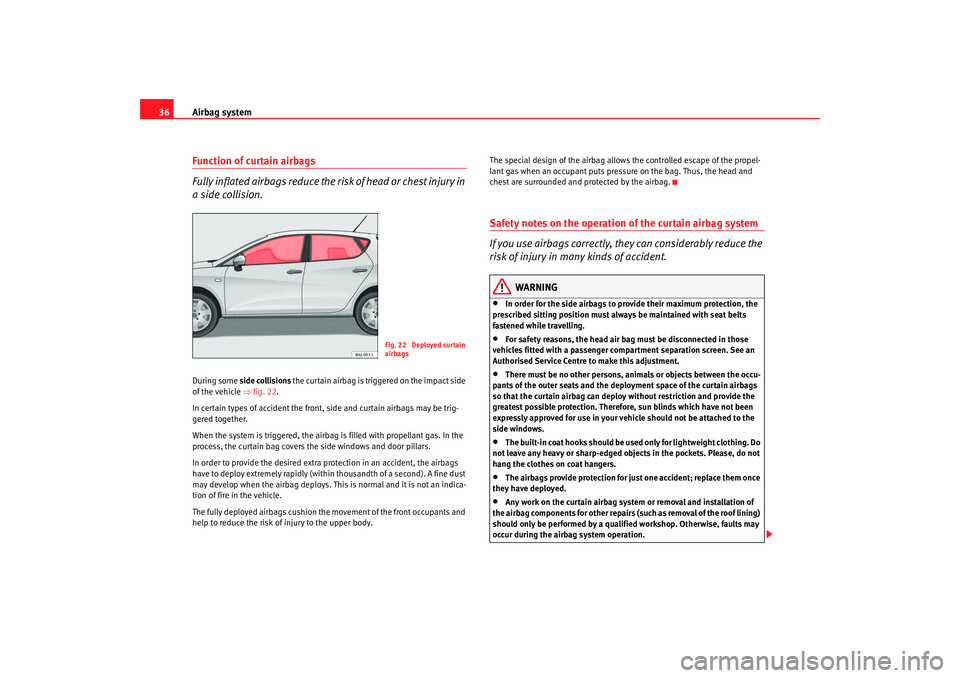
a side collision.During some side collisions the curtain airbag is tri ggered on the impact side
of the vehicle ⇒fig. 22 .
In certain types of accident the front, side and curtain airbags may be trig-
gered together.
When the system is triggered, the airbag is filled with propellant gas. In the
process, the curtain bag covers the side windows and door pillars.
In order to provide the desired extra protection in an accident, the airbags
have to deploy extremely rapidly (within thousandth of a second). A fine dust
may develop when the airbag deploys. This is normal and it is not an indica-
tion of fire in the vehicle.
The fully deployed airbags cushion the movement of the front occupants and
help to reduce the risk of injury to the upper body. The special design of the airbag allows the controlled escape of the propel-
lant gas when an occupant puts pressure on the bag. Thus, the head and
chest are surrounded and protected by the airbag.
Safety notes on the operation of the curtain airbag system
If you use airbags correctly, they can considerably reduce the
risk of injury in many kinds of accident.
WARNING
•
In order for the side airbags to provide their maximum protection, the
prescribed sitting position must alwa ys be maintained with seat belts
fastened while travelling.
•
For safety reasons, the head air bag must be disconnected in those
vehicles fitted with a passenger compartment separation screen. See an
Authorised Service Centre to make this adjustment.
•
There must be no other persons, animals or objects between the occu-
pants of the outer seats and the depl oyment space of the curtain airbags
so that the curtain airbag can deploy without restriction and provide the
greatest possible protection. Therefor e, sun blinds which have not been
expressly approved for use in your ve hicle should not be attached to the
side windows.
•
The built-in coat hooks should be us ed only for lightweight clothing. Do
not leave any heavy or sharp-edged objects in the pockets. Please, do not
hang the clothes on coat hangers.
•
The airbags provide protection for just one accident; replace them once
they have deployed.
•
Any work on the curtain airbag system or removal and installation of
the airbag components for other repairs (such as removal of the roof lining)
should only be performed by a qualified workshop. Otherwise, faults may
occur during the airbag system operation.
Fig. 22 Deployed curtain
airbags
Ibiza250_angles Seite 36 Dienstag, 5. August 2008 1:11 13
Page 78 of 260
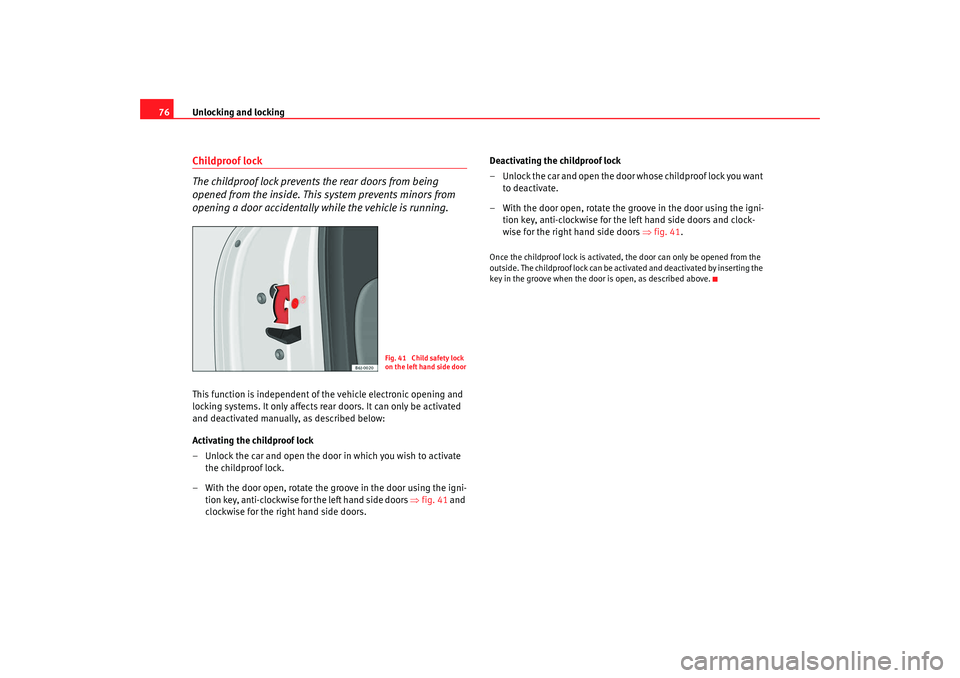
Unlocking and locking
76Childproof lock
The childproof lock prevents the rear doors from being
opened from the inside. This system prevents minors from
opening a door accidentally while the vehicle is running.This function is independent of the vehicle electronic opening and
locking systems. It only affects rear doors. It can only be activated
and deactivated manually, as described below:
Activating the childproof lock
– Unlock the car and open the door in which you wish to activate
the childproof lock.
– With the door open, rotate the groove in the door using the igni- tion key, anti-clockwise for the left hand side doors ⇒fig. 41 and
clockwise for the right hand side doors. Deactivating the childproof lock
– Unlock the car and open the door whose childproof lock you want
to deactivate.
– With the door open, rotate the groove in the door using the igni- tion key, anti-clockwise for the left hand side doors and clock-
wise for the right hand side doors ⇒fig. 41 .
Once the childproof lock is activated, the door can only be opened from the
outside. The childproof lock can be activated and deactivated by inserting the
key in the groove when the door is open, as described above.
Fig. 41 Child safety lock
on the left hand side door
Ibiza250_angles Seite 76 Dienstag, 5. August 2008 1:11 13
Page 83 of 260
Unlocking and locking81
Safety First
Operating instructions
Practical tips
Te c h n i c a l D a t a
The interior monitor and the anti-towing alarm are automatically switched on
again next time the vehicle is locked.
The interior monitor and anti-towing alarm (tilt sensor) are automatically
switched on when the anti-theft alarm is
switched on. In order to activate it,
all the doors and the tailgate must be closed.
If you wish to disconnect the interior monitor and the anti-towing system, it
must be done each time that the vehicle is locked; if not, they will connect
automatically.
The interior monitor and the anti-towing system should be disconnected if
animals are left inside the locked vehicle (otherwise, their movements will
trigger the alarm) or when, for example, the vehicle is transported or has to
be towed with only one axle on the ground.
False alarms
The interior monitor only operates co rrectly if the vehicle is completely
closed. Please observe legal requirements when doing so.
The following cases may cause a false alarm:
•
open windows (partially or fully).
•
panoramic glass roof/sunblind open (partially or completely).
•
movement of objects inside the vehicle, such as loose papers, items
hanging from the rear view mi rror (air fresheners), etc.Note
•
If the vehicle is relocked and the alarm is activated without the volumetric
sensor function, relocking will activate th e alarm with all its functions, except
the volumetric sensor. This function is reactivated when the alarm is switched
on again, unless it is deliberately switched off.
•
If the alarm has been triggered by the volumetric sensor, this will be indi-
cated by a flashing of the indicator on the driver's door. This flashing is
different to the flash indicating the alarm is activated.
•
The vibration of a mobile phone left inside the vehicle may cause the inte-
rior monitor alarm to trigger, as both sensors react to movements and shakes
inside the vehicle.
•
If, on activating the alarm, any door or the tailgate is open, only the alarm
will be activated. The interior monitor and the anti-towing system will only be
activated once all the doors are closed (including the tailgate).
Ibiza250_angles Seite 81 Dienstag, 5. August 2008 1:11 13
Page 89 of 260
Unlocking and locking87
Safety First
Operating instructions
Practical tips
Te c h n i c a l D a t a
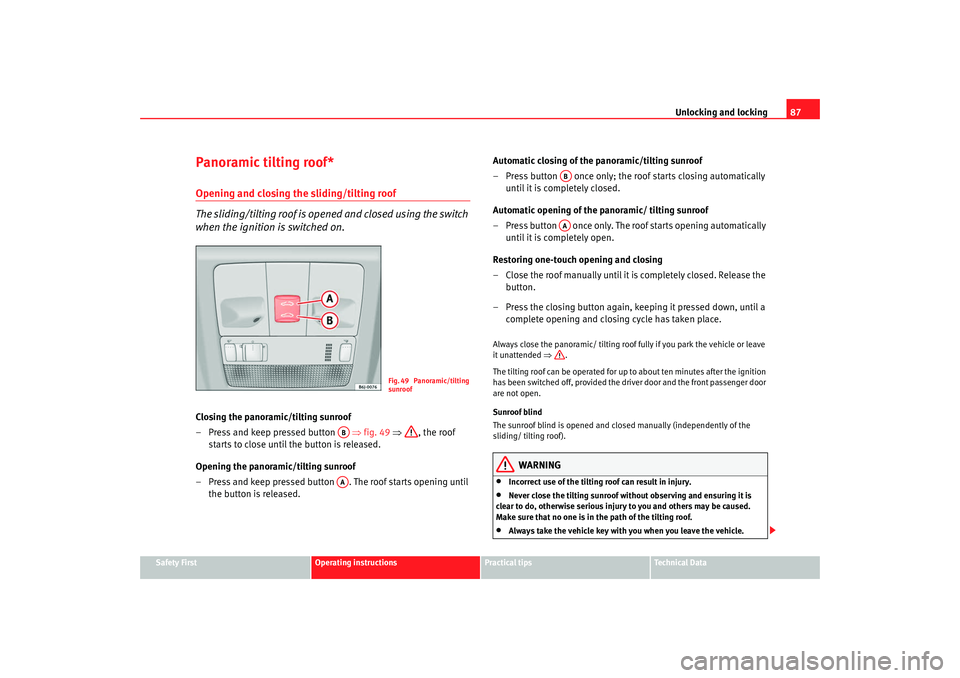
Panoramic tilting roof*Opening and closing the sliding/tilting roof
The sliding/tilting roof is opened and closed using the switch
when the ignition is switched on.Closing the panoramic/tilting sunroof
– Press and keep pressed button ⇒fig. 49 ⇒ , the roof
starts to close until the button is released.
Opening the panoramic/tilting sunroof
– Press and keep pressed button . The roof starts opening until the button is released. Automatic closing of the
panoramic/tilting sunroof
– Press button once only; the roof starts closing automatically until it is completely closed.
Automatic opening of the panoramic/ tilting sunroof
– Press button once only. The roof starts opening automatically until it is completely open.
Restoring one-touch opening and closing
– Close the roof manually until it is completely closed. Release the button.
– Press the closing button again, keeping it pressed down, until a complete opening and closing cycle has taken place.
Always close the panoramic/ tilting roof fully if you park the vehicle or leave
it unattended ⇒.
The tilting roof can be operated for up to about ten minutes after the ignition
has been switched off, provided the dr iver door and the front passenger door
are not open.
Sunroof blind
The sunroof blind is opened and closed manually (independently of the
sliding/ tilting roof).
WARNING
•
Incorrect use of the tilting roof can result in injury.
•
Never close the tilting sunroof with out observing and ensuring it is
clear to do, otherwise serious injury to you and others may be caused.
Make sure that no one is in the path of the tilting roof.
•
Always take the vehicle key with you when you leave the vehicle.
Fig. 49 Panoramic/tilting
sunroof
ABAA
ABAA
Ibiza250_angles Seite 87 Dienstag, 5. August 2008 1:11 13
Page 90 of 260
Unlocking and locking
88•
Never leave children or disabled persons in the vehicle, particularly if
they have access to the keys. Unsupervised use of a key could mean that
the engine is started or that electrical equipment is used (e.g. electric
tilting sunroof) with a risk of accide nt. The doors can be locked using the
remote control key. This could make assistance difficult in an emergency
situation.
•
The tilting sunroof continues to function until one of the front doors is
opened and the key removed from the ignition.
•
Ensure that no object and/or limb is between the glass and the roof
when the one-touch opening/closing function is reset.
Convenience closing*Using the door lock
– Hold the key in the door lock of the driver's door in the locking position until the tilting sunroof is closed.
– Release the key to interrupt this function.
Using the remote control
– Push the lock button on the remote control for about 3 seconds. The tilting roof closes.
– Press the unlock button to interrupt the function.
Roll-back function of the panoramic/ tilting roof*The panoramic/ tilting roof has a roll-back function which prevents larger
objects getting trapped when the roof is closed. The roll-back function does
not prevent fingers getting pinched ag ainst the roof opening. The tilting
sunroof stops and opens ag ain immediately if it is obstructed when closing.Operation in case of breakdown
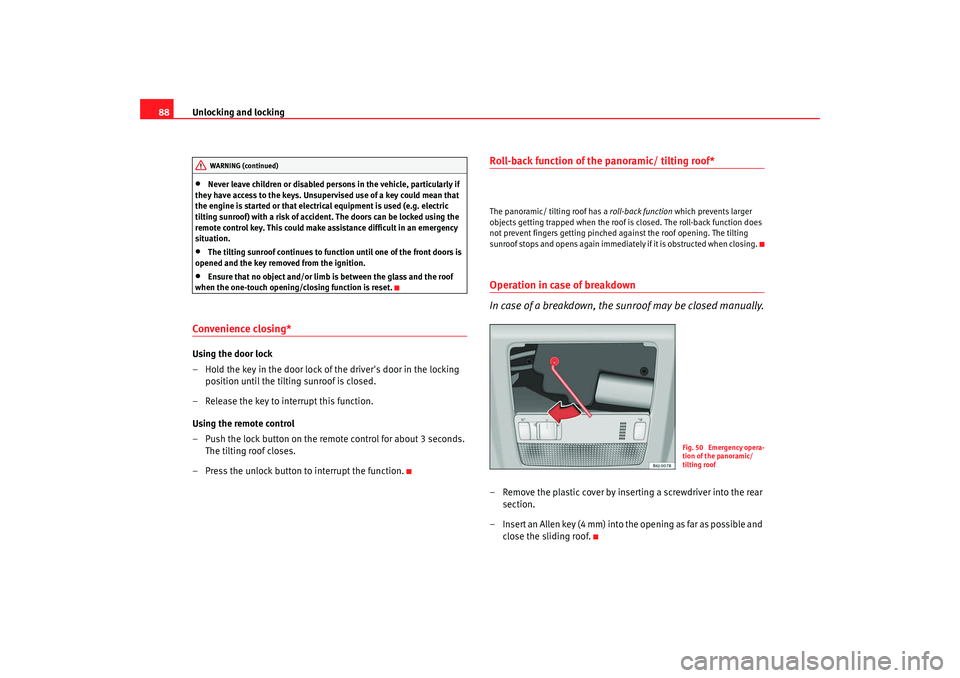
In case of a breakdown, the sunroof may be closed manually.– Remove the plastic cover by inserting a screwdriver into the rear
section.
– Insert an Allen key (4 mm) into the opening as far as possible and close the sliding roof.
WARNING (continued)
Fig. 50 Emergency opera-
tion of the panoramic/
tilting roof
Ibiza250_angles Seite 88 Dienstag, 5. August 2008 1:11 13
Page 97 of 260
Lights and visibility95
Safety First
Operating instructions
Practical tips
Te c h n i c a l D a t a
•
The main beam headlights can only be switched on if the dipped beam
headlights are already on. The warning lamp
then comes on in the combi-
instrument.
•
The headlight flasher comes on for as long as you pull the lever – even if
no other lights are switched on. The warning lamp
then comes on in the
combi-instrument.
•
When the parking lights are switched on, the headlight and the rear light
on the corresponding side of the vehicle light up. The parking lights will only
work if the key is removed from the ignition. If the lights are switched on, a
buzzer gives an audible warning while the driver door is open.
•
If the turn signal lever is left on after the key has been taken out of the
ignition lock, an acoustic signal sounds when the driver door is opened. This
is a reminder to switch off the turn signal, unless of course you wish to leave
the parking light on.
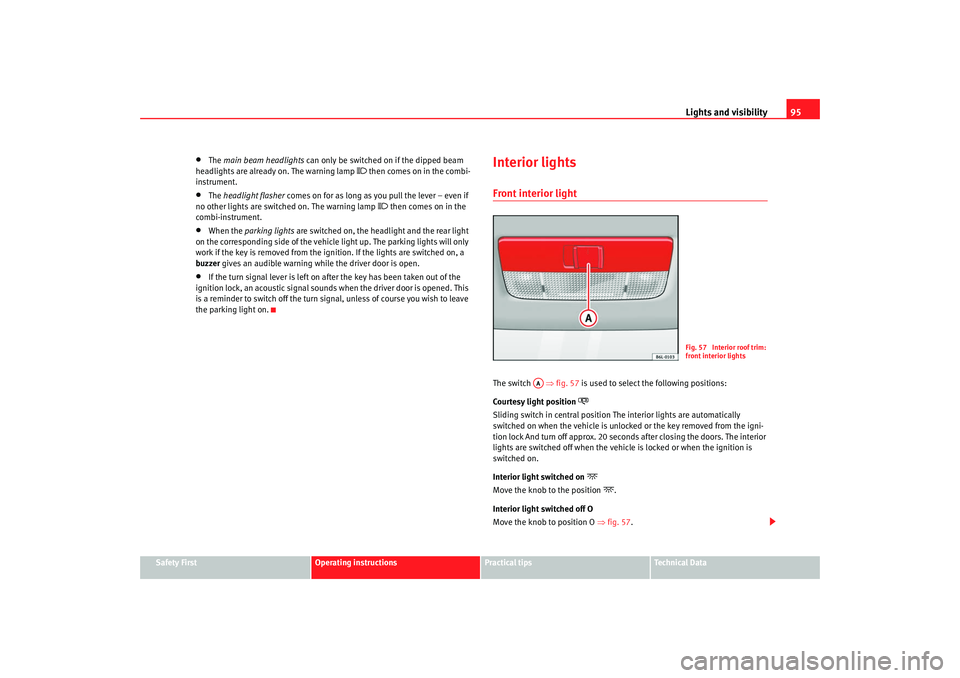
Interior lightsFront interior light The switch ⇒fig. 57 is used to select the following positions:
Courtesy light position
Sliding switch in central position The interior lights are automatically
switched on when the vehicle is unlocked or the key removed from the igni-
tion lock And turn off approx. 20 seconds after closing the doors. The interior
lights are switched off when the vehicle is locked or when the ignition is
switched on.
Interior light switched on
Move the knob to the position
.
Interior light switched off O
Move the knob to position O ⇒fig. 57.
Fig. 57 Interior roof trim:
front interior lights
AA
Ibiza250_angles Seite 95 Dienstag, 5. August 2008 1:11 13
Page 119 of 260
Seats and stowage117
Safety First
Operating instructions
Practical tips
Te c h n i c a l D a t a
•
An overloaded boot could mean that the rear stowage tray is not correctly
seated and it may be bent or damaged.
•
If the boot is overloaded, remove the tray.Note
•
Ensure that, when placing items of clothing on the luggage compartment
cover, rear visibility is not reduced.
Roof carrier*Please observe the following points if you intend to carry loads on the roof:•
For safety reasons, only luggage racks and accessories approved by SEAT
should be used.
•
It is imperative to precisely follow the fitting instructions included for the
rack, taking special care when fitting the front bar in the holes designed for
this and the rear bar between the marks on the upper part of the rear door
frame while respecting the correct direction of travel indicated in the installa-
tion manual. Not following these in structions may damage the bodywork.
•
Pay special attention to the tightening torque of the attachment bolts and
check them following a short journey. If necessary, retighten the bolts and
check them at regular intervals.
•
Distribute the load evenly. A maximum load of 40 kg only is permitted for
each roof carrier system support bar, the load must be distributed evenly
along the entire length. However, the maximum load permitted for the entire
roof (including the support system) of 75 kg must not be exceeded nor should
the total weight of the vehicle be exceeded. See the chapter on “Technical
Data”.
•
When transporting heavy or large objects on the roof, any change in the
normal vehicle behaviour due to a change in the centre of gravity or an increased wind resistance must be taken into account. For this reason, a suit-
able speed and driving style must be used.
•
For those vehicles fitted with a sunroof*, ensure that it does not interfere
with the load on the roof carrier system when opened.
Ibiza250_angles Seite 117 Dienstag, 5. August 2008 1:11 13