gearbox Seat Ibiza 5D 2010 User Guide
[x] Cancel search | Manufacturer: SEAT, Model Year: 2010, Model line: Ibiza 5D, Model: Seat Ibiza 5D 2010Pages: 266, PDF Size: 7.04 MB
Page 141 of 266
Driving139
Safety First
Operating Instructions
Practical Tips
Technical Specifications
Driving a car with an automatic gearbox
The gearbox changes gear ratios automatically as the vehicle
moves.Starting
– Start the engine with the selector lever in position P or N.
Driving
– Hold the brake pedal pressed down.
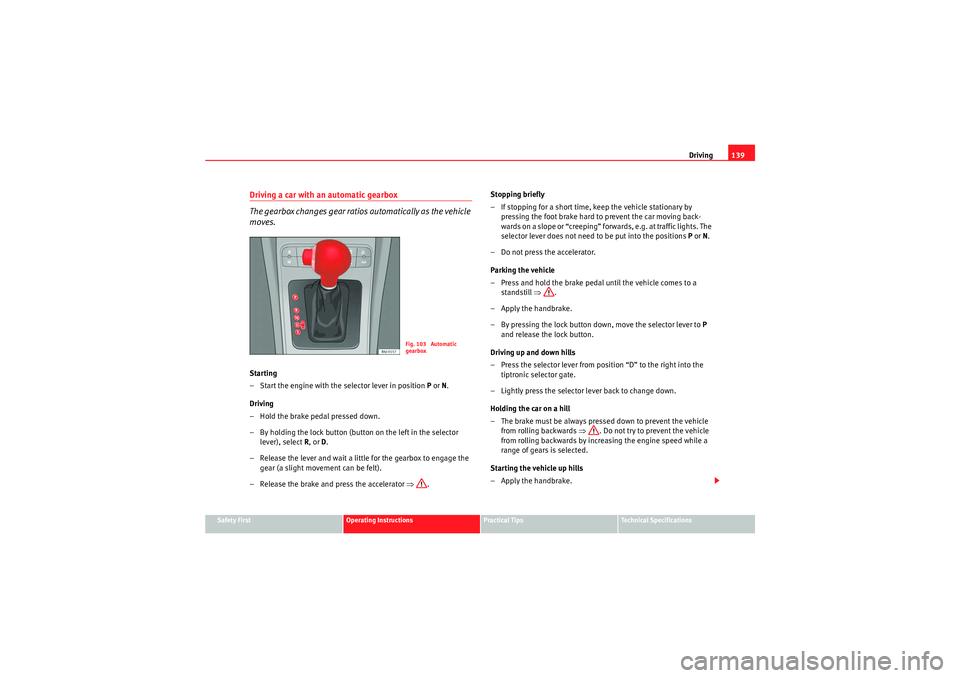
– By holding the lock button (button on the left in the selector lever), select R, or D.
– Release the lever and wait a little for the gearbox to engage the gear (a slight movement can be felt).
– Release the brake and press the accelerator ⇒. Stopping briefly
– If stopping for a short time, keep the vehicle stationary by
pressing the foot brake hard to prevent the car moving back-
wards on a slope or “creeping” forwards, e.g. at traffic lights. The
selector lever does not need to be put into the positions P or N.
– Do not press the accelerator.
Parking the vehicle
– Press and hold the brake pedal until the vehicle comes to a standstill ⇒.
– Apply the handbrake.
– By pressing the lock button down, move the selector lever to P
and release the lock button.
Driving up and down hills
– Press the selector lever from position “D” to the right into the tiptronic selector gate.
– Lightly press the selector lever back to change down.
Holding the car on a hill
– The brake must be always pressed down to prevent the vehicle from rolling backwards ⇒. Do not try to prevent the vehicle
from rolling backwards by increa sing the engine speed while a
range of gears is selected.
Starting the vehicle up hills
– Apply the handbrake.
Fig. 103 Automatic
gearbox
Ibiza_EN.book Seite 139 Mittwoch, 1. September 2010 5:24 17
Page 142 of 266
Driving
140
– With a selected gear, accelerate slowly and at the same time, release the handbrake.The steeper the slope, the lower the needed gear. This increases the braking
effect of the engine. For example, when driving down a very steep slope in
third gear. If the engine brake effect is not enough, the vehicle will speed up.
The automatic gearbox automatically changes up to prevent the engine over-
revving. Use the foot brake to reduce speed and change into third gear again
using Tiptronic* ⇒.
Your vehicle has an automatic interlock which prevents the selector lever
from being put into a position for driving forwards or in reverse from positions
P or N if the brake pedal is not depressed.
Warning lamp “Pressing brake pedal”
K
When the warning lamp next to the selector lever lights up, press the brake
pedal. This is necessary when the automatic gearbox selector lever is moved
out of positions P or N. At the same time, a text message or the instructions
to perform necessary operations may appear on the instrument panel.
WARNING
•As a driver, you should never leave your vehicle if the engine is running
and a gear is engaged. If you have to leave your vehicle while the engine is
running, you must apply the parking brake and put the selector lever in
position P.•If the engine is running and D or R are engaged, you will need to hold
vehicle stopped by depressing the brake pedal. The car would keep on
creeping forward as the power transmission is not fully interrupted even
when the engine is idling.•Never accelerate when moving the selector gear or you may cause an
accident.•Never move the selector lever to R or P when driving. Risk of accident!
•Before driving down a long, steep slope, it is advisable to reduce speed
and change into a lower gear.•If you stop the vehicle up hill, always hold the foot brake strongly
depressed down to stop it from rolling back.•Never allow the brake to rub and do not use the brake pedal too often
or for long periods. Constant braking will cause the brakes to overheat and
will considerably reduce the brake effect. This increases the braking
distance and could cause the brake system to fail.•Never allow the car to roll down a mountain or a slope with the lever in
the N or D position, regardless of the engine is running or not.Caution
•If you stop the vehicle up hills, do not attempt to stop it from rolling back
by depressing the accelerator when a gear has been selected. Otherwise, the
automatic gearbox may overheat causing damage. Pull the handbrake up or
fully depress the brake pedal to prevent the vehicle from rolling away.•If you allow the car to roll when the engine is not running, or with the
selector lever in position N, a lack of lubrication in the automatic gearbox will
damage it.WARNING (continued)
Ibiza_EN.book Seite 140 Mittwoch, 1. September 2010 5:24 17
Page 143 of 266
Driving141
Safety First
Operating Instructions
Practical Tips
Technical Specifications
Changing gear in tiptronic mode*
The tiptronic system allows the driver to select gears manu-
ally
General information about driving in tiptronic mode
Changing gear in tiptronic mode
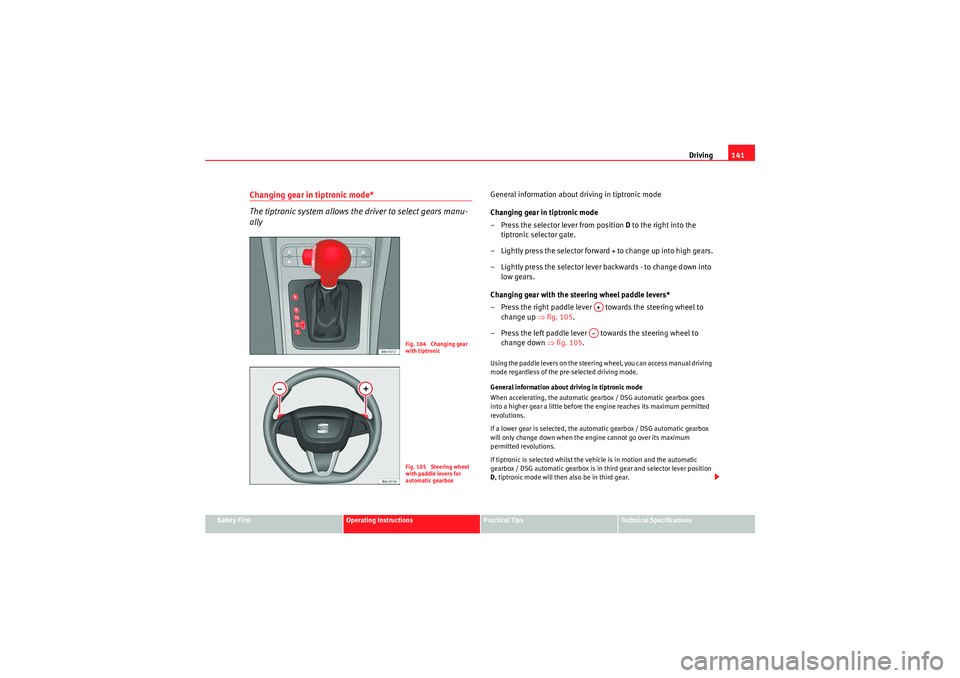
– Press the selector lever from position D to the right into the
tiptronic selector gate.
– Lightly press the selector forward + to change up into high gears.
– Lightly press the selector lever backwards - to change down into
low gears.
Changing gear with the steering wheel paddle levers*
– Press the right paddle lever towards the steering wheel to
change up ⇒ fig. 105.
– Press the left paddle lever towards the steering wheel to change down ⇒ fig. 105.Using the paddle levers on the steering wheel, you can access manual driving
mode regardless of the pre-selected driving mode.
General information about driving in tiptronic mode
When accelerating, the automatic gearbox / DSG automatic gearbox goes
into a higher gear a little before the engine reaches its maximum permitted
revolutions.
If a lower gear is selected, the automatic gearbox / DSG automatic gearbox
will only change down when the engine cannot go over its maximum
permitted revolutions.
If tiptronic is selected whilst the vehicle is in motion and the automatic
gearbox / DSG automatic gearbox is in third gear and selector lever position
D, tiptronic mode will then also be in third gear.
Fig. 104 Changing gear
with tiptronicFig. 105 Steering wheel
with paddle levers for
automatic gearbox
A+A–
Ibiza_EN.book Seite 141 Mittwoch, 1. September 2010 5:24 17
Page 144 of 266
Driving
142Changing gears in the normal or sport programme using the steering wheel
paddle levers
If the paddle levers ⇒ page 141, fig. 105 are used in the normal or sport
programme, the system switches temporarily to tiptronic mode. To exit
“tiptronic” mode again, press the right paddle lever towards the steering
wheel for approximately one second. You will also leave tiptronic mode if the
paddle levers are not moved for a certain time.
Note
•The gear paddle levers on the steering wheel can be operated with the
selector lever in any position and with the vehicle in motion.Selector lever positions
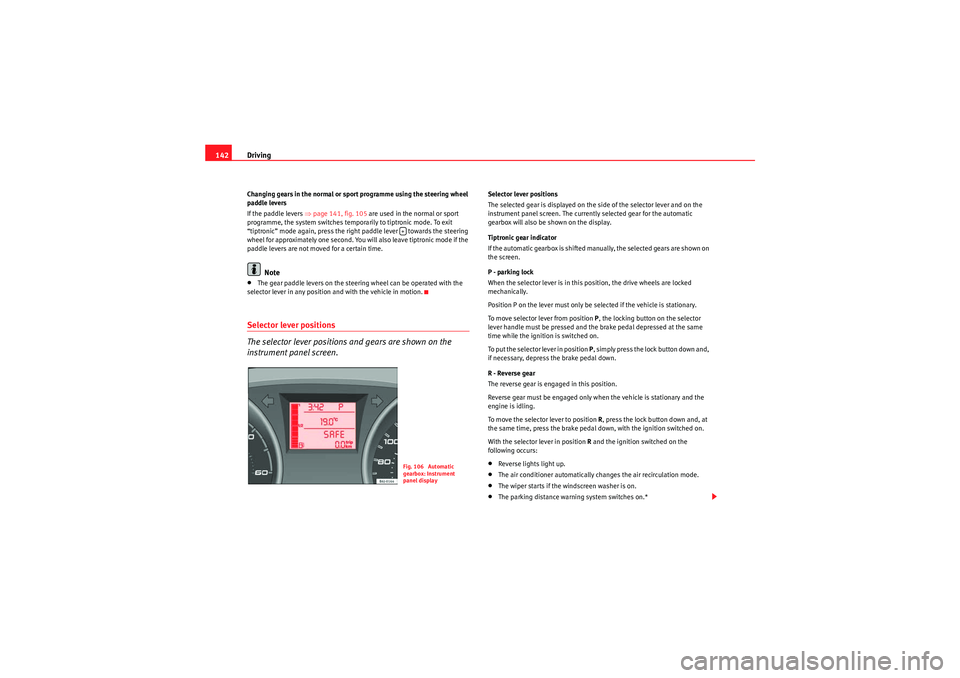
The selector lever positions and gears are shown on the
instrument panel screen.
Selector lever positions
The selected gear is displayed on the side of the selector lever and on the
instrument panel screen. The currently selected gear for the automatic
gearbox will also be shown on the display.
Tiptronic gear indicator
If the automatic gearbox is shifted manually, the selected gears are shown on
the screen.
P - parking lock
When the selector lever is in this position, the drive wheels are locked
mechanically.
Position P on the lever must only be selected if the vehicle is stationary.
To move selector lever from position P, the locking button on the selector
lever handle must be pressed and the brake pedal depressed at the same
time while the ignition is switched on.
To put the selector lever in position P, simply press the lock button down and,
if necessary, depress the brake pedal down.
R - Reverse gear
The reverse gear is engaged in this position.
Reverse gear must be engaged only when the vehicle is stationary and the
engine is idling.
To move the selector lever to position R, press the lock button down and, at
the same time, press the brake pedal down, with the ignition switched on.
With the selector lever in position R and the ignition switched on the
following occurs:•Reverse lights light up.•The air conditioner automatically changes the air recirculation mode.•The wiper starts if the windscreen washer is on.•The parking distance warning system switches on.*
+Fig. 106 Automatic
gearbox: Instrument
panel display
Ibiza_EN.book Seite 142 Mittwoch, 1. September 2010 5:24 17
Page 145 of 266
Driving143
Safety First
Operating Instructions
Practical Tips
Technical Specifications
N - Neutral (idling)
If this position is selected, the gearbox is in neutral. Power is not transmitted
to the wheels and the engine does not have a braking function.
Never use the
N position to drive down a hill. The engine does not function as
a brake and the brakes are subjected to excessive stain.
You could damage the automatic gearbox if you drive down hills with the gear
lever in position N and the engine switched off.
D - Drive (forward)
In this position the gearbox automatically changes to a lower or higher gear,
according to the engine’s requirements, the driving style and speed. The
braking effect of the engine when driving downhill is very limited when the
selector is in this position. The instrument panel displays the selected gear
as well as the selector lever in position D.
If position N has been selected and you wish to select D, you must press the
foot brake if the vehicle is stationary, or travelling at under 5 km/h.
S - Standard driving position (Sport programme)
When the selector lever is in position S, it will automatically change up into a
h igh er gea r late r, an d change d own i nto a low g ea r, if com pare d wi th p osi ti on
D . This way, it is possible to take full advantage of the engine reserve power,
depending on the engine demand, driving style and speed. The braking
effect of the engine when driving downhill is very limited. On the instrument
panel display the selected gear is shown as well as the selector lever to posi-
tion S.
To select gear range S, press the lock button on the selector lever.
WARNING
If the vehicle moves with no control, an accident and serious injury may
occur.
•As a driver, you should never leave your vehicle if the engine is running
and a gear is engaged. If you have to leave your vehicle while the engine is
running, you must always apply the handbrake and engage parking lock P.•If the engine is running and if D or R are engaged, you will need to hold
the the vehicle stopped by depressing footbrake down. The car would creep
forward as the power transmission is not fully interrupted even when the
engine is idling.•Never accelerate when moving the selector gear or you may cause an
accident.•Never move the selector lever to “R” or “P” when driving. Risk of acci-
dent.•Before driving down a very steep slope, reduce your speed and shift to
first gear.•Always hold the vehicle on the foot brake if you stop on hills. Other-
wise, the vehicle could roll back.•Never allow the brake to rub and do not use the brake pedal too often
or for long periods. Constant braking will cause the brakes to overheat and
will considerably reduce the brake effect. This increases the braking
distance and could cause the brake system to fail.WARNING
Never switch the engine off until the vehicle is stationary. You could lose
control of your vehicle. This could cause an accident and serious injury.•The airbags and belt tensioners do not work when the ignition is
switched off.•The brake servo does not work with the engine off. You need more force
to stop the vehicle.•Power steering does not work when the engine is not running. That is
why it is much more difficult to turn the steering wheel.WARNING (continued)
Ibiza_EN.book Seite 143 Mittwoch, 1. September 2010 5:24 17
Page 146 of 266
Driving
144•Never remove the key from the ignition if the vehicle is in motion. The
steering lock could suddenly engage, and you would not be able to steer
the vehicle.•Never allow the car to roll downhill with the selector lever in “N”,
regardless of the engine is running or not.Caution
If you allow the vehicle to move when the engine is switched off or with the
selector lever in position “N”, take your foot off the accelerator and wait until
the engine starts idling before returning to position “D”.Kickdown feature
This feature allows maximum acceleration.If you press the accelerator down thoroughly, the gearbox automatically
changes down, depending on speed and en gine speed, into a lower gear to
take full advantage of give the vehicle maximum acceleration.
The gearbox does not change gear until the engine reaches the maximum
determined engine speed for the gear.
WARNING
You could lose control of the vehicle if you accelerate on slippery road
surfaces. Risk of serious injury.•Be particularly careful when using the kickdown features on slippery
road surfaces. With a fast acceleration, the vehicle could lose traction and
skid.
•You should use the kickdown feature only when traffic and weather
conditions allow it to be used safely.
HandbrakeUsing the handbrake
The handbrake should be applied firmly to prevent the
vehicle from accidentally rolling away.Always apply the handbrake when you leave your vehicle and when
you park.
WARNING (continued)
WARNING (continued)
Fig. 107 Handbrake
between the front seats
Ibiza_EN.book Seite 144 Mittwoch, 1. September 2010 5:24 17
Page 153 of 266
Driving151
Safety First
Operating Instructions
Practical Tips
Technical Specifications
Vehicles with a manual gearbox
The system
is completely turned off by moving the control all the way to
the right hand side (OFF engaged), or when the vehicle is stationary, ignition
off.
Vehicles with an automatic gearbox
To completely disengage the system, the selector lever must be placed in one
of the following positions: P , N , R or 1 or with the vehicle stopped and the
ignition turned off.
AA
Ibiza_EN.book Seite 151 Mittwoch, 1. September 2010 5:24 17
Page 163 of 266
Driving and the environment161
Safety First
Operating Instructions
Practical Tips
Technical Specifications
Economical and environmentally friendly
drivingEconomical and environmentally friendly drivingFuel consumption, environmental pollution and wear to the engine, brakes
and tyres depend mostly on your driving style. By adopting an economical
driving style and anticipating the traffic situation ahead, you can easily
reduce fuel consumption by 10-15%. Some tips on how to help you reduce
pollution while saving money are listed below.
Drive anticipating the traffic situation
A vehicle uses most fuel when accelerating. When you anticipate the situa-
tion, you have to brake less often and, thus, accelerate less. If it is possible,
let the vehicle roll with a gear engaged , for example, if you see a red light
ahead. The braking effect achieved in this way helps to reduce the wear of
brakes and tyres; emissions and fuel consumption are reduced to zero
(disconnection due to inertia).
Change gear early to save energy
An effective way of saving fuel is to change up quickly through the gears.
Running the engine at high rpm in the lower gears uses an unnecessary
amount of fuel.
Manual gearbox: Change from first to second gear as quickly as possible. We
recommend that, whenever possible, you change to a higher gear upon
reaching 2000 rpm. Follow the recommended gear indication that appears on
the instrument panel ⇒page 51.
Avoid driving at high speed
We advise you not to drive at the top speed permitted by the vehicle. Fuel
consumption, exhaust emissions and noise levels all increase very rapidly at
higher speeds. Driving at moderate speeds will help to save fuel. Avoid idling
It is worthwhile switching off the engine when waiting in a traffic jam, at level
crossings or at traffic lights with a long red phase. The fuel saved after only
30 - 40 seconds is greater than the amount of fuel needed to restart the
engine.
The engine takes a long time to warm up when it is idling. Mechanical wear
and pollutant emissions are also especially high during this initial warm-up
phase. It is therefore best to drive off immediately after starting the engine.
Avoid running the engine at high speed.
Periodic maintenance
Periodic maintenance work guarantees that, before beginning a journey, you
will not consume more than the required amount of fuel. A well-serviced
engine gives you the benefit of improved fuel efficiency
as well as maximum
reliability and an enhanced resale value.
A badly serviced engine can consume up to 10% more fuel than necessary.
Avoid short journeys
To reduce the consumption and emission of polluting gases, the engine and
the exhaust filtration systems should reach the optimum service tempera-
ture .
With the engine cold, fuel consumption is proportionally higher. The engine
does not warm up and fuel consumption does not normalise until having
driven approximately four kilometres. This is why we recommend avoiding
short trips whenever possible.
Maintain the correct tyre pressures
Bear in mind that keeping the tyres at an adequate pressure saves fuel. If the
tyre pressure is just one bar too low, fuel consumption can increase by as
much as 5%. Due to the greater rolling resistance, under-inflation also
increases tyre wear and impairs handling.
The tyre pressures should always be checked when the tyres are cold.
Ibiza_EN.book Seite 161 Mittwoch, 1. September 2010 5:24 17
Page 207 of 266
If and when205
Safety First
Operating Instructions
Practical Tips
Technical Specifications
Snow chains
For technical reasons, snow chains must
not be used on the compact tempo-
rary spare wheel.
If you have a puncture on one of the front wheels when using snow chains, fit
the compact temporary spare in place of one of the rear wheels. You can then
attach the snow chains to the wheel taken from the rear and use this wheel to
replace the punctured front wheel.
WARNING
•The tyre pressures must be checked and corrected as soon as possible.•Do not drive faster than 80 km/h. Higher speeds can cause an accident.•Avoid heavy acceleration, hard braking and fast cornering. Risk of acci-
dent.•Never use two or more compact spare tyres at the same time, risk of
accident.•No other type of tyre (normal summer or winter tyre) may be fitted on
the compact temporary spare wheel rim.
Tyre repair kit*
The tyre repair kit (for vehicles not including a spare wheel) is
stored under the floor panel in the luggage compartment.Your vehicle is equipped with the Tyre Mobility System “Tyre repair kit”.
The tyre repair kit consists of a container with sealing compound to repair the
puncture and a compressor to generate the required tyre pressure. The kit will
reliably seal punctures up to a size of about 4 mm caused by the penetration
of a foreign body into the tyre.
Note
•Seek professional assistance if the repair of a tyre puncture is not
possible with the sealing compound.Changing a wheelPreparation work
What you must do before changing a wheel.– If you have a flat tyre or puncture, park the vehicle as far away from the flow of traffic as possible. Choose a location that is as
level as possible.
– All passengers should leave the vehicle. They should wait in a safe area (for instance behind the roadside crash barrier).
– Switch the engine off. Switch the hazard warning lights on and place the warning triangles in position.
–Apply the handbrake firmly.
– Engage the first gear, or put the selector lever to position P for
those vehicles with an automatic gearbox.
– If you are towing a trailer, unhitch it from your vehicle.
– Take the vehicle tools and the spare wheel out of the luggage
compartment.
Ibiza_EN.book Seite 205 Mittwoch, 1. September 2010 5:24 17
Page 215 of 266
If and when213
Safety First
Operating Instructions
Practical Tips
Technical Specifications
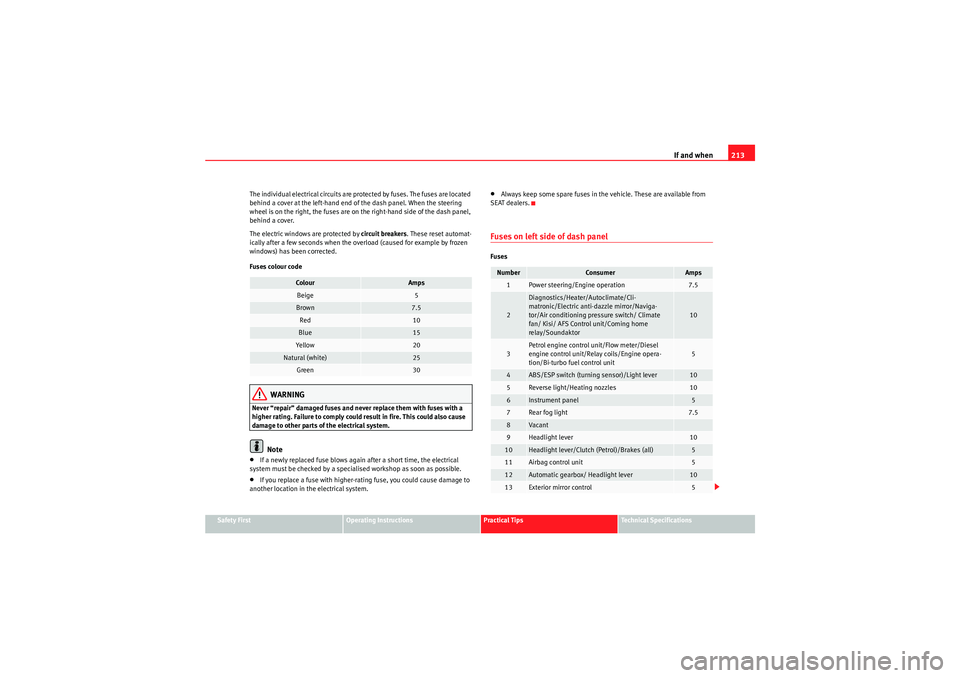
The individual electrical circuits are protected by fuses. The fuses are located
behind a cover at the left-hand end of the dash panel. When the steering
wheel is on the right, the fuses are on the right-hand side of the dash panel,
behind a cover.
The electric windows are protected by
circuit breakers. These reset automat-
ically after a few seconds when the overload (caused for example by frozen
windows) has been corrected.
Fuses colour code
WARNING
Never “repair” damaged fuses and never replace them with fuses with a
higher rating. Failure to comply could result in fire. This could also cause
damage to other parts of the electrical system.
Note
•If a newly replaced fuse blows again after a short time, the electrical
system must be checked by a specialised workshop as soon as possible.•If you replace a fuse with higher-rating fuse, you could cause damage to
another location in the electrical system.
•Always keep some spare fuses in the vehicle. These are available from
SEAT dealers.Fuses on left side of dash panelFuses
Colour
Amps
Beige
5
Brown
7.5
Red
10
Blue
15
Ye l l o w
20
Natural (white)
25
Green
30
Number
Consumer
Amps
1
Power steering/Engine operation
7.5
2
Diagnostics/Heater/Autoclimate/Cli-
matronic/Electric anti-dazzle mirror/Naviga-
tor/Air conditioning pressure switch/ Climate
fan/ Kisi/ AFS Control unit/Coming home
relay/Soundaktor
10
3
Petrol engine control unit/Flow meter/Diesel
engine control unit/Relay coils/Engine opera-
tion/Bi-turbo fuel control unit
5
4
ABS/ESP switch (turning sensor)/Light lever
10
5
Reverse light/Heating nozzles
10
6
Instrument panel
5
7
Rear fog light
7.5
8
Va can t
9
Headlight lever
10
10
Headlight lever/Clutch (Petrol)/Brakes (all)
5
11
Airbag control unit
5
12
Automatic gearbox/ Headlight lever
10
13
Exterior mirror control
5
Ibiza_EN.book Seite 213 Mittwoch, 1. September 2010 5:24 17