ECU Seat Ibiza 5D 2010 Owner's Guide
[x] Cancel search | Manufacturer: SEAT, Model Year: 2010, Model line: Ibiza 5D, Model: Seat Ibiza 5D 2010Pages: 266, PDF Size: 7.04 MB
Page 109 of 266
Seats and storage compartments107
Safety First
Operating Instructions
Practical Tips
Technical Specifications
•When fitting the head restraints again, insert the tubes as far as possible
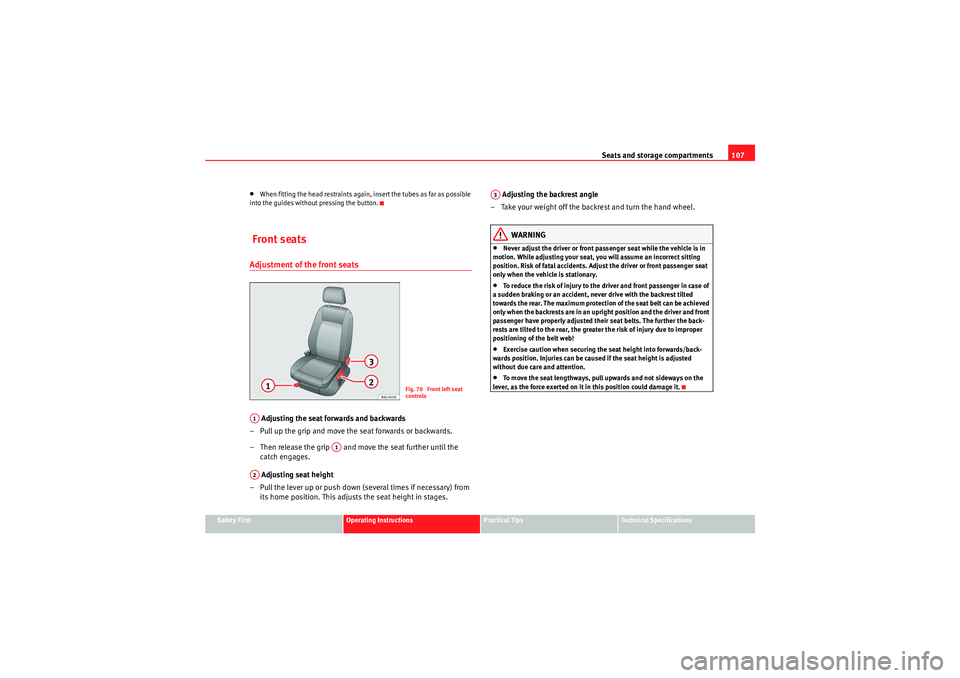
into the guides without pressing the button. Front seatsAdjustment of the front seats Adjusting the seat forwards and backwards
– Pull up the grip and move the seat forwards or backwards.
– Then release the grip and move the seat further until the catch engages.
Adjusting seat height
– Pull the lever up or push down (several times if necessary) from its home position. This adjust s the seat height in stages. Adjusting the backrest angle
– Take your weight off the backrest and turn the hand wheel.
WARNING
•Never adjust the driver or front passenger seat while the vehicle is in
motion. While adjusting your seat, you will assume an incorrect sitting
position. Risk of fatal accidents. Adjust the driver or front passenger seat
only when the vehicle is stationary.•To reduce the risk of injury to the driver and front passenger in case of
a sudden braking or an accident, ne ver drive with the backrest tilted
towards the rear. The maximum protection of the seat belt can be achieved
only when the backrests are in an upright position and the driver and front
passenger have properly adjusted their seat belts. The further the back-
rests are tilted to the rear, the greater the risk of injury due to improper
positioning of the belt web!•Exercise caution when securing the seat height into forwards/back-
wards position. Injuries can be caused if the seat height is adjusted
without due care and attention.•To move the seat lengthways, pull upwards and not sideways on the
lever, as the force exerted on it in this position could damage it.
Fig. 70 Front left seat
controls
A1
A1
A2
A3
Ibiza_EN.book Seite 107 Mittwoch, 1. September 2010 5:24 17
Page 111 of 266
Seats and storage compartments109
Safety First
Operating Instructions
Practical Tips
Technical Specifications
Rear seatsFolding down rear seats
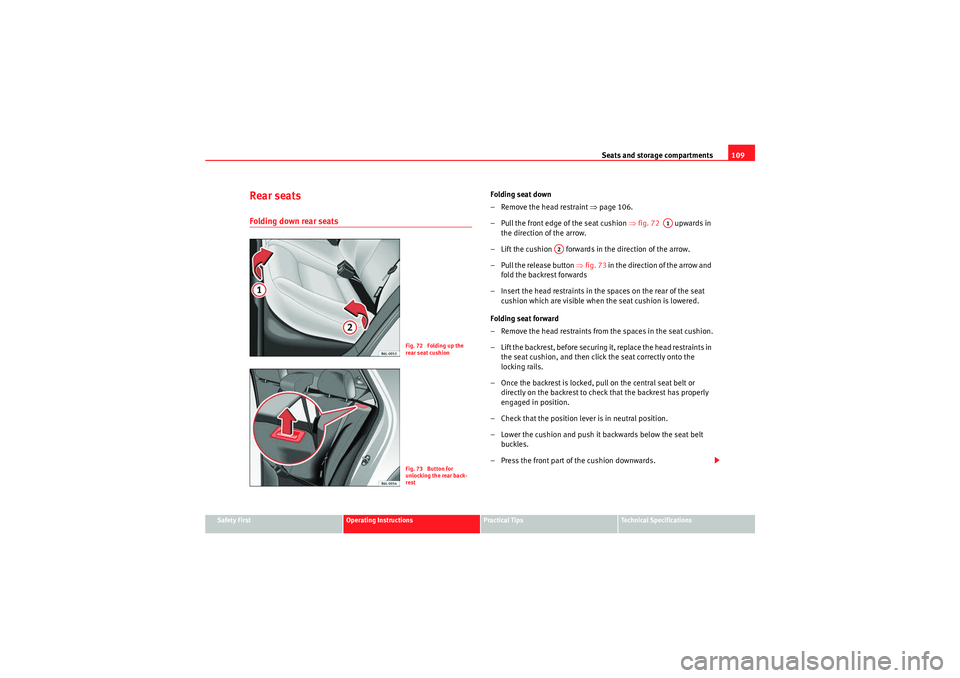
Folding seat down
– Remove the head restraint ⇒page 106.
– Pull the front edge of the seat cushion ⇒fig. 72 upwards in
the direction of the arrow.
– Lift the cushion forwards in the direction of the arrow.
– Pull the release button ⇒fig. 73 in the direction of the arrow and
fold the backrest forwards
– Insert the head restraints in the spaces on the rear of the seat cushion which are visible when the seat cushion is lowered.
Folding seat forward
– Remove the head restraints from the spaces in the seat cushion.
– Lift the backrest, before securing it, replace the head restraints in
the seat cushion, and then click the seat correctly onto the
locking rails.
– Once the backrest is locked, pull on the central seat belt or directly on the backrest to check that the backrest has properly
engaged in position.
– Check that the position lever is in neutral position.
– Lower the cushion and push it backwards below the seat belt
buckles.
– Press the front part of the cushion downwards.
Fig. 72 Folding up the
rear seat cushionFig. 73 Button for
unlocking the rear back-
rest
A1
A2
Ibiza_EN.book Seite 109 Mittwoch, 1. September 2010 5:24 17
Page 118 of 266
Seats and storage compartments
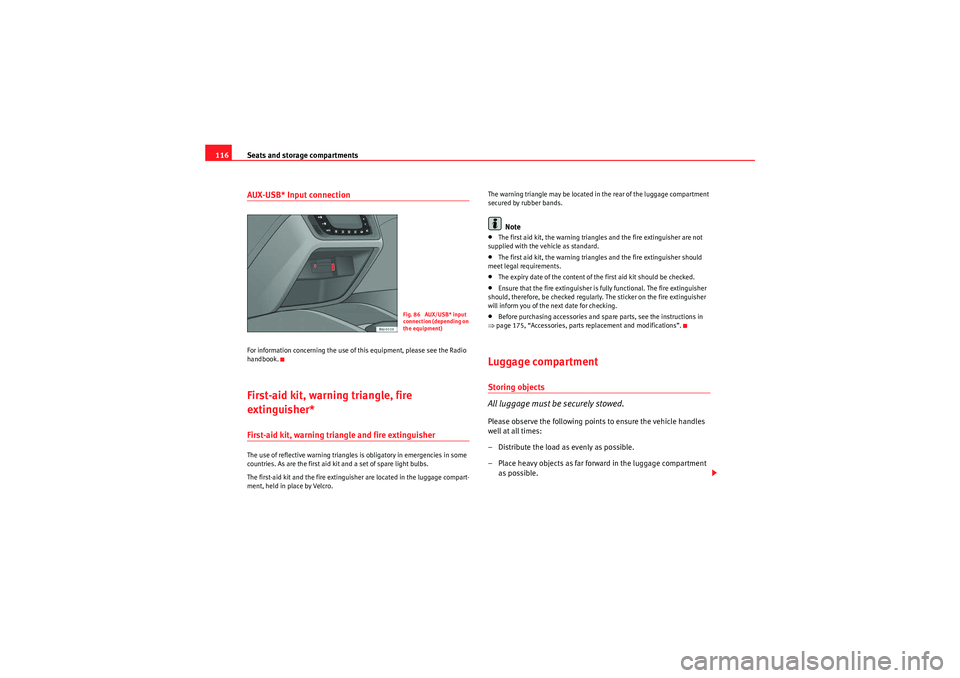
116AUX-USB* Input connectionFor information concerning the use of this equipment, please see the Radio
handbook.First-aid kit, warning triangle, fire
extinguisher*First-aid kit, warning triangle and fire extinguisherThe use of reflective warning triangles is obligatory in emergencies in some
countries. As are the first aid kit and a set of spare light bulbs.
The first-aid kit and the fire extinguisher are located in the luggage compart-
ment, held in place by Velcro. The warning triangle may be located in the rear of the luggage compartment
secured by rubber bands.
Note
•The first aid kit, the warning triangles and the fire extinguisher are not
supplied with the vehicle as standard.•The first aid kit, the warning triangles and the fire extinguisher should
meet legal requirements.•The expiry date of the content of the first aid kit should be checked.•Ensure that the fire extinguisher is fully functional. The fire extinguisher
should, therefore, be checked regularly. The sticker on the fire extinguisher
will inform you of the next date for checking.•Before purchasing accessories and spare parts, see the instructions in
⇒ page 175, “Accessories, parts replacement and modifications”.Luggage compartmentStoring objects
All luggage must be securely stowed.Please observe the following points to ensure the vehicle handles
well at all times:
– Distribute the load as evenly as possible.
– Place heavy objects as far forward in the luggage compartment
as possible.
Fig. 86 AUX/USB* input
connection (depending on
the equipment)
Ibiza_EN.book Seite 116 Mittwoch, 1. September 2010 5:24 17
Page 147 of 266
Driving145
Safety First
Operating Instructions
Practical Tips
Technical Specifications
Applying the handbrake
– Pull the handbrake lever up firmly ⇒ fig. 107.
Releasing the handbrake
– Pull the lever up slightly and press the release knob in the direc- tion of the arrow ⇒fig. 107 and guide the handbrake lever down
fully ⇒ .Always apply the handbrake as far as it will go in order to prevent you from
driving with the handbrake applied by mistake ⇒ .
The handbrake warning lamp
H lights up when the handbrake is applied
and the ignition switched on. The warning turns off when the handbrake is
released.
WARNING
•Never use the handbrake to stop the vehicle when it is in motion. The
braking distance is considerably longer, because braking is only applied to
the rear wheels. Risk of accident!•If it is only partially released, this will cause rear brakes overheating,
which can impair the function of the brake system and could lead to an acci-
dent. This also causes premature wear on the rear brake pads.Caution
Always apply the handbrake before you leave the vehicle. The 1st gear should
also be selected.
Parking
The handbrake should always be firmly applied when the
vehicle is parked.Always note the following points when parking the vehicle:
– Use the brake pedal to stop the vehicle.
– Apply the handbrake.
– The 1st gear should also be selected.
– Switch the engine off and remove the key from the ignition. Turn the steering wheel slightly to engage the steering lock.
– Always take you car keys with you when you leave the vehicle ⇒ .Additional notes on parking the vehicle on gradients:
Turn the steering wheel so that the vehicle rolls against the kerb if it started
to roll.•If the vehicle is parked facing downhill, turn the front wheels so that they
point towards the kerb .•If the vehicle is parked facing uphill, turn the front wheels so that they
point away from the kerb .•Secure the vehicle as normal by applying the handbrake firmly and
engaging 1st gear.WARNING
•Take measures to reduce the risk of injury when you leave your vehicle
unattended.
Ibiza_EN.book Seite 145 Mittwoch, 1. September 2010 5:24 17
Page 166 of 266
Driving and the environment
164figures for your specific model, which may be lower than these figures for the
towing bracket, are given in the vehicle documents or in ⇒Section “Tech-
nical Data”.
Distributing the load
Distribute loads in the trailer so that heavy objects are as near to the axle as
possible. Loads carried in the trailer must be secured to prevent them
moving.
Tyre pressure
Set tyre pressure to the maximum permissible pressure shown on the sticker
on the inside of the fuel tank flap. Set the tyre pressure of the trailer tyres in
accordance with the trailer manufacturer’s recommendations.
Exterior mirrors
Check whether you can see enough of the road behind the trailer with the
standard mirrors. If this is not the case, you should have additional mirrors
fitted. Both exterior mirrors should be mounted on hinged extension
brackets. Adjust the mirrors to give sufficient vision to the rear.
WARNING
Never transport people in a trailer. This could result in fatal accidents.
Note
•Towing a trailer places additional demands on the vehicle. We recom-
mend additional services between the normal inspection intervals if the
vehicle is used frequently for towing a trailer.•Find out whether special regulations apply to towing a trailer in your
country.
Ball coupling of towing bracket*The ball coupling is provided with instructions on fitting and removing the
ball coupling of the towing bracket.
WARNING
The towing bracket ball coupling must be stored securely in the luggage
compartment to prevent them being flung through the vehicle and causing
injury.
Note
•By law, the ball coupling must be re moved if a trailer is not being towed
and it obscures the number plate.Driving tips
Driving with a trailer always requires extra care.Weight distribution
The weight distribution of a loaded trailer with an unladen vehicle is very
unfavourable. However, if this cannot be avoided, drive extra slowly to allow
for the unbalanced weight distribution.
Speed
The stability of the vehicle and trailer is reduced with increasing speed. For
this reason, it is advisable not to drive at the maximum permissible speed in
an unfavourable road, weather or wind conditions. This applies especially
when driving downhill.
You should always reduce speed immediately if the trailer shows the slightest
sign of snaking . Never try to stop the “snaking” by increasing speed.
Ibiza_EN.book Seite 164 Mittwoch, 1. September 2010 5:24 17
Page 181 of 266
Accessories, parts replacement and modifications179
Safety First
Operating Instructions
Practical Tips
Technical Specifications
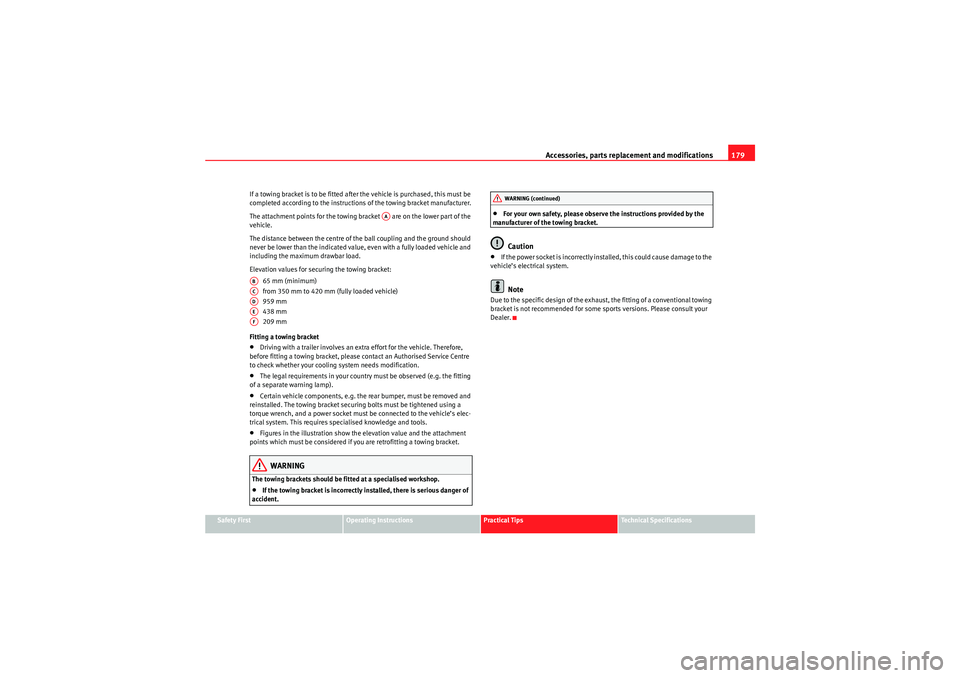
If a towing bracket is to be fitted after the vehicle is purchased, this must be
completed according to the instructions of the towing bracket manufacturer.
The attachment points for the towing bracket are on the lower part of the
vehicle.
The distance between the centre of the ball coupling and the ground should
never be lower than the indicated value, even with a fully loaded vehicle and
including the maximum drawbar load.
Elevation values for securing the towing bracket:
65 mm (minimum)
from 350 mm to 420 mm (fully loaded vehicle)
959 mm
438 mm
209 mm
Fitting a towing bracket
•Driving with a trailer involves an extra effort for the vehicle. Therefore,
before fitting a towing bracket, please contact an Authorised Service Centre
to check whether your cooling system needs modification.•The legal requirements in your country must be observed (e.g. the fitting
of a separate warning lamp).•Certain vehicle components, e.g. the rear bumper, must be removed and
reinstalled. The towing bracket securi ng bolts must be tightened using a
torque wrench, and a power socket must be connected to the vehicle’s elec-
trical system. This requires specialised knowledge and tools.•Figures in the illustration show the elevation value and the attachment
points which must be considered if you are retrofitting a towing bracket.WARNING
The towing brackets should be fitted at a specialised workshop.•If the towing bracket is incorrectly in stalled, there is serious danger of
accident.
•For your own safety, please observe the instructions provided by the
manufacturer of the towing bracket.Caution
•If the power socket is incorrectly installed, this could cause damage to the
vehicle’s electrical system.Note
Due to the specific design of the exhaust, the fitting of a conventional towing
bracket is not recommended for some sports versions. Please consult your
Dealer.
AA
ABACADAEAF
WARNING (continued)
Ibiza_EN.book Seite 179 Mittwoch, 1. September 2010 5:24 17
Page 182 of 266
Checking and refilling levels
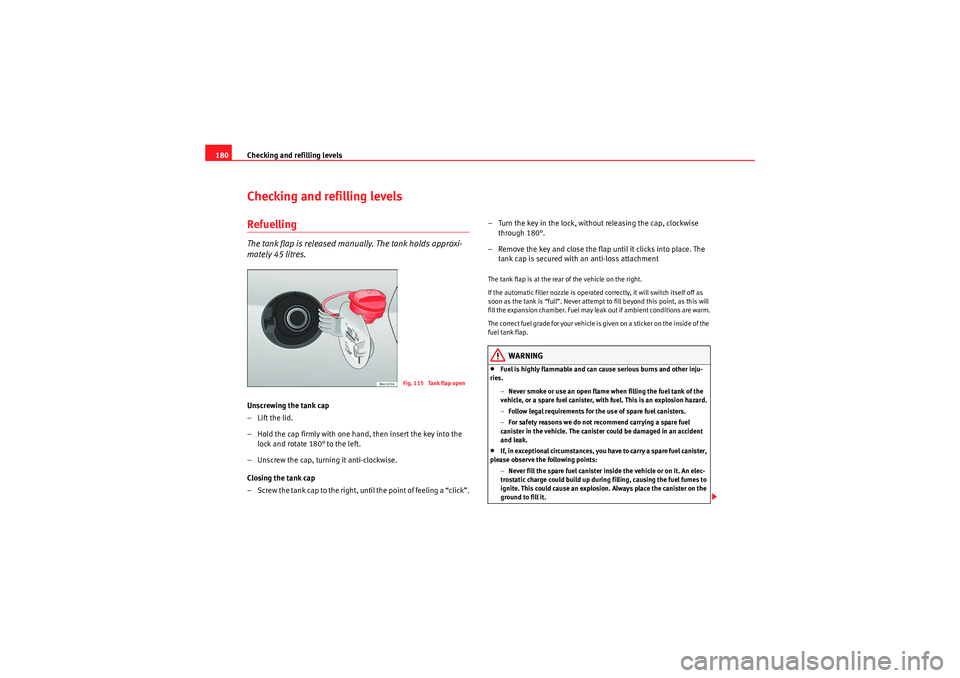
180Checking and refilling levelsRefuellingThe tank flap is released manually. The tank holds approxi-
mately 45 litres.Unscrewing the tank cap
– Lift the lid.
– Hold the cap firmly with one hand, then insert the key into the
lock and rotate 180° to the left.
– Unscrew the cap, turning it anti-clockwise.
Closing the tank cap
– Screw the tank cap to the right, until the point of feeling a “click”. – Turn the key in the lock, without releasing the cap, clockwise
through 180°.
– Remove the key and close the flap until it clicks into place. The tank cap is secured with an anti-loss attachment
The tank flap is at the rear of the vehicle on the right.
If the automatic filler nozzle is operated correctly, it will switch itself off as
soon as the tank is “full”. Never attempt to fill beyond this point, as this will
fill the expansion chamber. Fuel may leak out if ambient conditions are warm.
T he co rr ec t fu el g rad e fo r you r v eh icle is giv en on a sti cker o n th e i nsid e of the
fuel tank flap.
WARNING
•Fuel is highly flammable and can cause serious burns and other inju-
ries.
−Never smoke or use an open flame when filling the fuel tank of the
vehicle, or a spare fuel canister, with fuel. This is an explosion hazard.
− Follow legal requirements for the use of spare fuel canisters.
− For safety reasons we do not recommend carrying a spare fuel
canister in the vehicle. The canister could be damaged in an accident
and leak.•If, in exceptional circumstances, you have to carry a spare fuel canister,
please observe the following points:
−Never fill the spare fuel canister inside the vehicle or on it. An elec-
trostatic charge could build up during filling, causing the fuel fumes to
ignite. This could cause an explosion. Always place the canister on the
ground to fill it.
Fig. 115 Tank flap open
Ibiza_EN.book Seite 180 Mittwoch, 1. September 2010 5:24 17
Page 185 of 266
Checking and refilling levels183
Safety First
Operating Instructions
Practical Tips
Technical Specifications
Working in the engine compartmentSafety instructions on working in the engine compartment
Any work carried out in the engine compartment or on the
engine must be carried out cautiously.Before starting any work on the engine or in the engine compart-
ment:
1. Switch off the engine and remove the key from the ignition.
2. Apply the handbrake.
3. Move the gear lever to neutral or the selector lever to position P.
4. Wait for the engine to cool down.
5. Keep children away from the vehicle.
6. Raise the bonnet ⇒page 185.You should not do any work in the engine compartment unless you know
exactly how to carry out the jobs and have the correct tools! Have the work
carried out by a specialised workshop if you are uncertain.
All service fluids and consumables, e.g. coolant, engine oil, spark plugs and
batteries, are being constantly developed. SEAT provides a constant flow of
information to the Authorised Service Centres concerning modifications. For
this reason, we recommend you to have service fluids and consumables
replaced by an Authorised Service Centre. Please observe the relevant
instructions ⇒page 175. The engine compartment of the vehicle is a
hazardous area. ⇒.
WARNING
All work on the engine or in the engine compartment, e.g. checking and
refilling fluids, involves a risk of injury and scalding as well as the risk of
accident or fire.•Never open the bonnet if you see steam, smoke or coolant escaping
from the engine compartment. Otherwise, there is a risk of sustaining
burns. Wait until no more steam or coolant is emitted, then allow the
engine to cool before carefully opening the bonnet.•Switch off the engine and remove the key from the ignition.•Apply the handbrake and move the gear lever to neutral or selector
lever to position P.•Keep children away from the vehicle.•Never touch hot engine parts. There is a risk of burns.•Never spill liquids on a hot engine or on a hot exhaust gas system. This
is a fire hazard.•Avoid causing short-circuits in the electrical system, particularly at the
points where the jump leads are attached ⇒page 225. The battery could
explode.•Never touch the radiator fan. It is temperature controlled and could
start automatically, even when the engine has been switched off and the
key removed from the ignition!•Do not unscrew the cap on the coolant reservoir when the engine is hot.
If the coolant is hot, the cooling system will be pressurised!•Protect face, hands and arms by covering the cap with a large, thick
cloth to protect against escaping coolant and steam.•A l w ays ma ke s u re yo u ha v e n o t l e f t a n y obj e c ts , s u ch as c l ea n in g cl o t h s
and tools, in the engine compartment.•If you have to work underneath the vehicle, you must use suitable
stands additionally to support the vehicle, there is a risk of accident!. A
hydraulic jack is insufficient for securing the vehicle and there is a risk of
injury.
Ibiza_EN.book Seite 183 Mittwoch, 1. September 2010 5:24 17
Page 187 of 266
Checking and refilling levels185
Safety First
Operating Instructions
Practical Tips
Technical Specifications
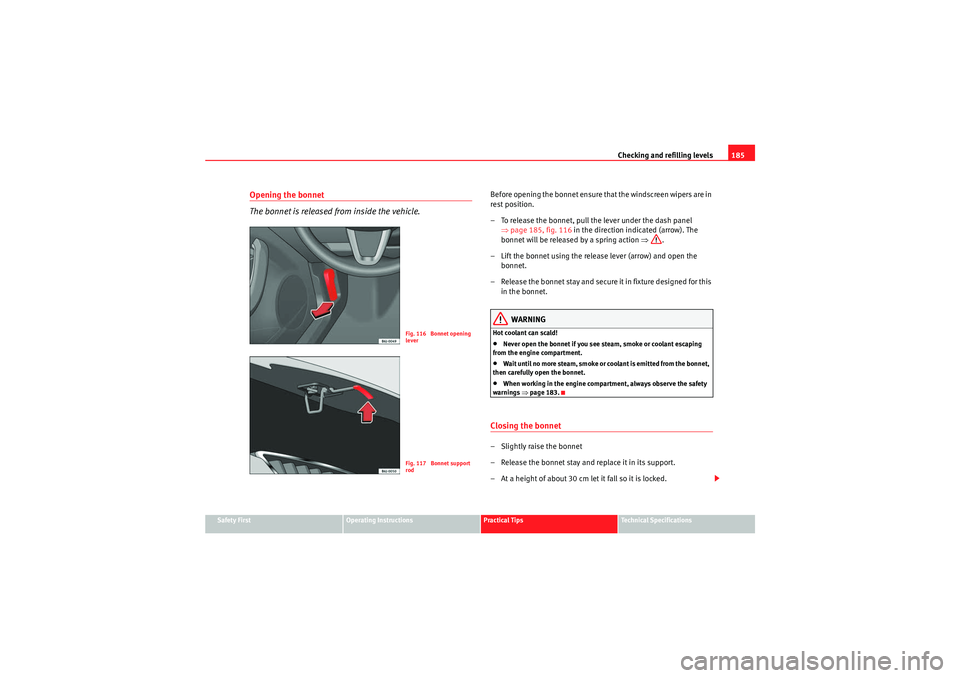
Opening the bonnet
The bonnet is released from inside the vehicle.
Before opening the bonnet ensure that the windscreen wipers are in
rest position.
– To release the bonnet, pull the lever under the dash panel
⇒page 185, fig. 116 in the direction indicated (arrow). The
bonnet will be released by a spring action ⇒.
– Lift the bonnet using the release lever (arrow) and open the bonnet.
– Release the bonnet stay and secure it in fixture designed for this
in the bonnet.
WARNING
Hot coolant can scald!•Never open the bonnet if you see steam, smoke or coolant escaping
from the engine compartment.•Wait until no more steam, smoke or coolant is emitted from the bonnet,
then carefully open the bonnet.•When working in the engine compartment, always observe the safety
warnings ⇒page 183.
Closing the bonnet– Slightly raise the bonnet
– Release the bonnet stay and replace it in its support.
– At a height of about 30 cm let it fall so it is locked.
Fig. 116 Bonnet opening
leverFig. 117 Bonnet support
rod
Ibiza_EN.book Seite 185 Mittwoch, 1. September 2010 5:24 17
Page 188 of 266
Checking and refilling levels
186If the b onn et d o es n ot clos e , do not p ress d ownwa rds . Op e n it o nce m or e an d
let it fall as before.
WARNING
If the bonnet is not closed properly, it could open while you are driving and
completely obscure your view of the road. Risk of accident.•After closing the bonnet, always check that it is properly secured. The
bonnet must be flush with the surrounding body panels.•If you notice that the bonnet latch is not secured when the vehicle is
moving, stop the vehicle immediately and close the bonnet properly. Risk
of accident.
Engine oilGeneral notesThe engine comes with a special, high quality, multi grade oil that can be
used in all seasons of the year except for those regions affected by extreme
cold.
As the use of good quality oil is necessary for the correct operation and long
service life of the engine, when it becomes necessary to replenish or change
the oil, always use an oil that complies with VW standards.
The specifications (VW standards) set out in the following page should
appear on the container of the service oil; when the container displays the
specific standards for petrol and diesel engines together, it means that the
oil can be used for both types of engines.
We recommend that the oil change, indicated in the Maintenance
Programme, be performed by an Authorised Service Centre or a specialised
workshop. The correct oil specifications for your engine are listed in
⇒page 187, “Oil
properties”.
Service intervals
Service intervals can be flexible (LongLife service) or fixed (dependent on
time/distance travelled).
If the PR code that appears on the back of the Maintenance Programme
booklet is QG1, this means that your vehicle has the LongLife service
programmed. If it has the codes QG0 or QG2 the interval service is dependent
on time/distance travelled.
Flexible service intervals (LongLife*)
Special oils and processes have been developed which, depending on the
characteristics and individual driving profiles, allow to extend the oil change
service (LongLife service intervals).
Because this oil is essential for extending the service intervals, it must only
be used observing the following indications:
•Avoid mixing it with oil for fixed service intervals.•Only in exceptional circumstances, if the engine oil level is too low
⇒ page 187 and LongLife oil is not available, it is permitted to top up (once)
with oil for fixed service intervals ⇒ page 187 (up to a maximum of 0.5
litres).
Fixed service intervals*
If your vehicle does not have the “LongLife service interval” or it has been
disabled (by request), you may use oils for fixed service intervals, which also
appear in ⇒page 187, “Oil properties”. In this case, your vehicle must be
serviced after a fixed interval of 1 year / 15,000 km (whatever comes first)
⇒ Booklet “Maintenance Programme”.•In exceptional circumstances, if the engine oil level is too low
⇒ page 187 and you cannot obtain the oil specified for your vehicle, you can
put in a small quantity of oil conforming to the specification ACEA A2 or
ACEA A3 (petrol engines) or ACEA B3 or ACEA B4 (diesel engines) (up to 0.5 l).
Ibiza_EN.book Seite 186 Mittwoch, 1. September 2010 5:24 17