lock Seat Ibiza 5D 2010 Service Manual
[x] Cancel search | Manufacturer: SEAT, Model Year: 2010, Model line: Ibiza 5D, Model: Seat Ibiza 5D 2010Pages: 266, PDF Size: 7.04 MB
Page 122 of 266
Air conditioning
120•In air recirculation mode, no cold air from the outside enters the vehicle
interior. The windows can quickly fog over if the heating is switched off.
Therefore, never leave the air recirculation mode switched on for a long
time (risk of accident).Note
•Please consider the general notes ⇒page 128.Vehicle ventilation or heatingVentilating the passenger compartment
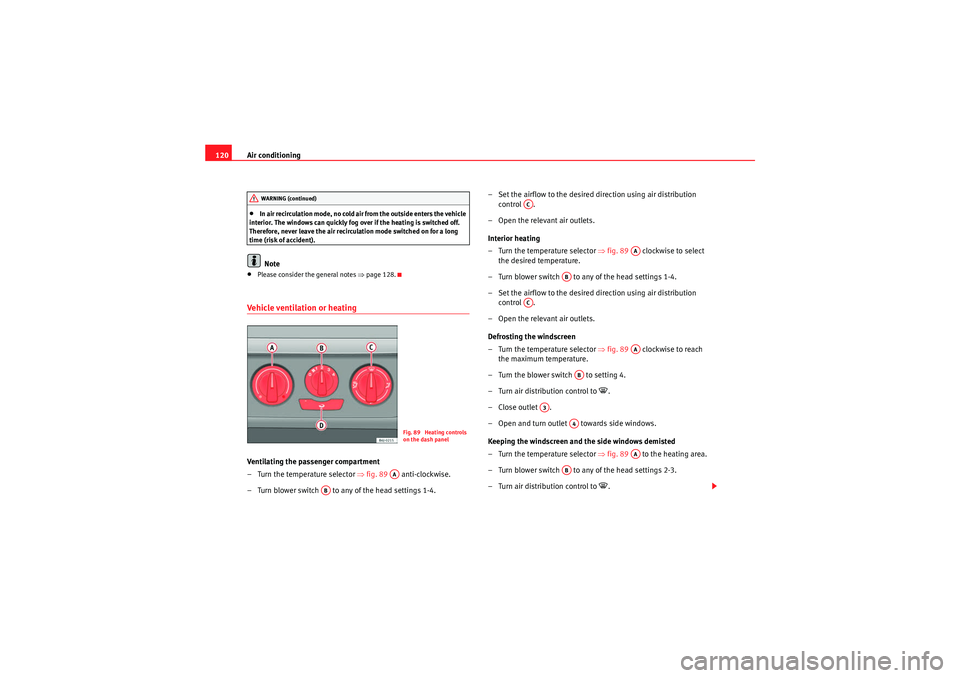
– Turn the temperature selector ⇒fig. 89 anti-clockwise.
– Turn blower switch to any of the head settings 1-4. – Set the airflow to the desired direction using air distribution
control .
– Open the relevant air outlets.
Interior heating
– Turn the temperature selector ⇒fig. 89 clockwise to select
the desired temperature.
– Turn blower switch to any of the head settings 1-4.
– Set the airflow to the desired direction using air distribution control .
– Open the relevant air outlets.
Defrosting the windscreen
– Turn the temperature selector ⇒fig. 89 clockwise to reach
the maximum temperature.
– Turn the blower switch to setting 4.
– Turn air distribution control to
<.
–Close outlet .
– Open and turn outlet towards side windows.
Keeping the windscreen and the side windows demisted
– Turn the temperature selector ⇒fig. 89 to the heating area.
– Turn blower switch to any of the head settings 2-3.
– Turn air distribution control to <.
WARNING (continued)
Fig. 89 Heating controls
on the dash panel
AA
AB
AC
AA
AB
AC
AA
AB
A3
A4
AA
AB
Ibiza_EN.book Seite 120 Mittwoch, 1. September 2010 5:24 17
Page 131 of 266
Driving129
Safety First
Operating Instructions
Practical Tips
Technical Specifications
DrivingSteeringAdjusting the steering wheel position
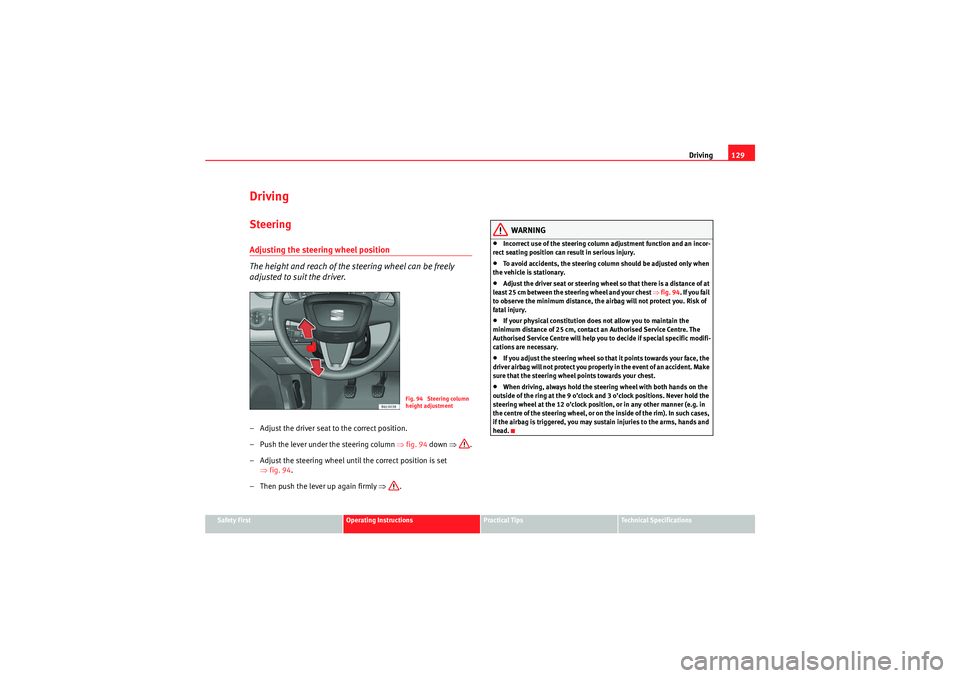
The height and reach of the steering wheel can be freely
adjusted to suit the driver.– Adjust the driver seat to the correct position.
– Push the lever under the steering column ⇒fig. 94 down ⇒.
– Adjust the steering wheel until the correct position is set ⇒fig. 94.
– Then push the lever up again firmly ⇒.
WARNING
•Incorrect use of the steering column adjustment function and an incor-
rect seating position can result in serious injury.•To avoid accidents, the steering column should be adjusted only when
the vehicle is stationary.•Adjust the driver seat or steering whee l so that there is a distance of at
least 25 cm between the steering wheel and your chest ⇒fig. 94 . If you fail
to observe the minimum distance, the airbag will not protect you. Risk of
fatal injury.•If your physical constitution does not allow you to maintain the
minimum distance of 25 cm, contact an Authorised Service Centre. The
Authorised Service Centre will help you to decide if special specific modifi-
cations are necessary.•If you adjust the steering wheel so that it points towards your face, the
driver airbag will not protect you properly in the event of an accident. Make
sure that the steering wheel points towards your chest.•When driving, always hold the steering wheel with both hands on the
outside of the ring at the 9 o’clock and 3 o’clock positions. Never hold the
steering wheel at the 12 o’clock position, or in any other manner (e.g. in
the centre of the steering wheel, or on the inside of the rim). In such cases,
if the airbag is triggered, you may sustain injuries to the arms, hands and
head.
Fig. 94 Steering column
height adjustment
Ibiza_EN.book Seite 129 Mittwoch, 1. September 2010 5:24 17
Page 132 of 266
Driving
130SafetyElectronic Stability Programme (ESP)*
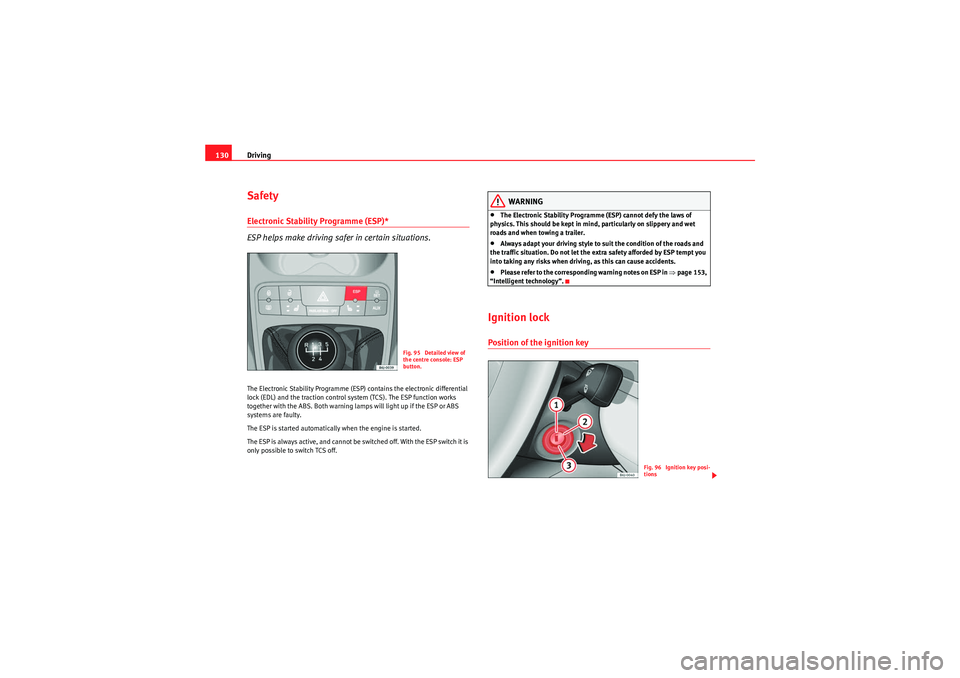
ESP helps make driving safer in certain situations.The Electronic Stability Programme (ESP) contains the electronic differential
lock (EDL) and the traction control system (TCS). The ESP function works
together with the ABS. Both warning lamps will light up if the ESP or ABS
systems are faulty.
The ESP is started automatically when the engine is started.
The ESP is always active, and cannot be switched off. With the ESP switch it is
only possible to switch TCS off.
WARNING
•The Electronic Stability Programme (ESP) cannot defy the laws of
physics. This should be kept in mi nd, particularly on slippery and wet
roads and when towing a trailer.•Always adapt your driving style to suit the condition of the roads and
the traffic situation. Do not let the extra safety afforded by ESP tempt you
into taking any risks when driving, as this can cause accidents.•Please refer to the corresponding warning notes on ESP in ⇒page 153,
“Intelligent technology”.
Ignition lockPosition of the ignition key
Fig. 95 Detailed view of
the centre console: ESP
button.
Fig. 96 Ignition key posi-
tions
Ibiza_EN.book Seite 130 Mittwoch, 1. September 2010 5:24 17
Page 133 of 266
Driving131
Safety First
Operating Instructions
Practical Tips
Technical Specifications
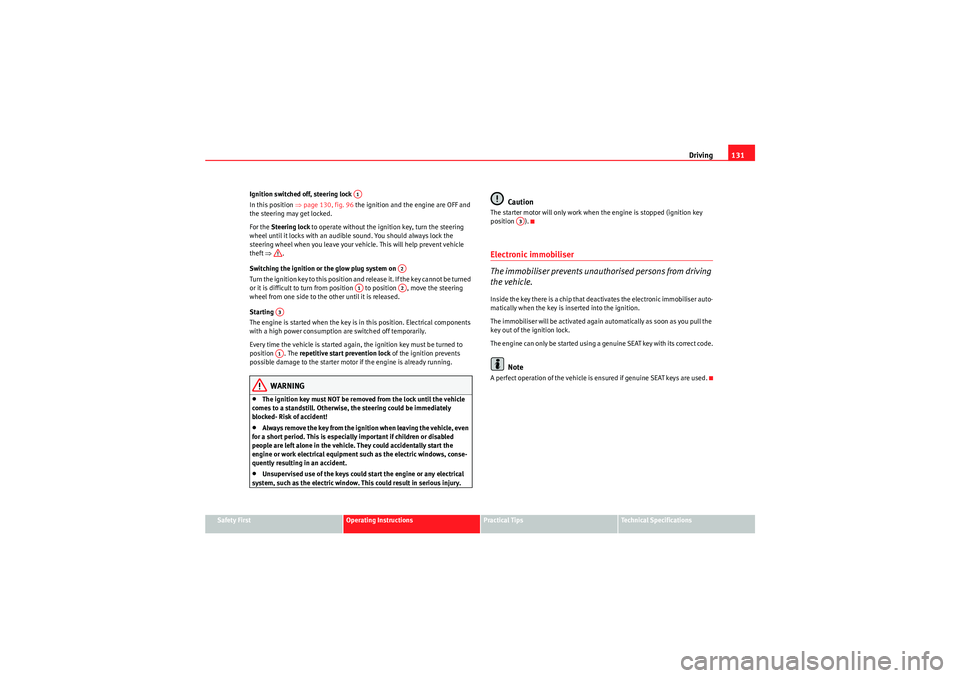
Ignition switched off, steering lock
In this position
⇒page 130, fig. 96 the ignition and the engine are OFF and
the steering may get locked.
For the Steering lock to operate without the ignition key, turn the steering
wheel until it locks with an audible sound. You should always lock the
steering wheel when you leave your vehicle. This will help prevent vehicle
theft ⇒ .
Switching the ignition or the glow plug system on
Turn the ignition key to this position and release it. If the key cannot be turned
or it is difficult to turn from position to position , move the steering
wheel from one side to the other until it is released.
Starting
The engine is started when the key is in this position. Electrical components
with a high power consumption are switched off temporarily.
Every time the vehicle is started again, the ignition key must be turned to
position . The repetitive start prevention lock of the ignition prevents
possible damage to the starter motor if the engine is already running.
WARNING
•The ignition key must NOT be removed from the lock until the vehicle
comes to a standstill. Otherwise, the steering could be immediately
blocked- Risk of accident!•Always remove the key from the ignition when leaving the vehicle, even
for a short period. This is especially important if children or disabled
people are left alone in the vehicle. They could accidentally start the
engine or work electrical equipment such as the electric windows, conse-
quently resulting in an accident.•Unsupervised use of the keys could start the engine or any electrical
system, such as the electric window. This could result in serious injury.
Caution
The starter motor will only work when the engine is stopped (ignition key
position ).Electronic immobiliser
The immobiliser prevents unauthorised persons from driving
the vehicle.Inside the key there is a chip that deactivates the electronic immobiliser auto-
matically when the key is inserted into the ignition.
The immobiliser will be activated again automatically as soon as you pull the
key out of the ignition lock.
The engine can only be started using a genuine SEAT key with its correct code.
Note
A perfect operation of the vehicle is ensured if genuine SEAT keys are used.
A1
A2
A1
A2
A3A1
A3
Ibiza_EN.book Seite 131 Mittwoch, 1. September 2010 5:24 17
Page 136 of 266
Driving
134operation cannot be performed, risk of accidents and serious injury may
exist.•The steering lock can be immediately blocked once the key is removed
from the ignition. The steering wheel cannot be turned. Risk of accident.Caution
When the engine has been running under a heavy load for a long period, heat
can accumulate in the engine compartment and cause engine damage. For
this reason, you should idle the engine for approx. 2 minutes before you
switch it off.Start-Stop function*Description and operationThe Start-Stop function stops the engine when the vehicle is
stopped and starts it automatically when required.
– When the vehicle is stopped, put it in neutral and release the clutch pedal. The engine will stop.
– When the clutch pedal is pressed, the engine starts again.
– The instrument panel screen displays information about the status of the Start-Stop function ⇒page 136, fig. 98 .Start-Stop function conditions•The driver seat belt must be buckled.
•The engine hood must be closed.•The engine must be at operating temperature•The steering wheel must be straight.•The vehicle must be on flat ground.•The vehicle must not be in reverse.•A trailer must not be connected.•The temperature of the passenger compartment must be within the
convenience limits ( button should be selected).•The windscreen de-mist function must be off.•If in an increase in airflow is not requested.•The temperature must not be set to HI or LO.•The driver door must be closed.•The diesel particulate filter must not be in regeneration mode, for diesel
engines.•The battery charge must not be low for the next start.•The battery temperature must be between -1 °C and 55 °C.
Start-Stop function interruption
In the following situations, the Start-Stop function will be interrupted and the
engine will automatically start:•The vehicle starts moving.•The brake pedal is pressed several times in a row.•The battery has been discharged excessively.•The Start-Stop System is manually deactivated.•The windscreen de-mist function is turned on.•The temperature of the passenger compartment exceeds the convenience
limits ( button).•If the airflow is increased by more than 3 presses.•Temperature setting HI or LO is selected.
WARNING (continued)
AC
AC
Ibiza_EN.book Seite 134 Mittwoch, 1. September 2010 5:24 17
Page 140 of 266
Driving
138If you select the sport programme, S, you will drive in a sporty mode, i.e. a
programme in which shifts into high gears are postponed in order to use the
full power of the engine.Selector lever lock functions
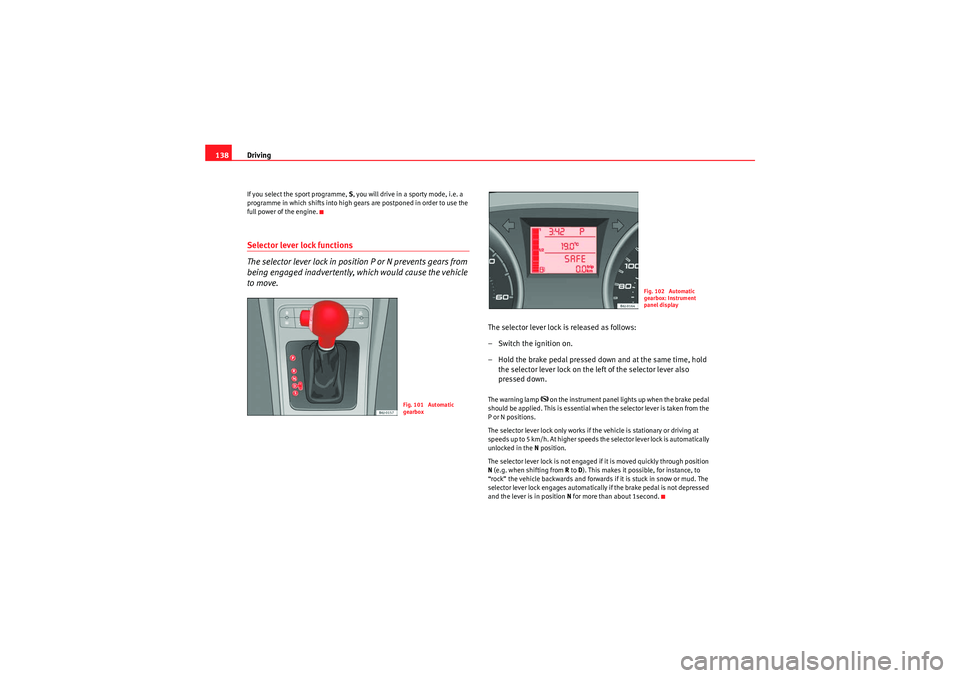
The selector lever lock in position P or N prevents gears from
being engaged inadvertently, which would cause the vehicle
to move.
The selector lever lock is released as follows:
– Switch the ignition on.
– Hold the brake pedal pressed down and at the same time, hold the selector lever lock on the left of the selector lever also
pressed down.The warning lamp
K on the instrument panel lights up when the brake pedal
should be applied. This is essential when the selector lever is taken from the
P or N positions.
The selector lever lock only works if the vehicle is stationary or driving at
speeds up to 5 km/h. At higher speeds the selector lever lock is automatically
unlocked in the N position.
The selector lever lock is not engaged if it is moved quickly through position
N (e.g. when shifting from R to D). This makes it possible, for instance, to
“rock” the vehicle backwards and forwards if it is stuck in snow or mud. The
selector lever lock engages automatically if the brake pedal is not depressed
and the lever is in position N for more than about 1second.
Fig. 101 Automatic
gearbox
Fig. 102 Automatic
gearbox: Instrument
panel display
Ibiza_EN.book Seite 138 Mittwoch, 1. September 2010 5:24 17
Page 141 of 266
Driving139
Safety First
Operating Instructions
Practical Tips
Technical Specifications
Driving a car with an automatic gearbox
The gearbox changes gear ratios automatically as the vehicle
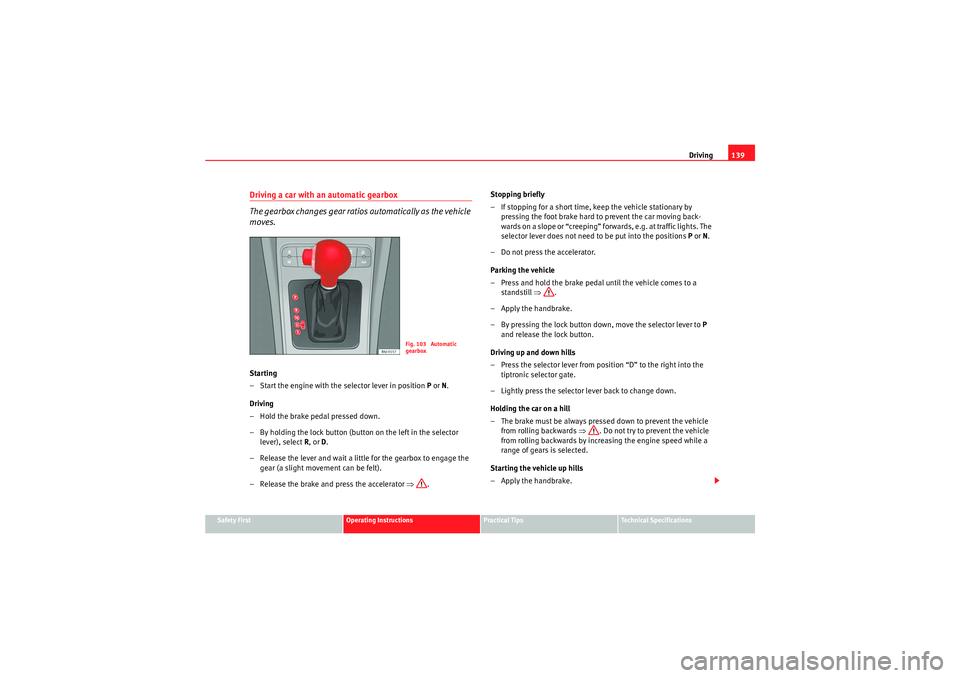
moves.Starting
– Start the engine with the selector lever in position P or N.
Driving
– Hold the brake pedal pressed down.
– By holding the lock button (button on the left in the selector lever), select R, or D.
– Release the lever and wait a little for the gearbox to engage the gear (a slight movement can be felt).
– Release the brake and press the accelerator ⇒. Stopping briefly
– If stopping for a short time, keep the vehicle stationary by
pressing the foot brake hard to prevent the car moving back-
wards on a slope or “creeping” forwards, e.g. at traffic lights. The
selector lever does not need to be put into the positions P or N.
– Do not press the accelerator.
Parking the vehicle
– Press and hold the brake pedal until the vehicle comes to a standstill ⇒.
– Apply the handbrake.
– By pressing the lock button down, move the selector lever to P
and release the lock button.
Driving up and down hills
– Press the selector lever from position “D” to the right into the tiptronic selector gate.
– Lightly press the selector lever back to change down.
Holding the car on a hill
– The brake must be always pressed down to prevent the vehicle from rolling backwards ⇒. Do not try to prevent the vehicle
from rolling backwards by increa sing the engine speed while a
range of gears is selected.
Starting the vehicle up hills
– Apply the handbrake.
Fig. 103 Automatic
gearbox
Ibiza_EN.book Seite 139 Mittwoch, 1. September 2010 5:24 17
Page 142 of 266
Driving
140
– With a selected gear, accelerate slowly and at the same time, release the handbrake.The steeper the slope, the lower the needed gear. This increases the braking
effect of the engine. For example, when driving down a very steep slope in
third gear. If the engine brake effect is not enough, the vehicle will speed up.
The automatic gearbox automatically changes up to prevent the engine over-
revving. Use the foot brake to reduce speed and change into third gear again
using Tiptronic* ⇒.
Your vehicle has an automatic interlock which prevents the selector lever
from being put into a position for driving forwards or in reverse from positions
P or N if the brake pedal is not depressed.
Warning lamp “Pressing brake pedal”
K
When the warning lamp next to the selector lever lights up, press the brake
pedal. This is necessary when the automatic gearbox selector lever is moved
out of positions P or N. At the same time, a text message or the instructions
to perform necessary operations may appear on the instrument panel.
WARNING
•As a driver, you should never leave your vehicle if the engine is running
and a gear is engaged. If you have to leave your vehicle while the engine is
running, you must apply the parking brake and put the selector lever in
position P.•If the engine is running and D or R are engaged, you will need to hold
vehicle stopped by depressing the brake pedal. The car would keep on
creeping forward as the power transmission is not fully interrupted even
when the engine is idling.•Never accelerate when moving the selector gear or you may cause an
accident.•Never move the selector lever to R or P when driving. Risk of accident!
•Before driving down a long, steep slope, it is advisable to reduce speed
and change into a lower gear.•If you stop the vehicle up hill, always hold the foot brake strongly
depressed down to stop it from rolling back.•Never allow the brake to rub and do not use the brake pedal too often
or for long periods. Constant braking will cause the brakes to overheat and
will considerably reduce the brake effect. This increases the braking
distance and could cause the brake system to fail.•Never allow the car to roll down a mountain or a slope with the lever in
the N or D position, regardless of the engine is running or not.Caution
•If you stop the vehicle up hills, do not attempt to stop it from rolling back
by depressing the accelerator when a gear has been selected. Otherwise, the
automatic gearbox may overheat causing damage. Pull the handbrake up or
fully depress the brake pedal to prevent the vehicle from rolling away.•If you allow the car to roll when the engine is not running, or with the
selector lever in position N, a lack of lubrication in the automatic gearbox will
damage it.WARNING (continued)
Ibiza_EN.book Seite 140 Mittwoch, 1. September 2010 5:24 17
Page 144 of 266
Driving
142Changing gears in the normal or sport programme using the steering wheel
paddle levers
If the paddle levers ⇒ page 141, fig. 105 are used in the normal or sport
programme, the system switches temporarily to tiptronic mode. To exit
“tiptronic” mode again, press the right paddle lever towards the steering
wheel for approximately one second. You will also leave tiptronic mode if the
paddle levers are not moved for a certain time.
Note
•The gear paddle levers on the steering wheel can be operated with the
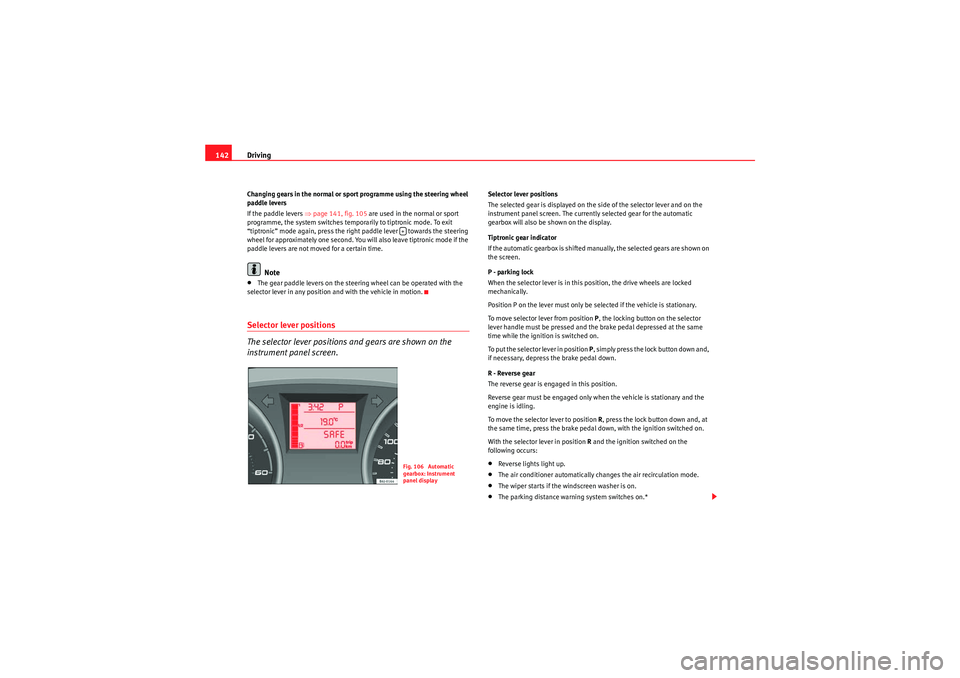
selector lever in any position and with the vehicle in motion.Selector lever positions
The selector lever positions and gears are shown on the
instrument panel screen.
Selector lever positions
The selected gear is displayed on the side of the selector lever and on the
instrument panel screen. The currently selected gear for the automatic
gearbox will also be shown on the display.
Tiptronic gear indicator
If the automatic gearbox is shifted manually, the selected gears are shown on
the screen.
P - parking lock
When the selector lever is in this position, the drive wheels are locked
mechanically.
Position P on the lever must only be selected if the vehicle is stationary.
To move selector lever from position P, the locking button on the selector
lever handle must be pressed and the brake pedal depressed at the same
time while the ignition is switched on.
To put the selector lever in position P, simply press the lock button down and,
if necessary, depress the brake pedal down.
R - Reverse gear
The reverse gear is engaged in this position.
Reverse gear must be engaged only when the vehicle is stationary and the
engine is idling.
To move the selector lever to position R, press the lock button down and, at
the same time, press the brake pedal down, with the ignition switched on.
With the selector lever in position R and the ignition switched on the
following occurs:•Reverse lights light up.•The air conditioner automatically changes the air recirculation mode.•The wiper starts if the windscreen washer is on.•The parking distance warning system switches on.*
+Fig. 106 Automatic
gearbox: Instrument
panel display
Ibiza_EN.book Seite 142 Mittwoch, 1. September 2010 5:24 17
Page 145 of 266
Driving143
Safety First
Operating Instructions
Practical Tips
Technical Specifications
N - Neutral (idling)
If this position is selected, the gearbox is in neutral. Power is not transmitted
to the wheels and the engine does not have a braking function.
Never use the
N position to drive down a hill. The engine does not function as
a brake and the brakes are subjected to excessive stain.
You could damage the automatic gearbox if you drive down hills with the gear
lever in position N and the engine switched off.
D - Drive (forward)
In this position the gearbox automatically changes to a lower or higher gear,
according to the engine’s requirements, the driving style and speed. The
braking effect of the engine when driving downhill is very limited when the
selector is in this position. The instrument panel displays the selected gear
as well as the selector lever in position D.
If position N has been selected and you wish to select D, you must press the
foot brake if the vehicle is stationary, or travelling at under 5 km/h.
S - Standard driving position (Sport programme)
When the selector lever is in position S, it will automatically change up into a
h igh er gea r late r, an d change d own i nto a low g ea r, if com pare d wi th p osi ti on
D . This way, it is possible to take full advantage of the engine reserve power,
depending on the engine demand, driving style and speed. The braking
effect of the engine when driving downhill is very limited. On the instrument
panel display the selected gear is shown as well as the selector lever to posi-
tion S.
To select gear range S, press the lock button on the selector lever.
WARNING
If the vehicle moves with no control, an accident and serious injury may
occur.
•As a driver, you should never leave your vehicle if the engine is running
and a gear is engaged. If you have to leave your vehicle while the engine is
running, you must always apply the handbrake and engage parking lock P.•If the engine is running and if D or R are engaged, you will need to hold
the the vehicle stopped by depressing footbrake down. The car would creep
forward as the power transmission is not fully interrupted even when the
engine is idling.•Never accelerate when moving the selector gear or you may cause an
accident.•Never move the selector lever to “R” or “P” when driving. Risk of acci-
dent.•Before driving down a very steep slope, reduce your speed and shift to
first gear.•Always hold the vehicle on the foot brake if you stop on hills. Other-
wise, the vehicle could roll back.•Never allow the brake to rub and do not use the brake pedal too often
or for long periods. Constant braking will cause the brakes to overheat and
will considerably reduce the brake effect. This increases the braking
distance and could cause the brake system to fail.WARNING
Never switch the engine off until the vehicle is stationary. You could lose
control of your vehicle. This could cause an accident and serious injury.•The airbags and belt tensioners do not work when the ignition is
switched off.•The brake servo does not work with the engine off. You need more force
to stop the vehicle.•Power steering does not work when the engine is not running. That is
why it is much more difficult to turn the steering wheel.WARNING (continued)
Ibiza_EN.book Seite 143 Mittwoch, 1. September 2010 5:24 17