wheel Seat Ibiza SC 2009 Owner's Guide
[x] Cancel search | Manufacturer: SEAT, Model Year: 2009, Model line: Ibiza SC, Model: Seat Ibiza SC 2009Pages: 257, PDF Size: 6.61 MB
Page 152 of 257
Intelligent technology
150Electronic Stabilising Program (ESP)*
ESP reduces the danger of skidding by braking the wheels individually.
The system uses the steering wheel angle and road speed to calculate the
changes of direction desired by the driver, and constantly compares them
with the actual behaviour of the vehicle. If the desired course is not being
maintained (for instance, if the car is starting to skid), then the ESP compen-
sates automatically by braking the appropriate wheel.
The forces acting on the braked wheel bring the vehicle back to a stable
condition. If the vehicle tends to oversteer, the system will act on the front
wheel on the outside of the turn.
WARNING
•It must be remembered that ESP cannot defy the laws of physics. This
should be kept in mind, particularly on slippery and wet roads and when
towing a trailer.•Always adapt your driving style to suit the condition of the roads and
the traffic situation. Do not let the extra safety afforded by ESP tempt you
into taking any risks when driving, this can cause accidents.Caution
•In order to ensure that ESP functions correctly, all four wheels must be
fitted with the same tyres. Any differences in the rolling radius of the tyres can
cause the system to reduce engine power when this is not desired.•Modifications to the vehicle (e.g. to the engine, the brake system, running
gear or any components affecting the wheels and tyres) could affect the effi-
ciency of the ABS, EDL, ESP and TCS.
Anti-lock brake system (ABS)The anti-lock brake system prevents the wheels locking during braking
⇒ page 148.Electronic differential lock (EDL)*
The electronic differential lock helps prevent the loss of trac-
tion caused if one of the driven wheels starts spinning.EDL helps the vehicle to start moving, accelerate and climb a gradient in slip-
pery conditions where this may otherwise be difficult or even impossible.
The system will control the revolutions of the drive wheels using the ABS
sensors (in case of an EDL fault the warning lamp for ABS lights up)
⇒ page 59.
At speeds of up to approximately 80 km/h, it is able to balance out differ-
ences in the speed of the driven wheels of approximately 100 rpm caused by
a slippery road surface on one side of the vehicle. It does this by braking the
wheel which has lost traction and distributing more driving force to the other
driven wheel via the differential.
To prevent the disc brake of the braking wheel from overheating, the EDL cuts
out automatically if subjected to excessive loads. The vehicle will continue to
function normally without EDL. For this reason, the driver is not informed that
the EDL has been switched off.
The EDL will switch on again automatically when the brake has cooled down.
WARNING
•When accelerating on a slippery surface, for example on ice and snow,
press the accelerator carefully. Despite EDL, the driven wheels may start to
spin. This could impair the vehicle's stability.
IbizaSC_EN.book Seite 150 Mittwoch, 16. September 2009 12:11 12
Page 153 of 257
Intelligent technology151
Safety First
Controls and equipment
Practical tips
Technical Data
•Always adapt your driving style to suit road conditions and the traffic
situation. Do not let the extra safety afforded by EDL tempt you into taking
any risks when driving, this can cause accidents.Caution
Modifications to the vehicle (e.g. to the engine, the brake system, running
gear or any components affecting the wheels and tyres) could affect the effi-
ciency of the EDL ⇒page 168.The traction control system (TCS)The traction control system prevents the drive wheels from spinning when the
car is accelerating ⇒page 148.
WARNING (continued)
IbizaSC_EN.book Seite 151 Mittwoch, 16. September 2009 12:11 12
Page 160 of 257
Driving and the environment
158
Note•By law, the ball coupling must be re moved if a trailer is not being towed
and it obscures the number plate.Driving tips
Driving with a trailer always requires extra care.Weight distribution
The weight distribution of a loaded trailer with an unladen vehicle is very
unfavourable. However, if this cannot be avoided, drive extra slowly to allow
for the unbalanced weight distribution.
Speed
The stability of the vehicle and trailer is reduced with increasing speed. For
this reason, it is advisable not to drive at the maximum permissible speed in
an unfavourable road, weather or wind conditions. This applies especially
when driving downhill.
You should always reduce speed immediately if the trailer shows the slightest
sign of snaking . Never try to stop the “snaking” by increasing speed.
Always brake in due course. If the trailer has an overrun brake, apply the
brakes gently at first and then, firmly. This will prevent the jerking that can be
caused by the trailer wheels locking. Select a low gear in due course before
going down a steep downhill. This enables you to use the engine braking to
slow down the vehicle.
Reheating
At ver y high temperatures and on prolonged slopes, driving in a low gear and
high engine speed, always monitor the temperature indicator for the coolant
⇒ page 47. Electronic Stabilisation Program*
The ESP* system helps to stabilise the trailer in case of skidding or rocking.
IbizaSC_EN.book Seite 158 Mittwoch, 16. September 2009 12:11 12
Page 162 of 257
Your vehicle maintenance and cleaning
160Vehicle exterior maintenanceAutomatic car washing tunnelThe vehicle paintwork is so durable that the car can normally be washed
without problems in an automatic car washing tunnel. However, the paint-
work wear depends to a large extent, on the kind of the car washing tunnel,
the brushes used, its water filtering and the type of cleaning and preservative
products.
Before going through a car wash, be sure to take the usual precautions such
as closing the windows and sunroof. There is nothing to note apart from that.
If the vehicle has special accessories such as spoilers or a roof carrier or two-
way radio aerial, etc., it is advisable to consult the car washing tunnel oper-
ator.
After washing, the brakes could hesitate to respond as the brake discs and
pads could be wet, or even frozen in winter. “Dry” the brakes by braking
several times.
WARNING
Water, ice and salt on the brakes can reduce braking efficiency. Risk of acci-
dent.
Caution
Before putting the vehicle through the car washing tunnel, do not tighten the
aerial if it is folded because it can be damaged.
Washing by handVehicle washing
– First soften the dirt with plenty of water and rinse it off.
– Clean your vehicle from top to bottom with a soft sponge, a glove or a brush. Use very light pressure.
– Rinse the sponge or glove often with clean water.
– Special car shampoo should only be used for very stubborn dirt.
– Clean the wheels, sill panels etc. until last with a different sponge or glove.
– Rinse the vehicle thoroughly with water.
– Dry your vehicle surface gently with a chamois leather.
–When temperature is cold , dry the rubber seals and its surfaces
to prevent them from freezing. Apply silicone spray to the rubber
seals.
After washing
– Directly after washing, avoid sudden and sharp braking. “Dry” ⇒page 152, “Braking effect and braking distance”the brakes by
braking several times.
WARNING
•Wash your car with the ignition switched off.•Protect your hands and arms from cuts on sharp metal edges when
cleaning the underbody, the inside of the wheel housings etc. Risk of
injury.
IbizaSC_EN.book Seite 160 Mittwoch, 16. September 2009 12:11 12
Page 166 of 257
Your vehicle maintenance and cleaning
164If this does not provide satisfying results, use a specialist chrome cleaning
product . Chrome cleaning products will remove stains and coatings from the
surface.
Caution
To prevent scratching chrome surfaces:•Never use an abrasive care product on chrome.•Do not clean or polish chrome parts in a sandy or dusty environment.Steel wheel rims– Clean steel wheel rims regularly using a separate sponge.Use an industrial cleanser to remove brake dust. Any damage to the paint on
steel wheel rims should be repaired before starting to rust.
WARNING
•Never wash tyres with a cylindrical jet. Even at large spraying distances
and short cleaning times, visible and invisible damage can occur to the
tyres. This may cause an accident.•Water, ice and salt on the brakes can reduce braking efficiency. Risk of
accident. Directly after washing, avoid sudden and sharp braking. “Dry”
⇒ page 152, “Braking effect and braking distance”the brakes by braking
several times.
Cleaning alloy wheel rimsEvery two weeks
– Wash salt and brake dust from alloy wheels.
– Use an acid free detergent to clean the wheel rims.
Every three months
– Apply a hard wax compound to the wheels.Alloy wheels require regular attention to preserve their appearance. If road
salt and brake dust are not often removed, the aluminium finish will be
impaired.
Always use an acid-free detergent for alloy wheel rims.
Car polish or other abrasive agents should not be used. If the protective
coating is damaged, e.g. by stone impact, the damaged area should be
repaired immediately.
WARNING
•Never wash tyres with a cylindrical jet. Even at large spraying distances
and short cleaning times, visible and invisible damage can occur to the
tyres. This may cause an accident.•Water, ice and salt on the brakes can reduce braking efficiency. Risk of
accident. Directly after washing, avoid sudden and sharp braking. “Dry”
⇒ page 152, “Braking effect and braking distance”the brakes by braking
several times.
IbizaSC_EN.book Seite 164 Mittwoch, 16. September 2009 12:11 12
Page 167 of 257
Your vehicle maintenance and cleaning165
Safety First
Controls and equipment
Practical tips
Technical Data
Underbody maintenance
The vehicle underbody is coated to protect it from chemical
and mechanical damage.The protective coating can be damaged when driving. We recommend you to
check the protective coating under the body and on the running gear, and
reinstated if necessary, before and after the winter season.
We recommend you to go to your Authorised Service Centre to carry out repair
work and additional anti-corrosion work.
WARNING
Do not apply underseal or anti-corrosion coatings to the exhaust pipes,
catalytic converter or the heat shields on the exhaust system. The heat of
the exhaust system or the engine could cause them to ignite! Fire hazard.Cleaning the engine compartment
Take special care when cleaning the engine compartment.Anti-corrosion treatment
The engine compartment and the surface of the power unit are given anti-
corrosion treatment at the factory.
Good corrosion protection is particularly important in winter when the car is
frequently driven on salted roads. To prevent the salt corroding the vehicle,
the entire engine compartment should be thoroughly cleaned before and
after winter.
Yo u r A u t h o r i s e d S e r v i ce Ce n t re has got the necessary equipment to provide
the correct cleaning and preserving products. For this reason, we recommend
having this work performed by them. The anti-corrosion protection is usually removed if the engine compartment
is cleaned with grease removing solutions, or if you have the engine cleaned.
On commissioning this work, ensure that all surfaces, seams, joints and
components in the engine compartment are given anti-corrosion treatment.
WARNING
•When working in the engine compartment, always observe the safety
warnings ⇒page 176.•Before opening the bonnet, switch the engine off, apply the parking
brake firmly and always remove the key from the ignition.•Allow the engine to cool before you clean the engine compartment.•Do not clean the vehicle underbody, wheel arches without protecting
your hands and arms. You may cut yourself on sharp-edged metal parts.
Failure to comply could result in injury.•Moisture, ice and salt on the brakes may affect braking efficiency. Risk
of accident. Directly after washing, avoid sudden and sharp braking.•Never touch the radiator fan. It is temperature-controlled and could
start automatically, even when the key is removed from the ignition!For the sake of the environment
Fuel, grease and oil deposits could be removed when the engine is washed.
The polluted water must be cleaned in an oil separator. For this reason,
engine washing should be carried out only by a qualified workshop or a petrol
station.
IbizaSC_EN.book Seite 165 Mittwoch, 16. September 2009 12:11 12
Page 193 of 257
Checking and refilling levels191
Safety First
Controls and equipment
Practical tips
Technical Data
Charging and changing the vehicle battery
The battery is maintenance-free and is checked during the
inspection service. All work on the vehicle battery requires
specialist knowledge.If you often drive short distances or if the vehicle is not driven for long
periods, the battery should be checked by a qualified workshop between the
scheduled services.
If the battery has discharged and you have problems starting the vehicle, the
battery might be damaged. If this happens, we recommend you have the
vehicle battery checked by an Authorised Service Centre where it will be re-
charged or replaced.
Charging the battery
The vehicle battery should be charged by a qualified workshop only, as
batteries using special technology have been installed and they must be
charged in a controlled environment.
Replacing a vehicle battery
The battery has been developed to suit the conditions of its location and has
special safety features.
Genuine SEAT batteries fulfil the maintenance, performance and safety spec-
ifications of your vehicle.
WARNING
•We recommend you use only maintenance-free or cycle free leak-proof
batteries which comply with the standards T 825 06 and VW 7 50 73. This
standard applies as of 2001.•Before starting any work on the batteries, you must read and observe
the warnings ⇒ in “Warnings on handling the battery” on page 189.
For the sake of the environment
Batteries contain toxic substances such as sulphuric acid and lead. They
m ust b e d isp os ed o f a ppro p ria tely and m ust not be d isp ose d of wi th o rd ina r y
household waste.WheelsGeneral notesAvoiding damage
– If you have to drive over a kerb or similar obstacle, drive very
slowly and as near as possible at a right angle to the kerb.
– Keep grease, oil and fuel off the tyres.
– Inspect the tyres regularly for da mage (cuts, cracks or blisters,
etc.). Remove any foreign objects embedded in the treads.
Storing tyres
– Mark tyres when you remove them to indicate the direction of rotation. This ensures you will be able to install them correctly
when you replace them.
– When removed, the wheels and/or tyres should be stored in a cool, dry and preferably dark location.
– Store tyres in a vertical position if they are not fitted on wheel
rims.
IbizaSC_EN.book Seite 191 Mittwoch, 16. September 2009 12:11 12
Page 194 of 257
Checking and refilling levels
192New tyres
New tyres must be run in ⇒page 152.
The tread depth of new tyres may vary, according to the type and make of tyre
and the tread pattern.
Concealed damage
Damage to tyres and rims is often not readily visible. If you notice unusual
vibrations or the car pulling to one side, this may indicate that one of the tyres
is damaged. The tyres should be checked immediately by an Authorised
Service Centre.
Tyres with directional tread pattern
An arrow on the tyre sidewall indicates the direction of rotation on tyres with
directional tread. Always observe the direction of rotation indicated when
fitting the wheel. This guarantees optimum grip and helps to avoid aqua-
planing, excessive noise and wear.
WARNING
•New tyres do not have maximum grip in the first 500 km. Drive particu-
larly carefully to avoid risk of accident.•Never drive with damaged tyres. This may cause an accident.•If you notice unusual vibration or if the vehicle pulls to one side when
driving, stop the vehicle immediately and check the tyres for damage.
Checking tyre pressure
The correct tyre pressure can be seen on the sticker on the
inside of the tank flap.1. Read the required tyre inflation pressure from the sticker. The values refer to Summer tyres. 2. The tyre pressures should only be checked when the tyres are
cold. The slightly raised pressu res of warm tyres must not be
reduced.
3. Adjust the tyre pressure to the load you are carrying.
Tyre pressure
The correct tyre pressure is especially important at high speeds. The pressure
should therefore be checked at least once a month and before starting a
journey.
WARNING
A tyre can easily burst if the pressure is too low, causing an accident!•At continuously high speeds, a tyre with insufficient pressure flexes
more. In this way it becomes too hot, and this can cause tread separation
and tyre blow-out. Always observe the recommended tyre pressures.•If the tyre pressure is too low or too high, the tyres will wear prema-
turely and the vehicle will not handle well. Risk of accident!For the sake of the environment
Under-inflated tyres will increase fuel consumption.
IbizaSC_EN.book Seite 192 Mittwoch, 16. September 2009 12:11 12
Page 195 of 257
Checking and refilling levels193
Safety First
Controls and equipment
Practical tips
Technical Data
Tyre ser vice life
The service life of tyres is dependent on tyre pressure, driving
style and fitting.
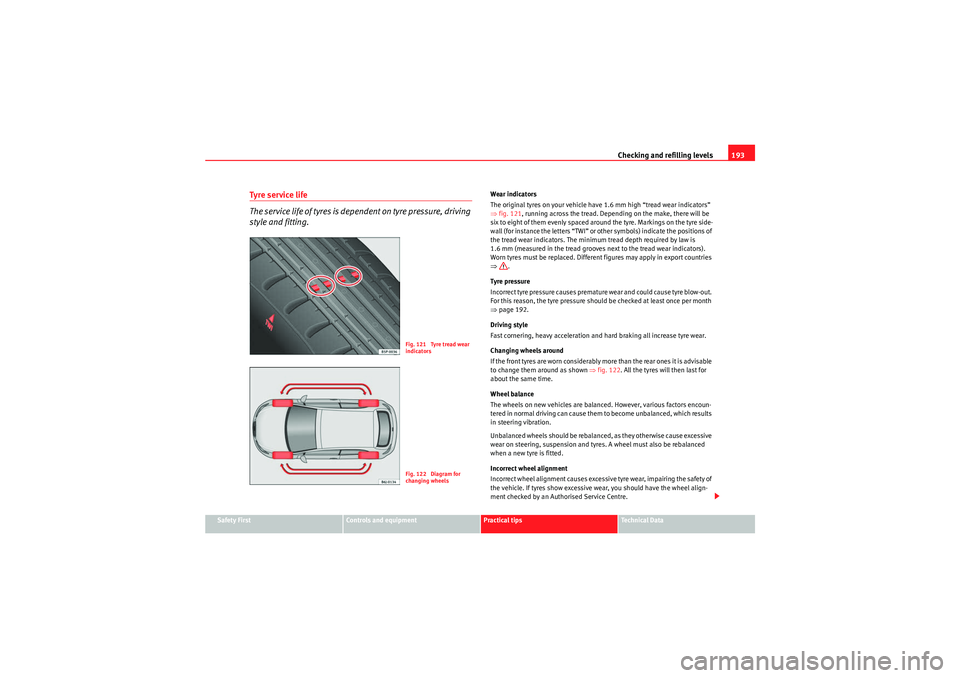
Wear indicators
The original tyres on your vehicle have 1.6 mm high “tread wear indicators”
⇒fig. 121 , running across the tread. Depending on the make, there will be
six to eight of them evenly spaced around the tyre. Markings on the tyre side-
wall (for instance the letters “TWI” or other symbols) indicate the positions of
the tread wear indicators. The minimum tread depth required by law is
1.6 mm (measured in the tread grooves next to the tread wear indicators).
Worn tyres must be replaced. Different figures may apply in export countries
⇒ .
Tyre pressure
Incorrect tyre pressure causes premature wear and could cause tyre blow-out.
For this reason, the tyre pressure should be checked at least once per month
⇒ page 192.
Driving style
Fast cornering, heavy acceleration and hard braking all increase tyre wear.
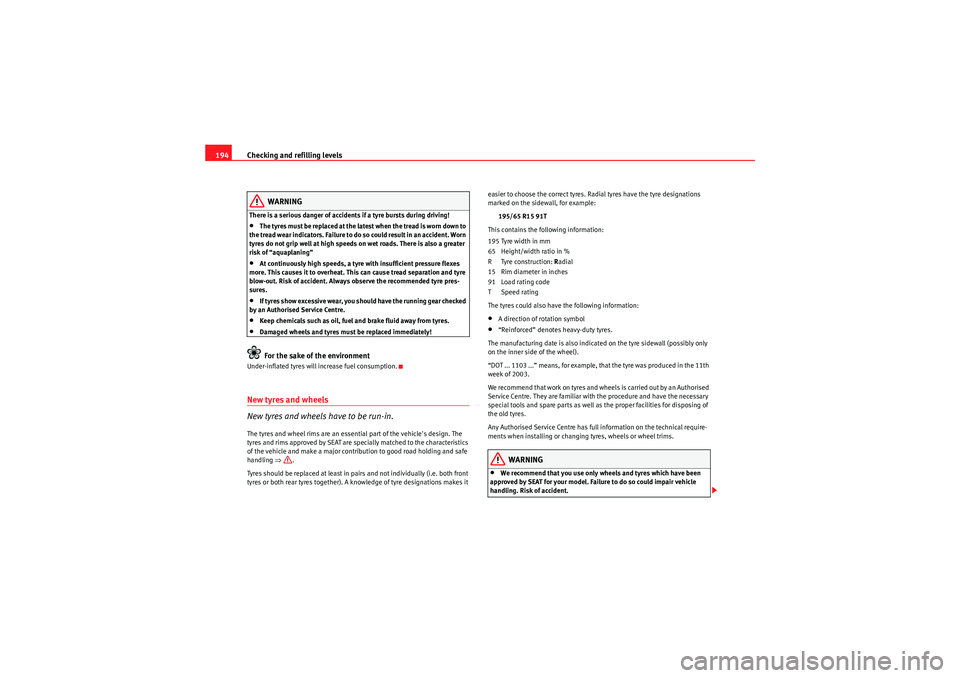
Changing wheels around
If the front tyres are worn considerably more than the rear ones it is advisable
to change them around as shown ⇒ fig. 122. All the tyres will then last for
about the same time.
Wheel balance
The wheels on new vehicles are balanced. However, various factors encoun-
tered in normal driving can cause them to become unbalanced, which results
in steering vibration.
Unbalanced wheels should be rebalanced, as they otherwise cause excessive
wear on steering, suspension and tyres. A wheel must also be rebalanced
when a new tyre is fitted.
Incorrect wheel alignment
Incorrect wheel alignment causes excessive tyre wear, impairing the safety of
the vehicle. If tyres show excessive wear, you should have the wheel align-
ment checked by an Authorised Service Centre.
Fig. 121 Tyre tread wear
indicatorsFig. 122 Diagram for
changing wheels
IbizaSC_EN.book Seite 193 Mittwoch, 16. September 2009 12:11 12
Page 196 of 257
Checking and refilling levels
194
WARNING
There is a serious danger of accidents if a tyre bursts during driving!•The tyres must be replaced at the latest when the tread is worn down to
the tread wear indicators. Failure to do so could result in an accident. Worn
tyres do not grip well at high speeds on wet roads. There is also a greater
risk of “aquaplaning” •At continuously high speeds, a tyre with insufficient pressure flexes
more. This causes it to overheat. This can cause tread separation and tyre
blow-out. Risk of accident. Always observe the recommended tyre pres-
sures.•If tyres show excessive wear, you should have the running gear checked
by an Authorised Service Centre.•Keep chemicals such as oil, fuel and brake fluid away from tyres.•Damaged wheels and tyres must be replaced immediately!For the sake of the environment
Under-inflated tyres will increase fuel consumption.New tyres and wheels
New tyres and wheels have to be run-in.The tyres and wheel rims are an essential part of the vehicle's design. The
tyres and rims approved by SEAT are specially matched to the characteristics
of the vehicle and make a major contribution to good road holding and safe
handling ⇒.
Tyres should be replaced at least in pairs and not individually (i.e. both front
tyres or both rear tyres together). A knowledge of tyre designations makes it easier to choose the correct tyres. Radial tyres have the tyre designations
marked on the sidewall, for example:
195/65 R15 91T
This contains the following information:
195 Tyre width in mm
65 Height/width ratio in %
RTyre construction: Radial
15 Rim diameter in inches
91 Load rating code
TSpeed rating
The tyres could also have the following information:
•A direction of rotation symbol•“Reinforced” denotes heavy-duty tyres.
The manufacturing date is also indicated on the tyre sidewall (possibly only
on the inner side of the wheel).
“DOT ... 1103 ...” means, for example, that the tyre was produced in the 11th
week of 2003.
We recomm end that work on tyres and wheels is carried out by an Authorised
Service Centre. They are familiar with the procedure and have the necessary
special tools and spare parts as well as the proper facilities for disposing of
the old tyres.
Any Authorised Service Centre has full information on the technical require-
ments when installing or changing tyres, wheels or wheel trims.WARNING
•We recommend that you use only wheels and tyres which have been
approved by SEAT for your model. Failure to do so could impair vehicle
handling. Risk of accident.
IbizaSC_EN.book Seite 194 Mittwoch, 16. September 2009 12:11 12