fuel type Seat Ibiza SC 2009 Owner's manual
[x] Cancel search | Manufacturer: SEAT, Model Year: 2009, Model line: Ibiza SC, Model: Seat Ibiza SC 2009Pages: 257, PDF Size: 6.61 MB
Page 157 of 257
Driving and the environment155
Safety First
Controls and equipment
Practical tips
Technical Data
during this initial warm-up phase. It is therefore best to drive off immediately
after starting the engine. When doing this, avoid running the engine at high
speed.
Periodic maintenance
Periodic maintenance work guarantees that, before beginning a journey, you
will not consume more than the required amount of fuel. A well-serviced
engine gives you the benefit of improved fuel efficiency as well as maximum
reliability and an enhanced resale value.
A badly serviced engine can consume up to 10% more fuel than necessary.
Avoid short journeys
To reduce the consumption and emission of polluting gases, the engine and
the exhaust filtration systems should reach the optimum
service tempera-
ture .
With the engine cold, fuel consumption is proportionally much higher. The
engine does not warm up and fuel consumption does not regularise until
having driven some four kilometres. This is the reason why we recommend
avoiding short trips wherever possible.
Maintain the correct tyre pressures
Bear in mind that keeping the tyres at an adequate pressure saves fuel. If the
tyre pressures are just 1 bar too low, this can put the fuel consumption up by
as much as 5 %. Due to the greater rolling resistance, under-inflation also
increases tyre wear and impairs handling.
The tyre pressures should always be checked when the tyres are cold.
Do not use winter tyres all year round: they will increase fuel consumption by
up to 10 %.
Avoid unnecessary weight
Every kilo of extra weight will put up the fuel consumption, so it is worth
checking the luggage compartment occasionally to make sure that no unnec-
essary loads are being carried. A roof carrier is often left in place for the sake of convenience, even when it is
no longer needed. At a speed of 100-120 km/h your car will use about 12%
more fuel as a result of the extra wind resistance caused by the roof carrier
even when it is not in use.
Saving electrical energy
The engine activates the alternator, which produces electricity. With the need
for electricity, fuel consumption is also increased. Because of this, always
turn off electrical equipment when you do not need it. Examples of equipment
that use a lot of electricity are: the fan at high speeds, the rear window
heating or the seat heaters*.
Environmental friendlinessEnvironmental protection is a top priority in the design, choice of materials
and production of your new Seat.
Design measures for economical recycling•Joints and connections designed for easy dismantling•Modular construction to facilitate dismantling•Increased use of single-grade materials•Plastic parts and elastomers are labelled in accordance with ISO 1043,
ISO 11469 and ISO 1629
Choice of materials•Nearly all materials used can be recycled•Similar types of plastics grouped together for easy recycling•Recycled materials used in manufacture•Reduction of volatile compounds in plastics•CFC-free refrigerant in air conditioning
IbizaSC_EN.book Seite 155 Mittwoch, 16. September 2009 12:11 12
Page 176 of 257
Checking and refilling levels
174
− Insert the fuel nozzle into the mouth of the canister as far as
possible.
− If the spare fuel canister is made of metal, the filling nozzle must be
in contact with the canister during filling. This helps prevent an electro-
static charge building up.
− Never spill fuel in the vehicle or in the luggage compartment. Fuel
vapours are explosive. Danger of death.Caution
•Fuel spills should be removed from the paintwork immediately.•Never run the tank completely dry. An irregular fuel supply could cause
misfiring. As a result, unburnt fuel could enter the catalytic converter and
cause damage.•When filling the fuel tank after having run it completely dry on a vehicle
with a diesel engine the ignition must be switched on for at least 30 seconds
without starting the engine. When you then start the engine it may take
longer than normal (up to one minute) for the engine to start firing. This is due
to the fact that the fuel system has to purge itself of air before starting.For the sake of the environment
Do not try to put in more fuel after the automatic filler nozzle has switched off;
this may cause the fuel to overflow if it becomes warm.
PetrolPetrol types
The correct petrol types are listed on a sticker inside the fuel
tank flap.Only unleaded petrol, corresponding to the standard DIN EN 228 , may be
used for vehicles with catalytic converters (EN = “European Standard”).
Fuel types are differentiated by the octane rating, e.g: 91, 95, 98 RON (RON
= “Regulation Octane Number, unit for determining the knock resistance of
petrol”). You may use petrol with a higher octane number than the one recom-
mended for your engine. However, this has no advantage in terms of fuel
consumption and engine power.
Caution
•Even one tankful of leaded fuel would permanently impair the efficiency
of the catalytic converter.•High engine speed and full throttle can damage the engine when using
petrol with an octane rating lower than the correct grade for the engine.For the sake of the environment
Just one full tank of leaded fuel would seriously impair the efficiency of the
catalytic converter.
WARNING (continued)
IbizaSC_EN.book Seite 174 Mittwoch, 16. September 2009 12:11 12
Page 178 of 257
Checking and refilling levels
176Winter driving
Diesel can thicken in winter.Winter-grade diesel
When using “summer-grade diesel fuel”, difficulties may be experienced at
sub-zero temperatures because the fuel thickens due to wax separation.
Therefore, “winter-grade diesel fuel” is available in some countries during
the cold months. It can be used at temperatures as low as -22°C.
In countries with different climatic conditions the diesel fuel generally sold
has different temperature characteristics. Check with an Authorised Service
Centre or filling stations in the country concerned regarding the type of diesel
fuels available.
Filter pre-heater
Your vehicle is fitted with a fuel filter pre-heater, making it well equipped for
operation in winter. This ensures that the fuel system remains operational to
approx. -24°C, provided you use winter-grade diesel which is safe to -15°C.
However, if the fuel has waxed to such an extent that the engine will not start
at temperatures of under -24°C, simply place the vehicle in a warm place for
a while.
Caution
Do not mix fuel additives (“thinners”, or similar additives) with diesel fuel.
Working in the engine compartmentSafety instructions on working in the engine compartment
Any work carried out in the engine compartment or on the
engine must be carried out cautiously.Before starting any work on the engine or in the engine compart-
ment:
1. Switch off the engine and remove the key from the ignition.
2. Apply the handbrake.
3. Move the gear stick to neutral or the selector lever to position P.
4. Wait for the engine to cool down.
5. Keep children away from the vehicle.
6. Raise the bonnet ⇒page 178.You should not do any work in the engine compartment unless you know
exactly how to carry out the jobs and have the correct tools! Have the work
carried out by a qualified workshop if you are uncertain.
All service fluids and consumables, e.g. coolant, engine oil, spark plugs and
batteries, are being constantly developed. SEAT provides a constant flow of
information to the Authorised Service Centres concerning modifications. For
this reason, we recommend you to have service fluids and consumables
replaced by an Authorised Service Centre. Please observe the relevant
instructions ⇒page 168. The engine compartment of any vehicle is a
hazardous area ⇒.
IbizaSC_EN.book Seite 176 Mittwoch, 16. September 2009 12:11 12
Page 194 of 257
Checking and refilling levels
192New tyres
New tyres must be run in ⇒page 152.
The tread depth of new tyres may vary, according to the type and make of tyre
and the tread pattern.
Concealed damage
Damage to tyres and rims is often not readily visible. If you notice unusual
vibrations or the car pulling to one side, this may indicate that one of the tyres
is damaged. The tyres should be checked immediately by an Authorised
Service Centre.
Tyres with directional tread pattern
An arrow on the tyre sidewall indicates the direction of rotation on tyres with
directional tread. Always observe the direction of rotation indicated when
fitting the wheel. This guarantees optimum grip and helps to avoid aqua-
planing, excessive noise and wear.
WARNING
•New tyres do not have maximum grip in the first 500 km. Drive particu-
larly carefully to avoid risk of accident.•Never drive with damaged tyres. This may cause an accident.•If you notice unusual vibration or if the vehicle pulls to one side when
driving, stop the vehicle immediately and check the tyres for damage.
Checking tyre pressure
The correct tyre pressure can be seen on the sticker on the
inside of the tank flap.1. Read the required tyre inflation pressure from the sticker. The values refer to Summer tyres. 2. The tyre pressures should only be checked when the tyres are
cold. The slightly raised pressu res of warm tyres must not be
reduced.
3. Adjust the tyre pressure to the load you are carrying.
Tyre pressure
The correct tyre pressure is especially important at high speeds. The pressure
should therefore be checked at least once a month and before starting a
journey.
WARNING
A tyre can easily burst if the pressure is too low, causing an accident!•At continuously high speeds, a tyre with insufficient pressure flexes
more. In this way it becomes too hot, and this can cause tread separation
and tyre blow-out. Always observe the recommended tyre pressures.•If the tyre pressure is too low or too high, the tyres will wear prema-
turely and the vehicle will not handle well. Risk of accident!For the sake of the environment
Under-inflated tyres will increase fuel consumption.
IbizaSC_EN.book Seite 192 Mittwoch, 16. September 2009 12:11 12
Page 234 of 257
Technical Data
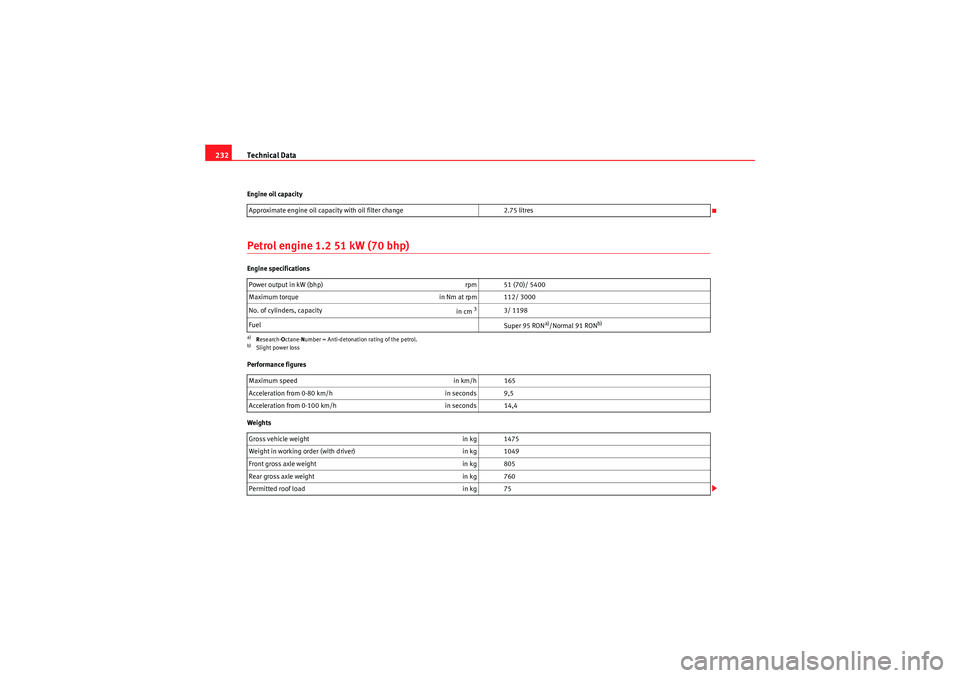
232Engine oil capacityPetrol engine 1.2 51 kW (70 bhp)Engine specifications
Performance figures
Weights Approximate engine oil capacity with oil filter change
2.75 litres
Power output in kW (bhp) rpm 51 (70)/ 5400
Maximum torque in Nm at rpm 112/ 3000
No. of cylinders, capacity in cm
3
3/ 1198
Fuel Super 95 RON
a)/Normal 91 RON
b)
a)Research- Octane- Number = Anti-detonation rating of the petrol.b)Slight power lossMaximum speed in km/h 165
Acceleration from 0-80 km/h in seconds 9,5
Acceleration from 0-100 km/h in seconds 14,4
Gross vehicle weight in kg 1475
Weight in working order (with driver) in kg 1049
Front gross axle weight in kg 805
Rear gross axle weight in kg 760
Permitted roof load in kg 75
IbizaSC_EN.book Seite 232 Mittwoch, 16. September 2009 12:11 12
Page 236 of 257
Technical Data
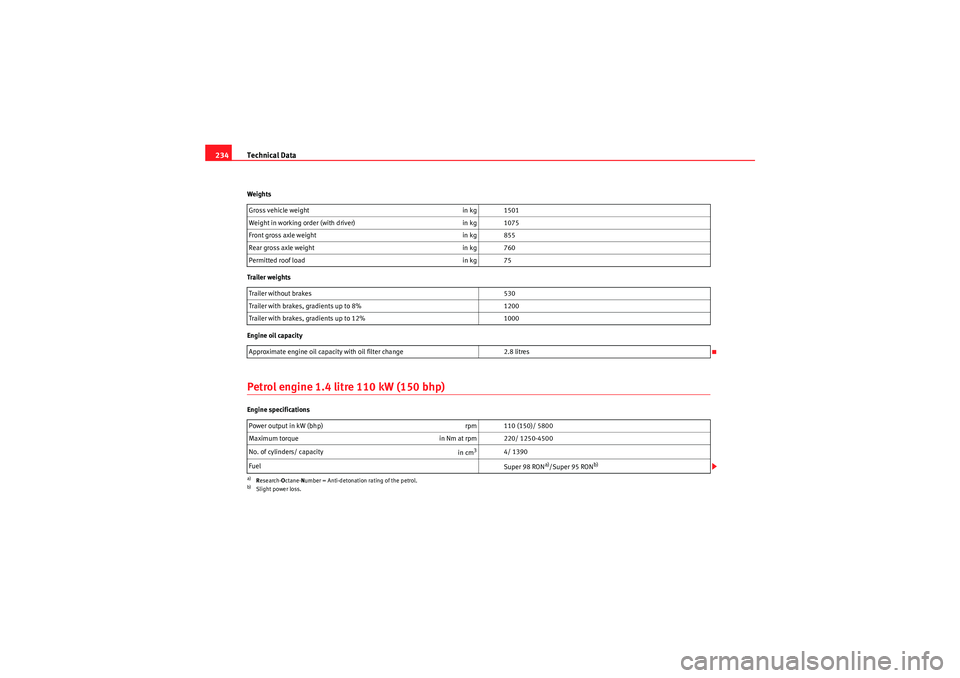
234Weights
Trailer weights
Engine oil capacityPetrol engine 1.4 litre 110 kW (150 bhp)Engine specifications Gross vehicle weight
in kg 1501
Weight in working order (with driver) in kg 1075
Front gross axle weight in kg 855
Rear gross axle weight in kg 760
Permitted roof load in kg 75
Trailer without brakes 530
Trailer with brakes, gradients up to 8% 1200
Trailer with brakes, gradients up to 12% 1000
Approximate engine oil capacity with oil filter change 2.8 litres
Power output in kW (bhp) rpm 110 (150)/ 5800
Maximum torque in Nm at rpm 220/ 1250-4500
No. of cylinders/ capacity in cm
3
4/ 1390
Fuel Super 98 RON
a)/Super 95 RON
b)
a)Research- Octane- Number = Anti-detonation rating of the petrol.b)Slight power loss.
IbizaSC_EN.book Seite 234 Mittwoch, 16. September 2009 12:11 12
Page 248 of 257
Technical Data
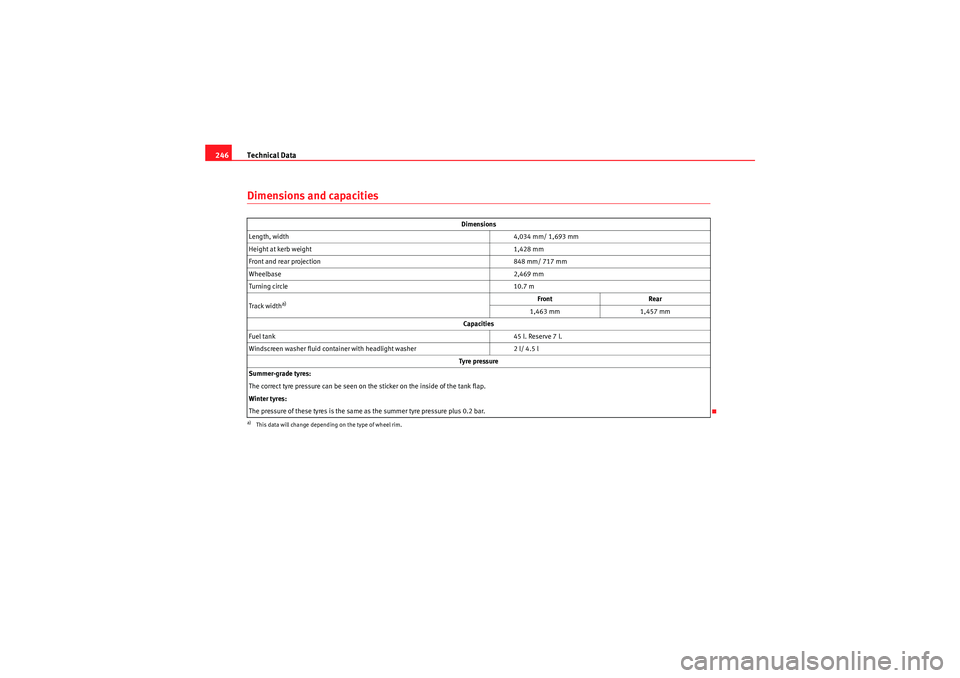
246Dimensions and capacities
Dimensions
Length, width 4,034 mm/ 1,693 mm
Height at kerb weight 1,428 mm
Front and rear projection 848 mm/ 717 mm
Wheelbase 2,469 mm
Turning circle 10.7 m
Track width
a)
a)This data will change depending on the type of wheel rim.
Front Rear
1,463 mm 1,457 mm
Capacities
Fuel tank 45 l. Reserve 7 l.
Windscreen washer fluid container with headlight washer 2 l/ 4.5 l
Ty re p re ss u re
Summer-grade tyres:
The correct tyre pressure can be seen on the sticker on the inside of the tank flap.
Winter tyres:
The pressure of these tyres is the same as the summer tyre pressure plus 0.2 bar.
IbizaSC_EN.book Seite 246 Mittwoch, 16. September 2009 12:11 12
Page 255 of 257
Index253
Switch
Hazard warning lights . . . . . . . . . . . . . . . . . . 90
Rear window heating . . . . . . . . . . . . . . . . . . . 89
Switches Electric windows . . . . . . . . . . . . . . . . . . . . . . 81
Sliding/tilting roof . . . . . . . . . . . . . . . . . . . . . 83
Switching off the engine . . . . . . . . . . . . . . . . . . 130TTailgate . . . . . . . . . . . . . . . . . . . . . . . . . . . . . . . . . 79 Emergency opening . . . . . . . . . . . . . . . . . . . . 80
warning lamp . . . . . . . . . . . . . . . . . . . . . . . . . 63
Tank fuel level . . . . . . . . . . . . . . . . . . . . . . . . . . . . . 50
reserve indicator . . . . . . . . . . . . . . . . . . . . . . 50
tank capacity . . . . . . . . . . . . . . . . . . . . . . . . . 50
TCS . . . . . . . . . . . . . . . . . . . . . . . . . . . . . . . . . . . 148
TCS (Traction control system) Warning lamp . . . . . . . . . . . . . . . . . . . . . . . . . 60
Technical modifications . . . . . . . . . . . . . . . . . . 168
The danger of not using the seat belt . . . . . . . . 18
Tightening torque of wheel bolts . . . . . . . . . . . 228
Tilting roof . . . . . . . . . . . . . . . . . . . . . . . . . . . . . . 83
Tools . . . . . . . . . . . . . . . . . . . . . . . . . . . . . . . . . . 197
Tow starting Comments . . . . . . . . . . . . . . . . . . . . . . . . . . 221
Towing . . . . . . . . . . . . . . . . . . . . . . . . . . . . . . . . 221
Towing a trailer . . . . . . . . . . . . . . . . . . . . 156, 228
Towing bracket . . . . . . . . . . . . . . . . . . . . . . . . . . 157
Towing bracket, fitting . . . . . . . . . . . . . . . . . . . 171 Towing eye . . . . . . . . . . . . . . . . . . . . . . . . . . . . . 221
Tow-starting . . . . . . . . . . . . . . . . . . . . . . . . . . . . 221
Traction control system
warning lamp . . . . . . . . . . . . . . . . . . . . . . . . . 60
Trailer eyes . . . . . . . . . . . . . . . . . . . . . . . . . . . . . 222
Trailer turn signals Warning lamp . . . . . . . . . . . . . . . . . . . . . . . . . 91
Trailer weights . . . . . . . . . . . . . . . . . . . . . . . . . . 228
Trips, checklist . . . . . . . . . . . . . . . . . . . . . . . . . . . . 8
Turn signals Warning lamp . . . . . . . . . . . . . . . . . . . . . . . . . 64
Two-way radio . . . . . . . . . . . . . . . . . . . . . . . . . . 169
Type plate . . . . . . . . . . . . . . . . . . . . . . . . . . . . . . 226
Tyre Mobility-System (Tyre repair kit) . . . . . . . . 198
Tyre monitor indicator . . . . . . . . . . . . . . . . . . . . . 61
Tyre pressure . . . . . . . . . . . . . . . . . . . . . . . . . . . 192
Tyre pressures . . . . . . . . . . . . . . . . . . . . . . . . . . 228
Tyre repair kit . . . . . . . . . . . . . . . . . . . . . . 198, 203
Tyre-Mobility-System (Tyre repair kit) . . . . . . . . 203
Tyres and wheels Dimensions . . . . . . . . . . . . . . . . . . . . . . . . . 194
Tyres service life . . . . . . . . . . . . . . . . . . . . . . . . 193
Tyres tread depth . . . . . . . . . . . . . . . . . . . . . . . . 193
Tyres with directional tread pattern . . . . . . . . . 192
UUnderbody maintenance . . . . . . . . . . . . . . . . . . 165
VVehicle battery . . . . . . . . . . . . . . . . . . . . . . . . . . 189
Vehicle data . . . . . . . . . . . . . . . . . . . . . . . . . . . . 226
Vehicle identification data . . . . . . . . . . . . . . . . 226
Vehicle identification number . . . . . . . . . . . . . 226
Vehicle interior heating or cooling system . . . 119
Vehicle Maintenance Exterior . . . . . . . . . . . . . . . . . . . . . . . . . . . . . 160
Vehicle modifications . . . . . . . . . . . . . . . . . . . . 168
Vehicle paintwork Products for vehicle maintenance . . . . . . . 159
Waxing . . . . . . . . . . . . . . . . . . . . . . . . . . . . . 161
Vehicle tools Storage . . . . . . . . . . . . . . . . . . . . . . . . . . . . . 197
Vehicle wallet storage . . . . . . . . . . . . . . . . . . . . 106
Vehicle washing . . . . . . . . . . . . . . . . . . . . . . . . 160
Ventilation . . . . . . . . . . . . . . . . . . . . . . . . . . . . . 116
Ventilation slits . . . . . . . . . . . . . . . . . . . . . . . . . . 15WWarning lamp . . . . . . . . . . . . . . . . . . . . . . . . . . . 26
Warning lamps . . . . . . . . . . . . . . . . . . . . . . . . . . . 56
Warning triangle . . . . . . . . . . . . . . . . . . . . . . . . 112
Washer fluid . . . . . . . . . . . . . . . . . . . . . . . . . . . . 185
Washing by hand . . . . . . . . . . . . . . . . . . . . . . . . 160
Washing tunnel . . . . . . . . . . . . . . . . . . . . . . . . . 160
Washing with high pressure cleaners . . . . . . . 161
Water in the windscreen washer tank . . . . . . . 185
IbizaSC_EN.book Seite 253 Mittwoch, 16. September 2009 12:11 12