fuel filter Seat Ibiza SC 2009 Owner's manual
[x] Cancel search | Manufacturer: SEAT, Model Year: 2009, Model line: Ibiza SC, Model: Seat Ibiza SC 2009Pages: 257, PDF Size: 6.61 MB
Page 59 of 257
Cockpit57
Safety First
Controls and equipment
Practical tips
Technical Data
WARNING
•Failure to observe warning lamps and warning messages can result in
serious personal injuries or damage to your vehicle.•The risk of an accident increases if your vehicle breaks down. Use a
warning triangle to draw the attention of other road users in order to
prevent danger to thirds.
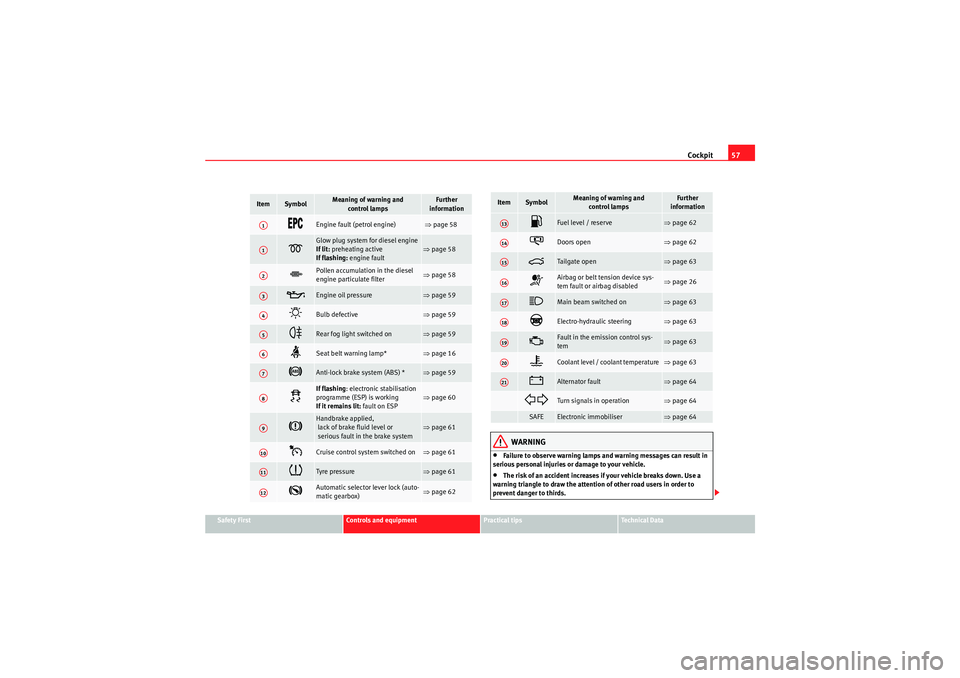
Item
Symbol
Meaning of warning and
control lamps
Further
information
Engine fault (petrol engine)
⇒ page 58
Glow plug system for diesel engine
If lit: preheating active
If flashing: engine fault
⇒page 58
Pollen accumulation in the diesel
engine particulate filter
⇒page 58
Engine oil pressure
⇒page 59
Bulb defective
⇒page 59
Rear fog light switched on
⇒page 59
Seat belt warning lamp*
⇒page 16
Anti-lock brake system (ABS) *
⇒page 59
If flashing : electronic stabilisation
programme (ESP) is working
If it remains lit: fault on ESP
⇒page 60
Handbrake applied,
lack of brake fluid level or
serious fault in the brake system
⇒page 61
Cruise control system switched on
⇒page 61
Tyre pressure
⇒page 61
Automatic selector lever lock (auto-
matic gearbox)
⇒page 62
A1A1A2A3A4A5A6A7A8A9A10A11A12
Fuel level / reserve
⇒ page 62
Doors open
⇒page 62
Tailgate op e n
⇒page 63
Airbag or belt tension device sys-
tem fault or airbag disabled
⇒page 26
Main beam switched on
⇒page 63
Electro-hydraulic steering
⇒page 63
Fault in the emission control sys-
tem
⇒page 63
Coolant level / coolant temperature
⇒page 63
Alternator fault
⇒page 64
Turn signals in operation
⇒page 64
SAFE
Electronic immobiliser
⇒page 64
Item
Symbol
Meaning of warning and
control lamps
Further
information
A13A14A15A16A17A18A19A20A21
IbizaSC_EN.book Seite 57 Mittwoch, 16. September 2009 12:11 12
Page 156 of 257
Driving and the environment
154Diesel engine particulate filter*
The diesel engine particulate filter eliminates soot produced
by burning diesel.The diesel engine dust filter eliminates most of the soot from the exhaust gas
system. Under normal driving conditions, the filter cleans itself. If the driving
conditions do not allow the filter to clean itself (for example, multiple short
trips) the filter will be obstructed by dust and pollen and the indicator
for
the diesel engine particulate filter indicator will light. See under Warning
Lights.
WARNING
•The diesel engine particulate filter may reach extremely high tempera-
tures; it should not enter into contact with flammable materials under-
neath the vehicle. Failure to comply could result in fire.Caution
•The vehicle is not designed for refuelling with mixtures of FAME fuel
(biodiesel) over 7%, in accordance with DIN 51628. The diesel particle filter
will be damaged if this mixture percentage is exceeded.Economical and environmentally friendly
drivingEconomical and environmentally friendly drivingFuel consumption, environmental pollution and wear to the engine, brakes
and tyres depend to a large extent on your driving style. By adopting an economical driving style and anticipating the traffic situation ahead, you can
easily reduce fuel consumption by 10-15%. Some tips on how to help you
reduce pollution while saving money are listed below.
As you drive try to anticipate the traffic situation
A vehicle uses most fuel when accelerating. When you anticipate the situa-
tion, you have to brake less frequently and therefore accelerate less. If
possible, let the vehicle roll with a gear engaged
, for example, if you see a red
light ahead. The braking effect achieved in this way helps to reduce wear on
brakes and tyres; emissions and fuel consumption are reduced to zero
(disconnection due to inertia).
Change gear early to save energy
An effective way of saving fuel is to change up quickly through the gears.
Running the engine at high rpm in lower gears uses an unnecessary amount
of fuel.
Manual gearbox: Change from first to second gear as quickly as possible. We
recommend that, whenever possible, you change to a higher gear when you
reach 2,000 rpm.
Automatic gearbox: Accelerate in moderation and avoid the “kick-down” (full
throttle) position.
Avoid driving at high speed
We advise you not to drive at the top speed permitted for the vehicle. Fuel
consumption, exhaust emissions and noise levels all increase very rapidly at
higher speeds. Driving at moderate speeds will help to save fuel.
Avoid idling
It is worthwhile to switch off the engine when waiting in a traffic jam, at level
crossings or at traffic lights with a long red phase. The fuel saved after only
30 - 40 seconds is greater than the amount of fuel needed to restart the
engine.
The engine takes a very long time to warm up when it is running at idling
speed. Mechanical wear and pollutant emissions are also especially high
IbizaSC_EN.book Seite 154 Mittwoch, 16. September 2009 12:11 12
Page 177 of 257
Checking and refilling levels175
Safety First
Controls and equipment
Practical tips
Technical Data
Petrol additives
Petrol additives improve the quality of the petrol.The quality of the petrol influences running behaviour, performance and
service life of the engine. For this reason, you should use good quality petrol
containing additives. These additives will help to prevent corrosion, keep the
fuel system clean and prevent deposits from building up in the engine.
If good quality petrol with additives is not available or engine problems occur,
the required additives must be added during refuelling.DieselDiesel*Diesel fuel must correspond to DIN EN 590 (EN = “European standard”). It
must have a cetane number (CN) of at least 51. The cetane number indicates
the ignition quality of the diesel fuel.
Notes on filling with fuel ⇒page 173.Biodiesel*The biodiesel fuel must comply with the DIN EN 14.214 (FAME) Standard.•Biodiesel is a methyl ester obtained from rapeseed oil.•DIN is the German abbreviation for “ Deutsches Institut für Normung e.V.”,
the German standards institute.•EN means European N orm.•FAME is the English abbreviation for “ Fatty Acid Methyl Ester”. Your Authorised Service Centre can also be consulted to know if the vehicle
has been prepared for biodiesel use.
Things to note about RME fuel (biodiesel)
•The performance of a vehicle using biodiesel maybe somewhat reduced.•Fuel consumption of a vehicle using biodiesel may be slightly higher.•Biodiesel fuel is resistant to cold down to approx. -10°C.•At temperatures below -10°C, we recommend refuelling with special
winter diesel fuel.•Your vehicle is designed to be refuelled with up to a maximum of 7%
blended biodiesel in accordance with standard DIN 51628.Caution
•RME fuel can damage the fuel system in vehicles which are not suitably
adjusted.•If you decide to use biodiesel in your vehicle, please use only RME fuel
which is DIN E 14,214 compliant.•If you use biodiesel that does not meet the required standard, the fuel
filter could become clogged.Note
•In case of low exterior temperatures and a fuel biodiesel percentage of
higher than 50%, an increase in gas emission may occur during operation of
the independent heating.•The fuel filter may become clogged when fuel is changed to biodiesel. For
this reason, we recommend you that, when having run 300 or 400 km after a
fuel change, the fuel filter change must also be done. Also note the instruc-
tions in the Inspection and Maintenance plan.•If the vehicle is to remain parked for more than about two weeks, we
recommend filling the fuel tank with biodiesel and driving about 50 km in
order to avoid damage to the injection system.
IbizaSC_EN.book Seite 175 Mittwoch, 16. September 2009 12:11 12
Page 178 of 257
Checking and refilling levels
176Winter driving
Diesel can thicken in winter.Winter-grade diesel
When using “summer-grade diesel fuel”, difficulties may be experienced at
sub-zero temperatures because the fuel thickens due to wax separation.
Therefore, “winter-grade diesel fuel” is available in some countries during
the cold months. It can be used at temperatures as low as -22°C.
In countries with different climatic conditions the diesel fuel generally sold
has different temperature characteristics. Check with an Authorised Service
Centre or filling stations in the country concerned regarding the type of diesel
fuels available.
Filter pre-heater
Your vehicle is fitted with a fuel filter pre-heater, making it well equipped for
operation in winter. This ensures that the fuel system remains operational to
approx. -24°C, provided you use winter-grade diesel which is safe to -15°C.
However, if the fuel has waxed to such an extent that the engine will not start
at temperatures of under -24°C, simply place the vehicle in a warm place for
a while.
Caution
Do not mix fuel additives (“thinners”, or similar additives) with diesel fuel.
Working in the engine compartmentSafety instructions on working in the engine compartment
Any work carried out in the engine compartment or on the
engine must be carried out cautiously.Before starting any work on the engine or in the engine compart-
ment:
1. Switch off the engine and remove the key from the ignition.
2. Apply the handbrake.
3. Move the gear stick to neutral or the selector lever to position P.
4. Wait for the engine to cool down.
5. Keep children away from the vehicle.
6. Raise the bonnet ⇒page 178.You should not do any work in the engine compartment unless you know
exactly how to carry out the jobs and have the correct tools! Have the work
carried out by a qualified workshop if you are uncertain.
All service fluids and consumables, e.g. coolant, engine oil, spark plugs and
batteries, are being constantly developed. SEAT provides a constant flow of
information to the Authorised Service Centres concerning modifications. For
this reason, we recommend you to have service fluids and consumables
replaced by an Authorised Service Centre. Please observe the relevant
instructions ⇒page 168. The engine compartment of any vehicle is a
hazardous area ⇒.
IbizaSC_EN.book Seite 176 Mittwoch, 16. September 2009 12:11 12
Page 234 of 257
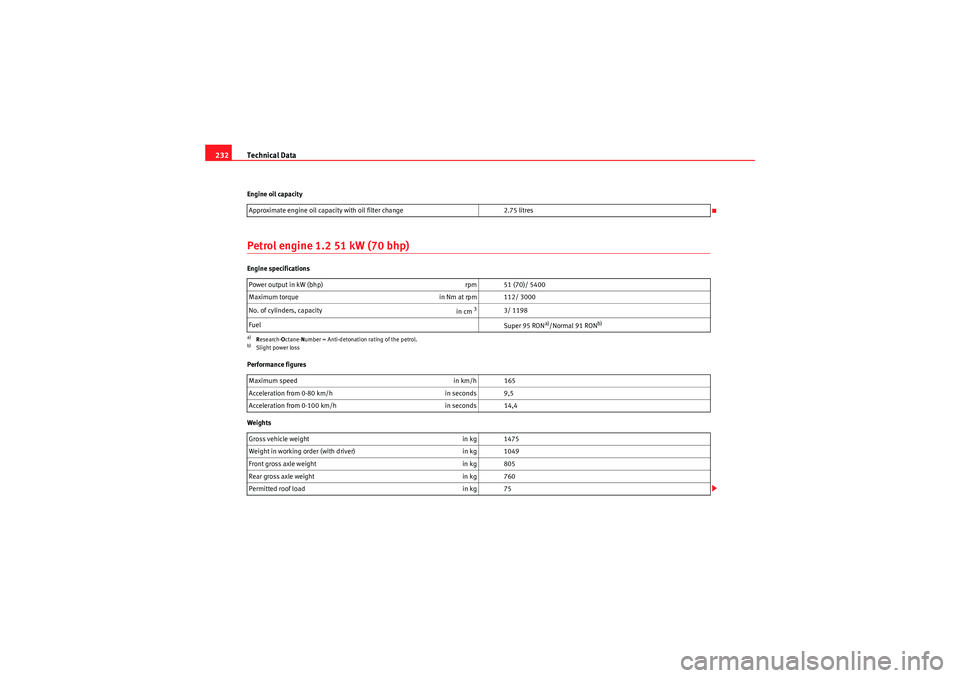
Technical Data
232Engine oil capacityPetrol engine 1.2 51 kW (70 bhp)Engine specifications
Performance figures
Weights Approximate engine oil capacity with oil filter change
2.75 litres
Power output in kW (bhp) rpm 51 (70)/ 5400
Maximum torque in Nm at rpm 112/ 3000
No. of cylinders, capacity in cm
3
3/ 1198
Fuel Super 95 RON
a)/Normal 91 RON
b)
a)Research- Octane- Number = Anti-detonation rating of the petrol.b)Slight power lossMaximum speed in km/h 165
Acceleration from 0-80 km/h in seconds 9,5
Acceleration from 0-100 km/h in seconds 14,4
Gross vehicle weight in kg 1475
Weight in working order (with driver) in kg 1049
Front gross axle weight in kg 805
Rear gross axle weight in kg 760
Permitted roof load in kg 75
IbizaSC_EN.book Seite 232 Mittwoch, 16. September 2009 12:11 12
Page 235 of 257
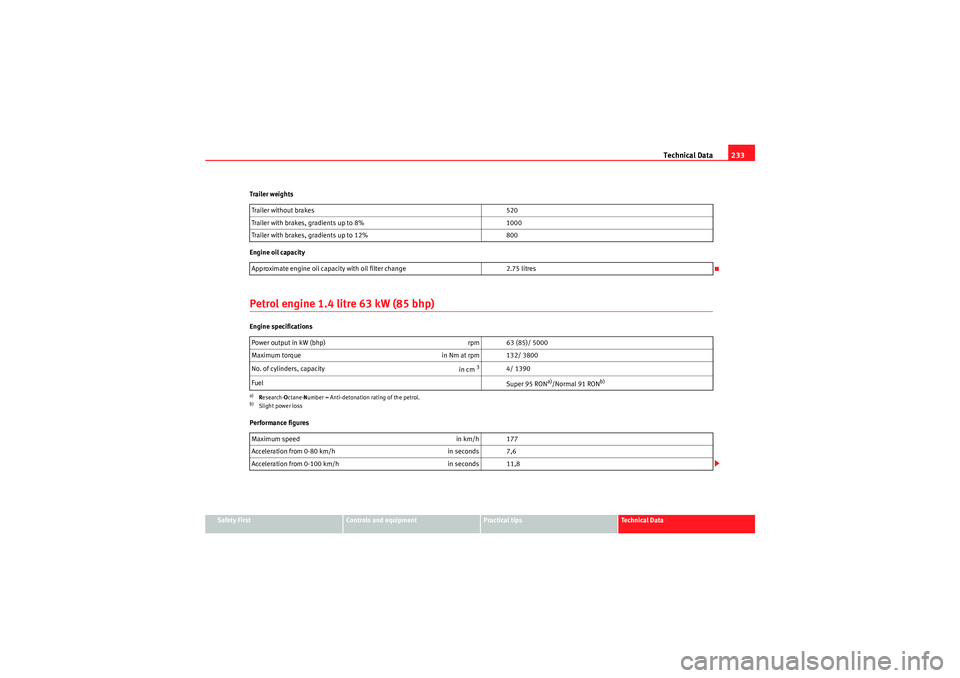
Technical Data233
Safety First
Controls and equipment
Practical tips
Technical Data
Trailer weights
Engine oil capacity
Petrol engine 1.4 litre 63 kW (85 bhp)Engine specifications
Performance figures
Trailer without brakes
520
Trailer with brakes, gradients up to 8% 1000
Trailer with brakes, gradients up to 12% 800
Approximate engine oil capacity with oil filter change 2.75 litres
Power output in kW (bhp) rpm 63 (85)/ 5000
Maximum torque in Nm at rpm 132/ 3800
No. of cylinders, capacity in cm
3
4/ 1390
Fuel Super 95 RON
a)/Normal 91 RON
b)
a)Research- Octane- Number = Anti-detonation rating of the petrol.b)Slight power lossMaximum speed in km/h 177
Acceleration from 0-80 km/h in seconds 7,6
Acceleration from 0-100 km/h in seconds 11,8
IbizaSC_EN.book Seite 233 Mittwoch, 16. September 2009 12:11 12
Page 236 of 257
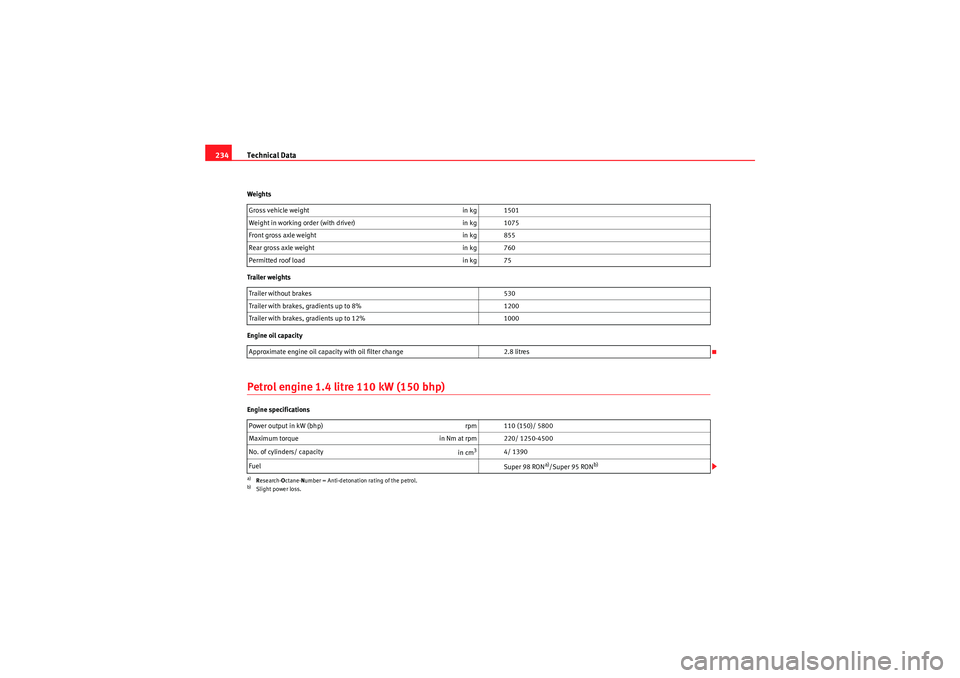
Technical Data
234Weights
Trailer weights
Engine oil capacityPetrol engine 1.4 litre 110 kW (150 bhp)Engine specifications Gross vehicle weight
in kg 1501
Weight in working order (with driver) in kg 1075
Front gross axle weight in kg 855
Rear gross axle weight in kg 760
Permitted roof load in kg 75
Trailer without brakes 530
Trailer with brakes, gradients up to 8% 1200
Trailer with brakes, gradients up to 12% 1000
Approximate engine oil capacity with oil filter change 2.8 litres
Power output in kW (bhp) rpm 110 (150)/ 5800
Maximum torque in Nm at rpm 220/ 1250-4500
No. of cylinders/ capacity in cm
3
4/ 1390
Fuel Super 98 RON
a)/Super 95 RON
b)
a)Research- Octane- Number = Anti-detonation rating of the petrol.b)Slight power loss.
IbizaSC_EN.book Seite 234 Mittwoch, 16. September 2009 12:11 12
Page 238 of 257
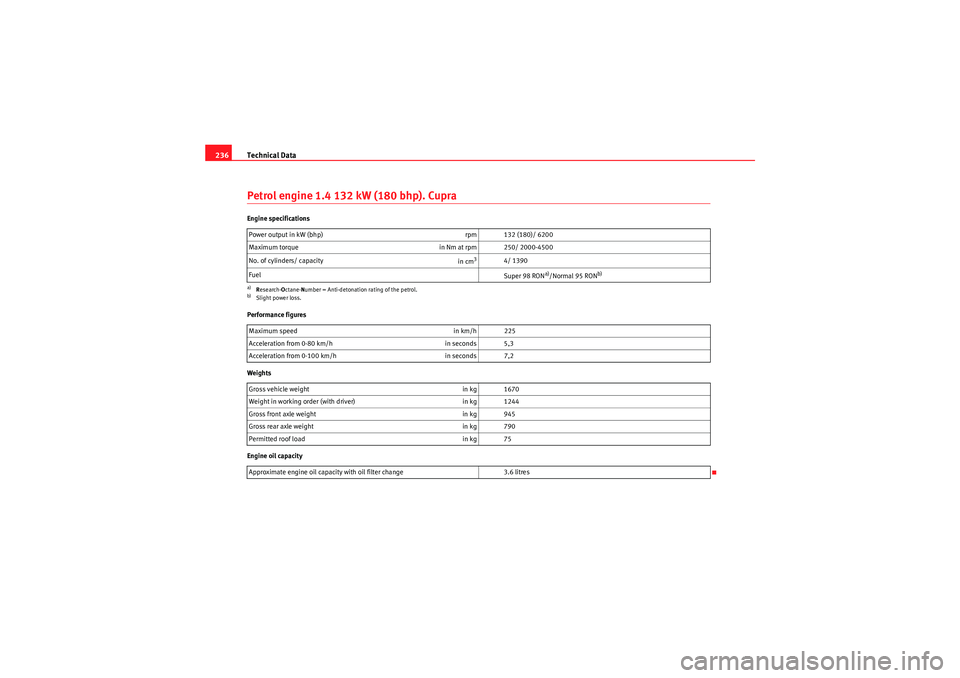
Technical Data
236Petrol engine 1.4 132 kW (180 bhp). CupraEngine specifications
Performance figures
Weights
Engine oil capacity Power output in kW (bhp)
rpm 132 (180)/ 6200
Maximum torque in Nm at rpm 250/ 2000-4500
No. of cylinders/ capacity in cm
3
4/ 1390
Fuel Super 98 RON
a)/Normal 95 RON
b)
a)Research- Octane- Number = Anti-detonation rating of the petrol.b)Slight power loss.Maximum speed in km/h 225
Acceleration from 0-80 km/h in seconds 5,3
Acceleration from 0-100 km/h in seconds 7,2
Gross vehicle weight in kg 1670
Weight in working order (with driver) in kg 1244
Gross front axle weight in kg 945
Gross rear axle weight in kg 790
Permitted roof load in kg 75
Approximate engine oil capacity with oil filter change 3.6 litres
IbizaSC_EN.book Seite 236 Mittwoch, 16. September 2009 12:11 12
Page 240 of 257
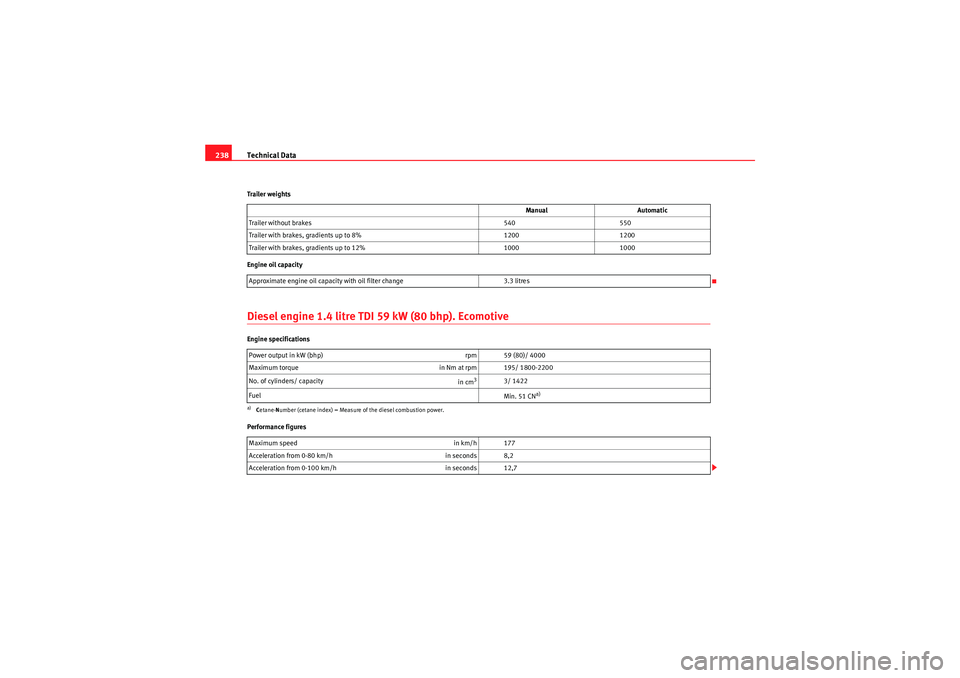
Technical Data
238Trailer weights
Engine oil capacityDiesel engine 1.4 litre TDI 59 kW (80 bhp). EcomotiveEngine specifications
Performance figures Manual
Automatic
Trailer without brakes 540550
Trailer with brakes, gradients up to 8% 12001200
Trailer with brakes, gradients up to 12% 10001000
Approximate engine oil capacity with oil filter change 3.3 litres
Power output in kW (bhp) rpm 59 (80)/ 4000
Maximum torque in Nm at rpm 195/ 1800-2200
No. of cylinders/ capacity in cm
3
3/ 1422
Fuel Min. 51 CN
a)
a)Cetane- Number (cetane index) = Measure of the diesel combustion power.Maximum speed in km/h 177
Acceleration from 0-80 km/h in seconds 8,2
Acceleration from 0-100 km/h in seconds 12,7
IbizaSC_EN.book Seite 238 Mittwoch, 16. September 2009 12:11 12
Page 241 of 257
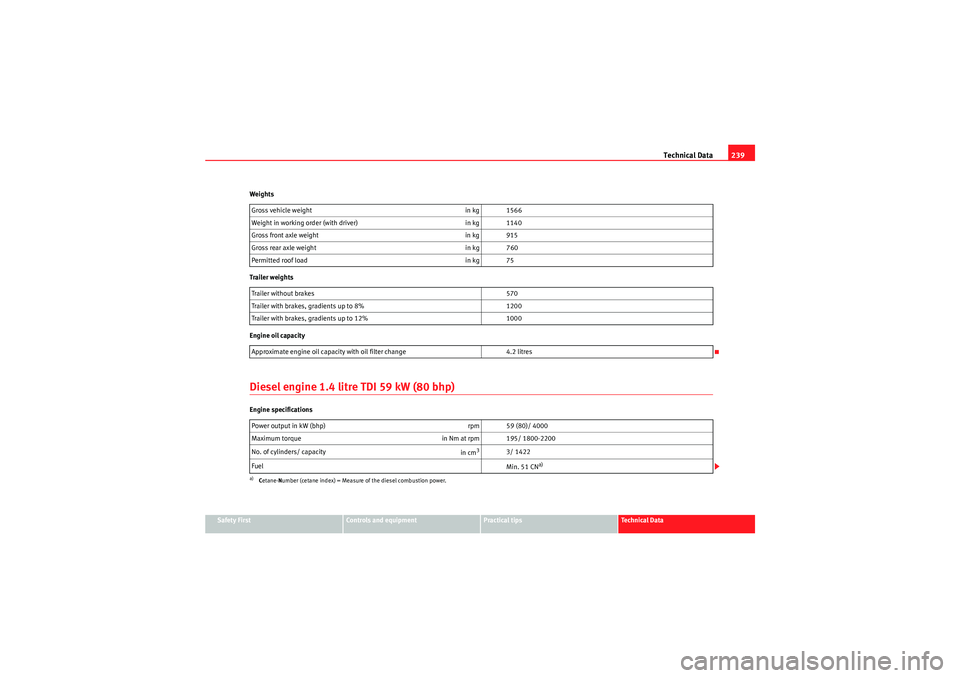
Technical Data239
Safety First
Controls and equipment
Practical tips
Technical Data
Weights
Trailer weights
Engine oil capacity
Diesel engine 1.4 litre TDI 59 kW (80 bhp) Engine specifications
Gross vehicle weight
in kg 1566
Weight in working order (with driver) in kg 1140
Gross front axle weight in kg 915
Gross rear axle weight in kg 760
Permitted roof load in kg 75
Trailer without brakes 570
Trailer with brakes, gradients up to 8% 1200
Trailer with brakes, gradients up to 12% 1000
Approximate engine oil capacity with oil filter change 4.2 litres
Power output in kW (bhp) rpm 59 (80)/ 4000
Maximum torque in Nm at rpm 195/ 1800-2200
No. of cylinders/ capacity in cm
3
3/ 1422
Fuel Min. 51 CN
a)
a)Cetane- Number (cetane index) = Measure of the diesel combustion power.
IbizaSC_EN.book Seite 239 Mittwoch, 16. September 2009 12:11 12