refuelling Seat Ibiza SC 2009 Owner's manual
[x] Cancel search | Manufacturer: SEAT, Model Year: 2009, Model line: Ibiza SC, Model: Seat Ibiza SC 2009Pages: 257, PDF Size: 6.61 MB
Page 6 of 257
Contents
4Your vehicle maintenance and cleaning
. . . .
General notes . . . . . . . . . . . . . . . . . . . . . . . . . . .
Vehicle exterior maintenance . . . . . . . . . . . . . . .
Vehicle interior maintenance . . . . . . . . . . . . . . .
Accessories, replacement of parts and
modifications
. . . . . . . . . . . . . . . . . . . . . . . . . . . .
Accessories and spare parts . . . . . . . . . . . . . . . .
Technical modifications . . . . . . . . . . . . . . . . . . .
Roof aerial* . . . . . . . . . . . . . . . . . . . . . . . . . . . . .
Mobile telephones and two-way radios . . . . . . .
Fitting a towing bracket* . . . . . . . . . . . . . . . . . . .
Checking and refilling levels
. . . . . . . . . . . . . .
Refuelling . . . . . . . . . . . . . . . . . . . . . . . . . . . . . . .
Petrol . . . . . . . . . . . . . . . . . . . . . . . . . . . . . . . . . .
Diesel . . . . . . . . . . . . . . . . . . . . . . . . . . . . . . . . . .
Working in the engine compartment . . . . . . . . .
Engine oil . . . . . . . . . . . . . . . . . . . . . . . . . . . . . . .
Coolant . . . . . . . . . . . . . . . . . . . . . . . . . . . . . . . . .
Washer fluid and windscreen wiper blades . . . .
Brake fluid . . . . . . . . . . . . . . . . . . . . . . . . . . . . . .
Battery . . . . . . . . . . . . . . . . . . . . . . . . . . . . . . . . .
Wheels . . . . . . . . . . . . . . . . . . . . . . . . . . . . . . . . .
If and when
. . . . . . . . . . . . . . . . . . . . . . . . . . . . . .
Vehicle tools, spare wheel . . . . . . . . . . . . . . . . .
Wheel change . . . . . . . . . . . . . . . . . . . . . . . . . . .
Tyre repair kit (Tyre-Mobility-System)* . . . . . . . .
Fuses . . . . . . . . . . . . . . . . . . . . . . . . . . . . . . . . . .
Bulb change . . . . . . . . . . . . . . . . . . . . . . . . . . . . .
Jump-starting . . . . . . . . . . . . . . . . . . . . . . . . . . . .
Towing and tow-starting . . . . . . . . . . . . . . . . . . .
Te c h n i c a l D a t a
. . . . . . . . . . . . . . . . . . . . . . .
General notes on the technical data
. . . . . . .
Outstanding information . . . . . . . . . . . . . . . . . .
Data on fuel consumption . . . . . . . . . . . . . . . . . Towing a trailer . . . . . . . . . . . . . . . . . . . . . . . . . .
Wheels . . . . . . . . . . . . . . . . . . . . . . . . . . . . . . . . .
Te chni cal Data
. . . . . . . . . . . . . . . . . . . . . . . . . . . .
Checking fluid levels . . . . . . . . . . . . . . . . . . . . . .
Petrol engine 1.2 44 kW (60 bhp) . . . . . . . . . . .
Petrol engine 1.2 51 kW (70 bhp) . . . . . . . . . . .
Petrol engine 1.4 litre 63 kW (85 bhp) . . . . . . .
Petrol engine 1.4 litre 110 kW (150 bhp) . . . . .
Petrol engine 1.4 132 kW (180 bhp). Cupra . . .
Petrol engine 1.6 77 kW (105 bhp) . . . . . . . . . .
Diesel engine 1.4 litre TDI 59 kW (80 bhp).
Ecomotive . . . . . . . . . . . . . . . . . . . . . . . . . . . . . .
Diesel engine 1.4 litre TDI 59 kW (80 bhp) . . . .
Diesel engine 1.6 litre TDI CR 66 kW (90 bhp) .
Diesel engine 1.6 litre TDI CR 77 kW (105 bhp)
Diesel engine 1.9 litre TDI 66 kw (90 bhp) . . . .
Diesel engine 1.9l TDI 77 kW (105 bhp) . . . . . .
Dimensions and capacities . . . . . . . . . . . . . . . .
Index
. . . . . . . . . . . . . . . . . . . . . . . . . . . . . . . . . .
159
159
160
166
168
168
168
169
169
171
173
173
174
175
176
179
183
185
188
189
191
197
197
198
203
205
209
218
221
225
225
225
227 228
228
230
230
231
232
233
234
236
237
238
239
241
242
243
244
246
247
IbizaSC_EN.book Seite 4 Mittwoch, 16. September 2009 12:11 12
Page 132 of 257
Driving
130Starting diesel engines
The engine can only be started using a genuine SEAT key with
its correct code.– Move the gear lever to the neutral position and depress the
clutch pedal thoroughly and hold it in this position for the starter
to turn the engine on.
– Turn the ignition key to the starting position.
– Turn the ignition key to position ⇒page 128, fig. 94 . The
indication lamp
will light for engine pre-heating.
– When the warning lamp turns off, turn the key to position to start the engine. Do not press the accelerator.
– Let go of the ignition key as soon as the engine starts, the starter motor must not be allowed to run on with the engine.
When starting a very cold engine, it may be a little noisy for the first few
seconds until oil pressure has built up in the hydraulic valve compensators.
This is quite normal, and no cause for concern.
If there are problems starting the engine, see the ⇒page 218.
Glow plug system for the diesel engine
To avoid unnecessary discharging of the battery, do not use any other major
electrical equipment while the glow plugs are pre-heating.
Start the engine as soon as the glow plug warning lamp goes out.
Starting the engine after the fuel tank has been completely run dry
If the fuel tank has been completely run dry, it may take longer than normal
(up to one minute) to start the engine after refuelling with diesel fuel. This is
because the system must eliminate air first.
WARNING
•Never start or run the engine in un ventilated or closed rooms. The
exhaust fumes contain carbon monoxide, an odourless and colourless
poisonous gas. Risk of fatal accidents. Carbon monoxide can cause loss of
consciousness. It can also cause death.•Never leave the vehicle unattended if the engine is running.•Never use “cold start sprays”, they could explode or cause the engine
to run at high revs. Risk of injury.Caution
•When the engine is cold, you should avoid high engine speeds, driving at
full throttle and over-loading the engine. Risk of engine damage.•The vehicle should not be pushed or towed more than 50 metres to start
the engine. Unburnt fuel could enter the catalytic converter and damage it.•Before attempting to push-start or tow a vehicle in order to start it, you
should first try to start it using the battery of another vehicle. Note and follow
the instructions ⇒page 218, “Jump-starting”.For the sake of the environment
Do not warm-up the engine by running the engine with the vehicle stationary.
You should drive off as soon as you start the engine. This helps the engine
reach operating temperature faster and reduces emissions.Switching the engine off– Stop the engine.
– Turn the ignition key to position ⇒page 128, fig. 94 .
A2A3
A1
IbizaSC_EN.book Seite 130 Mittwoch, 16. September 2009 12:11 12
Page 156 of 257
Driving and the environment
154Diesel engine particulate filter*
The diesel engine particulate filter eliminates soot produced
by burning diesel.The diesel engine dust filter eliminates most of the soot from the exhaust gas
system. Under normal driving conditions, the filter cleans itself. If the driving
conditions do not allow the filter to clean itself (for example, multiple short
trips) the filter will be obstructed by dust and pollen and the indicator
for
the diesel engine particulate filter indicator will light. See under Warning
Lights.
WARNING
•The diesel engine particulate filter may reach extremely high tempera-
tures; it should not enter into contact with flammable materials under-
neath the vehicle. Failure to comply could result in fire.Caution
•The vehicle is not designed for refuelling with mixtures of FAME fuel
(biodiesel) over 7%, in accordance with DIN 51628. The diesel particle filter
will be damaged if this mixture percentage is exceeded.Economical and environmentally friendly
drivingEconomical and environmentally friendly drivingFuel consumption, environmental pollution and wear to the engine, brakes
and tyres depend to a large extent on your driving style. By adopting an economical driving style and anticipating the traffic situation ahead, you can
easily reduce fuel consumption by 10-15%. Some tips on how to help you
reduce pollution while saving money are listed below.
As you drive try to anticipate the traffic situation
A vehicle uses most fuel when accelerating. When you anticipate the situa-
tion, you have to brake less frequently and therefore accelerate less. If
possible, let the vehicle roll with a gear engaged
, for example, if you see a red
light ahead. The braking effect achieved in this way helps to reduce wear on
brakes and tyres; emissions and fuel consumption are reduced to zero
(disconnection due to inertia).
Change gear early to save energy
An effective way of saving fuel is to change up quickly through the gears.
Running the engine at high rpm in lower gears uses an unnecessary amount
of fuel.
Manual gearbox: Change from first to second gear as quickly as possible. We
recommend that, whenever possible, you change to a higher gear when you
reach 2,000 rpm.
Automatic gearbox: Accelerate in moderation and avoid the “kick-down” (full
throttle) position.
Avoid driving at high speed
We advise you not to drive at the top speed permitted for the vehicle. Fuel
consumption, exhaust emissions and noise levels all increase very rapidly at
higher speeds. Driving at moderate speeds will help to save fuel.
Avoid idling
It is worthwhile to switch off the engine when waiting in a traffic jam, at level
crossings or at traffic lights with a long red phase. The fuel saved after only
30 - 40 seconds is greater than the amount of fuel needed to restart the
engine.
The engine takes a very long time to warm up when it is running at idling
speed. Mechanical wear and pollutant emissions are also especially high
IbizaSC_EN.book Seite 154 Mittwoch, 16. September 2009 12:11 12
Page 158 of 257
Driving and the environment
156Compliance with prohibited materials laws : cadmium, asbestos, lead,
mercury, chrome VI.
Manufacturing methods•Use of recycled material for manufacturing plastic parts•Solvent-free cavity sealing•Solvent-free wax for protecting the vehicles in transit•Solvent-free adhesives•No CFCs used in production•Surplus materials used extensively for energy conversion and building
materials•Reduction in waste water production•The use of heat recovery systems for power generation•The use of water-soluble paintDriving abroadObservationsTo drive abroad, the following must be taken into consideration:•For vehicles fitted with a catalytic converter ensure that unleaded petrol is
available for the journey. See the chapter “Refuelling”. Automobile organisa-
tions will have information about service station networks selling unleaded
fuel.•In some countries, it is possible that a vehicle model is sold under condi-
tions where some spare parts are not available or that the Authorised Service
Centre may only carry out limited repairs. SEAT importers and distributors will gladly provide information about the
technical preparation of your vehicle and also about necessary maintenance
and repair possibilities.
Adhesive strips for headlightsIf you have to drive a right-hand drive vehicle in a left-hand drive country, or
vice versa, the asymmetric dipped beam headlights will dazzle oncoming
traffic.
To prevent dazzling, you must apply stickers to certain parts of the headlight
lenses. Further information is available in your Authorised Service Centre.
In vehicles with self-directing headlights, the rotation system must be
disconnected first. To do this, please go to a specialist workshop.Trailer towingWhat do you need to bear in mind when towing a trailer?Your vehicle may be used to tow a trailer when fitted with the correct equip-
ment.
If the car is supplied with a
factory-fitted towing bracket it will already have
the necessary technical modifications and meet the statutory requirements
for towing a trailer. For the after-market fitting of a trailer towing bracket see
⇒ page 171.
Connectors
Your vehicle is fitted with a 12-pin connector for the electrical connection
between the trailer and the vehicle.
IbizaSC_EN.book Seite 156 Mittwoch, 16. September 2009 12:11 12
Page 175 of 257
Checking and refilling levels173
Safety First
Controls and equipment
Practical tips
Technical Data
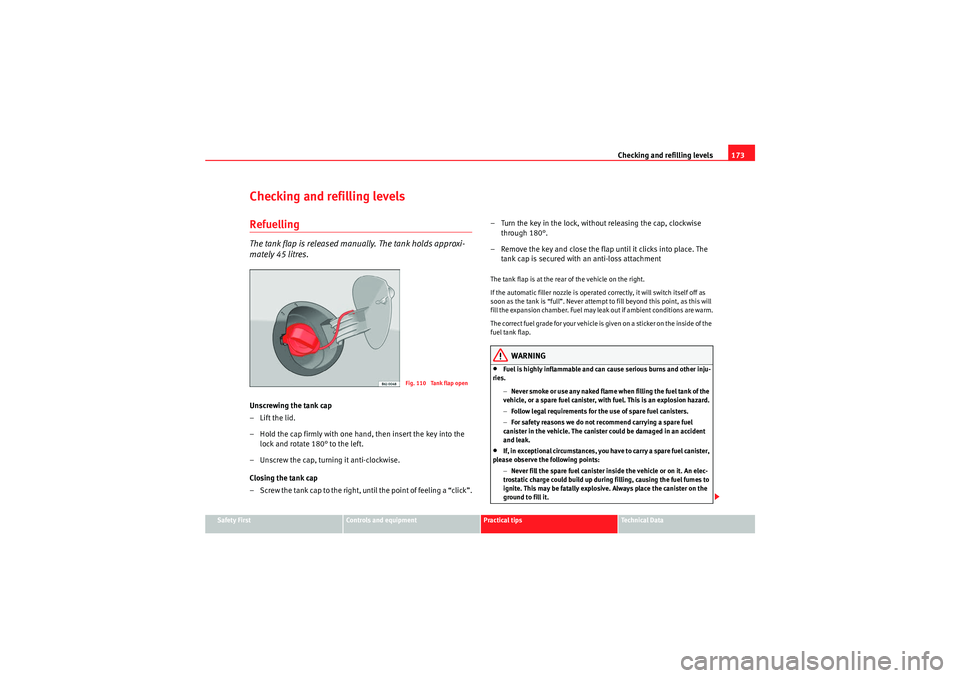
Checking and refilling levelsRefuellingThe tank flap is released manually. The tank holds approxi-
mately 45 litres.Unscrewing the tank cap
– Lift the lid.
– Hold the cap firmly with one hand, then insert the key into the
lock and rotate 180° to the left.
– Unscrew the cap, turning it anti-clockwise.
Closing the tank cap
– Screw the tank cap to the right, until the point of feeling a “click”. – Turn the key in the lock, without releasing the cap, clockwise
through 180°.
– Remove the key and close the flap until it clicks into place. The tank cap is secured with an anti-loss attachment
The tank flap is at the rear of the vehicle on the right.
If the automatic filler nozzle is operated correctly, it will switch itself off as
soon as the tank is “full”. Never attempt to fill beyond this point, as this will
fill the expansion chamber. Fuel may leak out if ambient conditions are warm.
The correct fuel grade for your vehicle is given on a sticker on the inside of the
fuel tank flap.
WARNING
•Fuel is highly inflammable and can cause serious burns and other inju-
ries.
−Never smoke or use any naked flame when filling the fuel tank of the
vehicle, or a spare fuel canister, with fuel. This is an explosion hazard.
− Follow legal requirements for the use of spare fuel canisters.
− For safety reasons we do not recommend carrying a spare fuel
canister in the vehicle. The canister could be damaged in an accident
and leak.•If, in exceptional circumstances, you have to carry a spare fuel canister,
please observe the following points:
−Never fill the spare fuel canister inside the vehicle or on it. An elec-
trostatic charge could build up during filling, causing the fuel fumes to
ignite. This may be fatally explosive. Always place the canister on the
ground to fill it.
Fig. 110 Tank flap open
IbizaSC_EN.book Seite 173 Mittwoch, 16. September 2009 12:11 12
Page 177 of 257
Checking and refilling levels175
Safety First
Controls and equipment
Practical tips
Technical Data
Petrol additives
Petrol additives improve the quality of the petrol.The quality of the petrol influences running behaviour, performance and
service life of the engine. For this reason, you should use good quality petrol
containing additives. These additives will help to prevent corrosion, keep the
fuel system clean and prevent deposits from building up in the engine.
If good quality petrol with additives is not available or engine problems occur,
the required additives must be added during refuelling.DieselDiesel*Diesel fuel must correspond to DIN EN 590 (EN = “European standard”). It
must have a cetane number (CN) of at least 51. The cetane number indicates
the ignition quality of the diesel fuel.
Notes on filling with fuel ⇒page 173.Biodiesel*The biodiesel fuel must comply with the DIN EN 14.214 (FAME) Standard.•Biodiesel is a methyl ester obtained from rapeseed oil.•DIN is the German abbreviation for “ Deutsches Institut für Normung e.V.”,
the German standards institute.•EN means European N orm.•FAME is the English abbreviation for “ Fatty Acid Methyl Ester”. Your Authorised Service Centre can also be consulted to know if the vehicle
has been prepared for biodiesel use.
Things to note about RME fuel (biodiesel)
•The performance of a vehicle using biodiesel maybe somewhat reduced.•Fuel consumption of a vehicle using biodiesel may be slightly higher.•Biodiesel fuel is resistant to cold down to approx. -10°C.•At temperatures below -10°C, we recommend refuelling with special
winter diesel fuel.•Your vehicle is designed to be refuelled with up to a maximum of 7%
blended biodiesel in accordance with standard DIN 51628.Caution
•RME fuel can damage the fuel system in vehicles which are not suitably
adjusted.•If you decide to use biodiesel in your vehicle, please use only RME fuel
which is DIN E 14,214 compliant.•If you use biodiesel that does not meet the required standard, the fuel
filter could become clogged.Note
•In case of low exterior temperatures and a fuel biodiesel percentage of
higher than 50%, an increase in gas emission may occur during operation of
the independent heating.•The fuel filter may become clogged when fuel is changed to biodiesel. For
this reason, we recommend you that, when having run 300 or 400 km after a
fuel change, the fuel filter change must also be done. Also note the instruc-
tions in the Inspection and Maintenance plan.•If the vehicle is to remain parked for more than about two weeks, we
recommend filling the fuel tank with biodiesel and driving about 50 km in
order to avoid damage to the injection system.
IbizaSC_EN.book Seite 175 Mittwoch, 16. September 2009 12:11 12
Page 253 of 257
Index251
MMain beam . . . . . . . . . . . . . . . . . . . . . . . . . . . 86, 91
Main beam headlights
Indicator lamp . . . . . . . . . . . . . . . . . . . . . . . . 63
Main headlight lamps . . . . . . . . . . . . . . . 210, 212
Maintenance airbags . . . . . . . . . . . . . . . . . . . . . . . . . . . . . . 27
Maintenance and cleaning . . . . . . . . . . . . . . . . 159
Manual gearbox . . . . . . . . . . . . . . . . . . . . . . . . . 131
Manual heating . . . . . . . . . . . . . . . . . . . . . . . . . 116 controls . . . . . . . . . . . . . . . . . . . . . . . . . . . . 115
Manual heating system Defrosting the windscreen . . . . . . . . . . . . . 116
Demisting the windscreen and side windows . .116
MFD . . . . . . . . . . . . . . . . . . . . . . . . . . . . . . . . . . . . 52
Mileage display . . . . . . . . . . . . . . . . . . . . . . . . . . 54
Mirrors Interior mirror . . . . . . . . . . . . . . . . . . . . . . . . . 97
vanity mirror . . . . . . . . . . . . . . . . . . . . . . . . . . 93
Wing mirrors . . . . . . . . . . . . . . . . . . . . . . . . . . 98
Mobile phone . . . . . . . . . . . . . . . . . . . . . . . . . . . 169
Multi-function display . . . . . . . . . . . . . . . . . . . . . 52NNumber of seats . . . . . . . . . . . . . . . . . . . . . . . . . . 16
OObject compartment right-hand front seat . . . . . . . . . . . . . . . . . . 108
Observations . . . . . . . . . . . . . . . . . . . . . . . . . . . 156
Octane number . . . . . . . . . . . . . . . . . . . . . . . . . 174
Oil . . . . . . . . . . . . . . . . . . . . . . . . . . . . . . . . . . . . 179
Oil change . . . . . . . . . . . . . . . . . . . . . . . . . . . . . 182
Oil properties . . . . . . . . . . . . . . . . . . . . . . . . . . . 180
One-touch opening and closing Electric windows . . . . . . . . . . . . . . . . . . . . . . 82
Open stowage compartment . . . . . . . . . . . . . . 113
Opening and locking . . . . . . . . . . . . . . . . . . . . . . 79
Operation when a fault occurs Panoramic/ tilting roof . . . . . . . . . . . . . . . . . 85
Overview Control lamps . . . . . . . . . . . . . . . . . . . . . . . . . 56
Instrument panel . . . . . . . . . . . . . . . . . . . . . . 47
Instruments . . . . . . . . . . . . . . . . . . . . . . . . . . 49
Warning lamps . . . . . . . . . . . . . . . . . . . . . . . . 56PPaintwork
Polishing . . . . . . . . . . . . . . . . . . . . . . . . . . . 162
Panoramic roof . . . . . . . . . . . . . . . . . . . . . . . . . . . 83
Parking . . . . . . . . . . . . . . . . . . . . . . . . . . . . . . . . 140
Parking lights . . . . . . . . . . . . . . . . . . . . . . . . . . . . 91
Pedals . . . . . . . . . . . . . . . . . . . . . . . . . . . . . . . . . . 14
Petrol . . . . . . . . . . . . . . . . . . . . . . . . . . . . . . . . . 174 Driving abroad . . . . . . . . . . . . . . . . . . . . . . . 156 Petrol additives . . . . . . . . . . . . . . . . . . . . . . . . . 175
Petrol engines, starting . . . . . . . . . . . . . . . . . . . 129
Physical principles of a frontal collision . . . . . . 17
Plastic parts . . . . . . . . . . . . . . . . . . . . . . . . . . . . 162
Plastic parts cleaning . . . . . . . . . . . . . . . . . . . . 166
Pollen filter . . . . . . . . . . . . . . . . . . . . . . . . . . . . . 124
Products for vehicle maintenance . . . . . . . . . . 159
RRadio frequency remote control
Changing the battery . . . . . . . . . . . . . . . . . . . 76
Radio wave remote control . . . . . . . . . . . . . . . . . 75
Rain sensor* . . . . . . . . . . . . . . . . . . . . . . . . . . . . 95
Rear cupholder* . . . . . . . . . . . . . . . . . . . . . . . . . 109
Rear fog light Warning lamp . . . . . . . . . . . . . . . . . . . . . . . . 59
warning lamp . . . . . . . . . . . . . . . . . . . . . . . . . 86
Rear head restraints . . . . . . . . . . . . . . . . . . . . . . 13
Rear pilot lights . . . . . . . . . . . . . . . . . . . . . . . . . 215
Rear seat folding down . . . . . . . . . . . . . . . . . . . . . . . . 105
Rear seat bench . . . . . . . . . . . . . . . . . . . . . . . . . 105
Rear window heating Heating element wires . . . . . . . . . . . . . . . . 163
Rear window wiper . . . . . . . . . . . . . . . . . . . . . . . 96
Rear-view mirror . . . . . . . . . . . . . . . . . . . . . . . . . . 97
Rear-view mirrors . . . . . . . . . . . . . . . . . . . . . . . . . 97
Recommended gear display . . . . . . . . . . . . . . . . 51
Refuelling . . . . . . . . . . . . . . . . . . . . . . . . . . . . . . 173
IbizaSC_EN.book Seite 251 Mittwoch, 16. September 2009 12:11 12