steering Seat Ibiza SC 2012 Owner's Guide
[x] Cancel search | Manufacturer: SEAT, Model Year: 2012, Model line: Ibiza SC, Model: Seat Ibiza SC 2012Pages: 280, PDF Size: 3.67 MB
Page 155 of 280
153
Driving
WARNING
If the vehicle moves with no control, an accident and serious injury may
occur.
● As a driver, you should never leave your vehicle if the engine is run-
ning and a gear is engaged. If you have to leave your vehicle while the
engine is running, you must always apply the handbrake and engage the
parking lock position P.
● If the engine is running and if D or R are engaged, you will need to
hold the vehicle stopped by depressing footbrake down. The vehicle
would creep forward as the power transmission is not fully interrupted
even when the engine is idling.
● Never accelerate when moving the selector lever or you may cause an
accident.
● Never move the selector lever to “R” or “P” when driving. Risk of acci-
dent.
● Before driving down a very steep slope, reduce your speed and shift
to first gear.
● Always hold the vehicle on the foot brake if you stop on hills. Other-
wise, the vehicle could roll back.
● Never allow the brake to rub and do not use the brake pedal too often
or for long periods. Constant braking will cause the brakes to overheat
and will considerably reduce the brake effect. This increases the braking
distance and could cause the brake system to fail.
WARNING
Never switch the engine off until the vehicle is stationary. You could lose
control of your vehicle. This could cause an accident and serious injury.
● The airbags and belt tensioners do not work when the ignition is
switched off.
WARNING (Continued)
● The brake servo does not work with the engine off. You need more
force to stop the vehicle.
● Power steering does not work when the engine is not running. That is
why it is much more difficult to turn the steering wheel.
● Never remove the key from the ignition if the vehicle is in motion. The
steering lock could suddenly engage, and you would not be able to steer
the vehicle.
● Never allow the vehicle to roll downhill with the selector lever in “N”,
regardless of whether the engine is running or not.
CAUTION
If you allow the vehicle to move when the engine is switched off or with the
selector lever in position “N”, take your foot off the accelerator and wait un-
til the engine starts idling before returning to position “D”.
Kickdown feature
This feature allows maximum acceleration. If you press the accelerator down thoroughly, the gearbox automatically
changes down, depending on speed and engine speed, into a lower gear to
take full advantage of give the vehicle maximum acceleration.
The gearbox does not change gear until the engine reaches the maximum
determined engine speed for the gear.
Safety FirstOperating InstructionsPractical TipsTechnical Specifications
Page 157 of 280
155
Driving
Parking
The handbrake should always be firmly applied when the
vehicle is parked.
Always note the following points when parking the vehicle:
– Use the brake pedal to stop the vehicle.
– Apply the handbrake.
– Select first gear.
– Switch the engine off and remove the key from the ignition. Turn
the steering wheel slightly to engage the steering lock.
– Always take you keys with you when you leave the vehicle ⇒
.
Additional notes on parking the vehicle on gradients:
Turn the steering wheel so that the vehicle rolls against the kerb if it started
to roll.
● If the vehicle is parked facing downhill, turn the front wheels so that
they point towards the kerb .
● If the vehicle is parked facing uphill, turn the front wheels so that they
point away from the kerb .
● Secure the vehicle as normal by applying the handbrake firmly and se-
lecting first gear.
WARNING
● Take measures to reduce the risk of injury when you leave your vehi-
cle unattended.
● Never park where the hot exhaust system could ignite inflammable
materials, such as dry grass, low bushes, spilt fuel etc.
● Never allow vehicle occupants to remain in the vehicle when it is
locked. They would be unable to open the vehicle from the inside, and
could become trapped in the vehicle in an emergency. In the event of an
emergency, locked doors will delay assistance to vehicle occupants.
● Never leave children alone in the vehicle. They could set the vehicle
in motion, for example, by releasing the handbrake or the gearbox lever.
● Depending on weather conditions, it may become extremely hot or
cold inside the vehicle. This can be fatal.
Hill-start assist*
This function is only included in vehicles with ESC. This device helps when starting uphill.
These are the basic operation conditions: doors closed, brake pedal press-
ed down and vehicle in neutral. The system gets activated on engaging
gear.
After removing your foot from the brake pedal, the braking force is main-
tained for a few seconds to prevent the vehicle from moving backward when
putting into gear. This short space of time is enough to start the vehicle
with ease.
This system also works when reversing uphill.
Safety FirstOperating InstructionsPractical TipsTechnical Specifications
Page 167 of 280
165
Intelligent technology
Electronic Stability Control (ESC)*
The ESC reduces the risk of skidding by braking the wheels individually.
The system uses the steering wheel angle and road speed to calculate the
changes of direction desired by the driver, and constantly compares them
with the actual behaviour of the vehicle. When irregularities occur, for exam-
ple, if the vehicle begins to skid, the ESC brakes the appropriate wheel au-
tomatically.
The forces acting on the braked wheel bring the vehicle back to a stable
condition. If the vehicle tends to oversteer, the system will act on the front
wheel on the outside of the turn.
WARNING
● Remember that not even the ESC can defy the laws of physics. This
should be kept in mind, particularly on slippery and wet roads and when
towing a trailer.
● Always adapt your driving style to suit the condition of the roads and
the traffic situation. The greater safety provided by the ESC should not
encourage you to run any risks.
CAUTION
● To ensure that the ESC works correctly, all four wheels must be fitted
with the same tyres. Any differences in the rolling radius of the tyres can
cause the system to reduce engine power when this is not desired.
● Any modifications made to the vehicle (for example, to the engine,
brake system, running gear or to the combination of wheels and tyres) may
affect the operation of the ABS, EDL, ESC and ASR. Anti-lock brake system (ABS)
The anti-lock brake system prevents the wheels locking during braking
⇒ page 163.
Electronic differential lock (EDL)*
The electronic differential lock helps prevent the loss of trac-
tion caused if one of the driven wheels starts spinning.
EDL helps the vehicle to start moving, accelerate and climb a gradient in
slippery conditions where this may otherwise be difficult or even impossi-
ble.
The system will control the revolutions of the driven wheels using the ABS
sensors (in case of an EDL fault the warning lamp for ABS lights up)
⇒ page 69.
At speeds of up to approximately 80 km/h (50 mph), it is able to balance
out differences in the speed of the driven wheels of approximately 100 rpm
caused by a slippery road surface on one side of the vehicle. It does this by
braking the wheel which has lost traction and distributing more driving
force to the other driven wheel via the differential.
To prevent the disc brake of the braking wheel from overheating, the EDL
cuts out automatically if subjected to excessive loads. The vehicle will con-
tinue to function normally without EDL. For this reason, the driver is not in-
formed that the EDL has been switched off.
The EDL will switch on again automatically when the brake has cooled
down.
Safety FirstOperating InstructionsPractical TipsTechnical Specifications
Page 213 of 280
211
Checking and refilling levels
Tyre useful life
The useful life of tyres is dependent on tyre pressure, driving
style and fitting.
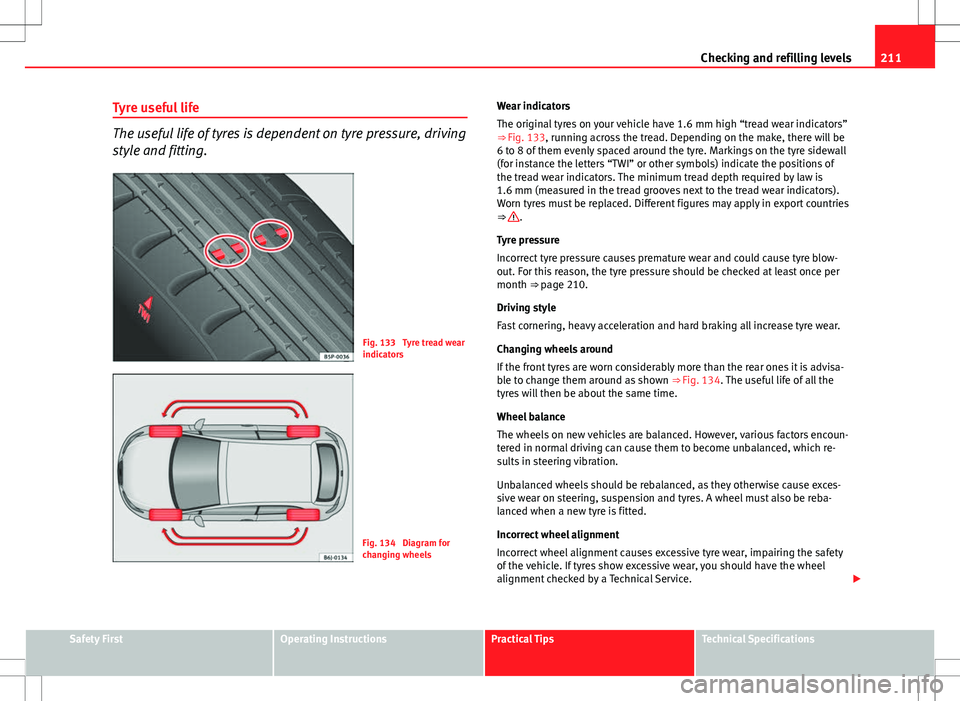
Fig. 133 Tyre tread wear
indicators
Fig. 134 Diagram for
changing wheels Wear indicators
The original tyres on your vehicle have 1.6 mm high “tread wear indicators”
⇒ Fig. 133, running across the tread. Depending on the make, there will be
6 to 8 of them evenly spaced around the tyre. Markings on the tyre sidewall
(for instance the letters “TWI” or other symbols) indicate the positions of
the tread wear indicators. The minimum tread depth required by law is
1.6 mm (measured in the tread grooves next to the tread wear indicators).
Worn tyres must be replaced. Different figures may apply in export countries
⇒
.
Tyre pressure
Incorrect tyre pressure causes premature wear and could cause tyre blow-
out. For this reason, the tyre pressure should be checked at least once per
month ⇒ page 210.
Driving style
Fast cornering, heavy acceleration and hard braking all increase tyre wear.
Changing wheels around
If the front tyres are worn considerably more than the rear ones it is advisa-
ble to change them around as shown ⇒ Fig. 134. The useful life of all the
tyres will then be about the same time.
Wheel balance
The wheels on new vehicles are balanced. However, various factors encoun-
tered in normal driving can cause them to become unbalanced, which re-
sults in steering vibration.
Unbalanced wheels should be rebalanced, as they otherwise cause exces-
sive wear on steering, suspension and tyres. A wheel must also be reba-
lanced when a new tyre is fitted.
Incorrect wheel alignment
Incorrect wheel alignment causes excessive tyre wear, impairing the safety
of the vehicle. If tyres show excessive wear, you should have the wheel
alignment checked by a Technical Service.
Safety FirstOperating InstructionsPractical TipsTechnical Specifications
Page 227 of 280
225
If and when
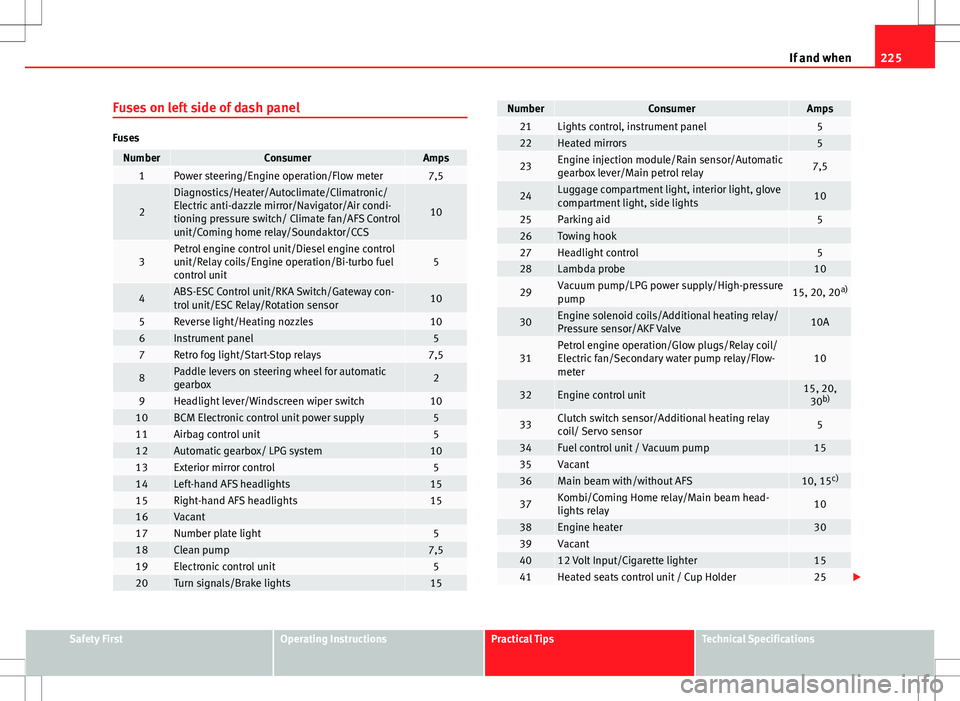
Fuses on left side of dash panel
Fuses
NumberConsumerAmps1Power steering/Engine operation/Flow meter7,5
2
Diagnostics/Heater/Autoclimate/Climatronic/
Electric anti-dazzle mirror/Navigator/Air condi-
tioning pressure switch/ Climate fan/AFS Control
unit/Coming home relay/Soundaktor/CCS
10
3Petrol engine control unit/Diesel engine control
unit/Relay coils/Engine operation/Bi-turbo fuel
control unit5
4ABS-ESC Control unit/RKA Switch/Gateway con-
trol unit/ESC Relay/Rotation sensor10
5Reverse light/Heating nozzles106Instrument panel57Retro fog light/Start-Stop relays7,5
8Paddle levers on steering wheel for automatic
gearbox2
9Headlight lever/Windscreen wiper switch1010BCM Electronic control unit power supply511Airbag control unit512Automatic gearbox/ LPG system1013Exterior mirror control514Left-hand AFS headlights1515Right-hand AFS headlights1516Vacant 17Number plate light518Clean pump7,519Electronic control unit520Turn signals/Brake lights15
NumberConsumerAmps21Lights control, instrument panel522Heated mirrors5
23Engine injection module/Rain sensor/Automatic
gearbox lever/Main petrol relay7,5
24Luggage compartment light, interior light, glove
compartment light, side lights10
25Parking aid526Towing hook 27Headlight control528Lambda probe10
29Vacuum pump/LPG power supply/High-pressure
pump15, 20, 20 a)
30Engine solenoid coils/Additional heating relay/
Pressure sensor/AKF Valve10A
31Petrol engine operation/Glow plugs/Relay coil/
Electric fan/Secondary water pump relay/Flow-
meter10
32Engine control unit15, 20,
30 b)
33Clutch switch sensor/Additional heating relay
coil/ Servo sensor5
34Fuel control unit / Vacuum pump1535Vacant 36Main beam with/without AFS10, 15 c)
37Kombi/Coming Home relay/Main beam head-
lights relay10
38Engine heater3039Vacant 4012 Volt Input/Cigarette lighter1541Heated seats control unit / Cup Holder25
Safety FirstOperating InstructionsPractical TipsTechnical Specifications
Page 228 of 280
226If and when
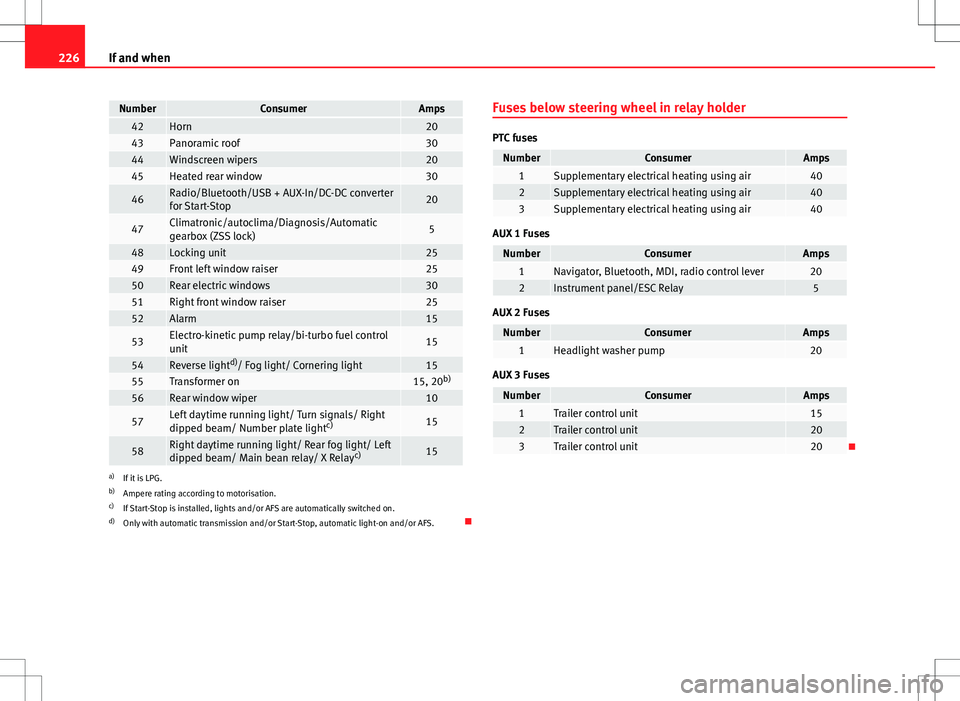
NumberConsumerAmps42Horn2043Panoramic roof3044Windscreen wipers2045Heated rear window30
46Radio/Bluetooth/USB + AUX-In/DC-DC converter
for Start-Stop20
47Climatronic/autoclima/Diagnosis/Automatic
gearbox (ZSS lock)5
48Locking unit2549Front left window raiser2550Rear electric windows3051Right front window raiser2552Alarm15
53Electro-kinetic pump relay/bi-turbo fuel control
unit15
54Reverse light d)
/ Fog light/ Cornering light1555Transformer on15, 20 b)56Rear window wiper10
57Left daytime running light/ Turn signals/ Right
dipped beam/ Number plate light c)15
58Right daytime running light/ Rear fog light/ Left
dipped beam/ Main bean relay/ X Relay c)15
a)
If it is LPG.
b) Ampere rating according to motorisation.
c) If Start-Stop is installed, lights and/or AFS are automatically switched on.
d) Only with automatic transmission and/or Start-Stop, automatic light-on and/or AFS. Fuses below steering wheel in relay holder
PTC fuses
NumberConsumerAmps1Supplementary electrical heating using air402Supplementary electrical heating using air403Supplementary electrical heating using air40
AUX 1 Fuses
NumberConsumerAmps1Navigator, Bluetooth, MDI, radio control lever202Instrument panel/ESC Relay5
AUX 2 Fuses
NumberConsumerAmps1Headlight washer pump20
AUX 3 Fuses
NumberConsumerAmps1Trailer control unit152Trailer control unit203Trailer control unit20
Page 246 of 280
244If and when
Towing and tow-starting
Tow-starting*
The use of jump leads is preferable to tow-starting.
We recommend that you do not tow-start your vehicle. Jump-start-
ing is preferable ⇒ page 241.
However, if your vehicle has to be tow-started:
– Engage the 2nd or the 3rd gear.
– Keep the clutch pressed down.
– Switch the ignition on.
– Once both vehicles are moving, release the clutch.
– As soon as the engine starts, press the clutch and move the
gear lever into neutral. This helps to prevent driving into the
towing vehicle.
WARNING
The risk of accidents is high when tow-starting. The vehicle being towed
can easily collide with the towing vehicle.
CAUTION
When tow-starting, fuel could enter the catalytic converter and damage it. Comments
Please observe the following points if you use a tow rope:
Notes for the driver of the towing vehicle
–
Drive slowly at first until the tow rope is taut. Then accelerate
gradually.
– Begin and change gears cautiously. If you are driving an auto-
matic vehicle, accelerate gently.
– Remember that the brake servo and power steering are not
working in the vehicle you are towing. Brake sooner than nor-
mal and pressing the pedal gently.
Notes for the driver of the towed vehicle
– Ensure that the tow rope remains taut at all times when towing.
Tow rope or tow bar
It is easier and safer to tow a vehicle with a tow bar. You should only use a
tow rope if you do not have a tow bar.
A tow rope should be slightly elastic to reduce the loading on both vehicles.
It is advisable to use a tow rope made of synthetic fibre or similarly elastic
material.
Attach the tow rope or the tow bar only to the towline anchorages provided
or a towing bracket.
Driving style
Towing requires some experience, especially when using a tow rope. Both
drivers should be familiar with the technique required for towing. Inexper-
ienced drivers should not attempt to tow.
Page 247 of 280
245
If and when
Do not pull too hard with the towing vehicle and take care to avoid jerking
the tow rope. When towing on an unpaved road, there is always a risk of
overloading and damaging the anchorage points.
The ignition of the vehicle being towed must be switched on to prevent the
steering wheel from locking and also to allow the use of the turn signals,
horn, windscreen wipers and washers.
As the brake servo does not work if the engine is not running, you must ap-
ply considerably more pressure to the brake pedal than you normally would.
As the power assisted steering does not work if the engine is not running,
you will need more strength to steer than you normally would.
Towing vehicles with an automatic gearbox
● Put the selector lever into position “N”.
● Do not drive faster than 50 km/h (30 mph).
● Do not tow further than 50 km (30 miles).
● If a breakdown vehicle is used, the vehicle must be towed with the front
wheels raised.
Note
● Observe legal requirements when towing or tow-starting.
● Switch on the hazard warning lights of both vehicles. However, observe
any regulations to the contrary.
● For technical reasons, vehicles with an automatic gearbox must not be
tow-started.
● If damage to your vehicle means that there is no lubricant in the gear-
box, you must raise the driven wheels while the vehicle is being towed.
● If the vehicle has to be towed more than 50 km (30 miles), the front
wheels should be raised during towing, and towing should be carried out by
a qualified person. ●
The steering wheel is locked when the vehicle has no electrical power.
The vehicle must then be towed with the front wheels raised. Towing should
be carried out by a qualified person.
● The towline anchorage should always be kept in the vehicle.
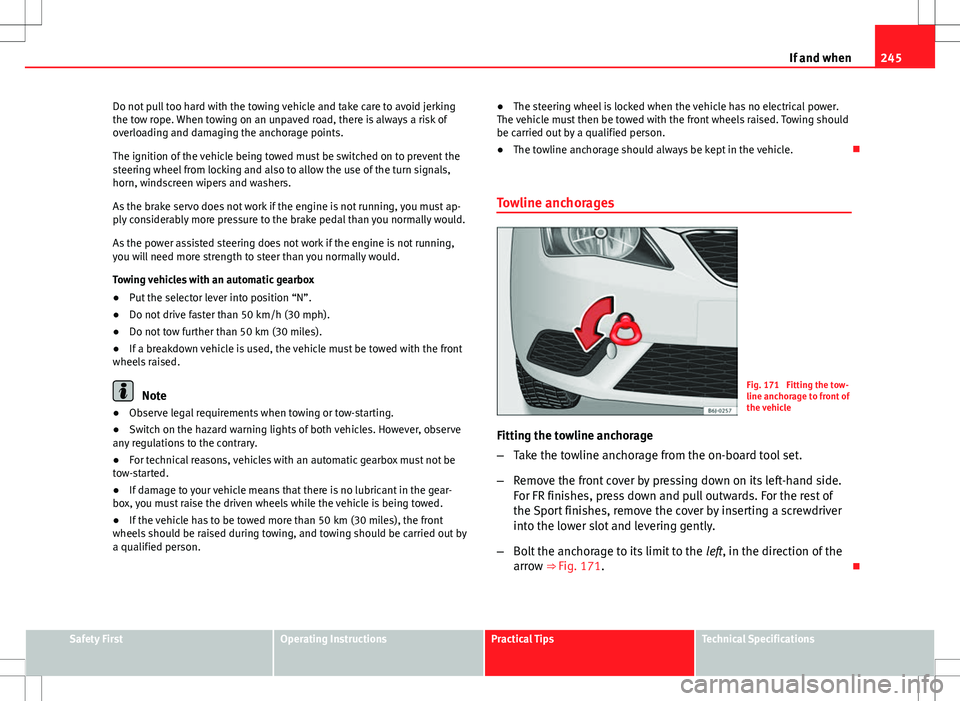
Towline anchoragesFig. 171 Fitting the tow-
line anchorage to front of
the vehicle
Fitting the towline anchorage
– Take the towline anchorage from the on-board tool set.
– Remove the front cover by pressing down on its left-hand side.
For FR finishes, press down and pull outwards. For the rest of
the Sport finishes, remove the cover by inserting a screwdriver
into the lower slot and levering gently.
– Bolt the anchorage to its limit to the left, in the direction of the
arrow ⇒ Fig. 171.
Safety FirstOperating InstructionsPractical TipsTechnical Specifications
Page 273 of 280
Correct sitting positionfront passenger . . . . . . . . . . . . . . . . . . . . . . 11
Incorrect sitting position . . . . . . . . . . . . . . . 14
passenger . . . . . . . . . . . . . . . . . . . . . . . . . . . 12
Cruise control Control lamp . . . . . . . . . . . . . . . . . . . . . . . . . 71
Cruise control system . . . . . . . . . . . . . . . . . . . . 158
Cruise speed . . . . . . . . . . . . . . . . . . . . . . . . . . . 158 Control lamp . . . . . . . . . . . . . . . . . . . . . . . . . 71
D Danger of fitting a child seat on the front pas- senger seat . . . . . . . . . . . . . . . . . . . . . . . . . . . 30
Dash panel . . . . . . . . . . . . . . . . . . . . . . . . . . . . . 53
Dash panel cleaning . . . . . . . . . . . . . . . . . . . . 180
Daytime driving lights . . . . . . . . . . . . . . . . . . . . 99
Deactivating front passenger airbag Safety notes . . . . . . . . . . . . . . . . . . . . . . . . . 40
Deactivating the airbag Front passenger front airbag . . . . . . . . . . . . 40
Diesel . . . . . . . . . . . . . . . . . . . . . . . . . . . . . . . . 192
Diesel engine Winter driving . . . . . . . . . . . . . . . . . . . . . . . 193
Diesel engine particulate filter . . . . . . . . . . . . 169
Differential lock . . . . . . . . . . . . . . . . . . . . . . . . 165
Differential lock fault (EDL) Control lamp . . . . . . . . . . . . . . . . . . . . . . . . . 70
Digital clock . . . . . . . . . . . . . . . . . . . . . . . . . . . . 58
Dipped beam headlights . . . . . . . . . . . . . . . . . . 97 Disposal
Airbags . . . . . . . . . . . . . . . . . . . . . . . . . . . . . 31
Seat belt tensioners . . . . . . . . . . . . . . . . . . . 27
Door lock cylinders . . . . . . . . . . . . . . . . . . . . . . 178
Door release lever . . . . . . . . . . . . . . . . . . . . . . . 53
Doors control lamp . . . . . . . . . . . . . . . . . . . . . . . . . 73
Double headlight . . . . . . . . . . . . . . . . . . . . . . . 231
Double headlight bulb change dipped beam headlights . . . . . . . . . . . . . . 233
main beam headlights . . . . . . . . . . . . . . . . 232
side light . . . . . . . . . . . . . . . . . . . . . . . . . . . 231
Driver see Correct sitting position . . . . . . . 10, 11, 12
Driveshaft differential XDS . . . . . . . . . . . . . . . . . . . . . . . . . . . . . . . 164
Drive wheel traction control system . . . . . . . . 163
Driving Driving abroad . . . . . . . . . . . . . . . . . . . . . . 171
Economically / Environmentally friendly . 169
With a trailer . . . . . . . . . . . . . . . . . . . . 172, 173
Driving abroad . . . . . . . . . . . . . . . . . . . . . . . . . 171 Headlights . . . . . . . . . . . . . . . . . . . . . . . . . 172
Driving safety . . . . . . . . . . . . . . . . . . . . . . . . . . . . 8
Duplicate keys . . . . . . . . . . . . . . . . . . . . . . . . . . 84
Dust filter . . . . . . . . . . . . . . . . . . . . . . . . . . . . . 135
Dynamic headlight range control . . . . . . . . . . . 99
E
Economical driving . . . . . . . . . . . . . . . . . . . . . . 169 EDL . . . . . . . . . . . . . . . . . . . . . . . . . . . . . . . . . . 165
Control lamp . . . . . . . . . . . . . . . . . . . . . . . . . 69
Electro-hydraulic steering control lamp . . . . . . . . . . . . . . . . . . . . . . . . . 73
Electronic differential lock . . . . . . . . . . . . . . . . 165 Control lamp . . . . . . . . . . . . . . . . . . . . . . . . . 69
Electronic immobiliser . . . . . . . . . . . . . . . . . . . 139
Electronic Stability Control . . . . . . . . . . . . 71, 164 description . . . . . . . . . . . . . . . . . . . . . . . . . 138
Electronic Stability Control (ESC) control lamp . . . . . . . . . . . . . . . . . . . . . . . . . 71
Emission control system control lamp . . . . . . . . . . . . . . . . . . . . . . . . . 74
Engine Running in . . . . . . . . . . . . . . . . . . . . . . . . . 167
Engine compartment Working in the engine compartment . . . . 193
Engine coolant . . . . . . . . . . . . . . . . . . . . . . . . . 200 G 12 plus-plus . . . . . . . . . . . . . . . . . . . . . . 200
G 13 . . . . . . . . . . . . . . . . . . . . . . . . . . . . . . . 200
Specifications . . . . . . . . . . . . . . . . . . . . . . . 200
Engine fault control lamp . . . . . . . . . . . . . . . . . . . . . . . . . 68
Engine management control lamp . . . . . . . . . . . . . . . . . . . . . . . . . 68
Engine oil . . . . . . . . . . . . . . . . . . . . . . . . . . . . . 196 Changing . . . . . . . . . . . . . . . . . . . . . . . . . . 199
Checking engine oil level . . . . . . . . . . . . . . 198
Oil properties . . . . . . . . . . . . . . . . . . . . . . . 197
Specifications . . . . . . . . . . . . . . . . . . . . . . . 196
Topping up . . . . . . . . . . . . . . . . . . . . . . . . . 199
Engine oil dipstick . . . . . . . . . . . . . . . . . . . . . . 198
271
Index
Page 277 of 280
Single headlight bulb . . . . . . . . . . . . . . . . . . . 229
Sitting positiondriver . . . . . . . . . . . . . . . . . . . . . . . . . . . . . . . 10
Sitting position, occupants . . . . . . . . . . . . . . . . 10
Snow chains . . . . . . . . . . . . . . . . . . . . . . . 214, 250
Soot accumulation in the diesel engine particu- late filter
control lamp . . . . . . . . . . . . . . . . . . . . . . . . . 68
Spanner symbol . . . . . . . . . . . . . . . . . . . . . . . . . 62
Spare parts . . . . . . . . . . . . . . . . . . . . . . . . . . . . 183
Spare wheel . . . . . . . . . . . . . . . . . . . . . . . . . . . 216
Speedometer . . . . . . . . . . . . . . . . . . . . . . . . . . . 56
Speed selector lever lock control lamp . . . . . . . . . . . . . . . . . . . . . . . . . 73
Start-Stop Activating and deactivating . . . . . . . . . . . . 145
Function . . . . . . . . . . . . . . . . . . . . . . . . . . . 143
Starting petrol engines . . . . . . . . . . . . . . 140, 141
Starting the engine . . . . . . . . . . . . . . . . . 140, 141 After the fuel tank has been run dry . . . . . 141
Steam jets . . . . . . . . . . . . . . . . . . . . . . . . . . . . . 176
Steering . . . . . . . . . . . . . . . . . . . . . . . . . . . . . . 137 Steering lock . . . . . . . . . . . . . . . . . . . . . . . . 138
Steering column controls Audio Control . . . . . . . . . . . . . . . . . . . . . . . . 76
Steering wheel height adjustment . . . . . . . . . 137
Storage compartment Front passenger side . . . . . . . . . . . . . . . . . 119
Right-hand front seat . . . . . . . . . . . . . . . . . 120
Sun visor Sliding/tilting sunroof . . . . . . . . . . . . . . . . . 95
Sun visors . . . . . . . . . . . . . . . . . . . . . . . . . . . . . 105 Switch
Hazard warning lights . . . . . . . . . . . . . . . . 102
Heated rear window . . . . . . . . . . . . . . . . . . 101
Light switch . . . . . . . . . . . . . . . . . . . . . . . . . 97
Switches Electric windows . . . . . . . . . . . . . . . . . . . . . . 92
panoramic/tilting sunroof . . . . . . . . . . . . . . 94
Switching off the engine . . . . . . . . . . . . . . . . . 141
T Tail lights . . . . . . . . . . . . . . . . . . . . . . . . . . . . . 237
Tank Fuel level . . . . . . . . . . . . . . . . . . . . . . . . . . . . 57
Reserve indicator . . . . . . . . . . . . . . . . . . . . . 57
Tank capacity . . . . . . . . . . . . . . . . . . . . . . . . 57
Technical modifications . . . . . . . . . . . . . . . . . . 183
The danger of not using the seat belt . . . . . . . . 21
Tightening torque of wheel bolts . . . . . . . . . . 250
Tilting sunroof . . . . . . . . . . . . . . . . . . . . . . . . . . 94
Tools . . . . . . . . . . . . . . . . . . . . . . . . . . . . . . . . . 216
Top Tether system . . . . . . . . . . . . . . . . . . . . . . . 49
Tow-starting . . . . . . . . . . . . . . . . . . . . . . . . . . . 244
Towing . . . . . . . . . . . . . . . . . . . . . . . . . . . . . . . . 244
Towing a trailer . . . . . . . . . . . . . . . . . . . . . 172, 249
Towing bracket . . . . . . . . . . . . . . . . . . . . . . . . . 173
Towing bracket, fitting . . . . . . . . . . . . . . . . . . . 185
Towline anchorage . . . . . . . . . . . . . . . . . . . . . . 244
Towline anchorages . . . . . . . . . . . . . . . . . . . . . 245
Tow starting Comments . . . . . . . . . . . . . . . . . . . . . . . . . . 244 Traction control system
control lamp . . . . . . . . . . . . . . . . . . . . . . . . . 70
Trailer turn signals control lamp . . . . . . . . . . . . . . . . . . . . . . . . 104
Trailer weights . . . . . . . . . . . . . . . . . . . . . . . . . 249
Turn signals . . . . . . . . . . . . . . . . . . . . . . . . . . . 103 control lamp . . . . . . . . . . . . . . . . . . . . . 75, 104
Two-way radio . . . . . . . . . . . . . . . . . . . . . . . . . . 184
Tyre-Mobility-System (Tyre repair kit) . . . . . . . 222
Tyre Mobility-System (Tyre repair kit) . . . . . . . 217
Tyre pressure . . . . . . . . . . . . . . . . . . . . . . . . . . 210
Tyre pressure control lamp . . . . . . . . . . . . . . . . 72
Tyre pressures . . . . . . . . . . . . . . . . . . . . . . . . . . 250
Tyre repair kit . . . . . . . . . . . . . . . . . . . . . . 217, 222
Tyres and wheels Dimensions . . . . . . . . . . . . . . . . . . . . . . . . . 212
Tyres tread depth . . . . . . . . . . . . . . . . . . . . . . . 211
Tyres useful life . . . . . . . . . . . . . . . . . . . . . . . . . 211
Tyres with directional tread pattern . . . . . . . . 210
U Underbody protection . . . . . . . . . . . . . . . . . . . 179
V
Vehicle battery . . . . . . . . . . . . . . . . . . . . . . . . . 207
Vehicle data . . . . . . . . . . . . . . . . . . . . . . . . . . . 248
Vehicle identification data . . . . . . . . . . . . . . . . 248
Vehicle identification number . . . . . . . . . . . . . 248
Vehicle interior heating or cooling system . . . 131
275
Index