light Seat Ibiza ST 2009 Manual PDF
[x] Cancel search | Manufacturer: SEAT, Model Year: 2009, Model line: Ibiza ST, Model: Seat Ibiza ST 2009Pages: 250, PDF Size: 6.4 MB
Page 159 of 250
Driving and the environment
158
CautionNever fully drain the fuel tank because the irregularity of the fuel supply may
cause ignition problems. This allows unburnt fuel to enter the exhaust
system, which could cause overheating and damage the catalytic converter.
For the sake of the environment
Even when the emission control system is working perfectly, there may be a
smell of sulphur from the exhaust gas under some conditions. This depends
on the sulphur content of the fuel used. Quite often the problem can be
solved by changing to another brand of fuel.Diesel engine particulate filter*
The diesel engine particulate filter eliminates soot produced
by burning diesel.The diesel engine dust filter eliminates most of the soot from the exhaust gas
system. Under normal driving conditions, the filter cleans itself. If the driving
conditions do not allow the filter to clean itself (for example, multiple short
trips) the filter will be obstructed by dust and pollen and the indicator
for
the diesel engine particulate filter indicator will light up. See section on
Warning Lamps.
WARNING
•The diesel engine particulate filter may reach extremely high tempera-
tures; it should not enter into contact with flammable materials under-
neath the vehicle. Failure to comply could result in fire.
Caution
•The vehicle is not designed for refuelling with blends of FAME fuel
(biodiesel) over 7% in accordance with DIN 51628. The diesel particulate
filter is damaged when this blend percentage is exceeded.Economical and environmentally-friendly
drivingGeneral notes
Fuel consumption depends to a large extent on your personal
driving style.Fuel consumption, environmental impact and engine, brake and tyre wear
depend largely on three factors:•Personal driving style•Conditions of use (weather, road surface)•Te chni cal r eq ui re men ts
By adopting an economical driving style and anticipating the traffic situation
ahead, you can easily reduce fuel consumption by 10-15%. This section
suggests methods of lessening the impact on the environment and reducing
your operating costs at the same time.Foresight when drivingA vehicle uses most fuel when accelerating. If you think ahead when driving,
you will need to brake less and thus accelerate less. Wherev er possible, take
Ibiza ST_EN.book Seite 158 Dienstag, 12. Januar 2010 4:03 16
Page 160 of 250
Driving and the environment159
Safety First
Operating instructions
Practical tips
Technical Data
advantage of your vehicle inertia, for instance when you see that the next
traffic light is red.
Regular servicesBy taking your car to an Authorised Service Centre for regular servicing you
can establish a basis for good fuel economy
before you start driving. A well-
serviced engine gives you the benefit of improved fuel efficiency as well as
maximum reliability and an enhanced resale value.
A badly serviced engine can consume up to 10% more fuel than necessary.
Check the oil level every time you refuel ⇒page 183. Oil consumption
depends to a great extent on the engine load and engine speed. Depending
on your personal driving style, oil consumption can be up to 1 litre per 1,000
km.
Avoid short journeysThe engine and catalytic converter need to reach their proper working
temperature in order to minimise fuel consumption and emissions.
Directly after a cold start, the engine uses about 50-70 litres of fuel per 100
km. This figure then drops to 20-30 litres per 100 km after about one kilo-
metre. The engine only reaches it s working temperature after about four kilo-
metres, when fuel consumption will return to a normal level. You should
therefore avoid short journeys.
The ambient temperature has a decisive influence.
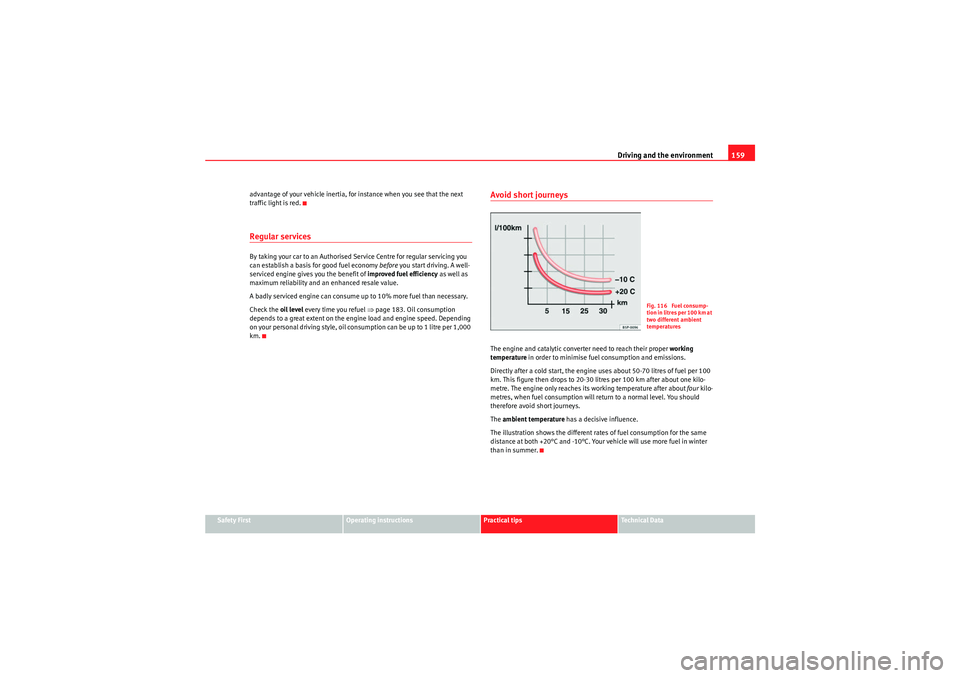
The illustration shows the different rates of fuel consumption for the same
distance at both +20°C and -10°C. Your vehicle will use more fuel in winter
than in summer.
Fig. 116 Fuel consump-
tion in litres per 100 km at
two different ambient
temperatures
Ibiza ST_EN.book Seite 159 Dienstag, 12. Januar 2010 4:03 16
Page 161 of 250
Driving and the environment
160Driving abroadObservationsTo drive abroad, the following must be taken into consideration:•For vehicles fitted with a catalytic converter ensure that unleaded petrol is
available for the journey. See the chapter “Refuelling”. Automobile organisa-
tions will have information about service station networks selling unleaded
fuel.•In some countries, it is possible that a vehicle model is sold under condi-
tions where some spare parts are not available or that the Authorised Service
Centre may only carry out limited repairs.
SEAT importers and distributors will gladly provide information about the
technical preparation of your vehicle and also about necessary maintenance
and repair possibilities.Adhesive strips for headlightsIf you have to drive a right-hand drive vehicle in a left-hand drive country, or
vice versa, the asymmetric dipped beam headlights will dazzle oncoming
traffic.
To prevent dazzling, you must apply stickers to certain parts of the headlight
lenses. Further information is available in your Authorised Service Centre.
In vehicles with adaptive headlights, the rotation system must previously be
disconnected. To do this, please go to a specialist workshop.
Trailer towingWhat do you need to bear in mind when towing a trailer?Your vehicle may be used to tow a trailer when fitted with the correct equip-
ment.
If the car is supplied with a factory-fitted towing bracket it will already have
the necessary technical modifications and meet the statutory requirements
for towing a trailer. For the after-market fitting of a trailer towing bracket see
⇒ page 174.
Connectors
Your vehicle is fitted with a 12-pin connector for the electrical connection
between the trailer and the vehicle.
If the trailer has a 7-pin plug you will need to use an adapter cable. This is
available in any SEAT dealer.
Trailer weight / drawbar load
Never exceed the authorised trailer weight. If you do not load the trailer up to
the maximum permitted trailer weight, you can then climb correspondingly
steeper slopes.
The maximum trailer weights listed are only applicable for altitudes up to
1,000 m above sea level. With increa sing altitude the engine power and
therefore the vehicle's climbing ability are impaired because of the reduced
air density. The maximum trailer weight has to be reduced accordingly. The
weight of the vehicle and trailer combination must be reduced by 10% for
every further 1,000 m (or part thereof). The gross combination weight is the
actual weight of the laden vehicle plus the actual weight of the laden trailer.
When possible, operate the trailer with the maximum permitted drawbar load
on the ball joint of the towing bracket, but do not exceed the specified limit.
The figures for trailer weights and drawbar loads that are given on the data
plate of the towing bracket are for certification purposes only. The correct
Ibiza ST_EN.book Seite 160 Dienstag, 12. Januar 2010 4:03 16
Page 162 of 250
Driving and the environment161
Safety First
Operating instructions
Practical tips
Technical Data
figures for your specific model, which may be
lower than these figures for the
towing bracket, are given in the registration documents ⇒Section “Technical
data”.
Distributing the load
Distribute loads in the trailer so that heavy objects are as near to the axle as
possible. Loads carried in the trailer must be secured to prevent them
moving.
Tyre pressure
Set tyre pressure to the maximum permissible pressure shown on the sticker
on the inside of the fuel tank flap. Set the tyre pressure of the trailer tyres in
accordance with the trailer manufacturer's recommendations.
Exterior mirrors
Check whether you can see enough of the road behind the trailer with the
standard mirrors. If this is not the case, you should have additional mirrors
fitted. Both exterior mirrors should be mounted on hinged extension
brackets. Adjust the mirrors to give sufficient vision to the rear.
WARNING
Never transport people in a trailer. This could result in fatal accidents.
Note
•Towing a trailer places additional demands on the vehicle. We recom-
mend additional services between the normal inspection intervals if the
vehicle is used frequently for towing a trailer.•Find out whether special regulations apply to towing a trailer in your
country.
Ball coupling of towing bracket*The ball coupling is provided with instructions on fitting and removing the
ball coupling of the towing bracket.
WARNING
The towing bracket ball coupling must be stored securely in the luggage
compartment to prevent them being flung through the vehicle and causing
injury.
Note
•By law, the ball coupling must be removed if a trailer is not being towed
and it obscures the number plate.Driving tips
Driving with a trailer always requires extra care.Weight distribution
The weight distribution of a loaded trailer with an unladen vehicle is very
unfavourable. However, if this cannot be avoided, drive extra slowly to allow
for the unbalanced weight distribution.
Speed
The stability of the vehicle and trailer is reduced with increasing speed. For
this reason, it is advisable not to drive at the maximum permissible speed in
an unfavourable road, weather or wind conditions. This applies especially
when driving downhill.
You should always reduce speed immediately if the trailer shows the slightest
sign of snaking . Never try to stop the “snaking” by increasing speed.
Ibiza ST_EN.book Seite 161 Dienstag, 12. Januar 2010 4:03 16
Page 164 of 250
Vehicle maintenance and cleaning163
Safety First
Operating instructions
Practical tips
Technical Data
Vehicle maintenance and cleaningGeneral notesRegular washing and care help maintain the value of your
vehicle.Yo u r v e h i c l e m a i n te n a n ce
Regular care and washing help to maintain the value of the vehicle. This may
also be one of the requirements for acknowledging warranty claims in the
event of bodywork corrosion or paint defects.
The best way to protect your car against the harmful effects of the environ-
ment is through correct maintenance and frequent washing. The longer
substances such as insects remains, bird droppings, resinous tree sap, road
dirt, industrial deposits, tar, soot or road salt and other aggressive materials
remain on the vehicle, the more damage they do to the paintwork. High
temperatures (for instance in strong sunlight) further intensify the corrosive
effect.
After winter, a period when salt is put on the roads, it is impor tant to have the
underside of the vehicle washed thoroughly.
Products for vehicle maintenance
Car care products are available in your Authorised Service Centre. Keep the
product instructions until you have used them up.
WARNING
•Car care products can be toxic. For this, they must always be kept
closed in their original container. Keep them out of the reach of children.
Failure to comply could result in poisoning.•Always read and observe the instructions and warnings on the package
before using car care products. Improper use could damage your health or your vehicle. The use of certain products may produce noxious vapours;
they should be used in well ventilated areas.
•Never use fuel, turpentine, engine oil, nail varnish remover or other
volatile fluids. These are toxic and highly flammable. Risk of fire and explo-
sion.•Before washing your vehicle, or carrying out any maintenance, switch
the engine off, apply your handbrake firmly and remove the key from the
ignition.Caution
Never attempt to remove dirt, mud or dust if the surface of the vehicle is dry.
Never use a dry cloth or sponge for cleaning purposes. This could damage the
paintwork or the windows of your vehicle. Soak dirt, mud or dust with plenty
of water.
For the sake of the environment
•When purchasing products for your vehicle maintenance, select the ones
which are not harmful to the environment.•The leftovers of the car care products should not be disposed of with ordi-
nary household waste. Observe the disposal information on the package.WARNING (continued)
Ibiza ST_EN.book Seite 163 Dienstag, 12. Januar 2010 4:03 16
Page 165 of 250
Vehicle maintenance and cleaning
164Care of the vehicle exteriorAutomatic car washing tunnelThe vehicle paintwork is so durable that the car can normally be washed
without problems in an automatic car washing tunnel. However, the paint-
work wear depends to a large extent, on the kind of the car washing tunnel,
the brushes used, its water filtering and the type of cleaning and preservative
products.
Before going through a car wash, be sure to take the usual precautions such
as closing the windows and sunroof. There is nothing to note apart from that.
If the vehicle has special accessories such as spoilers or a roof carrier or two-
way radio aerial, etc., it is advisable to consult the car washing tunnel oper-
ator.
After washing, the brakes could hesitate to respond as the brake discs and
pads could be wet, or even frozen in winter. “Dry” the brakes by braking
several times.
WARNING
Water, ice and salt on the brakes can reduce braking efficiency. Risk of acci-
dent.
Caution
Before putting the vehicle through the car washing tunnel, do not tighten the
aerial if it is folded because it can be damaged.
Washing by handVehicle washing
– First soften the dirt with plenty of water and rinse it off.
– Clean your vehicle from top to bottom with a soft sponge, a glove or a brush. Use very light pressure.
– Rinse the sponge or glove often with clean water.
– Special car shampoo should only be used for very stubborn dirt.
– Clean the wheels, sill panels etc. until last with a different sponge or glove.
– Rinse the vehicle thoroughly with water.
– Dry your vehicle surface gently with a chamois leather.
–When temperature is cold , dry the rubber seals and its surfaces
to prevent them from freezing. Apply silicone spray to the rubber
seals.
After washing
– Directly after washing, avoid sudden and sharp braking. “Dry” the brakes by braking several times.
WARNING
•Wash your car with the ignition switched off.•Protect your hands and arms from cuts on sharp metal edges when
cleaning the underbody, the inside of the wheel housings etc. Risk of
injury.
Ibiza ST_EN.book Seite 164 Dienstag, 12. Januar 2010 4:03 16
Page 166 of 250
Vehicle maintenance and cleaning165
Safety First
Operating instructions
Practical tips
Technical Data
•Water, ice and salt on the brakes can reduce braking efficiency. Risk of
accident.Caution
•Never remove dirt, mud or dust if the vehicle surface is dry. Never use a
dry cloth or sponge for cleaning purposes. This could scratch the paintwork
or glass on your vehicle.•Washing the vehicle in low temperatures: when washing the vehicle with
a hose, do not direct water into the lock cylinders or the gaps around the
doors, rear lid, or sunroof. Risk of freezing.For the sake of the environment
To protect environment, the car should be washed only in specially provided
wash bays. This prevents toxic, oil-laden waste water entering the sewerage
system. In some districts, washing vehicles outside wash bays is prohibited.
Note
Do not wash the vehicle in direct sunlight.Washing the car with a high pressure cleaner
Be particularly careful when using a high pressure cleaner!– Always observe the instructions for the high-pressure cleaner, particularly those concerning the pressure and the spraying
distance. – Increase the spraying distance
for soft materials and painted
bumpers.
– Do not use a high pressure cleaner to remove ice or snow from windows ⇒page 166.
– Never use concentrated jet nozzles (“rotating jets”) ⇒.
– Directly after washing, avoid sudden and sharp braking. “Dry” ⇒page 156 the brakes by braking several times.
WARNING
•Never wash tyres with a concentrated jet (“rotating nozzle”). Even at
large spraying distances and short cleaning times, visible and invisible
damage can occur to the tyres. This may cause an accident.•Water, ice and salt on the brakes can reduce braking efficiency. Risk of
accident.Caution
•Do not use water hotter than 60°C. This could damage the vehicle.•To avoid damage to the vehicle, keep a sufficient distance from sensitive
materials such as flexible hoses, plastic, soundproofing material, etc. This is
also important for bumpers painted as the paintwork. The closer the nozzle is
to the surface, the greater the wear on the material.Vehicle paint maintenance requirements
Regular waxing protects the paintwork.You need to apply wax to your car if water does not form small drops and run
off the paintwork when it is clean.
WARNING (continued)
Ibiza ST_EN.book Seite 165 Dienstag, 12. Januar 2010 4:03 16
Page 172 of 250
Vehicle maintenance and cleaning171
Safety First
Operating instructions
Practical tips
Technical Data
– Apply these products very sparingly.
– Then wipe off with a soft, dry cloth.SEAT does everything possible to preserve the genuine qualities of this
natural product. Due to the natural properties of the specially selected hides
employed, the finished leather has a certain sensitivity to grease and dirt, etc.
so a degree of care is required in everyday use and when looking after the
leather.
Dust and grit in the pores and seams can scratch and damage the surface. If
the vehicle is under solar radiation for long periods, the leather should be
protected to prevent it from fading. However, slight colour variations in high-
quality natural leather are normal.
Caution
•Do not use solvents, wax polish, shoe cream, spot removers or similar
products on leather.•To avoid damage, stubborn stains should be removed by a qualified
workshop.Seat belts cleaning
A dirty belt may not work properly.Check all seat belts regularly and keep them clean.
Seat belts cleaning
– Pull the dirty seat belt right out and unroll it.
– Clean dirty seat belts with a gentle soap solution.
– Allow it to dry. – Do not roll the seat belt up until it is dry.
If large stains form on the belts, it will not retract correctly into the automatic
belt retractor.
WARNING
•Do not use chemical cleaning agents on the seat belts, as this can
impair the strength of the webbing. Ensure that belts do not come into
contact with corrosive fluids.•Check all seat belts condition at regular inter vals. If you notice that the
belt webbing, fittings, retractor mechanism or buckle of any of the belts is
damaged, the belt must be replaced by a specialist workshop.•Do not attempt to repair a damaged seat belt yourself. The seat belts
must not be removed or modified in any way.Caution
After cleaning, allow seat belts to dr y completely before rolling them up.
Otherwise, the belt retractors could become damaged.
Ibiza ST_EN.book Seite 171 Dienstag, 12. Januar 2010 4:03 16
Page 179 of 250
Checking and refilling levels
178Petrol additives
Petrol additives improve the quality of the petrol.The quality of the petrol influences running behaviour, performance and
service life of the engine. For this reason, you should use good quality petrol
containing additives. These additives will help to prevent corrosion, keep the
fuel system clean and prevent deposits from building up in the engine.
If good quality petrol with additives is not available or engine problems occur,
the required additives must be added during refuelling.DieselDiesel*Diesel fuel must correspond to DIN EN 590 (EN = “European standard”). It
must have a cetane number (CN) of at least 51. The cetane number indicates
the ignition quality of the diesel fuel.
Notes on refuelling ⇒page 176.Biodiesel*The biodiesel fuel must comply with the DIN EN 14.214 (FAME) Standard.•Biodiesel is a methyl ester obtained from rapeseed oil.•DIN is the German abbreviation for “ Deutsches Institut für N ormung e.V.”,
the German standards institute.•EN means European Norm.•FAME is the English abbreviation for “ Fatty Acid Methyl Ester”. Your Authorised Service Centre can also be consulted to know if the vehicle
has been prepared for biodiesel use.
Things to note about RME fuel (biodiesel)
•The performance of a vehicle using biodiesel maybe somewhat reduced.•Fuel consumption of a vehicle using biodiesel may be slightly higher.•Biodiesel is resistant to the cold down to approx. -10°C.•At temperatures below -10°C, we recommend using winter diesel fuel.•Your vehicle is designed to be refuelled with up to a maximum of 7%
blended biodiesel in accordance with standard DIN 51628.Caution
•RME fuel can damage the fuel system in vehicles which are not suitably
adjusted.•If you decide to use biodiesel in your vehicle, please use only RME fuel
which is DIN E 14.214 compliant.•If you use biodiesel that does not meet the required standard, the fuel
filter could become clogged.Note
•In case of low outside temperatures and a fuel biodiesel percentage of
higher than 50%, an increase in gas emission may occur during operation of
the independent heating.•The fuel filter may become clogged when fu el is changed to biodiesel. For
this reason, we recommend that, after driving 300 or 400 km, the fuel filter
should also be changed after a fuel change. Also note the instructions in the
Maintenance Programme.•If the vehicle is to remain parked for more than about two weeks, we
recommend filling the fuel tank with biodiesel and driving about 50 km in
order to avoid damage to the injection system.
Ibiza ST_EN.book Seite 178 Dienstag, 12. Januar 2010 4:03 16
Page 183 of 250
Checking and refilling levels
182•Wait until no more steam, smoke or coolant is emitted from the bonnet,
then carefully open the bonnet.•When working in the engine compartment, always observe the safety
warnings ⇒page 179.
Closing the bonnet– Slightly raise the bonnet
– Release the bonnet stay and replace it in its support.
– At a height of about 30 cm let it fall so it is locked.If the b onn et d o es n ot clos e , do not p ress d ownwa rds . Op e n it o nce m or e an d
let it fall as before.
WARNING
If the bonnet is not closed properly, it could open while you are driving and
completely obscure your view of the road. Risk of accident.•After closing the bonnet, always check that it is properly secured. The
bonnet must be flush with the surrounding body panels.•If you notice that the bonnet latch is not secured when the vehicle is
moving, stop the vehicle immediately and close the bonnet properly. Risk
of accident.
Engine oilEngine oil specifications
The engine oil used must conf orm with exact specifications.Specifications
The engine comes with a special, high quality, multi grade oil that can be
used in all seasons of the year except for those regions affected by extreme
cold.
As the use of good quality oil is necessary for the correct operation and long
service life of the engine, when it becomes necessary to replenish or change
the oil, always use an oil that complies to the VW standards.
If it is not possible to find oil conforming to the VW standards then oil
conforming to the ACEA or API standards with an appropriate viscosity at
atmospheric temperature should be used instead. The use of this type of oil
may have some repercussions on the performance of the engine for example,
long starting time, increased consumption and a higher emission level.
If a top up is required then different oils may be mixed as long as they all
conform to the VW standards.
The specifications (VW standards) set out in the following page should
appear on the container of the service oil; the container will display together
the different standards for petrol and diesel engines, the oil can be used for
both types of engines.
WARNING (continued)
Ibiza ST_EN.book Seite 182 Dienstag, 12. Januar 2010 4:03 16