radio Seat Ibiza ST 2014 User Guide
[x] Cancel search | Manufacturer: SEAT, Model Year: 2014, Model line: Ibiza ST, Model: Seat Ibiza ST 2014Pages: 240, PDF Size: 4.89 MB
Page 85 of 240
Opening and closing
WARNING
● An incorrect use of the keys can cause seri-
ous injuries.
● Never leave children or disabled persons in
the vehicle. In case of emergency, they may
not be able to leave the vehicle or manage on
their own.
● An uncontrolled use of the key could start
the engine or activate any electric equipment
(e.g. electric windows), causing risk of acci-
dent. The doors can be locked using the re-
mote control key. This could become an ob-
stacle for assistance in an emergency situa-
tion.
● Never forget the keys inside the vehicle. An
unauthorised use of your vehicle could result
in injury, damage or theft. Always take the
key with you when you leave the vehicle.
● Never remove the key from the ignition if
the vehicle is in motion. Otherwise, the steer-
ing could suddenly block and it would be im-
possible to steer the vehicle. CAUTION
There are electronic components in the re-
mote control key. Avoid wetting and hitting
the keys. Radio frequency remote
control*
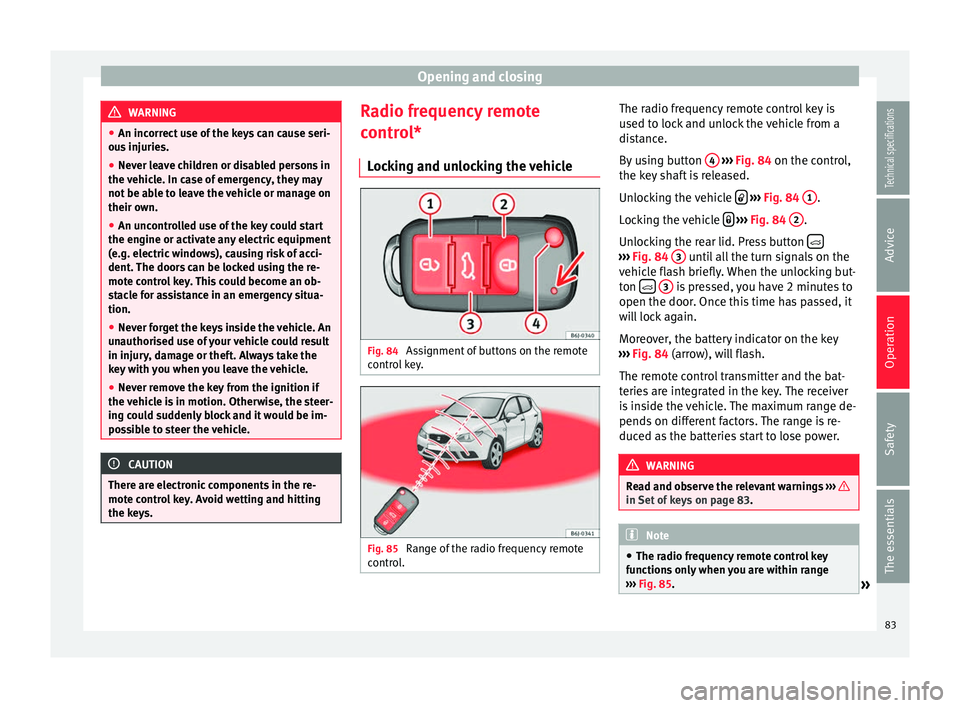
Locking and unlocking the vehicle Fig. 84
Assignment of buttons on the remote
control key. Fig. 85
Range of the radio frequency remote
control. The radio frequency remote control key is
used to lock and unlock the vehicle from a
distance.
By using button
4
››› Fig. 84 on the control,
the k ey
shaft is released.
Unlocking the vehicle
››› Fig. 84 1 .
Locking the vehicle
››› Fig. 84 2 .
Unlocking the rear lid. Press button ›››
Fig. 84 3 until all the turn signals on the
vehicle flash briefly. When the unlocking but-
ton
3 is pressed, you have 2 minutes to
open the door. Once this time has passed, it
will lock again.
Moreover, the battery indicator on the key
››› Fig. 84 (arrow), will flash.
The r emot
e control transmitter and the bat-
teries are integrated in the key. The receiver
is inside the vehicle. The maximum range de-
pends on different factors. The range is re-
duced as the batteries start to lose power. WARNING
Read and observe the relevant warnings ››› in Set of keys on page 83.
Note
● The radio frequency remote control key
functions only when you are within range
››› Fig. 85.
» 83
Technical specifications
Advice
Operation
Safety
The essentials
Page 86 of 240
Operation
●
If the vehicle cannot be unlocked or locked
by using the radio frequency remote control,
the remote control key will have to be re-
synchronised. For this, go to your technical
services. Changing the battery
If the battery indicator does not flash when
the buttons are pushed, the battery must be
replaced.
CAUTION
The use of inappropriate batteries may dam-
age the radio frequency remote control. For
this reason, always replace the dead battery
with another of the same size and power. For the sake of the environment
Used batteries must be disposed of at an ap-
propriate waste facility or through an author-
ised service, given that their components can
affect the environment. Synchronising the remote control key
If it is not possible to unlock or lock the door
with the remote control, it should be re-
synchronised. While the vehicle is open:
– Press the button
2
››› Fig. 84 on the re-
mot e c
ontrol.
– Then close the vehicle using the key shaft
within one minute.
Whil
e the vehicle is closed:
– Press the button
1
››› Fig. 84 on the re-
mot e c
ontrol.
– Then close the vehicle using the key shaft
within one minute.
It i
s possible that the vehicle could no longer
be opened and closed with the remote con-
trol if the button is repeatedly pressed
outside of the effective range of the radio fre-
quency remote control. The remote control
key will have to be resynchronised.
Spare remote control keys are available at
your Technical Service, where they must be
matched to the locking system.
Up to five remote control keys can be used.
Anti-theft alarm system* Description of anti-theft alarm
system* The anti-theft alarm makes it more difficult to
break into the vehicle or steal it. The systemwill initiate acoustic and optical warning sig-
nals when your vehicle is tried to be forced.
The anti-theft alarm system is automatically
switched on when locking the vehicle. The
system is immediately activated and the turn
signal light located on the driver door will
flash along with the turn signals, indicating
that the alarm and the locking security sys-
tem (double lock) have been turned on.
If any of the doors or the bonnet are open,
they will not be included in the protection
zones of the vehicle when the alarm is con-
nected. If the door or the bonnet are subse-
quently closed, they will be automatically in-
cluded in the protection areas of the vehicle
and the turn signals will flash accordingly
when the doors close.
● The turn signal light will flash twice on
opening and deactivating the alarm.
● The turn signal light will flash once on clos-
ing and activating the alarm.
When does the system trigger an alarm?
The system triggers an alarm, if the following
unauthorised actions are carried out when
the vehicle is locked:
● Mechanical opening of the vehicle with the
vehicle key without switching on the ignition
in the next 15 seconds (in certain markets,
such as the Netherlands, the alarm is activa-
ted immediately).
84
Page 87 of 240
Opening and closing
● A door is opened.
● Opening the bonnet.
● The rear lid is opened.
● Ignition switched on with a non-validated
key.
● Movements in the driving compartment
(vehicles with a volume sensor).
● Towing of the vehicle 1)
.
● Vehicle tilt angle 1)
.
● Undue manipulation of the alarm.
● Battery handling.
In this case, the acoustic signals will go off
and the turn signal will flash for approximate-
ly 30 seconds. This cycle may be repeated up
to 10 times depending on the country.
Opening all the doors in manual mode
In vehicles without an alarm, when opening
the driver door manually, all doors are
opened.
How to switch the alarm off
To deactivate the anti-theft alarm, turn the
key in the opening direction, open the door
and switch the ignition on, or press the un-
lock button on the remote control. In vehicles equipped with an anti-theft alarm
system, you have 15 seconds to insert the
key in the ignition lock and activate the igni-
tion if the vehicle is opened using the driver
door key.
Otherwise, the alarm will trigger for 30 sec.
and the ignition will be blocked.
Note
● After 28 days, the indicator light will be
switched off to prevent the battery from
draining if the vehicle has been left parked
for a long period of time. The alarm system
remains activated.
● The alarm will trigger again if attempts are
made to open another protection zone.
● The alarm system can be activated or deac-
tivated using the radio frequency remote con-
trol ››› page 83.
● The anti-thef t
alarm is not activated when
the vehicle is locked from within using the
central locking button .
● If the vehicle battery is run down or flat
then the anti-theft alarm will not operate cor-
rectly.
● Vehicle monitoring remains active even if
the battery is disconnected or not working for
any reason. ●
The alarm is triggered immediately if one of
the battery cables is disconnected while the
alarm system is active. Vehicle interior monitoring and anti-
tow system*
Monitoring or control function incorporated
in the anti-theft alarm* which detects unau-
thorized vehicle entry by means of ultra-
sound.
Activation
– It is automatically switched on when the
anti-theft alarm is activated.
Deactivation – Open the vehicle with the key, either me-
chanically or by pressing the button on
the remote control. The time period from
when the door is opened until the key is in-
serted into the contact should not exceed
15 seconds, otherwise the alarm will be
triggered.
– Press the button on the remote control
twice. The volumetric sensor and tilt sen-
sors will be deactivated. The alarm system
remains activated. »1)
With vehicles fitted with a tow-away protection
85
Technical specifications
Advice
Operation
Safety
The essentials
Page 110 of 240
Operation
CAUTION
Always use the correct type of plugs to avoid
damaging the sockets. Note
● The power sockets will only work with the
ignition on.
● The use of electrical appliances with the
engine switched off will cause a battery dis-
charge. Auxiliary audio connection (AUX)*
Fig. 116
Centre console: AUX Connection. –
Insert the pin as far as possible ››› Fig. 116
( ››› Booklet Radio ). L
ug gage compartment
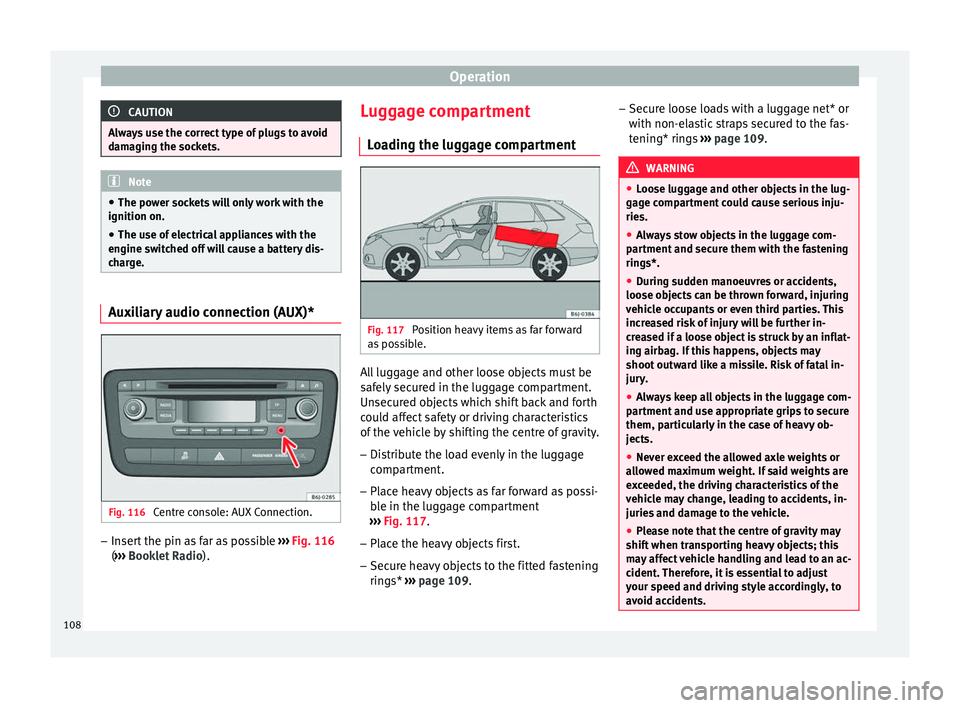
Loading the luggage compartment Fig. 117
Position heavy items as far forward
as possible. All luggage and other loose objects must be
safely secured in the luggage compartment.
Unsecured objects which shift back and forth
could affect safety or driving characteristics
of the vehicle by shifting the centre of gravity.
– Distribute the load evenly in the luggage
compartment.
– Place heavy objects as far forward as possi-
ble in the luggage compartment
››› Fig. 117 .
– Plac
e the heavy objects first.
– Secure heavy objects to the fitted fastening
rings* ››› page 109. –
Secur
e loose loads with a luggage net* or
with non-elastic straps secured to the fas-
tening* rings ››› page 109. WARNING
● Loose luggage and other objects in the lug-
gage compartment could cause serious inju-
ries.
● Always stow objects in the luggage com-
partment and secure them with the fastening
rings*.
● During sudden manoeuvres or accidents,
loose objects can be thrown forward, injuring
vehicle occupants or even third parties. This
increased risk of injury will be further in-
creased if a loose object is struck by an inflat-
ing airbag. If this happens, objects may
shoot outward like a missile. Risk of fatal in-
jury.
● Always keep all objects in the luggage com-
partment and use appropriate grips to secure
them, particularly in the case of heavy ob-
jects.
● Never exceed the allowed axle weights or
allowed maximum weight. If said weights are
exceeded, the driving characteristics of the
vehicle may change, leading to accidents, in-
juries and damage to the vehicle.
● Please note that the centre of gravity may
shift when transporting heavy objects; this
may affect vehicle handling and lead to an ac-
cident. Therefore, it is essential to adjust
your speed and driving style accordingly, to
avoid accidents. 108
Page 158 of 240
Advice
To fold
Unscrew the aerial rod, tilting it backwards
into a horizontal position and then screw in
again.
To return to working position
Continue in the reverse order to the previous
instruction. CAUTION
If an automatic car wash tunnel is used, be-
fore entering the tunnel, put the aerial down
parallel to the roof and do not tighten to
avoid damage. Mobile phones and two-way radios
SEAT has approved for your vehicle the use of
mobile telephones and two-way radios pro-
viding under the following conditions:
●
The external aerial should be correctly in-
stalled.
● The transmitting power should be a maxi-
mum 10 watts.
The optimal reach of the equipment is only
achieved with an external aerial.
First consult your Technical Service if you
wish to use a mobile telephone or a two-way
radio with a transmitting power output in ex-
cess of 10 watts. Here you will receive infor- mation concerning the technical possibilities
for retrofitting this equipment.
Mobile telephones and two-way radios
should be only fitted by a specialised work-
shop, for example a SEAT dealership.
WARNING
● Always concentrate primarily on driving. If
you are distracted while driving you could
have an accident.
● Never attach the telephone mountings to
the surfaces covering the airbag units or
within the range of the airbags. There is a
high danger of injury if the airbag is trig-
gered.
● Using your mobile telephones or two-way
radios in the vehicle without an external aer-
ial, electromagnetic radiation in the vehicle
could exceed authorised limits. This also may
occur to external aerials that have not been
correctly installed. CAUTION
Failure to consider the above-mentioned con-
ditions could cause the electronics to mal-
function. The most common causes of faults
are:
● no external aerial,
● external aerial incorrectly installed,
● transmitting power output in excess of 10
watts. Note
Please observe the operating instructions of
your mobile telephone/two-way radio. Care and cleaning
General notes Vehicle maintenance
Regular care and washing help to maintain
the value
of the vehicle. This may also be one
of the requirements for acknowledging war-
ranty claims in the event of bodywork corro-
sion or paint defects.
The best way to protect your vehicle against
the harmful effects of the environment is
through correct maintenance and frequent
washing. The longer substances such as in-
sect remains, bird droppings, resinous tree
sap, road dirt, industrial deposits, tar, soot or
road salt and other aggressive materials re-
main on the vehicle, the more damage they
do to the paintwork. High temperatures, for
instance in strong sunlight, further intensify
the corrosive effect.
After winter, a period when salt is put on the
roads, it is important to have the underside
of the vehicle washed thoroughly.
156
Page 159 of 240
Care and maintenance
Products for vehicle maintenance
Car-care products are available in your Tech-
nical Services. Keep the product instructions
until you have used them up. WARNING
● Car-care products can be toxic. Because of
this, they must always be kept closed in their
original container. Keep them out of the reach
of children. Failure to comply could result in
poisoning.
● Always read and observe the instructions
and warnings on the package before using
car-care products. Improper use could cause
health problems or damage the vehicle. The
use of certain products may produce noxious
vapours; they should be used in well ventila-
ted areas.
● Never use fuel, turpentine, engine oil, nail
varnish remover or other volatile fluids.
These are toxic and highly flammable. Risk of
fire and explosion.
● Before washing your vehicle, or carrying
out any maintenance, switch the engine off,
apply the handbrake firmly and remove the
key from the ignition. CAUTION
Never attempt to remove dirt, mud or dust if
the surface of the vehicle is dry. Never use a
dry cloth or sponge for cleaning purposes.
This could damage the paintwork or the win-
dows of your vehicle. Soak dirt, mud or dust
with plenty of water. For the sake of the environment
● When purchasing products for your vehicle
maintenance, select the ones which are not
harmful to the environment.
● The waste from car-care products should
not be disposed of with ordinary household
waste. Observe the disposal information on
the package. Care of the vehicle exterior
Automatic car washing tunnel The vehicle paintwork is so durable that the
vehicle can normally be washed without
problems in an automatic car wash tunnel.
However, the paintwork wear depends to a
large extent on the kind of the car wash tun-
nel, the brushes used, its water filtering and
the type of cleaning and preservative prod-
ucts.
Before going through a car wash, be sure to
take the usual precautions such as closing
the windows and sunroof. There is nothing to
note apart from that.
If the vehicle has special accessories such as
spoilers or a roof rack or two-way radio aerial,
etc., it is advisable to consult the car wash
tunnel operator first.After washing, the brakes could take some
time to respond as the brake discs and pads
could be wet, or even frozen in winter. “Dry”
the brakes by braking several times. WARNING
Water, ice and salt on the brake system can
reduce braking effectiveness. Risk of acci-
dent. CAUTION
Before putting the vehicle through the car
wash, do not tighten the aerial if it is folded
because it can be damaged. Washing by hand
Vehicle washing
– First soften the dirt and rinse it off with wa-
ter.
– Clean your vehicle from top to bottom with
a soft sponge, a glove or a brush. Use very
light pressure.
– Rinse the sponge or glove often with clean
water.
– Special car shampoo should only be used
for very stubborn dirt.
– Leave the wheels, sill panels etc. until last,
using a different sponge or glove.
»
157Technical specifications
Advice
Operation
Safety
The essentials
Page 164 of 240
Advice
carried out only by a specialised workshop or
a petrol station.
Caring for the vehicle interior
Cleaning plastic parts and the
instrument panel –
Use a clean, damp cloth to clean plastic
parts and the dash panel.
– If this does not provide satisfactory results,
use a special solvent-free plastic cleaning
product. WARNING
Never clean the dash panel and the airbag
module surface with cleaners containing sol-
vents. Solvents cause the surface to become
porous. If the airbag triggered, plastic parts
could become detached and cause injuries. CAUTION
Cleaning products which contain solvents will
damage the material. Wooden trim cleaning*
–
Clean the wooden trim with a water-mois-
tened clean cloth. –
If this does not provide satisfactory results,
use a gentle
soap solution. CAUTION
Cleaning products which contain solvents will
damage the material. Cloth seat covers and fabric trim
cleaning
Cloth seat covers and fabric trim on the
doors, headlining etc. can be cleaned with a
special interior cleaner or with dry foam and
a soft brush.
Cleaning the radio and climate
controls To clean the radio and/or climate controls,
use a soft damp cloth. For more resistant dirt,
a neutral soap solution may be used.
Leather cleaning* Normal cleaning
–
Moisten a cotton or woollen cloth with wa-
ter and wipe over the leather surfaces. Cleaning stubborn stains
– More stubborn dirt can be removed using a
mild soap solution (pure liquid soap; two
tablespoons diluted in one litre of water)
and a cloth.
– Do not let the water soak through the leath-
er or soak into the seams.
– Then wipe off with a soft, dry cloth.
Leather maintenance – The leather should be treated twice a year
with a special leather-care product, availa-
ble at Technical Services.
– Apply these products very sparingly.
– Then wipe off with a soft, dry cloth.
SEAT does everything possible to preserve
the genuine qualities of this natural product.
Due to the natural properties of the specially
selected hides employed, the finished leath-
er has a certain sensitivity to grease and dirt,
etc. so a degree of care is required in every-
day use and when looking after the leather.
Dust and grit in the pores and seams can
scratch and damage the surface. If the vehi-
cle is under solar radiation for long periods,
the leather should be protected to prevent it
from fading. However, slight colour variations
in high-quality natural leather are normal.
162
Page 235 of 240
Index
M Main beam . . . . . . . . . . . . . . . . . . . . . . . . . . . . . . . 14
Main beam headlights control lamp . . . . . . . . . . . . . . . . . . . . . . . . . . . . 62
Maintenance and cleaning . . . . . . . . . . . . . . . . . 155
Manual Release of the selector lever . . . . . . . . . . . . . . 192
Manual gearbox . . . . . . . . . . . . . . . . . . . . . . 19, 128
Manual heating . . . . . . . . . . . . . . . . . . . . . . . . . . 116 controls . . . . . . . . . . . . . . . . . . . . . . . . . . . . . . . 114
Manual heating system Defrosting the windscreen . . . . . . . . . . . . . . . . 116
Demisting the windscreen and side windows 116
MFI . . . . . . . . . . . . . . . . . . . . . . . . . . . . . . . . . . . . . . 65
Mirrors Exterior mirrors . . . . . . . . . . . . . . . . . . . . . . . . . . 99
Interior rear vision mirror . . . . . . . . . . . . . . . . . . 99
vanity mirror . . . . . . . . . . . . . . . . . . . . . . . . . . . . 97
Mobile phone . . . . . . . . . . . . . . . . . . . . . . . . . . . . 156
Mounting points (jack) . . . . . . . . . . . . . . . . . . . . . 184
Multi-function display . . . . . . . . . . . . . . . . . . . . . . 16 Memories . . . . . . . . . . . . . . . . . . . . . . . . . . . . . . 16
Multi-function display (MFI) . . . . . . . . . . . . . . . . . . 65 Memory displays . . . . . . . . . . . . . . . . . . . . . . . . 65
N Notes . . . . . . . . . . . . . . . . . . . . . . . . . . . . . . . . . . . 138
Number of seats . . . . . . . . . . . . . . . . . . . . . . . . . . . 34
O Octane number . . . . . . . . . . . . . . . . . . . . . . . . . . . 164
Odometer . . . . . . . . . . . . . . . . . . . . . . . . . . . . . . . . 67
Oil . . . . . . . . . . . . . . . . . . . . . . . . . . . . . . . . . . . . . . 24
Oil change . . . . . . . . . . . . . . . . . . . . . . . . . . . . . . . 171
Oil properties . . . . . . . . . . . . . . . . . . . . . . . . . . . . 169 One-touch opening and closing
Electric windows . . . . . . . . . . . . . . . . . . . . . . . . . 88
Opening and closing . . . . . . . . . . . . . . . . . . . . . 9, 86
Operation when a fault occurs panoramic/tilting sunroof . . . . . . . . . . . . . . . . . 90
Outside temperature . . . . . . . . . . . . . . . . . . . . . . . 66
Outside temperature display . . . . . . . . . . . . . . . . . 66
Overview . . . . . . . . . . . . . . . . . . . . . . . . . . . . . . . . . 55 Control lamps . . . . . . . . . . . . . . . . . . . . . . . . . . . 57
Instruments . . . . . . . . . . . . . . . . . . . . . . . . . . . . . 56
Warning lamps . . . . . . . . . . . . . . . . . . . . . . . . . . 57
P
Panoramic sunroof . . . . . . . . . . . . . . . . . . . . . . . . . 89
Parking . . . . . . . . . . . . . . . . . . . . . . . . . . . . . . . . . 127
Parking aid . . . . . . . . . . . . . . . . . . . . . . . . . . . . . . 146
Parking lights . . . . . . . . . . . . . . . . . . . . . . . . . . . . . 93
Passenger see Correct sitting position . . . . . . . . . 30, 31, 32
P ed
als . . . . . . . . . . . . . . . . . . . . . . . . . . . . . . . . . . . 34
Petrol . . . . . . . . . . . . . . . . . . . . . . . . . . . . . . . . . . . 164 driving abroad . . . . . . . . . . . . . . . . . . . . . . . . . 138
Petrol additives . . . . . . . . . . . . . . . . . . . . . . . . . . 165
Plastic parts . . . . . . . . . . . . . . . . . . . . . . . . . . . . . 159
Pollution filter . . . . . . . . . . . . . . . . . . . . . . . . . . . . 113
Power . . . . . . . . . . . . . . . . . . . . . . . . . . . . . . . . . . 107
Power socket in the luggage compartment . . . . . . . . . . . . . . 107
Power sockets . . . . . . . . . . . . . . . . . . . . . . . . . . . . 107
Products for vehicle maintenance . . . . . . . 156, 157
PTT . . . . . . . . . . . . . . . . . . . . . . . . . . . . . . . . . . . . . . 76
Puncture . . . . . . . . . . . . . . . . . . . . . . . . . . . . . . . . . 26 With anti-puncture kit . . . . . . . . . . . . . . . . . . . . 26
With a spare wheel . . . . . . . . . . . . . . . . . . . . . . . 27
Puncture repair . . . . . . . . . . . . . . . . . . . . . . . . . . . 186
Push To Talk (PTT) . . . . . . . . . . . . . . . . . . . . . . . . . . 76 R
Radio frequency remote control . . . . . . . . . . . . . . 83 Changing the battery . . . . . . . . . . . . . . . . . . . . . 84
Raising the vehicle . . . . . . . . . . . . . . . . . . . . . . . . 184
Rear head restraints . . . . . . . . . . . . . . . . . . . . . . . . . . 33
Rear Assist . . . . . . . . . . . . . . . . . . . . . . . . . . . . . . 144 instructions for use . . . . . . . . . . . . . . . . . . . . . 145
parking . . . . . . . . . . . . . . . . . . . . . . . . . . . . . . . 146
screen . . . . . . . . . . . . . . . . . . . . . . . . . . . . . . . . 145
special features . . . . . . . . . . . . . . . . . . . . . . . . 145
Rear Assist System . . . . . . . . . . . . . . . . . . . . . . . . . . . . . . . . . . . . . . 144
Rear drink holder . . . . . . . . . . . . . . . . . . . . . . . . . 106
Rear fog light control lamp . . . . . . . . . . . . . . . . . . . . . . . . . 59, 90
Rear head restraints . . . . . . . . . . . . . . . . . . . . . . . . 33
Rear lid . . . . . . . . . . . . . . . . . . . . . . . . . . . 9, 62, 192 control lamp . . . . . . . . . . . . . . . . . . . . . . . . . . . . 62
Emergency opening . . . . . . . . . . . . . . . . . . . . . 192
Rear parking aid . . . . . . . . . . . . . . . . . . . . . . . . . . . . . . . . . . . 147
Rear seats lowering . . . . . . . . . . . . . . . . . . . . . . . . . . . . . . 103
Rear shelf . . . . . . . . . . . . . . . . . . . . . . . . . . . . . . . 110
Rear shelf with storage compartment Storage compartment . . . . . . . . . . . . . . . . . . . 110
Rear towline anchorage . . . . . . . . . . . . . . . . . . . . 191
Rear view mirror Adjusting . . . . . . . . . . . . . . . . . . . . . . . . . . . . . . . 13
Rear view mirrors . . . . . . . . . . . . . . . . . . . . . . . . . . 99
Rear window automatic wiper/washer . . . . . . . . . 98
Rear window wiper . . . . . . . . . . . . . . . . . . . . . . . . . 98
Recommended gear . . . . . . . . . . . . . . . . . . . . . . . . 64
Recommended gear display . . . . . . . . . . . . . . . . . 64
Refuelling . . . . . . . . . . . . . . . . . . . . . . . . . . . . . . . 163
233
Page 237 of 240
Index
Tightening the belt . . . . . . . . . . . . . . . . . . . . . . . . . 39
Tightening torque of wheel bolts . . . . . . . . . . . . 210
Tilting sunroof . . . . . . . . . . . . . . . . . . . . . . . . . . . . 89
Tire Mobility Set Check after 10 minutes . . . . . . . . . . . . . . . . . . 188
Do not use . . . . . . . . . . . . . . . . . . . . . . . . . . . . . 186
Inflating a tyre . . . . . . . . . . . . . . . . . . . . . . . . . . 187
Tools . . . . . . . . . . . . . . . . . . . . . . . . . . . . . . . . . . . 182
Top Tether system . . . . . . . . . . . . . . . . . . . . . . . . . 52
Tow-starting . . . . . . . . . . . . . . . . . . . . . . . . . . . . . 190
Towing . . . . . . . . . . . . . . . . . . . . . . . . . . . . . 152, 190
Towing a trailer . . . . . . . . . . . . . . . . . . . . . . . . . . . 210
Towing bracket . . . . . . . . . . . . . . . . . . . . . . 152, 190
Towing bracket, fitting . . . . . . . . . . . . . . . . . . . . . 153
Towing the vehicle . . . . . . . . . . . . . . . . . . . . . . . . . 28
Towline anchorage . . . . . . . . . . . . . . . . . . . . . . . . 190
Tow starting . . . . . . . . . . . . . . . . . . . . . . . . . . . . . 190 Comments . . . . . . . . . . . . . . . . . . . . . . . . . . . . . 190
Traction control system control lamp . . . . . . . . . . . . . . . . . . . . . . . . . . . . 60
Traction control system (ASR) . . . . . . . . . . . . . . . 141
Trailer towing . . . . . . . . . . . . . . . . . . . . . . . . . . . . . . . . 152
Trailer turn signals control lamp . . . . . . . . . . . . . . . . . . . . . . . . . . . . 93
Trailer weights . . . . . . . . . . . . . . . . . . . . . . . . . . . 210
Transport Roof carrier . . . . . . . . . . . . . . . . . . . . . . . . . . . . 111
Transporting children . . . . . . . . . . . . . . . . . . . . . . . 46
Turn signals . . . . . . . . . . . . . . . . . . . . . . . . . . . . . . 14 control lamp . . . . . . . . . . . . . . . . . . . . . . . . . 63, 93
Two-way radio . . . . . . . . . . . . . . . . . . . . . . . . . . . . 156
Tyre mobility set Components . . . . . . . . . . . . . . . . . . . . . . . . . . . 187
Sealing a tyre . . . . . . . . . . . . . . . . . . . . . . . . . . 187
Tyre mobility system . . . . . . . . . . . . . . . . . . . . . . . 186 Tyre Mobility System
See tyre mobility system . . . . . . . . . . . . . . . . . 186
Tyre pressure . . . . . . . . . . . . . . . . . . . . . . . . . . . . 177
Tyre pressure control lamp . . . . . . . . . . . . . . . . . . 61
Tyre pressures . . . . . . . . . . . . . . . . . . . . . . . . . . . . 210
Tyre profile . . . . . . . . . . . . . . . . . . . . . . . . . . . . . . 177
Tyre repair set See tyre mobility system . . . . . . . . . . . . . . . . . 186
Tyres and wheels Dimensions . . . . . . . . . . . . . . . . . . . . . . . . . . . . 178
Tyres useful life . . . . . . . . . . . . . . . . . . . . . . . . . . . 177
Tyres with directional tread pattern . . . . . . . . . . 177
Tyre tread depth . . . . . . . . . . . . . . . . . . . . . . . . . . 177
U Underbody protection . . . . . . . . . . . . . . . . . . . . . 161
Unlocking and locking . . . . . . . . . . . . . . . . . . . . 9, 86
User profile . . . . . . . . . . . . . . . . . . . . . . . . . . . . . . . 74
V Vehicle Raising . . . . . . . . . . . . . . . . . . . . . . . . . . . . . . . 184
Vehicle battery . . . . . . . . . . . . . . . . . . . . . . . . . . . 174
Vehicle data . . . . . . . . . . . . . . . . . . . . . . . . . . . . . 209
Vehicle identification data . . . . . . . . . . . . . . . . . . 208
Vehicle identification number . . . . . . . . . . . . . . . 209
Vehicle interior heating or cooling system . . . . . 119
Vehicle interior monitoring and anti-tow system Activation . . . . . . . . . . . . . . . . . . . . . . . . . . . . . . 85
Vehicle modifications . . . . . . . . . . . . . . . . . . . . . 155
Vehicle paintwork Maintenance . . . . . . . . . . . . . . . . . . . . . . . . . . . 159
polishing . . . . . . . . . . . . . . . . . . . . . . . . . . . . . . 159
Products for vehicle maintenance . . . . . . . . . . 157
Vehicle tools Storage . . . . . . . . . . . . . . . . . . . . . . . . . . . . . . . 182
Vehicle washing . . . . . . . . . . . . . . . . . . . . . . . . . . 157 Ventilation . . . . . . . . . . . . . . . . . . . . . . . . . . . . . . 116
Ventilation slits . . . . . . . . . . . . . . . . . . . . . . . . . . 109
Voice control . . . . . . . . . . . . . . . . . . . . . . . . . . . . . . 76
W Warning lamps . . . . . . . . . . . . . . . . . . . . . . . . . 18, 57 On the instrument panel . . . . . . . . . . . . . . . . . . 18
Warning messages Red . . . . . . . . . . . . . . . . . . . . . . . . . . . . . . . . . . . 57
Yellow . . . . . . . . . . . . . . . . . . . . . . . . . . . . . . . . . 57
Warning symbols . . . . . . . . . . . . . . . . . . . . . . . . . . 57
Warning triangle . . . . . . . . . . . . . . . . . . . . . . . . . . 181
Washer fluid . . . . . . . . . . . . . . . . . . . . . . . . . . . . . 174
Washing by hand . . . . . . . . . . . . . . . . . . . . . . . . . 157
Washing the vehicle . . . . . . . . . . . . . . . . . . . . . . . 157
Washing tunnel . . . . . . . . . . . . . . . . . . . . . . . . . . 157
Washing with high pressure cleaners . . . . . . . . . 158
Water in the windscreen washer tank . . . . . . . . . 174
Wear indicators . . . . . . . . . . . . . . . . . . . . . . . . . . 177
Wearing suitable shoes . . . . . . . . . . . . . . . . . . . . . 34
Wheel bolts . . . . . . . . . . . . . . . . . . . . . . . . . 184, 210 Tightening torque . . . . . . . . . . . . . . . . . . . . . . . 179
Wheel change . . . . . . . . . . . . . . . . . . . . . . . . . . . . 183
Wheels . . . . . . . . . . . . . . . . . . . . . . . . . . . . 176, 210
Why assume the correct sitting position? . . . . . . . 40
Why wear seat belts? . . . . . . . . . . . . . . . . . . . . 34, 40
Windscreen defrosting . . . . . . . . . . . . . . . . . . . . . 116
Windscreen washer . . . . . . . . . . . . . . . . . . . . . . . . 25
Windscreen washer fluid Control lamp . . . . . . . . . . . . . . . . . . . . . . . . . . . . 59
Windscreen wiper blades Cleaning . . . . . . . . . . . . . . . . . . . . . . . . . . . . . . 160
Windscreen wipers . . . . . . . . . . . . . . . . . . . . . . . . . 97 Changing blades . . . . . . . . . . . . . . . . . . . . . . . 193
Changing the rear wiper blade . . . . . . . . . . . . 194
Windscreen wipers and rear window wipers . . . . 15
235