seats Seat Ibiza ST 2016 User Guide
[x] Cancel search | Manufacturer: SEAT, Model Year: 2016, Model line: Ibiza ST, Model: Seat Ibiza ST 2016Pages: 252, PDF Size: 5.56 MB
Page 61 of 252
Safe driving
●
Alwa y
s keep your feet in the footwell when
the vehicle is moving; never rest them on the
dash panel, out the window or on the seat. An
incorrect sitting position exposes you to an
increased risk of injury in case of a sudden
braking or an accident. If the airbag is trig-
gered, you could sustain severe injuries due
to an incorrect sitting position.
● To reduce the risk of injury to the front pas-
senger in event
s such as sudden braking ma-
noeuvres or an accident, never travel with the
backrest tilted far back! The airbag system
and seat belts can only provide optimal pro-
tection when the backrest is in an upright po-
sition and the front passenger is wearing his
or her seat belt properly. The further the seat
backrests are tilted to the rear, the greater
the risk of injury due to incorrect positioning
of the belt web or to the incorrect sitting po-
sition!
● Adjust the head restraint correctly in order
to achieve m
aximum protection. Correct sitting position for rear seat
p
a
ssen
gers To reduce the risk of injury in the event of a
s
ud
den br ak
ing manoeuvre or an accident,
passengers on the rear seat bench must con-
sider the following:
– Sit up straight.
– Adjust the head restraint to the correct po-
sition ›››
page 60. –
Alway
s keep both feet in the footwell in
front of the rear seat.
– Fasten your seat belt securely ››› p
age 61.
– Use an appropriate child restraint system
when you tak
e children in the vehicle
››› page 72. WARNING
● If the pa s
sengers in the rear seats are not
sitting properly, they could sustain severe in-
juries.
● Adjust the head restraint correctly in order
to achieve m
aximum protection.
● Seat belts can only provide optimal protec-
tion when seat bac
krests are in an upright
position and the vehicle occupants are wear-
ing their seat belts correctly. If passengers In
the rear seats are not sitting in an upright po-
sition, the risk of injury due to incorrect posi-
tioning of the seat belt increases. Examples of incorrect sitting posi-
tion
s Seat belts can provide optimal protection on-
ly
when the belt
we
bs are properly posi-
tioned. Incorrect sitting positions substan-
tially reduce the protective function of seat
belts and increase the risk of injury due to in-
correct seat belt position. As the driver, you
are responsible for all passengers, especially
children. –
Never allow an
yone to assume an incorrect
sitting position in the vehicle while travel-
ling ››› .
The f o
llo
wing list contains examples of sit-
ting positions that could be dangerous for all
vehicle occupants. The list is not complete,
but we would like to make you aware of this
issue.
Therefore, whenever the vehicle is in motion:
● Never stand in the vehicle.
● Never stand on the seats.
● Never kneel on the seats.
● Never tilt your seat backrest far to the rear.
● Never lean against the dash panel.
● Never lie on the rear bench.
● Never sit on the front edge of a seat.
● Never sit sideways.
● Never lean out of a window.
● Never put your feet out of a window.
● Never put your feet on the dash panel.
● Never put your feet on the surface of a seat.
● Do not allow anyone to travel in the foot-
well.
● Nev
er travel without wearing the seat belt.
● Do not allow anyone to travel in the lug-
gage comp
artment. »
59
Technical data
Advice
Operation
Emergencies
Safety
Page 62 of 252
Safety
WARNING
● Any inc orr
ect sitting position increases the
risk of severe injuries.
● Sitting in an incorrect position exposes the
vehicle oc
cupants to severe injuries if airbags
are triggered, by striking a vehicle occupant
who has assumed an incorrect sitting posi-
tion.
● Before the vehicle moves, assume the prop-
er sitting pos
ition and maintain it throughout
the trip. Before every trip, instruct your pas-
sengers to sit properly and to stay in this po-
sition during the trip ››› page 57, Correct posi-
tion for passengers. Correct adjustment of front head re-
s
tr
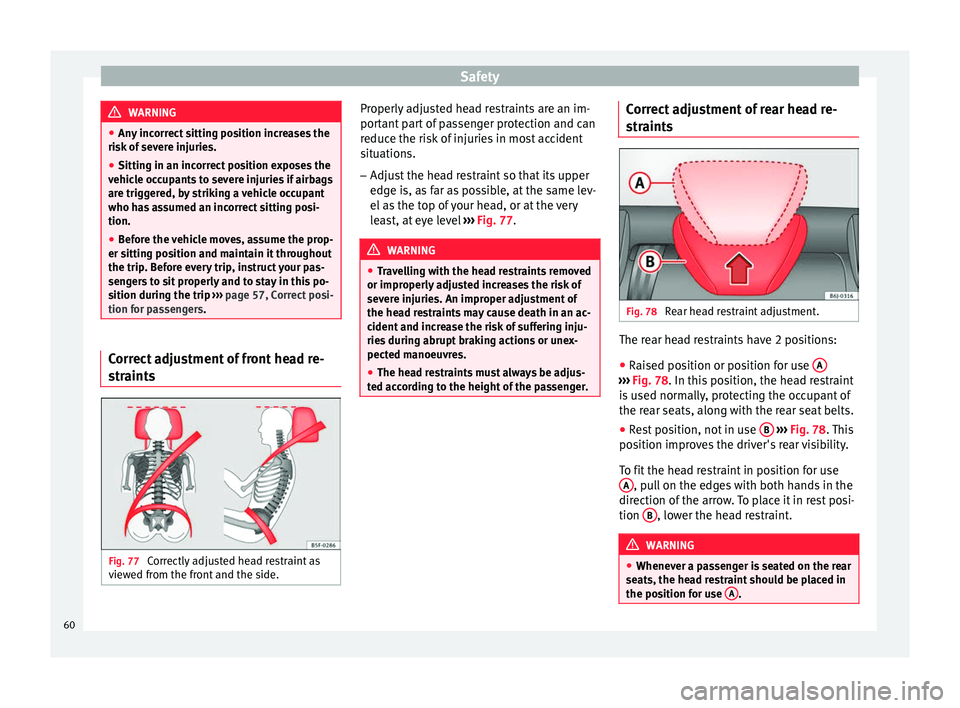
aint s Fig. 77
Correctly adjusted head restraint as
v iew
ed fr om the fr
ont and the side. Properly adjusted head restraints are an im-
por
t
ant p
art of passenger protection and can
reduce the risk of injuries in most accident
situations.
– Adjust the head restraint so that its upper
edge is, as
far as possible, at the same lev-
el as the top of your head, or at the very
least, at eye level ››› Fig. 77. WARNING
● Trav el
ling with the head restraints removed
or improperly adjusted increases the risk of
severe injuries. An improper adjustment of
the head restraints may cause death in an ac-
cident and increase the risk of suffering inju-
ries during abrupt braking actions or unex-
pected manoeuvres.
● The head restraints must always be adjus-
ted accor
ding to the height of the passenger. Correct adjustment of rear head re-
s
tr
aint s Fig. 78
Rear head restraint adjustment. The rear head restraints have 2 positions:
● Raised position or position for use A ›››
Fig. 78. In this po s ition, the head restraint
is used normally, protecting the occupant of
the rear seats, along with the rear seat belts.
● Rest position, not in use B
› ›
› Fig. 78 .
This
position improves the driver's rear visibility.
To fit the head restraint in position for use A , pull on the edges with both hands in the
dir ection of
the arro
w. To place it in rest posi-
tion B , lower the head restraint.
WARNING
● Whenever a pa s
senger is seated on the rear
seats, the head restraint should be placed in
the position for use A .
60
Page 63 of 252
Seat belts
●
Do not swap the c entr
e rear head restraint
with either of the outer seat rear head re-
straints. Risk of injury in case of an accident! Note
Note the instructions on the head restraints
a djus tment
.Pedal area
P ed
al
s –
Ensure that you can always press the accel-
er at
or , br
ake and clutch pedals unimpaired
to the floor.
– Ensure that the pedals can return unim-
paired to their initi
al positions.
– Ensure that the floor mats are securely fas-
tened during the trip and do not o
bstruct
the pedals ››› .
On ly
u se floor m
ats which leave the pedals
clear and which are secured to prevent them
from slipping. You can obtain suitable floor
mats from a specialised dealership.
If a brake circuit fails, the brake pedal must
be pressed down thoroughly in order to stop
the vehicle. Wear suitable footwear
Alway
s wear shoes which support your feet
properly and give you a good feeling for the
pedals. WARNING
● If the peda l
s are obstructed, an accident
may occur. Risk of serious injuries.
● Never lay or fit floor mats or other floor cov-
erings o
ver the original floor mats. This
would reduce the pedal area and could ob-
struct the pedals. Risk of accident.
● Never place objects in the driver footwell.
An object
could move into the pedal area and
impair pedal operation. In the event of a sud-
den driving or braking manoeuvre, you will
not be able to operate the brake, clutch or ac-
celerator pedal. Risk of accident! Seat belts
Wh y
w e
ar a seat belt?
Number of seats Your vehicle has
five seats, tw
o in the front
and three in the rear. Each seat is equipped
with a three-point seat belt.
In some versions, your vehicle is approved
only for four seats. Two front seats and two
rear seats. WARNING
● Never tran s
port more than the permitted
amount of people in your vehicle.
● Every vehicle occupant must properly fas-
ten and wear the se
at belt belonging to his or
her seat. Children must be protected with an
appropriate child restraint system. 61
Technical data
Advice
Operation
Emergencies
Safety
Page 66 of 252
Safety
called “kinetic energy” is created both in the
p a
ssen
gers and inside the vehicle.
The amount of “kinetic energy” depends on
the speed of the vehicle and the weight of
the vehicle and its passengers. The higher
the speed and the greater the weight, the
more energy there is to be “absorbed” in an
accident.
The most significant factor, however, is the
speed of the vehicle. If the speed doubles
from 25 km/h (15 mph) to 50 km/h
(30 mph), for example, the corresponding ki-
netic energy is multiplied by four.
Because the vehicle occupants in our exam-
ple are not restrained by seat belts, in the
event of crashing against a wall, all of the oc-
cupants' kinetic energy will be absorbed
solely by said impact.
Even at speeds of 30 km/h (19 mph) to
50 km/h (30 mph), the forces acting on bod-
ies in a collision can easily exceed one tonne
(1000 kg). At greater speed these forces are
even higher.
Vehicle occupants not wearing seat belts are
not “attached” to the vehicle. In a head-on
collision, they will move forward at the same
speed their vehicle was travelling just before
the impact. This example applies not only to
head-on collisions, but to all accidents and
collisions. Even at low speeds the forces acting on the
body in a col
lision are so great that it is not
possible to brace oneself with one's hands.
In a frontal collision, unbelted passengers
are thrown forward and will make violent con-
tact with the steering wheel, dash panel,
windscreen or whatever else is in the way
››› Fig. 81.
It is also important for rear passengers to
wear seat belts properly, as they could other-
wise be thrown forward violently through the
vehicle interior in an accident. Passengers in
the rear seats who do not use seat belts en-
danger not only themselves but also the front
occupants ››› Fig. 82. How to properly adjust your
seatbelt
Fa
stening and unfastening the seat
belt Fig. 83
Positioning and removing the seat
belt b
uc k
le. 64
Page 67 of 252
Seat belts
Fig. 84
Position of seat belt during pregnan-
cy . Fasten your seat belt
The se
at
belt c
annot offer its full protection if
the seat belt is not positioned correctly.
● Adjust the seat and head restraint correctly.
● To fasten the belt, take hold of the latch
plate and p
ull it slowly across your chest and
lap.
● Insert the latch plate into the buckle for the
appropriat
e seat and push it down until it is
securely locked with an audible click
››› Fig. 83.
● Pull the belt to ensure that the latch plate is
securely en
gaged in the buckle.
The seat belts are equipped with an automat-
ic retractor on the shoulder strap. Full free-
dom of movement is permitted when the
shoulder belt is pulled slowly. However, dur- ing sudden braking, during travel in steep
areas
or bends and during acceleration, the
automatic retractor on the shoulder belt is
locked.
The automatic belt retractors on the front
seats are fitted with seat belt tensioners
››› page 65.
Releasing the seat belt ● Press the red button on the belt buckle
››› Fig. 83
. The latch plate is released and
springs out ››› .
● Guide the belt back by hand so that it rolls
up e a
si
ly and the trim is not damaged.
Positioning seat belts
Seat belts offer their maximum protection on-
ly when they are properly positioned. WARNING
● The seat belt s
offer best protection only
when the backrests are in an upright position
and the seat belts have been fastened prop-
erly.
● Never put the latch plate in the buckle of
another seat. If
you do this, the seat belt will
not protect you properly and the risk of injury
is increased.
● Never unbuckle a seat belt while the vehi-
cle is
in motion. If you do, you increase the
risk of sustaining severe or fatal injuries. ●
An incorrectly w
orn seat belt can cause se-
vere injuries in the event of an accident.
● The shoulder part of the seat belt must lie
on the centre of the shou
lder, never across
the neck. The seat belt must lie flat and fit
comfortably on the torso
● The lap part of the seat belt must lie across
the pelvis, never ac
ross the stomach. The
seat belt must lie flat and fit comfortably on
the pelvis Pull the belt tight if necessary to
take up any slack.
● For pregnant women, the lap part of the
seat belt mu
st lie as low as possible over the
pelvis, never across the stomach, and always
lie flat so that no pressure is exerted on the
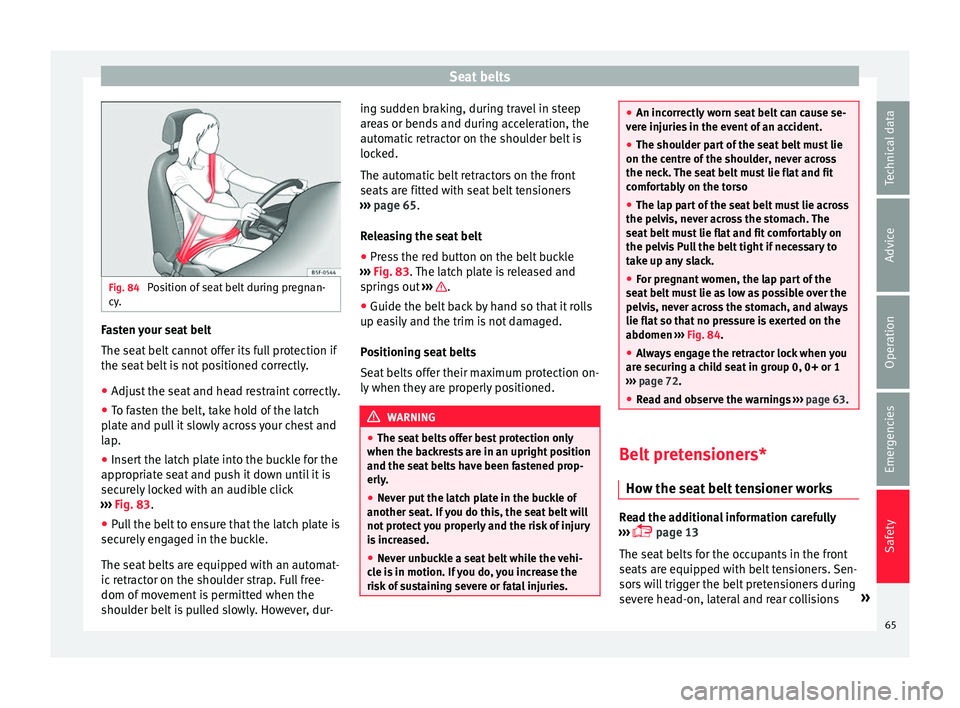
abdomen ››› Fig. 84.
● Always engage the retractor lock when you
are securing a c
hild seat in group 0, 0+ or 1
››› page 72.
● Read and observe the warnings ››› p
age 63. Belt pretensioners*
Ho w the se at
belt
tensioner works Read the additional information carefully
› ›
›
p
age 13
The seat belts for the occupants in the front
seats are equipped with belt tensioners. Sen-
sors will trigger the belt pretensioners during
severe head-on, lateral and rear collisions »
65
Technical data
Advice
Operation
Emergencies
Safety
Page 68 of 252
Safety
only if the seat belt is being worn. This re-
tr acts
and tight en
s the seat belts, reducing
the forward motion of the occupants.
The belt tensioners will not be triggered in
the event of minor collisions, if the vehicle
overturns, or in accidents where no major
forces act on the vehicle. Note
● If the seat belt
tensioners are triggered, a
fine dust is produced. This is normal and it is
not an indication of fire in the vehicle.
● The relevant safety requirements must be
observ
ed when the vehicle or components of
the system are scrapped. Specialised work-
shops are familiar with these regulations,
which are also available to you. Service and disposal of belt tension-
er
s The belt tensioners are components of the
se
at
belts th
at are installed in the seats of
your vehicle. If you work on the belt tension-
ers or remove and install parts of the system
when performing other repair work, the seat
belt may be damaged. The consequence may
be that, in the event of an accident, the belt
tensioners function incorrectly or may not
function at all.
So that the effectiveness of the seat belt ten-
sioner is not reduced and that removed parts do not cause any injuries or environmental
pollution, re
gulations, which are known to
the specialised workshops, must be ob-
served. WARNING
● Improper use or r ep
airs not carried out by
qualified mechanics increase the risk of se-
vere or fatal injuries. The belt tensioners may
fail to trigger or may trigger in the wrong cir-
cumstances.
● Never attempt to repair, adjust, remove or
insta
ll parts of the belt tensioners or seat
belts.
● The seat belt tensioner, seat belt and auto-
matic retr
actor cannot be repaired.
● Any work on the belt tensioners and seat
belts, including the r
emoval and refitting of
system parts in conjunction with other repair
work, must be performed by a specialised
workshop only.
● The belt tensioners will only provide pro-
tection for one acc
ident and must be changed
if they have been activated. Airbag system
Brief intr
oduction
Wh y
is it so important to wear a seat
belt and to sit correctly? For the inflating airbags to achieve the best
protection, the se
at
belt must always be worn
properly and the correct sitting position must
be assumed.
The airbag system is not a substitute for seat
belts, but it is an integral part of the vehicle's
overall passive safety system. Please bear in
mind that the airbag system can only work ef-
fectively when the vehicle occupants are
wearing their seat belts correctly and have
adjusted the head restraints properly. There-
fore, it is most important to properly wear the
seat belts at all times, not only because this
is required by law in most countries, but also
for your safety ›››
page 61, Why wear a seat
belt?.
The airbag inflates in a matter of seconds, so
if you are not properly seated when the air-
bag is triggered, you may sustain fatal inju-
ries. Therefore, it is essential that all vehicle
occupants assume a correct sitting position
while travelling.
Sharp braking before an accident may cause
a passenger not wearing a seat belt to be
thrown forward into the area of the deploying
66
Page 69 of 252
Airbag system
airbag. In this case, the inflating airbag may
inflict c
ritic al
or fatal injuries on the occu-
pant. This also applies to children.
Always maintain the greatest possible dis-
tance between yourself and the front airbag.
This way, the front airbags can completely
deploy when triggered, providing their maxi-
mum protection.
The most important factors that will trigger
an airbag are: the type of accident, the angle
of collision and the speed of the vehicle.
Whether or not the airbags are triggered de-
pends primarily on the vehicle deceleration
rate resulting from the collision and detected
by the control unit. If the vehicle deceleration
occurring during the collision and measured
by the control unit remains below the speci-
fied reference values, the front, side and/or
curtain airbags will not be triggered. Take in-
to account that the visible damage in a vehi-
cle involved in an accident, no matter how
serious, is not a determining factor for the
airbags to have been triggered. WARNING
● Wearin g the se
at belt incorrectly or assum-
ing an incorrect sitting position can lead to
critical or fatal injuries.
● All vehicle occupants, including children,
who are not properly
belted can sustain criti-
cal or fatal injuries if the airbag is triggered.
Children up to 12 years old should always travel on the rear seat. Never transport chil-
dren in the v
ehic
le if they are not restrained
or the restraint system is not appropriate for
their age, size or weight.
● If you are not wearing a seat belt, or if you
lean for
ward or to the side while travelling or
assume an incorrect sitting position, there is
a substantially increased risk of injury. This
increased risk of injury will be further in-
creased if you are struck by an inflating air-
bag.
● To reduce the risk of injury from an inflating
airbag, alwa
ys wear the seat belt properly.
● Always adjust the front seats properly. Description of airbag system
The airbag system mainly comprises (as per
v
ehic
le equipment):
● an el
ectronic control and monitoring sys-
tem (contro
l unit)
● frontal airbags for driver and passenger,
● side airbags,
● curtain airbags,
● a control lamp on the dash panel
›
›› page 68.
● key-operated switch for front passenger air-
bag,
● a contro
l lamp for disabling/enabling the
front pa
ssenger airbag. The airbag system operation is monitored
electronical
ly. The airbag control lamp will il-
luminate for a few seconds every time the ig-
nition is switched on (self-diagnosis).
There is a fault in the system if the control
lamp :
● does not light up when the ignition is
switched on ›
›› page 68,
● turns off after 4 seconds after the ignition
is swit
ched on
● turns off and then lights up again after the
ignition is swit
ched on
● illuminates or flashes while the vehicle is
moving.
The airb
ag system is not triggered if:
● the ignition is switched off
● there is a minor frontal collision
● there is a minor side collision
● there is a rear-end collision
● the vehicle turns over. WARNING
● The seat belt s
and airbags can only provide
maximum protection if the occupants are
seated correctly ››› page 57, Correct position
for passengers.
● If a fault has occurred in the airbag system,
have the sys
tem checked immediately by a
specialised workshop. Otherwise, during a » 67
Technical data
Advice
Operation
Emergencies
Safety
Page 71 of 252
Airbag system
If any of the airbags are disabled by a Techni-
c al
Ser
vice, the warning lamp flashes for sev-
eral more seconds after verification and will
turn off if there is no fault. WARNING
● If there i s
a malfunction, the airbag and
belt tensioner system cannot properly per-
form its protective function.
● If a malfunction occurs, have the system
checked immedi
ately by a specialised work-
shop. Otherwise, in the event of an accident,
the airbag system and belt tensioners may
not be triggered, or may not be triggered cor-
rectly. Airbag safety instructions
Fr ont
airb ag
sRead the additional information carefully
› ›
›
p
age 14. WARNING
● The seat belt s
and airbags can only provide
maximum protection if the occupants are
seated correctly ››› page 57, Correct position
for passengers.
● The deployment space between the front
passen
gers and the airbags must not in any
case be occupied by other passenger, pets
and objects. ●
The airbags pr
ovide protection for just one
accident; replace them once they have de-
ployed.
● It is also important not to attach any ob-
jects s
uch as cup holders or telephone
mountings to the surfaces covering the air-
bag units.
● Do not attempt to modify components of
the airbag syst
em in any way. Side airbags*
Read the additional information carefully
› ›
›
p
age 15. WARNING
● If y ou do not
wear a seat belt, if you lean
forward, or are not seated correctly while the
vehicle is in motion, you are at a greater risk
of injury if the side airbag system is triggered
in an accident.
● In order for the side airbags to provide their
maximum prot
ection, the prescribed sitting
position must always be maintained with
seat belts fastened while travelling.
● Occupants of the outer seats must never
carry an
y objects or pets in the deployment
space between them and the airbags, or al-
low children or other passengers to travel in
this position. It is also important not to at-
tach any accessories (such as cup holders) to the doors. This would impair the protection
offered b
y
the side airbags.
● The built-in coat hooks should be used only
for lightweight c
lothing. Do not leave any
heavy or sharp-edged objects in the pockets.
● Great forces, such as hard blows or kicks,
must not
be exerted upon the backrest bol-
ster because the system may be damaged. In
this case, the side airbags would not be trig-
gered.
● Under no circumstances should protective
cover
s be fitted over seats with side airbags
unless the covers have been approved for use
in your vehicle. Because the airbag deploys
from the side of the backrest, the use of con-
ventional seat covers would obstruct the side
airbag, seriously reducing the airbag's effec-
tiveness.
● Any damage to the original seat upholstery
or around the seams
of the side airbag units
must be repaired immediately by a special-
ised workshop.
● The airbags provide protection for just one
accident; rep
lace them once they have de-
ployed.
● Any work on the side airbag system or re-
moval
and installation of the airbag compo-
nents for other repairs (such as removal of
the front seat) should only be performed by a
specialised workshop. Otherwise, faults may
occur during the airbag system operation.
● Do not attempt to modify components of
the airbag syst
em in any way. » 69
Technical data
Advice
Operation
Emergencies
Safety
Page 72 of 252
Safety
●
The side and hea d airb
ags are managed
through sensors located in the interior of the
front doors. To ensure the correct operation of
the side and curtain (head) airbags neither
the doors nor the door panels should be
modified in any way (e.g. fitting loudspeak-
ers). If the front door is damaged, the airbag
system may not work correctly. All work car-
ried out on the front door must be done in a
specialised workshop.
● In a side-on collision the side airbags will
not work if
the sensors do not correctly meas-
ure the pressure increase on the interior of
the doors, due to air escaping through the
areas with holes or openings in the door pan-
el.
● Never drive if the interior door panels have
been removed or if
the panels have not been
correctly fitted.
● Never drive the vehicle if the loudspeakers
in the door panels h
ave been removed, un-
less the holes left by the loudspeakers have
been closed properly.
● Always check that the openings are closed
or cover
ed if additional loudspeakers or other
equipment are fitted inside the door panels.
● Any work carried out to the doors should be
made in an authorised s
pecialised workshop.Curtain airbags*
Read the additional information carefully
› ›
›
p
age 16. WARNING
The airbag is deployed at high speed in frac-
tions of a sec
ond.
● Do not obstruct the head-protection airbag
deployment ar
eas.
● Never secure objects over the curtain air-
bag cov
er or in its deployment area.
● Occupants of the front seats and rear side
seats mu
st never carry any other people, ani-
mals or objects in the deployment space be-
tween them and the airbags. Make sure that
all the vehicle occupants, including children,
observe this.
● The clothes hangers are intended only for
light articl
es of clothing. Do not leave any
heavy or sharp-edged objects in the pockets.
● Do not mount accessories on the doors.
● Use only sun blinds which have been ex-
press
ly approved for use in your vehicle.
● Do not turn the sun blinds towards the win-
dows if
there are objects, e.g. pens or garage
remote controls, secured to them. Deactivating airbags
D e
activ ation of
front passenger front
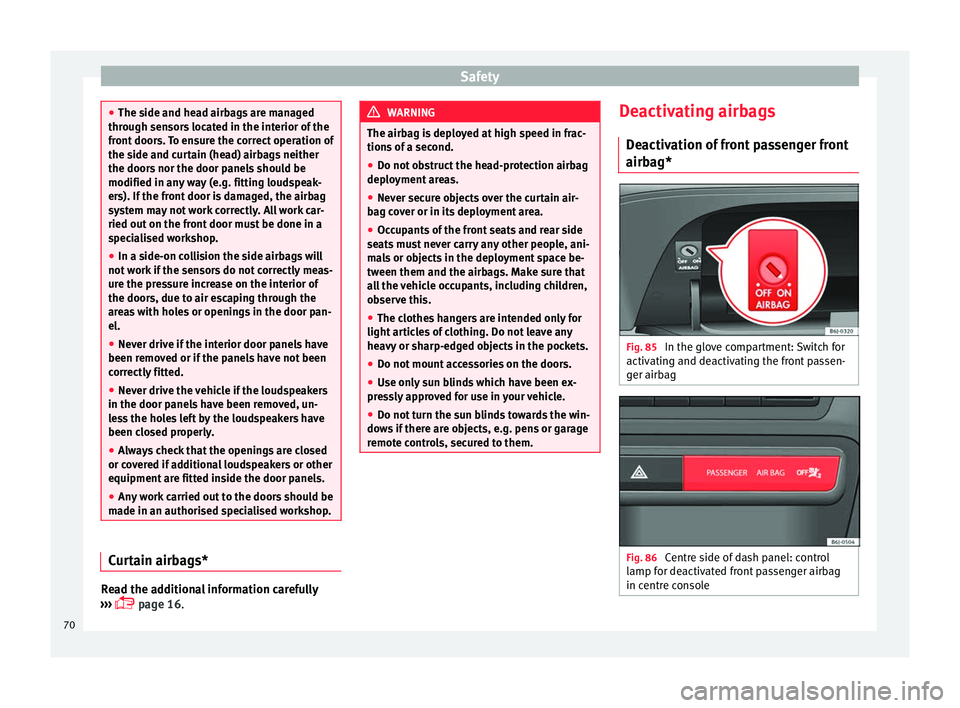
airbag* Fig. 85
In the glove compartment: Switch for
activ atin
g and de activ
ating the front passen-
ger airbag Fig. 86
Centre side of dash panel: control
l amp f
or deactiv
ated front passenger airbag
in centre console 70
Page 74 of 252
Safety
Transporting children safely Saf ety
for c
hildren
Introduction For safety reasons, as we have learned from
accident
s
tatistics, we recommend that chil-
dren under 12 years of age travel in the rear
seats. Depending on their age, height and
weight, children travelling in rear seats must
use a child seat or a seat belt. For safety rea-
sons, the child seat should be installed in the
rear seat, behind the front passenger seat or
in the centre back seat.
The physical laws involved and the forces
acting in a collision apply also to children
››› page 63. But unlike adults, children do not
have fully developed muscle and bone struc-
tures. This means that children are subject to
a greater risk of injury.
To reduce the risk of injuries, children must
always use special child restraint systems
when travelling in the vehicle.
We recommend the use of child safety prod-
ucts from the SEAT Original Accessories Pro-
gramme, which includes systems for all ages
made by “Peke” (not for all countries).
These systems have been especially de-
signed and approved, complying with the
ECE-R44. regulation. Follow the manufacturer's instructions and
obser
v
e any statutory requirements when in-
stalling and using child seats. Always read
and note ››› page 72.
We recommend you always carry the manu-
facturer's Child Seat Instruction Manual to-
gether with the on-board documentation.
Important information regarding the
front pa
ssenger's airbag Read the additional information carefully
› ›
›
p
age 16.
Read and always observe the safety informa-
tion included in the following chapters:
● Safety distance with respect to the passen-
ger airbag ››
› page 66.
● Objects between the passenger and the
passen
ger side airbag ››› in Front airbags
on p ag
e 69 .
The p
assenger side front airbag, when ena-
bled, is a serious risk for a child that is facing
backward since the airbag can strike the seat
with such force that it can cause serious or
fatal injuries. Children up to 12 years old
should always travel on the rear seat.
Therefore we strongly recommend you to
transport children on the rear seats. This is
the safest location in the vehicle. Alternative-
ly, the front passenger airbag can be disa- bled with a key-operated switch
››› p
age 70.
When transporting children, use a child seat
appropriate to the age and size of each child. WARNING
● If a chi l
d seat is secured to the front pas-
senger seat, the risk to the child of sustain-
ing critical or fatal injuries in the event of an
accident increases.
● An inflating front passenger airbag can
strike the re
ar-facing child seat and project it
with great force against the door, the roof or
the backrest.
● Never install a child seat facing backwards
on the front pa
ssenger seat unless the front
passenger front airbag has been disabled.
Risk of potentially fatal injuries to the child!
However, if it is necessary, in exceptional ca-
ses, to transport a child in the front passen-
ger seat, the front passenger front airbag
must always be disabled ››› page 70, Deacti-
vation of front passenger front airbag*. If the
front passenger seat has a height adjustment
option, move it to the highest position.
● For those vehicles that do not include a key
lock swit
ch to deactivate the airbag, the vehi-
cle must be taken to a technical service.
● All vehicle occupants, especially children,
must a
ssume the proper sitting position and
be properly belted in while travelling.
● Never hold children or babies on your lap,
this can r
esult in potentially fatal injuries to
the child! 72