technical data Seat Ibiza ST 2016 User Guide
[x] Cancel search | Manufacturer: SEAT, Model Year: 2016, Model line: Ibiza ST, Model: Seat Ibiza ST 2016Pages: 252, PDF Size: 5.56 MB
Page 75 of 252
Transporting children safely
●
Never al lo
w a child to be transported in a
vehicle without being properly secured, or to
stand up or kneel on a seat while travelling.
In an accident, the child could be flung
through the vehicle, causing possibly fatal in-
juries to themselves and to the other vehicle
occupants.
● If children assume an improper sitting posi-
tion when the vehicl
e is moving, they expose
themselves to greater risk of injury in the
event of a sudden braking manoeuvre or in an
accident. This is particularly important if the
child is travelling on the front passenger seat
and the airbag system is triggered in an acci-
dent; as this could cause serious injury or
even death.
● A suitable child seat can protect your child!
● Never leave a child alone in the child seat
or inside the v
ehicle because depending on
the season, very high temperatures may be
reached inside a parked vehicle, which could
be fatal.
● Children who are less than 1.5 metres tall
must not
wear a normal seat belt without a
child seat, as this could cause injuries to the
abdominal and neck areas during a sudden
braking manoeuvre or in an accident.
● Do not allow the seat belt to become twis-
ted and the seat belt
should be properly in
place ››› page 61.
● Only one child may occupy a child seat
››› p
age 73, Child seats. ●
When a chil d se
at is mounted in the rear
seats, the door child-proof lock should be ac-
tivated ››› page 110. Child seats
Safety in s
tructions Read the additional information carefully
›››
p
age 16. WARNING
When travelling, children must be secured in
the vehic l
e with a restraint system suitable
for age, weight and size.
● Read and always observe information and
warnings
concerning the use of child seats
››› page 72. WARNING
The retaining rings are designed only for use
with “ISOFIX” and Top T
ether* system child
seats.
● Never secure other child seats that do not
have the “ISOFIX” or Top
Tether* system, or
retaining belts or objects to the fastening
rings - this can result in potentially fatal inju-
ries to the child.
● Ensure that the child seat is secured cor-
rectly us
ing the “ISOFIX” and Top Tether* se-
curing rings. WARNING
An undue installation of the safety seat will
incre a
se the risk of injury in the event of a
crash.
● Never tie the retainer strap to a hook in the
luggage c
ompartment.
● Never secure or tie luggage or other items
to the lower anc
horages (ISOFIX) or the upper
ones (Top Tether). Categorisation of child seats into
gr
oup
s Only use child seats that are officially ap-
pr
o
ved and s
uitable for the child.
Child seats are subject to the regulation ECE-
R 44. ECE-R stands for: Economic Commis-
sion for Europe Regulation.
The child seats are grouped into 5 catego-
ries:
Group 0: Up to 10 kg (up to around 9
months)
Group 0+: Up to 13 kg (up to around 18
months)
Group 1: from 9 to 18 kg (up to approx. 4
years old)
Group 2: from 15 to 25 kg (up to approx. 7
years old) »
73
Technical data
Advice
Operation
Emergencies
Safety
Page 77 of 252
Self-help
Emergencies
Self -help
Emer gency
equipment
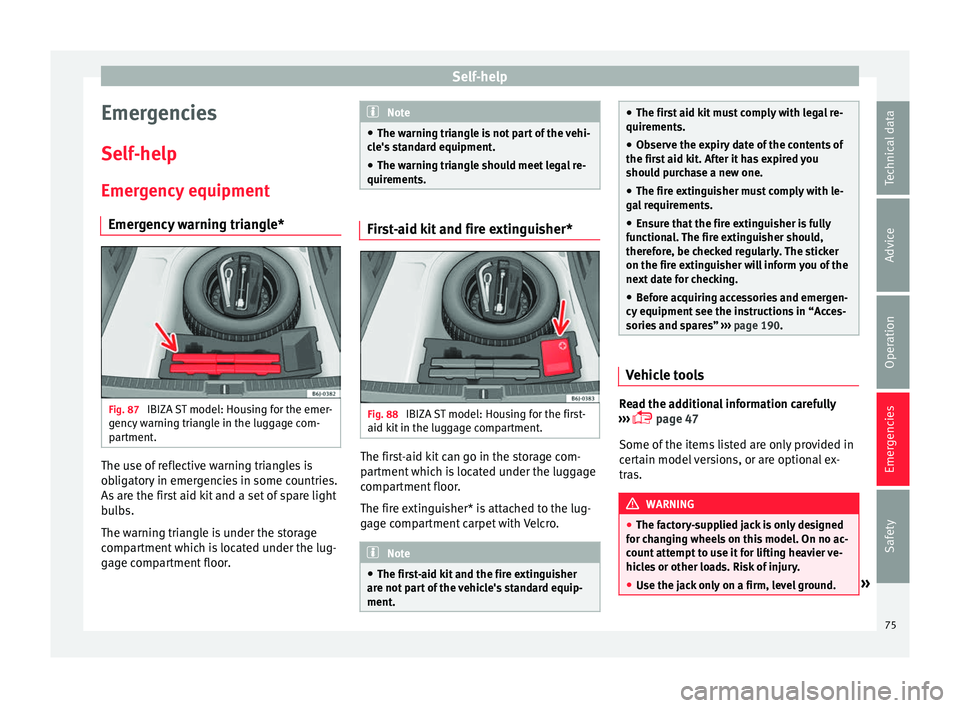
Emergency warning triangle* Fig. 87
IBIZA ST model: Housing for the emer-
g ency
warnin
g triangle in the luggage com-
partment. The use of reflective warning triangles is
o
b
lig at
ory in emergencies in some countries.
As are the first aid kit and a set of spare light
bulbs.
The warning triangle is under the storage
compartment which is located under the lug-
gage compartment floor. Note
● The warning tri an
gle is not part of the vehi-
cle's standard equipment.
● The warning triangle should meet legal re-
quirements. First-aid kit and fire extinguisher*
Fig. 88
IBIZA ST model: Housing for the first-
aid k it
in the lug g
age compartment. The first-aid kit can go in the storage com-
p
ar
tment whic
h is located under the luggage
compartment floor.
The fire extinguisher* is attached to the lug-
gage compartment carpet with Velcro. Note
● The first -
aid kit and the fire extinguisher
are not part of the vehicle's standard equip-
ment. ●
The first aid k
it must comply with legal re-
quirements.
● Observe the expiry date of the contents of
the first aid k
it. After it has expired you
should purchase a new one.
● The fire extinguisher must comply with le-
gal r
equirements.
● Ensure that the fire extinguisher is fully
functiona
l. The fire extinguisher should,
therefore, be checked regularly. The sticker
on the fire extinguisher will inform you of the
next date for checking.
● Before acquiring accessories and emergen-
cy equipment see the ins
tructions in “Acces-
sories and spares” ››› page 190. Vehicle tools
Read the additional information carefully
› ›
›
p
age 47
Some of the items listed are only provided in
certain model versions, or are optional ex-
tras. WARNING
● The factor y
-supplied jack is only designed
for changing wheels on this model. On no ac-
count attempt to use it for lifting heavier ve-
hicles or other loads. Risk of injury.
● Use the jack only on a firm, level ground. » 75
Technical data
Advice
Operation
Emergencies
Safety
Page 79 of 252
Self-help
After inserting the sealant residue in the tyre,
y ou mu
st
again check the tyre pressure about
10 minutes after starting the engine.
You should only use the tyre mobility set if
the vehicle is parked in a safe place, you are
familiar with the procedure and you have the
necessary tyre mobility set! Otherwise, you
should seek professional assistance.
Do not use the tyre sealant in the following
cases:
● If the wheel rim has been damaged.
● In outside temperatures below -20 °C
(-4 °F).
● In the event of cuts or perforations in the
tyre gre
ater than 4 mm.
● If you have been driving with very low pres-
sure or a comp
letely flat tyre.
● If the sealant bottle has passed its use by
date. WARNING
Using the tyre mobility system can be dan-
gerou s, e
specially when filling the tyre at the
roadside. Please observe the following rules
to minimise the risk of injury:
● Stop the vehicle safely as soon as possible.
Park it at
a safe distance from surrounding
traffic to fill the tyre.
● Ensure the ground on which you park is flat
and solid. ●
All p
assengers and particularly children
must keep a safe distance from the work area.
● Turn on the hazard warning lights to warn
other road u
sers.
● Use the tyre mobility system only if you are
familiar w
ith the necessary procedures. Oth-
erwise, you should seek professional assis-
tance.
● The tyre mobility set is intended for tempo-
rary emer
gency use only until you can reach
the nearest specialised workshop.
● Replace the repaired tyre with the tyre mo-
bility set
as soon as possible.
● The sealant is a health hazard and must be
cleaned immedi
ately if it comes into contact
with the skin.
● Always keep the tyre mobility set out of the
reach of
small children.
● Never use a jack, even if it has been ap-
proved f
or your vehicle.
● Always stop the engine, apply the hand-
brake lev
er firmly and engage gear if using a
manual gearbox, in order to reduce the risk of
vehicle involuntary movement. WARNING
A tyre filled with sealant does not have the
same perf orm
ance properties as a conven-
tional tyre.
● Never drive faster than 80 km/h (50 mph).
● Avoid heavy acceleration, hard braking and
fast
cornering. ●
Drive for on ly
10 minutes at a maximum
speed of 80 km/h (50 mph) and then check
the tyre. For the sake of the environment
Dispose of used or expired sealant observing
an y le
gal requirements. Note
● A new bottle of se a
lant can be purchased at
SEAT dealerships.
● Take into account the separate instruction
manual of
the tyre mobility set* manufactur-
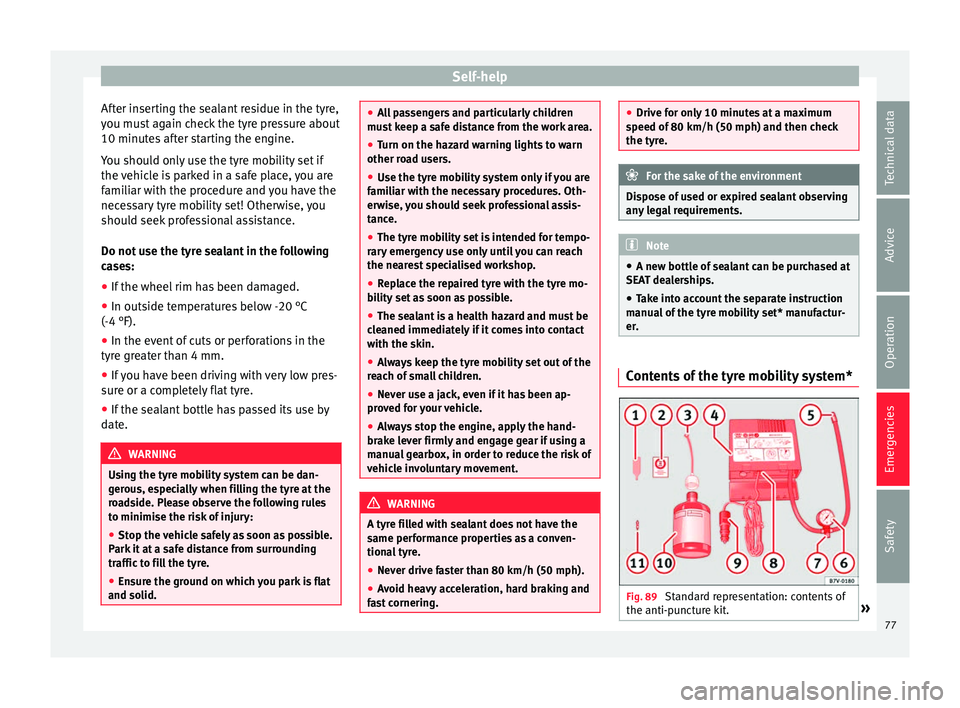
er. Contents of the tyre mobility system*
Fig. 89
Standard representation: contents of
the anti-p u
nct ur
e kit. » 77
Technical data
Advice
Operation
Emergencies
Safety
Page 81 of 252
Self-help
Check the condition of the wiper blades regu-
l arly
. If
the wipers scrape across the glass ,
they should be changed if they are damaged,
or cleaned if they are dirty ››› .
If thi
s doe
s not produce the desired results,
the setting angle of the windscreen wiper
arms might be incorrect. They should be
checked by a specialised workshop and cor-
rected if necessary. WARNING
Do not drive unless you have good visibility
through al l
windows!
● Clean the windscreen wiper blades and all
windows
regularly.
● The wiper blades should be changed once
or twice a y
ear. CAUTION
● Damaged or dir ty
windscreen wipers could
scratch the glass.
● Never use fuel, nail varnish remover, paint
thinner or similar pr
oducts to clean the win-
dows. This could damage the windscreen
wiper blades.
● Never move any windscreen wiper by hand.
This cou
ld cause damage.
● To prevent damage to the bonnet and the
windsc
reen wiper arms, the latter should only
be lifted off the windscreen when in service
position. Note
● The winds c
reen wiper arms can be moved
to the service position only when the bonnet
is properly closed.
● You can also use the service position, for
exampl
e, if you want to fix a cover over the
windscreen in the winter to keep it clear of
ice. Towing or tow-starting
Notes Read the additional information carefully
› ›
›
p
age 51
Please observe the following points if you
use a tow rope:
Notes for the driver of the towing vehicle
– Move the vehicle slowly until the cable is
taut. Then ac
celerate gradually.
– Begin and change gears cautiously. If you
are driving an aut
omatic vehicle, accelerate
gently.
– Remember that the brake servo and power
steering ar
e not working in the vehicle you
are towing. Brake sooner than normal and
pressing the pedal gently. Notes for the driver of the towed vehicle
– Ensure that the tow rope remains taut at all
times when to
wing.
Towing vehicles with an automatic gearbox
● Put the selector lever into position “N”.
● Do not drive faster than 50 km/h (31 mph).
● Do not tow further than 50 km.
● If a breakdown vehicle is used, the vehicle
must be t
owed with the front wheels raised. WARNING
If the vehicle has no electrical power, the
brake light s, t
urn signals and all other lights
will no longer function. Do not have the vehi-
cle towed away. Failure to follow this instruc-
tion could result in an accident. WARNING
Vehicle handling and braking capacity
chan g
e considerably during towing. Please
observe the following instructions to mini-
mise the risk of serious accidents and injury:
● As the driver of the vehicle being towed:
– You should depr
ess the brake much hard-
er as the brake servo does not operate.
Pay the utmost attention to avoid crash-
ing into the towing vehicle.
– More strength is required at the steering
wheel as the power steering does not op-
erate when the engine is switched off. » 79
Technical data
Advice
Operation
Emergencies
Safety
Page 83 of 252
Fuses and bulbs
Fuses and bulbs F u
se s
Intr
oduction Due to the constant updating of vehicles,
fuse a
s
signments based on equipment and
the use of the same fuse for various electrical
components, it is not possible to provide an
up-to-date summary of the fuse positions for
the electrical components at the time this
manual was printed. For detailed information
about the fuse positions, please consult a
technical service.
In general, a fuse can be assigned to various
electrical components. Likewise, an electrical
component can be protected by several
fuses.
Only replace fuses when the cause of the
problem has been solved. If a newly inserted
fuse blows after a short time, you must have
the electrical system checked by a special-
ised workshop as soon as possible. WARNING
The high voltages in the electrical system can
give serious el
ectrical shocks, causing burns
and even death!
● Never touch the electrical wiring of the igni-
tion system. ●
Take c ar
e not to cause short circuits in the
electrical system. WARNING
Using unsuitable fuses, repairing fuses or
bridgin g a curr ent
circuit without fuses can
cause a fire and serious injury.
● Never use a fuse with a higher value. Only
replac
e fuses with a fuse of the same amper-
age (same colour and markings) and size.
● Never repair a fuse.
● Never replace a fuse by a metal strip, staple
or similar
. CAUTION
● To prev ent
damage to the vehicle's electric
system, before replacing a fuse always turn
off the ignition, the lights and all electrical
elements and remove the key from the igni-
tion.
● If you replace a fuse with higher-rating
fuse, y
ou could cause damage to another part
of the electrical system.
● Protect the fuse boxes when open to pre-
vent the entry
of dust or humidity as they can
damage the electrical system.
● Always carefully remove the fuse box cov-
ers and refit
them correctly to avoid problems
with your vehicle. Note
● One component m a
y have more than one
fuse.
● Several components may run on a single
fuse.
● In the v
ehicle, there are more fuses than
those indicated in thi
s chapter. These should
only be changed by a specialised workshop.
● Positions not containing a fuse do not ap-
pear in the fol
lowing tables.
● Some of the equipment listed in the tables
below pertain on
ly to certain versions of the
model or are optional extras.
● Please note that the above lists, while cor-
rect at the time of
printing, are subject to
change. Fuses to the left of the instrument
p
anel Read the additional information carefully
› ›
›
p
age 44
Only replace fuses with a fuse of the same
amperage (same colour and markings) and
size.
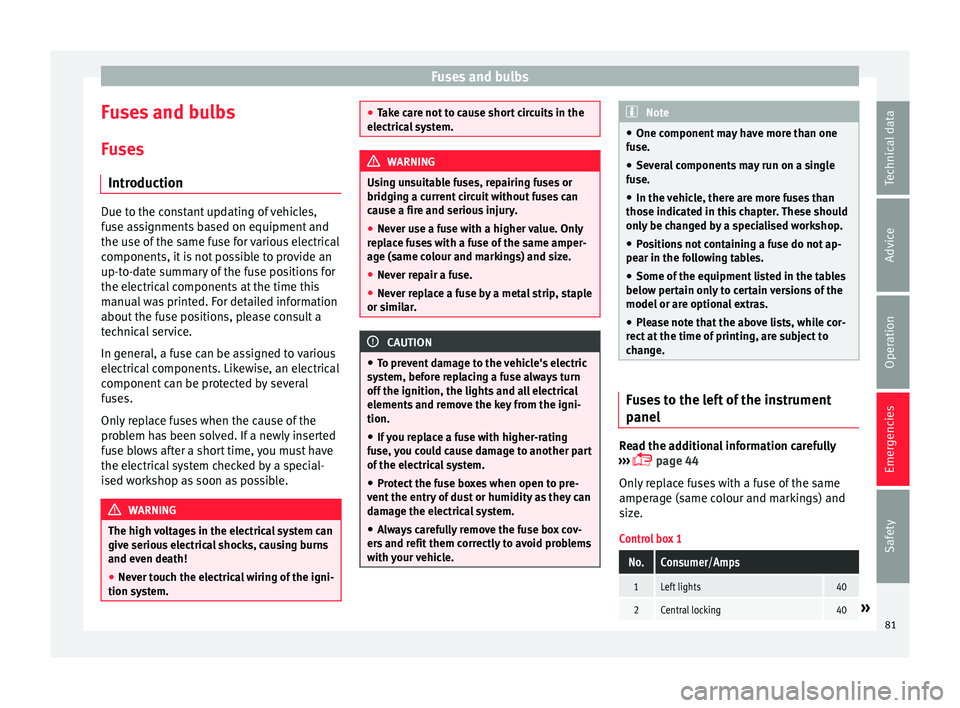
Control box 1
No.Consumer/Amps
1Left lights40
2Central locking40» 81
Technical data
Advice
Operation
Emergencies
Safety
Page 85 of 252
Fuses and bulbs
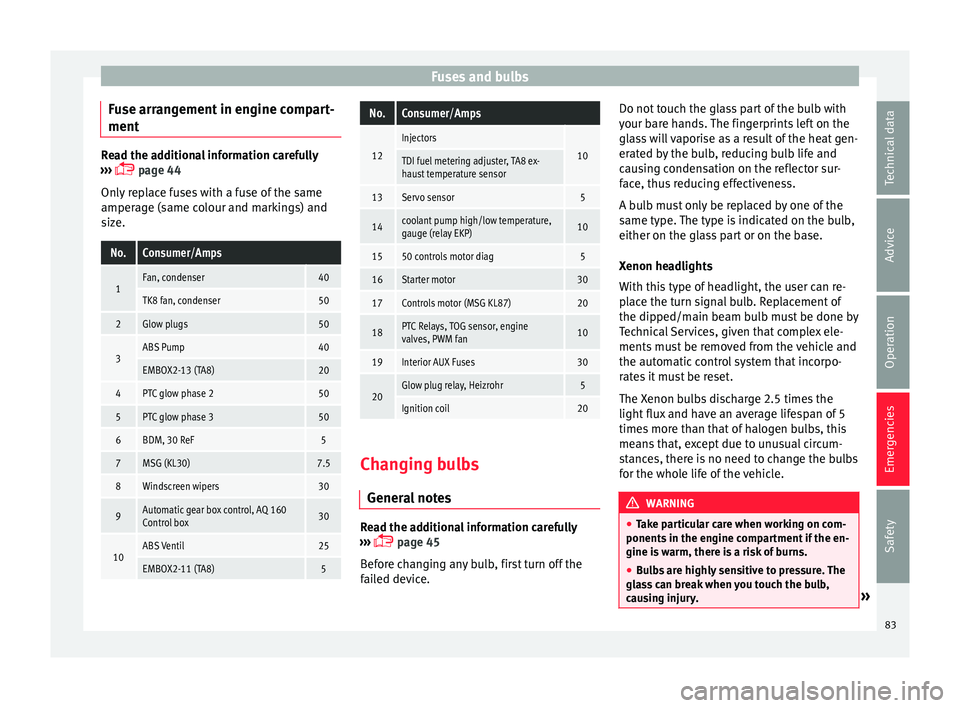
Fuse arrangement in engine compart-
ment Read the additional information carefully
›››
p
age 44
Only replace fuses with a fuse of the same
amperage (same colour and markings) and
size.
No.Consumer/Amps
1Fan, condenser40
TK8 fan, condenser50
2Glow plugs50
3ABS Pump40
EMBOX2-13 (TA8)20
4PTC glow phase 250
5PTC glow phase 350
6BDM, 30 ReF5
7MSG (KL30)7.5
8Windscreen wipers30
9Automatic gear box control, AQ 160
Control box30
10ABS Ventil25
EMBOX2-11 (TA8)5
No.Consumer/Amps
12
Injectors
10TDI fuel metering adjuster, TA8 ex-
haust temperature sensor
13Servo sensor5
14coolant pump high/low temperature,
gauge (relay EKP)10
1550 controls motor diag5
16Starter motor30
17Controls motor (MSG KL87)20
18PTC Relays, TOG sensor, engine
valves, PWM fan10
19Interior AUX Fuses30
20Glow plug relay, Heizrohr5
Ignition coil20 Changing bulbs
Gener al
not
es Read the additional information carefully
› ›
›
p
age 45
Before changing any bulb, first turn off the
failed device. Do not touch the glass part of the bulb with
your bare h
ands. The fingerprints left on the
glass will vaporise as a result of the heat gen-
erated by the bulb, reducing bulb life and
causing condensation on the reflector sur-
face, thus reducing effectiveness.
A bulb must only be replaced by one of the
same type. The type is indicated on the bulb,
either on the glass part or on the base.
Xenon headlights
With this type of headlight, the user can re-
place the turn signal bulb. Replacement of
the dipped/main beam bulb must be done by
Technical Services, given that complex ele-
ments must be removed from the vehicle and
the automatic control system that incorpo-
rates it must be reset.
The Xenon bulbs discharge 2.5 times the
light flux and have an average lifespan of 5
times more than that of halogen bulbs, this
means that, except due to unusual circum-
stances, there is no need to change the bulbs
for the whole life of the vehicle. WARNING
● Take p ar
ticular care when working on com-
ponents in the engine compartment if the en-
gine is warm, there is a risk of burns.
● Bulbs are highly sensitive to pressure. The
glass
can break when you touch the bulb,
causing injury. » 83
Technical data
Advice
Operation
Emergencies
Safety
Page 87 of 252
Fuses and bulbs
– Ins
tal
lation involves all of the above steps
in reverse sequence.
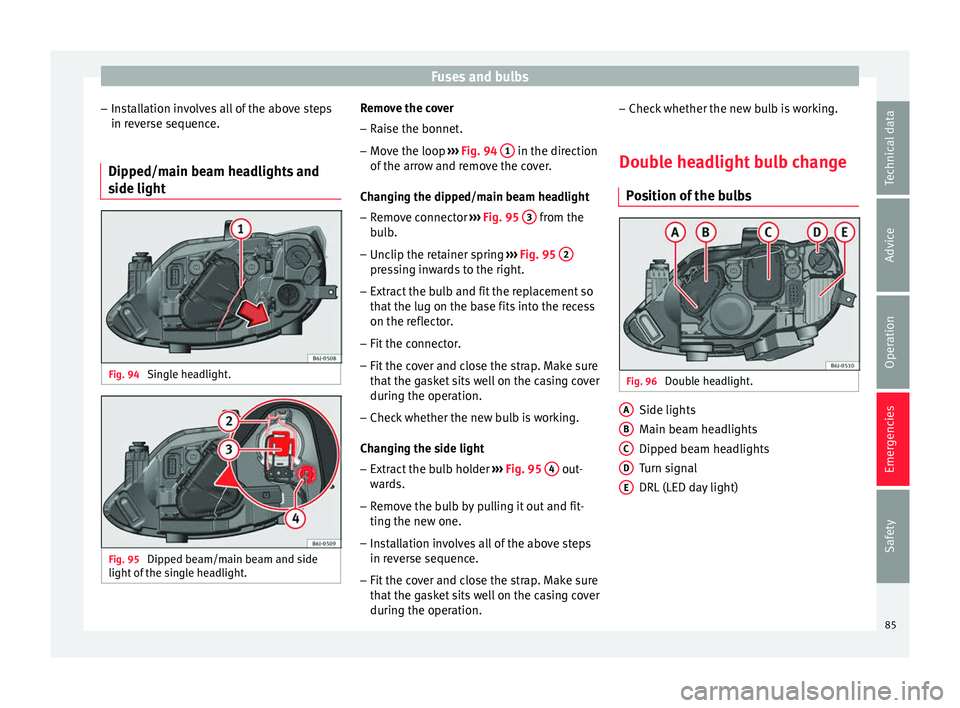
Dipped/main beam headlights and
side light Fig. 94
Single headlight. Fig. 95
Dipped beam/main beam and side
light of
the s in
gle headlight. Remove the cover
– Raise the bonnet.
– Move the loop ›
››
Fig. 94
1 in the direction
of the arr
ow and r
emove the cover.
Changing the dipped/main beam headlight – Remove connector ››› Fig. 95
3 from the
b u
lb
.
– Unclip the retainer spring ››› Fig. 95
2 pressing inwards to the right.
– Extract the bulb and fit the replacement so
th at
the lug on the b a
se fits into the recess
on the reflector.
– Fit the connector.
– Fit the cover and close the strap. Make sure
that the ga
sket sits well on the casing cover
during the operation.
– Check whether the new bulb is working.
Changing the s
ide light
– Extract the bulb holder ››› Fig. 95
4 out-
w ar
ds.
– R
emove the bulb by pulling it out and fit-
ting the new one.
– Inst
allation involves all of the above steps
in reverse sequenc
e.
– Fit the cover and close the strap. Make sure
that the ga
sket sits well on the casing cover
during the operation. –
Check whether the new bu
lb is working.
Double headlight bulb change Position of
the bulbs Fig. 96
Double headlight. Side lights
M
ain be
am hea
dlights
Dipped beam headlights
Turn signal
DRL (LED day light)
A B
C
D
E
85
Technical data
Advice
Operation
Emergencies
Safety
Page 89 of 252
Fuses and bulbs
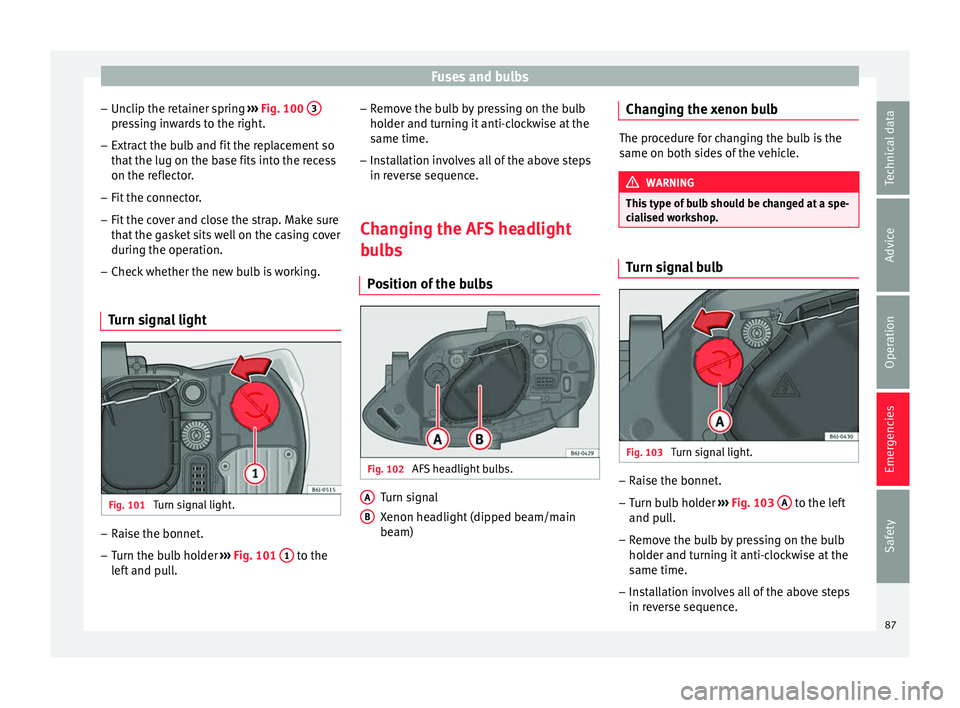
– Unc lip the r
etainer s
pring ››› Fig. 100 3 pressing inwards to the right.
– Extract the bulb and fit the replacement so
th at
the lug on the b a
se fits into the recess
on the reflector.
– Fit the connector.
– Fit the cover and close the strap. Make sure
that the ga
sket sits well on the casing cover
during the operation.
– Check whether the new bulb is working.
Turn signal light Fig. 101
Turn signal light. –
Raise the bonnet.
– Turn the bulb holder ››
›
Fig. 101
1 to the
l ef t
and p
ull. –
Remove the b
ulb by pressing on the bulb
holder and turning it anti-clockwise at the
same time.
– Installation involves all of the above steps
in reverse sequenc
e.
Changing the AFS headlight
bulb
s
Position of the bulbs Fig. 102
AFS headlight bulbs. Turn signal
X
enon he
adlight
(dipped beam/main
beam)
A B Changing the xenon bulb
The procedure for changing the bulb is the
same on both side
s
of the vehicle. WARNING
This type of bulb should be changed at a spe-
cia li
sed workshop. Turn signal bulb
Fig. 103
Turn signal light. –
Raise the bonnet.
– Turn bulb holder ››
›
Fig. 103
A to the left
and p u
ll
.
– Remove the bulb by pressing on the bulb
holder and turnin
g it anti-clockwise at the
same time.
– Installation involves all of the above steps
in reverse sequenc
e.
87
Technical data
Advice
Operation
Emergencies
Safety
Page 91 of 252
Fuses and bulbs
Changing the tail light bulbs S umm
ary
of LED tail lights3 Applies to the model: IBIZA/IBIZA SC
LED
● Brak e lights
● Side lights
B
ulb
s
● Retro fog light
● Reverse lights
● Turn signal
Tail light summary 3 Applies to the model: IBIZA ST
T ai
l lights on side panel Bulb lamps
● Brake lights
● Side lights
● Turn signal
Lights on the r e
ar lid Bulb lamps
● Reverse lights
● Side lights
● Fog lights Tail lights on side panel LED lamps
●
Brake light (LED)
● Side light (LED)
● Turn signal
Lights on the re
ar lid LED lamps
● Reverse lights
● Side light (LED)
● Fog lights
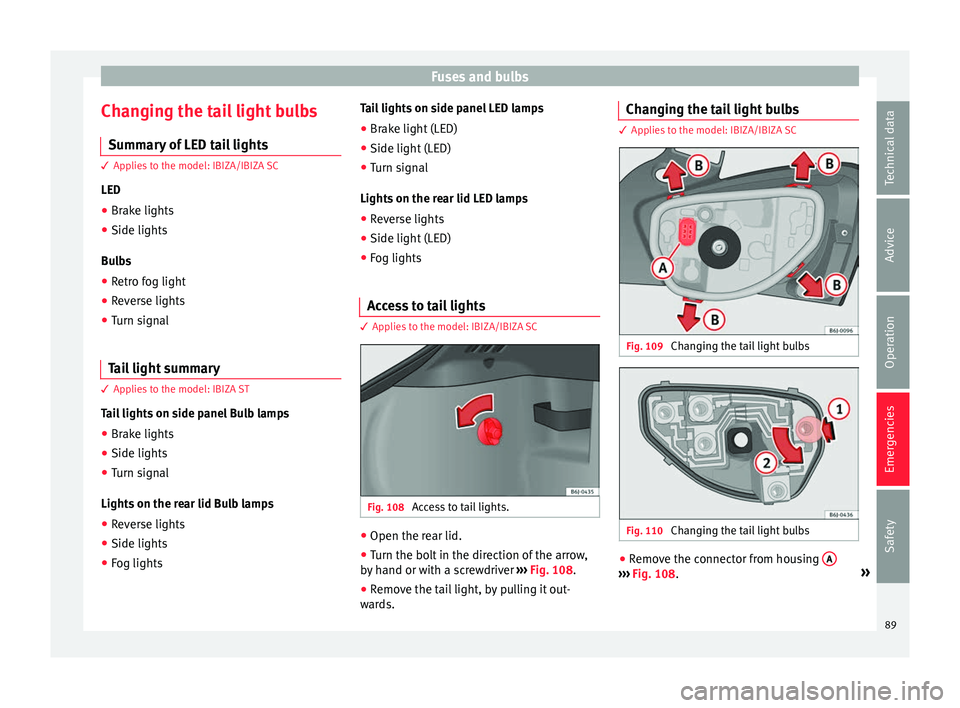
Access to tail lights 3 Applies to the model: IBIZA/IBIZA SC
Fig. 108
Access to tail lights. ●
Open the rear lid.
● Turn the bolt in the direction of the arrow,
b y
h and or w
ith a screwdriver ››› Fig. 108.
● Remove the tail light, by pulling it out-
wards. Ch
anging the tail light bulbs 3 Applies to the model: IBIZA/IBIZA SC
Fig. 109
Changing the tail light bulbs Fig. 110
Changing the tail light bulbs ●
Remove the connector from housing A ›››
Fig. 108. »
89
Technical data
Advice
Operation
Emergencies
Safety
Page 93 of 252
Fuses and bulbs
Changing the tail light bulbs (on the
r e
ar lid) 3 Applies to the model: IBIZA ST
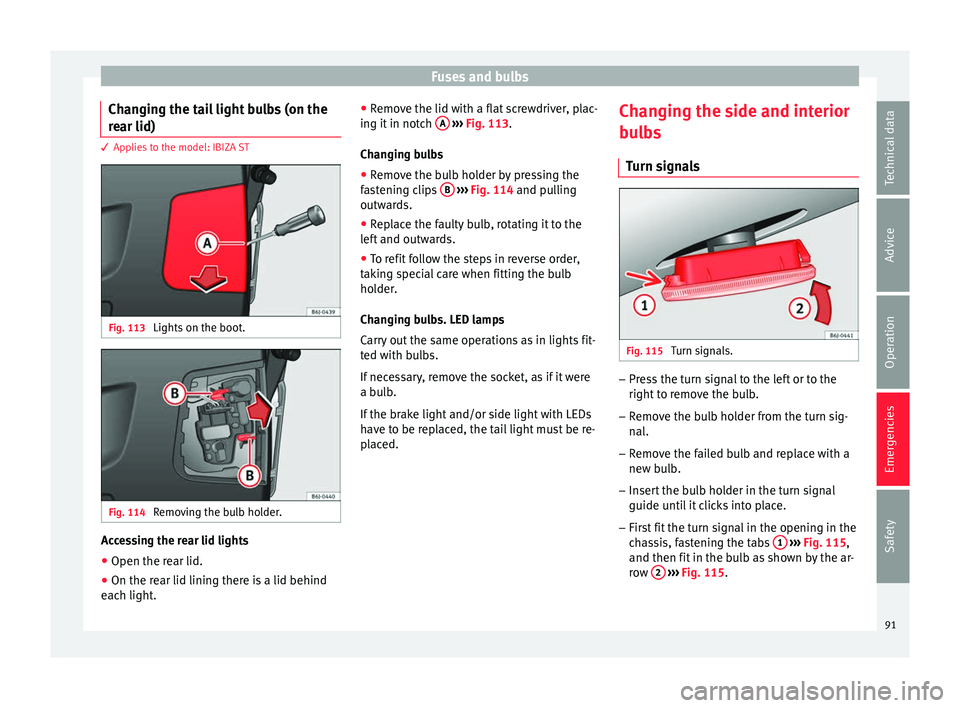
Fig. 113
Lights on the boot. Fig. 114
Removing the bulb holder. Accessing the rear lid lights
● Open the rear lid.
● On the rear lid lining there is a lid behind
e ac
h light . ●
R emove the lid w
ith a flat screwdriver, plac-
ing it in notch A
› ››
Fig. 113
.
Ch an
ging bulbs
● Remove the bulb holder by pressing the
fast
ening clips B
› ››
Fig. 114
and pu
lling
outwards.
● Replace the faulty bulb, rotating it to the
left and outw
ards.
● To refit follow the steps in reverse order,
taking s
pecial care when fitting the bulb
holder.
Changing bulbs. LED lamps
Carry out the same operations as in lights fit-
ted with bulbs.
If necessary, remove the socket, as if it were
a bulb.
If the brake light and/or side light with LEDs
have to be replaced, the tail light must be re-
placed. Changing the side and interior
bulb
s
Turn signals Fig. 115
Turn signals. –
Press the turn signal to the left or to the
right t
o r emo
ve the bulb.
– Remove the bulb holder from the turn sig-
nal.
– Remo
ve the failed bulb and replace with a
new bulb
.
– Insert the bulb holder in the turn signal
guide until it
clicks into place.
– First fit the turn signal in the opening in the
chas
sis, fastening the tabs 1
› ›
› Fig. 115 ,
and then fit
in the bulb as shown by the ar-
row 2
› ›
› Fig. 115 .
91
Technical data
Advice
Operation
Emergencies
Safety