stop start Seat Ibiza ST 2016 Owner's manual
[x] Cancel search | Manufacturer: SEAT, Model Year: 2016, Model line: Ibiza ST, Model: Seat Ibiza ST 2016Pages: 252, PDF Size: 5.56 MB
Page 5 of 252
Table of Contents
Table of Contents
The e s
senti a
ls . . . . . . . . . . . . . . . . . . . . . . . . 5
Exterior view . . . . . . . . . . . . . . . . . . . . . . . . . . . . 5
Exterior view . . . . . . . . . . . . . . . . . . . . . . . . . . . . 6
Interior view (left-hand drive) . . . . . . . . . . . . . . 7
Interior view (right-hand drive) . . . . . . . . . . . . . 8
How it works . . . . . . . . . . . . . . . . . . . . . . . . . . . . 9
Opening and closing . . . . . . . . . . . . . . . . . . . . . 9
Before driving . . . . . . . . . . . . . . . . . . . . . . . . . . . 12
Airbags . . . . . . . . . . . . . . . . . . . . . . . . . . . . . . . . 14
Child seats . . . . . . . . . . . . . . . . . . . . . . . . . . . . . 16
Starting the vehicle . . . . . . . . . . . . . . . . . . . . . . 21
Lights and visibility . . . . . . . . . . . . . . . . . . . . . . 21
Easy Connect . . . . . . . . . . . . . . . . . . . . . . . . . . . 24
Driver information system . . . . . . . . . . . . . . . . . 25
Journey data . . . . . . . . . . . . . . . . . . . . . . . . . . . . 29
Cruise control . . . . . . . . . . . . . . . . . . . . . . . . . . . 34
Warning lamps . . . . . . . . . . . . . . . . . . . . . . . . . . 35
Gearbox lever . . . . . . . . . . . . . . . . . . . . . . . . . . . 37
Air conditioning . . . . . . . . . . . . . . . . . . . . . . . . . 39
Fluid Level control . . . . . . . . . . . . . . . . . . . . . . . 40
Emergencies . . . . . . . . . . . . . . . . . . . . . . . . . . . . 44
Fuses . . . . . . . . . . . . . . . . . . . . . . . . . . . . . . . . . . 44
Bulbs . . . . . . . . . . . . . . . . . . . . . . . . . . . . . . . . . . 45
Action in the event of a puncture . . . . . . . . . . . 45
Changing a wheel . . . . . . . . . . . . . . . . . . . . . . . 47
Snow chains . . . . . . . . . . . . . . . . . . . . . . . . . . . . 50
Emergency towing of the vehicle . . . . . . . . . . . 51
How to jump start . . . . . . . . . . . . . . . . . . . . . . . . 52
Changing the windscreen wiper blades . . . . . . 54
Safety . . . . . . . . . . . . . . . . . . . . . . . . . . . . . . . . 56
Safe driving . . . . . . . . . . . . . . . . . . . . . . . . . . . . 56
Safety first! . . . . . . . . . . . . . . . . . . . . . . . . . . . . . 56
Advice about driving . . . . . . . . . . . . . . . . . . . . . 56 Correct position for passengers . . . . . . . . . . . . 57
Pedal area . . . . . . . . . . . . . . . . . . . . . . . . . . . . . . 61
Seat belts
. . . . . . . . . . . . . . . . . . . . . . . . . . . . . . 61
Why wear a seat belt? . . . . . . . . . . . . . . . . . . . . 61
How to properly adjust your seatbelt . . . . . . . . 64
Belt pretensioners* . . . . . . . . . . . . . . . . . . . . . . 65
Airbag system . . . . . . . . . . . . . . . . . . . . . . . . . . 66
Brief introduction . . . . . . . . . . . . . . . . . . . . . . . . 66
Airbag safety instructions . . . . . . . . . . . . . . . . . 69
Deactivating airbags . . . . . . . . . . . . . . . . . . . . . 70
Transporting children safely . . . . . . . . . . . . . . . 72
Safety for children . . . . . . . . . . . . . . . . . . . . . . . 72
Child seats . . . . . . . . . . . . . . . . . . . . . . . . . . . . . 73
Emergencies . . . . . . . . . . . . . . . . . . . . . . . . . . 75
Self-help . . . . . . . . . . . . . . . . . . . . . . . . . . . . . . . 75
Emergency equipment . . . . . . . . . . . . . . . . . . . . 75
Tyre repair . . . . . . . . . . . . . . . . . . . . . . . . . . . . . . 76
Changing the windscreen wiper blades . . . . . . 78
Towing or tow-starting . . . . . . . . . . . . . . . . . . . . 79
Fuses and bulbs . . . . . . . . . . . . . . . . . . . . . . . . . 81
Fuses . . . . . . . . . . . . . . . . . . . . . . . . . . . . . . . . . . 81
Changing bulbs . . . . . . . . . . . . . . . . . . . . . . . . . 83
Single headlight bulb change . . . . . . . . . . . . . . 84
Double headlight bulb change . . . . . . . . . . . . . 85
Changing the AFS headlight bulbs . . . . . . . . . . 87
Changing the fog light bulbs . . . . . . . . . . . . . . . 88
Changing the tail light bulbs . . . . . . . . . . . . . . . 89
Changing the side and interior bulbs . . . . . . . . 91
Operation . . . . . . . . . . . . . . . . . . . . . . . . . . . . . 95
Controls and displays . . . . . . . . . . . . . . . . . . . . 95
General instrument panel . . . . . . . . . . . . . . . . . 94
Instruments and warning/control lamps . . . . . 96
Instruments . . . . . . . . . . . . . . . . . . . . . . . . . . . . 96
Warning and control lamps . . . . . . . . . . . . . . . . 100
Introduction to the Easy Connect system* . . . . 101
System settings (CAR)* . . . . . . . . . . . . . . . . . . . 101 Communications and multimedia
. . . . . . . . . . . 103
Steering wheel controls* . . . . . . . . . . . . . . . . . . 103
Multimedia . . . . . . . . . . . . . . . . . . . . . . . . . . . . . 107
Opening and closing . . . . . . . . . . . . . . . . . . . . . 107
Central locking system . . . . . . . . . . . . . . . . . . . . 107
Keys . . . . . . . . . . . . . . . . . . . . . . . . . . . . . . . . . . . 111
Radio frequency remote control* . . . . . . . . . . . 112
Anti-theft alarm* . . . . . . . . . . . . . . . . . . . . . . . . 113
Boot hatch . . . . . . . . . . . . . . . . . . . . . . . . . . . . . 115
Electric windows . . . . . . . . . . . . . . . . . . . . . . . . . 115
Tilting panoramic roof* . . . . . . . . . . . . . . . . . . . 117
Lights and visibility . . . . . . . . . . . . . . . . . . . . . . 118
Lights . . . . . . . . . . . . . . . . . . . . . . . . . . . . . . . . . 118
Interior lights . . . . . . . . . . . . . . . . . . . . . . . . . . . 123
Visibility . . . . . . . . . . . . . . . . . . . . . . . . . . . . . . . 124
Windscreen wiper and rear window wiper sys-
tems . . . . . . . . . . . . . . . . . . . . . . . . . . . . . . . . . . 125
Re
ar view mirrors . . . . . . . . . . . . . . . . . . . . . . . . 126
Seats and head restraints . . . . . . . . . . . . . . . . . 128
Adjusting the seat and head restraints . . . . . . 128
Seat functions . . . . . . . . . . . . . . . . . . . . . . . . . . 130
Transport and practical equipment . . . . . . . . . 131
Practical equipment . . . . . . . . . . . . . . . . . . . . . . 131
Luggage compartment . . . . . . . . . . . . . . . . . . . . 135
Roof rack/roof luggage rack* . . . . . . . . . . . . . . 138
Air conditioning . . . . . . . . . . . . . . . . . . . . . . . . . 140
Heating, ventilation and cooling . . . . . . . . . . . . 140
Heating and fresh air . . . . . . . . . . . . . . . . . . . . . 142
Air conditioning* . . . . . . . . . . . . . . . . . . . . . . . . 144
Climatronic* . . . . . . . . . . . . . . . . . . . . . . . . . . . . 146
Driving . . . . . . . . . . . . . . . . . . . . . . . . . . . . . . . . 148
Address . . . . . . . . . . . . . . . . . . . . . . . . . . . . . . . . 148
Starting and stopping the engine . . . . . . . . . . . 150
Braking and parking . . . . . . . . . . . . . . . . . . . . . 152
Braking and stability systems . . . . . . . . . . . . . . 155
Manual gearbox . . . . . . . . . . . . . . . . . . . . . . . . . 161
Automatic gearbox* . . . . . . . . . . . . . . . . . . . . . . 161
Run-in and economical driving . . . . . . . . . . . . . 167 3
Page 6 of 252
Table of Contents
Engine management and exhaust gas purifica-
tion sy s
tem
. . . . . . . . . . . . . . . . . . . . . . . . . . . . . 169
Driving tips . . . . . . . . . . . . . . . . . . . . . . . . . . . . . 171
Driver assistance systems . . . . . . . . . . . . . . . . . 172
Start-Stop System* . . . . . . . . . . . . . . . . . . . . . . . 172
Fatigue detection (break recommendation)* . . 174
Parking aid . . . . . . . . . . . . . . . . . . . . . . . . . . . . . 175
Rear Assist “Rear View Camera”* . . . . . . . . . . . 180
Cruise speed* (cruise control - GRA) . . . . . . . . . 183
“SEAT Drive Profile” system . . . . . . . . . . . . . . . . 184
Towing bracket device and trailer . . . . . . . . . . . 186
Trailer mode . . . . . . . . . . . . . . . . . . . . . . . . . . . . 186
Retrofitting a towing bracket* . . . . . . . . . . . . . . 188
Advice . . . . . . . . . . . . . . . . . . . . . . . . . . . . . . . . 190
Care and maintenance . . . . . . . . . . . . . . . . . . . . 190
Accessories and modifications to the vehi-
cle . . . . . . . . . . . . . . . . . . . . . . . . . . . . . . . . . . . . 190
C
are and cleaning . . . . . . . . . . . . . . . . . . . . . . . 191
Care of the vehicle exterior . . . . . . . . . . . . . . . . 192
Caring for the vehicle interior . . . . . . . . . . . . . . 197
Checking and refilling levels . . . . . . . . . . . . . . . 199
Refuelling . . . . . . . . . . . . . . . . . . . . . . . . . . . . . . 199
Fuel . . . . . . . . . . . . . . . . . . . . . . . . . . . . . . . . . . . 200
Working in the engine compartment . . . . . . . . 201
Engine oil . . . . . . . . . . . . . . . . . . . . . . . . . . . . . . 204
Cooling system . . . . . . . . . . . . . . . . . . . . . . . . . . 207
Brake fluid . . . . . . . . . . . . . . . . . . . . . . . . . . . . . 209
Windscreen washer reservoir . . . . . . . . . . . . . . 210
Vehicle battery . . . . . . . . . . . . . . . . . . . . . . . . . . 210
Wheels . . . . . . . . . . . . . . . . . . . . . . . . . . . . . . . . 213
Wheels and tyres . . . . . . . . . . . . . . . . . . . . . . . . 213
Winter service . . . . . . . . . . . . . . . . . . . . . . . . . . . 217
Technical data . . . . . . . . . . . . . . . . . . . . . . . . 219
Technical specifications . . . . . . . . . . . . . . . . . . 219
Important information . . . . . . . . . . . . . . . . . . . . 219
Information on fuel consumption . . . . . . . . . . . 220 Trailer mode . . . . . . . . . . . . . . . . . . . . . . . . . . . . 220
Wheels . . . . . . . . . . . . . . . . . . . . . . . . . . . . . . . . 221
Engine data . . . . . . . . . . . . . . . . . . . . . . . . . . . . . 222
Dimensions . . . . . . . . . . . . . . . . . . . . . . . . . . . . . 234
Index . . . . . . . . . . . . . . . . . . . . . . . . . . . . . . . . . 235
4
Page 23 of 252
The essentials
● Pu
sh the loc k
and release it from the an-
choring support.
››› in Safety instructions on page 73 Starting the vehicle
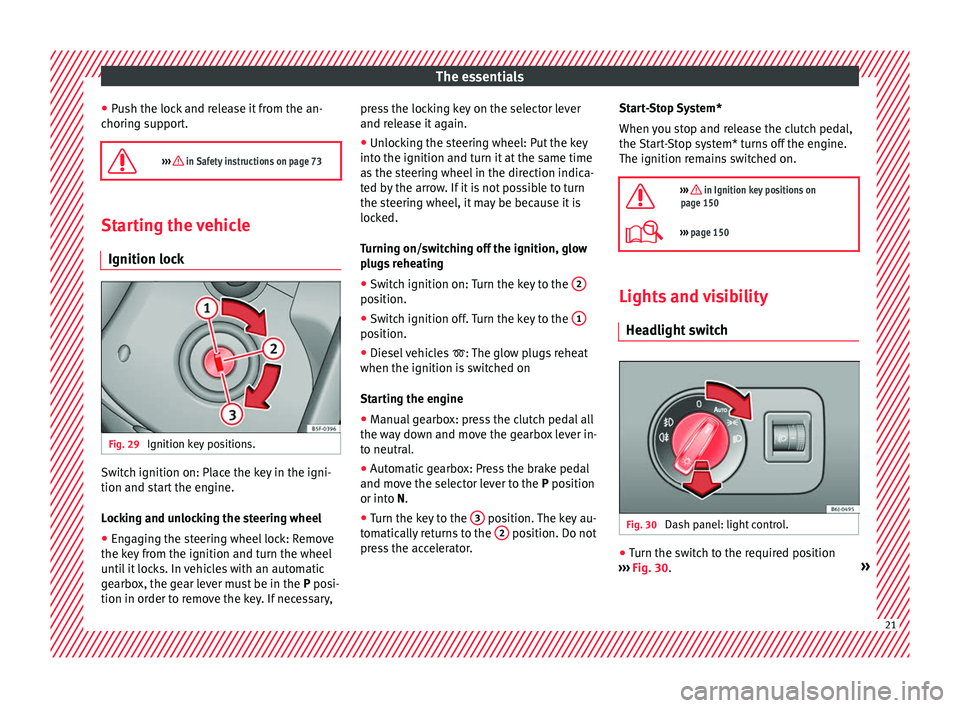
Ignition lock Fig. 29
Ignition key positions. Switch ignition on: Place the key in the igni-
tion and s
t
ar t
the engine.
Locking and unlocking the steering wheel
● Engaging the steering wheel lock: Remove
the key from the ignition and t
urn the wheel
until it locks. In vehicles with an automatic
gearbox, the gear lever must be in the P posi-
tion in order to remove the key. If necessary, press the locking key on the selector lever
and relea
se it again.
● Unlocking the steering wheel: Put the key
into the ignition and turn it at
the same time
as the steering wheel in the direction indica-
ted by the arrow. If it is not possible to turn
the steering wheel, it may be because it is
locked.
Turning on/switching off the ignition, glow
plugs reheating
● Switch ignition on: Turn the key to the 2 position.
●
Switch ignition off. Turn the key to the 1 position.
●
Diesel vehicles : The glo
w plug
s reheat
when the ignition is switched on
Starting the engine
● Manual gearbox: press the clutch pedal all
the way do
wn and move the gearbox lever in-
to neutral.
● Automatic gearbox: Press the brake pedal
and move the select
or lever to the P position
or into N.
● Turn the key to the 3 position. The key au-
t om
atic al
ly returns to the 2 position. Do not
pr e
ss
the accelerator. Start-Stop System*
When you st
op and release the clutch pedal,
the Start-Stop system* turns off the engine.
The ignition remains switched on.
››› in Ignition key positions on
page 150
››› page 150 Lights and visibility
He a
dlight sw
itch Fig. 30
Dash panel: light control. ●
Turn the switch to the required position
› ›
›
Fig. 30
. » 21
Page 32 of 252
The essentialsMenuFunction
MFD from
departure
Display and storage of the values for
the journey and the consumption from
when the ignition is switched on to
when it is switched off.
If the journey is continued in less than
2 hours after the ignition is switched
off, the new data is added to the data
already stored in the memory. The
memory will automatically be deleted if
the journey is interrupted for more than
2 hours.
MFD from refuellingDisplay and storage of the values for
the journey and the consumption. By
refuelling, the memory will be erased
automatically.
MFD total
calcula-
tion
The memory records the values for a
specific number of partial trips, up to a
total of 19 hours and 59 minutes or 99
hours and 59 minutes, or 1999.9 km or
9999 km, depending on the model of
instrument panel. On reaching either of
these limits a)
, the memory is automati-
cally erased and starts to count from 0
again.
a) It varies according to the instrument panel version.
Erasing a memory manually
● Select the memory that you wish to erase.
● Hold the button of the multifunction
s t
eerin g wheel
or the button of the multi-
f u nction wheel
pr
essed down for about 2 sec-
onds. Personalising the displays
In the Easy C
onnect system you can adjust
which of the possible displays of the MFD can
be shown on the instrument panel display
with the button and the function button
Set up
› ››
p
age 101.
Dat a s
ummary
MenuFunction
Current fuel
consumption
The current fuel consumption dis-
play operates throughout the jour-
ney, in litres/100 km; and with the
engine running and the vehicle
stopped, in litres/hour.
Average fuelconsumption
After turning on the ignition, aver-
age fuel consumption in li-
tres/100 km will be displayed after
travelling about 100 metres. Other-
wise horizontal lines are displayed.
The value shown is updated approxi-
mately every 5 seconds.
ACT ®
*: Depending on the equip-
ment, number of active cylinders.
Operating range
Approximate distance in km that can
still be travelled with the fuel re-
maining in the tank, assuming the
same style of driving is maintained.
This is calculated using the current
fuel consumption.
MenuFunction
TravellingtimeThis indicates the hours (h) and mi-
nutes (min) since the ignition was
switched on.
Distance
coveredDistance covered in km (m) after
switching on the ignition.
Average
speed
The average speed will be shown af-
ter a distance of about 100 metres
has been travelled. Otherwise hori-
zontal lines are displayed. The value
shown is updated approximately ev-
ery 5 seconds.
Digital dis- play of
speedCurrent speed displayed in digital
format.
Speed warn-
ing at ---
km/h or Speed
warning at
--- mphIf the stored speed is exceeded (be-
tween 30 - 250 km/h, or 19 -
155 mph), an audible warning is
given together with a visual warn-
ing.
Oil tempera-
tureUpdated engine oil temperature dig-
ital display
Coolant tem-
perature
gaugeDigital display of the current temper-
ature of the liquid coolant. Storing a speed with the speed warning
● Select the display Speed warning at
--- km/h (---
mph) 30
Page 34 of 252
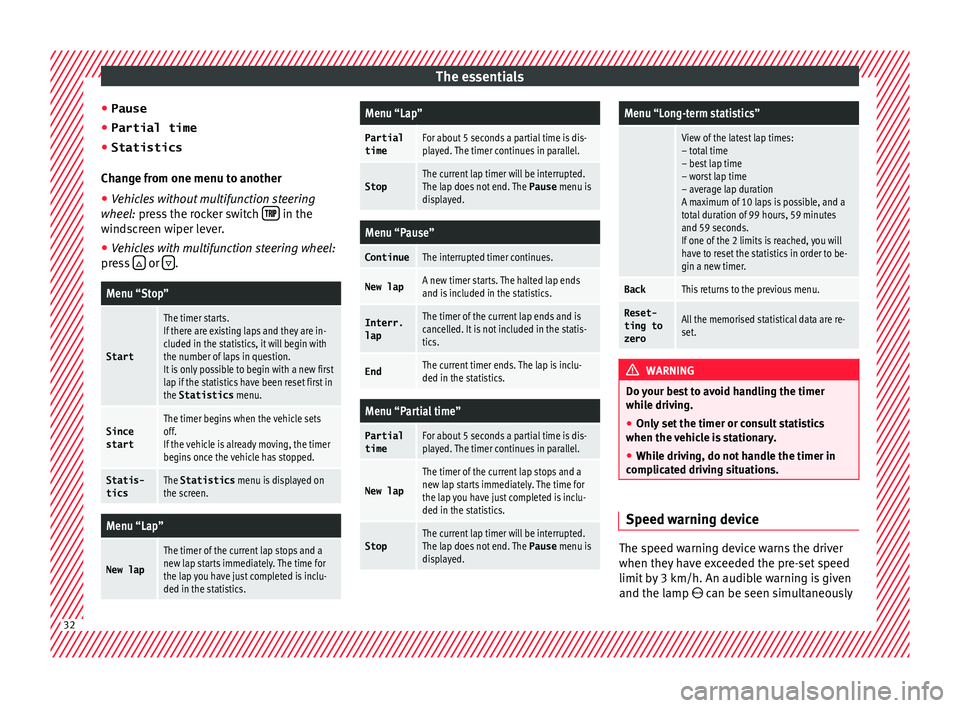
The essentials
● Pause
● Partial time
● Statistics
Ch an
ge fr
om one menu to another
● Vehicles without multifunction steering
wheel: pr
ess the rocker switch in the
w ind
sc
reen wiper lever.
● Vehicles with multifunction steering wheel:
press
or
.
Menu “Stop”
Start
The timer starts.
If there are existing laps and they are in-
cluded in the statistics, it will begin with
the number of laps in question.
It is only possible to begin with a new first
lap if the statistics have been reset first in
the Statistics
menu.
Since
startThe timer begins when the vehicle sets
off.
If the vehicle is already moving, the timer
begins once the vehicle has stopped.
Statis-
ticsThe Statistics menu is displayed on
the screen.
Menu “Lap”
New lap
The timer of the current lap stops and a
new lap starts immediately. The time for
the lap you have just completed is inclu-
ded in the statistics.
Menu “Lap”
Partial
timeFor about 5 seconds a partial time is dis-
played. The timer continues in parallel.
StopThe current lap timer will be interrupted.
The lap does not end. The Pause menu is
displayed.
Menu “Pause”
ContinueThe interrupted timer continues.
New lapA new timer starts. The halted lap ends
and is included in the statistics.
Interr. lapThe timer of the current lap ends and is
cancelled. It is not included in the statis-
tics.
EndThe current timer ends. The lap is inclu-
ded in the statistics.
Menu “Partial time”
Partial
timeFor about 5 seconds a partial time is dis-
played. The timer continues in parallel.
New lap
The timer of the current lap stops and a
new lap starts immediately. The time for
the lap you have just completed is inclu-
ded in the statistics.
StopThe current lap timer will be interrupted.
The lap does not end. The Pause menu is
displayed.
Menu “Long-term statistics”
View of the latest lap times:
– total time
– best lap time
– worst lap time
– average lap duration
A maximum of 10 laps is possible, and a
total duration of 99 hours, 59 minutes
and 59 seconds.
If one of the 2 limits is reached, you will
have to reset the statistics in order to be-
gin a new timer.
BackThis returns to the previous menu.
Reset-
ting to
zeroAll the memorised statistical data are re-
set. WARNING
Do your best to avoid handling the timer
while driv in
g.
● Only set the timer or consult statistics
when the vehicl
e is stationary.
● While driving, do not handle the timer in
complicat
ed driving situations. Speed warning device
The speed warning device warns the driver
when they
h
av e e
xceeded the pre-set speed
limit by 3 km/h. An audible warning is given
and the lamp can be seen simultaneously 32
Page 39 of 252
The essentials
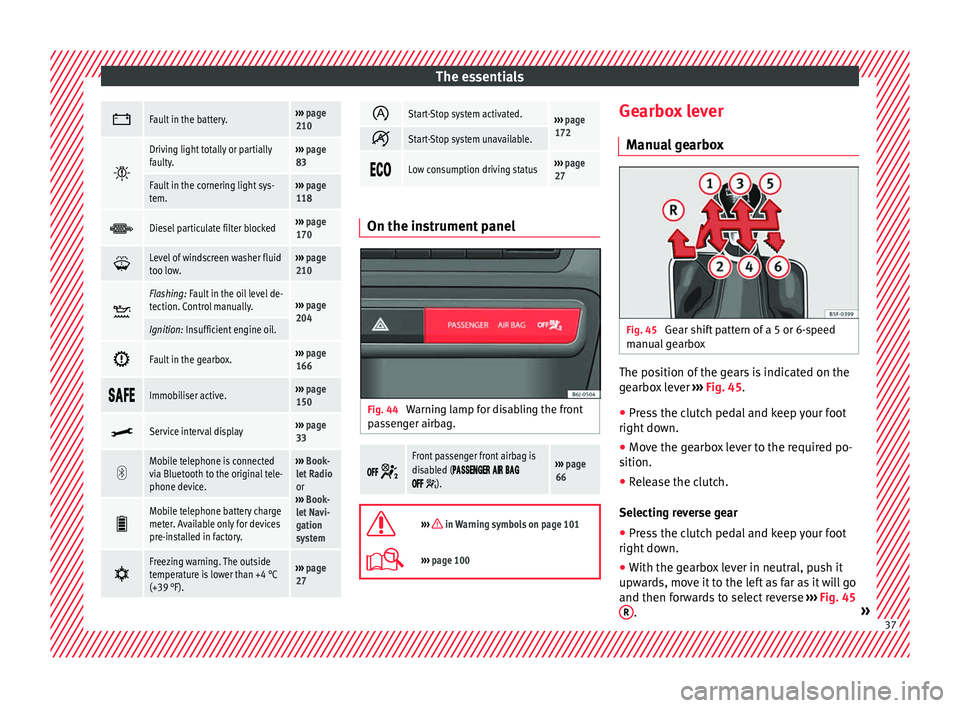
Fault in the battery.›››
page
210
Driving light totally or partially
faulty.›››
page
83
Fault in the cornering light sys-
tem.››› page
118
Diesel particulate filter blocked›››
page
170
Level of windscreen washer fluid
too low.›››
page
210
Flashing: Fault in the oil level de-
tection. Control manually.›››
page
204
Ignition: Insufficient engine oil.
Fault in the gearbox.›››
page
166
Immobiliser active.›››
page
150
Service interval display›››
page
33
Mobile telephone is connected
via Bluetooth to the original tele-
phone device.›››
Book-
let Radio
or
››› Book-
let Navi-
gation
system
Mobile telephone battery charge
meter. Available only for devices
pre-installed in factory.
Freezing warning. The outside
temperature is lower than +4 °C
(+39 °F).›››
page
27
Start-Stop system activated.›››
page
172
Start-Stop system unavailable.
Low consumption driving status›››
page
27 On the instrument panel
Fig. 44
Warning lamp for disabling the front
p a
ssen
ger airbag.
Front passenger front airbag is
disabled (
).
››› page
66
››› in Warning symbols on page 101
›››
page 100 Gearbox lever
M anua
l g
earbox Fig. 45
Gear shift pattern of a 5 or 6-speed
m anual
ge
arbox The position of the gears is indicated on the
g
e
arbo x
lever ››› Fig. 45.
● Press the clutch pedal and keep your foot
right down.
● Mov
e the gearbox lever to the required po-
sition.
● Rele
ase the clutch.
Selecting rev
erse gear
● Press the clutch pedal and keep your foot
right down.
● With the g
earbox lever in neutral, push it
upward
s, move it to the left as far as it will go
and then forwards to select reverse ››› Fig. 45
R .
» 37
Page 48 of 252
The essentials
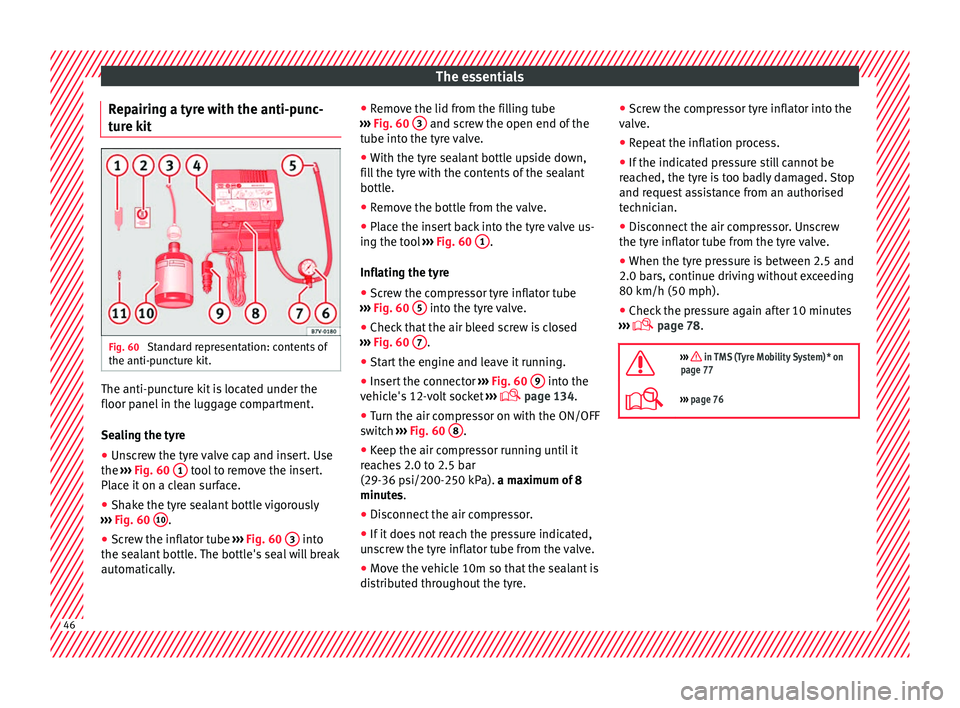
Repairing a tyre with the anti-punc-
t ur
e k it Fig. 60
Standard representation: contents of
the anti-p u
nct ur
e kit. The anti-puncture kit is located under the
floor p
anel
in the lug g
age compartment.
Sealing the tyre
● Unscrew the tyre valve cap and insert. Use
the ››› Fig. 60
1 tool to remove the insert.
Pl ac
e it on a c
lean surface.
● Shake the tyre sealant bottle vigorously
››› Fig. 60
10 .
● Screw the inflator tube ››
›
Fig. 60
3 into
the se al
ant bottl
e. The bottle's seal will break
automatically. ●
Remove the lid fr
om the filling tube
››› Fig. 60 3 and screw the open end of the
t ube int
o the ty r
e valve.
● With the tyre sealant bottle upside down,
fill the ty
re with the contents of the sealant
bottle.
● Remove the bottle from the valve.
● Place the insert back into the tyre valve us-
ing the tool
››› Fig. 60 1 .
Infl atin
g the ty r
e
● Screw the compressor tyre inflator tube
››› Fig. 60
5 into the tyre valve.
● Check that the air bleed screw is closed
› ›
›
Fig. 60
7 .
● Start the engine and leave it running.
● Insert the connector ››
›
Fig. 60
9 into the
v ehic
le's
12-volt socket ›››
page 134.
● Turn the air compressor on with the ON/OFF
switch ›
›› Fig. 60 8 .
● Keep the air compressor running until it
r e
ac he
s 2.0 to 2.5 bar
(29-36 psi/200-250 kPa). a maximum of 8
minutes.
● Disconnect the air compressor.
● If it does not reach the pressure indicated,
unsc
rew the tyre inflator tube from the valve.
● Move the vehicle 10m so that the sealant is
distrib ut
ed throughout the tyre. ●
Screw the c ompr
essor tyre inflator into the
valve.
● Repeat the inflation process.
● If the indicated pressure still cannot be
reached, the ty
re is too badly damaged. Stop
and request assistance from an authorised
technician.
● Disconnect the air compressor. Unscrew
the tyre inflat
or tube from the tyre valve.
● When the tyre pressure is between 2.5 and
2.0 bars, continue driv
ing without exceeding
80 km/h (50 mph).
● Check the pressure again after 10 minutes
››› p
age 78.
››› in TMS (Tyre Mobility System)* on
page 77
››› page 76 46
Page 54 of 252
The essentials
››› in Notes on page 79
››› page 79 Tow-starting
If the engine will not start, first try starting it
usin
g the b
attery of another vehicle
››› page 52. You should only attempt to tow-
start a vehicle if charging the battery does
not work. This is done by leveraging wheel
movement.
When tow-starting a vehicle with a petrol en-
gine, do not tow it more than a short dis-
tance, otherwise unburned fuel can enter the
catalytic converter.
However, if your vehicle has to be tow-star-
ted:
● Engage 2 nd
or 3 rd
ge ar
.
● Keep the clutch pressed down.
● Switch the ignition on.
● Once both vehicles are moving, release the
clutch.
● As
soon as the engine starts, press the
clutch and mo
ve the gear lever into neutral.
This helps to prevent driving into the towing
vehicle.
››› in Notes on page 79
›››
page 79 How to jump start
Jump l e
a d
s The jump lead must have a sufficient wire
cro
s
s section.
If the engine fails to start because of a dis-
charged battery, the battery can be connec-
ted to the battery of another vehicle to start
the engine.
Jump leads
Jump leads must comply with standard DIN
72553 (see cable manufacturer's instruc-
tions). The wire cross section must be at least
25 mm 2
for petrol engines and at least
35 mm 2
for diesel engines. Note
● The vehic l
es must not touch each other,
otherwise electricity could flow as soon as
the positive terminals are connected.
● The discharged battery must be properly
connected to the on-bo
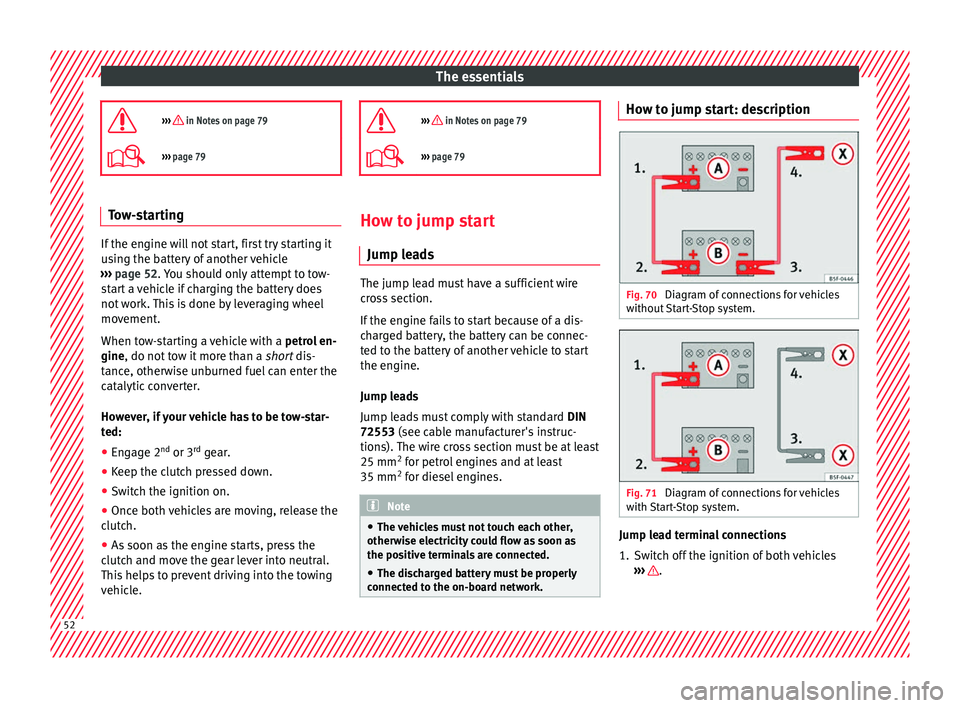
ard network. How to jump start: description
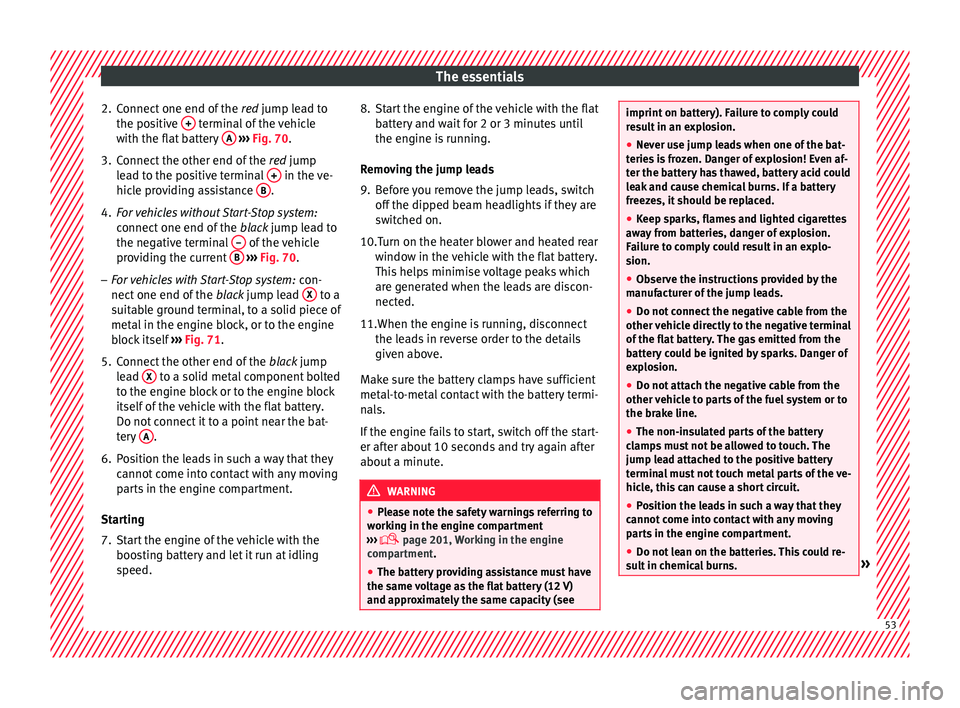
Fig. 70
Diagram of connections for vehicles
w ithout
St
art-Stop system. Fig. 71
Diagram of connections for vehicles
w ith
Star
t-Stop system. Jump lead terminal connections
1. Switch off the ignition of both vehicles
››
› .
52
Page 55 of 252
The essentials
2. Connect one end of the re
d jump l
ead to
the positive + terminal of the vehicle
w ith the fl
at b
attery A
› ››
Fig. 70
.
3. C
onnect the other end of the red jump
l
ead to the positive terminal + in the ve-
hic l
e pr o
viding assistance B .
4. For vehicles without Start-Stop system:
connect
one end of the
b
lack jump lead to
the negative terminal – of the vehicle
pr o
vidin
g the current B
› ››
Fig. 70
.
– For
vehicles with Start-Stop system: con-
nect one end of the b
lack jump lead X to a
s uit
abl
e ground terminal, to a solid piece of
metal in the engine block, or to the engine
block itself ››› Fig. 71.
5. Connect the other end of the black jump
l
ead X to a solid metal component bolted
t o the en
gine bloc
k or to the engine block
itself of the vehicle with the flat battery.
Do not connect it to a point near the bat-
tery A .
6. Position the leads in such a way that they cannot
come int
o contact with any moving
parts in the engine compartment.
Starting
7. Start the engine of the vehicle with the boosting b
attery and let it run at idling
speed. 8. Start the engine of the vehicle with the flat
battery
and wait for 2 or 3 minutes until
the engine is running.
Removing the jump leads
9. Before you remove the jump leads, switch off the dipped beam he
adlights if they are
switched on.
10.Turn on the heater blower and heated rear window in the v
ehicle with the flat battery.
This helps minimise voltage peaks which
are generated when the leads are discon-
nected.
11.When the engine is running, disconnect the lead
s in reverse order to the details
given above.
Make sure the battery clamps have sufficient
metal-to-metal contact with the battery termi-
nals.
If the engine fails to start, switch off the start-
er after about 10 seconds and try again after
about a minute. WARNING
● Plea se not
e the safety warnings referring to
working in the engine compartment
››› page 201, Working in the engine
compartment.
● The battery providing assistance must have
the same vo
ltage as the flat battery (12 V)
and approximately the same capacity (see imprint on battery). Failure to comply could
res
u
lt in an explosion.
● Never use jump leads when one of the bat-
teries i
s frozen. Danger of explosion! Even af-
ter the battery has thawed, battery acid could
leak and cause chemical burns. If a battery
freezes, it should be replaced.
● Keep sparks, flames and lighted cigarettes
away
from batteries, danger of explosion.
Failure to comply could result in an explo-
sion.
● Observe the instructions provided by the
manufactur
er of the jump leads.
● Do not connect the negative cable from the
other vehicl
e directly to the negative terminal
of the flat battery. The gas emitted from the
battery could be ignited by sparks. Danger of
explosion.
● Do not attach the negative cable from the
other vehicl
e to parts of the fuel system or to
the brake line.
● The non-insulated parts of the battery
clamps
must not be allowed to touch. The
jump lead attached to the positive battery
terminal must not touch metal parts of the ve-
hicle, this can cause a short circuit.
● Position the leads in such a way that they
cannot come int
o contact with any moving
parts in the engine compartment.
● Do not lean on the batteries. This could re-
sult in c
hemical burns. » 53
Page 79 of 252
Self-help
After inserting the sealant residue in the tyre,
y ou mu
st
again check the tyre pressure about
10 minutes after starting the engine.
You should only use the tyre mobility set if
the vehicle is parked in a safe place, you are
familiar with the procedure and you have the
necessary tyre mobility set! Otherwise, you
should seek professional assistance.
Do not use the tyre sealant in the following
cases:
● If the wheel rim has been damaged.
● In outside temperatures below -20 °C
(-4 °F).
● In the event of cuts or perforations in the
tyre gre
ater than 4 mm.
● If you have been driving with very low pres-
sure or a comp
letely flat tyre.
● If the sealant bottle has passed its use by
date. WARNING
Using the tyre mobility system can be dan-
gerou s, e
specially when filling the tyre at the
roadside. Please observe the following rules
to minimise the risk of injury:
● Stop the vehicle safely as soon as possible.
Park it at
a safe distance from surrounding
traffic to fill the tyre.
● Ensure the ground on which you park is flat
and solid. ●
All p
assengers and particularly children
must keep a safe distance from the work area.
● Turn on the hazard warning lights to warn
other road u
sers.
● Use the tyre mobility system only if you are
familiar w
ith the necessary procedures. Oth-
erwise, you should seek professional assis-
tance.
● The tyre mobility set is intended for tempo-
rary emer
gency use only until you can reach
the nearest specialised workshop.
● Replace the repaired tyre with the tyre mo-
bility set
as soon as possible.
● The sealant is a health hazard and must be
cleaned immedi
ately if it comes into contact
with the skin.
● Always keep the tyre mobility set out of the
reach of
small children.
● Never use a jack, even if it has been ap-
proved f
or your vehicle.
● Always stop the engine, apply the hand-
brake lev
er firmly and engage gear if using a
manual gearbox, in order to reduce the risk of
vehicle involuntary movement. WARNING
A tyre filled with sealant does not have the
same perf orm
ance properties as a conven-
tional tyre.
● Never drive faster than 80 km/h (50 mph).
● Avoid heavy acceleration, hard braking and
fast
cornering. ●
Drive for on ly
10 minutes at a maximum
speed of 80 km/h (50 mph) and then check
the tyre. For the sake of the environment
Dispose of used or expired sealant observing
an y le
gal requirements. Note
● A new bottle of se a
lant can be purchased at
SEAT dealerships.
● Take into account the separate instruction
manual of
the tyre mobility set* manufactur-
er. Contents of the tyre mobility system*
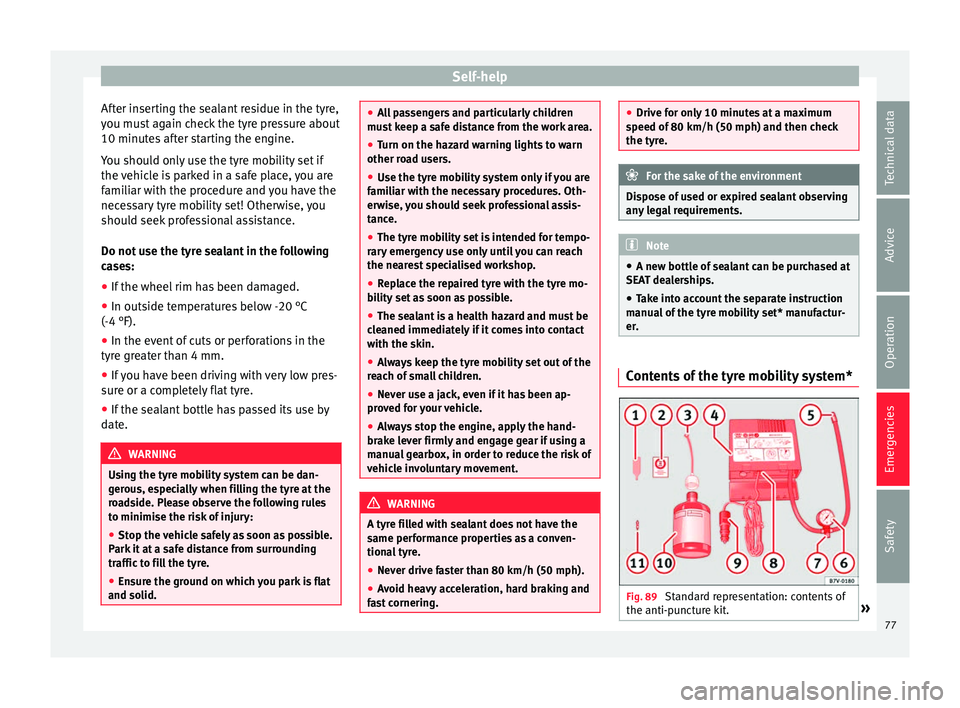
Fig. 89
Standard representation: contents of
the anti-p u
nct ur
e kit. » 77
Technical data
Advice
Operation
Emergencies
Safety