warning Seat Leon 5D 2009 Owner's manual
[x] Cancel search | Manufacturer: SEAT, Model Year: 2009, Model line: Leon 5D, Model: Seat Leon 5D 2009Pages: 304, PDF Size: 7.72 MB
Page 142 of 304

Seats and stowage
140The fire extinguisher* is attached to the luggage compartment carpet by
Ve lcro.
Note
•The first-aid kit and the fire extinguisher are not part of the vehicle's
standard equipment.•The first aid kit must comply with legal requirements.•Observe the expiry date of the contents of the first aid kit. You should
purchase a new first-aid kit as soon as possible after the shelf-life date of the
first-aid kit has expired.•The fire extinguisher must comply with legal requirements.•Ensure that the fire extinguisher is fully functional. The fire extinguisher
should, therefore, be checked regularly. The sticker on the fire extinguisher
will inform you of the next date for checking.•Before acquiring accessories and emergency equipment see the instruc-
tions on ⇒page 206.BootStowing luggage
All luggage must be securely stowed.Please observe the following points to ensure the vehicle handles
well at all times:
– Distribute the load as evenly as possible.
– Place heavy objects as far forward in the luggage compartment
as possible. – Secure luggage in the luggage compartment with suitable straps
on the fastening rings.
WARNING
•Loose luggage and other loose items in the vehicle can cause serious
injuries.•Loose objects in the luggage compartment can suddenly move and
change the way the vehicle handles.•During sudden manoeuvres or accidents, loose objects in the
passenger compartment can be flung forward, injuring vehicle occupants.•Always store objects in the luggage compartment and secure with suit-
able straps. This is especially important for heavy objects.•When you transport heavy objects, always take in account that a
change in the centre of gravity can also cause changes in vehicle handling.•Please observe information on safe driving ⇒page 7, “Safe driving”.Caution
Hard objects on the shelf could chafe against the wires of the heating
element in the rear window and cause damage.
Note
The ventilation slots in front of the rear side windows must not be covered as
this would prevent stale air being extracted from the vehicle.
Leon_EN.book Seite 140 Dienstag, 8. September 2009 5:25 17
Page 143 of 304

Seats and stowage141
Safety First
Controls and equipment
Practical tips
Technical Data
Luggage compartment coverRemoving the cover
– Unhook the loops ⇒fig. 106 from housings
– Extract the cover from its slot, in its rest position and pull outwards.
WARNING
Do not place heavy or hard objects on the open stowage compartment,
because they will endanger the vehicle occupants in case of sudden
braking.
Caution
•Before closing the tailgate, ensure that the stowage compartment tray is
correctly fitted.
•An overloaded boot could mean that the rear stowage tray is not correctly
seated and it may be bent or damaged.•If the boot is overloaded, remove the tray.Note
•Ensure that, when placing items of clothing on the luggage compartment
cover, rear visibility is not reduced.Roof carrier*Please observe the following points if you intend to carry loads on the roof:•For safety reasons, only luggage racks and accessories approved by SEAT
should be used.•It is imperative to precisely follow the fitting instructions included for the
rack, taking special care when fitting the front bar in the holes designed for
this and the rear bar between the marks on the upper part of the rear door
frame while respecting the correct direction of travel indicated in the installa-
tion manual. Not following these instructions may damage the bodywork.•Pay special attention to the tightening torque of the attachment bolts and
check them following a short journey. If necessary, retighten the bolts and
check them at regular intervals.•Distribute the load evenly. A maximum load of 40 kg only is permitted for
each roof carrier system support bar, the load must be distributed evenly
along the entire length. However, the maximum load permitted for the entire
roof (including the support system) of 75 kg must not be exceeded nor should
the total weight of the vehicle be exceeded. See the chapter on “Technical
Data”.•When transporting heavy or large objects on the roof, any change in the
normal vehicle behaviour due to a change in the centre of gravity or an
Fig. 106 Stowage tray
AB
AA
Leon_EN.book Seite 141 Dienstag, 8. September 2009 5:25 17
Page 146 of 304
Heating, Ventilation and Air conditioning
144With low temperatures outside, the air recirculation increases the effective-
ness of the heating system by heating the air inside the passenger compart-
ment rather than the air from outside.
Air distribution
Control for setting the flow of air in the required direction. – Air distribution towards the windscreen. If the windscreen air output is
on and the air recirculation mode is pressed, this remains active. When the
recirculation mode is on, if the air distribution towards the windscreen mode
is selected, the recirculation mode is deactivated. For safety reasons, the air
recirculation mode should not be connected. – Air distribution to the upper body. – Air distribution to footwell – Air distribution to the windscreen and the foot well.
Blower
The air flow can be set at four speeds with the control . The air flow should
always be set at the lowest speed when driving slowly.
WARNING
•For road safety all windows must be clear of ice, snow, and condensa-
tion. This is essential to ensure good visibility. Please familiarise yourself
with the correct operation of the heating and ventilation system, including
the anti-fog/defrost functions for the windscreens.•In air recirculation mode, no cold air from the outside enters the vehicle
interior. The windows can quickly fog over if the heating is switched off.
Therefore, never leave the air recirculation mode switched on for a long
time (risk of accident).Note
Please observe the general notes ⇒page 153.
A4
A5
Leon_EN.book Seite 144 Dienstag, 8. September 2009 5:25 17
Page 147 of 304

Heating, Ventilation and Air conditioning145
Safety First
Controls and equipment
Practical tips
Technical Data
Climatic*Control switchesThe climatic or semi-automatic air conditioning system only works
when the engine is running and the turbine is switched on.
– Using the controls ⇒fig. 108 and and the control you
can set the temperature, air distribution and the turbine speed.
– To switch a function on or off, press the appropriate button , or . When the function is activated, the display window in
the lower corner of the button is lit.
Temperature selector ⇒page 146
Button – Heating, ventilation and air-conditioning system on/off
⇒ page 146 Button – Rear window heating. The heating will be switched off auto-
matically approximately
20 minutes after switching on. It can also be
switched off beforehand by pushing the button.
Button – Air recirculation mode ⇒page 147
Air distribution control ⇒page 146
Blower switch. There are four speed settings for the air flow. The air flow
should always be set at the lowest speed when driving slowly.
WARNING
For road safety all windows must be clear of ice, snow, and condensation.
This is essential to ensure good visibility. Please familiarise yourself with
the correct operation of the heating and ventilation system, including the
anti-fog/defrost functions for the windscreens.
Fig. 108 On the dash panel: Climatic controls
A1
A5
A6A2
A3
A4
A1A2
AC
A3
A4
A5A6
Leon_EN.book Seite 145 Dienstag, 8. September 2009 5:25 17
Page 150 of 304
Heating, Ventilation and Air conditioning
148Air recirculation mode ⇒page 147, fig. 110 prevents strong odours in
the outside air from entering the vehicle interior, for example when passing
through a tunnel or in queuing traffic.
With low temperatures outside, the air recirculation increases the effective-
ness of the heating system by warming the air inside the passenger compart-
ment rather than the cold air from outside.
With high ambient temperatures, the air recirculation increases the effective-
ness of the air conditioning system by cooling the air inside the passenger
compartment rather than the ambient air.
If the windscreen air output is on and the air recirculation mode is pressed,
this remains active. When the recirculation mode is on, if the air distribution
towards the windscreen mode is selected, the recirculation mode is deacti-
vated. For safety reasons, the air recirculation mode should not be
connected.
WARNING
In air recirculation mode, no cold air from the outside enters the vehicle
interior. If the air conditioning system is switched off, the windows can
quickly mist over. Therefore, never leave the air recirculation mode
switched on for a long time (risk of accident).
Leon_EN.book Seite 148 Dienstag, 8. September 2009 5:25 17
Page 152 of 304

Heating, Ventilation and Air conditioning
150
Button – Manual air recirculation mode.
Button – Rear window heating. The heating will be switched off auto-
matically approximately 20 minutes after switching on. However, it may
be turned off by pushing the button. The button lights up yellow and the
symbol appears in the display.
Button – Automatic temperature, ventilation and air distribution
control ⇒page 151
button - Dual zone synchroniser
Button – Switches the 2C-Climatronic on and off ⇒page 152
Blower control ⇒page 152
button – Switches heating, ventilation and air-conditioning system
onWARNING
For road safety all windows must be clear of ice, snow, and condensation.
This is essential to ensure good visibility. Please familiarise yourself with
the correct operation of the heating and ventilation system, including the
anti-fog/defrost functions for the windscreens.
Note
Please observe the general notes ⇒page 153.
Viewing Climatronic information
Information about the Climatronic system can be displayed
on the radio or radio and navigation screen mounted at
factory.
A5
A6
A7
AUTO
A8
DUAL
A9
OFF
A10A11
AC
Fig. 112 Navigation
display with information
about the ClimatronicFig. 113 Radio display
with information about
Climatronic
Leon_EN.book Seite 150 Dienstag, 8. September 2009 5:25 17
Page 155 of 304

Heating, Ventilation and Air conditioning153
Safety First
Controls and equipment
Practical tips
Technical Data
When the button is off (LED off), the heating, ventilation and air condi-
tioning system is off.
When the button is off, the heating, ventilation and air conditioning
system is switched off to save fuel. The temperature continues to self-regu-
late. The set temperature can then only be reached if it is higher than the
ambient temperature.
Driver and passenger temperature control
The button controls the synchronisation of the 2 Climatronic climate
zones.
When the button is on (LED lit), the climate zone of the Climatronic is
personalised, for example: Driver side temperature 22°C and passenger side
temperature 23°C.
When the button is off (LED off), the climate zone of the Climatronic is
synchronised, for example: Driver side temperature 22°C and passenger side
temperature 22°C.
If the button is off and the passenger side temperature is changed, the
function is automatically activated.
Air recirculation mode
Air recirculation mode prevents fumes or unpleasant smells
from coming from the outside.– Press the button
⇒page 152, fig. 114 to switch air recir-
culation mode on or off. It is switched on if the following symbol
appears in the display
.
Air recirculation mode prevents strong odours in the ambient air from
entering the vehicle interior, for example when passing through a tunnel or in
a traffic jam. With low temperatures outside, the air recirculation increases the effective-
ness of the heating system by heating the air inside the passenger compart-
ment rather than the air from outside.
With high ambient temperatures, the air recirculation increases the effective-
ness of the air conditioning system by cooling the air inside the passenger
compartment rather than the ambient air.
If the windscreen air output is on and the air recirculation mode is pressed,
this remains active. When the recirculation mode is on, if the air distribution
towards the windscreen mode is selected, the recirculation mode is deacti-
vated. For safety reasons, the air recirculation mode should not be
connected.
WARNING
In air recirculation mode, no cold air from the outside enters the vehicle
interior. If the air conditioning system is switched off, the windows can
quickly mist over. Therefore, never leave the air recirculation mode
switched on for a long time (risk of accident).General notesThe impurity filter
The impurity filter (a combined particle filter and active carbon filter) serves
as a barrier against impurities in the ambient air, including dust and pollen.
For the air conditioning system to work with maximum efficiency, the pollen
filter must be replaced at the intervals specified in the Service Schedule.
If the filter loses efficiency prematurely due to use in areas reaching very high
pollution levels, the pollen filter must be changed more frequently than
stated in the Service Schedule.
ACAC
DUAL
DUALDUAL
DUAL
A2
Leon_EN.book Seite 153 Dienstag, 8. September 2009 5:25 17
Page 157 of 304
Driving155
Safety First
Controls and equipment
Practical tips
Technical Data
DrivingAddressAdjusting the steering wheel position
The height and reach of the steering wheel can be freely
adjusted to suit the driver.
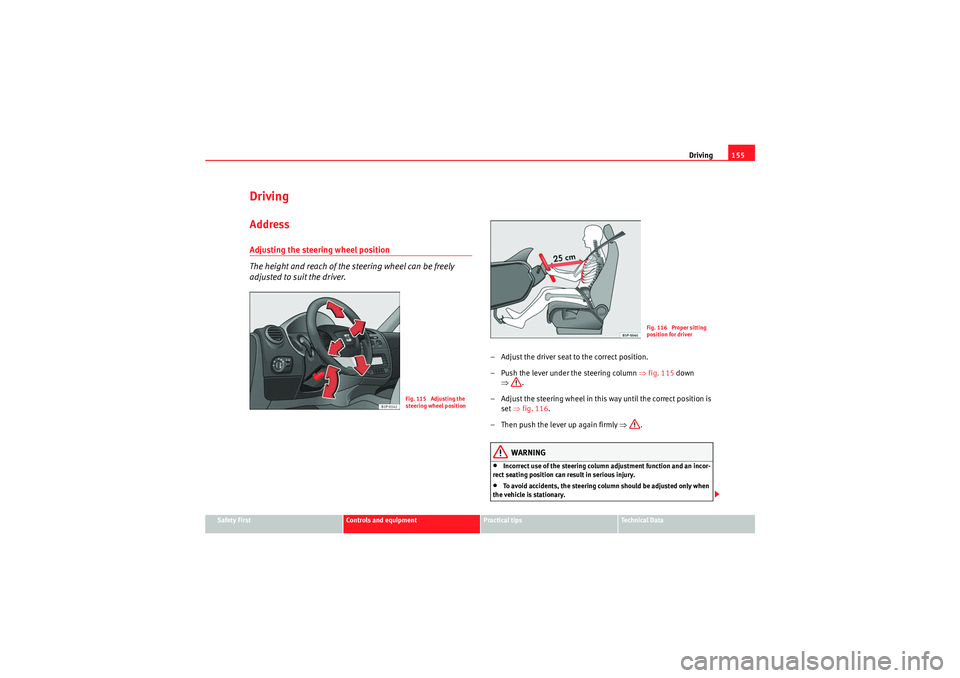
– Adjust the driver seat to the correct position.
– Push the lever under the steering column ⇒fig. 115 down
⇒ .
– Adjust the steering wheel in this way until the correct position is set ⇒fig. 116 .
– Then push the lever up again firmly ⇒.
WARNING
•Incorrect use of the steering column adjustment function and an incor-
rect seating position can result in serious injury.•To avoid accidents, the steering column should be adjusted only when
the vehicle is stationary.
Fig. 115 Adjusting the
steering wheel position
Fig. 116 Proper sitting
position for driver
Leon_EN.book Seite 155 Dienstag, 8. September 2009 5:25 17
Page 158 of 304

Driving
156•Adjust the driver seat or steering wheel so that there is a distance of at
least 25 cm between the steering wheel and your chest ⇒page 155,
fig. 116 . If you fail to observe the minimum distance, the airbag will not
protect you. Risk of fatal injury.•If your physical constitution does not allow you to maintain the
minimum distance of 25 cm, contact an Authorised Service Centre. The
Authorised Service Centre will help you to decide if special specific modifi-
cations are necessary.•If you adjust the steering wheel so that it points towards your face, the
driver airbag will not protect you properly in the event of an accident. Make
sure that the steering wheel points towards your chest.•When driving, always hold the steering wheel with both hands on the
outside of the ring at the 9 o'clock and 3 o'clock positions. Never hold the
steering wheel at the 12 o'clock position, or in any other manner (e.g. in
the centre of the steering wheel, or on the inside of the rim). In such cases,
you could receive severe injuries to the arms, hands and head.
SafetyElectronic stabilisation programme (ESP)*
ESP helps make driving safer in certain situations.The Electronic Stabilisation Program (ESP) contains the electronic differential
lock (EDL) and the traction control system (TCS). The ESP function works
together with the ABS. Both warning lamps will light up if the ESP or ABS
systems are faulty.
The ESP is started automatically when the engine is started.
The ESP is always active, and cannot be switched off. With the ESP switch it is
only possible to switch TCS off.
The TCS can be deactivated when in cases where wheel sliding is desirable.
For example:•When driving with snow chains,
WARNING (continued)
Fig. 117 Detail of the
centre console: ESP
button
Leon_EN.book Seite 156 Dienstag, 8. September 2009 5:25 17
Page 159 of 304

Driving157
Safety First
Controls and equipment
Practical tips
Technical Data
•when driving in deep snow or on loose surfaces,•when rocking the vehicle backwards and forwards to free it from mud, for
example.
Next, the button should be pressed to reactivate the TCS.
When does the warning light switch on or flash ?•On switching the ignition on, it lights up for about two seconds to carry
out a function control.•The warning lamp will start flashing when the vehicle is moving if the ESP
or the TCS is activated. The warning lamp will light up slowly if the TCS is
switched off.•It will light up continuously if there is a malfunction in the ESP.WARNING
•The electronic stabilisation programme (ESP) cannot defy the laws of
physics. This should be kept in mind, particularly on slippery and wet
roads and when towing a trailer.•Always adapt your driving style to suit the condition of the roads and
the traffic situation. Do not let the extra safety afforded by ESP tempt you
into taking any risks when driving, this can cause accidents.•Please refer to the corresponding warning notes on ESP in ⇒page 181,
“Intelligent technology”.
Ignition lockPosition of the ignition keyIgnition switched off, steering lock
In this position ⇒ fig. 118 the ignition and the engine are OFF and the
steering may be locked.
For the Steering lock to operate without the ignition key, turn the steering
wheel until it locks with an audible sound. You should always lock the
steering wheel when you leave your vehicle. This will help prevent theft of the
vehicle ⇒.
Switching the ignition or the glow plug system on
Turn the ignition key to this position and release it. If the key cannot be turned
or it is difficult to turn from position to position , move the steering
wheel back and forth until it loosens up.
Fig. 118 Ignition key
positions
A0
A1
A0
A1
Leon_EN.book Seite 157 Dienstag, 8. September 2009 5:25 17