instrument panel Seat Leon 5D 2009 Owner's Guide
[x] Cancel search | Manufacturer: SEAT, Model Year: 2009, Model line: Leon 5D, Model: Seat Leon 5D 2009Pages: 304, PDF Size: 7.72 MB
Page 118 of 304

Lights and visibility
116Dynamic curve lights (AFS)
The dynamic curve lights only operate if the vehicle is travelling at more than
10 km/h and the dipped headlamps are on. When taking a bend, the road is
illuminated better with directional gas discharge lamps than with conven-
tional fixed headlamps.
A fault in the system is indicated via the flashing of the control lamp
on the
dash panel. At the same time, a text message with information or instructions
to perform necessary operations may appear on the dash panel display. Take
the vehicle to a qualified workshop and have the fault repaired.
If the control lamp
lights up on the dash panel but all the lamps are oper-
ating correctly ⇒page 254, there may still be a fault in the dynamic curve
lighting system (AFS). Take the vehicle to a qualified workshop and have the
fault repaired.
WARNING
If the “automatic dipped light control” is switched on, the dipped head-
lights will not be switched on in fog. They should be switched on manually
using the light switch. The driver is personally responsible for the correct
use of lights in all situations. “Automatic headlight control” is merely a
system to support the driver. Where necessary, switch on the lights manu-
ally using the light switch.Fog lights with cornering function*When the indicator is switched on to turn or on very tight bends, the right or
left fog lamp automatically comes on to function as a cornering light. The
cornering light only operates if the dipped lights are on.
WARNING
If the “automatic dipped light control” is switched on, the dipped head-
lights will not be switched on in fog. They should be switched on manually
using the light switch. The driver is personally responsible for the correct
use of lights in all situations. “Automatic headlight control” is merely a
system to support the driver. Where necessary, switch on the lights manu-
ally using the light switch.Hazard warning lights
The hazard warning lights are used to draw the attention of
other road users to your vehicle in emergencies.
If your vehicle breaks down:
1. Park your vehicle at a safe distance from moving traffic.
Fig. 76 Instrument panel:
switch for hazard warning
lights
Leon_EN.book Seite 116 Dienstag, 8. September 2009 5:25 17
Page 131 of 304

Seats and stowage129
Safety First
Controls and equipment
Practical tips
Technical Data
Seats and stowageThe importance of correct seat adjustmentProper seat adjustment optimises the level of protection
offered by seat belts and airbags.Your vehicle has five passenger places, two individual front seats and three
places on the rear seat. Each seat is equipped with a three-point seat belt.
The driver seat and the front passenger seat can be adjusted in many ways to
suit the physical requirements of the vehicle occupants. The correct seat
position is very important for:•a fast and easy operation of all controls on the instrument panel,•a relaxed posture which does not cause drowsiness,•a safe driving ⇒ page 7,•ensuring that the seat belts and airbag system provide maximum protec-
tion ⇒page 19.WARNING
•If the driver and passengers assume improper sitting positions, they
may sustain critical injuries.•More people than available seats must never be transported in your
vehicle.•Every passenger in the vehicle must properly fasten and wear the seat
belt belonging to his or her seat. Chil dren must be protected with an appro-
priate child restraint system ⇒page 44, “Child safety”.•The front seats and all head restraints must always be adjusted to body
size and the seat belt must always be properly adjusted to provide you and
your passengers with optimum protection.
•Always keep your feet on the foot well when the vehicle is moving;
never rest them on the dash panel, out of the window or on the seat. This
is also applied to passengers. An incorrect sitting position exposes you to
an increased risk of injury in case of a sudden braking or an accident. If the
airbag is triggered, you could sustain severe injuries due to an incorrect
sitting position.•It is important for the driver and front passenger to keep a distance of
at least 25 cm from the steering wheel or dash panel. Failure to respect the
minimum distance means that the airbag will not protect you. Risk of fatal
injury. The distance between the driver and the steering wheel or between
the front passenger and the dash panel should always be as great as
possible.•Adjust the driver or front passenger seat only when the vehicle is
stationary. Otherwise, your seat could move unexpectedly while the
vehicle is moving. This could increase the risk of an accident and therefore,
injury. In addition, while adjusting your seat, you will assume an incorrect
sitting position. Risk of fatal accidents.•Special guidelines apply to installing a child seat on the front
passenger seat. When installing a child seat, observe the warning note in
the ⇒page 44, “Child safety”.WARNING (continued)
Leon_EN.book Seite 129 Dienstag, 8. September 2009 5:25 17
Page 154 of 304

Heating, Ventilation and Air conditioning
152Manual mode
In manual mode you can adjust the air temperature, air flow and distribution as required.Switching on manual mode
– To enter manual mode, press one of the buttons ⇒ fig. 114 to
or press the air flow control . The selected function is
shown on the radio or navigator display.Te m p e r a t u r e
There are separate temperature selectors for the left and right sides of the
vehicle interior. The selected temperature is displayed above the selector.
The compartment temperature can be set between +18°C (64°F) and +26°C
(80°F). These are approximate temperatures and the actual temperature may
be slightly higher or lower depending on the ambient conditions.
If a temperature below 18°C (64°F) is selected, the display switches to LO In
this setting the system runs at maximum cooling output and the temperature
is not regulated. If a temperature above 26°C (80°F) is selected, the display switches to
HI In
this setting the system runs at maximum heating output and the temperature
is not regulated.
Blower
The air flow may be adjusted freely using the control . Always have the
blower running at a low setting to ensure a constant flow of fresh air into the
vehicle. Pushing the button
to the minimum -1, turns the Climatronic off.
Air distribution
The air distribution is adjusted using the buttons , and . It is also
possible to open and close some of the air vents separately.
Switching the air conditioning system on and off
When the button is on (LED lit), the heating, ventilation and air condi-
tioning system is on.Fig. 114 On the instrument panel: 2C Climatronic
controls.
A1
A5
A10
A10
AC
Leon_EN.book Seite 152 Dienstag, 8. September 2009 5:25 17
Page 164 of 304

Driving
162•If there is a fault in the LPG system.•At very low temperatures below minus 10°C.
Manual switch from petrol to LPG
Press the GAS button to switch modes. When the necessary conditions are
met, the system switches to LPG mode and the ON lamp is lit. If the ON
lamp flashes, the following conditions have not been met:•There is enough LPG in the tank.•The temperature of the vehicle coolant is above 30°C.•Engine speed while driving is above 1200 rpm.
When these conditions are met, the system switches to LPG mode and the ON
lamp is lit .
Manual switch from LPG to petrol
Press the button to switch modes. When the OFF lamp is lit, the
vehicle is running on petrol.
Running on petrol
Run the engine with petrol for short journeys at regular intervals to avoid
problems in the petrol system.WARNING
LPG is a highly explosive and inflammable substance. It may cause severe
burns and other injury.•Due care must be taken to avoid any risk of fire or explosion.•When parking the vehicle in a closed area (for example in a garage),
make sure that there is adequate ventilation, either natural or mechanical,
to neutralise the LPG in the event of a leak.
Note
•If frequent short journeys are made, especially when the outside temper-
ature is low, the vehicle will tend to run on petrol more often than on LPG.
Therefore, the petrol tank may empty before the LPG tank.Start-Stop function*Description and operationThe Start-Stop function stops the engine when the vehicle is
stopped and starts it automatically when required.
– When the vehicle is stopped, put it in neutral and release the clutch pedal. The engine will stop.
– When the clutch pedal is pressed, the engine starts again.
– The instrument panel screen displays information about the status of the Start-Stop function ⇒page 164, fig. 121 .Start-Stop function conditions•The driver's seat belt must be buckled.•The engine hood must be closed.•The engine must be at operating temperature•The steering wheel must be straight.•The vehicle must be on flat ground.•The vehicle must not be in reverse.•A trailer must not be connected.
A1
A3
A3A3GAS
A1
A2
Leon_EN.book Seite 162 Dienstag, 8. September 2009 5:25 17
Page 178 of 304
Driving
176
NoteIf the fault is not corrected before you switch off the ignition, it will only be
indicated by the flashing LED on the switch
the next time you switch on
the parking aid.
Cruise control* (GRA)Description
The cruise control system is able to maintain the set speed in
the range from approx. 30 km/h to 180 km/h.Once the speed setting has been saved, you may take your foot off the accel-
erator.
WARNING
It could be dangerous to use the cruise control system if it is not possible
to drive at constant speed.•For safety reasons the cruise control system should not be used in
dense traffic, in sections with bends or where roads are in bad conditions
(e.g. aquaplaning, loose chippings, slippery surfaces, snow). Risk of acci-
dent.•Always switch the CCS off when finish to use it in order to avoid an
involuntary use.•It is dangerous to use a set speed which is too high for the current road,
traffic or weather conditions. Risk of accident.
Note
The cruise control cannot maintain a constant speed when descending down-
hill. The vehicle will accelerate due to its own weight. Use the foot brake to
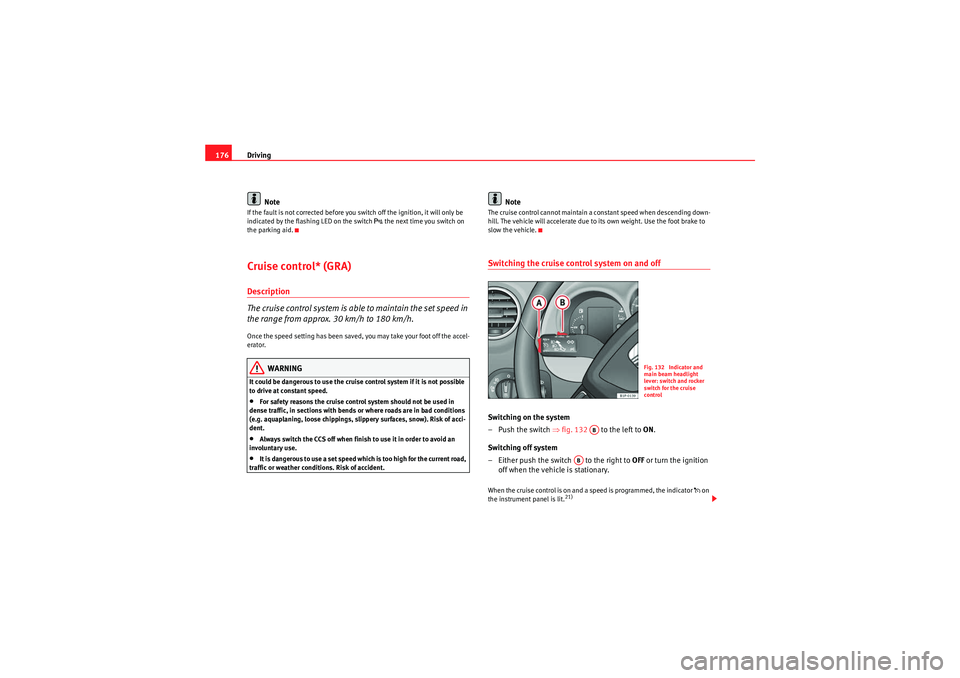
slow the vehicle.Switching the cruise control system on and offSwitching on the system
–Push the switch ⇒fig. 132 to the left to ON.
Switching off system
– Either push the switch to the right to OFF or turn the ignition
off when the vehicle is stationary.W h en the cr uis e cont rol is o n an d a sp ee d is pr ogra m m e d, the in di cato r on
the instrument panel is lit.
21)
Fig. 132 Indicator and
main beam headlight
lever: switch and rocker
switch for the cruise
control
AB
AB
Leon_EN.book Seite 176 Dienstag, 8. September 2009 5:25 17
Page 237 of 304

Wheels and tyres235
Safety First
Controls and equipment
Practical tips
Technical Data
Wear indicators
The original tyres on your vehicle have 1.6 mm high “tread wear indicators”
⇒
page 234, fig. 153 , running across the tread. Depending on the make,
there will be six to eight of them evenly spaced around the tyre. Markings on
the tyre sidewall (for instance the letters “TWI” or other symbols) indicate the
positions of the tread wear indicators. The minimum tread depth required by
law is 1.6 mm (measured in the tread grooves next to the tread wear indica-
tors). Worn tyres must be replaced. Different figures may apply in export
countries ⇒.
Tyre pressure
Incorrect tyre pressure causes premature wear and could cause tyre blow-out.
For this reason, the tyre pressure should be checked at least once per month
⇒ page 232.
Driving style
Fast cornering, heavy acceleration and hard braking all increase tyre wear.
Changing wheels around
If the front tyres are worn considerably more than the rear ones it is advisable
to cha nge t he m ar oun d as sh own ⇒ page 234, fig. 154. All the tyres will then
last for about the same time.
Wheel balance
The wheels on new vehicles are balanced. However, various factors encoun-
tered in normal driving can cause them to become unbalanced, which results
in steering vibration.
Unbalanced wheels should be rebalanced, as they otherwise cause excessive
wear on steering, suspension and tyres. A wheel must also be rebalanced
when a new tyre is fitted.
Incorrect wheel alignment
Incorrect wheel alignment causes excessive tyre wear, impairing the safety of
the vehicle. If tyres show excessive wear, you should have the wheel align-
ment checked by an Authorised Service Centre.
WARNING
There is a serious danger of accidents if a tyre bursts during driving!•The tyres must be replaced at the latest when the tread is worn down to
the tread wear indicators. Failure to do so could result in an accident. Worn
tyres do not grip well at high speeds on wet roads. There is also a greater
risk of “aquaplaning” •At continuously high speeds, a tyre with insufficient pressure flexes
more. This causes it to overheat. This can cause tread separation and tyre
blow-out. Risk of accident. Always observe the recommended tyre pres-
sures.•If tyres show excessive wear, you should have the running gear checked
by an Authorised Service Centre.•Keep chemicals such as oil, fuel and brake fluid away from tyres.•Damaged wheels and tyres must be replaced immediately!For the sake of the environment
Under-inflated tyres will increase fuel consumption.Anti-puncture tyres
Anti-puncture tyres allow you to continue driving even with a
punctured tyre, in the majority of cases.Vehicles equipped with anti-puncture
23) tyres from the factory indi-
cate the loss of tyre pressure on the instrument panel.
23)Depending upon version and country.
Leon_EN.book Seite 235 Dienstag, 8. September 2009 5:25 17
Page 238 of 304

Wheels and tyres
236
Driving with anti-puncture tyres (emergency gear)
– Leave the ESP/TCS (electronic stabilisation programme) switched on, or switch on ⇒page 182.
– Continue driving carefully and slowly (80 km/h maximum).
– Avoid sudden manoeuvres and sharp turns.
– Avoid driving over obstacles (for example kerbs) or potholes.
– Look out for the ESP/TCS intervening often, smoke coming from the tyres or the smell of rubber, the vehicle vibrating or a clat-
tering noise. If any of these occur, stop the vehicle.The anti-puncture tyres have a tag on the side of the tyre, with the description:
“DSST”, “Eufonia”, “RFT”, “ROF”, “RSC”, “SSR” or “ZP”.
The sides of this type of tyre are reinforced. When the tyres lose air they are
supported on the sides (emergency driving).
The loss of pressure in the tyre is shown on the instrument panel. You can
then drive a maximum of 80 km and if the circumstances are favourable (for
example, low load), even more.
The damaged tyre should be changed as soon as possible. The rim should be
checked in a specialist workshop to detect possible damage and replace it if
necessary. We recommend you contact Technical Service. If more than one
tyre is being used under emergency co nditions, this reduces the distance
which can be travelled.
Starting driving in emergency conditions
When the loss in tyre pressure is displayed on the instrument panel, this
implies that at least one tyre is being driven in emergency conditions ⇒.
End of emergency operation
Do not drive on if:
•smoke is coming from one of the tyres,•there is a smell of rubber,•the vehicle vibrates,•there is a rattling noise.
When is it no longer possible to continue driving even using anti-puncture
tyres?•If one of the tyres has been severely damaged in an accident, etc. If a tyre
has been badly damaged there is a risk that parts of the tread can be thrown
off and cause damage to the fuel lines, brake pipes or fuel filler.•It is also advisable to stop driving if severe vibrations occur, or if the wheel
starts overheating and gives off smoke.WARNING
When driving in emergency conditions, the driving quality of the vehicle is
considerably impaired.•The maximum permitted speed of 80 km/h is subject to road and
weather conditions. Please observe legal requirements when doing so.•Avoid sharp turns and rapid manoeuvres, and brake earlier than usual.•Avoid driving over obstacles (for example kerbs) or potholes.•If one or more tyres is being driven in emergency conditions, the driving
quality of the vehicle is impaired and there is a risk of accident.Note
•The anti-puncture tyres do not “deflate” on losing pressure because they
are supported on the reinforced sides. Therefore defects in the tyre can not be
detected with a visual inspection.•Snow chains must not be used on front tyres used in emergency
conditions.
Leon_EN.book Seite 236 Dienstag, 8. September 2009 5:25 17
Page 254 of 304

If and when
252Fuses on left side of dash panelFusesNumber
Consumer
Amperes
1
Diagnosis Switchboard/ Instrument lighting/
Headlight control switchboard/ Flow meter/
Heated wipers/ Engine management/ AFS Head-
lamps
10
2
Engine control unit/ ABS-ESP switchboard/ Auto-
matic gearbox/ Instrument panel/ Trailer switch-
board/ Light switch / Brake sensor/ Power
steering/ Right and left headlights
10
3
Airbag
5
4
Heating/ Reverse switch / ASR-ESP switch/ Elec-
trochrome mirror/ Park Pilot/ Oil level sensor
5
5
Right xenon headlight
10
6
Left xenon headlight
10
7
Vacant
8
Trailer hook pre-installation assistant
5
9
Vacant
10
Vacant
11
Vacant
12
Central locking
15
13
Diagnosis/ Light switch/ Rain sensor/ Heated rear
window
10
14
Automatic gearbox / Heating/ Automatic gearbox
lever
10
15
Vacant
16
Vacant
17
Alarm
5
18
Kombi / levers with START STOP
5
19
Fog light aid
20
20
Navigation/radio with START STOP
15
21
Engine management
10
22
Fan switch
40
23
Electric windows (front)
30
24
Body Control Unit
20
25
Rear window heater
25
26
Rear electric windows
30
27
Engine (fuel control unit/pump relay)
15
28
Convenience controls
30
29
Vacant
30
Automatic gearbox
20
31
Vacuum pum p
20
32
Vacant
33
Sunroof
25
34
Comfort switchboard/Central locking system
25
35
Vacant
36
Headlight washer system
20
37
Heated seats
30
38
Engine management
10
39
Te lep ho ne wi th START STOP
10
Number
Consumer
Amperes
Leon_EN.book Seite 252 Dienstag, 8. September 2009 5:25 17
Page 255 of 304

If and when253
Safety First
Controls and equipment
Practical tips
Technical Data
Some of the electrical items listed in the table are only fitted on certain
models or are optional extras.
Please note that the above list, while correct at the time of printing, is subject
to alterations. If discrepancies should occur, please refer to the sticker on the
inside of the fuse cover for the correct information for your model.
Fuses layout, engine compartment, left partFuses
40
Fan switch
40
41
Rear wiper motor / Switchboard wiring
20
42
12 V socket/ Cigarette lighter
20
43
Trailer bracket preinstallation
15
44
Trailer bracket preinstallation
20
45
Trailer bracket preinstallation
15
46
Vaca n t
47
Engine management
10
48
Engine management
10
49
Vaca n t
Number
Consumer
Amperes
1
Windscreen wipers
30
2
DQ200 gearbox
30
3
Cable control unit
5
Number
Consumer
Amperes
4
ABS
20
5
AQ gearbox
15
6
Instrument panel/Steering column
5
7
Ignition key
40
8
Radio
15
9
Telephone/TomTom Navigator
5
10
Engine management
5
Engine management
10
11
Vaca n t
12
Electronic control unit
5
13
Petrol injection module supply
15
Diesel injection module supply
30
14
Coil
20
15
Engine management
5
Pump relay
10
16
Right lighting
30
17
Horn
15
18
Vaca n t
19
Clean
30
20
Water pump
10
Pressure sensor pump for 1.8 engine
20
21a)
Lambda probe
15
22
Brake pedal, speed sensor
5
Number
Consumer
Amperes
Leon_EN.book Seite 253 Dienstag, 8. September 2009 5:25 17
Page 300 of 304

Index
298OObservations . . . . . . . . . . . . . . . . . . . . . . . . . . . 192
Octane number . . . . . . . . . . . . . . . . . . . . . . . . . 213
Oil . . . . . . . . . . . . . . . . . . . . . . . . . . . . . . . . . . . . \
218
Oil change . . . . . . . . . . . . . . . . . . . . . . . . . . . . . 221
Oil properties . . . . . . . . . . . . . . . . . . . . . . . . . . . 219
One-touch opening and closing
Electric windows . . . . . . . . . . . . . . . . . . . . . 107
Opening and locking . . . . . . . . . . . . . . . . . . . . 104
Overview Control lamps . . . . . . . . . . . . . . . . . . . . . . . . 75
Dash panel . . . . . . . . . . . . . . . . . . . . . . . . . . . 53
Instruments . . . . . . . . . . . . . . . . . . . . . . . . . . 55
Warning lamps . . . . . . . . . . . . . . . . . . . . . . . 75PPaintworkPolishing . . . . . . . . . . . . . . . . . . . . . . . . . . . 200
Parking . . . . . . . . . . . . . . . . . . . . . . . . . . . . . . . . 172
Parking lights . . . . . . . . . . . . . . . . . . . . . . . . . . 118
Parking system . . . . . . . . . . . . . . . . . . . . . . . . . 173
Parking system plus . . . . . . . . . . . . . . . . . . . . . 174
Parts . . . . . . . . . . . . . . . . . . . . . . . . . . . . . . . . . . 206
Parts replacement . . . . . . . . . . . . . . . . . . . . . . . 206
Pedals . . . . . . . . . . . . . . . . . . . . . . . . . . . . . . . . . 16
Petrol . . . . . . . . . . . . . . . . . . . . . . . . . . . . . . . . . 213 Driving abroad . . . . . . . . . . . . . . . . . . . . . . . 192
Petrol additives . . . . . . . . . . . . . . . . . . . . . . . . . 214
Petrol engines, starting . . . . . . . . . . . . . . . . . . 158 Physical principles of a frontal collision . . . . . . 20
Plastic parts . . . . . . . . . . . . . . . . . . . . . . . . . . . . 200
Plastic parts cleaning . . . . . . . . . . . . . . . . . . . . 204
Pollen filter . . . . . . . . . . . . . . . . . . . . . . . . . . . . 153
Power steering . . . . . . . . . . . . . . . . . . . . . . . . . . 187
Power steering system
warning light . . . . . . . . . . . . . . . . . . . . . . . . . 82
Products for vehicle maintenance . . . . . . . . . . 197
RRadio frequency remote control Changing the battery . . . . . . . . . . . . . . . . . 101
Radio navigation Steering wheel controls audio + telephone version . . . . . . . . . . . . . . 89
audio version . . . . . . . . . . . . . . . . . . . . . . . . . 89
Radio wave remote control . . . . . . . . . . . . . . . . 100
Rain sensor* . . . . . . . . . . . . . . . . . . . . . . . . . . . 123
Rear fog light Indication lamp . . . . . . . . . . . . . . . . . . . . . . 111
Warning lamp . . . . . . . . . . . . . . . . . . . . . . . . 78
Rear interior lights . . . . . . . . . . . . . . . . . . . . . . 120
Rear lights . . . . . . . . . . . . . . . . . . . . . . . . . . . . . 258
Rear reading lights . . . . . . . . . . . . . . . . . . . . . . 120
Rear seat bench . . . . . . . . . . . . . . . . . . . . . . . . . 134
Rear window heating Heating element wires . . . . . . . . . . . . . . . . 201
Rear window wiper . . . . . . . . . . . . . . . . . . . . . . 124
Rear-view mirror . . . . . . . . . . . . . . . . . . . . . . . . 125
Recommended gear display . . . . . . . . . . . . . . . . 60 Refuelling . . . . . . . . . . . . . . . . . . . . . . . . . . . . . 208
Registration light . . . . . . . . . . . . . . . . . . . . . . . 262
Remote control key
Buttons . . . . . . . . . . . . . . . . . . . . . . . . . . . . 100
Synchronising . . . . . . . . . . . . . . . . . . . . . . . 101
Removing and fitting the wheel . . . . . . . . . . . . 246
Repairs airbags . . . . . . . . . . . . . . . . . . . . . . . . . . . . . . 31
Replacement keys . . . . . . . . . . . . . . . . . . . . . . . . 99
Rev counter . . . . . . . . . . . . . . . . . . . . . . . . . . . . . 57
Reverse gear Manual gearbox . . . . . . . . . . . . . . . . . . . . . 165
Roll-back function Sliding/tilting roof . . . . . . . . . . . . . . . . . . . 110
Windows . . . . . . . . . . . . . . . . . . . . . . . . . . . 107
Roof aerial* . . . . . . . . . . . . . . . . . . . . . . . . . . . . 207
Roof carrier* . . . . . . . . . . . . . . . . . . . . . . . . . . . 141
Rubber seals . . . . . . . . . . . . . . . . . . . . . . . . . . . 201
Running in Engine . . . . . . . . . . . . . . . . . . . . . . . . . . . . . 188
SSafe driving . . . . . . . . . . . . . . . . . . . . . . . . . . . . . . 7
Safety . . . . . . . . . . . . . . . . . . . . . . . . . . . . . . . . . . . 8
Safety equipment . . . . . . . . . . . . . . . . . . . . . . . . . 7
Safety instructionsCoolant temperature . . . . . . . . . . . . . . . . . . . 78
Safety notes Airbags . . . . . . . . . . . . . . . . . . . . . . . . . . . . . . 31
Belt tension devices . . . . . . . . . . . . . . . . . . . 27
Leon_EN.book Seite 298 Dienstag, 8. September 2009 5:25 17