ECU Seat Leon 5D 2010 Owner's Guide
[x] Cancel search | Manufacturer: SEAT, Model Year: 2010, Model line: Leon 5D, Model: Seat Leon 5D 2010Pages: 309, PDF Size: 8.2 MB
Page 139 of 309
Seats and storage compartments137
Safety First
Operating Instructions
Practical Tips
Technical Specifications
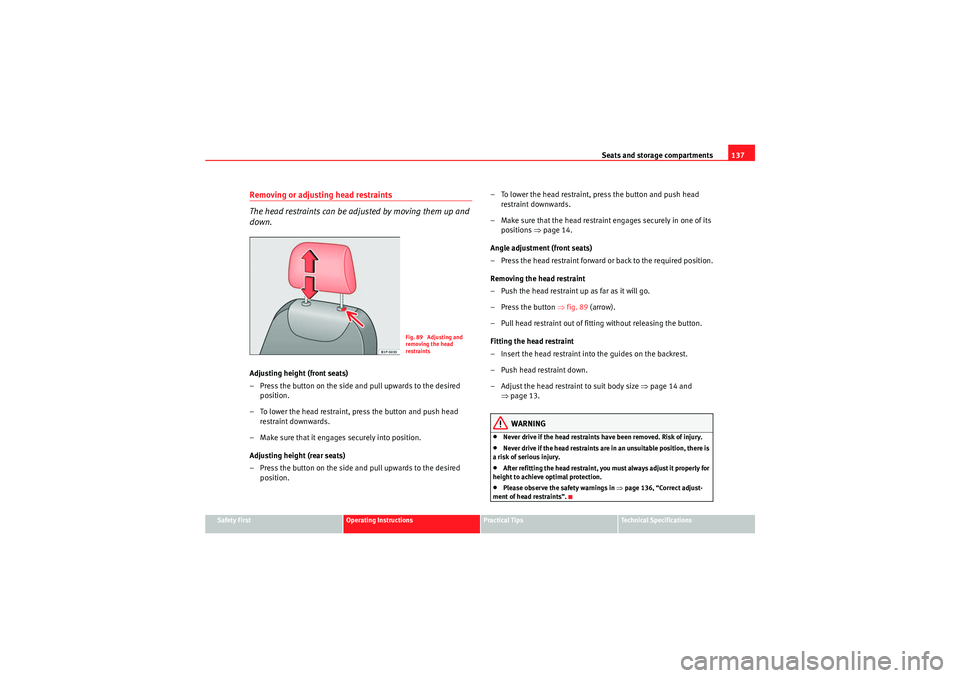
Removing or adjusting head restraints
The head restraints can be adjusted by moving them up and
down.Adjusting height (front seats)
– Press the button on the side and pull upwards to the desired
position.
– To lower the head restraint, press the button and push head
restraint downwards.
– Make sure that it engages securely into position.
Adjusting height (rear seats)
– Press the button on the side and pull upwards to the desired position. – To lower the head restraint,
press the button and push head
restraint downwards.
– Make sure that the head restraint engages securely in one of its positions ⇒page 14.
Angle adjustment (front seats)
– Press the head restraint forward or back to the required position.
Removing the head restraint
– Push the head restraint up as far as it will go.
– Press the button ⇒fig. 89 (arrow).
– Pull head restraint out of fitting without releasing the button.
Fitting the head restraint
– Insert the head restraint into the guides on the backrest.
– Push head restraint down.
– Adjust the head restraint to suit body size ⇒page 14 and
⇒ page 13.
WARNING
•Never drive if the head restraints have been removed. Risk of injury.•Never drive if the head restraints are in an unsuitable position, there is
a risk of serious injury.•After refitting the head restraint, you must always adjust it properly for
height to achieve optimal protection.•Please observe the safety warnings in ⇒page 136, “Correct adjust-
ment of head restraints”.
Fig. 89 Adjusting and
removing the head
restraints
Leon_EN.book Seite 137 Mittwoch, 1. September 2010 6:16 18
Page 140 of 309

Seats and storage compartments
138 Front seatsAdjustment of the front seats The control elements in ⇒fig. 90 are mirrored for the front right-
hand seat.
Adjusting the seat forwards and backwards
– Pull up the grip and move the seat forwards or backwards.
– Then release the grip and move the seat further until the catch engages.
Adjusting the seat height*
– Pull the lever up or push down (several times if necessary) from its home position. This adjust s the seat height in stages. Adjusting the backrest angle
– Take your weight off the backrest and turn the hand wheel.
Adjusting the lumbar support*
– Take your weight off the backrest and turn the hand wheel to adjust the lumbar support.
As you make the adjustments, the curvature of the cushioned area of the
lumbar region becomes more or less acute. In this way, it adapts to the
natural curvature of the spine.
WARNING
•Never adjust the driver or front passenger seat while the vehicle is in
motion. While adjusting your seat, you will assume an incorrect sitting
position. Risk of fatal accidents. Adjust the driver or front passenger seat
only when the vehicle is stationary.•To reduce the risk of injury to the driver and front passenger in case of
a sudden braking or an accident, never drive with the backrest tilted
towards the rear. The maximum protection of the seat belt can be achieved
only when the backrests are in an upright position and the driver and front
passenger have properly adjusted their seat belts. The further the back-
rests are tilted to the rear, the greater the risk of injury due to improper
positioning of the belt web!•Exercise caution when securing the seat height into forwards/back-
wards position. Injuries can be caused if the seat height is adjusted
without due care and attention.
Fig. 90 Front left seat
controls
A1
A1
A2
A3A4
Leon_EN.book Seite 138 Mittwoch, 1. September 2010 6:16 18
Page 148 of 309

Seats and storage compartments
146The fire extinguisher* is attached to the luggage compartment carpet with
Ve lcro.
Note
•The first aid kit and the fire extinguisher are not part of the vehicle’s
standard equipment.•The first aid kit must comply with legal requirements.•Observe the expiry date of the contents of the first aid kit. After it has
expired you should purchase a new one.•The fire extinguisher must comply with legal requirements.•Ensure that the fire extinguisher is fully functional. The fire extinguisher
should, therefore, be checked regularly. The sticker on the fire extinguisher
will inform you of the next date for checking.•Before acquiring accessories and emergency equipment see the instruc-
tions in ⇒page 212.Luggage compartmentStoring objects
All luggage must be securely stowed.Please observe the following points to ensure the vehicle handles
well at all times:
– Distribute the load as evenly as possible.
– Place heavy objects as far forward in the luggage compartment
as possible. – Secure luggage in the luggage compartment with suitable straps
on the fastening rings.
WARNING
•Loose luggage and other loose items in the vehicle can cause serious
injuries.•Loose objects in the luggage compartment can suddenly move and
change the way the vehicle handles.•During sudden manoeuvres or accidents, loose objects in the
passenger compartment can be flung forward, injuring vehicle occupants.•Always store objects in the luggage compartment and secure with suit-
able straps. This is especially important for heavy objects.•When you transport heavy objects, always take in account that a
change in the centre of gravity can also cause changes in vehicle handling.•Please observe information on safe driving ⇒page 7, “Safe driving”.Caution
Hard objects on the shelf could chafe against the wires of the heating
element in the rear window and cause damage.
Note
The ventilation slots in front of the rear side windows must not be covered as
this would prevent stale air being extracted from the vehicle.
Leon_EN.book Seite 146 Mittwoch, 1. September 2010 6:16 18
Page 179 of 309

Driving177
Safety First
Operating Instructions
Practical Tips
Technical Specifications
– Apply the handbrake.
– The 1st gear should also be selected.
– Switch the engine off and remove the key from the ignition. Turn
the steering wheel slightly to engage the steering lock.
– Always take you car keys with you when you leave the vehicle ⇒ .Additional notes on parking the vehicle on gradients:
Turn the steering wheel so that the vehicle rolls against the kerb if it started
to roll.•If the vehicle is parked facing downhill, turn the front wheels so that they
point towards the kerb .•If the vehicle is parked facing uphill, turn the front wheels so that they
point away from the kerb .•Secure the vehicle as normal by applying the handbrake firmly and
engaging 1st gear.WARNING
•Take measures to reduce the risk of injury when you leave your vehicle
unattended.•Never park where the hot exhaust system could ignite inflammable
materials, such as dry grass, low bushes, spilt fuel etc.•Never allow vehicle occupants to remain in the vehicle when it is
locked. They would be unable to open the vehicle from the inside, and
could become trapped in the vehicle in an emergency. In the event of an
emergency, locked doors will delay assistance to occupants.•Never leave children alone in the vehicle. They could set the vehicle in
motion, for example, by releasing the handbrake or the gear lever.
•Depending on weather conditions, it may become extremely hot or cold
inside the vehicle. This can be fatal.
Hill-start aid*
This function is only included in vehicles with ESP.This device helps when starting uphill.
These are the basic operation conditions: doors closed, brake pedal pressed
down and vehicle in neutral. The system gets activated on engaging gear.
This system also works when reversing uphill.
After removing your foot from the brake pedal, the braking force is maintained
for a few seconds to prevent the vehicle from moving backward when putting
into gear. This short space of time is enough to start the vehicle with ease.
This system also works when reversing uphill.
WARNING
•If you do not start the vehicle immediately after taking your foot off the
brake pedal, the vehicle may start to roll back under certain conditions.
Depress the brake pedal or use the hand brake immediately.•If the engine stalls, depress the brake pedal or use the hand brake
immediately.•When following a line of traffic uphill, if you want to prevent the vehicle
from rolling back accidentally when starting off, hold the brake pedal down
for a few seconds before starting off.WARNING (continued)
Leon_EN.book Seite 177 Mittwoch, 1. September 2010 6:16 18
Page 201 of 309

Trailer towing199
Safety First
Operating Instructions
Practical Tips
Technical Specifications
Trailer towingInstructions to followYour vehicle may be used to tow a trailer when fitted with the correct equip-
ment.
If the vehicle is supplied with a factory-fitted towing bracket it will already
have the necessary technical modifications and meet the statutory require-
ments for towing a trailer. For the after-market fitting of a trailer towing
bracket see ⇒page 201.
Connectors
Your vehicle is fitted with a 12-pin connector for the electrical connection
between the trailer and the vehicle.
If the trailer has a 7-pin plug you will need to use an adapter cable. This is
available in any SEAT dealer.
Trailer weight / drawbar load
Never exceed the authorised trailer weight. If you do not load the trailer up to
the maximum permitted trailer weight, you can then climb correspondingly
steeper slopes.
The maximum trailer weights listed are only applicable for altitudes up to
1000m above sea level. With increasing altitude the engine power and there-
fore the vehicle’s climbing ability are impaired because of the reduced air
density. The maximum trailer weight has to be reduced accordingly. The
weight of the vehicle and trailer combination must be reduced by 10% for
every 1000 m of height. The gross combination weight is the actual weight of
the laden vehicle plus the actual weight of the laden trailer. When possible,
operate the trailer with the maximum permitted drawbar load on th e ba ll jo int
of the towing bracket, but do not exceed the specified limit. The figures for
trailer weights and drawbar loads that are given on the data
plate of the towing bracket are for certification purposes only. The correct
figures for your specific model, which may be lower than these figures for the
towing bracket, are given in the vehicle documents or in ⇒Section “Tech-
nical Data”.
Distributing the load
Distribute loads in the trailer so that heavy objects are as near to the axle as
possible. Loads carried in the trailer must be secured to prevent them
moving.
Tyre pressure
Set tyre pressure to the maximum permissible pressure shown on the sticker
on the inside of the fuel tank flap. Set the tyre pressure of the trailer tyres in
accordance with the trailer manufacturer’s recommendations.
Exterior mirrors
Check whether you can see enough of the road behind the trailer with the
standard mirrors. If this is not the case, you should have additional mirrors
fitted. Both exterior mirrors should be mounted on hinged extension
brackets. Adjust the mirrors to give sufficient vision to the rear.
WARNING
Never transport people in a trailer. This could result in fatal accidents.
Note
•Towing a trailer places additional demands on the vehicle. We recom-
mend additional services between the normal inspection intervals if the
vehicle is used frequently for towing a trailer.
Leon_EN.book Seite 199 Mittwoch, 1. September 2010 6:16 18
Page 202 of 309

Trailer towing
200•Find out whether special regulations apply to towing a trailer in your
country.Ball coupling of towing bracket*Depending on the model version, the spherical head on the trailer hook may
be found in the tool box.
The ball coupling is provided with instructions on fitting and removing the
ball coupling of the towing bracket.
WARNING
The towing bracket ball coupling must be stored securely in the luggage
compartment to prevent them being flung through the vehicle and causing
injury.
Note
•By law, the ball coupling must be re moved if a trailer is not being towed
and it obscures the number plate.Driving tipsDriving with a trailer always requires extra care.Weight distribution
The weight distribution of a loaded trailer with an unladen vehicle is very
unfavourable. However, if this cannot be avoided, drive extra slowly to allow
for the unbalanced weight distribution. Speed
The stability of the vehicle and trailer is reduced with increasing speed. For
this reason, it is advisable not to drive at the maximum permissible speed in
an unfavourable road, weather or wind conditions. This applies especially
when driving downhill.
You should always reduce speed immediately if the trailer shows the slightest
sign of
snaking . Never try to stop the “snaking” by increasing speed.
Always brake in due course. If the trailer has an overrun brake, apply the
brakes gently at first and then, firmly. This will prevent the jerking that can be
caused by the trailer wheels locking. Select a low gear in due course before
going down a steep downhill. This enables you to use the engine braking to
slow down the vehicle.
Reheating
At very high temperatures and during prolonged slopes, driving in a low gear
and high engine speed, always monitor the coolant temperature gauge
⇒ page 55.
Electronic Stability Programme*
The ESP* system helps to stabilise the trailer in case of skidding or rocking.
Leon_EN.book Seite 200 Mittwoch, 1. September 2010 6:16 18
Page 204 of 309

Trailer towing
202If a towing bracket is to be fitted after the vehicle is purchased, this must be
completed according to the instructions of the towing bracket manufacturer.
The attachment points for the towing bracket are on the lower part of the
vehicle.
The distance between the centre of the ball coupling and the ground should
never be lower than the indicated value, even with a fully loaded vehicle and
including the maximum drawbar load.
Elevation values for securing the towing bracket:
65 mm (minimum)
350 mm to 420 mm (fully laden vehicle)
357 mm
569 mm
875 mm
1040 mm
Fitting a towing bracket•Driving with a trailer involves an extra effort for the vehicle. Therefore,
before fitting a towing bracket, please contact an Authorised Service Centre
to check whether your cooling system needs modification.•The legal requirements in your country must be observed (e.g. the fitting
of a separate warning lamp).•Certain vehicle components, e.g. the rear bumper, must be removed and
reinstalled. The towing bracket securing bolts must be tightened using a
torque wrench, and a power socket must be connected to the vehicle’s elec-
trical system. This requires specialised knowledge and tools.•Figures in the illustration show the elevation value and the attachment
points which must be considered if you are retrofitting a towing bracket.WARNING
The towing brackets should be fitted at a specialised workshop.
•If the towing bracket is incorrectly installed, there is serious danger of
accident.•For your own safety, please observe the instructions provided by the
manufacturer of the towing bracket.Caution
•If the power socket is incorrectly installed, this could cause damage to the
vehicle’s electrical system.Note
For the sports model (FR, Cupra...), fitting of a trailer bracket is not recom-
mended due to the design of the bumpers.
AA
ABACADAEAFAG
WARNING (continued)
Leon_EN.book Seite 202 Mittwoch, 1. September 2010 6:16 18
Page 216 of 309

Checking and refilling levels
214Checking and refilling levelsRefuellingThe fuel cap cover opens automatically with the central
locking system. The tank holds approximately 55 litres.Unscrewing the tank cap
– Lift the lid.
– Unscrew the cap, turning it anti-clockwise.
Closing the tank cap
– Screw the tank cap to the right, until the point of feeling a “click”.
– Close the drawer. Make sure you hear it click into place. The tank
cap is secured with an anti-loss attachment
The tank flap is at the rear of the vehicle on the right.
If the automatic filler nozzle is operated correctly, it will switch itself off as
soon as the tank is “full”. Never attempt to fill beyond this point, as this will
fill the expansion chamber. Fuel may leak out if ambient conditions are warm.
T he co rr ec t fu el g rad e fo r you r v eh icle is giv en on a sti cker o n th e i nsid e of the
fuel tank flap. Here you will find further information on fuel.
Releasing the fuel tank flap manually
If the central locking system fails, the fuel tank flap can be opened manually
as follows:•Open the tailgate•Remove the cover from the right side trim in the luggage compartment.•Insert a hand and pull the locking device back•Open the cap and take out the plug.WARNING
•Fuel is highly flammable and can cause serious burns and other inju-
ries.
−Never smoke or use an open flame when filling the fuel tank of the
vehicle, or a spare fuel canister, with fuel. This is an explosion hazard.
− Follow legal requirements for the use of spare fuel canisters.
− For safety reasons we do not recommend carrying a spare fuel
canister in the vehicle. The canister could be damaged in an accident
and leak.•If, in exceptional circumstances, you have to carry a spare fuel canister,
please observe the following points:
Fig. 138 Tank flap open
Leon_EN.book Seite 214 Mittwoch, 1. September 2010 6:16 18
Page 224 of 309

Checking and refilling levels
222•Never touch the radiator fan. It is temperature controlled and could
start automatically, even when the engine has been switched off and the
key removed from the ignition!•Do not unscrew the cap on the coolant reservoir when the engine is hot.
If the coolant is hot, the cooling system will be pressurised!•Protect face, hands and arms by covering the cap with a large, thick
cloth to protect against escaping coolant and steam.•Al wa ys m ake s u re yo u ha ve n o t l e f t a ny o bj e c t s , s u ch as cl e an i n g cl o t h s
and tools, in the engine compartment.•If you have to work underneath the vehicle, you must use suitable
stands additionally to support the vehicle, there is a risk of accident!. A
hydraulic jack is insufficient for securing the vehicle and there is a risk of
injury.•If any work has to be performed when the engine is started or with the
engine running, there is an additional, potentially fatal, safety risk from the
rotating parts, such as the drive belts, alternator, radiator fan, etc., and
from the high-voltage ignition system. You should also observe the
following points:
−Never touch the electrical wiring of the ignition system.
− Ensure that jewellery, loose clothing and long hair do not get
trapped in rotating engine parts. Da nger of death. Before starting any
work remove jewellery, tie back and cover hair, and wear tight-fitting
clothes.
− Never accelerate with a gear engaged without taking the necessary
precautions. The vehicle could move, even if the handbrake is applied.
Danger of death.•If work has to be carried out on the fuel system or on electrical compo-
nents, you must observe the following safety notes in addition to the above
warnings:
−Always disconnect the battery. The vehicle must be unlocked when
this is done, otherwise the alarm will be triggered. −
Do not smoke.
− Never work near naked flames.
− Always have a fire extinguisher on hand.
Caution
When topping up service fluids, make sure not to mistake them. Using the
wrong fluids could cause serious malfunctions and engine damage!
For the sake of the environment
Service fluids leaks are harmful to the environment. For this reason you
should make regular checks on the grou nd underneath your vehicle. If you
find spots of oil or other fluids, have your vehicle inspected at a specialised
workshop.
WARNING (continued)
WARNING (continued)
Leon_EN.book Seite 222 Mittwoch, 1. September 2010 6:16 18
Page 225 of 309

Checking and refilling levels223
Safety First
Operating Instructions
Practical Tips
Technical Specifications
Opening the bonnet
The bonnet is released from inside the vehicle.
Before opening the bonnet ensure that the windscreen wipers are in
rest position.
– To release the bonnet, pull the lever under the dash panel
⇒fig. 142 in the direction indicated (arrow). The bonnet will be
released by a spring action ⇒.
– Lift the bonnet using the release lever (arrow) and open the bonnet.
– Release the bonnet stay and secure it in fixture designed for this
in the bonnet.
WARNING
Hot coolant can scald!•Never open the bonnet if you see steam, smoke or coolant escaping
from the engine compartment.•Wait until no more steam, smoke or coolant is emitted from the bonnet,
then carefully open the bonnet.•When working in the engine compartment, always observe the safety
warnings ⇒page 221.
Closing the bonnet– Raise the bonnet slightly.
– Release the bonnet stay and replace it in its support.
– At a height of about 30 cm let it fall so it is locked.
Fig. 142 Detail of foot-
well area on driver side:
lever for unlocking the
bonnet.Fig. 143 Arrester hook
for bonnet.
Leon_EN.book Seite 223 Mittwoch, 1. September 2010 6:16 18