maintenance Seat Leon 5D 2011 User Guide
[x] Cancel search | Manufacturer: SEAT, Model Year: 2011, Model line: Leon 5D, Model: Seat Leon 5D 2011Pages: 302, PDF Size: 4.17 MB
Page 203 of 302
201
Vehicle maintenance and cleaning
WARNING
● Wash your vehicle with the ignition switched off.
● Protect your hands and arms from cuts on sharp metal edges when
cleaning the underbody, the inside of the wheel housings etc. Risk of in-
jury.
● Water, ice and salt on the brakes can reduce braking efficiency. Risk
of accident.
CAUTION
● Never remove dirt, mud or dust if the vehicle surface is dry. Never use a
dry cloth or sponge for cleaning purposes. This could scratch the paintwork
or glass on your vehicle.
● Washing the vehicle in low temperatures: when washing the vehicle
with a hose, do not direct water into the lock cylinders or the gaps around
the doors, tailgate, or sunroof. Risk of freezing.
For the sake of the environment
To protect environment, the vehicle should be washed only in specially pro-
vided wash bays. This prevents toxic, oil-laden waste water entering the
sewerage system. In some places, washing vehicles outside wash bays is
prohibited.
Note
Do not wash the vehicle in direct sunlight. Washing the vehicle with a high pressure cleaner
Be particularly careful when using a high pressure cleaner!
– Always observe the instructions for the high-pressure cleaner,
particularly those concerning the pressure and the spraying
distance.
– Increase the spraying distance for soft materials and painted
bumpers.
– Do not use a high pressure cleaner to remove ice or snow from
windows ⇒ page 202.
– Never use concentrated jet nozzles (“rotating jets”) ⇒
.
– After washing, avoid sudden and sharp braking. “Dry” the
brakes by braking several times ⇒ page 189.
WARNING
● Never wash tyres with a concentrated jet (“rotating nozzle”). Even at
large spraying distances and short cleaning times, visible and invisible
damage can occur to the tyres. This may cause an accident.
● Water, ice and salt on the brakes can reduce braking efficiency. Risk
of accident.
CAUTION
● Do not use water hotter than 60°C. This could damage the vehicle.
● To avoid damage to the vehicle, keep a sufficient distance from sensitive
materials such as flexible hoses, plastic, soundproofing material, etc. This
is also important for bumpers painted in the colour of the bodywork. The
closer the nozzle is to the surface, the greater the wear on the material.
Safety FirstOperating InstructionsPractical TipsTechnical Specifications
Page 204 of 302
202Vehicle maintenance and cleaning
Vehicle paint maintenance
Regular waxing protects the paintwork.
You need to apply wax to your vehicle if water does not form small drops
and run off the paintwork when it is clean.
Good quality hard wax products are available at your Authorised Service
Centre.
Regular wax applications help to protects the paintwork from environmental
contaminants. ⇒ page 199. It also protects against minor scratches.
Even if a wax solution is used regularly in the vehicle washing tunnel, it is
advisable to protect the paint with a hard wax coating at least twice a year.
Polishing the paintwork
Polishing brings back gloss to the paintwork. Polishing is only necessary if the paint has lost its shine, and the gloss can-
not be brought back by applying wax. Polishing products can be purchased
in your Authorised Service Centre.
The vehicle must be waxed after polishing if the polish used does not con-
tain wax compounds to seal the paint ⇒ page 202, Vehicle paint mainte-
nance.
CAUTION
To prevent damage to the paintwork:
● Do not use polishes and hard wax on painted parts with a matte finish
or on plastic parts.
● Do not polish your vehicle in a sandy or dusty environment. Caring for plastic parts
Solvents damage plastic parts.
If normal washing fails to clean plastic parts, clean them with approved
sol-
vent-free plastic cleaning and care products.
CAUTION
● The use of liquid air freshener directly over the air vents of the vehicle
may damage the plastic parts if the liquid is accidentally spilled.
● Cleaning products which contain solvents will damage the material.
Cleaning windows and exterior mirrors
Cleaning windows
– Moisten the windows with commercially available, alcohol
based glass cleaner.
– Dry the windows with a clean chamois leather or a lint-free
cloth.
Removing snow
– Use a small brush to remove snow from the windows and mir-
rors.
Removing ice
– Use a de-icer spray.
Use a clean cloth or chamois leather to dry the windows. The chamois leath-
ers used on painted surfaces are not suitable to clean windows because
they are soiled with wax deposits which could smear the windows.
Page 205 of 302
203
Vehicle maintenance and cleaning
If possible, use a de-icing spray to remove ice. If you use an ice scraper,
push it in one direction only without swinging it.
Use window cleaner or a silicone remover to clean rubber, oil, grease and
silicone deposits off.
Wax deposits can be removed with a special cleaner available in your Au-
thorised Service Centre. Wax deposits on the windscreen could cause the
wiper blades to judder. Adding a window cleaner that dissolves wax to the
windscreen washer fluid prevents wiper blades from juddering, but wax de-
posits are not removed.
CAUTION
● Never use warm or hot water to remove snow and ice from windows and
mirrors. This could cause the glass to crack!
● The heating element for the rear window is located on the inner side of
the window. To prevent damage, do not put stickers on the heating ele-
ments inside the window.
Cleaning windscreen wiper blades
Clean wiper blades improve visibility.
1. Use a soft cloth to remove dust and dirt from the windscreen wiper blades.
2. Use window cleaner to clean the windscreen wiper blades. Use a sponge or a cloth to remove stubborn dirt. Rubber seals maintenance
If rubber seals are well looked after, they will not freeze so
quickly.
1. Use a soft cloth to remove dust and dirt from the rubber seals.
2. Apply a specialist care product to the rubber seals.
The rubber strips on the doors, windows, bonnet and tailgate will remain
pliable and last longer if they are treated with a suitable care product (for
example silicone spray).
Caring for rubber seals will also prevent premature ageing and leaks. The
doors will be easier to open. If rubber seals are well looked after, they will
not freeze so quickly in winter.
Door lock cylinders
The door lock cylinders can freeze up in winter.
To de-ice the lock cylinders you should only use spray with lubricating and
anti-corrosive properties.
Cleaning chrome parts
1. Clean chrome parts with a damp cloth.
2. Polish chrome parts with a soft, dry cloth. If this does not provide satisfying results, use a specialist chrome cleaning
product. Chrome cleaning products will remove stains from the surface.
Safety FirstOperating InstructionsPractical TipsTechnical Specifications
Page 206 of 302
204Vehicle maintenance and cleaning
CAUTION
To prevent scratching chrome surfaces:
● Never use an abrasive cleaning product on chrome.
● Do not clean or polish chrome parts in a sandy or dusty environment.
Steel wheel rims
– Clean steel wheel rims regularly using a separate sponge.
Use an industrial cleaner to remove brake dust. Any damage to the paint on
steel wheel rims should be repaired before starting to rust.
WARNING
● Never wash tyres with a cylindrical jet. Even at large spraying distan-
ces and short cleaning times, visible and invisible damage can occur to
the tyres. This may cause an accident.
● Water, ice and salt on the brakes can reduce braking efficiency. Risk
of accident. Directly after washing, avoid sudden and sharp braking.
“Dry” the brakes by braking several times ⇒ page 189, Braking capacity
and braking distance.
Alloy wheel rims
Every two weeks
– Wash salt and brake dust from alloy wheels.
– Use an acid free detergent to clean the wheel rims. Every three months
–
Apply a hard wax compound to the wheels.
Alloy wheels require regular attention to preserve their appearance. If road
salt and brake dust are not often removed, the aluminium finish will be im-
paired.
Always use an acid-free detergent for alloy wheel rims.
Car polish or other abrasive agents should not be used. If the protective
coating is damaged, e.g. by flying stones, the damaged area should be re-
paired immediately.
WARNING
● Never wash tyres with a cylindrical jet. Even at large spraying distan-
ces and short cleaning times, visible and invisible damage can occur to
the tyres. This may cause an accident.
● Water, ice and salt on the brakes can reduce braking efficiency. Risk
of accident. Directly after washing, avoid sudden and sharp braking.
“Dry” the brakes by braking several times ⇒ page 189, Braking capacity
and braking distance.
Underbody protection
The vehicle underbody is coated to protect it from chemical
and mechanical damage.
The protective coating can be damaged when driving. We recommend you
to check the protective coating under the body and on the running gear, and
reinstated if necessary, before and after the winter season.
We recommend you to go to your Authorised Service Centre to carry out re-
pair work and additional anti-corrosion work.
Page 207 of 302
205
Vehicle maintenance and cleaning
WARNING
Do not apply underseal or anti-corrosion coatings to the exhaust pipes,
catalytic converter or the heat shields on the exhaust system. The heat of
the exhaust system or the engine could cause them to ignite. Risk of fire.
Cleaning the engine compartment
Take special care when cleaning the engine compartment.
Anti-corrosion treatment
The engine compartment and the surface of the power unit are given anti-
corrosion treatment at the factory.
Good corrosion protection is particularly important in winter when the vehi-
cle is frequently driven on salted roads. To prevent the salt corroding the ve-
hicle, the entire engine compartment should be thoroughly cleaned before
and after winter.
Your Authorised Service Centre has got the necessary equipment to provide
the correct cleaning and preserving products. For this reason, we recom-
mend having this work performed by them.
The anti-corrosion protection is usually removed if the engine compartment
is cleaned with grease removing solutions, or if you have the engine
cleaned. On commissioning this work, ensure that all surfaces, seams,
joints and components in the engine compartment are given anti-corrosion
treatment.
WARNING
● When working in the engine compartment, always observe the safety
warnings ⇒ page 217.
● Before opening the bonnet, switch the engine off, apply the hand-
brake firmly and always remove the key from the ignition.
● Allow the engine to cool before you clean the engine compartment.
● Do not clean the vehicle underbody, wheel arches or wheel trims
without protecting your hands and arms. You may cut yourself on sharp-
edged metal parts. Failure to comply could result in injury.
● Moisture, ice and salt on the brakes may affect braking efficiency.
Risk of accident. Directly after washing, avoid sudden and sharp braking.
● Never touch the radiator fan. It is temperature-controlled and could
start automatically, even when the key is removed from the ignition!
For the sake of the environment
Fuel, grease and oil deposits could be removed when the engine is washed.
The polluted water must be cleaned in an oil separator. For this reason, en-
gine washing should be carried out only by a specialised workshop or a pet-
rol station.
Vehicle interior maintenance Plastic parts and dash panel cleaning
– Use a clean, damp cloth to clean plastic parts and the dash
panel.
– If this does not provide satisfactory results, use a special sol-
vent-free plastic cleaning product.
Safety FirstOperating InstructionsPractical TipsTechnical Specifications
Page 208 of 302

206Vehicle maintenance and cleaning
WARNING
Never clean the dash panel and the airbag module surface with cleaners
containing solvents. Solvents cause the surface to become porous. If the
airbag triggered, plastic parts could become detached and cause inju-
ries.
CAUTION
Cleaning products which contain solvents will damage the material.
Wooden trim cleaning*
– Clean the wooden trim with a water-moistened clean cloth.
– If this does not provide satisfactory results, use a gentle soap
solution.
CAUTION
Cleaning products which contain solvents will damage the material.
Cleaning the radio and climate controls
To clean the radio and/or climate controls, use a soft damp cloth. For more
resistant dirt, a neutral soap solution may be used. Cloth seat covers and fabric trim cleaning
Cloth seat covers and fabric trim on the doors, headlining etc. can be
cleaned with a special interior cleaner or with dry foam and a soft brush.
Leather cleaning*
Normal cleaning
– Moisten a cotton or woollen cloth with water and wipe over the
leather surfaces.
Cleaning stubborn stains
– More stubborn dirt can be removed using a mild soap solution
(pure liquid soap; two tablespoons diluted in one litre of water)
and a cloth.
– Do not let the water soak through the leather or soak into the
seams.
– Then wipe off with a soft, dry cloth.
Leather maintenance
– The leather should be treated twice a year with a special leath-
er-care product, available in your Authorised Service Centre.
– Apply these products very sparingly.
– Then wipe off with a soft, dry cloth.
SEAT does everything possible to preserve the genuine qualities of this nat-
ural product. Due to the natural properties of the specially selected hides
employed, the finished leather has a certain sensitivity to grease and dirt,
Page 209 of 302
207
Vehicle maintenance and cleaning
etc. so a degree of care is required in everyday use and when looking after
the leather.
Dust and grit in the pores and seams can scratch and damage the surface. If
the vehicle is under solar radiation for long periods, the leather should be
protected to prevent it from fading. However, slight colour variations in
high-quality natural leather are normal.
CAUTION
● Do not use solvents, wax polish, shoe cream, spot removers or similar
products on leather.
● To avoid damage, stubborn stains should be removed by a specialised
workshop.
Seat belt cleaning
A dirty belt may not work properly.
Check all seat belts regularly and keep them clean.
Seat belt cleaning
– Pull the dirty seat belt right out and unroll it.
– Clean dirty seat belts with a gentle soap solution.
– Allow it to dry.
– Do not roll the seat belt up until it is dry.
If large stains form on the belts, it will not retract correctly into the automat-
ic belt retractor.
WARNING
● Do not use chemical cleaning agents on the seat belts, as this can im-
pair the strength of the webbing. Ensure that belts do not come into con-
tact with corrosive fluids.
● Check the condition of the seat belts at regular intervals. If you notice
that the belt webbing, fittings, retractor mechanism or buckle of any of
the belts is damaged, the belt must be replaced by a specialist work-
shop.
● Do not attempt to repair a damaged seat belt yourself. The seat belts
must not be removed or modified in any way.
CAUTION
After cleaning, allow seat belts to dry completely before rolling them up.
Otherwise, the belt retractors could become damaged.
Safety FirstOperating InstructionsPractical TipsTechnical Specifications
Page 217 of 302

215
Checking and refilling levels
The safety of the LPG system guarantees operation without risk. The follow-
ing safety measures have been adopted:
● The LPG tank has a solenoid valve which closes automatically when the
engine is switched off (ignition off) or when running on petrol.
● A solenoid type main valve disconnects the supply of gas to the engine
compartment when the engine is switched off or running on petrol.
● A safety valve in the LPG tank with pipes to the outside prevents the gas
from entering the vehicle interior.
● All anchorage points and materials have been designed to ensure the
maximum possible levels of safety.
The condition of the LPG system should be checked regularly to guarantee
safe driving conditions ⇒
. These checks are included in the Maintenance
Programme.
WARNING
● If there is a smell of gas or a suspected leak, stop the vehicle immedi-
ately and switch off the ignition. Open the doors to ventilate the vehicle.
Do not carry on driving! Take the vehicle to a specialised workshop and
have the fault repaired.
● Immediately extinguish any cigarettes and remove from the vehicle
any objects which might produce a spark or cause a fire, and switch off
immediately if gas is smelt or a leak is detected.
● LPG tanks are subject to pressure and must be checked regularly. The
owner of the vehicle must check that these services are performed cor-
rectly.
● When parking the vehicle in a closed area (for example in a garage),
make sure that there is adequate ventilation, either natural or mechani-
cal, to neutralise the LPG in the event of a leak.
Note
For any fault in the LPG system, please refer to the SEAT web page, which
lists the workshops authorised to repair these faults. Petrol
Petrol types
The recommended fuel types are listed on a sticker inside
the fuel tank flap.
Only unleaded petrol conforming to standard DIN EN 228 may be used for
vehicles with catalytic converters (EN = “European Standard”).
Fuel types are differentiated by the octane rating, e.g: 91, 95, 98 RON (RON
= “Research Octane Number”, unit for determining the knock resistance of
petrol). You may use petrol with a higher octane number than the one rec-
ommended for your engine. However, this has no advantage in terms of fuel
consumption and engine power.
The correct fuel type for your vehicle is given in the technical table for the
engine, in the Technical Data section.
CAUTION
● Petrol with standard EN 228 may be mixed with small quantities of etha-
nol. However, bioethanol fuels available at commercial establishments with
reference E50 or E85, which contain a high percentage of ethanol, may not
be used, as they will damage the fuel system.
● Even one tankful of leaded fuel would permanently impair the efficiency
of the catalytic converter.
● High engine speed and full throttle can damage the engine when using
petrol with an octane rating lower than the correct grade for the engine.
For the sake of the environment
Just one full tank of leaded fuel would seriously impair the efficiency of the
catalytic converter.
Safety FirstOperating InstructionsPractical TipsTechnical Specifications
Page 222 of 302
220Checking and refilling levels
WARNING
If the bonnet is not closed properly, it could open while you are driving
and completely obscure your view of the road. Risk of accident.
● After closing the bonnet, always check that it is properly secured. The
bonnet must be flush with the surrounding body panels.
● If you notice that the bonnet latch is not secured when the vehicle is
moving, stop the vehicle immediately and close the bonnet properly.
Risk of accident.
Engine oil General notes
The engine comes with a special, high quality, multi grade oil that can be
used in all seasons of the year except for those regions affected by extreme
cold.
As the use of good quality oil is necessary for the correct operation and long
service life of the engine, when it becomes necessary to replenish or
change the oil, always use an oil that complies to the VW standards.
The specifications (VW standards) set out in the following page should ap-
pear on the container of the service oil; when the container displays the
specific standards for petrol and diesel engines together, it means that the
oil can be used for both types of engines.
We recommend that the oil change, indicated in the Maintenance Pro-
gramme, be performed by an Authorised Service Centre or a specialised
workshop.
The correct oil specifications for your engine are listed in ⇒ page 221, Oil
properties. Service intervals
Service intervals can be flexible (LongLife service) or fixed (dependent on
time/distance travelled).
If the PR code that appears on the back of the Maintenance Programme
booklet is QG1, this means that your vehicle has the LongLife service pro-
grammed. If it has the codes QG0 or QG2 the interval service is dependent
on time/distance travelled.
Flexible service intervals (LongLife*)
Special oils and processes have been developed which, depending on the
characteristics and individual driving profiles, allow to extend the oil
change service (LongLife service intervals).
Because this oil is essential for extending the service intervals, it
must only
be used observing the following indications:
● Avoid mixing it with oil for fixed service intervals.
● Only in exceptional circumstances, if the engine oil level is too low
⇒ page 221 and LongLife oil is not available, it is permitted to top up
(once) with oil for fixed service intervals ⇒ page 221 (up to a maximum of
0.5 litres).
Fixed service intervals*
If your vehicle does not have the “LongLife service interval” or it has been
disabled (by request), you may use oils for fixed service intervals, which al-
so appear in ⇒ page 221, Oil properties. In this case, your vehicle must be
serviced after a fixed interval of 1 year / 15 000 km (whatever comes first)
⇒ Booklet Maintenance Programme.
● In exceptional circumstances, if the engine oil level is too low
⇒ page 221 and you cannot obtain the oil specified for your vehicle, you
can put in a small quantity of oil conforming to the specification ACEA A2 or
ACEA A3 (petrol engines) or ACEA B3 or ACEA B4 (diesel engines) (up to 0.5
l).
Page 223 of 302
221
Checking and refilling levels
Vehicles with diesel particulate filter*
The “Maintenance Programme” states whether your vehicle is fitted with a
diesel particulate filter.
Only VW 507 00 engine oil, with reduced ash formation, may be used in die-
sel engines equipped with particulate filter. Using other types of oil will
cause a higher soot concentration and reduce the life of the DPF. Therefore:
● Avoid mixing this oil with other engine oils.
● Only in exceptional circumstances, if the engine oil level is too low
⇒ page 221 and you cannot obtain the oil specified for your vehicle, you
can use a small quantity of oil (once) conforming to the VW 506 00,
VW 506 01, VW 505 00, VW 505 01 or ACEA B3 / ACEA B4 specification. (up
to 0.5 l).
Oil properties
Engine typeSpecificationPetrol without flexible service in-
tervalVW 502 00/ VW 504 00
Petrol with flexible service inter-
val (LongLife)VW 504 00
Diesel. Engines without Particu-
late filter (DPF)VW 505 01 / VW 506 01 / VW 507 00
Diesel. Engines with particulate
filter (DPF)
With or without flexible service in-
terval (with or without LongLife) a)VW 507 00
a)
Only use recommended oils, otherwise you may damage the engine.
Engine oil additives
No type of additive should be mixed with the engine oil. The deterioration
caused by these additives is not covered by the warranty.
Note
Before a long trip, we recommend finding an engine oil that conforms to the
corresponding VW specifications and keeping it in the vehicle. This way, the
correct engine oil will always be available for a top-up if needed.
Checking the engine oil level
The engine oil dipstick indicates the level of the oil.
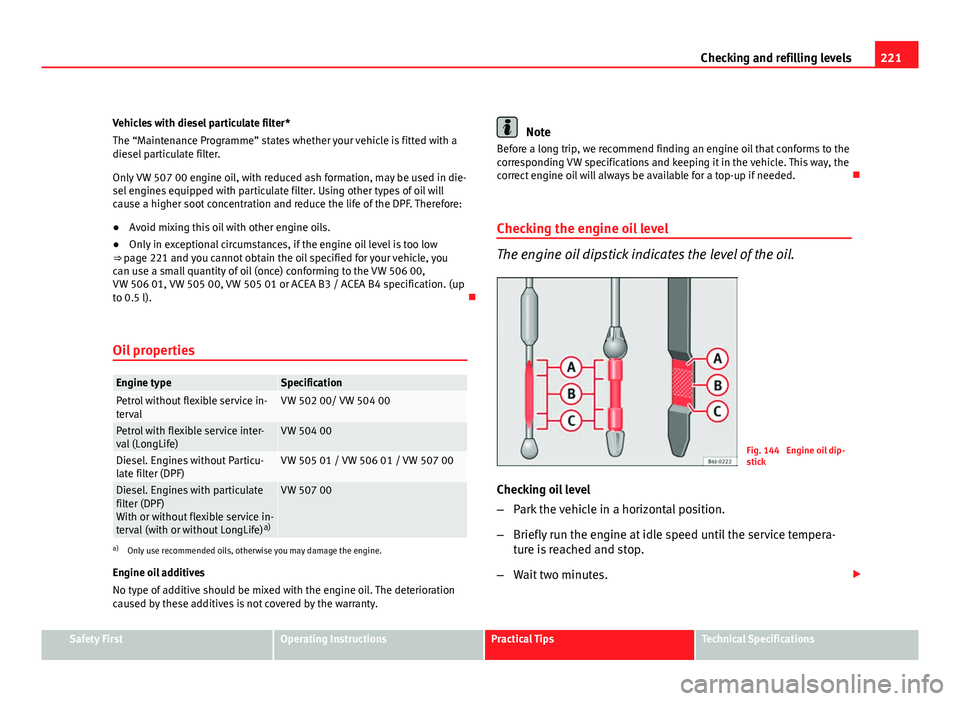
Fig. 144 Engine oil dip-
stick
Checking oil level
– Park the vehicle in a horizontal position.
– Briefly run the engine at idle speed until the service tempera-
ture is reached and stop.
– Wait two minutes.
Safety FirstOperating InstructionsPractical TipsTechnical Specifications