brake fluid Seat Leon 5D 2011 Owner's manual
[x] Cancel search | Manufacturer: SEAT, Model Year: 2011, Model line: Leon 5D, Model: Seat Leon 5D 2011Pages: 302, PDF Size: 4.17 MB
Page 6 of 302
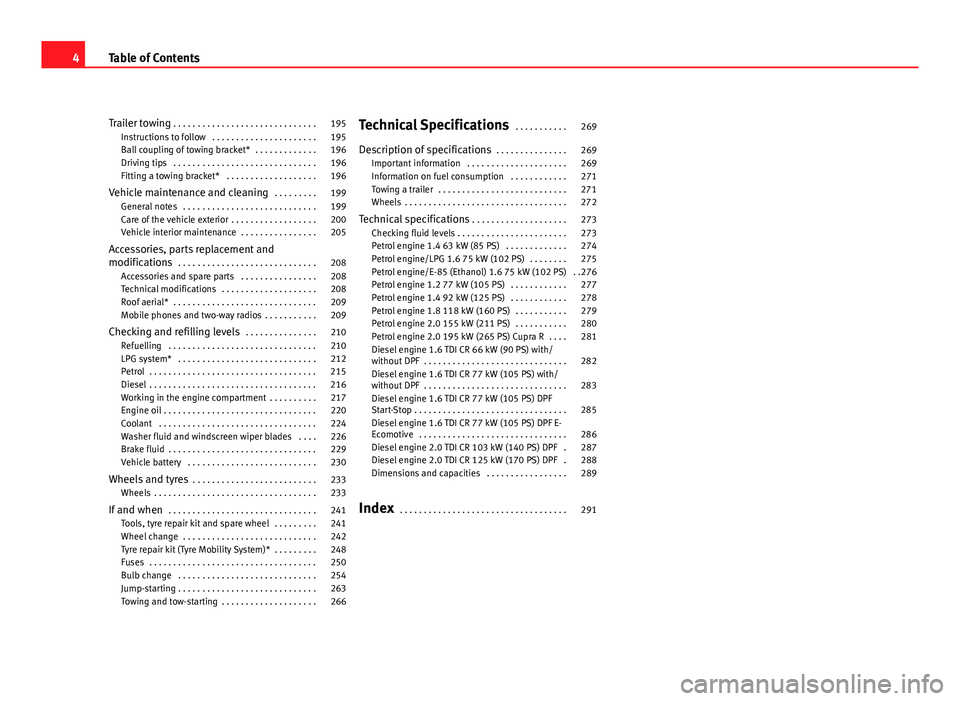
Trailer towing . . . . . . . . . . . . . . . . . . . . . . . . . . . . . . 195
Instructions to follow . . . . . . . . . . . . . . . . . . . . . . 195
Ball coupling of towing bracket* . . . . . . . . . . . . . 196
Driving tips . . . . . . . . . . . . . . . . . . . . . . . . . . . . . . 196
Fitting a towing bracket* . . . . . . . . . . . . . . . . . . . 196
Vehicle maintenance and cleaning . . . . . . . . . 199
General notes . . . . . . . . . . . . . . . . . . . . . . . . . . . . 199
Care of the vehicle exterior . . . . . . . . . . . . . . . . . . 200
Vehicle interior maintenance . . . . . . . . . . . . . . . . 205
Accessories, parts replacement and
modifications . . . . . . . . . . . . . . . . . . . . . . . . . . . . . 208
Accessories and spare parts . . . . . . . . . . . . . . . . 208
Technical modifications . . . . . . . . . . . . . . . . . . . . 208
Roof aerial* . . . . . . . . . . . . . . . . . . . . . . . . . . . . . . 209
Mobile phones and two-way radios . . . . . . . . . . . 209
Checking and refilling levels . . . . . . . . . . . . . . . 210
Refuelling . . . . . . . . . . . . . . . . . . . . . . . . . . . . . . . 210
LPG system* . . . . . . . . . . . . . . . . . . . . . . . . . . . . . 212
Petrol . . . . . . . . . . . . . . . . . . . . . . . . . . . . . . . . . . . 215
Diesel . . . . . . . . . . . . . . . . . . . . . . . . . . . . . . . . . . . 216
Working in the engine compartment . . . . . . . . . . 217
Engine oil . . . . . . . . . . . . . . . . . . . . . . . . . . . . . . . . 220
Coolant . . . . . . . . . . . . . . . . . . . . . . . . . . . . . . . . . 224
Washer fluid and windscreen wiper blades . . . . 226
Brake fluid . . . . . . . . . . . . . . . . . . . . . . . . . . . . . . . 229
Vehicle battery . . . . . . . . . . . . . . . . . . . . . . . . . . . 230
Wheels and tyres . . . . . . . . . . . . . . . . . . . . . . . . . . 233
Wheels . . . . . . . . . . . . . . . . . . . . . . . . . . . . . . . . . . 233
If and when . . . . . . . . . . . . . . . . . . . . . . . . . . . . . . . 241
Tools, tyre repair kit and spare wheel . . . . . . . . . 241
Wheel change . . . . . . . . . . . . . . . . . . . . . . . . . . . . 242
Tyre repair kit (Tyre Mobility System)* . . . . . . . . . 248
Fuses . . . . . . . . . . . . . . . . . . . . . . . . . . . . . . . . . . . 250
Bulb change . . . . . . . . . . . . . . . . . . . . . . . . . . . . . 254
Jump-starting . . . . . . . . . . . . . . . . . . . . . . . . . . . . . 263
Towing and tow-starting . . . . . . . . . . . . . . . . . . . . 266 Technical Specifications
. . . . . . . . . . . 269
Description of specifications . . . . . . . . . . . . . . . 269
Important information . . . . . . . . . . . . . . . . . . . . . 269
Information on fuel consumption . . . . . . . . . . . . 271
Towing a trailer . . . . . . . . . . . . . . . . . . . . . . . . . . . 271
Wheels . . . . . . . . . . . . . . . . . . . . . . . . . . . . . . . . . . 272
Technical specifications . . . . . . . . . . . . . . . . . . . . 273
Checking fluid levels . . . . . . . . . . . . . . . . . . . . . . . 273
Petrol engine 1.4 63 kW (85 PS) . . . . . . . . . . . . . 274
Petrol engine/LPG 1.6 75 kW (102 PS) . . . . . . . . 275
Petrol engine/E-85 (Ethanol) 1.6 75 kW (102 PS) . .276
Petrol engine 1.2 77 kW (105 PS) . . . . . . . . . . . . 277
Petrol engine 1.4 92 kW (125 PS) . . . . . . . . . . . . 278
Petrol engine 1.8 118 kW (160 PS) . . . . . . . . . . . 279
Petrol engine 2.0 155 kW (211 PS) . . . . . . . . . . . 280
Petrol engine 2.0 195 kW (265 PS) Cupra R . . . . 281
Diesel engine 1.6 TDI CR 66 kW (90 PS) with/
without DPF . . . . . . . . . . . . . . . . . . . . . . . . . . . . . . 282
Diesel engine 1.6 TDI CR 77 kW (105 PS) with/
without DPF . . . . . . . . . . . . . . . . . . . . . . . . . . . . . . 283
Diesel engine 1.6 TDI CR 77 kW (105 PS) DPF
Start-Stop . . . . . . . . . . . . . . . . . . . . . . . . . . . . . . . . 285
Diesel engine 1.6 TDI CR 77 kW (105 PS) DPF E-
Ecomotive . . . . . . . . . . . . . . . . . . . . . . . . . . . . . . . 286
Diesel engine 2.0 TDI CR 103 kW (140 PS) DPF . 287
Diesel engine 2.0 TDI CR 125 kW (170 PS) DPF . 288
Dimensions and capacities . . . . . . . . . . . . . . . . . 289
Index . . . . . . . . . . . . . . . . . . . . . . . . . . . . . . . . . . . 291
4Table of Contents
Page 64 of 302
62Cockpit
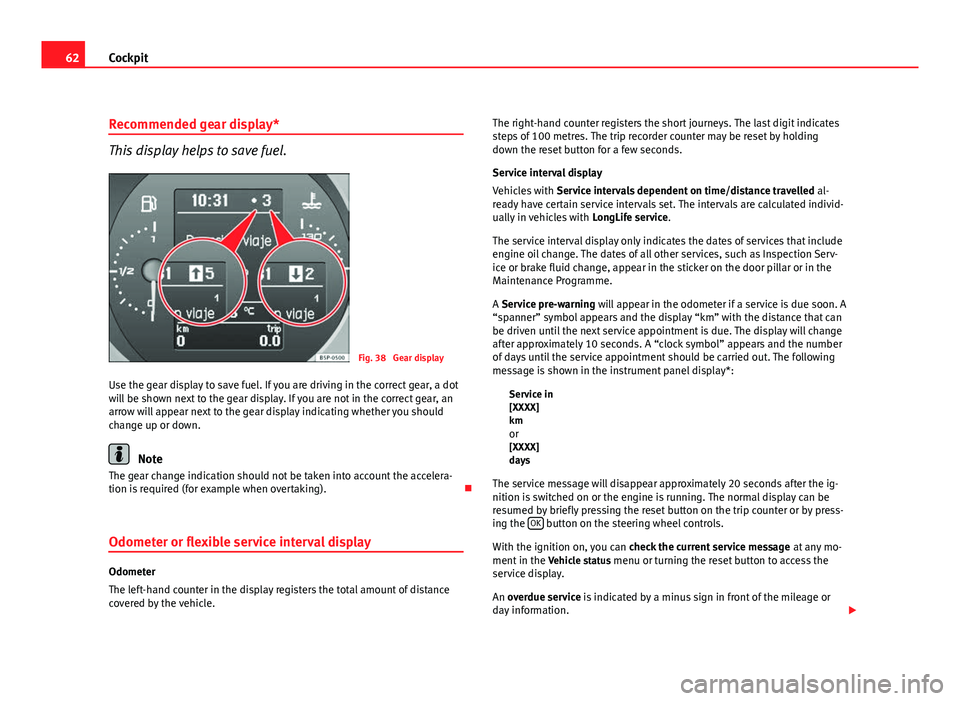
Recommended gear display*
This display helps to save fuel.
Fig. 38 Gear display
Use the gear display to save fuel. If you are driving in the correct gear, a dot
will be shown next to the gear display. If you are not in the correct gear, an
arrow will appear next to the gear display indicating whether you should
change up or down.
Note
The gear change indication should not be taken into account the accelera-
tion is required (for example when overtaking).
Odometer or flexible service interval display
Odometer
The left-hand counter in the display registers the total amount of distance
covered by the vehicle. The right-hand counter registers the short journeys. The last digit indicates
steps of 100 metres. The trip recorder counter may be reset by holding
down the reset button for a few seconds.
Service interval display
Vehicles with
Service intervals dependent on time/distance travelled al-
ready have certain service intervals set. The intervals are calculated individ-
ually in vehicles with LongLife service.
The service interval display only indicates the dates of services that include
engine oil change. The dates of all other services, such as Inspection Serv-
ice or brake fluid change, appear in the sticker on the door pillar or in the
Maintenance Programme.
A Service pre-warning will appear in the odometer if a service is due soon. A
“spanner” symbol appears and the display “km” with the distance that can
be driven until the next service appointment is due. The display will change
after approximately 10 seconds. A “clock symbol” appears and the number
of days until the service appointment should be carried out. The following
message is shown in the instrument panel display*: Service in
[XXXX]
kmor
[XXXX]
days
The service message will disappear approximately 20 seconds after the ig-
nition is switched on or the engine is running. The normal display can be
resumed by briefly pressing the reset button on the trip counter or by press-
ing the OK
button on the steering wheel controls.
With the ignition on, you can check the current service message at any mo-
ment in the Vehicle status menu or turning the reset button to access the
service display.
An overdue service is indicated by a minus sign in front of the mileage or
day information.
Page 68 of 302
66Cockpit
This may be deactivated by pressing the button A
(Reset).
The speed may be altered using the rocker switch B
in steps of 5 km/h
within 5 seconds of the initial memory value.
WARNING
There could be black ice on the road surface even if the “snowflake sym-
bol” is not shown. For this reason you should not rely exclusively on this
display - Risk of accident!
Note
When the vehicle is stationary or travelling at very low speeds, the tempera-
ture displayed may be slightly higher than the actual outside temperature
as a result of the heat radiated from the engine.
Warning or information message in the display
Faults are shown in the display with warning lamps and
warning/information reports.
The system runs a check on certain components and functions when the ig-
nition is switched on and while the vehicle is moving. Functional faults are
indicated by symbols with warning or information messages in the display.
An acoustic warning is given in certain cases.
Warning symbols
There are red warning symbols (priority 1) and yellow warning symbols (pri-
ority 2)
Information text
In addition to warning messages given on a fault, you will receive informa-
tion in the display on procedures or will be asked to carry out certain tasks.
Note
In the case of screens without warning or information texts, faults are indi-
cated exclusively by the warning lamps.
Warning reports, Priority 1 (red)
If one of these faults occurs, the warning lamp will flash or light up and will
be accompanied by three audible warnings. This is a danger warning. Stop
the vehicle and switch off the engine. Check the fault and correct it. Obtain
professional assistance if necessary.
If several priority 1 faults are detected at the same time, the symbols will be
displayed one after the other for about 2 seconds at a time and will contin-
ue until the fault is corrected.
No menus will be shown in the display for the duration of a priority 1 warn-
ing message.
Examples of priority 1 warning messages (red)
● Brake system symbol with the warning message STOP BRAKE FLUID
SERVICE MANUAL or STOP BRAKE FAULT SERVICE MANUAL .
● Coolant symbol with the warning message STOP SEE COOLANT IN-
STRUCTION MANUAL.
● Engine oil pressure symbol with the warning message STOP ENGINE
OIL PRESSURE LOW! INSTRUCTION MANUAL .
Warning reports, Priority 2 (yellow)
If one of these faults occurs, the warning lamp lights up, and is accompa-
nied by one audible warning. The function should be checked as soon as
possible.
Page 80 of 302
78Cockpit
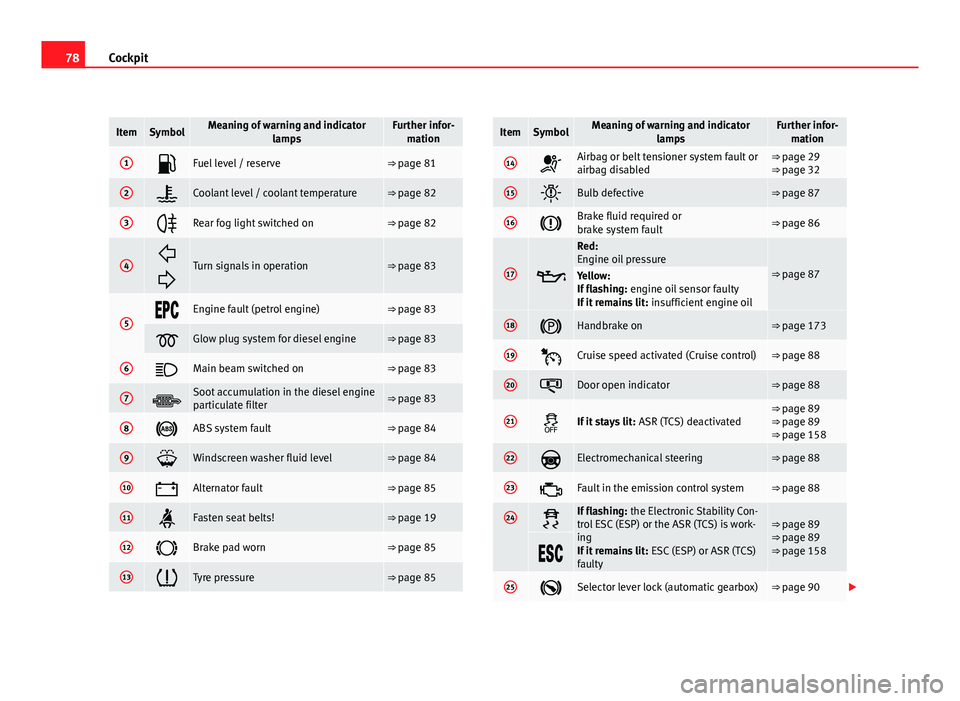
ItemSymbolMeaning of warning and indicator
lampsFurther infor-mation
1Fuel level / reserve⇒ page 81
2Coolant level / coolant temperature⇒ page 82
3Rear fog light switched on⇒ page 82
4
Turn signals in operation⇒ page 83
5Engine fault (petrol engine)⇒ page 83
Glow plug system for diesel engine⇒ page 83
6Main beam switched on⇒ page 83
7Soot accumulation in the diesel engine
particulate filter⇒ page 83
8ABS system fault⇒ page 84
9Windscreen washer fluid level⇒ page 84
10Alternator fault⇒ page 85
11Fasten seat belts!⇒ page 19
12Brake pad worn⇒ page 85
13Tyre pressure⇒ page 85
ItemSymbolMeaning of warning and indicator lampsFurther infor-mation
14Airbag or belt tensioner system fault or
airbag disabled⇒ page 29
⇒ page 32
15Bulb defective⇒ page 87
16Brake fluid required or
brake system fault⇒ page 86
17
Red:
Engine oil pressure
⇒ page 87Yellow:
If flashing: engine oil sensor faulty
If it remains lit: insufficient engine oil
18Handbrake on⇒ page 173
19Cruise speed activated (Cruise control)⇒ page 88
20Door open indicator⇒ page 88
21If it stays lit: ASR (TCS) deactivated⇒ page 89
⇒ page 89
⇒ page 158
22Electromechanical steering⇒ page 88
23Fault in the emission control system⇒ page 88
24If flashing: the Electronic Stability Con-
trol ESC (ESP) or the ASR (TCS) is work-
ing
If it remains lit: ESC (ESP) or ASR (TCS)
faulty⇒ page 89
⇒ page 89
⇒ page 158
25Selector lever lock (automatic gearbox)⇒ page 90
Page 82 of 302
80Cockpit
WARNING
● Failure to observe warning lamps and warning messages can result in
serious personal injury or damage to your vehicle.
● The risk of an accident increases if your vehicle breaks down. Use a
warning triangle to draw the attention of other road users in order to pre-
vent danger to third parties.
● The engine compartment is a dangerous area! Before you open the
bonnet to work on the engine or in the engine compartment, you must
switch the engine off and allow it to cool to reduce the risk of scalding or
other injuries. Read and observe the relevant warnings ⇒ page 217.
Note
● The appropriate warning lamp for a fault will light up in vehicles without
warning or information messages in the display.
● In vehicles with warning or information texts on the screen, the appro-
priate warning lamp for a fault will light up and a warning or information
message will also appear on the screen.
Warning symbols
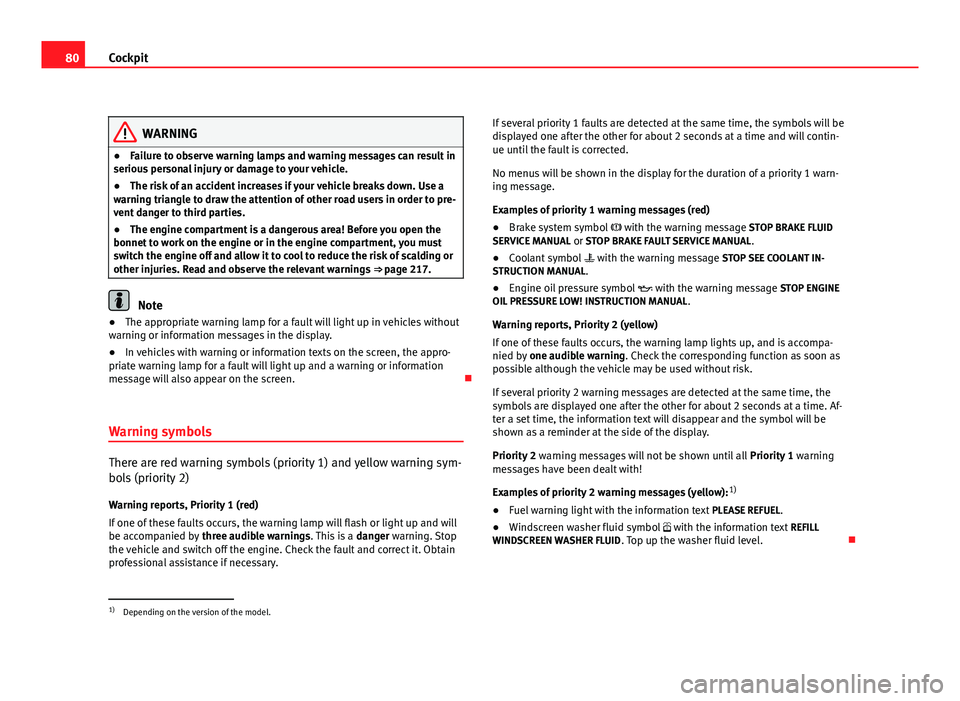
There are red warning symbols (priority 1) and yellow warning sym-
bols (priority 2) Warning reports, Priority 1 (red)
If one of these faults occurs, the warning lamp will flash or light up and will
be accompanied by three audible warnings. This is a danger warning. Stop
the vehicle and switch off the engine. Check the fault and correct it. Obtain
professional assistance if necessary. If several priority 1 faults are detected at the same time, the symbols will be
displayed one after the other for about 2 seconds at a time and will contin-
ue until the fault is corrected.
No menus will be shown in the display for the duration of a priority 1 warn-
ing message.
Examples of priority 1 warning messages (red)
●
Brake system symbol with the warning message STOP BRAKE FLUID
SERVICE MANUAL or STOP BRAKE FAULT SERVICE MANUAL .
● Coolant symbol with the warning message STOP SEE COOLANT IN-
STRUCTION MANUAL.
● Engine oil pressure symbol with the warning message STOP ENGINE
OIL PRESSURE LOW! INSTRUCTION MANUAL .
Warning reports, Priority 2 (yellow)
If one of these faults occurs, the warning lamp lights up, and is accompa-
nied by one audible warning. Check the corresponding function as soon as
possible although the vehicle may be used without risk.
If several priority 2 warning messages are detected at the same time, the
symbols are displayed one after the other for about 2 seconds at a time. Af-
ter a set time, the information text will disappear and the symbol will be
shown as a reminder at the side of the display.
Priority 2 warning messages will not be shown until all Priority 1 warning
messages have been dealt with!
Examples of priority 2 warning messages (yellow): 1)
● Fuel warning light with the information text PLEASE REFUEL.
● Windscreen washer fluid symbol with the information text REFILL
WINDSCREEN WASHER FLUID . Top up the washer fluid level.
1)
Depending on the version of the model.
Page 86 of 302
84Cockpit
To do this, drive about 15 minutes in fourth or fifth gear (automatic gear-
box: S gear range) at a speed of 60 km/h, with the engine running at ap-
proximately 2000 rpm. In this way, the pollen build up in the filter is burned.
When cleaning is successful, the indicator turns off.
If the warning lamp does not turn off, or the three lamps turn on (partic-
ulate filter , emission control system fault and glow plugs ), take
the vehicle to a specialised workshop to repair the fault.
WARNING
● Always drive according to the road weather conditions, the terrain
and traffic. Driving recommendations should never lead to illegal ma-
noeuvres in surrounding traffic.
● The diesel engine particulate filter may reach extremely high temper-
atures; it should not enter into contact with flammable materials under-
neath the vehicle. Otherwise there is a risk of fire.
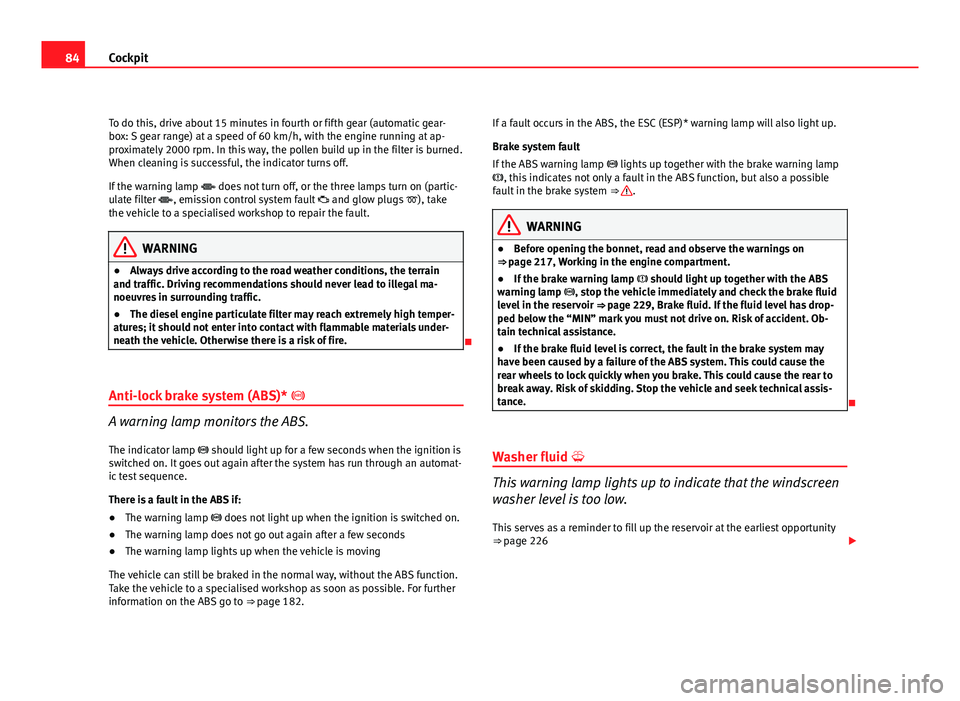
Anti-lock brake system (ABS)*
A warning lamp monitors the ABS.
The indicator lamp should light up for a few seconds when the ignition is
switched on. It goes out again after the system has run through an automat-
ic test sequence.
There is a fault in the ABS if:
● The warning lamp does not light up when the ignition is switched on.
● The warning lamp does not go out again after a few seconds
● The warning lamp lights up when the vehicle is moving
The vehicle can still be braked in the normal way, without the ABS function.
Take the vehicle to a specialised workshop as soon as possible. For further
information on the ABS go to ⇒ page 182. If a fault occurs in the ABS, the ESC (ESP)* warning lamp will also light up.
Brake system fault
If the ABS warning lamp
lights up together with the brake warning lamp
, this indicates not only a fault in the ABS function, but also a possible
fault in the brake system ⇒
.
WARNING
● Before opening the bonnet, read and observe the warnings on
⇒ page 217, Working in the engine compartment.
● If the brake warning lamp should light up together with the ABS
warning lamp , stop the vehicle immediately and check the brake fluid
level in the reservoir ⇒ page 229, Brake fluid. If the fluid level has drop-
ped below the “MIN” mark you must not drive on. Risk of accident. Ob-
tain technical assistance.
● If the brake fluid level is correct, the fault in the brake system may
have been caused by a failure of the ABS system. This could cause the
rear wheels to lock quickly when you brake. This could cause the rear to
break away. Risk of skidding. Stop the vehicle and seek technical assis-
tance.
Washer fluid
This warning lamp lights up to indicate that the windscreen
washer level is too low. This serves as a reminder to fill up the reservoir at the earliest opportunity
⇒ page 226
Page 87 of 302
85
Cockpit
The following message is shown on the instrument panel display* 1)
: REFILL
WINDSCREEN WASHER FLUID .
Alternator
This warning lamp signals a fault in the alternator.
The warning lamp lights up when the ignition is switched on. It should
go out when the engine has started running.
If the warning lamp lights up while driving, the alternator is no longer
charging the battery. You should immediately drive to the nearest special-
ised workshop.
You should avoid using electrical equipment that is not absolutely necessa-
ry because this will drain the battery.
Worn brake pads
If the symbol lights up, have the front brake pads (and, for safety rea-
sons, the rear pads as well) inspected by a specialised workshop. Tyre pressure
The tyre pressure control system controls the tyre speed and
the frequency spectrum of each tyre.
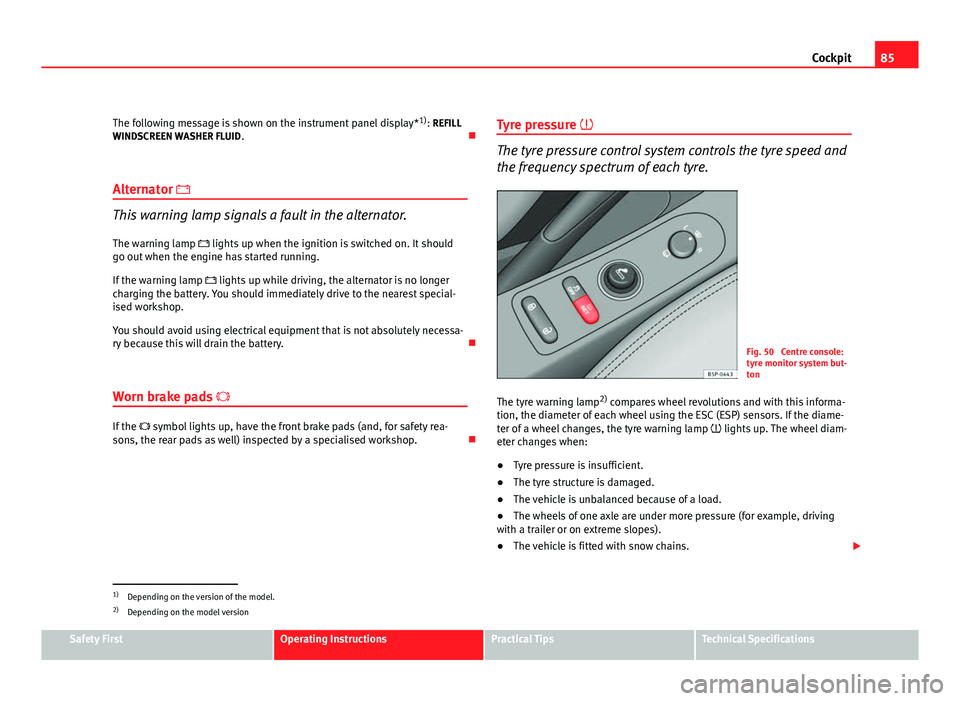
Fig. 50 Centre console:
tyre monitor system but-
ton
The tyre warning lamp 2)
compares wheel revolutions and with this informa-
tion, the diameter of each wheel using the ESC (ESP) sensors. If the diame-
ter of a wheel changes, the tyre warning lamp lights up. The wheel diam-
eter changes when:
● Tyre pressure is insufficient.
● The tyre structure is damaged.
● The vehicle is unbalanced because of a load.
● The wheels of one axle are under more pressure (for example, driving
with a trailer or on extreme slopes).
● The vehicle is fitted with snow chains.
1)
Depending on the version of the model.
2) Depending on the model version
Safety FirstOperating InstructionsPractical TipsTechnical Specifications
Page 88 of 302
86Cockpit
● The temporary spare wheel is fitted.
● The wheel on one axle is changed.
Tyre pressure adjustment
Following the modification to tyre pressure or after changing one or more
wheels, the button ⇒ fig. 50 must be kept pressed while the ignition is on
until an acoustic signal is heard and the warning lamp goes out.
If the wheels are under excessive load (for example, driving with a trailer or
heavy load), the tyre pressure must be increased to the recommended value
for a full load (see the sticker on the inside of the fuel flap). If the tyre moni-
tor system button is pressed down, the new tyre pressures are confirmed.
The tyre pressure warning lamp lights up
If the tyre pressure of one or more wheels is much lower than the value set
by the driver, the tyre control warning lamp lights up ⇒
.
The tyre pressure warning lamp flashes
If the tyre pressure warning lamp flashes, this indicates a fault. Go to the
nearest specialist workshop.
WARNING
● When the tyre pressure warning lamp lights up, reduce speed imme-
diately and avoid any sudden manoeuvre or braking. Stop when possible,
and check the tyre pressure and status.
● The driver is responsible for maintaining correct tyre pressures. For
this reason, tyre pressure must be regularly checked.
● Under certain circumstances (for example, when driving in a sports-
like manner, in winter conditions or on a dirt track) the tyre warning lamp
may light up or function incorrectly.
Note
If the battery is disconnected, the yellow warning lamp lights up after
turning the ignition on. This should turn off after a brief journey.
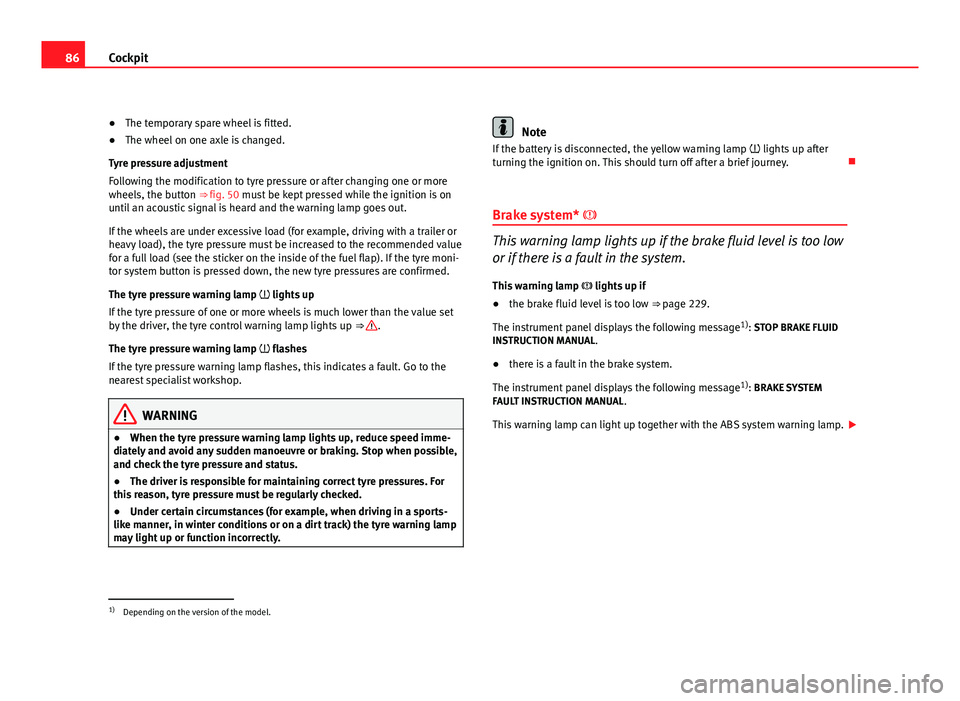
Brake system*
This warning lamp lights up if the brake fluid level is too low
or if there is a fault in the system.
This warning lamp lights up if
● the brake fluid level is too low ⇒ page 229.
The instrument panel displays the following message 1)
: STOP BRAKE FLUID
INSTRUCTION MANUAL.
● there is a fault in the brake system.
The instrument panel displays the following message 1)
: BRAKE SYSTEM
FAULT INSTRUCTION MANUAL.
This warning lamp can light up together with the ABS system warning lamp.
1)
Depending on the version of the model.
Page 89 of 302
87
Cockpit
WARNING
● Before opening the bonnet, read and observe the warnings on
⇒ page 217.
● If the brake warning lamp does not go out, or if it lights up when driv-
ing, the brake fluid level ⇒ page 229, Brake fluid in the reservoir is too
low. Risk of accident. Stop the vehicle and do not drive on. Obtain techni-
cal assistance.
● If the brake warning lamp lights up together with the ABS warning
lamp , the control function of the ABS could be out of action. This could
cause the rear wheels to lock quickly when you brake. This could cause
the rear to break away. Risk of skidding. Stop the vehicle and seek tech-
nical assistance.
Handbrake
This lamp lights up when the handbrake is applied. If you drive faster than 6 km/h with the handbrake on, the following mes-
sage will appear on the instrument panel display 1)
: HANDBRAKE ON. You will
also hear an acoustic warning signal ⇒ page 173.
Bulb defect
The warning lamp lights up when a bulb in the vehicle's ex-
terior lighting is defective.
The warning lamp lights up when a bulb in the vehicle's exterior lighting
(e.g. left-hand main beam) is defective. The instrument panel displays the following message
1)
: LEFT FULL BEAM
FAULTY.
Engine oil pressure
If this warning lamp is red it indicates that the engine oil
pressure is too low.
If this warning symbol starts to flash, and is accompanied by three audible
warnings, switch off the engine and check the oil level. If necessary, add
more oil ⇒ page 220.
The instrument panel displays the following message 1)
: STOP ENGINE OIL
PRESSURE INSTRUCTION MANUAL .
If the symbol flashes although the oil level is correct, do not drive on. The
engine must not even run at idle speed. Obtain technical assistance.
Checking the oil level
If the warning lamp is yellow the engine oil level should be checked as
soon as possible. Top up the oil ⇒ page 222 at the next opportunity.
Oil level sensor faulty*
If the yellow warning lamp flashes, take the vehicle to a specialised
workshop to have the oil level sensor checked. Until then it is advisable to
check the oil level every time you refuel.
1)
Depending on the version of the model.
Safety FirstOperating InstructionsPractical TipsTechnical Specifications
Page 189 of 302
187
Intelligent technology
If the brakes are not used frequently, or if rust has formed on the disks, it is
advisable to clean off the pads and disks by braking firmly a few times at a
moderately high speed ⇒
.
Faults in the brake system
If the brake pedal travel should ever increase suddenly, this may mean that
one of the two brake circuits has failed. Drive immediately to the nearest
specialised workshop and have the fault repaired. Drive there slowly and re-
member that you will have to apply more pressure on the brake pedal and
allow for longer stopping distances.
Low brake fluid level
Malfunctions can occur in the brake system if the brake fluid level is too
low. The brake fluid level is monitored electronically.
Brake servo
The brake servo increases the pressure you apply to the brake pedal. The
brake servo works only when the engine is running.
WARNING
● When applying the brakes to clean off deposits on the pads and
discs, select a clear, dry road. Be sure not to inconvenience or endanger
other road users. Risk of accident.
● Ensure the vehicle does not move while in neutral, when the engine is
stopped. Failure to do so could result in an accident.
CAUTION
● Never let the brakes “drag” by leaving your foot on the pedal when it is
not necessary to brake. This overheats the brakes, resulting in longer stop-
ping distances and greater wear.
● Before driving down a long, steep gradient, it is advisable to reduce
speed and change to a lower gear (or move the gear lever to a lower gear
position if your vehicle has automatic transmission). This makes use of en- gine braking and prolongs the service life of the brakes. If you still have to
use the brakes, it is better to brake firmly at intervals than to apply the
brakes continuously.
Note
● If the brake servo is not functioning due to a malfunction, or if the vehi-
cle has to be towed, you will have to press the brake pedal considerably
harder to make up for the lack of servo assistance.
● If you wish to equip the vehicle with accessories such as a front spoiler
or wheel covers, it is important that the flow of air to the front wheels is not
obstructed, otherwise the brakes can overheat.
Power steering (servotronic*)
Power steering makes it easier to turn the steering wheel
when the engine is running. Power steering assists the driver by reducing the force needed to turn the
steering wheel. In cars equipped with servotronic* power steering the de-
gree of power assistance is regulated electronically according to road
speed.
The power steering will keep on working in spite servotronic* device fails.
The degree of power assistance will, however, no longer adapt to different
speeds. If the electronic regulating system is not working properly, this is
most noticeable when turning the steering wheel at low speeds (for in-
stance when parking), as more effort will be required than usual. The fault
should be corrected by a specialised workshop as soon as possible.
Power steering does not work if the engine is off. In this case the steering
wheel requires much more force to turn.
If the steering is held at its turning limit when the vehicle is stationary, this
will place an excessive load on the power steering system. Turning the
Safety FirstOperating InstructionsPractical TipsTechnical Specifications