warning Seat Leon 5D 2012 Owner's manual
[x] Cancel search | Manufacturer: SEAT, Model Year: 2012, Model line: Leon 5D, Model: Seat Leon 5D 2012Pages: 289, PDF Size: 3.81 MB
Page 231 of 289

230Accessories and modifications to the vehicle
Accessories and modifications to the vehicle
Accessories, replacement parts and repairs
Always ask your dealer or specialist retailer for advice be-
fore purchasing accessories and replacement parts.
Your vehicle is designed to offer a high standard of active and passive safe-
ty. For this reason, we recommend that you ask a SEAT Official Service for
advice before fitting accessories or replacement parts. Your SEAT Official
Service has the latest information from the manufacturer and can recom-
mend accessories and replacement parts which are suitable for your re-
quirements. They can also answer any questions you might have regarding
official regulations.
We recommend you to use only SEAT accessories and Genuine SEAT parts ®
.
SEAT has tested these parts and accessories for suitability, reliability and
safety. SEAT Official Services have the necessary experience and facilities to
ensure that the parts are installed correctly and professionally.
Any retro-fitted equipment which has a direct effect on the vehicle and/or
the way it is driven (e.g. cruise control system or electronically-controlled
suspension) must be approved for use in your vehicle and bear the e mark
(the European Union's authorisation symbol).
If any additional electrical components are fitted which do not serve to con-
trol the vehicle itself (for instance a refrigerator box, laptop or ventilator fan,
etc.), these must bear the mark (manufacturer conformity declaration in
the European Union).
WARNING
Accessories, for example telephone holders or cup holders, should never
be fitted on the covers, or within the working range of the airbags. Other-
wise, there is a danger of injury if the airbag is triggered in an accident.
Technical modifications
Modifications must always be carried out according to our
specifications.
Unauthorised modifications to the electronic components, software, wiring
or data transfer in the vehicle may cause malfunctioning. Due to the way the
electronic components are linked together in networks, other indirect sys-
tems may be affected by the faults. This can seriously impair safety, lead to
excessive wear of components, and also invalidate your vehicle registration
documents.
You will appreciate that your SEAT dealership cannot be held liable for any
damage caused by modifications and/or work performed incorrectly.
We recommend that all work should be performed by a SEAT Official Service
using Genuine SEAT parts
®
.
WARNING
Incorrectly performed modifications or other work on your vehicle can
lead to malfunctions and cause accidents.
Radio transmitters and business equipment
Radio transmitters (fixed installation)
Any retrofit installations of radio transmitters in the vehicle require prior ap-
proval. SEAT generally authorises in-vehicle installations of approved types
of radio transmitters provided that:
Page 232 of 289

231
Accessories and modifications to the vehicle
● the aerial is installed correctly.
● the aerial is installed on the exterior of the vehicle (and shielded cables
are used together with non-reflective aerial trimming).
● the effective transmitting power does not exceed 10 Watts at the aerial
base.
A SEAT Official Service and specialised workshop will be able to inform you
about options for installing and operating radio transmitters with a higher
transmitting power.
Mobile radio transmitters
Commercial mobile telephones or radio equipment might interfere with the
electronics of your vehicle and cause malfunctions. This may be due to:
● no external aerial
● external aerial incorrectly installed
● transmitting power more than 10 W
You must, therefore, do not operate portable mobile telephones or radio
equipment inside the vehicle without a properly installed external aerial
⇒
.
Please note also that the maximum range of the equipment can only be ach-
ieved with an external aerial.
Business equipment
Retrofit installation of business or private equipment in the vehicle is per-
mitted, provided the equipment cannot interfere with the driver's immedi-
ate control of the vehicle and that any such equipment carries the mark.
Any retrofit equipment that could influence the driver's control of the vehi-
cle must have a type approval for your vehicle and must carry the e mark.
WARNING
Mobile telephones or radio equipment which is operated inside the vehi-
cle without a properly installed external aerial can create excessive mag-
netic fields that could cause a health hazard.
Note
● The posterior fitting of electric and electronic equipment in this vehicle
affects its licence type and could lead to the withdrawal of the vehicle regis-
tration document under certain circumstances.
● Please use the mobile telephone/radio operating instructions.
Safety FirstOperating instructionsPractical TipsTechnical specifications
Page 233 of 289
232Emergencies
Emergencies
General information
– If you have a flat tyre or puncture, park the car as far away from
the flow of traffic as possible in a safe place. If you have a punc-
ture, stop the vehicle on a horizontal surface. If you are on a
slope, take extra care.
– Apply the handbrake.
– Switch on the hazard warning lights.
– Always wear a reflective vest ⇒ page 232.
– Set up the warning triangle.
– All vehicle occupants should leave the car. They should wait in
a safe place (for instance behind the roadside crash barrier).
WARNING
Always observe the above steps and protect yourself and other road
users.
Equipment
Reflective vests
Wearing a reflective vest makes you more visible to other road
users.
Note
● Always wear a reflective vest when you get out of the vehicle in moving
traffic (for example, in the event of breakdown or to load/unload the vehi-
cle).
● Observe the applicable legislation for each country.
Vehicle tools/Tyre repair kit/Compressor*
The vehicle tools, the tyre repair kit and the compressor* are stor-
ed under the floor panel in the luggage compartment.
To access the vehicle tools:
– Lift up the floor panel by the plastic handle until it is fastened to
the tabs on both sides.
Depending on the vehicle equipment, you will find the tyre repair set and
the compressor* under the floor panel cover.
Page 234 of 289

233
Emergencies
Tyre repair kit
What to do first
– Please observe the important safety notes ⇒ page 232.
– Apply the handbrake.
– Manual gearbox: Select first gear.
– Automatic gearbox: Move the selector lever to P.
– Check whether a repair is possible using the tyre repair kit
⇒ page 233.
Using the tyre repair kit
Fig. 117 Tyre: irrepara-
ble damage The tyre repair kit is designed to repair your tyre provisionally only. The dam-
aged tyre should be replaced as soon as possible
⇒
.
If the tyre has been damaged by a nail, for example, remove the nail from
the tyre.
The tyre repair kit can be used at outside temperatures of up to -20 °C
(-4 °F).
The tyre repair kit must NOT be used:
● on cuts and punctures larger than 4 mm 1
⇒ Fig. 117
● If the wheel rim has been damaged 2
●
if you have been driving with very low pressure or a completely flat tyre
3.
If necessary, request assistance from specialised personnel.
WARNING
● Remember that the tyre repair kit cannot always be used, and that it
only serves to provide a provisional repair.
● Do not allow the sealing product to come into contact with your eyes,
skin or clothing.
● If you do come into contact with the sealing product immediately
rinse the eyes or skin affected with clean water.
● Do not inhale vapours.
● If any of the sealing product is accidentally ingested, immediately
rinse the mouth thoroughly and drink lots of water. Do not induce vomit-
ing. Seek medical advice immediately.
● Change clothing immediately if it becomes soiled with the sealing
product.
● If any allergic reactions should occur get medical help immediately.
● Keep the sealing product away from children.
Safety FirstOperating instructionsPractical TipsTechnical specifications
Page 235 of 289

234Emergencies
Note
● If sealing product should leak out, leave it to dry. This way you can pull it
off like a piece of foil.
● Observe the expiry date stated on the sealing compound can. Have the
sealing compound changed by a specialised workshop or SEAT Service.
● Please observe legal requirements when doing so.
Repairing tyres
Fig. 118 Tyre: top up
Important: have the tyre repair kit ready ⇒
page 232.
Filling the tyre
– Before filling the tyre, shake the bottle of sealing product thor-
oughly.
– Screw the enclosed filling hose onto the sealant can as far as it
will go. This will pierce the foil sealing on the can. –
Take the valve cap off the tyre valve and use a screwdriver
⇒ Fig. 118 to unscrew the valve insert.
– Place the valve insert onto a clean surface.
– Remove the sealing plug from the filling hose and insert the
hose into the tyre valve.
– Hold the bottle upside down and insert the contents in the tyre
until the bottle is empty.
– Then disconnect the hose and screw the valve insert back onto
the tyre valve.
Inflating the tyre
– Screw the compressor filling hose (tyre repair kit) onto the tyre
valve and plug the connector into the 12V connection.
– Pump the tyre up to 2.0 to 2.5 bar and monitor the pressure
shown on the pressure gauge.
– If the tyre does not reach this pressure, move the car forwards
or backwards 10 metres to allow the sealing compound to
spread all around the tyre.WARNING
● Please observe the manufacturer's safety notes on the compressor
and the instructions supplied with the tyre sealant can.
● If, after six minutes of trying to inflate the tyre, it is not possible get
up to a pressure of 2.0 bar, this indicates that the tyre is too severely
damaged for repair with the kit. Do not carry on driving!
● If the tyre cannot be repaired with the sealing compound, seek pro-
fessional assistance.
Page 236 of 289
235
Emergencies
Note
Do not use the compressor for longer than 6 minutes at a time, as it could
overheat. Once it has cooled down, the compressor may be used again.
After changing a wheel
– Attach the "max. 80 km/h (50 mph)" adhesive label from the
tyre repair kit on the instrument panel, clearly within view of the
driver.
– Stop the vehicle after 10 minutes driving and check the tyre
pressure.
– If tyre pressure is less than 1.3 bar, the tyre is too badly dam-
aged. Do not carry on driving!
WARNING
After repairing a tyre please note the following points:
● Do not drive faster than 80 km/h (50 mph).
● Avoid heavy acceleration, hard braking and fast cornering.
● Vehicle handling could be impaired.
● If the tyre is very damaged, seek professional assistance.
For the sake of the environment
You can dispose of the used bottle of sealing compound at a SEAT Official
Service.
Note
After repairing a tyre, remember to purchase a new bottle of sealing com-
pound from a SEAT Official Service or a specialised workshop.
Changing a wheel What to do first
Before changing the wheel, the following preliminary steps
are required. – Please observe the important safety notes ⇒ page 232.
– Apply the handbrake.
– Manual gearbox: Select first gear.
– Automatic gearbox: Move the selector lever to P.
– When towing a trailer: Unhitch the trailer from your vehicle.
– Have the vehicle tool kit ⇒ page 232 and the spare wheel ready
⇒ page 240.
WARNING
If you change the wheel on a slope, block the wheel on the opposite side
of the car with a stone or similar to prevent the vehicle from moving.
Safety FirstOperating instructionsPractical TipsTechnical specifications
Page 239 of 289
238Emergencies
WARNING
Slightly loosen the wheel bolts (one turn) before raising the vehicle with
the jack*. If not, an accident may occur.
Raising the vehicle
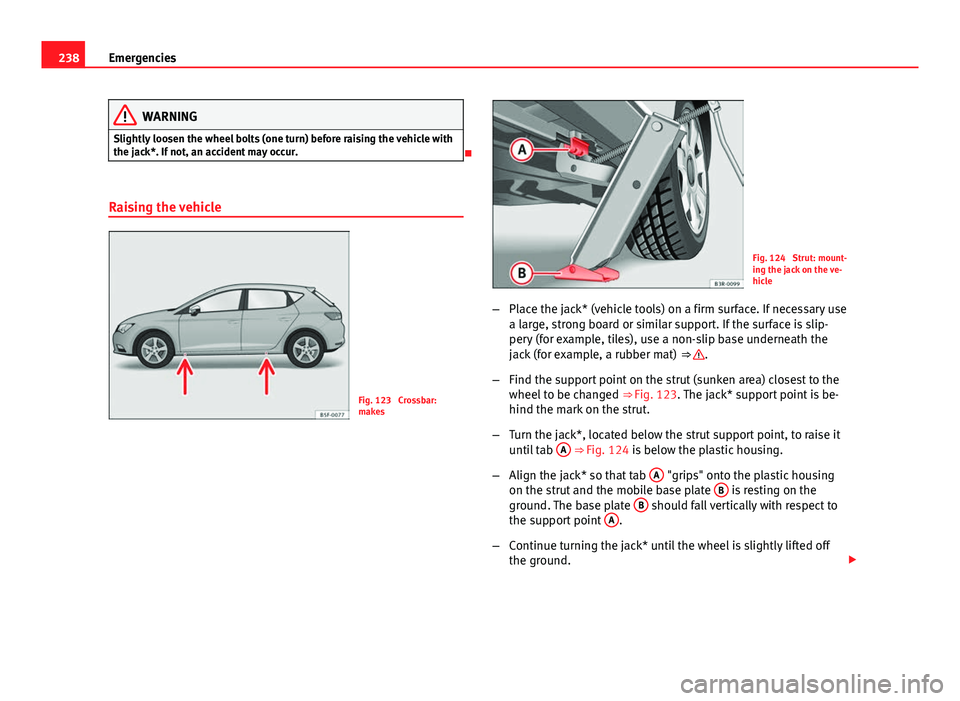
Fig. 123 Crossbar:
makes
Fig. 124 Strut: mount-
ing the jack on the ve-
hicle
– Place the jack* (vehicle tools) on a firm surface. If necessary use
a large, strong board or similar support. If the surface is slip-
pery (for example, tiles), use a non-slip base underneath the
jack (for example, a rubber mat) ⇒
.
– Find the support point on the strut (sunken area) closest to the
wheel to be changed ⇒ Fig. 123. The jack* support point is be-
hind the mark on the strut.
– Turn the jack*, located below the strut support point, to raise it
until tab A
⇒ Fig. 124 is below the plastic housing.
– Align the jack* so that tab A
"grips" onto the plastic housing
on the strut and the mobile base plate B is resting on the
ground. The base plate B should fall vertically with respect to
the support point A.
– Continue turning the jack* until the wheel is slightly lifted off
the ground.
Page 240 of 289

239
Emergencies
WARNING
● Make sure that the jack* remains stable. If the surface is slippery or
soft, the jack* could slip or sink, respectively, with the resultant risk of
injury.
● Only raise the vehicle with the jack* supplied by the manufacturer.
Other vehicles could slip, with the consequent risk of injury.
● Only mount the jack* on the support points designed for this purpose
on the strut, and always align the jack correctly. If you do not, the jack*
could slip as it does not have an adequate grip on the vehicle: risk of in-
jury!
● The height of the parked vehicle can change as a result of variations
in temperature and loading.
CAUTION
The vehicle must not be raised on the crossbar. Only place the jack* on the
points designed for this purpose on the strut. Otherwise, the vehicle may be
damaged.
Removing and fitting a wheel
After loosening the wheel bolts and raising the vehicle with the
jack, change the wheel as described below:
Taking off the wheel
– Unscrew the wheel bolts using the box spanner and place them
on a clean surface.
– Take off the wheel ⇒
. Putting on the spare wheel
When fitting tyres with a compulsory rotation direction, observe
the instructions in
⇒ page 239.
– Mount the wheel.
– Screw on the wheel bolts in position and tighten them loosely
with a box spanner.
– Carefully lower the vehicle using the jack*.
– Tighten the wheel bolts in diagonal pairs using the wheel
brace.
The wheel bolts should be clean and turn easily. Before fitting the spare
wheel, inspect the wheel condition and hub mounting surfaces. These sur-
faces must be clean before fitting the wheel.
CAUTION
When removing/fitting the wheel, the rim may hit and damage the brake
disc. For this reason, please take care and get a second person to assist
you.
Tyres with compulsory direction of rotation
A directional tread pattern can be identified by arrows on the sidewall that
point in the direction of rotation. Always observe the direction of rotation in-
dicated when mounting the wheel. This is important so that these tyres can
give maximum grip and avoid excessive noise, tread wear and aquaplaning.
If, exceptionally, it is necessary to mount the spare wheel* in the opposite
direction of rotation, please drive carefully, as in this case the tyre does not
have optimum conditions of use. This is particularly important when driving
on wet roads.
Safety FirstOperating instructionsPractical TipsTechnical specifications
Page 242 of 289

241
Emergencies
– Take out the temporary spare wheel.
Chains
For technical reasons, snow chains must not be used on the temporary
spare wheel.
If you have a puncture on one of the front wheels when using snow chains,
fit the temporary spare wheel in place of one of the rear wheels. Fit the snow
chains on the rear wheel that you have removed and replace the punctured
front wheel with this wheel.
WARNING
● After fitting the temporary spare wheel, check the tyre pressures as
soon as possible. Failure to do so may cause an accident. The tyre pres-
sures are listed on the inside of the fuel tank flap.
● Do not drive at over 80 km/h (50 mph) when the temporary spare
wheel is fitted on the vehicle: risk of accident!
● Avoid heavy acceleration, hard braking and fast cornering: risk of ac-
cident!
● Never use more than one temporary spare wheel at the same time,
risk of accident.
● No other type of tyre (normal summer or winter tyre) may be fitted on
the compact temporary spare wheel rim.
Jump starting
Jump leads
The jump lead must have a sufficient wire cross section.
If the engine fails to start because of a discharged battery, the battery can
be connected to the battery of another vehicle to start the engine.
Jump leads
Jump leads must comply with standard DIN 72553 (see cable manufactur-
er's instructions). The wire cross section must be at least 25 mm 2
for petrol
engines and at least 35 mm 2
for diesel engines.
Note
● The vehicles must not touch each other, otherwise electricity could flow
as soon as the positive terminals are connected.
● The discharged battery must be properly connected to the on-board net-
work.
Safety FirstOperating instructionsPractical TipsTechnical specifications
Page 244 of 289

243
Emergencies
Starting
5. Start the engine of the vehicle with the boosting battery and let it run at idling speed.
6. Start the engine of the vehicle with the flat battery and wait two or three minutes until the engine is “running”.
Removing the jump leads
7. Before you remove the jump leads, switch off the dipped beam headlights (if they are switched on).
8. Turn on the heater blower and heated rear window in the vehi- cle with the flat battery. This helps minimise voltage peaks
which are generated when the leads are disconnected.
9. When the engine is running, disconnect the leads in reverse or- der to the details given above.
Connect the battery clamps so they have good metal-to-metal contact with
the battery terminals.
If the engine fails to start, switch off the starter after about 10 seconds and
try again after about half a minute.
WARNING
● Please note the safety warnings referring to working in the engine
compartment ⇒ page 209.
● The battery providing assistance must have the same voltage as the
flat battery (12V) and approximately the same capacity (see imprint on
battery). Failure to comply could result in an explosion.
WARNING (Continued)
● Never use jump leads when one of the batteries is frozen. Danger of
explosion! Even after the battery has thawed, battery acid could leak and
cause chemical burns. If a battery freezes, it should be replaced.
● Keep sparks, flames and lighted cigarettes away from batteries, dan-
ger of explosion. Failure to comply could result in an explosion.
● Observe the instructions provided by the manufacturer of the jump
leads.
● Do not connect the negative cable from the other vehicle directly to
the negative terminal of the flat battery. The gas emitted from the battery
could be ignited by sparks. Danger of explosion.
● Do not attach the negative cable from the other vehicle to parts of the
fuel system or to the brake line.
● The non-insulated parts of the battery clamps must not be allowed to
touch. The jump lead attached to the positive battery terminal must not
touch metal parts of the vehicle, this can cause a short circuit.
● Position the leads in such a way that they cannot come into contact
with any moving parts in the engine compartment.
● Do not lean on the batteries. This could result in chemical burns.
Note
The vehicles must not touch each other, otherwise electricity could flow as
soon as the positive terminals are connected.
Safety FirstOperating instructionsPractical TipsTechnical specifications