warning Seat Leon 5D 2012 Owner's manual
[x] Cancel search | Manufacturer: SEAT, Model Year: 2012, Model line: Leon 5D, Model: Seat Leon 5D 2012Pages: 289, PDF Size: 3.81 MB
Page 217 of 289

216Checking and refilling levels
Topping up coolant
Top up coolant when the level is below the MIN (minimum)
mark.
Fig. 110 Engine com-
partment: Coolant expan-
sion tank cap
Checking coolant level
– Park the vehicle in a horizontal position.
– Switch the ignition off
– Read off the coolant level on coolant expansion tank. When the
engine is cold, the coolant level should be between the marks.
When the engine is hot, it may be slightly above the upper
mark.
Topping up coolant
– Wait for the engine to cool down.
– Cover the coolant expansion tank cap with a cloth and carefully
unscrew it to the left ⇒
. –
Top up the coolant only if there is still coolant in the expansion
tank, otherwise you could damage the engine. If there is no
coolant in the expansion tank, do not continue driving. You
should obtain professional assistance ⇒
.
– If there is still some coolant in the expansion tank, top up to the
upper mark.
– Top up with coolant to the upper mark until the level becomes
stable.
– Screw the cap back on correctly.
Any loss of coolant fluid normally indicates a leak in the cooling system.
Take the vehicle straight to a specialised workshop to have the cooling sys-
tem examined. If there are no leaks in the engine cooling system, a loss of
coolant can only occur if the coolant boils and is forced out of the system as
a result of overheating.
WARNING
● The cooling system is under pressure. Do not unscrew the cap on the
coolant expansion tank when the engine is hot: risk of burns!
● The antifreeze and coolant fluid can be a health hazard. Therefore,
the antifreeze should be stored in the original container in a safe place
out of reach of children. Failure to comply could result in poisoning.
● If working inside the engine compartment, remember that, even when
the ignition is switched off, the radiator fan may start up automatically,
and therefore there is a risk of injury.
CAUTION
Do not top up the expansion tank with coolant fluid if it is empty! Air could
enter the cooling system. In this case, stop driving. Seek specialist assis-
tance. Otherwise, there is a risk of engine damage.
Page 218 of 289
217
Checking and refilling levels
Brake fluid
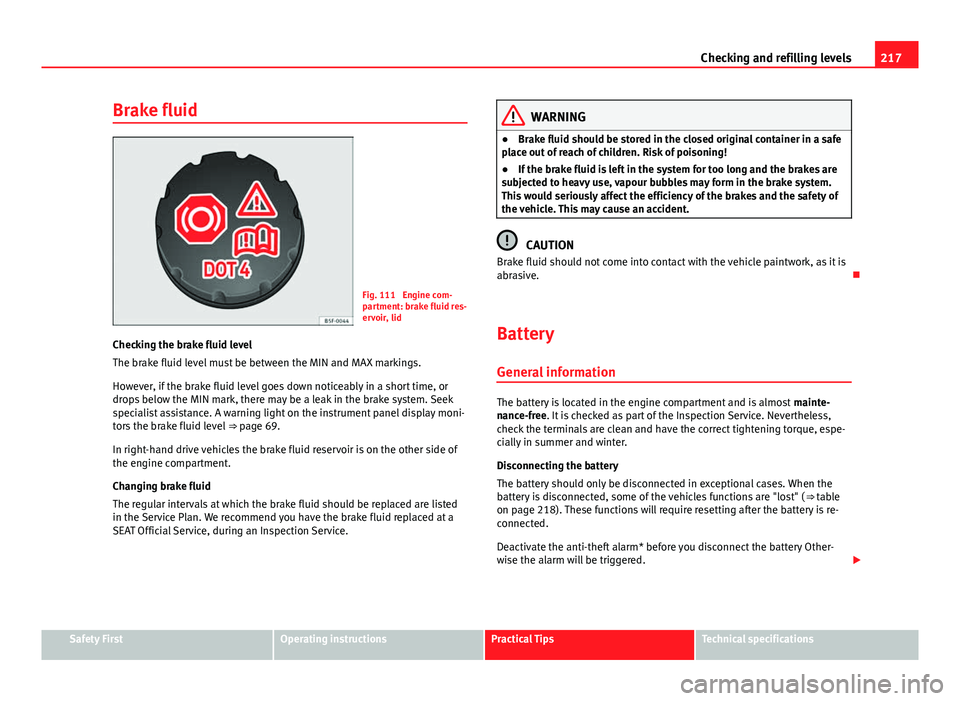
Fig. 111 Engine com-
partment: brake fluid res-
ervoir, lid
Checking the brake fluid level
The brake fluid level must be between the MIN and MAX markings.
However, if the brake fluid level goes down noticeably in a short time, or
drops below the MIN mark, there may be a leak in the brake system. Seek
specialist assistance. A warning light on the instrument panel display moni-
tors the brake fluid level ⇒ page 69.
In right-hand drive vehicles the brake fluid reservoir is on the other side of
the engine compartment.
Changing brake fluid
The regular intervals at which the brake fluid should be replaced are listed
in the Service Plan. We recommend you have the brake fluid replaced at a
SEAT Official Service, during an Inspection Service.
WARNING
● Brake fluid should be stored in the closed original container in a safe
place out of reach of children. Risk of poisoning!
● If the brake fluid is left in the system for too long and the brakes are
subjected to heavy use, vapour bubbles may form in the brake system.
This would seriously affect the efficiency of the brakes and the safety of
the vehicle. This may cause an accident.
CAUTION
Brake fluid should not come into contact with the vehicle paintwork, as it is
abrasive.
Battery General information
The battery is located in the engine compartment and is almost mainte-
nance-free. It is checked as part of the Inspection Service. Nevertheless,
check the terminals are clean and have the correct tightening torque, espe-
cially in summer and winter.
Disconnecting the battery
The battery should only be disconnected in exceptional cases. When the
battery is disconnected, some of the vehicles functions are "lost" ( ⇒ table
on page 218). These functions will require resetting after the battery is re-
connected.
Deactivate the anti-theft alarm* before you disconnect the battery Other-
wise the alarm will be triggered.
Safety FirstOperating instructionsPractical TipsTechnical specifications
Page 219 of 289

218Checking and refilling levels
FunctionReprogrammingOne-touch function of the electric
windows⇒ page 101, One-touch opening and
closing*
Remote control keyIf the vehicle does not respond to the
key, they should be synchronised
⇒ page 90
Digital clock⇒ page 63
ESC warning lampAfter driving for a few metres, the
warning lamp goes out again.
If the vehicle is not used for long periods
The vehicle has a system for monitoring the current consumption when the
engine is left unused for long periods of time ⇒ page 187. Some functions,
such as the interior lights, or the remote door opening, may be temporarily
disabled to prevent the battery from running flat. These functions will come
back on as soon as the ignition is switched on and the engine started.
Winter conditions
During the winter, the starting power may be reduced, and if necessary, the
battery should be charged ⇒
in Important safety warnings for handling a
vehicle battery on page 218
Important safety warnings for handling a vehicle battery
All work on batteries requires specialist knowledge. Please refer to a SEAT
Official Service or a workshop specialising in batteries: risk of burns or ex-
ploding battery!
The battery must not be opened. Never try to change the fluid level of the
battery. Explosive gas is released from the battery that could cause an ex-
plosion.
Wear eye protection.
Battery acid is very corrosive and caustic. Wear protective gloves
and eye protection. In the event of electrolyte splashes, rinse off
with plenty of water.
Fires, sparks, open flames and smoking are prohibited.
The battery should only be charged in a well-ventilated zone. Risk
of explosion!
Keep children away from acid and batteries!
WARNING
● When repairing or working on the electrical system, proceed as fol-
lows:
● 1. Remove the key from the ignition. The negative cable on the bat-
tery must be disconnected.
● 2. When the repair is finished, reconnect the negative pole of the bat-
tery.
● Switch off all electrical consumers before reconnecting the battery.
Reconnect first the positive cable and then the negative cable. Never re-
verse the polarity of the connections. This could cause an electrical fire.
● Ensure that the vent hose is always connected to the battery.
● Never use damaged batteries. This could cause an explosion! Replace
a damaged battery immediately.
CAUTION
● Never disconnect the battery if the ignition is switched on or if the en-
gine is running. This could damage the electrical system or electronic com-
ponents.
Page 220 of 289

219
Checking and refilling levels
Charging the battery
Terminals for charging the battery are fitted in the engine
compartment.
– Note the warnings ⇒
in Important safety warnings for han-
dling a vehicle battery on page 218 and ⇒ .
– Switch off all electrical equipment. Remove the ignition key.
– Raise the bonnet ⇒ page 210.
– Open the battery cover.
– Connect the charger clamps as described to the positive pole of
the battery (+) and, exclusively to an earth on the bodywork
(–).
– Only use a charger which is compatible for use with 12 V nomi-
nal voltage batteries. The charge must not exceed a voltage of
15 V.
– Now connect the battery charger to the power socket and switch
on.
– After charging the battery: switch off the battery charger and
disconnect the power socket cable.
– Finally disconnect the charger cables from the battery.
– Replace the battery cover correctly.
– Close the bonnet ⇒ page 210.
Important: Before you charge the battery make sure you read the manufac-
turer's instructions for using the battery charger.
WARNING
Never charge a battery that has frozen: replace battery! Failure to do so
may lead to an explosion.
Note
Use only the terminals in the engine compartment to charge the battery.
Replacing the battery
The new battery should have the same specifications (am-
perage, load and voltage) as the used battery.
Your vehicle is equipped with an intelligent power management system to
control the distribution of electrical energy ⇒ page 187. The power manage-
ment function ensures that the battery is charged much more efficiently
than on vehicles without a power management system. To maintain this
function after replacing the battery, we recommend that the replacement
battery used is of the same make and type as the original fitted battery. To
make proper use of the power management function after the battery has
been changed, have the battery coded to the power management mode at a
specialised workshop.
CAUTION
● Some vehicles, for example those with the Start-Stop system* are fitted
with a special battery (AGM-type or EFB-type battery). If any other type of
battery is fitted, the Start-Stop function may be considerably reduced and
the vehicle may not stop on repeated occasions.
● Make sure that the vent hose is always attached to the original opening
on the side of the battery. Gases or battery acid can otherwise escape and
possibly cause damage.
● The battery holder and clamps must always be correctly secured.
Safety FirstOperating instructionsPractical TipsTechnical specifications
Page 221 of 289

220Checking and refilling levels
● Before starting any work on the battery, always observe the warnings lis-
ted under ⇒ page 218, Important safety warnings for handling a vehicle
battery.
● Do not forget to replace the battery coverings, where applicable. This
helps to protect against excess temperatures. This in turn extends the vehi-
cle service life.
For the sake of the environment
Batteries contain toxic substances including sulphuric acid and lead. They
must be disposed of appropriately and must not be disposed of with ordi-
nary household waste. Make sure disconnected batteries cannot tip over.
Sulphuric acid could be spilt!
Windscreen washer reservoir and wiper
blades
Windscreen washer
Fig. 112 Engine com-
partment: Windscreen
washer reservoir top The windscreen washer reservoir contains the cleaning fluid for the wind-
screen, the rear window and the headlight washer system* ⇒ Fig. 112. Res-
ervoir capacity: ⇒ page 276.
To prevent the nozzles from becoming blocked with chalk deposits, fill res-
ervoir with water with a low calcium content (distilled water). Always add
washer fluid to the water (with anti-freeze additive in winter).
CAUTION
● Never put radiator anti-freeze or other additives into the windscreen
washer fluid.
● Never use washer fluid which contains paint thinners or solvents as it
can damage the paintwork.
Page 223 of 289
222Checking and refilling levels
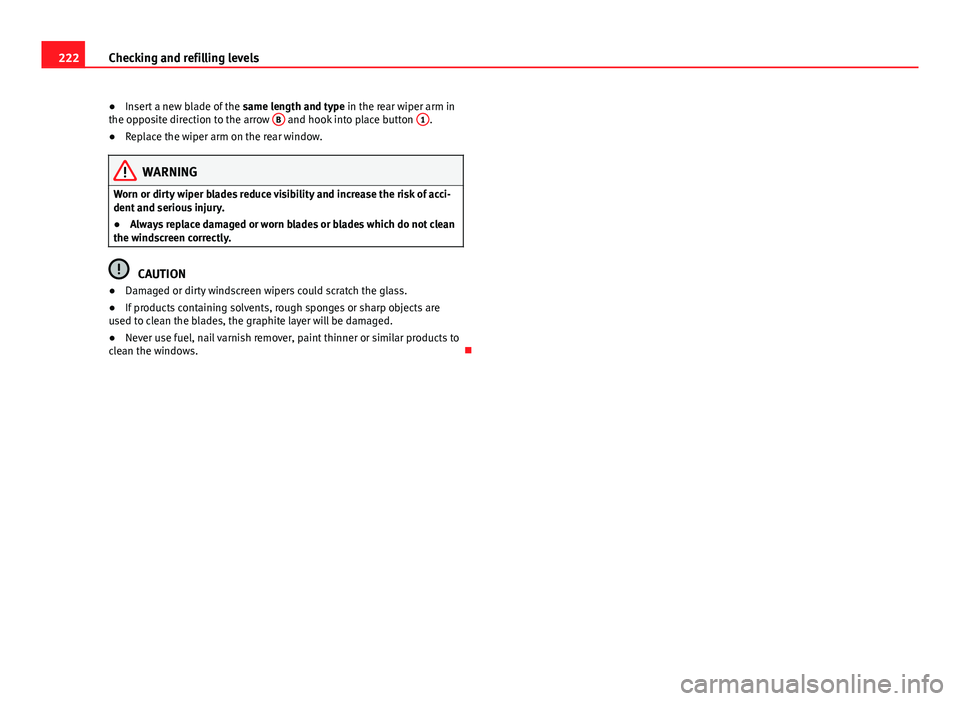
● Insert a new blade of the same length and type in the rear wiper arm in
the opposite direction to the arrow B
and hook into place button 1.
● Replace the wiper arm on the rear window.
WARNING
Worn or dirty wiper blades reduce visibility and increase the risk of acci-
dent and serious injury.
● Always replace damaged or worn blades or blades which do not clean
the windscreen correctly.
CAUTION
● Damaged or dirty windscreen wipers could scratch the glass.
● If products containing solvents, rough sponges or sharp objects are
used to clean the blades, the graphite layer will be damaged.
● Never use fuel, nail varnish remover, paint thinner or similar products to
clean the windows.
Page 225 of 289

224Wheels and tyres
–The tyre pressure should only be checked when the tyres are
cold. The slightly raised pressures of warm tyres must not be re-
duced.
– Adjust tyre pressure to the load being carried by the vehicle.
– In vehicles with a tyre pressure indicator, save the pressure of
modified tyres ⇒ page 175, ⇒ page 223.
– Avoid fast cornering and hard acceleration.
– Inspect the tyres for irregular wear from time to time.
The useful life of your tyres depends on the following factors:
Tyre pressure
Tyre pressure values are indicated on the inside of the fuel tank flap.
Insufficient or excessive pressure greatly reduces the useful life of the tyres
and adversely affects vehicle performance and ride. Correct inflation pres-
sures are very important, especially at high speeds.
If you want a more comfortable ride, you can inflate tyres to the pressure
corresponding to the normal vehicle load (up to 3 people) if the vehicle is
carrying a normal load. If the vehicle is going to carry the maximum load,
the tyre pressure should be increased to maximum value indicated.
The tyre pressure must be adjusted according to the load the vehicle is car-
rying. We recommend adhering to the tyre pressure specifications for a max-
imum load.
Do not forget the spare wheel when checking the tyre pressures: Keep the
spare wheel inflated to the highest pressure required for the road wheels.
In the case of a minimised temporary spare wheel (125/70 R16 or 125/70
R18) inflate to a pressure of 4.2 bar as indicated on the tyre pressure label
on the fuel tank flap. Driving style
Fast cornering, heavy acceleration and hard braking (squealing tyres) all in-
crease tyre wear.
Wheel balance
The wheels on new vehicles are balanced. However, certain circumstances
may lead to imbalance (run-out), which is detected as vibrations in the
steering wheel.
Unbalanced wheels should be rebalanced, as they otherwise cause exces-
sive wear on steering, suspension and tyres. A wheel must also be reba-
lanced when a new tyre is fitted or if a tyre is repaired.
Incorrect wheel alignment
Incorrect wheel alignment causes excessive tyre wear, impairing the safety
of the vehicle. If you notice excessive tyre wear, you should check wheel
alignment at a SEAT Official Service.
WARNING
● Always adapt the tyre pressure accordingly when the vehicle load
changes.
● A tyre with low air pressure has to flex a lot more when the vehicle is
heavily loaded or at high speeds, therefore causing overheating to occur.
Under these conditions, the tyre bead may be released or the tyre may
burst. Risk of accident!
For the sake of the environment
Under-inflated tyres will increase fuel consumption.
Page 226 of 289

225
Wheels and tyres
Indications of wear
Tread wear indicators indicate if a tyre is worn.
Fig. 115 Tyre tread:
tread wear indicators
The original tyres on your vehicle have 1.6 mm high “tread wear indicators”
running across the tread. Depending on the manufacturer, there will be 6 to
8 of them spaced at equal distances around the tyre. Markings on the tyre
sidewall (for instance the letters “TWI” or a triangle) indicate the positions
of the tread wear indicators.
The minimum tread depth required by law is 1.6 mm (measured in the tread
grooves next to the tread wear indicators). (Different figures may apply in
other countries.)
WARNING
The tyres must be replaced at the latest when the tread is worn down to
the tread wear indicators. Failure to do so could result in an accident.
● Especially in difficult driving conditions such as wet or icy roads, it is
important that the tyres have sufficient tread depth. The tread depth
should same on the tyres of both the front and the rear axles.
● The decrease in driving safety due to insufficient tread depth is par-
ticularly evident in vehicle handling, when there is a risk of aquaplaning
in deep puddles of water and when driving through corners. Braking is
also adversely affected.
● The speed has to be adapted accordingly, otherwise there is a risk of
losing control over the vehicle.
Changing wheels
Fig. 116 Changing
wheels around
Safety FirstOperating instructionsPractical TipsTechnical specifications
Page 228 of 289

227
Wheels and tyres
If you use tyres that are approved by SEAT you can be sure that the actual
tyre dimensions will be correct for your vehicle. If you decide to fit a differ-
ent type of tyre, you must obtain the appropriate manufacturer's certificate
from the tyre retailer to confirm that the tyres are suitable for your vehicle.
Keep this certificate in a safe place.
Your SEAT Official Service will be able to advise you on which tyres may be
fitted to your vehicle.
It is best to have all servicing of wheels and tyres performed by a special-
ised workshop. They are familiar with the procedure and have the necessary
special tools and spare parts as well as the proper facilities for disposing of
the old tyres.
WARNING
● It is very important to ensure that the tyres you have chosen have ad-
equate clearance. When selecting replacement tyres, do not rely entirely
on the nominal tyre size marked on the tyre; with some makes of tyre the
effective tyre size can differ significantly from the nominal dimensions,
even though the tyres have the same size designation. Inadequate tyre
clearance can result in damage to the tyres or the vehicle, causing a seri-
ous safety risk. It may also invalidate the vehicle's registration for use on
public roads.
● Avoid running the vehicle on tyres that are more than 6 years old. If
you have no alternative, you should drive slowly and with extra care at all
times.
● If wheel trims are fitted after the car is purchased, ensure that there
is an adequate flow of air for cooling the brake system.
For the sake of the environment
Old tyres must be disposed of according to the laws in the country con-
cerned.
Note
● Never mount used tyres if you are not sure of their “previous history”.
● For technical reasons, it is not generally possible to use the wheels from
other vehicles. In some cases, this may also be true for the same model of
wheel.
Wheel bolts
The wheel bolts are designed to suit the rims on your car.
The wheel bolts are matched to the rims. When installing different wheels
(for instance alloy wheels or wheels with winter tyres) it is important to use
the correct wheel bolts with the right length and correctly shaped bolt
heads. This ensures that wheels are fitted securely and that the brake sys-
tem functions correctly.
The wheel bolts must be clean and turn easily.
A special adapter is required to turn the anti-theft wheel bolts*
⇒ page 237.
Winter tyres
Winter tyres will improve the vehicles handling on snow and
ice.
– Winter tyres must be fitted on all four wheels.
– Only use winter tyres that are approved for your vehicle.
– Please note that the maximum permissible speed for winter
tyres may be lower than for summer tyres.
Safety FirstOperating instructionsPractical TipsTechnical specifications
Page 229 of 289

228Wheels and tyres
–Also note that winter tyres are no longer effective when the
tread is worn down.
– After fitting the wheels you must always check the tyre pres-
sures. The correct tyre pressures are listed on the sticker on the
inside of the fuel tank flap ⇒ page 223.
In winter road conditions winter tyres will considerably improve vehicle han-
dling. The design of summer tyres (width, rubber compound, tread pattern)
gives less grip on ice and snow. This applies particularly to vehicles equip-
ped with wide section tyres or high speed tyres (code letters H, V or Y on
the sidewall).
Only use winter tyres of the correct type approved for your vehicle. The sizes
of the winter tyres approved for your vehicle are listed in the vehicle docu-
mentation (e.g. EC Certificate of Conformity or COC document 1)
). The vehi-
cle documentation varies depending on the country of residence. See also
⇒ page 226.
Winter tyres lose a great deal of their properties when the tread is worn
down to a depth of 4 mm.
The performance of winter tyres is also severely impaired by ageing, even if
the tread is still much deeper than 4 mm.
Winter tyres are subject to the following maximum speed limits according to
speed rating code letter: ⇒
Speed rating code
letter ⇒ page 226Maximum speed limit
Q160 km/h (140 mph)S180 km/h (140 mph)T190 km/h (140 mph)
Speed rating code
letter ⇒ page 226Maximum speed limit
H210 km/h (140 mph)V240 km/h (150 mph)
(note restrictions)
Vehicles capable of exceeding these speeds must have an appropriate
sticker attached so that it is visible to the driver. Suitable stickers are availa-
ble from the SEAT Official Service and specialised workshop. Please note
regulations to this effect in your country.
“All-weather” tyres can also be used instead of winter tyres.
Using winter tyres with V-rating
Please note that the generally applicable 240 km/h (150 mph) speed rating
for winter tyres with the letter V is subject to technical restrictions; the max-
imum permissible speed for your vehicle may be significantly lower . The
maximum speed limit for tyres with a V-rating depends directly on the maxi-
mum axle weights for your car and on the listed weight rating of the tyres
being used.
It is best to contact a SEAT Official Service to check the maximum speed
which is permissible for the V-rated tyres fitted on your car on the basis of
this information.
WARNING
Exceeding the maximum speed permitted for the winter tyres fitted on
your car can cause tyre failure, resulting in a loss of control of the vehicle
– risk of accident.
1)
COC = certificate of conformity