%27 Seat Leon 5D 2012 User Guide
[x] Cancel search | Manufacturer: SEAT, Model Year: 2012, Model line: Leon 5D, Model: Seat Leon 5D 2012Pages: 289, PDF Size: 3.81 MB
Page 209 of 289
208Checking and refilling levels
–Close the tank flap. Make sure you hear it click into place.
If the automatic filler nozzle is operated correctly, it will switch itself off as
soon as the fuel tank is “full”. Do not try to put in more fuel after the nozzle
cuts out, as this will fill the expansion chamber in the fuel tank.
The correct fuel grade for your vehicle is given on a sticker on the inside of
the fuel tank flap. Further notes on fuel can be found at ⇒ page 206.
The capacity of the fuel tank is listed in the vehicle technical specifications
⇒ page 276.
WARNING
Fuel is highly flammable and can cause serious burns and other injuries.
● Do not smoke when filling the fuel tank or a canister. Naked flames
are forbidden in the vicinity due to the risk of explosion.
● Observe legislation governing the use, storage and carrying of a
spare fuel canister in the vehicle.
● For safety reasons we do not recommend carrying a spare fuel canis-
ter in the vehicle. In an accident the canister could be damaged and could
leak.
● If, in exceptional circumstances, you have to carry a spare fuel canis-
ter, please observe the following points:
–Never fill fuel into the spare fuel canister if it is inside or on top of
the vehicle. An electrostatic charge could build up during filling, caus-
ing the fuel vapour to ignite. Danger of explosion. Always place the
canister on the ground to fill it.
– Insert the filling nozzle as far as possible into the spare fuel canis-
ter.
WARNING (Continued)
– If the spare fuel canister is made of metal, the filling nozzle must
be in contact with the canister during filling. This helps prevent an
electrostatic charge building up.
– Never spill fuel in the vehicle or in the luggage compartment. Fuel
vapour is explosive. Risk of fatal accident!
CAUTION
● If any fuel is spilt onto the vehicle, it should be removed immediately. It
could otherwise damage the paintwork.
● Never run the tank completely dry. An irregular fuel supply could cause
misfiring. As a result, unburnt fuel could enter the exhaust system and dam-
age the catalytic converter.
● When filling the fuel tank after having run it completely dry on a vehicle
with a diesel engine , the ignition must be switched on for at least 30 sec-
onds before starting the engine. When you then start the engine it may take
longer than normal (up to one minute) for the engine to start firing. This is
because air needs to be bled from the fuel system while starting.
For the sake of the environment
Do not overfill the fuel tank – it may cause the fuel to overflow if it becomes
warm.
Page 221 of 289

220Checking and refilling levels
● Before starting any work on the battery, always observe the warnings lis-
ted under ⇒ page 218, Important safety warnings for handling a vehicle
battery.
● Do not forget to replace the battery coverings, where applicable. This
helps to protect against excess temperatures. This in turn extends the vehi-
cle service life.
For the sake of the environment
Batteries contain toxic substances including sulphuric acid and lead. They
must be disposed of appropriately and must not be disposed of with ordi-
nary household waste. Make sure disconnected batteries cannot tip over.
Sulphuric acid could be spilt!
Windscreen washer reservoir and wiper
blades
Windscreen washer
Fig. 112 Engine com-
partment: Windscreen
washer reservoir top The windscreen washer reservoir contains the cleaning fluid for the wind-
screen, the rear window and the headlight washer system* ⇒ Fig. 112. Res-
ervoir capacity: ⇒ page 276.
To prevent the nozzles from becoming blocked with chalk deposits, fill res-
ervoir with water with a low calcium content (distilled water). Always add
washer fluid to the water (with anti-freeze additive in winter).
CAUTION
● Never put radiator anti-freeze or other additives into the windscreen
washer fluid.
● Never use washer fluid which contains paint thinners or solvents as it
can damage the paintwork.
Page 228 of 289

227
Wheels and tyres
If you use tyres that are approved by SEAT you can be sure that the actual
tyre dimensions will be correct for your vehicle. If you decide to fit a differ-
ent type of tyre, you must obtain the appropriate manufacturer's certificate
from the tyre retailer to confirm that the tyres are suitable for your vehicle.
Keep this certificate in a safe place.
Your SEAT Official Service will be able to advise you on which tyres may be
fitted to your vehicle.
It is best to have all servicing of wheels and tyres performed by a special-
ised workshop. They are familiar with the procedure and have the necessary
special tools and spare parts as well as the proper facilities for disposing of
the old tyres.
WARNING
● It is very important to ensure that the tyres you have chosen have ad-
equate clearance. When selecting replacement tyres, do not rely entirely
on the nominal tyre size marked on the tyre; with some makes of tyre the
effective tyre size can differ significantly from the nominal dimensions,
even though the tyres have the same size designation. Inadequate tyre
clearance can result in damage to the tyres or the vehicle, causing a seri-
ous safety risk. It may also invalidate the vehicle's registration for use on
public roads.
● Avoid running the vehicle on tyres that are more than 6 years old. If
you have no alternative, you should drive slowly and with extra care at all
times.
● If wheel trims are fitted after the car is purchased, ensure that there
is an adequate flow of air for cooling the brake system.
For the sake of the environment
Old tyres must be disposed of according to the laws in the country con-
cerned.
Note
● Never mount used tyres if you are not sure of their “previous history”.
● For technical reasons, it is not generally possible to use the wheels from
other vehicles. In some cases, this may also be true for the same model of
wheel.
Wheel bolts
The wheel bolts are designed to suit the rims on your car.
The wheel bolts are matched to the rims. When installing different wheels
(for instance alloy wheels or wheels with winter tyres) it is important to use
the correct wheel bolts with the right length and correctly shaped bolt
heads. This ensures that wheels are fitted securely and that the brake sys-
tem functions correctly.
The wheel bolts must be clean and turn easily.
A special adapter is required to turn the anti-theft wheel bolts*
⇒ page 237.
Winter tyres
Winter tyres will improve the vehicles handling on snow and
ice.
– Winter tyres must be fitted on all four wheels.
– Only use winter tyres that are approved for your vehicle.
– Please note that the maximum permissible speed for winter
tyres may be lower than for summer tyres.
Safety FirstOperating instructionsPractical TipsTechnical specifications
Page 243 of 289

242Emergencies
How to jump start: description
Fig. 126 Diagram of con-
nections for vehicles
without Start Stop sys-
tem
Fig. 127 Diagram of con-
nections for vehicles
with Start Stop system
Jump lead terminal connections
1. Switch off the ignition of both vehicles ⇒
.
2. For vehicles without Start-Stop system :–
Connect one end of the red jump lead to the positive +
termi-
nal of the vehicle with the flat battery A ⇒ Fig. 126.
– Connect the other end of the red jump lead to the positive ter-
minal +
in the vehicle providing assistance B.
– Connect one end of the black jump lead to the negative terminal
–
of the vehicle providing assistance B ⇒ Fig. 126.
– Connect the other end of the black jump lead X
to a solid met-
al component bolted to the engine block or to the engine block
itself of the vehicle with the flat battery. However, connect it to
a point as far as possible from the battery A
.
3. For vehicles with Start-Stop system :
– Connect one end of the red jump lead to the positive +
termi-
nal of the vehicle with the flat battery A ⇒ Fig. 127.
– Connect the other end of the red jump lead to the positive ter-
minal +
in the vehicle providing assistance B.
– Connect one end of the black jump lead X
to a suitable ground
terminal, a solid piece of metal in the engine block, or to the en-
gine block ⇒ Fig. 127.
– Connect the other end of the black jump lead X
to a solid met-
al component bolted to the engine block or to the engine block
itself of the vehicle with the flat battery. However, connect it to
a point as far as possible from the battery A
.
4. Position the leads in such a way that they cannot come into contact with any moving parts in the engine compartment.
Page 251 of 289

250Fuses and bulbs
–Unlock the fuse cover ⇒ Fig. 132.
– Remove the clips from the fuse cover.
– Use the plastic clip to pull out the fuse and replace the blown
fuse with a fuse of the same rating.
The individual electrical circuits are protected by fuses. Fuses are located
under a cover below the steering wheel on the left side of the engine com-
partment.
WARNING
Do not repair fuses, and never replace a blown fuse with a higher amper-
age fuse. The electrical system could be damaged, with risk of fire.
CAUTION
● Multiple fuse values on the same line (for example, 5/10/20) in the fol-
lowing tables indicate equipment-related differences. Replace the blown
fuse with a fuse of the same amperage.
● If a newly replaced fuse blows again after a short time, the electrical sys-
tem must be checked by a specialised workshop as soon as possible.
Note
● Positions are not occupied by a fuse do not appear in the following ta-
bles.
● Some of the equipment listed in the tables below pertain only to certain
versions of the model or are an optional extra. Fuses in the vehicle interior
No.Electrical consumerAmpsF2Vacant-F4Alarm10F5Gateway5F6Anti-theft alarm system5
F7Air conditioner/heating control panel, selector
lever (automatic gearbox), relay coil, rear win-
dow heating, additional heating10
F8Diagnosis, handbrake switch, light switch, re-
verse light, interior lighting10
F9Vacant-F10Radio display10F11Vacant-F12Radio20F13Vacant-F14Air conditioner fan40F15Vacant-F16Vacant-F17Instrument panel5F18Vacant-F19Vacant-F20Vacant-F23Right lights40F24Sunroof30F25Left door30F26Heated seats30F27Vacant-F28Vacant-
Page 271 of 289
270Technical specifications
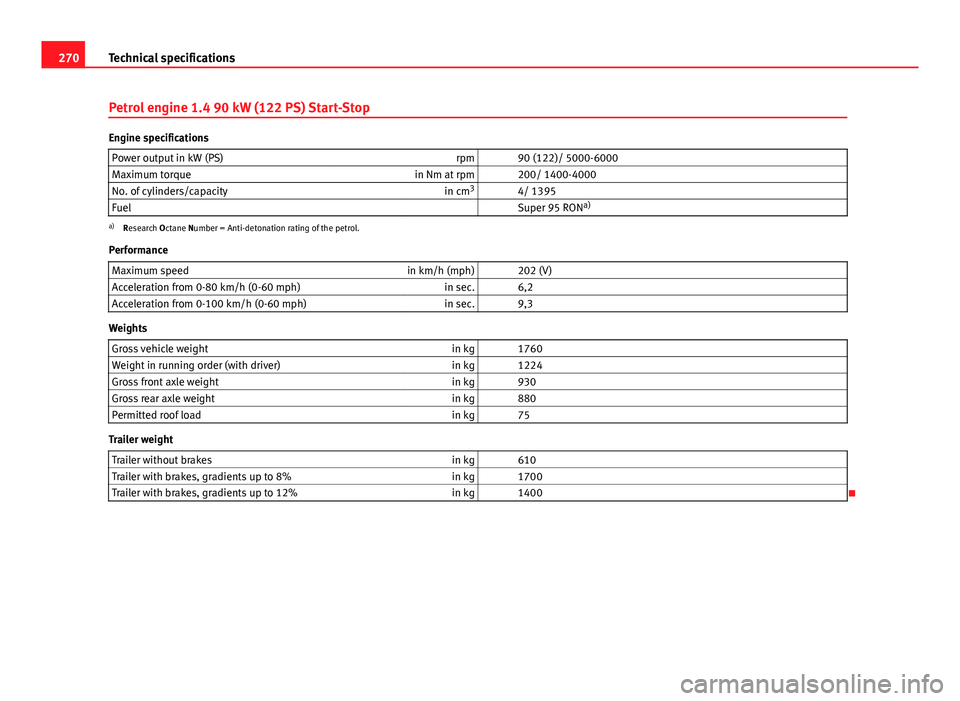
Petrol engine 1.4 90 kW (122 PS) Start-Stop
Engine specifications
Power output in kW (PS) rpm 90 (122)/ 5000-6000
Maximum torque in Nm at rpm 200/ 1400-4000
No. of cylinders/capacity in cm3
4/ 1395
Fuel Super 95 RON a)
a)
Research Octane Number = Anti-detonation rating of the petrol.
Performance Maximum speed in km/h (mph) 202 (V)
Acceleration from 0-80 km/h (0-60 mph) in sec. 6,2
Acceleration from 0-100 km/h (0-60 mph) in sec. 9,3
Weights
Gross vehicle weight in kg 1760
Weight in running order (with driver) in kg 1224
Gross front axle weight in kg 930
Gross rear axle weight in kg 880
Permitted roof load in kg 75
Trailer weight
Trailer without brakes in kg 610
Trailer with brakes, gradients up to 8% in kg 1700
Trailer with brakes, gradients up to 12% in kg 1400
Page 272 of 289

271
Technical specifications
Petrol engine 1.4 103 kW (140 PS) Start-Stop
Engine specifications Power output in kW (PS) rpm 103 (140)/ 5000
Maximum torque in Nm at rpm 250/ 1500-3500
No. of cylinders/capacity in cm3
4/ 1395
Fuel Super 95 RON a)
/Normal 91 RON b)
a)
Research Octane Number = Anti-detonation rating of the petrol.
b) With a slight power loss
Performance Maximum speed in km/h (mph) 212 (V&VI)
Acceleration from 0-80 km/h (0-60 mph) in sec. 5,8
Acceleration from 0-100 km/h (0-60 mph) in sec. 8,2
Weights
Gross vehicle weight in kg 1740
Weight in running order (with driver) in kg 1228
Gross front axle weight in kg 910
Gross rear axle weight in kg 880
Permitted roof load in kg 75
Trailer weight
Trailer without brakes in kg 610
Trailer with brakes, gradients up to 8% in kg 1800
Trailer with brakes, gradients up to 12% in kg 1500
Engine oil filling capacity
Approximate engine oil capacity with oil filter change 4.0 litres
Safety FirstOperating instructionsPractical TipsTechnical specifications
Page 273 of 289

272Technical specifications
Petrol engine 1.8 132 kW (180 PS) Start-Stop
Engine specifications
Power output in kW (PS) rpm 132 / 5100-6200
Maximum torque in Nm at rpm 250/ 1250-3900
No. of cylinders/capacity in cm3
4/ 1798
Fuel Super 95 RON a)
a)
Research Octane Number = Anti-detonation rating of the petrol.
Performance ManualAutomatic
Maximum speed in km/h (mph) 225 (V&VI) 225 (VI)
Acceleration from 0-80 km/h (0-60 mph) in sec. 5,5 5,5
Acceleration from 0-100 km/h (0-60 mph) in sec. 7,5 7,5
Weights
Manual Automatic
Gross vehicle weight in kg 1810 1820
Weight in running order (with driver) in kg 1300 1315
Gross front axle weight in kg 980 1000
Gross rear axle weight in kg 880 870
Permitted roof load in kg 75 75
Trailer weight
ManualAutomatic
Trailer without brakes in kg 650 650
Trailer with brakes, gradients up to 8% in kg 1800 1800
Trailer with brakes, gradients up to 12% in kg 1500 1500
Page 274 of 289

273
Technical specifications
Diesel engine 1.6 66 kW (90 PS)
Engine specifications Power output in kW (PS) rpm 66 (90) /2750-4800
Maximum torque in Nm at rpm 230/1400-2750
No. of cylinders/capacity in cm3
4/1598
Fuel Diesel according to standard EN 590, Min. 51 CN
Performance
Maximum speed in km/h (mph) 179 (IV)
Acceleration from 0-80 km/h (0-60 mph) in sec. 8,2
Acceleration from 0-100 km/h (0-60 mph) in sec. 12,6
Weights
Gross vehicle weight in kg 1820
Weight in running order (with driver) in kg 1281
Gross front axle weight in kg 990
Gross rear axle weight in kg 850
Permitted roof load in kg 75
Trailer weight
Trailer without brakes in kg 640
Trailer with brakes, gradients up to 8% in kg 1700
Trailer with brakes, gradients up to 12% in kg 1400
Safety FirstOperating instructionsPractical TipsTechnical specifications
Page 275 of 289

274Technical specifications
Diesel engine 1.6 77 kW (105 PS)
Engine specifications
Power output in kW (PS) rpm 77 (105) /3000-4000
Maximum torque in Nm at rpm 250/1500-2750
No. of cylinders/capacity in cm3
4/1598
Fuel Diesel according to standard EN 590, Min. 51 CN
Performance
ManualStart-Stop Automatic
Maximum speed in km/h (mph) 192 (V) 192 (V) 190 (V)
Acceleration from 0-80 km/h (0-60
mph) in sec. 7,3
7,3 7,1
Acceleration from 0-100 km/h (0-60
mph) in sec. 10,7
10,7 10,9
Weights
ManualStart-Stop Automatic
Gross vehicle weight in kg 1810 1820 1830
Weight in running order (with driver) in kg 1274 1286 1303
Gross front axle weight in kg 990 990 1020
Gross rear axle weight in kg 870 850 860
Permitted roof load in kg 75 75 75
Trailer weight
ManualStart-Stop Automatic
Trailer without brakes in kg 630 640 650
Trailer with brakes, gradients up to 8% in kg 1800 1800 1800
Trailer with brakes, gradients up to 12% in kg 1500 1500 1500