ESP Seat Leon 5D 2012 Repair Manual
[x] Cancel search | Manufacturer: SEAT, Model Year: 2012, Model line: Leon 5D, Model: Seat Leon 5D 2012Pages: 289, PDF Size: 3.81 MB
Page 216 of 289
215
Checking and refilling levels
Cooling system Engine coolant specifications
The engine cooling system is supplied from the factory with a specially trea-
ted mixture of water and, at least, 40 % of the additive G 13 (TLVW 774 J).
The engine coolant additive is recognisable by its purple colour. This mix-
ture of water and additive gives the necessary frost protection down to
-25°C (-13 F) and protects the light alloy parts of the cooling system against
corrosion. It also prevents scaling and considerably raises the boiling point
of the coolant.
To protect the engine cooling system, the percentage of additive must al-
ways be at least 40 %, even in warm climates where anti-freeze protection is
not required.
If greater frost protection is required in very cold climates, the proportion of
additive can be increased. However, the percentage of additive should not
exceed 60 %, as this would reduce the frost protection and, in turn, de-
crease the cooling capacity.
When the coolant is topped up, use a mixture of distilled water and, at
least, 40 % of the G 13 or G 12 plus-plus (TL-VW 774 G) additive (both are
purple) to obtain an optimum anticorrosion protection ⇒
. The mixture of
G 13 with G 12 plus (TL-VW 774 F), G 12 (red) or G 11 (green-blue) engine
coolants will significantly reduce the anticorrosion protection and should,
therefore be avoided ⇒
.
WARNING
If there is not enough anti-freeze in the coolant system, the engine may
fail leading to serious damage.
● Please make sure that the percentage of additive is correct with re-
spect to the lowest expected ambient temperature in the zone in which
the vehicle is to be used.
● When the outside temperature is very low, the coolant could freeze
and the vehicle would be immobilised. In this case, the heating would
not work either and inadequately dressed passengers could die of cold.
CAUTION
The original additives should never be mixed with coolants which are not
approved by SEAT. Otherwise, you run the risk of causing severe damage to
the engine and the engine cooling system.
● If the fluid in the expansion tank is not purple but is, for example,
brown, this indicates that the G 13 additive has been mixed with an inade-
quate coolant. The coolant must be changed as soon as possible if this is
the case! This could result in serious faults and engine damage.
For the sake of the environment
Coolants and additives can contaminate the environment. If any fluids are
spilled, they should be collected and correctly disposed of, with respect to
the environment.
Safety FirstOperating instructionsPractical TipsTechnical specifications
Page 218 of 289
217
Checking and refilling levels
Brake fluid
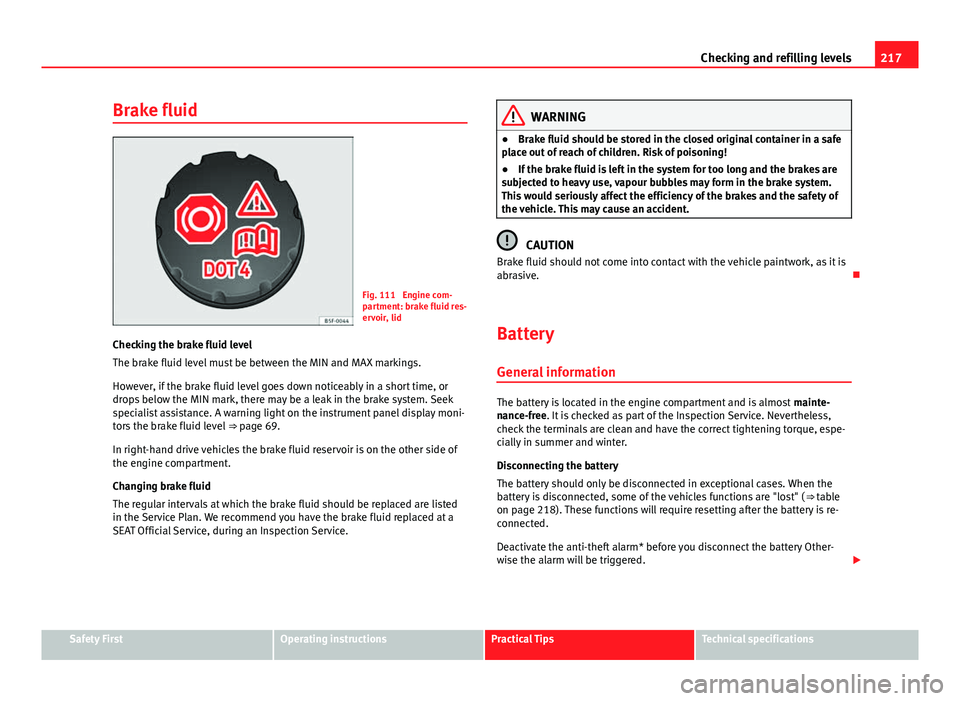
Fig. 111 Engine com-
partment: brake fluid res-
ervoir, lid
Checking the brake fluid level
The brake fluid level must be between the MIN and MAX markings.
However, if the brake fluid level goes down noticeably in a short time, or
drops below the MIN mark, there may be a leak in the brake system. Seek
specialist assistance. A warning light on the instrument panel display moni-
tors the brake fluid level ⇒ page 69.
In right-hand drive vehicles the brake fluid reservoir is on the other side of
the engine compartment.
Changing brake fluid
The regular intervals at which the brake fluid should be replaced are listed
in the Service Plan. We recommend you have the brake fluid replaced at a
SEAT Official Service, during an Inspection Service.
WARNING
● Brake fluid should be stored in the closed original container in a safe
place out of reach of children. Risk of poisoning!
● If the brake fluid is left in the system for too long and the brakes are
subjected to heavy use, vapour bubbles may form in the brake system.
This would seriously affect the efficiency of the brakes and the safety of
the vehicle. This may cause an accident.
CAUTION
Brake fluid should not come into contact with the vehicle paintwork, as it is
abrasive.
Battery General information
The battery is located in the engine compartment and is almost mainte-
nance-free. It is checked as part of the Inspection Service. Nevertheless,
check the terminals are clean and have the correct tightening torque, espe-
cially in summer and winter.
Disconnecting the battery
The battery should only be disconnected in exceptional cases. When the
battery is disconnected, some of the vehicles functions are "lost" ( ⇒ table
on page 218). These functions will require resetting after the battery is re-
connected.
Deactivate the anti-theft alarm* before you disconnect the battery Other-
wise the alarm will be triggered.
Safety FirstOperating instructionsPractical TipsTechnical specifications
Page 219 of 289

218Checking and refilling levels
FunctionReprogrammingOne-touch function of the electric
windows⇒ page 101, One-touch opening and
closing*
Remote control keyIf the vehicle does not respond to the
key, they should be synchronised
⇒ page 90
Digital clock⇒ page 63
ESC warning lampAfter driving for a few metres, the
warning lamp goes out again.
If the vehicle is not used for long periods
The vehicle has a system for monitoring the current consumption when the
engine is left unused for long periods of time ⇒ page 187. Some functions,
such as the interior lights, or the remote door opening, may be temporarily
disabled to prevent the battery from running flat. These functions will come
back on as soon as the ignition is switched on and the engine started.
Winter conditions
During the winter, the starting power may be reduced, and if necessary, the
battery should be charged ⇒
in Important safety warnings for handling a
vehicle battery on page 218
Important safety warnings for handling a vehicle battery
All work on batteries requires specialist knowledge. Please refer to a SEAT
Official Service or a workshop specialising in batteries: risk of burns or ex-
ploding battery!
The battery must not be opened. Never try to change the fluid level of the
battery. Explosive gas is released from the battery that could cause an ex-
plosion.
Wear eye protection.
Battery acid is very corrosive and caustic. Wear protective gloves
and eye protection. In the event of electrolyte splashes, rinse off
with plenty of water.
Fires, sparks, open flames and smoking are prohibited.
The battery should only be charged in a well-ventilated zone. Risk
of explosion!
Keep children away from acid and batteries!
WARNING
● When repairing or working on the electrical system, proceed as fol-
lows:
● 1. Remove the key from the ignition. The negative cable on the bat-
tery must be disconnected.
● 2. When the repair is finished, reconnect the negative pole of the bat-
tery.
● Switch off all electrical consumers before reconnecting the battery.
Reconnect first the positive cable and then the negative cable. Never re-
verse the polarity of the connections. This could cause an electrical fire.
● Ensure that the vent hose is always connected to the battery.
● Never use damaged batteries. This could cause an explosion! Replace
a damaged battery immediately.
CAUTION
● Never disconnect the battery if the ignition is switched on or if the en-
gine is running. This could damage the electrical system or electronic com-
ponents.
Page 222 of 289

221
Checking and refilling levels
Cleaning and changing the wiper blades of the windscreen
and rear window
Fig. 113 Changing the
windscreen wiper blades
Fig. 114 Changing the
rear wiper blade
The windscreen wiper blades are supplied as standard with a layer of graph-
ite. This layer is responsible for ensuring that the wipe is silent. If the graph- ite layer is damaged, the noise of the water as it is wiped across the wind-
screen will be louder.
Check the condition of the wiper blades regularly.
If the wipers scrape
across the glass they should be changed if they are damaged, or cleaned if
they are dirty ⇒
.
Damaged wiper blades should be replaced immediately. Wiper blades are
available from specialised workshops.
Raising/lowering windscreen wiper arms
For windscreen wipers, please note: the wiper should be in service position
before being lowering ⇒ page 119. When raising or lowering an arm, it should only be held at the blade fasten-
ing point.
Cleaning windscreen wiper blades
● Raising the wiper arms.
● Use a soft cloth to remove dust and dirt from the windscreen wiper
blades.
● If the blades are very dirty, a sponge or damp cloth may be used ⇒
.
Changing the windscreen wiper blades
● Raising/lowering wiper arms
● Hold down the release button ⇒ Fig. 113 1
while gently pulling the
blade in the direction of the arrow.
● Fit a new wiper blade of the same length and design on to the wiper arm
and hook it into place.
● Rest the wiper arms back onto the windscreen.
Changing the rear wiper blade
● Raising/lowering the wiper arm.
● Turn the blade slightly ⇒ Fig. 114 (arrow A
).
● Hold down the release button 1 while gently pulling the blade in the
direction of the arrow B.
Safety FirstOperating instructionsPractical TipsTechnical specifications
Page 224 of 289

223
Wheels and tyres
Wheels and tyres
Wheels
General notes
– When driving with new tyres, be especially careful during the
first 500 km (300 miles).
– If you have to drive over a kerb or similar obstacle, drive very
slowly and as near as possible at a right angle to the obstacle.
– Check from time to time if the tyres are damaged (punctures,
cuts, cracks or dents). Remove any foreign objects embedded in
the treads.
– Damaged wheels and tyres must be replaced immediately.
– Keep grease, oil and fuel off the tyres.
– Replace any missing valve caps as soon as possible.
– Mark the wheels before taking them off so that they rotate in
the same direction when put back.
– When removed, the wheels or tyres should be stored in a cool,
dry and preferably dark place.
New tyres
New tyres do not give maximum grip straight away and should therefore be
“run in” by driving carefully and at moderate speeds for about the first 500
km (300 miles). This will also increase the useful life of the tyres. The tread depth of new tyres may
vary, according to the type and make of
tyre and the tread pattern.
Concealed damage
Damage to tyres and rims is often not readily visible. If you notice unusual
vibration or the car pulling to one side, this may indicate that one of the
tyres is damaged. Reduce speed immediately if there is any reason to sus-
pect that damage may have occurred. Inspect the tyres for damage. If no ex-
ternal damage is visible, drive slowly and carefully to the nearest special-
ised workshop and have the car inspected.
Tyres with directional tread pattern
An arrow on the tyre sidewall indicates the direction of rotation on single
drive tyres. Always note the direction of rotation indicated when mounting
the wheel. This guarantees optimum grip and helps to avoid aquaplaning,
excessive noise and wear.
Retrofitting Accessories
If you wish to change or fit wheels, rims or wheel trims, we recommend that
you consult with a SEAT Official Service centre for advice regarding current
techniques.
Useful life of tyres
Correct inflation pressures and sensible driving habits will
increase the useful life of your tyres.
– Check tyre pressure at least once a month, and also prior to any
long trip.
Safety FirstOperating instructionsPractical TipsTechnical specifications
Page 225 of 289

224Wheels and tyres
–The tyre pressure should only be checked when the tyres are
cold. The slightly raised pressures of warm tyres must not be re-
duced.
– Adjust tyre pressure to the load being carried by the vehicle.
– In vehicles with a tyre pressure indicator, save the pressure of
modified tyres ⇒ page 175, ⇒ page 223.
– Avoid fast cornering and hard acceleration.
– Inspect the tyres for irregular wear from time to time.
The useful life of your tyres depends on the following factors:
Tyre pressure
Tyre pressure values are indicated on the inside of the fuel tank flap.
Insufficient or excessive pressure greatly reduces the useful life of the tyres
and adversely affects vehicle performance and ride. Correct inflation pres-
sures are very important, especially at high speeds.
If you want a more comfortable ride, you can inflate tyres to the pressure
corresponding to the normal vehicle load (up to 3 people) if the vehicle is
carrying a normal load. If the vehicle is going to carry the maximum load,
the tyre pressure should be increased to maximum value indicated.
The tyre pressure must be adjusted according to the load the vehicle is car-
rying. We recommend adhering to the tyre pressure specifications for a max-
imum load.
Do not forget the spare wheel when checking the tyre pressures: Keep the
spare wheel inflated to the highest pressure required for the road wheels.
In the case of a minimised temporary spare wheel (125/70 R16 or 125/70
R18) inflate to a pressure of 4.2 bar as indicated on the tyre pressure label
on the fuel tank flap. Driving style
Fast cornering, heavy acceleration and hard braking (squealing tyres) all in-
crease tyre wear.
Wheel balance
The wheels on new vehicles are balanced. However, certain circumstances
may lead to imbalance (run-out), which is detected as vibrations in the
steering wheel.
Unbalanced wheels should be rebalanced, as they otherwise cause exces-
sive wear on steering, suspension and tyres. A wheel must also be reba-
lanced when a new tyre is fitted or if a tyre is repaired.
Incorrect wheel alignment
Incorrect wheel alignment causes excessive tyre wear, impairing the safety
of the vehicle. If you notice excessive tyre wear, you should check wheel
alignment at a SEAT Official Service.
WARNING
● Always adapt the tyre pressure accordingly when the vehicle load
changes.
● A tyre with low air pressure has to flex a lot more when the vehicle is
heavily loaded or at high speeds, therefore causing overheating to occur.
Under these conditions, the tyre bead may be released or the tyre may
burst. Risk of accident!
For the sake of the environment
Under-inflated tyres will increase fuel consumption.
Page 226 of 289

225
Wheels and tyres
Indications of wear
Tread wear indicators indicate if a tyre is worn.
Fig. 115 Tyre tread:
tread wear indicators
The original tyres on your vehicle have 1.6 mm high “tread wear indicators”
running across the tread. Depending on the manufacturer, there will be 6 to
8 of them spaced at equal distances around the tyre. Markings on the tyre
sidewall (for instance the letters “TWI” or a triangle) indicate the positions
of the tread wear indicators.
The minimum tread depth required by law is 1.6 mm (measured in the tread
grooves next to the tread wear indicators). (Different figures may apply in
other countries.)
WARNING
The tyres must be replaced at the latest when the tread is worn down to
the tread wear indicators. Failure to do so could result in an accident.
● Especially in difficult driving conditions such as wet or icy roads, it is
important that the tyres have sufficient tread depth. The tread depth
should same on the tyres of both the front and the rear axles.
● The decrease in driving safety due to insufficient tread depth is par-
ticularly evident in vehicle handling, when there is a risk of aquaplaning
in deep puddles of water and when driving through corners. Braking is
also adversely affected.
● The speed has to be adapted accordingly, otherwise there is a risk of
losing control over the vehicle.
Changing wheels
Fig. 116 Changing
wheels around
Safety FirstOperating instructionsPractical TipsTechnical specifications
Page 230 of 289

229
Wheels and tyres
For the sake of the environment
Summer tyres should be fitted again as soon as possible; they give better
handling on roads which are free of snow and ice. Summer tyres perform
with less rolling noise, tyre wear and – most important – reduce fuel con-
sumption.
Snow chains
Snow chains will improve vehicle handling on snow-covered
roads.
– Snow chains can be used on the front wheels only.
– Check that the snow chains are correctly seated after driving for
a few yards. Always take the manufacturer assembly instruc-
tions into account.
– Keep your speed below 50 km/h (30 mph).
– If there is a danger of being trapped despite having mounted
the chains, it is best to disable the driving wheels (ASR) in the
ESC ⇒ page 184, Switching on/off the ESC and ASR.
Snow chains will improve braking ability as well as traction in winter condi-
tions.
For technical reasons snow chains may only be used with the following
wheel rim/tyre combination.
195/65 R15Chains with links of maximum 15 mm205/55 R16Chains with links of maximum 15 mm225/45 R17Chains with links of maximum 9 mm225/40 R18Chains with links of maximum 9 mm
Only use snow chains with fine-pitch links. The links must not protrude
more than 13.5 mm from the tyres (including tensioner).
Remove wheel covers and trim rings before fitting snow chains.
Remove the chains when roads are free of snow. Otherwise they will impair
handling, damage the tyres and wear out very quickly.
Safety FirstOperating instructionsPractical TipsTechnical specifications
Page 239 of 289
238Emergencies
WARNING
Slightly loosen the wheel bolts (one turn) before raising the vehicle with
the jack*. If not, an accident may occur.
Raising the vehicle
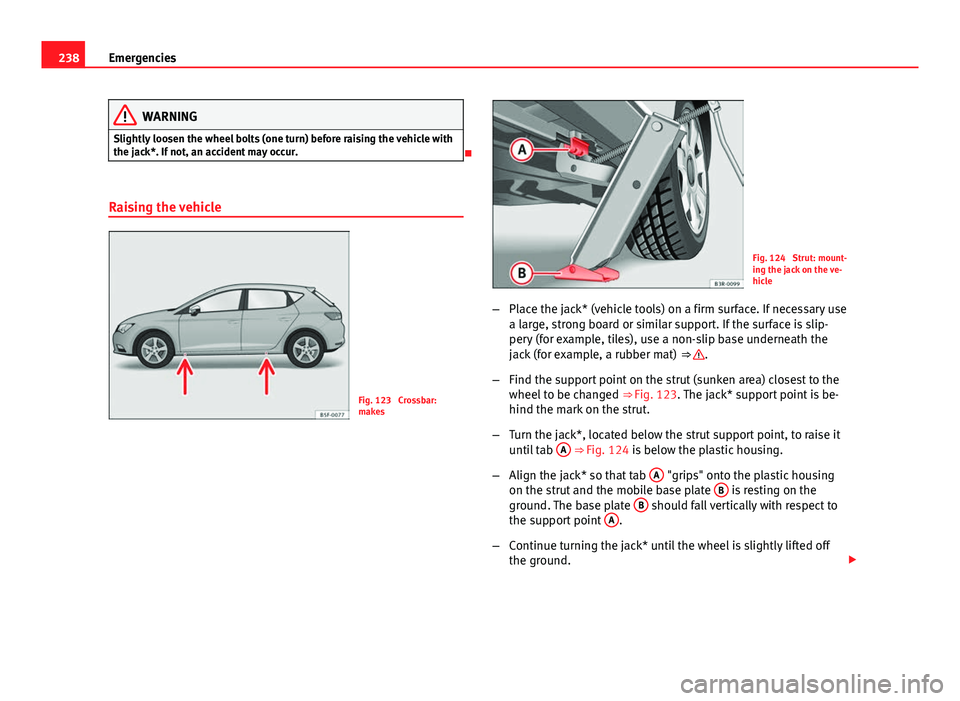
Fig. 123 Crossbar:
makes
Fig. 124 Strut: mount-
ing the jack on the ve-
hicle
– Place the jack* (vehicle tools) on a firm surface. If necessary use
a large, strong board or similar support. If the surface is slip-
pery (for example, tiles), use a non-slip base underneath the
jack (for example, a rubber mat) ⇒
.
– Find the support point on the strut (sunken area) closest to the
wheel to be changed ⇒ Fig. 123. The jack* support point is be-
hind the mark on the strut.
– Turn the jack*, located below the strut support point, to raise it
until tab A
⇒ Fig. 124 is below the plastic housing.
– Align the jack* so that tab A
"grips" onto the plastic housing
on the strut and the mobile base plate B is resting on the
ground. The base plate B should fall vertically with respect to
the support point A.
– Continue turning the jack* until the wheel is slightly lifted off
the ground.
Page 240 of 289

239
Emergencies
WARNING
● Make sure that the jack* remains stable. If the surface is slippery or
soft, the jack* could slip or sink, respectively, with the resultant risk of
injury.
● Only raise the vehicle with the jack* supplied by the manufacturer.
Other vehicles could slip, with the consequent risk of injury.
● Only mount the jack* on the support points designed for this purpose
on the strut, and always align the jack correctly. If you do not, the jack*
could slip as it does not have an adequate grip on the vehicle: risk of in-
jury!
● The height of the parked vehicle can change as a result of variations
in temperature and loading.
CAUTION
The vehicle must not be raised on the crossbar. Only place the jack* on the
points designed for this purpose on the strut. Otherwise, the vehicle may be
damaged.
Removing and fitting a wheel
After loosening the wheel bolts and raising the vehicle with the
jack, change the wheel as described below:
Taking off the wheel
– Unscrew the wheel bolts using the box spanner and place them
on a clean surface.
– Take off the wheel ⇒
. Putting on the spare wheel
When fitting tyres with a compulsory rotation direction, observe
the instructions in
⇒ page 239.
– Mount the wheel.
– Screw on the wheel bolts in position and tighten them loosely
with a box spanner.
– Carefully lower the vehicle using the jack*.
– Tighten the wheel bolts in diagonal pairs using the wheel
brace.
The wheel bolts should be clean and turn easily. Before fitting the spare
wheel, inspect the wheel condition and hub mounting surfaces. These sur-
faces must be clean before fitting the wheel.
CAUTION
When removing/fitting the wheel, the rim may hit and damage the brake
disc. For this reason, please take care and get a second person to assist
you.
Tyres with compulsory direction of rotation
A directional tread pattern can be identified by arrows on the sidewall that
point in the direction of rotation. Always observe the direction of rotation in-
dicated when mounting the wheel. This is important so that these tyres can
give maximum grip and avoid excessive noise, tread wear and aquaplaning.
If, exceptionally, it is necessary to mount the spare wheel* in the opposite
direction of rotation, please drive carefully, as in this case the tyre does not
have optimum conditions of use. This is particularly important when driving
on wet roads.
Safety FirstOperating instructionsPractical TipsTechnical specifications