remove seats Seat Leon 5D 2012 Owner's manual
[x] Cancel search | Manufacturer: SEAT, Model Year: 2012, Model line: Leon 5D, Model: Seat Leon 5D 2012Pages: 289, PDF Size: 3.81 MB
Page 30 of 289
29
Seat belts
Note
● If the seat belt tensioners are triggered, a fine dust is produced. This is
normal and it is not an indication of fire in the vehicle.
● The relevant safety requirements must be observed when the vehicle or
components of the system are scrapped. Specialised workshops are famili-
ar with these regulations, which are also available to you.
Service and disposal of belt tensioners
The belt tensioners are components of the seat belts that are installed in
the seats of your vehicle. If you work on the belt tensioners or remove and
install parts of the system when performing other repair work, the seat belt
may be damaged. The consequence may be that, in the event of an acci-
dent, the belt tensioners function incorrectly or not at all.
So that the effectiveness of the seat belt tensioner is not reduced and that
removed parts do not cause any injuries or environmental pollution, regula-
tions, which are known to the specialised workshops, must be observed.
WARNING
● Improper use or repairs not carried out by qualified mechanics in-
crease the risk of severe or fatal injuries. The belt tensioners may fail to
trigger or may trigger in the wrong circumstances.
● Never attempt to repair, adjust, remove or install parts of the belt ten-
sioners or seat belts.
● The seat belt tensioner, seat belt and automatic retractor cannot be
repaired.
WARNING (Continued)
● Any work on the belt tensioners and seat belts, including the removal
and refitting of system parts in conjunction with other repair work, must
be performed by a specialised workshop only.
● The belt tensioners will only provide protection for one accident and
must be changed if they have been activated.
Safety FirstOperating instructionsPractical TipsTechnical specifications
Page 40 of 289

39
Airbag system
Side airbags* Description of side airbags
The airbag system is not a substitute for the seat belts.
Fig. 23 Side airbag in
driver seat
The side airbags are located in the backrest cushions of the driver seat
⇒ Fig. 23 and the front passenger seat as well as in the rear seats*. The lo-
cations are identified by the text “AIRBAG” in the upper region of the backr-
ests.
Together with the seat belts, the side airbag system gives the front seat oc-
cupants additional protection for the upper body in the event of a severe
side collision ⇒ page 41, Safety notes on the operation of the side airbag
system.
In a side collision, the side airbags reduce the risk of injury to passengers
on the front seats to the areas of the body facing the impact. In addition to
their normal function of protecting the occupants in a collision, the seat
belts also hold the passengers in the front seats and the outer rear seats in
a position where the side airbags can provide maximum protection. The airbag system is not a substitute for seat belts, but it is an integral part
of the vehicle's overall passive safety system. Please bear in mind that the
airbag system can only work effectively when the occupants are wearing
their seat belts. Therefore, it is most important to wear the seat belts at all
times, not only because this is required by law in most countries, but also
for your safety
⇒ page 19, Brief introduction.
The side airbag system will not be triggered if:
● the ignition is switched off
● there is a minor side collision
● there is a frontal collision
● there is a rear-end collision
● the vehicle turns over
The main parts of the airbag system are:
● an electronic control and monitoring system (control unit)
● the side airbags in the sides of the backrests of the front and rear seats
● a control lamp in the dash panel
The airbag system operation is monitored electronically. The airbag control
lamp will light up for approx. 4 seconds every time the ignition is switched
on (self-diagnosis).
WARNING
● In a side-on collision the side airbags will not work if the sensors do
not correctly measure the pressure increase on the interior of the doors,
due to air escaping through the areas with holes or openings in the door
panel.
● Never drive the vehicle if the interior panels have been removed.
● Never drive if the interior door panels have been removed or if the
panels have not been correctly fitted.
Safety FirstOperating instructionsPractical TipsTechnical specifications
Page 41 of 289

40Airbag system
WARNING (Continued)
● Never drive the vehicle if the loudspeakers in the door panels have
been removed, unless the holes left by the loudspeakers have been cor-
rectly closed.
● Always check that the openings are closed or covered if loudspeakers
or other equipment are fitted in the interior door panels.
● Any work carried out to the doors should be made in an authorised
specialised workshop.
● The seat belts and airbags can only provide maximum protection if
the occupants are seated correctly ⇒ page 10, Sitting position for vehicle
occupants.
● If a fault has occurred in the airbag system, have the system checked
immediately by a specialised workshop. Otherwise, during a side colli-
sion, the system may fail to trigger, or not trigger correctly.
Operation of side airbags
Inflated airbags can reduce the risk of head or chest injury
in many side impact collisions.
Fig. 24 Illustration of
completely inflated side
airbags on left side of ve-
hicle
In some side collisions, the side airbag is triggered on the impact side of
the vehicle ⇒ Fig. 24.
In certain types of accident the front, curtain and side airbags may be trig-
gered together.
When the system is triggered, the airbag is filled with propellant gas.
The airbags deploy extremely rapidly, within thousandths of a second, to
provide additional protection in the event of an accident. A fine dust may
develop when the airbag deploys. This is normal and it is not an indication
of fire in the vehicle.
The fully deployed airbags cushion the movement of the occupants of the
front seats and the outer rear seats and help to reduce the risk of injury to
the upper body.
Page 53 of 289

52Child safety
Securing child seats
Ways to secure a child seat
A child seat can be secured differently on the rear seat and
on the front passenger seat.
Fig. 31 On the rear seats: figure A shows the basic child restraint system mounting
using lower retaining rings and the upper retaining strap figure B shows the child re-
straint system mounting using the vehicle seat belt
You can secure a child seat to the rear seat or front passenger seat in the
following ways:
● Child seats in groups 0 to 3 can be secured with a seat belt.
● Child seats in groups 0, 0+ and 1 with the ISOFIX and Top Tether* sys-
tems can be secured without using the seatbelt, thanks to the ISOFIX and
Top Tether* securing rings ⇒ page 54.
● During installation of some models of group I, II and III car seats in the
rear seat, difficulty may arise in mounting the seat given that it comes into
contact with the head restraint. In this case adjust the height of the head restraint or remove it from the seat following the instructions in the corre-
sponding chapter ⇒
page 127. Once you remove the car seat, replace the
head restraint in its original position.
Securing the child seat using the seat belt
The seat belt may be used to secure universal type child seats to the vehicle
seats marked with a U in the table below.
● If the front passenger seat lacks a height adjustment, child seats cannot
be mounted is this location.
Mass groupSeating positionFront passenger seatRear side seatRear centralseat
Group 0
to 10 kgU*UU
Group 0+ to 13 kgU*UU
Group I
9 to 18 kgU*UU
Group II
15 to 25 kgU*UU
Group III
22 to 36 kgU*UU
Suitable for universal restraint systems for use in this mass group.
Only compatible for models with adjustable seat height. Place seat in
the backmost highest position possible.
U:
*:
Page 56 of 289

55
Child safety
WARNING
● The securing rings are designed only for use with ISOFIX and Top
Tether* child seats.
● Never secure child seats that do not have the ISOFIX and Top Tether*
system, retaining belts or other objects to the securing rings – this could
result in potentially fatal injuries to the child!
● Ensure that the child seat is secured correctly using the “ISOFIX” and
Top Tether* securing rings.
ISOFIX child seat mounting system
Fig. 32 ISOFIX securing
rings
When removing or fitting the child seat, please be sure to follow
the manufacturer's instructions.
– Remove the protective caps of the “ISOFIX” rings by placing a
finger in the hole and pulling up ⇒
Fig. 32. –
Press the child seat onto the ISOFIX retaining rings until the
child seat can be heard to engage securely. If the child seat is
equipped with Toptether* anchor points, secure it to the corre-
spondent ring. Observe the manufacturer's instructions.
– Do a test by pulling both sides of the car seat to ensure that it is
properly anchored.
Child seats with the ISOFIX and Top Tether* attachment system are available
from Technical Services.
Top Tether retainer straps*
Some child restraint seats have a third Top Tether anchoring
point, apart from both “ISOFIX” anchoring points, which al-
low better child retention.
Fig. 33 Position of the
Top Tether rings on the
back of the rear seat
Safety FirstOperating instructionsPractical TipsTechnical specifications
Page 126 of 289

125
Seats and storage
Seats and storage General notes
WARNING
The Safe driving chapter contains important information, tips, sugges-
tions and warnings that you should read and observe for your own safety
and the safety of your passengers ⇒ page 7.
Front seats Manual seat adjustment
Fig. 71 Front seats:
manual seat adjustment Adjusting the seat forward/backward: pull the lever and move the seat
forwards or backwards.
Adjusting the lumbar support* : press the button in the corresponding
position.
Backrest lower/raise: turn the hand wheel.
Raise/lower the seat: Pull/push the lever.
WARNING
● Adjust the front seats only when the vehicle is stationary. Failure to
do so could result in an accident.
● Be careful when adjusting the seat height. Careless or uncontrolled
adjustment can cause injuries.
● The front seat backrests must not be reclined for driving. Otherwise,
seat belts and the airbag system might not protect as they should, with
the subsequent danger of injury.
Front centre armrest
The centre armrest can be adjusted to various levels. Adjusting the centre armrest
– To adjust the tilt, lift the armrest from the starting position so
that it is engaged.
– To return the armrest to the starting position, remove the arm-
rest from the upper fixed position and lower it.
The armrest can be moved backwards and forwards.
1
2
34
Safety FirstOperating instructionsPractical TipsTechnical specifications
Page 129 of 289
128Seats and storage
Rear head restraints
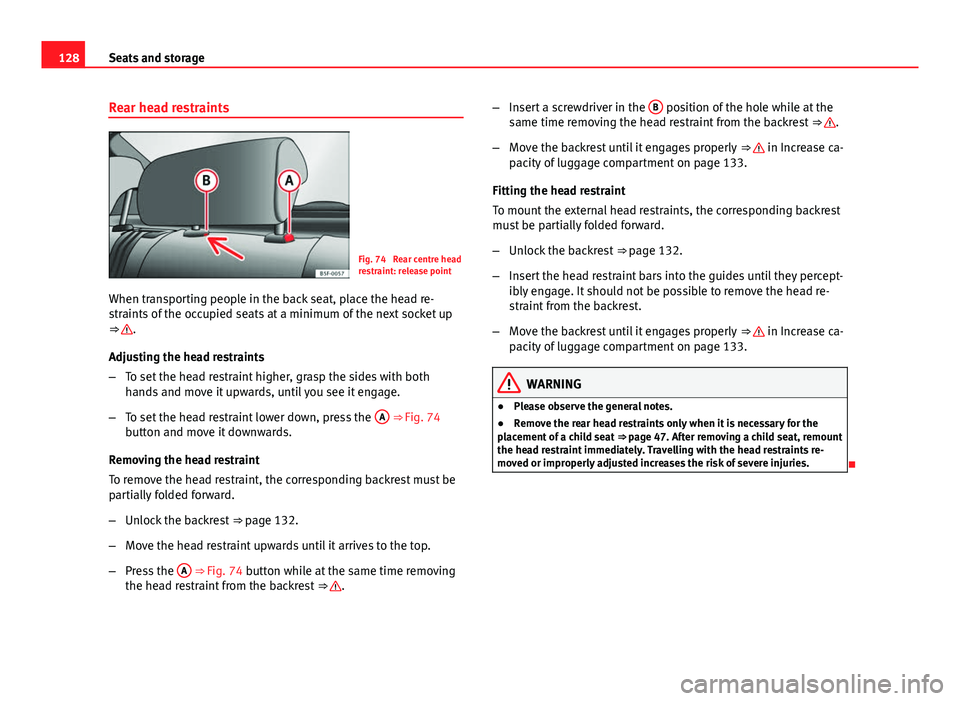
Fig. 74 Rear centre head
restraint: release point
When transporting people in the back seat, place the head re-
straints of the occupied seats at a minimum of the next socket up
⇒
.
Adjusting the head restraints
– To set the head restraint higher, grasp the sides with both
hands and move it upwards, until you see it engage.
– To set the head restraint lower down, press the A
⇒ Fig. 74
button and move it downwards.
Removing the head restraint
To remove the head restraint, the corresponding backrest must be
partially folded forward.
– Unlock the backrest ⇒ page 132.
– Move the head restraint upwards until it arrives to the top.
– Press the A
⇒ Fig. 74 button while at the same time removing
the head restraint from the backrest ⇒ .–
Insert a screwdriver in the B
position of the hole while at the
same time removing the head restraint from the backrest ⇒ .
– Move the backrest until it engages properly ⇒
in Increase ca-
pacity of luggage compartment on page 133.
Fitting the head restraint
To mount the external head restraints, the corresponding backrest
must be partially folded forward.
– Unlock the backrest ⇒ page 132.
– Insert the head restraint bars into the guides until they percept-
ibly engage. It should not be possible to remove the head re-
straint from the backrest.
– Move the backrest until it engages properly ⇒
in Increase ca-
pacity of luggage compartment on page 133.
WARNING
● Please observe the general notes.
● Remove the rear head restraints only when it is necessary for the
placement of a child seat ⇒ page 47. After removing a child seat, remount
the head restraint immediately. Travelling with the head restraints re-
moved or improperly adjusted increases the risk of severe injuries.
Page 130 of 289
129
Seats and storage
Power socket
Electrical equipment can be connected to the 12 volt power
socket.
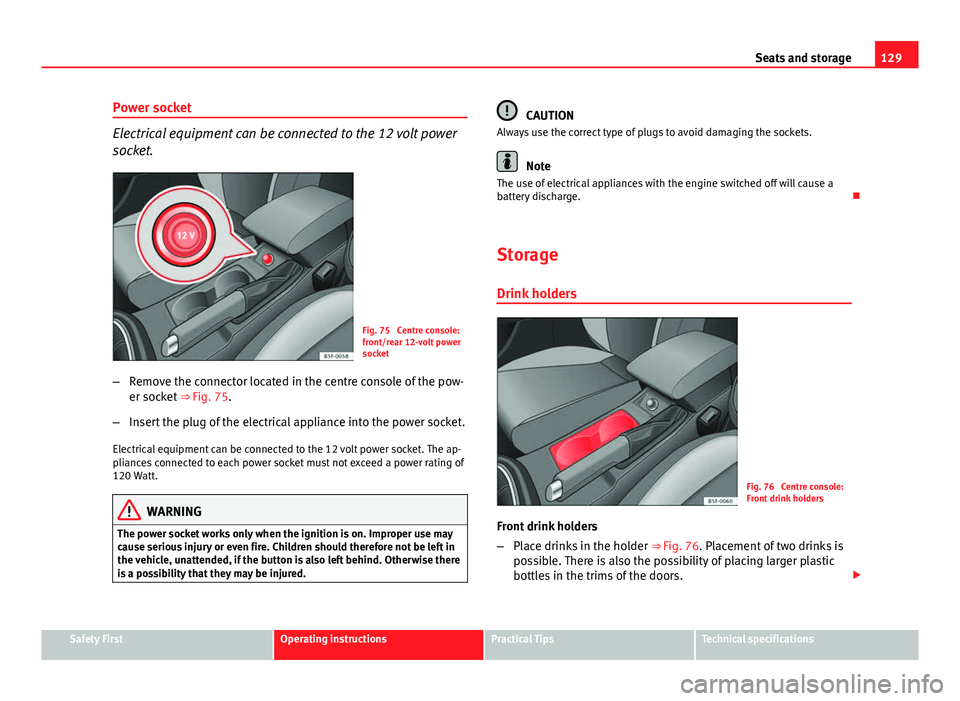
Fig. 75 Centre console:
front/rear 12-volt power
socket
– Remove the connector located in the centre console of the pow-
er socket ⇒ Fig. 75.
– Insert the plug of the electrical appliance into the power socket.
Electrical equipment can be connected to the 12 volt power socket. The ap-
pliances connected to each power socket must not exceed a power rating of
120 Watt.
WARNING
The power socket works only when the ignition is on. Improper use may
cause serious injury or even fire. Children should therefore not be left in
the vehicle, unattended, if the button is also left behind. Otherwise there
is a possibility that they may be injured.
CAUTION
Always use the correct type of plugs to avoid damaging the sockets.
Note
The use of electrical appliances with the engine switched off will cause a
battery discharge.
Storage
Drink holders
Fig. 76 Centre console:
Front drink holders
Front drink holders
– Place drinks in the holder ⇒ Fig. 76. Placement of two drinks is
possible. There is also the possibility of placing larger plastic
bottles in the trims of the doors.
Safety FirstOperating instructionsPractical TipsTechnical specifications
Page 133 of 289
132Seats and storage
Luggage compartment cover
The luggage compartment cover blocks the view into the
luggage compartment.
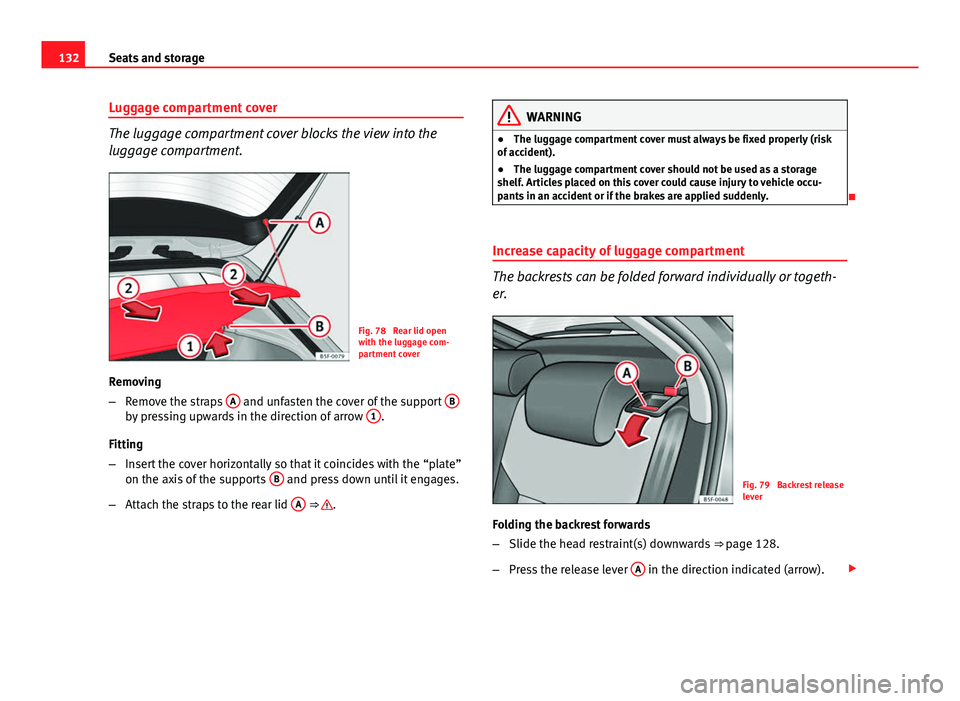
Fig. 78 Rear lid open
with the luggage com-
partment cover
Removing
– Remove the straps A
and unfasten the cover of the support Bby pressing upwards in the direction of arrow 1.
Fitting
– Insert the cover horizontally so that it coincides with the “plate”
on the axis of the supports B
and press down until it engages.
– Attach the straps to the rear lid A
⇒ .
WARNING
● The luggage compartment cover must always be fixed properly (risk
of accident).
● The luggage compartment cover should not be used as a storage
shelf. Articles placed on this cover could cause injury to vehicle occu-
pants in an accident or if the brakes are applied suddenly.
Increase capacity of luggage compartment
The backrests can be folded forward individually or togeth-
er.
Fig. 79 Backrest release
lever
Folding the backrest forwards
– Slide the head restraint(s) downwards ⇒
page 128.
– Press the release lever A
in the direction indicated (arrow).
Page 203 of 289

202Care and cleaning
Care of the vehicle interior
Radio display/Easy Connect* and control panel*
The display can be cleaned with a soft cloth and a professionally available
“LCD cleaner”. Moisten the cloth with a small amount of the cleaning fluid.
The Easy Connect control panel* should first be cleaned with a brush so
that no dirt goes into the device or between the keys and housing. Next, we
recommend cleaning the Easy Connect control panel* using a cloth damp-
ened with water and washing-up liquid.
CAUTION
● To avoid scratching the screen, do not wipe the display with a dry cloth.
● To avoid damage, ensure that no liquid goes into the Easy Connect con-
trol panel*.
Plastic and leatherette parts
Plastic parts and leatherette can be cleaned with a damp cloth. If this is not
sufficient, plastic parts and leatherette should only be treated with a special
solvent-free plastic cleaner .
Textile covers and trim parts
Textile covers and trim parts (e.g. seats, door trim) should be cleaned regu-
larly with a vacuum cleaner. This will remove surface dirt which could other-
wise be rubbed into the textile material during use. Do not use steam clean-
ers, as the steam could carry the dirt deeper into the textile material. Normal cleaning
We recommend that you use a soft sponge or a commercially available lint-
free, micro-fibre cloth for normal cleaning. Only use brushes on floor cover-
ings and mats, as other textile surfaces could become damaged.
In the case of normal surface dirt you can use a foam cleaner. Use a sponge
to spread the foam on the textile surface and to work it into the material
lightly. However, make sure that the textile material does not become soak-
ing wet. Then dab off the foam with a dry and absorbent cloth (e.g. a micro-
fibre cloth) and vacuum off any residue once the surface is completely dry.
Cleaning stains
Treat drink stains (such as coffee or fruit juice, etc.) with a cleaning solution
for delicate fabrics. The cleaning product solution should be applied with a
sponge. If the stains are difficult to remove, a washing paste can be applied
directly onto the stain and worked into the fabric. The surface will then have
to be wiped with clear water to remove any residue left by the paste. To do
so, use a damp cloth or sponge and then dab the stain with an absorbent
cloth.
Remove chocolate or make-up stains with a cleaning paste (for e.g., soft
soap). Then remove the soap with water (wet sponge).
A spirit-based cleaner can be used to remove grease, oil, lipstick or ball
point pen. Then dab the dissolved grease or colour particles off with an ab-
sorbent cloth or similar. You may also have to treat the stain once more us-
ing washing paste and water.
If the covers or textile trim panels are badly soiled we recommend that you
have them cleaned by a professional cleaning company with a shampoo
and spray.Note
Open Velcro fasteners on clothes can damage the seat upholstery. Make
sure that Velcro fasteners are closed.