child restraint Seat Leon 5D 2014 User Guide
[x] Cancel search | Manufacturer: SEAT, Model Year: 2014, Model line: Leon 5D, Model: Seat Leon 5D 2014Pages: 284, PDF Size: 5.85 MB
Page 62 of 284
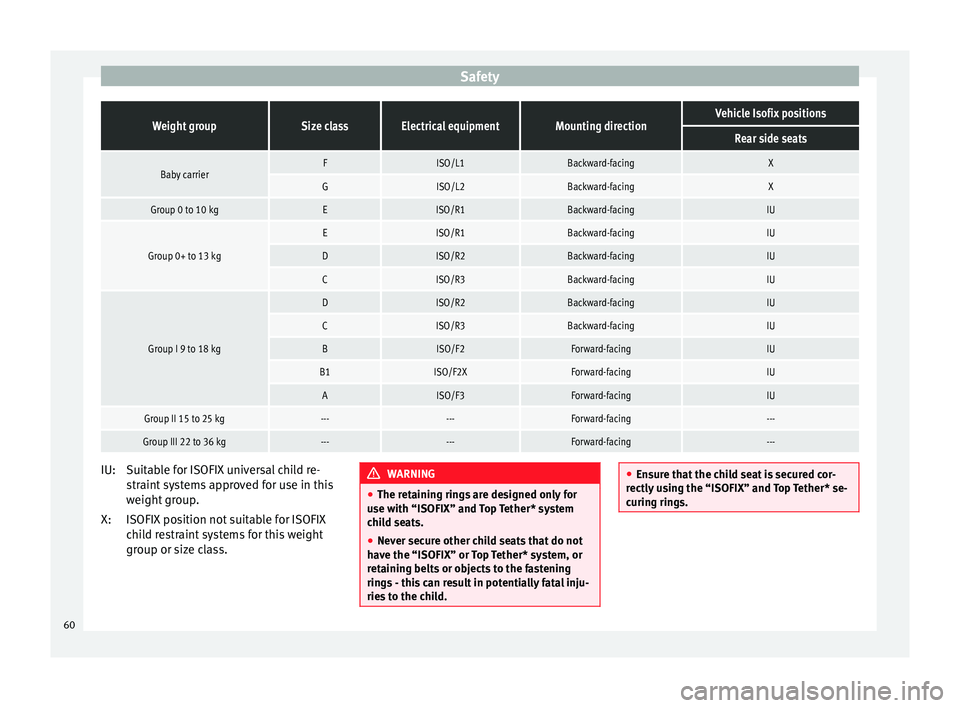
SafetyWeight groupSize classElectrical equipmentMounting directionVehicle Isofix positions
Rear side seats
Baby carrierFISO/L1Backward-facingX
GISO/L2Backward-facingX
Group 0 to 10 kgEISO/R1Backward-facingIU
Group 0+ to 13 kg
EISO/R1Backward-facingIU
DISO/R2Backward-facingIU
CISO/R3Backward-facingIU
Group I 9 to 18 kg
DISO/R2Backward-facingIU
CISO/R3Backward-facingIU
BISO/F2Forward-facingIU
B1ISO/F2XForward-facingIU
AISO/F3Forward-facingIU
Group II 15 to 25 kg------Forward-facing---
Group III 22 to 36 kg------Forward-facing---
Suitable for ISOFIX universal child re-
straint systems approved for use in this
weight group.
ISOFIX position not suitable for ISOFIX
child restraint systems for this weight
group or size class.
IU:
X: WARNING
● The retaining rings are designed only for
use with “ISOFIX” and Top Tether* system
child seats.
● Never secure other child seats that do not
have the “ISOFIX” or Top Tether* system, or
retaining belts or objects to the fastening
rings - this can result in potentially fatal inju-
ries to the child. ●
Ensure that the child seat is secured cor-
rectly using the “ISOFIX” and Top Tether* se-
curing rings. 60
Page 63 of 284

Transporting children safety
“ISOFIX” child seat mounting system Fig. 78
ISOFIX securing rings. When removing or fitting the child seat,
please be sure to follow the manufacturer's
instructions.
– Remove the protective caps of the “ISOFIX”
rings by placing a finger in the hole and
pulling up ››› Fig. 78 .
– Pr e
ss the child seat onto the “ISOFIX” re-
taining rings until the child seat can be
heard to engage securely. If the child seat
is equipped with Top Tether* anchor points,
secure it to the correspondent ring
››› Fig. 79
. Observe the manufacturer's in-
structions.
– Do a test by pulling both sides of the child
seat to ensure that it is properly anchored.
Child seats with the “ISOFIX” and Top Tether*
attachment system are available from Techni-
cal Services. Top Tether* retainer straps
Fig. 79
Position of the Top Tether rings on the
back of the rear seat. Child seats with the Top Tether system come
with a strap for securing the seat to the vehi-
cle anchor point, located at the back of the
rear seat backrest and provide greater re-
straint.
The objective of this strap is to reduce for-
ward movements of the child seat in a crash,
to reduce the risk of injuries to the head from
hitting the inside of the vehicle.
Using the Top Tether in rear-facing mounted
seats
Currently, there are very few rear-facing child
safety seats that have Top Tether. Please
carefully read and follow the seat manufac-
turer instructions to learn the proper way to
install the Top Tether strap. Fitting the Top Tether child restraint to
the anchoring point
Fig. 80
Retainer strap: correct adjustment
and fitting. Securing the Top Tether child restraint to the
anchor point situated on the rear of the
backrest
– Pull out the fastening belt of the child re-
straint seat according to the manufacturer's
instructions.
– Guide the Top Tether fastening belt under
the rear seat head restraint ››› Fig. 80 (lift
the he a
d restraint where necessary).
– Slide the belt so that the Top Tether belt of
the child restraint seat is correctly secured
to the anchor on the back of the rear seat
››› Fig. 79.
– Firmly
tighten the Top Tether belt following
the child restraint seat manufacturer's in-
structions. »
61
Technical specifications
Advice
Operation
Safety
The essentials
Page 108 of 284
Operation
Note
If the electrical adjustment should fail to op-
erate, both of the mirrors can be adjusted by
hand by lightly pressing the edge of the mir-
ror glass. Seats and head restraints
Adjusting the seats and
headrests
Manual adjustment of seats Read the additional information carefully
››› page 12 WARNING
The safe driving chapter contains important
information, tips, suggestions and warnings
that you should read and observe for your
own safety and the safety of your passengers
››› page 37. WARNING
● Adjust the front seats only when the vehi-
cle is stationary. Failure to follow this instruc-
tion could result in an accident.
● Be careful when adjusting the seat height.
Careless or uncontrolled adjustment can
cause injuries.
● The front seat backrests must not be re-
clined for driving. Otherwise, seat belts and
the airbag system might not protect as they
should, with the subsequent danger of injury. Electric driver seat adjustment*
Read the additional information carefully
››› page 12 WARNING
● If the electric front seats are used negli-
gently or without paying due attention, it can
cause serious injury.
● The front seats can also be electrically ad-
justed when the ignition is switched off. Nev-
er leave a child or any other person who may
need help in the vehicle.
● In the event of an emergency, electrical ad-
justment can be stopped by pressing any
control. CAUTION
To avoid damaging the electrical components
of the front seats, please refrain from kneel-
ing on the seat or applying sharp pressure at
a single point to the seat cushion and back-
rest. Note
● It may not be possible to electrically adjust
the seat if the vehicle battery is very low.
● If the engine is started while the seats are
being electrically adjusted, the adjustment
will stop. 106
Page 109 of 284
Seats and head restraints
Adjusting the front head restraints Read the additional information carefully
››› page 12
Adjust the head restraint ›››
page 12 so
that as far as possible the top of the head re-
straint is level with the top of your head.
When this is not possible, try to get as close
as possible to this position.
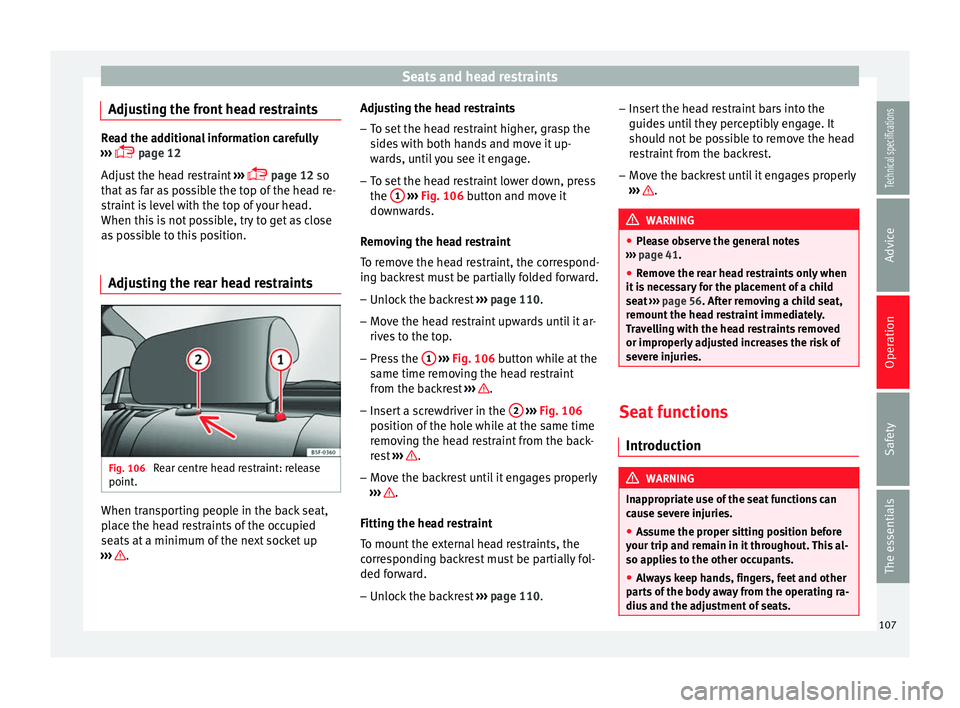
Adjusting the rear head restraints Fig. 106
Rear centre head restraint: release
point. When transporting people in the back seat,
place the head restraints of the occupied
seats at a minimum of the next socket up
››› . Adjusting the head restraints
– To set the head restraint higher, grasp the
sides with both hands and move it up-
wards, until you see it engage.
– To set the head restraint lower down, press
the 1
››› Fig. 106 button and move it
do wn
wards.
Removing the head restraint
To remove the head restraint, the correspond-
ing backrest must be partially folded forward. – Unlock the backrest ››› page 110.
– Move the head restraint upwards until it ar-
rives to the top.
– Press the 1
››› Fig. 106 button while at the
same time removing the head restraint
from the backrest ››› .
– Insert a screwdriver in the 2
››› Fig. 106
position of the hole while at the same time
removing the head restraint from the back-
rest ››› .
– Move the backrest until it engages properly
››› .
Fitting the head restraint
To mount the external head restraints, the
corresponding backrest must be partially fol-
ded forward.
– Unlock the backrest ››› page 110. –
Insert the head restraint bars into the
guides until they perceptibly engage. It
should not be possible to remove the head
restraint from the backrest.
– Move the backrest until it engages properly
››› .
WARNING
● Please observe the general notes
››› page 41.
● Remo
ve the rear head restraints only when
it is necessary for the placement of a child
seat ››› page 56. After removing a child seat,
remou
nt the head restraint immediately.
Travelling with the head restraints removed
or improperly adjusted increases the risk of
severe injuries. Seat functions
Introduction WARNING
Inappropriate use of the seat functions can
cause severe injuries.
● Assume the proper sitting position before
your trip and remain in it throughout. This al-
so applies to the other occupants.
● Always keep hands, fingers, feet and other
parts of the body away from the operating ra-
dius and the adjustment of seats. 107
Technical specifications
Advice
Operation
Safety
The essentials
Page 112 of 284
Operation
compartment will not fly forward through the
interior during sudden braking.
CAUTION
● With the backrest inclined there is a danger
of damaging the rear head restraints when
adjusting the front seats backwards.
● When folding the backrest forwards, make
sure to place the side seat belts in the trim
clip to prevent them from being damaged by
becoming trapped in the backrest lock. Folding down and lifting the rear seat
backrest
3 Applies to the model: LEON ST
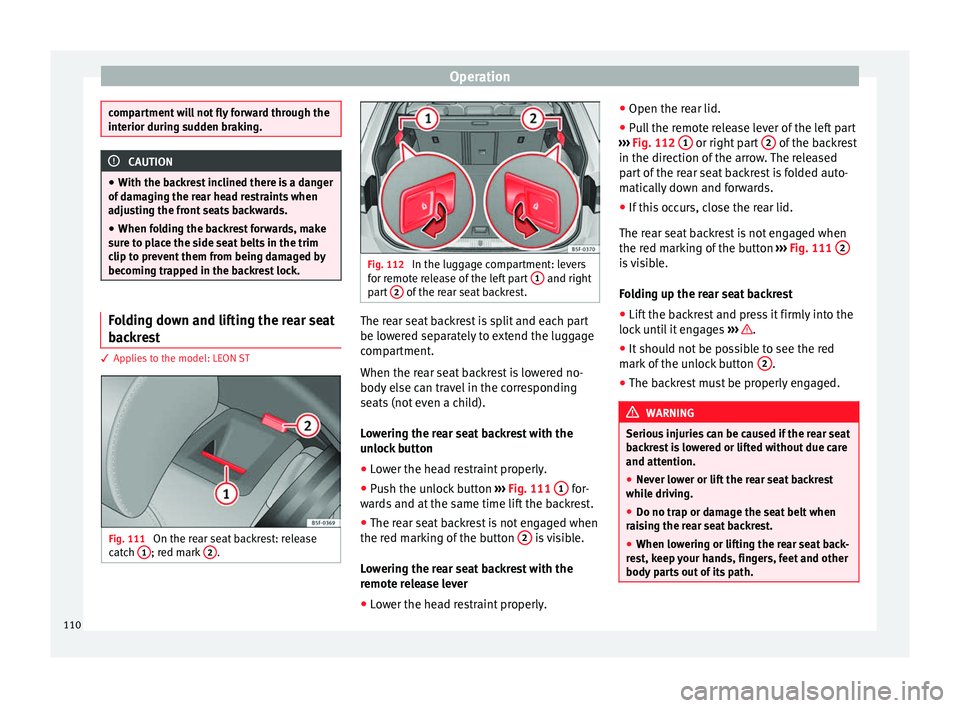
Fig. 111
On the rear seat backrest: release
catch 1 ; red mark
2 . Fig. 112
In the luggage compartment: levers
for remote release of the left part 1 and right
part 2 of the rear seat backrest.
The rear seat backrest is split and each part
be lowered separately to extend the luggage
compartment.
When the rear seat backrest is lowered no-
body else can travel in the corresponding
seats (not even a child).
Lowering the rear seat backrest with the
unlock button
● Lower the head restraint properly.
● Push the unlock button ››› Fig. 111 1 for-
wards and at the same time lift the backrest.
● The rear seat backrest is not engaged when
the red marking of the button 2 is visible.
Lowering the rear seat backrest with the
remote release lever
● Lower the head restraint properly. ●
Open the rear lid.
● Pull the remote release lever of the left part
››› Fig. 112 1 or right part
2 of the backrest
in the direction of the arrow. The released
part of the rear seat backrest is folded auto-
matically down and forwards.
● If this occurs, close the rear lid.
The rear seat backrest is not engaged when
the red marking of the button ››› Fig. 111 2 is visible.
Folding up the rear seat backrest
●
Lift the backrest and press it firmly into the
lock until it engages ››› .
● It should not be possible to see the red
mark of the unlock button 2 .
● The backrest must be properly engaged. WARNING
Serious injuries can be caused if the rear seat
backrest is lowered or lifted without due care
and attention.
● Never lower or lift the rear seat backrest
while driving.
● Do no trap or damage the seat belt when
raising the rear seat backrest.
● When lowering or lifting the rear seat back-
rest, keep your hands, fingers, feet and other
body parts out of its path. 110
Page 113 of 284
Transport and practical equipment
●
For the rear seat seat belts to offer the nec-
essary protection all the parts of the rear
backrest must be properly engaged. This is
particularly important in the case of the cen-
tre rear seat. If someone is seated in a seat
whose backrest is not properly engaged they
will fly forward, along with the backrest, dur-
ing an accident or a sudden driving or braking
manoeuvre.
● A red signal on the button 2 warns that
the backrest is not engaged. Always check
that the red marking is not visible when the
backrest is in the upright position.
● When the rear seat backrest is lowered or is
not properly engaged nobody else can travel
in the corresponding seats (not even a child). CAUTION
Serious damage can be caused to the vehicle
and other objects if the rear seat backrest is
lowered or lifted without due care and atten-
tion.
● Before lowering the rear seat backrest, al-
ways adjust the front seats so that neither
the head restraints nor the cushions of the
rear backrest can hit them. Transport and practical
equipment
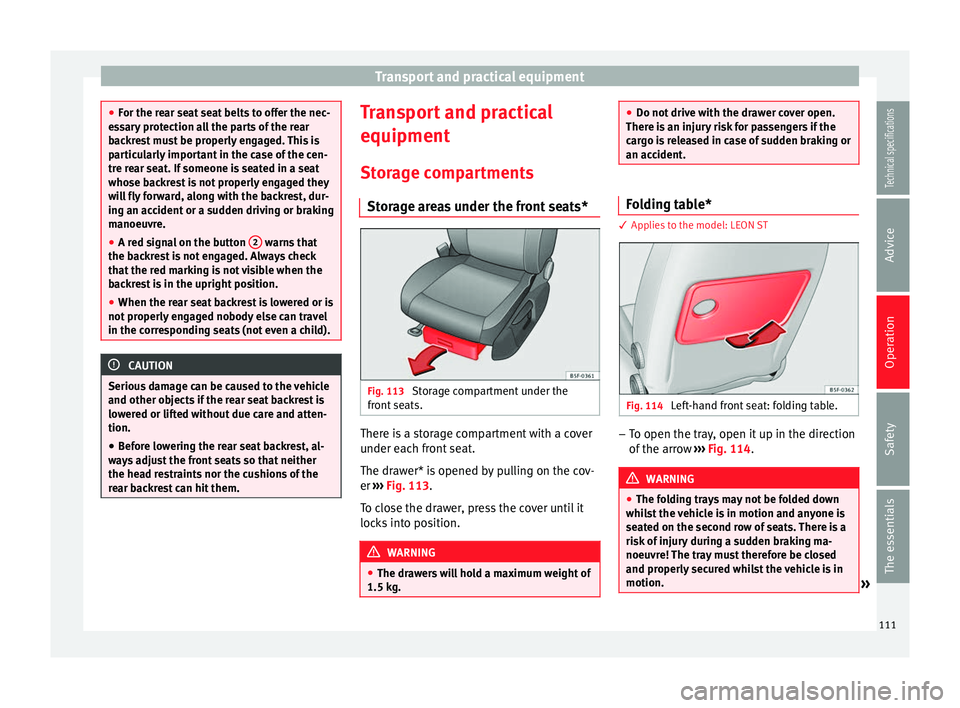
Storage compartments Storage areas under the front seats* Fig. 113
Storage compartment under the
front seats. There is a storage compartment with a cover
under each front seat.
The drawer* is opened by pulling on the cov-
er
››› Fig. 113 .
T o c
lose the drawer, press the cover until it
locks into position. WARNING
● The drawers will hold a maximum weight of
1.5 kg. ●
Do not drive with the drawer cover open.
There is an injury risk for passengers if the
cargo is released in case of sudden braking or
an accident. Folding table*
3 Applies to the model: LEON ST
Fig. 114
Left-hand front seat: folding table. –
To open the tray, open it up in the direction
of the arrow ››› Fig. 114 . WARNING
● The folding trays may not be folded down
whilst the vehicle is in motion and anyone is
seated on the second row of seats. There is a
risk of injury during a sudden braking ma-
noeuvre! The tray must therefore be closed
and properly secured whilst the vehicle is in
motion. » 111
Technical specifications
Advice
Operation
Safety
The essentials
Page 273 of 284

Index
Cooling system Checking the coolant . . . . . . . . . . . . . . . . . . . . 203
Coolant temperature gauge . . . . . . . . . . . . . . . . 69
Topping up coolant . . . . . . . . . . . . . . . . . . . . . . 203
Cornering lights . . . . . . . . . . . . . . . . . . . . . . . . . . . 97
Correct adjustment of front head restraints . . . . . 41
Correct adjustment of rear head restraints In-use and non-use positions of rear head re-straints . . . . . . . . . . . . . . . . . . . . . . . . . . . . . . 41
Correct sitting position front passenger . . . . . . . . . . . . . . . . . . . . . . . . . 39
Incorrect sitting position . . . . . . . . . . . . . . . . . . 40
passenger . . . . . . . . . . . . . . . . . . . . . . . . . . . . . . 40
Cruise control . . . . . . . . . . . . . . . . . . . . . . . . 21, 150 Control lamp . . . . . . . . . . . . . . . . . . . . . . . . . . . 150
Operation . . . . . . . . . . . . . . . . . . . . . . . . . . . . . 151
Warning lamp . . . . . . . . . . . . . . . . . . . . . . . . . . 150
Cruise control system . . . . . . . . . . . . . . . . . . . . . . 150
D Dangers in not using the seat belt . . . . . . . . . . . . 45
Daytime driving light . . . . . . . . . . . . . . . . . . . . . . . 95
Deactivating the front passenger front airbag . . . 11
DEF (instrument panel) . . . . . . . . . . . . . . . . . . . . . 69
Diesel Diesel particulate filter . . . . . . . . . . . . . . . . . . . 141
Engine oil . . . . . . . . . . . . . . . . . . . . . . . . . . . . . 200
Pre-heating . . . . . . . . . . . . . . . . . . . . . . . . . . . . 129
Digital clock . . . . . . . . . . . . . . . . . . . . . . . . . . . . . . 66
Dimensions . . . . . . . . . . . . . . . . . . . . . . . . . . . . . . 267
Dipped beam headlight . . . . . . . . . . . . . . . . . . . . . 94
Direction of rotation (tyres) . . . . . . . . . . . . . . . . . 220
Disabling the front airbag . . . . . . . . . . . . . . . . . . . 54
Display . . . . . . . . . . . . . . . . . . . . . . . . . . . . . . . 66, 67
Display/Easy Connect control panel: cleaning . . 187
Disposal Seat belt tensioners . . . . . . . . . . . . . . . . . . . . . . 47 Distance control
see Adaptive cruise control . . . . . . . . . . . . . . . 151
Door/r e
ar lid warning . . . . . . . . . . . . . . . . . . . . . . . 72
Door cylinder . . . . . . . . . . . . . . . . . . . . . . . . . . . . 227
Door handle . . . . . . . . . . . . . . . . . . . . . . . . . . . . . 227
Door lock . . . . . . . . . . . . . . . . . . . . . . . . . . . . . . . . 227
Doors Childproof locks . . . . . . . . . . . . . . . . . . . . . . . . . 87
Opening and closing . . . . . . . . . . . . . . . . . . . . . . 9
Downhill speed control . . . . . . . . . . . . . . . . . . . . 138
Drawer . . . . . . . . . . . . . . . . . . . . . . . . . . . . . . . . . . 111
Drink holders . . . . . . . . . . . . . . . . . . . . . . . . . . . . 112
Driver see
Correct sitting position . . . . . . . . . 38, 39, 40
Driver information system . . . . . . . . . . . . . . . . . . . 19 CD/radio display . . . . . . . . . . . . . . . . . . . . . . . . . 72
Control . . . . . . . . . . . . . . . . . . . . . . . . . . . . . . . . . 19
Door/rear lid warning . . . . . . . . . . . . . . . . . . . . . 72
Engine oil temperature display . . . . . . . . . . . . . 77
Menu . . . . . . . . . . . . . . . . . . . . . . . . . . . . . . . . . . 20
Operation via the windscreen wiper lever . . . . . 72
Outside temperature display . . . . . . . . . . . . . . . 72
Driving With a trailer . . . . . . . . . . . . . . . . . . . . . . 177, 179
Driving abroad Headlights . . . . . . . . . . . . . . . . . . . . . . . . . . . . 100
Driving mode . . . . . . . . . . . . . . . . . . . . . . . 170, 171
Driving profile . . . . . . . . . . . . . . . . . . . . . . . 170, 171
Driving safety . . . . . . . . . . . . . . . . . . . . . . . . . . . . . 37
Driving through water . . . . . . . . . . . . . . . . . . . . . 141
Dynamic headlight range control . . . . . . . . . . . . 100
E
E10 see Ethanol (fuel) . . . . . . . . . . . . . . . . . . . . . . . 195
E a
sy Connect . . . . . . . . . . . . . . . . . . . . . . . . . . 17, 81
Economic driving . . . . . . . . . . . . . . . . . . . . . . . . . 142 EDL
see Electronic differential lock . . . . . . . . . . . . . 143
Effic iency
programme
Additional electrical appliances . . . . . . . . . . . . 77
Saving tips . . . . . . . . . . . . . . . . . . . . . . . . . . . . . 78
Electric Windows . . . . . . . . . . . . . . . . . . . . . . . . . . . . . . . 90
Electrical accessories see
Power socket . . . . . . . . . . . . . . . . . . . . . . . 113
Electrical sockets trailer . . . . . . . . . . . . . . . . . . . . . . . . . . . . . . . . . 179
Electric seat Adjustment . . . . . . . . . . . . . . . . . . . . . . . . . . . . . 12
Electric windows . . . . . . . . . . . . . . . . . . . . . . . . 10, 90 Convenience opening/closing . . . . . . . . . . . . . . 91
Electro-mechanical steering . . . . . . . . . . . . . . . . 190 Warning lamp . . . . . . . . . . . . . . . . . . . . . . . . . . 190
Electronic differential lock . . . . . . . . . . . . . . . . . . 143
Electronic self-locking . . . . . . . . . . . . . . . . . . . . . 143
Electronic Stability Control (ESC) . . . . . . . . . . . . 143
Emergencies . . . . . . . . . . . . . . . . . . . . . . . . . . . . . 217 Automatic gearbox Backup programme . . . . . 139
Replacing the battery . . . . . . . . . . . . . . . . . . . . 207
Emergency braking warning . . . . . . . . . . . . . . . . . 99
Emergency locking and unlocking . . . . . . . . . . . 227
Emergency towing . . . . . . . . . . . . . . . . . . . . . . . . . 35
Engine Assisted starting . . . . . . . . . . . . . . . . . . . . . . . . 223
Pre-heating . . . . . . . . . . . . . . . . . . . . . . . . . . . . 129
Start-Stop system . . . . . . . . . . . . . . . . . . . . . . . 148
Starting . . . . . . . . . . . . . . . . . . . . . . . . . . . . . . . 129
Starting up (driver messages with the me-chanical contact) . . . . . . . . . . . . . . . . . . . . . 129
Switching off (engine) . . . . . . . . . . . . . . . . . . . 130
Engine compartment . . . . . . . . . . . . . . . . . . 10, 198 Closing the bonnet . . . . . . . . . . . . . . . . . . . . . . 199
Opening the bonnet . . . . . . . . . . . . . . . . . . . . . 199
Safety notes . . . . . . . . . . . . . . . . . . . . . . . . . . . 198 271