ECU Seat Leon 5D 2014 Owner's Guide
[x] Cancel search | Manufacturer: SEAT, Model Year: 2014, Model line: Leon 5D, Model: Seat Leon 5D 2014Pages: 284, PDF Size: 5.85 MB
Page 111 of 284
Seats and head restraints
The armrest can be moved backwards and
forwards.
Folding down the passenger seat
backrest* 3 Applies to the model: LEON ST
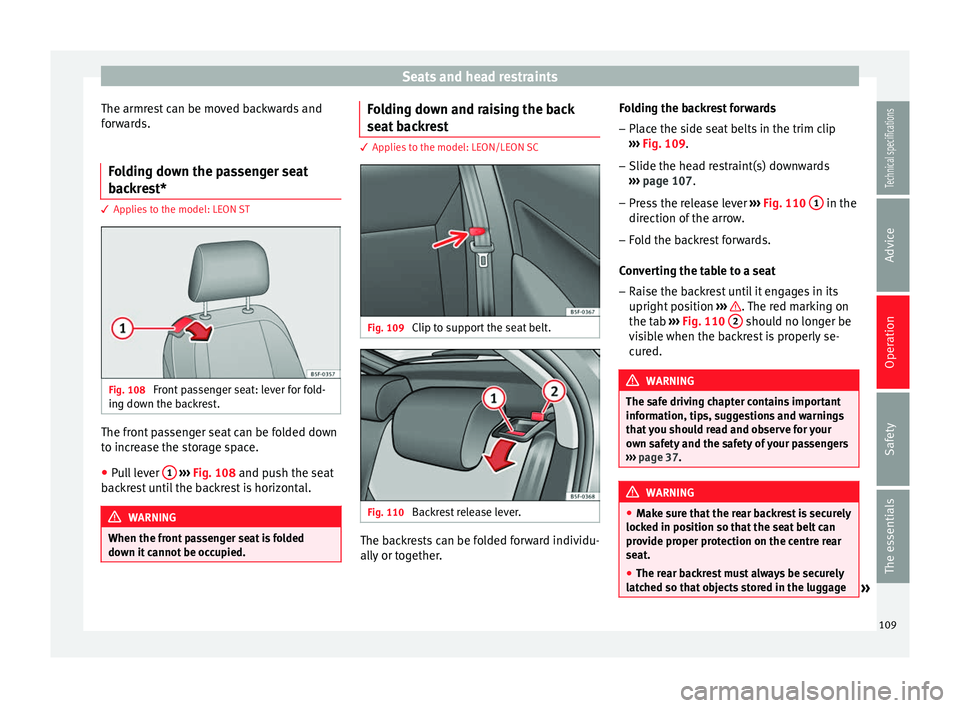
Fig. 108
Front passenger seat: lever for fold-
ing down the backrest. The front passenger seat can be folded down
to increase the storage space.
● Pull lever 1
››› Fig. 108 and push the seat
b ac
krest until the backrest is horizontal. WARNING
When the front passenger seat is folded
down it cannot be occupied. Folding down and raising the back
seat backrest
3 Applies to the model: LEON/LEON SC
Fig. 109
Clip to support the seat belt. Fig. 110
Backrest release lever. The backrests can be folded forward individu-
ally or together.Folding the backrest forwards
– Place the side seat belts in the trim clip
››› Fig. 109 .
– Slide the he a
d restraint(s) downwards
››› page 107.
– Press the release lever ››› Fig. 110 1 in the
direction of the arrow.
– Fold the backrest forwards.
Converting the table to a seat – Raise the backrest until it engages in its
upright position ››› . The red marking on
the tab ››› Fig. 110 2 should no longer be
visible when the backrest is properly se-
cured. WARNING
The safe driving chapter contains important
information, tips, suggestions and warnings
that you should read and observe for your
own safety and the safety of your passengers
››› page 37. WARNING
● Make sure that the rear backrest is securely
locked in position so that the seat belt can
provide proper protection on the centre rear
seat.
● The rear backrest must always be securely
latched so that objects stored in the luggage » 109
Technical specifications
Advice
Operation
Safety
The essentials
Page 113 of 284
Transport and practical equipment
●
For the rear seat seat belts to offer the nec-
essary protection all the parts of the rear
backrest must be properly engaged. This is
particularly important in the case of the cen-
tre rear seat. If someone is seated in a seat
whose backrest is not properly engaged they
will fly forward, along with the backrest, dur-
ing an accident or a sudden driving or braking
manoeuvre.
● A red signal on the button 2 warns that
the backrest is not engaged. Always check
that the red marking is not visible when the
backrest is in the upright position.
● When the rear seat backrest is lowered or is
not properly engaged nobody else can travel
in the corresponding seats (not even a child). CAUTION
Serious damage can be caused to the vehicle
and other objects if the rear seat backrest is
lowered or lifted without due care and atten-
tion.
● Before lowering the rear seat backrest, al-
ways adjust the front seats so that neither
the head restraints nor the cushions of the
rear backrest can hit them. Transport and practical
equipment
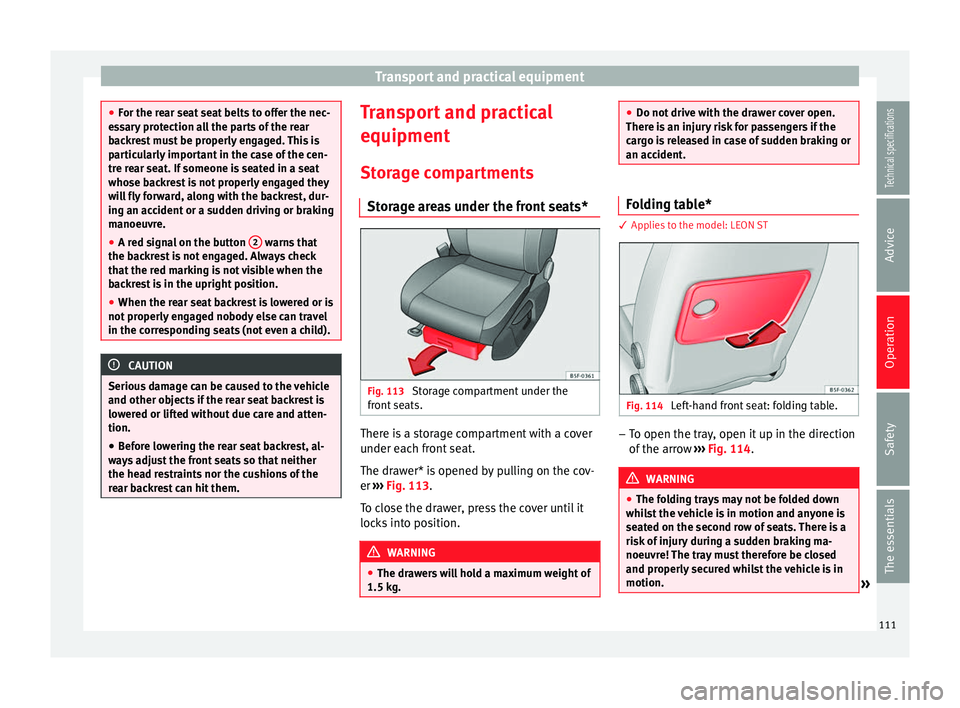
Storage compartments Storage areas under the front seats* Fig. 113
Storage compartment under the
front seats. There is a storage compartment with a cover
under each front seat.
The drawer* is opened by pulling on the cov-
er
››› Fig. 113 .
T o c
lose the drawer, press the cover until it
locks into position. WARNING
● The drawers will hold a maximum weight of
1.5 kg. ●
Do not drive with the drawer cover open.
There is an injury risk for passengers if the
cargo is released in case of sudden braking or
an accident. Folding table*
3 Applies to the model: LEON ST
Fig. 114
Left-hand front seat: folding table. –
To open the tray, open it up in the direction
of the arrow ››› Fig. 114 . WARNING
● The folding trays may not be folded down
whilst the vehicle is in motion and anyone is
seated on the second row of seats. There is a
risk of injury during a sudden braking ma-
noeuvre! The tray must therefore be closed
and properly secured whilst the vehicle is in
motion. » 111
Technical specifications
Advice
Operation
Safety
The essentials
Page 116 of 284

Operation
Storing objects Loading the luggage compartment All luggage and other loose objects must be
safely secured in the luggage compartment.
Unsecured objects which shift back and forth
could impair the driving safety or driving
characteristics of the vehicle by shifting the
centre of gravity.
– Distribute the load evenly in the luggage
compartment.
– Place heavy objects as far forward as possi-
ble in the luggage compartment.
– Place the heavy objects first.
– Secure heavy objects to the fitted fastening
rings ›››
page 119 . WARNING
● Loose luggage and other objects in the lug-
gage compartment could cause serious inju-
ries.
● Always stow objects in the luggage com-
partment and secure them on the fastening
rings.
● Use suitable straps to secure heavy ob-
jects.
● During sudden manoeuvres or accidents,
loose objects can be thrown forward, injuring
vehicle occupants or passers-by. This in-
creased risk of injury will be further increased if a loose object is struck by an inflating air-
bag. If this happens, objects may shoot out-
ward like a missile. Risk of fatal injury.
●
Please note that the centre of gravity may
shift when transporting heavy objects; this
may affect vehicle handling and lead to an ac-
cident. Therefore, it is essential to adjust
your speed and driving style accordingly, to
avoid accidents.
● Never exceed the allowed axle weights or
allowed maximum weight. If said weights are
exceeded, the driving characteristics of the
vehicle may change, leading to accidents, in-
juries and damage to the vehicle.
● Never leave your vehicle unattended, espe-
cially when the rear lid is open. Children
could climb into the luggage compartment,
closing the door behind them; they will be
trapped and run the risk of death.
● Never allow children to play in or around
the vehicle. Close and lock all the doors and
rear lid when you leave the vehicle. Before
you lock the vehicle, make sure that there are
no adults or children in the vehicle. Note
● Air circulation in the vehicle helps reduce
fogging of the windows. Used air escapes
through ventilation slits in the side trim of
the luggage compartment. Ensure that the
ventilation slots are never covered.
● Straps for securing the load to the fasten-
ing rings are commercially available. Luggage compartment cover
3 Applies to the model: LEON/LEON SC
Fig. 119
Rear lid open with the luggage com-
partment cover. The luggage compartment cover blocks the
view into the luggage compartment.
Removing
– Remove the straps A and unfasten the
cover of the support B by pressing up-
wards in the direction of arrow 1 .
Fitting
– Insert the cover horizontally so that it coin-
cides with the “plate” on the axis of the
supports B and press down until it engag-
es.
– Attach the straps to the rear lid A
››› .
114
Page 117 of 284

Transport and practical equipment
WARNING
● The luggage compartment cover must al-
ways be fixed properly (risk of accident).
● The luggage compartment cover should not
be used as a storage shelf. Articles placed on
this cover could cause injury to vehicle occu-
pants in an accident or if the brakes are ap-
plied suddenly. Retractable rear shelf
3 Applies to the model: LEON ST
Fig. 120
In the luggage compartment: closing
the rear shelf. Fig. 121
In the luggage compartment: remov-
ing the rear shelf. Opening the rear shelf
● Press the release catch of the rear shelf
( press
) until it is released › ›› Fig. 120 1 . The
shelf will automatically move towards the
end and will retract completely.
Closing the rear shelf
● Pull the unfolded shelf evenly backwards.
Removing the rear shelf
● Press the support of the rear shelf
››› Fig. 121 1 in the direction of the arrow.
● Remove the rear shelf through the support
and upwards.
● The rear shelf can be stored under the lug-
gage compartment variable floor when the
latter is in the top position (except for vehi-
cles equipped with natural gas engine CNG)
››› page 116 . Fittin
g the r
ear shelf
● Place the rear shelf in the housing provided
in the left side cover.
● Engage the support of the rear shelf
››› Fig. 121 1 in the right housing.
● Check that the support ››› Fig. 121 1 is
properly engaged. WARNING
Animals, loose or unsecured or objects car-
ried on the rear shelf can cause serious injury
in case of sudden manoeuvring or braking or
in case of an accident.
● Do not leave hard, sharp or heavy objects
or in bags on the rear shelf.
● Never carry animals on the rear shelf. 115
Technical specifications
Advice
Operation
Safety
The essentials
Page 118 of 284
Operation
Storing the rear shelf 3 Applies to the model: LEON ST
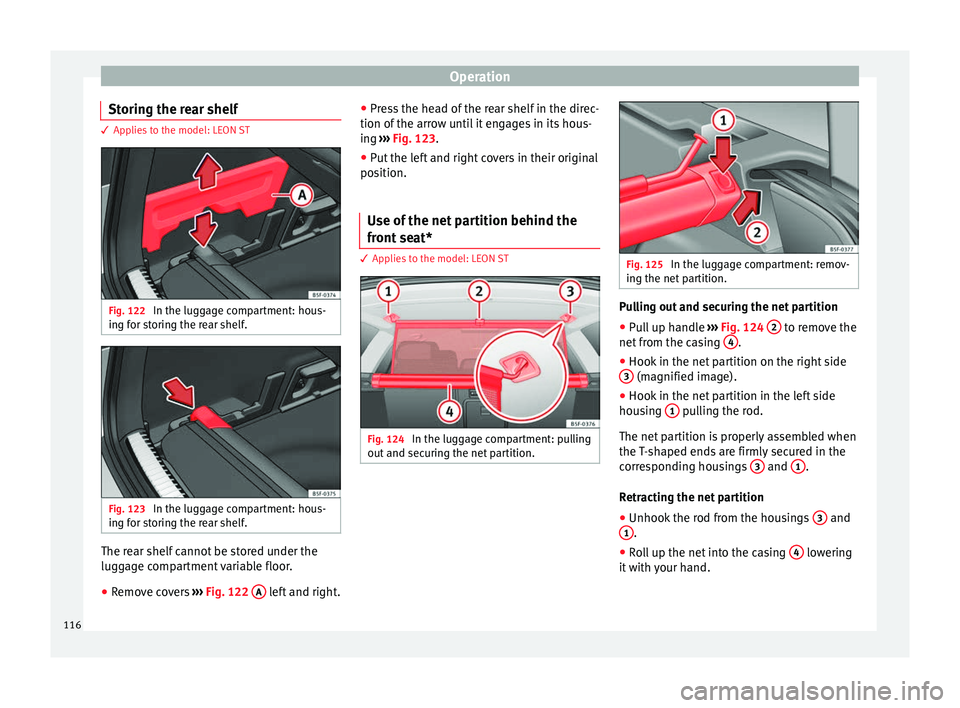
Fig. 122
In the luggage compartment: hous-
ing for storing the rear shelf. Fig. 123
In the luggage compartment: hous-
ing for storing the rear shelf. The rear shelf cannot be stored under the
luggage compartment variable floor.
● Remove covers ››› Fig. 122 A left and right.●
Press the head of the rear shelf in the direc-
tion of the arrow until it engages in its hous-
ing ››› Fig. 123 .
● Put
the left and right covers in their original
position.
Use of the net partition behind the
front seat* 3 Applies to the model: LEON ST
Fig. 124
In the luggage compartment: pulling
out and securing the net partition. Fig. 125
In the luggage compartment: remov-
ing the net partition. Pulling out and securing the net partition
● Pull up handle ››› Fig. 124 2 to remove the
net from the casing 4 .
● Hook in the net partition on the right side
3 (magnified image).
● Hook in the net partition in the left side
housing 1 pulling the rod.
The net partition is properly assembled when
the T-shaped ends are firmly secured in the
corresponding housings 3 and
1 .
Retracting the net partition
● Unhook the rod from the housings 3 and
1 .
● Roll up the net into the casing 4 lowering
it with your hand.
116
Page 119 of 284
Transport and practical equipment
Removing the net partition
● Fold the rear seat backrests forward.
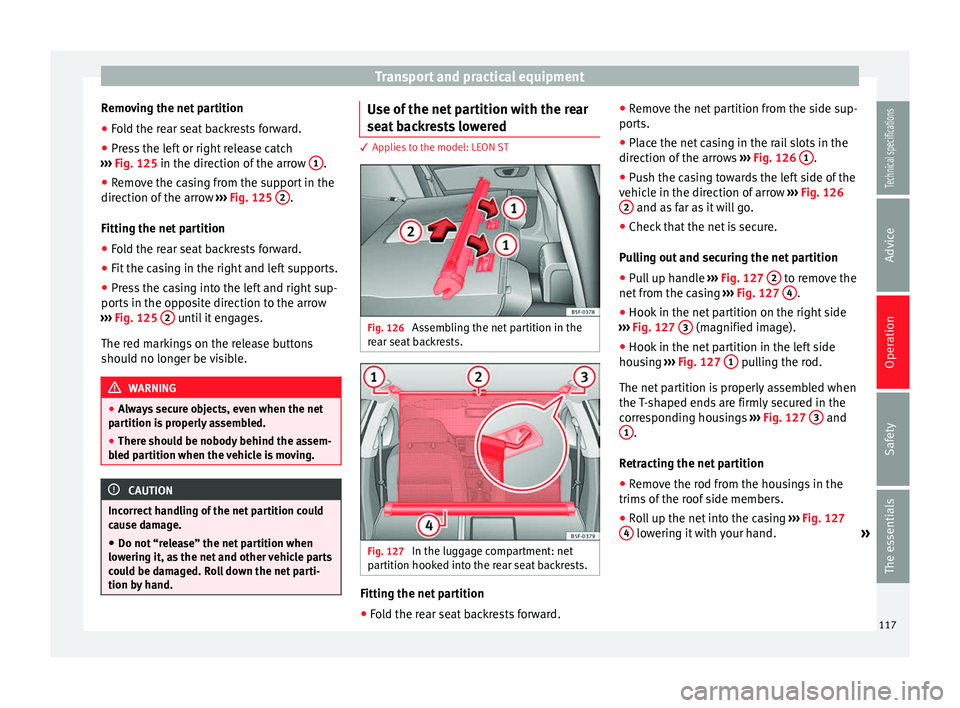
● Press the left or right release catch
››› Fig. 125 in the direction of the arrow 1 .
● Remove the casing from the support in the
direction of the arrow ››› Fig. 125 2 .
Fitting the net partition
● Fold the rear seat backrests forward.
● Fit the casing in the right and left supports.
● Press the casing into the left and right sup-
ports in the opposite direction to the arrow
››› Fig. 125 2 until it engages.
The red markings on the release buttons
should no longer be visible. WARNING
● Always secure objects, even when the net
partition is properly assembled.
● There should be nobody behind the assem-
bled partition when the vehicle is moving. CAUTION
Incorrect handling of the net partition could
cause damage. ● Do not “release” the net partition when
lowering it, as the net and other vehicle parts
could be damaged. Roll down the net parti-
tion by hand. Use of the net partition with the rear
seat backrests lowered
3 Applies to the model: LEON ST
Fig. 126
Assembling the net partition in the
rear seat backrests. Fig. 127
In the luggage compartment: net
partition hooked into the rear seat backrests. Fitting the net partition
● Fold the rear seat backrests forward. ●
Remove the net partition from the side sup-
ports.
● Place the net casing in the rail slots in the
direction of the arrows ››› Fig. 126 1 .
● Push the casing towards the left side of the
vehicle in the direction of arrow ››› Fig. 126
2 and as far as it will go.
● Check that the net is secure.
Pulling out and securing the net partition
● Pull up handle ››› Fig. 127 2 to remove the
net from the casing ››› Fig. 127 4 .
● Hook in the net partition on the right side
››› Fig. 127 3 (magnified image).
● Hook in the net partition in the left side
housing ››› Fig. 127 1 pulling the rod.
The net partition is properly assembled when
the T-shaped ends are firmly secured in the
corresponding housings ››› Fig. 127 3 and
1 .
Retracting the net partition
● Remove the rod from the housings in the
trims of the roof side members.
● Roll up the net into the casing ››› Fig. 127
4 lowering it with your hand.
»
117Technical specifications
Advice
Operation
Safety
The essentials
Page 120 of 284
Operation
Removing the net partition
● Pull the net casing out approximately 5 cm
in the opposite direction to the arrow
››› Fig. 126 2 .
● Remove the casing from the rails by pulling
in the opposite direction to the arrows
››› Fig. 126 1 .
● Lift the rear seat backrests. WARNING
During a sudden driving or braking manoeu-
vre, or in the event of an accident, objects
could be flung though the interior and cause
serious or fatal injuries.
● Always secure objects, even when the net
partition is properly assembled.
● There should be nobody behind the assem-
bled partition when the vehicle is moving. WARNING
The rear seat backrests should only be lifted
again once the net partition has been disas-
sembled. CAUTION
Incorrect handling of the net partition could
cause damage. ● Do not “release” the net partition when
lowering it, as the net and other vehicle parts
could be damaged. Roll down the net parti-
tion by hand. Tailboard for transporting long items
3 Applies to the model: LEON ST
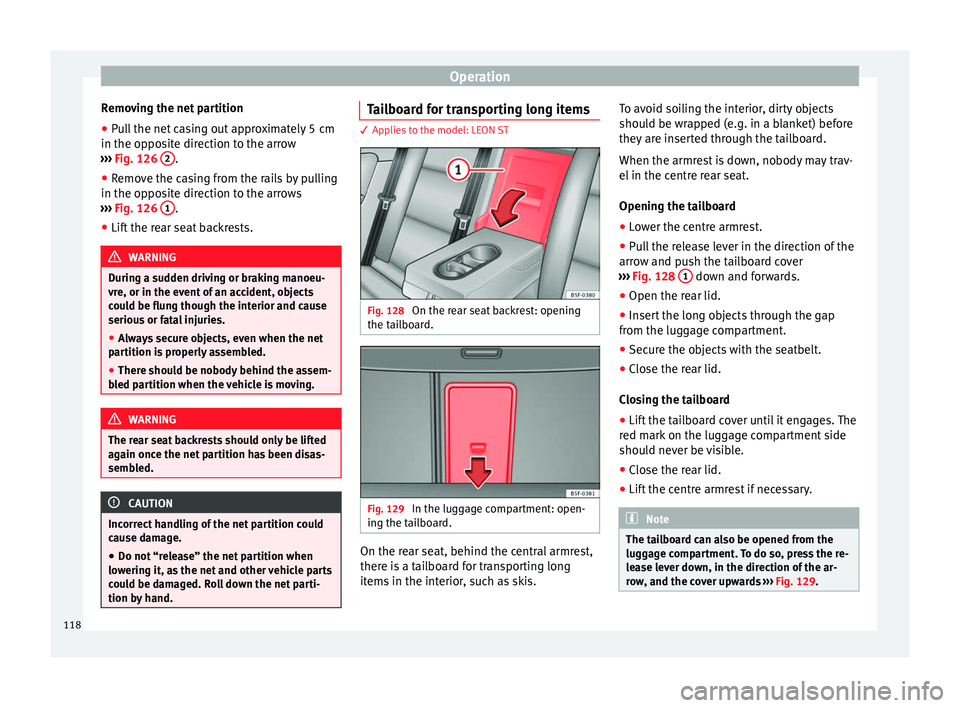
Fig. 128
On the rear seat backrest: opening
the tailboard. Fig. 129
In the luggage compartment: open-
ing the tailboard. On the rear seat, behind the central armrest,
there is a tailboard for transporting long
items in the interior, such as skis.To avoid soiling the interior, dirty objects
should be wrapped (e.g. in a blanket) before
they are inserted through the tailboard.
When the armrest is down, nobody may trav-
el in the centre rear seat.
Opening the tailboard
● Lower the centre armrest.
● Pull the release lever in the direction of the
arrow and push the tailboard cover
››› Fig. 128 1 down and forwards.
● Open the rear lid.
● Insert the long objects through the gap
from the luggage compartment.
● Secure the objects with the seatbelt.
● Close the rear lid.
Closing the tailboard
● Lift the tailboard cover until it engages. The
red mark on the luggage compartment side
should never be visible.
● Close the rear lid.
● Lift the centre armrest if necessary. Note
The tailboard can also be opened from the
luggage compartment. To do so, press the re-
lease lever down, in the direction of the ar-
row, and the cover upwards ››› Fig. 129.118
Page 121 of 284
Transport and practical equipment
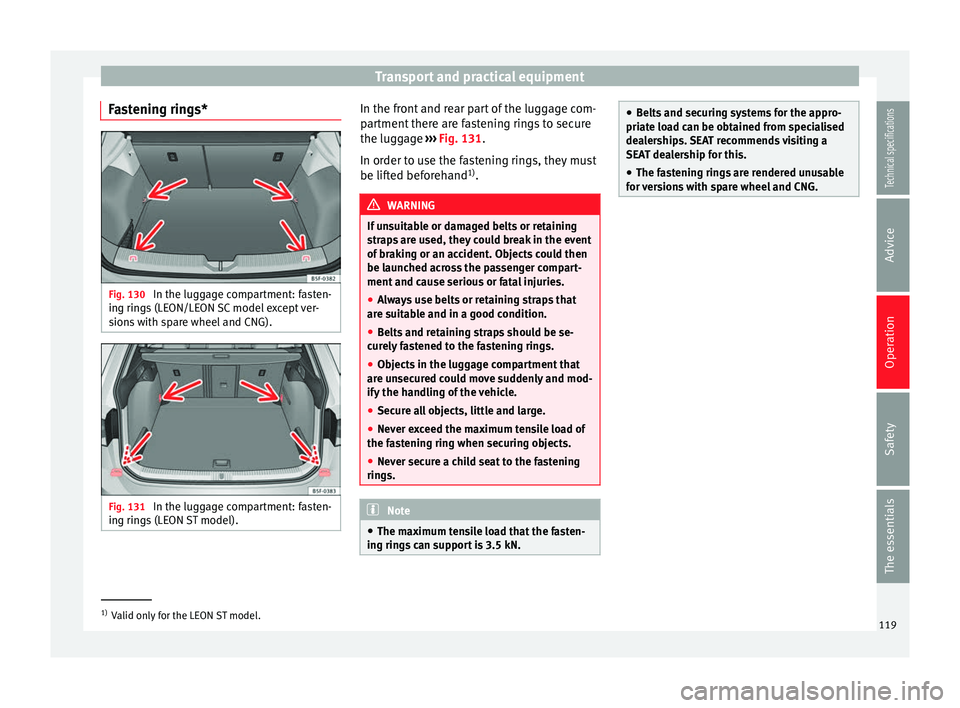
Fastening rings* Fig. 130
In the luggage compartment: fasten-
ing rings (LEON/LEON SC model except ver-
sions with spare wheel and CNG). Fig. 131
In the luggage compartment: fasten-
ing rings (LEON ST model). In the front and rear part of the luggage com-
partment there are fastening rings to secure
the luggage
››› Fig. 131 .
In or der t
o use the fastening rings, they must
be lifted beforehand 1)
. WARNING
If unsuitable or damaged belts or retaining
straps are used, they could break in the event
of braking or an accident. Objects could then
be launched across the passenger compart-
ment and cause serious or fatal injuries.
● Always use belts or retaining straps that
are suitable and in a good condition.
● Belts and retaining straps should be se-
curely fastened to the fastening rings.
● Objects in the luggage compartment that
are unsecured could move suddenly and mod-
ify the handling of the vehicle.
● Secure all objects, little and large.
● Never exceed the maximum tensile load of
the fastening ring when securing objects.
● Never secure a child seat to the fastening
rings. Note
● The maximum tensile load that the fasten-
ing rings can support is 3.5 kN. ●
Belts and securing systems for the appro-
priate load can be obtained from specialised
dealerships. SEAT recommends visiting a
SEAT dealership for this.
● The fastening rings are rendered unusable
for versions with spare wheel and CNG. 1)
Valid only for the LEON ST model.
119
Technical specifications
Advice
Operation
Safety
The essentials
Page 122 of 284
Operation
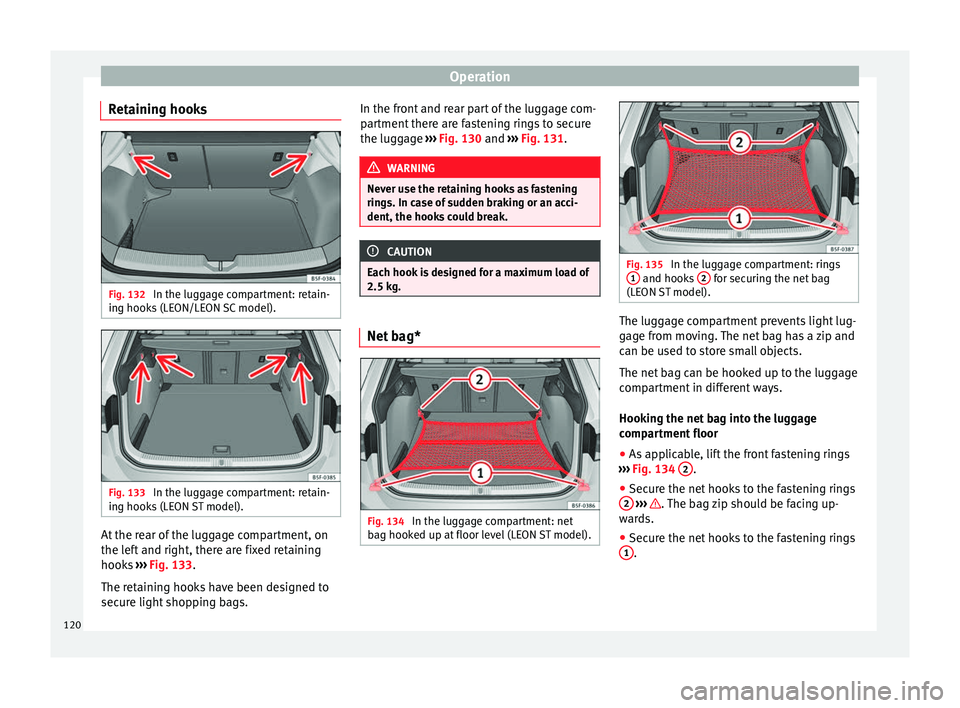
Retaining hooks Fig. 132
In the luggage compartment: retain-
ing hooks (LEON/LEON SC model). Fig. 133
In the luggage compartment: retain-
ing hooks (LEON ST model). At the rear of the luggage compartment, on
the left and right, there are fixed retaining
hooks
››› Fig. 133 .
The r et
aining hooks have been designed to
secure light shopping bags. In the front and rear part of the luggage com-
partment there are fastening rings to secure
the luggage
››› Fig. 130
and ››› Fig. 131. WARNING
Never use the retaining hooks as fastening
rings. In case of sudden braking or an acci-
dent, the hooks could break. CAUTION
Each hook is designed for a maximum load of
2.5 kg. Net bag*
Fig. 134
In the luggage compartment: net
bag hooked up at floor level (LEON ST model). Fig. 135
In the luggage compartment: rings
1 and hooks
2 for securing the net bag
(LEON ST model). The luggage compartment prevents light lug-
gage from moving. The net bag has a zip and
can be used to store small objects.
The net bag can be hooked up to the luggage
compartment in different ways.
Hooking the net bag into the luggage
compartment floor
●
As applicable, lift the front fastening rings
››› Fig. 134 2 .
● Secure the net hooks to the fastening rings
2
››› . The bag zip should be facing up-
wards.
● Secure the net hooks to the fastening rings
1 .
120
Page 123 of 284
Transport and practical equipment
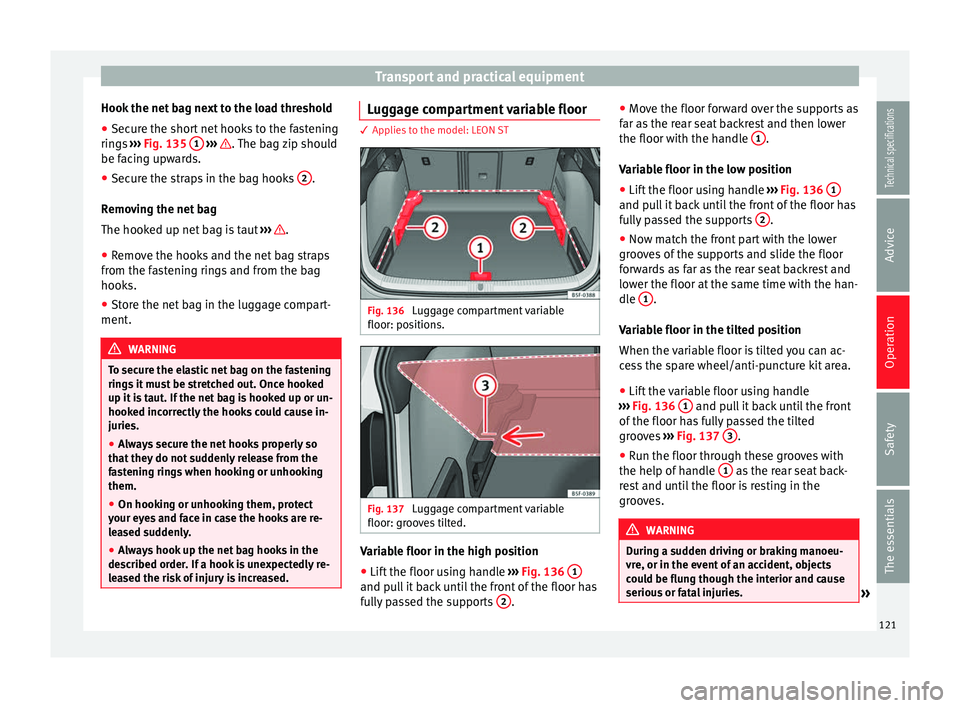
Hook the net bag next to the load threshold
● Secure the short net hooks to the fastening
rings ››› Fig. 135 1
››› . The bag zip should
be facing upwards.
● Secure the straps in the bag hooks 2 .
Removing the net bag
The hooked up net bag is taut ››› .
● Remove the hooks and the net bag straps
from the fastening rings and from the bag
hooks.
● Store the net bag in the luggage compart-
ment. WARNING
To secure the elastic net bag on the fastening
rings it must be stretched out. Once hooked
up it is taut. If the net bag is hooked up or un-
hooked incorrectly the hooks could cause in-
juries.
● Always secure the net hooks properly so
that they do not suddenly release from the
fastening rings when hooking or unhooking
them.
● On hooking or unhooking them, protect
your eyes and face in case the hooks are re-
leased suddenly.
● Always hook up the net bag hooks in the
described order. If a hook is unexpectedly re-
leased the risk of injury is increased. Luggage compartment variable floor
3 Applies to the model: LEON ST
Fig. 136
Luggage compartment variable
floor: positions. Fig. 137
Luggage compartment variable
floor: grooves tilted. Variable floor in the high position
● Lift the floor using handle ››› Fig. 136 1 and pull it back until the front of the floor has
fully passed the supports
2 .●
Move the floor forward over the supports as
far as the rear seat backrest and then lower
the floor with the handle 1 .
Variable floor in the low position
● Lift the floor using handle ››› Fig. 136 1 and pull it back until the front of the floor has
fully passed the supports
2 .
● Now match the front part with the lower
grooves of the supports and slide the floor
forwards as far as the rear seat backrest and
lower the floor at the same time with the han-
dle 1 .
Variable floor in the tilted position
When the variable floor is tilted you can ac-
cess the spare wheel/anti-puncture kit area.
● Lift the variable floor using handle
››› Fig. 136 1 and pull it back until the front
of the floor has fully passed the tilted
grooves ››› Fig. 137 3 .
● Run the floor through these grooves with
the help of handle 1 as the rear seat back-
rest and until the floor is resting in the
grooves. WARNING
During a sudden driving or braking manoeu-
vre, or in the event of an accident, objects
could be flung though the interior and cause
serious or fatal injuries. » 121Technical specifications
Advice
Operation
Safety
The essentials