service Seat Leon 5D 2014 Workshop Manual
[x] Cancel search | Manufacturer: SEAT, Model Year: 2014, Model line: Leon 5D, Model: Seat Leon 5D 2014Pages: 284, PDF Size: 5.85 MB
Page 216 of 284

Advice
● The vehicle is unbalanced because of a
load
● The wheels on an axle are subject to a
heavier load (e.g. with a heavy load).
● The vehicle is fitted with snow chains
● The temporary spare wheel is fitted
● The wheel on one axle is changed
There may be a delay in the reaction of the
tyre
monitoring indicator or it may not in-
dic
ate anything under certain circumstances
(e.g. sporty driving, snow-covered or un-
paved roads, or when driving with snow
chains).
Calibrating the tyre monitoring
indicator Fig. 180
Glove compartment: tyre control
switch. After changing the tyre pressure or replacing
one or more wheels, the tyre monitoring indi-
cator must be recalibrated. Do the same, for
example, when the front and rear wheels are
swapped.
● Switch the ignition on.
● Store the new tyre pressure in the Easy
Connect system with the button and the
function button Setup
›››
page 17 or us-
ing the switch located in the glove compart-
ment* ››› Fig. 180 .
When driv in
g, the system self-calibrates the
tyre pressure provided by the driver and the
wheels fitted. After a long journey with varied
speeds the programmed values are collected
and monitored.
With the wheels under very heavy loads, the
tyre pressure must be increased to the total
recommended tyre pressure before the cali-
bration ››› page 243
. Note
● The tyre monitoring indicator does not
function when there is a fault in the ESC or
ABS ››› page 143.
● An err oneou
s indication may be given when
snow chains are in use because they increase
the tread of the wheel. Compact temporary spare
wheel
General information Fig. 181
Compact temporary spare wheel:
raised floor panel. The temporary spare wheel has been de-
signed to be used for short periods of time.
Have the tyres checked, and if necessary, re-
placed as soon as possible at a SEAT Official
Service or at a specialised workshop.
Please note the following restrictions when
using the compact temporary spare wheel.
The compact temporary spare wheel is de-
signed specifically for this model. For this
reason, do not use a temporary spare wheel
from a different type of vehicle.
214
Page 217 of 284

Wheels
Removing the temporary spare wheel
– Lift and hold up the floor panel to remove
the temporary spare wheel ››› Fig. 181 .
– Turn the thumb wheel anti-clockwise.
– Take out the temporary spare wheel.
Chains
For technical reasons, snow chains must not
be used on the temporary spare wheel.
If you have a puncture on one of the front
wheels when using snow chains, fit the tem-
porary spare wheel in place of one of the rear
wheels. Fit the snow chains on the rear wheel
that you have removed and replace the punc-
tured front wheel with this wheel. WARNING
● After fitting the temporary spare wheel,
check the tyre pressures as soon as possible.
Failure to do so may cause an accident. The
tyre pressures are listed on the inside of the
fuel tank flap.
● Do not drive at over 80 km/h (50 mph)
when the temporary spare wheel is fitted on
the vehicle: risk of accident!
● Avoid heavy acceleration, hard braking and
fast cornering: risk of accident!
● Never use more than one temporary spare
wheel at the same time, risk of accident. ●
No other type of tyre (normal summer or
winter tyre) may be fitted on the compact
temporary spare wheel rim.
● If you are driving using the spare wheel,
the ACC system could automatically switch
off during the journey. Switch off the system
when starting off. Extraction of the spare wheel in
vehicles with SEAT SOUND 10
speakers (with
subwoofer)* –
Disassemble the subwoofer's
floor panel
(c
arpet) as follows:
– LEON/LEON SC model: first, pull the carpet
in the direction of the backrest and then
pull it upwards to remove it. LEON ST mod-
el: lift and secure the floor storage com-
par
tment as explained in ››› page 121.
– Disconnect the subwoofer's speaker cable.
– Turn the sec
uring wheel anti-clockwise.
– Remove the subwoofer speaker and the
s
pare wheel.
– When replacing the spare wheel, place the
subwoofer speaker in the direction indica-
ted b
y the arrow and with the word
“FRONT” facing forward.
– Reconnect the speaker cable and firmly ro-
tate the securing wheel clockwise so that the subwoofer system and wheel are firmly
in place.
Winter service Winter tyres –
Winter tyres must be fitted on all four
wheels.
– Only use winter tyres that are approved for
your vehicle.
– Please note that the maximum permissible
speed for winter tyres may be lower than
for summer tyres.
– Also note that winter tyres are no longer ef-
fective when the tread is worn down.
– Af
ter fitting the wheels you must always
check the tyre pressures. The correct tyre
pressures are listed on the sticker on the
inside of the fuel tank flap ›››
page 208.
In winter road conditions winter tyres will
considerably improve vehicle handling. The
design of summer tyres (width, rubber com-
pound, tread pattern) gives less grip on ice
and snow. This applies particularly to vehi-
cles equipped with wide section tyres or with
high speed tyres (code letters H, V or Y on
the sidew
all). »
215
Technical specifications
Advice
Operation
Safety
The essentials
Page 218 of 284
Advice
Only use winter tyres of the correct type ap-
proved for your vehicle. The sizes of these
tyres are specified in the vehicle's docu-
ments (e.g. EC Certificate of Conformity or
COC 1)
). The vehicle documentation varies de-
pending on the country of residence. See al-
so ››› page 210 .
W int
er tyres lose a great deal of their proper-
ties when the tread
is worn down to a depth
of 4 mm.
The performance of winter tyres is also se-
verely impaired by ageing, even if the tread is
still much deeper than 4 mm.
Winter tyres are subject to the following max-
imum speed limits according to speed rating
code l
etter: ›››
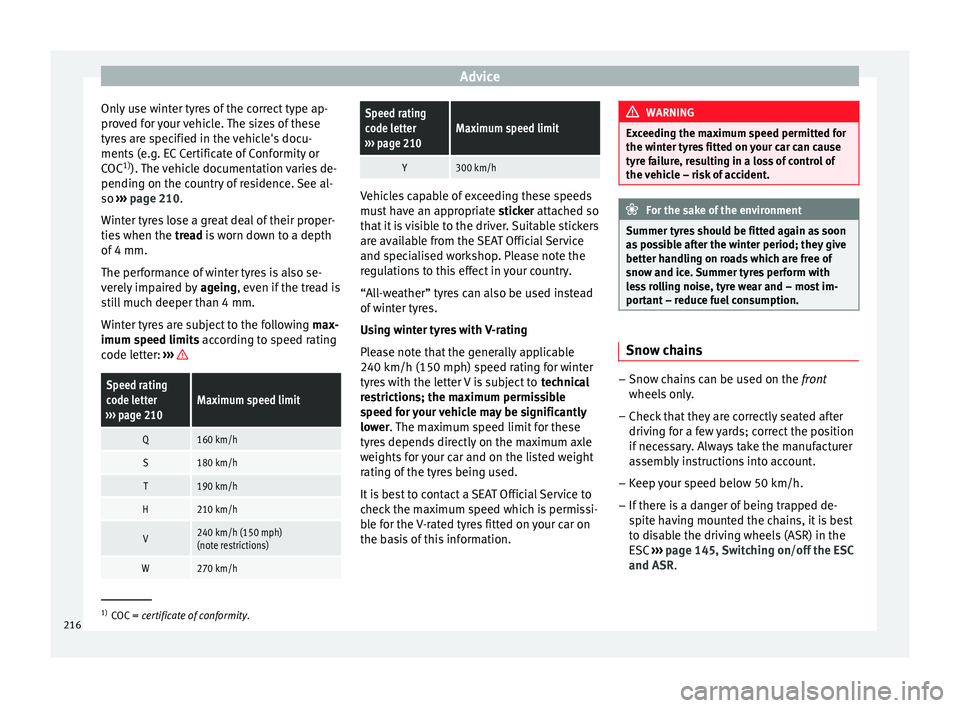
Speed rating
code letter
››› page 210Maximum speed limit
Q160 km/h
S180 km/h
T190 km/h
H210 km/h
V240 km/h (150 mph)
(note restrictions)
W270 km/h
Speed rating
code letter
››› page 210Maximum speed limit
Y300 km/h Vehicles capable of exceeding these speeds
must have an appropriate
sticker attached so
that it is visible to the driver. Suitable stickers
are available from the SEAT Official Service
and specialised workshop. Please note the
regulations to this effect in your country.
“All-weather” tyres can also be used instead
of winter tyres.
Using winter tyres with V-rating
Please note that the generally applicable
240 km/h (150 mph) speed rating for winter
tyres with the letter V is subject to technical
restrictions; the maximum permissible
speed for your vehicle may be significantly
lower . The maximum speed limit for these
ty r
es depends directly on the maximum axle
weights for your car and on the listed weight
rating of the tyres being used.
It is best to contact a SEAT Official Service to
check the maximum speed which is permissi-
ble for the V-rated tyres fitted on your car on
the basis of this information. WARNING
Exceeding the maximum speed permitted for
the winter tyres fitted on your car can cause
tyre failure, resulting in a loss of control of
the vehicle – risk of accident. For the sake of the environment
Summer tyres should be fitted again as soon
as possible after the winter period; they give
better handling on roads which are free of
snow and ice. Summer tyres perform with
less rolling noise, tyre wear and – most im-
portant – reduce fuel consumption. Snow chains
–
Snow chains can be used on the front
wheels only.
– Check that they are correctly seated after
driving for a few yards; correct the position
if necessary. Always take the manufacturer
assembly instructions into account.
– Keep your speed below 50 km/h.
– If there is a danger of being trapped de-
spite having mounted the chains, it is best
to disable the driving wheels (ASR) in the
ESC ›››
page 145, Switching on/off the ESC
and ASR . 1)
COC = certificate of conformity.
216
Page 220 of 284

Advice
Fitting
– Fit the wheel cover onto the wheel rim by
pressing it firmly. Put pressure initially on
the point of the cut-out for the valve. Next
fit the rest of the hubcap
Wheel bolt caps* Fig. 183
Wheel: wheel bolts with caps. Removal
– Fit the plastic clip (vehicle tools) over the
cap until it clicks into place ››› Fig. 183.
– Remove the cap with the plastic clip. Anti-theft wheel bolts
Fig. 184
Anti-theft wheel bolt with cap and
adapter. A special adapter (vehicle tools) is required
to remove the anti-theft wheel bolts.
–
Remove the wheel cover* or the cap*.
– Insert the adapter onto the anti-theft wheel
bolt and push it on as far as it will go.
– Insert the wheel brace (vehicle tools) onto
the adapter as far as it will go.
– Remove the wheel bolt ››› page 218. Note
Make a note of the code number of the anti-
theft wheel bolt and keep it in a safe place,
but not in your vehicle. If you need a new
adapter, you can obtain it from the SEAT Offi-
cial Service, indicating the code number. Loosening the wheel bolts
Fig. 185
Wheel: loosen the wheel bolts. –
Insert the box spanner (vehicle tools) onto
the wheel bolt as far as it will go. An adapt-
er is required to unscrew or tighten the an-
ti-theft wheel bolts ››› page 218.
– Turn the wheel bolt approximately one turn
to the left ››› Fig. 185 (arrow). To apply the
r equir
ed torque, hold the wheel brace at
the end. If it is not possible to loosen a
wheel bolt, carefully apply pressure with
one foot on the end of the box spanner.
Hold on to the vehicle for support and take
care not to slip. WARNING
Slightly loosen the wheel bolts (one turn) be-
fore raising the vehicle with the jack*. If not,
an accident may occur. 218
Page 232 of 284
Advice
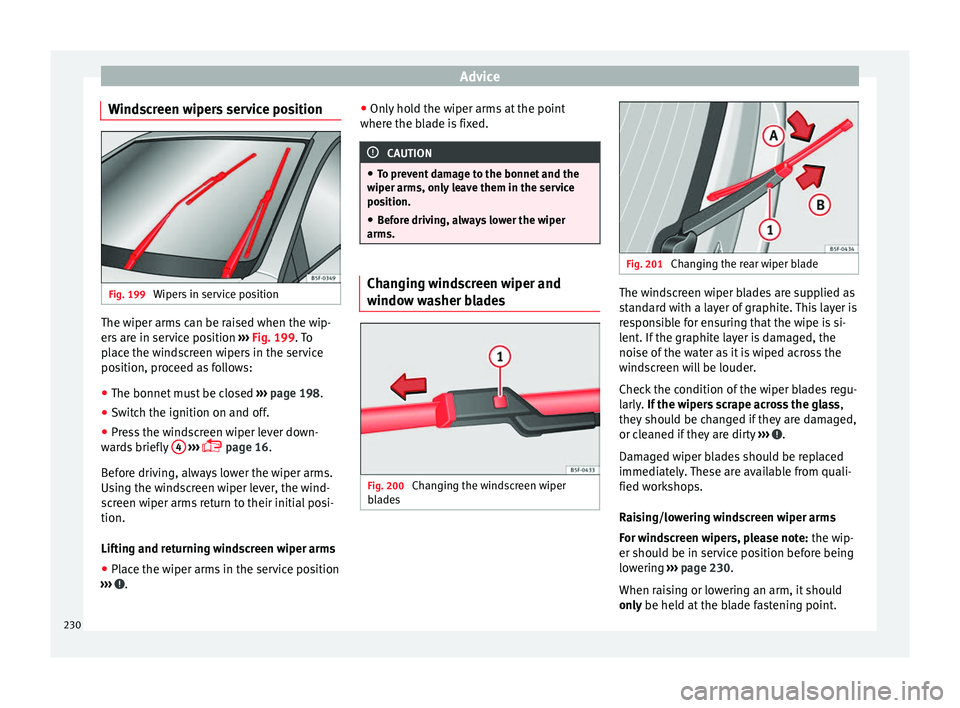
Windscreen wipers service position Fig. 199
Wipers in service position The wiper arms can be raised when the wip-
ers are in service position
››› Fig. 199 . To
p l
ace the windscreen wipers in the service
position, proceed as follows:
● The bonnet must be closed ››› page 198.
● Switch the ignition on and off.
● Press the windscreen wiper lever down-
wards briefly 4
›››
page 16.
Before driving, always lower the wiper arms.
Using the windscreen wiper lever, the wind-
screen wiper arms return to their initial posi-
tion.
Lifting and returning windscreen wiper arms
● Place the wiper arms in the service position
››› . ●
Only hold the wiper arms at the point
where the blade is fixed. CAUTION
● To prevent damage to the bonnet and the
wiper arms, only leave them in the service
position.
● Before driving, always lower the wiper
arms. Changing windscreen wiper and
window washer blades
Fig. 200
Changing the windscreen wiper
blades Fig. 201
Changing the rear wiper blade The windscreen wiper blades are supplied as
standard with a layer of graphite. This layer is
responsible for ensuring that the wipe is si-
lent. If the graphite layer is damaged, the
noise of the water as it is wiped across the
windscreen will be louder.
Check the condition of the wiper blades regu-
larly. If the wipers scrape across the glass
,
they shou
ld be changed if they are damaged,
or cleaned if they are dirty ››› .
Damaged wiper blades should be replaced
immediately. These are available from quali-
fied workshops.
Raising/lowering windscreen wiper arms
For windscreen wipers, please note: the wip-
er should be in service position before being
lowering ››› page 230 .
When r ai
sing or lowering an arm, it should
only
be held at the blade fastening point.
230
Page 233 of 284
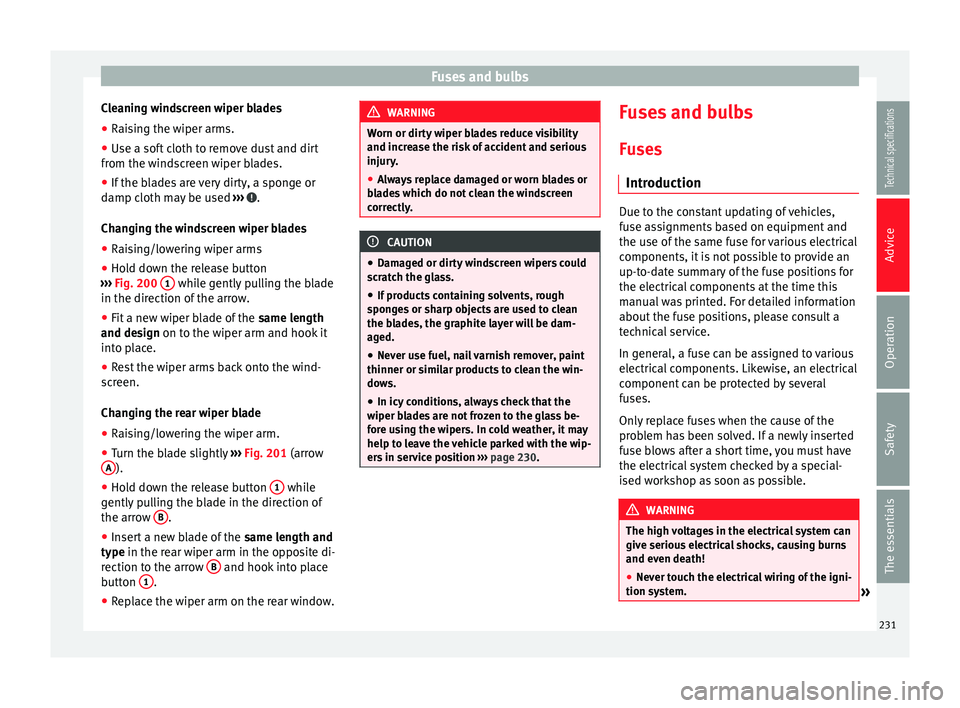
Fuses and bulbs
Cleaning windscreen wiper blades
● Raising the wiper arms.
● Use a soft cloth to remove dust and dirt
from the windscreen wiper blades.
● If the blades are very dirty, a sponge or
damp cloth may be used ››› .
Changing the windscreen wiper blades
● Raising/lowering wiper arms
● Hold down the release button
››› Fig. 200 1 while gently pulling the blade
in the direction of the arrow.
● Fit a new wiper blade of the same length
and design on to the wiper arm and hook it
int o p
lace.
● Rest the wiper arms back onto the wind-
screen.
Changing the rear wiper blade
● Raising/lowering the wiper arm.
● Turn the blade slightly ››› Fig. 201 (arrow
A ).
● Hold down the release button 1 while
gently pulling the blade in the direction of
the arrow B .
● Insert a new blade of the same length and
type in the rear wiper arm in the opposite di-
r ection t
o the arrow B and hook into place
button 1 .
● Replace the wiper arm on the rear window. WARNING
Worn or dirty wiper blades reduce visibility
and increase the risk of accident and serious
injury.
● Always replace damaged or worn blades or
blades which do not clean the windscreen
correctly. CAUTION
● Damaged or dirty windscreen wipers could
scratch the glass.
● If products containing solvents, rough
sponges or sharp objects are used to clean
the blades, the graphite layer will be dam-
aged.
● Never use fuel, nail varnish remover, paint
thinner or similar products to clean the win-
dows.
● In icy conditions, always check that the
wiper blades are not frozen to the glass be-
fore using the wipers. In cold weather, it may
help to leave the vehicle parked with the wip-
ers in service position ››› page 230. Fuses and bulbs
Fuses Introduction Due to the constant updating of vehicles,
fuse assignments based on equipment and
the use of the same fuse for various electrical
components, it is not possible to provide an
up-to-date summary of the fuse positions for
the electrical components at the time this
manual was printed. For detailed information
about the fuse positions, please consult a
technical service.
In general, a fuse can be assigned to various
electrical components. Likewise, an electrical
component can be protected by several
fuses.
Only replace fuses when the cause of the
problem has been solved. If a newly inserted
fuse blows after a short time, you must have
the electrical system checked by a special-
ised workshop as soon as possible.
WARNING
The high voltages in the electrical system can
give serious electrical shocks, causing burns
and even death!
● Never touch the electrical wiring of the igni-
tion system. » 231
Technical specifications
Advice
Operation
Safety
The essentials
Page 238 of 284

Advice
– Remove the bulb by pressing on the bulb
holder and turning it anti-clockwise at the
same time.
– Installation involves all of the above steps
in reverse sequence.
Main beam headlight bulb Fig. 210
Main beam headlight bulb. Fig. 211
Main beam headlight bulb. –
Raise the bonnet.
– Move the loop ››› Fig. 210 1 in the direc-
tion of the arrow and remove the cover.
– Slide connector ››› Fig. 211 2 to the left or
right and pull.
– Remove the bulb by disconnecting the con-
nector.
– Installation involves all of the above steps
in reverse sequence.
Changing bulb for front fog
light* Front fog light bulb Fig. 212
Front fog light. Fig. 213
Front fog light. –
Remove the bolt ››› Fig. 212 1 from the fog
light grille with a screwdriver.
– Remove the bolts (3x) ››› Fig. 213 2 to re-
move the fog light.
– Remove the fog light. Note
Due to the difficulty of accessing fog light
bulbs, have them replaced at a Technical
Service or specialised workshop. 236
Page 239 of 284

Fuses and bulbs
Fog light, FR version Fig. 214
Fog light: access to the connector
and to the light bulb holder. Fig. 215
Fog light: access to the connector
and to the light bulb holder. –
Remove the 3 bolts 1
››› Fig. 214 from the
in s
ide of the wheel housing and the 2 bot-
tom bolts 2
››› Fig. 214 from the bumper
with the help of a screwdriver. –
Pull the wheel housing 3
››› Fig. 215 ac-
c e
ss the 2 hidden screws 4
››› Fig. 215 of
the b umper
.
– Remove the screws using a screwdriver.
– Pull the bumper to release it from its an-
chorages to access the connector and the
light bulb holder. Note
Due to the difficulty of accessing fog light
bulbs, have them replaced at a Technical
Service or specialised workshop. Remove the bulb holder
Fig. 216
Front fog light. –
Remove connector ››› Fig. 216 1 from the
bulb.
– Turn the bulb holder ››› Fig. 216
2 anti-
clockwise and pull. –
Remove the bulb by pressing on the bulb
holder and turning it anti-clockwise at the
same time.
– Installation involves all of the above steps
in reverse sequence.
– Check that the bulb works properly.
Changing tail light bulbs (on
side panel) Overview of tail lights Rear lights on the side panel
Turn signalPY21W NA LL
Side light and brake lightP21W LL
237
Technical specifications
Advice
Operation
Safety
The essentials
Page 244 of 284
Technical specifications
VIN in the Easy Connect – Select: Function button CAR > control but-
ton (Car)* Systems > Service & Control >
Ch a
ssis number .
Chassis number
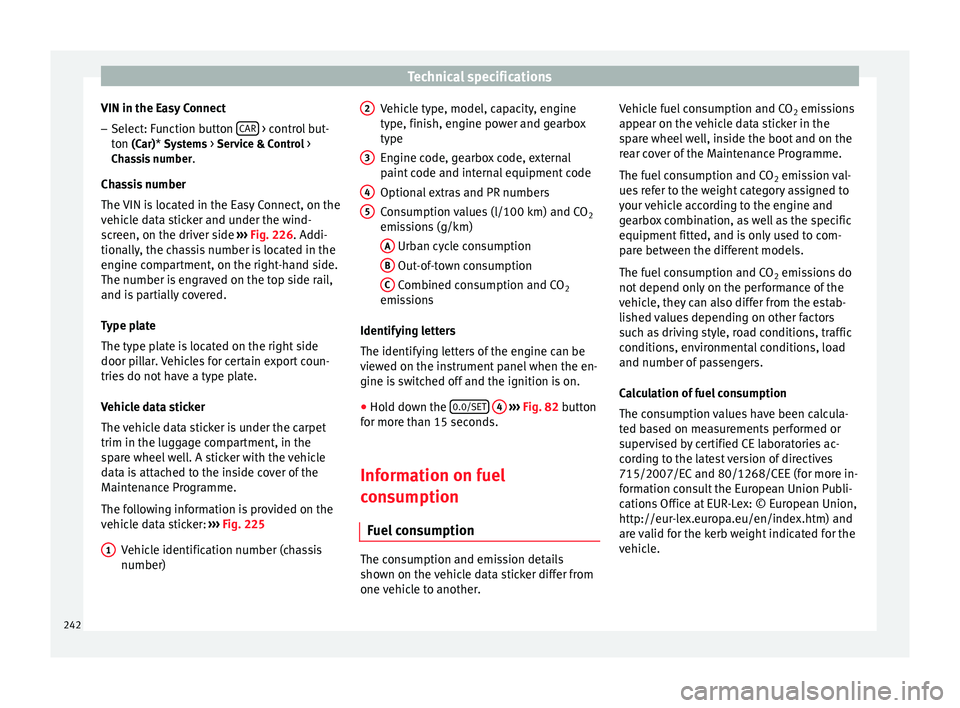
The VIN is located in the Easy Connect, on the
vehicle data sticker and under the wind-
screen, on the driver side ››› Fig. 226. Addi-
tional
ly, the chassis number is located in the
engine compartment, on the right-hand side.
The number is engraved on the top side rail,
and is partially covered.
Type plate
The type plate is located on the right side
door pillar. Vehicles for certain export coun-
tries do not have a type plate.
Vehicle data sticker
The vehicle data sticker is under the carpet
trim in the luggage compartment, in the
spare wheel well. A sticker with the vehicle
data is attached to the inside cover of the
Maintenance Programme.
The following information is provided on the
vehicle data sticker: ››› Fig. 225
Vehicle identification number (chassis
number)
1 Vehicle type, model, capacity, engine
type, finish, engine power and gearbox
type
Engine code, gearbox code, external
paint code and internal equipment code
Optional extras and PR numbers
Consumption values (l/100 km) and CO
2
emissions (g/km)
A Urban cycle consumption
B Out-of-town consumption
C Combined consumption and CO
2
emissions
Identifying letters
The identifying letters of the engine can be
viewed on the instrument panel when the en-
gine is switched off and the ignition is on.
● Hold down the 0.0/SET
4
››› Fig. 82 button
for more than 15 seconds.
Information on fuel
consumption
Fuel consumption The consumption and emission details
shown on the vehicle data sticker differ from
one vehicle to another.2 3
4
5 Vehicle fuel consumption and CO
2 emissions
appear on the vehicle data sticker in the
spare wheel well, inside the boot and on the
rear cover of the Maintenance Programme.
The fuel consumption and CO 2 emission val-
ues refer to the weight category assigned to
your vehicle according to the engine and
gearbox combination, as well as the specific
equipment fitted, and is only used to com-
pare between the different models.
The fuel consumption and CO 2 emissions do
not depend only on the performance of the
vehicle, they can also differ from the estab-
lished values depending on other factors
such as driving style, road conditions, traffic
conditions, environmental conditions, load
and number of passengers.
Calculation of fuel consumption
The consumption values have been calcula-
ted based on measurements performed or
supervised by certified CE laboratories ac-
cording to the latest version of directives
715/2007/EC and 80/1268/CEE (for more in-
formation consult the European Union Publi-
cations Office at EUR-Lex: © European Union,
http://eur-lex.europa.eu/en/index.htm) and
are valid for the kerb weight indicated for the
vehicle.
242
Page 246 of 284

Technical specifications195/65 R15Chains with links of maximum 15 mm
205/55 R16Chains with links of maximum 15 mm
205/50 R17Chains with links of maximum 15 mm
225/45 R17Chains with links of maximum 9 mm
225/40 R18Chains with links of maximum 9 mm
225/35 R19Chains with links of maximum 7 mm
205/55 R17Snow chains are not permitted
225/45 R18Snow chains are not permitted
Wheel bolts
After the wheels have been changed, the
tightening torque
of the wheel bolts should
be c hec
ked as soon as possible with a torque
wrench ››› . The tightening torque for steel
and alloy wheels is 120 Nm. WARNING
● Check the tyre pressure at least once per
month. Checking the tyre pressure is very im-
portant. If the tyre pressure is too high or too
low, there is an increased danger of accidents
- particularly at high speeds.
● If the tightening torque of the wheel bolts
is too low, they could loosen while the vehi-
cle is in motion. Risk of accident! If the tight-
ening torque is too high, the wheel bolts and
threads can be damaged. Note
We recommend that you ask your Technical
Service for information about appropriate
wheel, tyre and snow chain size. 244