lights Seat Leon 5D 2014 Repair Manual
[x] Cancel search | Manufacturer: SEAT, Model Year: 2014, Model line: Leon 5D, Model: Seat Leon 5D 2014Pages: 284, PDF Size: 5.85 MB
Page 223 of 284

Emergencies
TMS (Tyre Mobility System)* Read the additional information carefully
››› page 33
The Anti-puncture kit* (Tyre Mobility System)
will reliably seal punctures caused by the
penetration of a foreign body of up to about
4 mm in diameter. Do not remove foreign ob-
j
ects, e.g. screws or nails, from the tyre.
After inserting the sealant residue in the tyre,
you must again check the tyre pressure about
10 minutes after starting the engine.
You should only use the tire mobility set if
the vehicle is parked in a safe place, you are
familiar with the procedure and you have the
necessary tire mobility set! Otherwise, you
should seek professional assistance.
The tyre sealant must not be used in the
following cases:
● If the wheel rim has been damaged.
● In outside temperatures below -20°C (-4°F).
● In the event of cuts or perforations in the
tyre greater than 4 mm.
● If you have been driving with very low pres-
sure or a completely flat tyre.
● If the sealant bottle has passed its use by
date. WARNING
Using the tyre mobility system can be dan-
gerous, especially when filling the tyre at the
roadside. Please observe the following rules
to minimise the risk of injury:
● Stop the vehicle safely as soon as possible.
Park it at a safe distance from surrounding
traffic to fill the tyre.
● Ensure the ground on which you park is flat
and solid.
● All passengers and particularly children
must keep a safe distance from the work area.
● Turn on the hazard warning lights to warn
other road users.
● Use the tyre mobility system only if you are
familiar with the necessary procedures. Oth-
erwise, you should seek professional assis-
tance.
● The tyre mobility set is intended for tempo-
rary emergency use only until you can reach
the nearest specialised workshop.
● Replace the repaired tyre with the tire mo-
bility set as soon as possible.
● The sealant is a health hazard and must be
cleaned immediately if it comes into contact
with the skin.
● Always keep the tire mobility set out of the
reach of small children.
● Never use an equivalent jack, even if it has
been approved for your vehicle.
● Always stop the engine, apply the hand-
brake lever firmly and engage gear if using a manual gearbox, in order to reduce the risk of
vehicle involuntary movement.
WARNING
A tyre filled with sealant does not have the
same performance properties as a conven-
tional tyre.
● Never drive faster than 80 km/h (50 mph).
● Avoid heavy acceleration, hard braking and
fast cornering.
● Drive for only 10 minutes at a maximum
speed of 80 km/h (50 mph) and then check
the tyre. For the sake of the environment
Dispose of used or expired sealant observing
any legal requirements. Note
A new bottle of sealant can be purchased at
SEAT dealerships. Note
Take into account the separate instruction
manual of the tyre mobility set* manufactur-
er. 221
Technical specifications
Advice
Operation
Safety
The essentials
Page 226 of 284

Advice
8. Start the engine of the vehicle with the flat battery and wait 2 or 3 minutes until the
engine is “running”.
Removing the jump leads
9. Before you remove the jump leads, switch off the dipped beam headlights (if they
are switched on).
10.Turn on the heater blower and heated rear window in the vehicle with the flat battery.
This helps minimise voltage peaks which
are generated when the leads are discon-
nected.
11. When the engine is running, disconnect
the l e
ads in reverse order to the details
given above.
Connect the battery clamps so they have
good metal-to-metal contact with the battery
terminals.
If the engine fails to start, switch off the start-
er after about 10 seconds and try again after
about 1 minute. WARNING
● Please note the safety warnings referring to
working in the engine compartment
››› page 198.
● The b att
ery providing assistance must have
the same voltage as the flat battery (12V) and
approximately the same capacity (see imprint on battery). Failure to comply could result in
an explosion.
●
Never use jump leads when one of the bat-
teries is frozen. Danger of explosion! Even af-
ter the battery has thawed, battery acid could
leak and cause chemical burns. If a battery
freezes, it should be replaced.
● Keep sparks, flames and lighted cigarettes
away from batteries, danger of explosion.
Failure to comply could result in an explo-
sion.
● Observe the instructions provided by the
manufacturer of the jump leads.
● Do not connect the negative cable from the
other vehicle directly to the negative terminal
of the flat battery. The gas emitted from the
battery could be ignited by sparks. Danger of
explosion.
● Do not attach the negative cable from the
other vehicle to parts of the fuel system or to
the brake line.
● The non-insulated parts of the battery
clamps must not be allowed to touch. The
jump lead attached to the positive battery
terminal must not touch metal parts of the ve-
hicle, this can cause a short circuit.
● Position the leads in such a way that they
cannot come into contact with any moving
parts in the engine compartment.
● Do not lean on the batteries. This could re-
sult in chemical burns. Note
The vehicles must not touch each other, oth-
erwise electricity could flow as soon as the
positive terminals are connected. Towing and tow-starting the
vehicle
General information Read the additional information carefully
››› page 35
Points to observe when tow-starting or tow-
ing away
If you use a tow rope:
Notes for the driver of the towing vehicle
– The tow rope must be taut before you drive
off.
– Release the clutch very carefully when start-
ing the vehicle (manual gearbox), or accel-
erate gently (automatic gearbox).
Driving style
Towing requires some experience, especially
when using a tow rope
. Both drivers should
be f
amiliar with the technique required for
towing. Inexperienced drivers should not at-
tempt to tow.
224
Page 227 of 284

Emergencies
Do not pull too hard with the towing vehicle
and take care to avoid jerking the tow rope.
When towing on an unpaved road, there is al-
ways a risk of overloading and damaging the
anchorage points. WARNING
If the vehicle has no electrical power, the
brake lights, turn signals and all other lights
will no longer function. Do not have the vehi-
cle towed away. Failure to follow this instruc-
tion could result in an accident. CAUTION
If there is no oil in the gearbox or no lubricant
in the automatic transmission the car may
only be towed with the driven wheels lifted
clear of the road, or transported on a special
car transporter or trailer. Note
● Please observe related legal requirements.
● Switch on the hazard warning lights of both
vehicles. However, observe any regulations
to the contrary.
● The tow rope must not be twisted. Other-
wise the front towline anchorage could be
pulled off the vehicle. Towline anchorage at the front of the
vehicle
Fig. 191
Right side of the front bumper: tow-
line anchorage screwed in. The front towline anchorage is only mounted
if the vehicle has to be towed.
There is a cover with an opening into which
the towline anchorage is screwed on the right
part of the front bumper.
– To remove the bumper cover, just press the
upper left side inwards.
– Take the towline anchorage out of the vehi-
cle tool kit ››› page 220 .
– Sc r
ew the towline anchorage into the screw
connection as far as it will go ››› Fig. 191
and tighten with the wheel brace.
After use, unscrew the towline anchorage
and fit the cover back on the bumper. Put the
towline anchorage back in the vehicle tool kit. The towline anchorage should always be
kept in the vehicle.
Rear towline anchorage Fig. 192
Right side of the rear bumper: cover-
cap. Fig. 193
Right side of the rear bumper: tow-
line anchorage screwed in. The rear towline anchorage should only be
mounted if you wish to tow another vehicle.
»
225
Technical specifications
Advice
Operation
Safety
The essentials
Page 234 of 284

Advice
●
Take care not to cause short circuits in the
electrical system. WARNING
Using unsuitable fuses, repairing fuses or
bridging a current circuit without fuses can
cause a fire and serious injury.
● Never use a fuse with a higher value. Only
replace fuses with a fuse of the same amper-
age (same colour and markings) and size.
● Never repair a fuse.
● Never replace a fuse by a metal strip, staple
or similar. CAUTION
● To prevent damage to the vehicle's electric
system, before replacing a fuse always turn
off the ignition, the lights and all electrical
elements and remove the key from the igni-
tion.
● If you replace a fuse with higher-rating
fuse, you could cause damage to another part
of the electrical system.
● Protect the fuse boxes when open to pre-
vent the entry of dust or humidity as they can
damage the electrical system. Note
● One component may have more than one
fuse. ●
Several components may run on a single
fuse. Vehicle fuses
Fig. 202
On the driver-side dash panel: fuse
box cover Fig. 203
In the engine compartment: fuse box
cover Read the additional information carefully
››› page 33 Only replace fuses with a fuse of the same
amperage (same colour and markings) and
size.
Identifying fuses situated below the driver-
side dash panel by coloursColourAmp rating
Black1
Purple3
Light brown5
Brown7.5
Red10
Blue15
Yellow20
White or trans-
parent25
Green30
Orange40 Opening and closing the fuse box situated
below the dash panel
●
Opening: fold the cover down ›
›
›
Fig. 202.
● Closing:
push back the cover it in until it
clicks into place.
To open the engine compartment fuse box
● Open the bonnet ››› page 198.
232
Page 235 of 284

Fuses and bulbs
● Press the locking tabs to release the fuse
box cover ››› Fig. 203 .
● Then lif t
the cover out.
● To
fit the cover, place it on the fuse box.
Push the locking tabs down until they click
audibly into place. CAUTION
● Always carefully remove the fuse box cov-
ers and refit them correctly to avoid problems
with your vehicle.
● Protect the fuse boxes when open to avoid
the entry of dust or humidity. Dirt and humid-
ity inside fuse boxes can cause damage to
the electrical system. Note
In the vehicle, there are more fuses than
those indicated in this chapter. These should
only be changed by a specialised workshop. Replacing a blown fuse
Fig. 204
Image of a blown fuse Preparation
● Switch off the ignition, lights and all elec-
trical equipment.
● Open the corresponding fuse box
››› page 232 .
Identif y
ing a blown fuse
A fuse is blown if its metal strip is ruptured
››› Fig. 204.
Point a lamp at the fuse. This will make it
easier to see if the fuse is blown.
To replace a fuse ● Remove the fuse.
● Replace the blown fuse by one with an
identical amperage rating (same colour and
mark
ings) and identical size ››› .●
Replace the cover again or close the fuse
box lid. CAUTION
If you replace a fuse with higher-rating fuse,
you could cause damage to another part of
the electrical system. Bulbs
Changing a bulb Changing bulbs requires a certain degree of
practical skill.
If you choose to change the engine compart-
ment lamps yourself, remember that it is a
dangerous area
››› in Work in the engine
compartment on page 198 .
A lw
ays use identical bulbs with the same
designation. The name can be found on the
base of the bulb holder.
Depending on how equipped the vehicle is,
there are different sets of headlights and tail
lights:
● Halogen headlights
● Full-LED main headlights*
● Rear bulb light
● LED rear light* »
233
Technical specifications
Advice
Operation
Safety
The essentials
Page 236 of 284

Advice
Full-LED headlight system*
Full-LED headlights handle all light functions
(daylight, side light, turn signal, dipped
beam and route light) with light emitting di-
odes (LEDs) as a light source.
Full-LED headlights are designed to last the
lifetime of the car and light bulbs cannot be
replaced. In case of headlight failure, go to
an authorised workshop to have it replaced.
Bulbs (12 V)Halogen headlightsType
Daytime driving light/side lightP21W SLL
Dipped beam headlightsH7 LL
Main beam headlightsH7 LL
Turn signalPY21W LL
Full-LED main headlightsType
No bulbs may be replaced. All
functions are with LEDs
Front fog lightType
Fog/cornering lights*H8
Rear bulb lightType
Brake light/tail lightP21W LL
Side lights2x W5W LL
Rear bulb lightType
Turn signalPY21W LL
Retro fog lightH21W
Reverse lightsP21W LL
LED rear lightType
Turn signalPY21W LL
Retro fog lightH21W
Reverse lightsP21W LL
The remaining functions work
with LEDs WARNING
● Take particular care when working on com-
ponents in the engine compartment if the en-
gine is warm. Risk of burns.
● Bulbs are highly sensitive to pressure. The
glass can break when you touch the bulb,
causing injury.
● When changing bulbs, please take care not
to injure yourself on sharp edges, in particu-
lar on the headlight housing. CAUTION
● Remove the ignition key before working on
the electric system. Otherwise, a short circuit
could occur. ●
Switch off the lights and the parking light
before changing a bulb.
● Take good care to avoid damaging any com-
ponents. For the sake of the environment
Please ask your specialist retailer how to dis-
pose of used bulbs in the proper manner. Note
● Please check at regular intervals that all
lighting (especially the exterior lighting) on
your vehicle is functioning properly. This is
not only in the interest of your own safety,
but also that of all other road users.
● Before changing a bulb, make sure you
have the correct new bulb.
● Do not touch the glass part of the bulb with
your bare hands, use a cloth or paper towel
instead, since the fingerprints left on the
glass will vaporise as a result of the heat gen-
erated by the bulb, they will be deposited on
the reflector and will impair its surface. 234
Page 237 of 284

Fuses and bulbs
Changing bulbs in headlight
unit Dipped light bulb Fig. 205
Dipped beam headlights. Fig. 206
Dipped beam headlights. –
Raise the bonnet.
– Move the loops ››› Fig. 205 1 in the direc-
tion of the arrow and remove the cover. –
Remove connector ››› Fig. 206 2 from the
bulb.
– Unclip the retainer spring ››› Fig. 206 3 pressing inwards to the right.
– Extract the bulb and fit the replacement so
that the lug on the base fits into the recess
on the reflector.
Day light bulb Fig. 207
Day light bulb. –
Raise the bonnet.
– Turn the bulb holder ››› Fig. 207 1 to the
left and pull.
– Remove the bulb by pressing on the bulb
holder and turning it anti-clockwise at the
same time.
– Installation involves all of the above steps
in reverse sequence. Turn signal bulb
Fig. 208
Turn signal bulb. Fig. 209
Turn signal bulb. –
Raise the bonnet.
– Move the loop ››› Fig. 208 1 in the direc-
tion of the arrow and remove the cover.
– Turn the bulb holder ››› Fig. 209 2 anti-
clockwise and pull. »
235Technical specifications
Advice
Operation
Safety
The essentials
Page 239 of 284

Fuses and bulbs
Fog light, FR version Fig. 214
Fog light: access to the connector
and to the light bulb holder. Fig. 215
Fog light: access to the connector
and to the light bulb holder. –
Remove the 3 bolts 1
››› Fig. 214 from the
in s
ide of the wheel housing and the 2 bot-
tom bolts 2
››› Fig. 214 from the bumper
with the help of a screwdriver. –
Pull the wheel housing 3
››› Fig. 215 ac-
c e
ss the 2 hidden screws 4
››› Fig. 215 of
the b umper
.
– Remove the screws using a screwdriver.
– Pull the bumper to release it from its an-
chorages to access the connector and the
light bulb holder. Note
Due to the difficulty of accessing fog light
bulbs, have them replaced at a Technical
Service or specialised workshop. Remove the bulb holder
Fig. 216
Front fog light. –
Remove connector ››› Fig. 216 1 from the
bulb.
– Turn the bulb holder ››› Fig. 216
2 anti-
clockwise and pull. –
Remove the bulb by pressing on the bulb
holder and turning it anti-clockwise at the
same time.
– Installation involves all of the above steps
in reverse sequence.
– Check that the bulb works properly.
Changing tail light bulbs (on
side panel) Overview of tail lights Rear lights on the side panel
Turn signalPY21W NA LL
Side light and brake lightP21W LL
237
Technical specifications
Advice
Operation
Safety
The essentials
Page 240 of 284
Advice
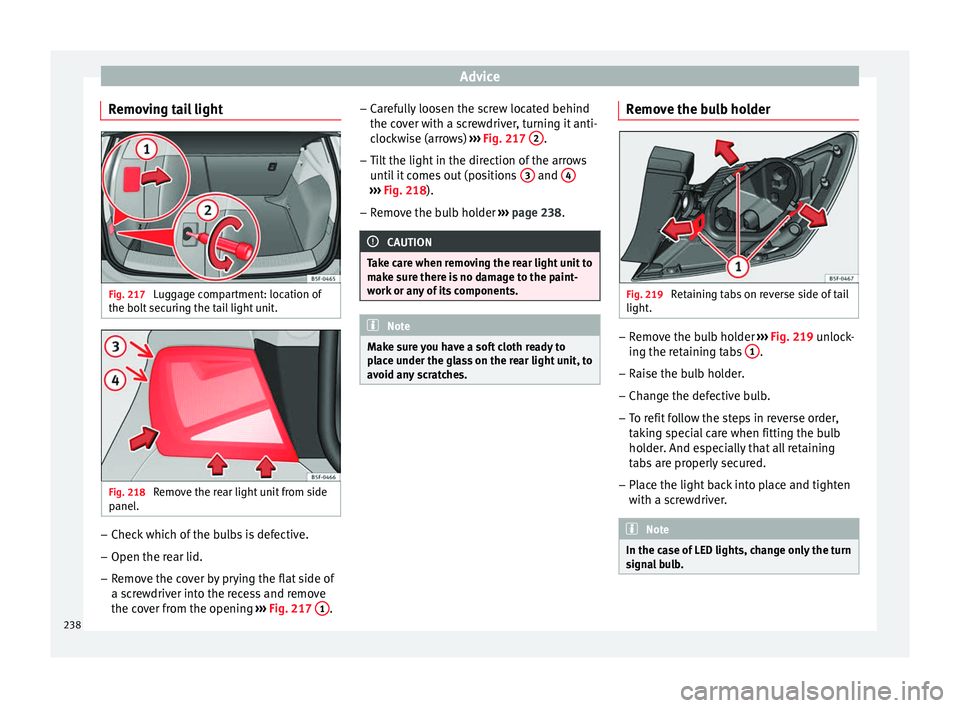
Removing tail light Fig. 217
Luggage compartment: location of
the bolt securing the tail light unit. Fig. 218
Remove the rear light unit from side
panel. –
Check which of the bulbs is defective.
– Open the rear lid.
– Remove the cover by prying the flat side of
a screwdriver into the recess and remove
the cover from the opening ››› Fig. 217 1 .–
Carefully loosen the screw located behind
the cover with a screwdriver, turning it anti-
clockwise (arrows) ››› Fig. 217 2 .
– Tilt the light in the direction of the arrows
until it comes out (positions 3 and
4 ›››
Fig. 218 ).
– Remo
ve the bulb holder ››› page 238. CAUTION
Take care when removing the rear light unit to
make sure there is no damage to the paint-
work or any of its components. Note
Make sure you have a soft cloth ready to
place under the glass on the rear light unit, to
avoid any scratches. Remove the bulb holder
Fig. 219
Retaining tabs on reverse side of tail
light. –
Remove the bulb holder ››› Fig. 219 unlock-
in g the r
etaining tabs 1 .
– Raise the bulb holder.
– Change the defective bulb.
– To refit follow the steps in reverse order,
taking special care when fitting the bulb
holder. And especially that all retaining
tabs are properly secured.
– Place the light back into place and tighten
with a screwdriver. Note
In the case of LED lights, change only the turn
signal bulb. 238
Page 241 of 284

Fuses and bulbs
Changing tail light bulbs (on
rear lid) Overview of tail lights Rear lights on tailgateLeft side
Side lights2x W5W LL
Fog lightsH21 W
Right side
Side lights2x W5W LL
Reverse lightP21W LL
The table corresponds to a right-hand traffic
vehicle. The position of lights may vary ac-
cording to the country.
Remove the bulb holder Fig. 220
Remove the cover from the boot lid. Fig. 221
Remove the lamp holder The rear lid must be open to change the
bulbs.
– Remove the rear lid cover in the direction
indicated ››› Fig. 220 .
– Un loc
k the retaining tabs A of the bulb
holder, following the direction of arrows 1 and
2
››› Fig. 221 . –
Remo
ve the bulb holder by turning it in the
direction of arrow 3
››› Fig. 221 .
Ch an
ging bulbs Fig. 222
Position of the bulbs in the bulb
holder –
Lightly press the defective bulb into the
bulb holder ››› Fig. 222 1 , then turn it to
the left 2 and remove it.
– Fit the new bulb, pressing it into the bulb
holder and turn it to the right as far as it
will go.
– Use a cloth to remove any fingerprints from
the glass part of the bulb.
– Check that the new bulb works properly.
– Replace the bulb holder.
»
239
Technical specifications
Advice
Operation
Safety
The essentials