wheel Seat Leon 5D 2014 Manual PDF
[x] Cancel search | Manufacturer: SEAT, Model Year: 2014, Model line: Leon 5D, Model: Seat Leon 5D 2014Pages: 284, PDF Size: 5.85 MB
Page 228 of 284

Advice
Vehicles with towline anchorage
On the right of the rear bumper there is a cov-
er which covers a threaded hole. – Take the towline anchorage out of the vehi-
cle tool set ››› page 220 .
– To r
emove the bumper cover, just press the
upper side of the cover inwards (arrow) and
remo
ve the cover by levering on the lower
››› Fig. 192 side.
– Scr
ew the towline anchorage into the screw
connection as far as it will go ››› Fig. 193
and tighten with the wheel brace.
After use, unscrew the towline anchorage
and put it back in the vehicle tool kit. Replace
the cover on the bumper. The towline anchor-
age should always be kept in the vehicle. WARNING
● If the towline anchorage is not screwed in
as far as the stop, there is a risk of the screw
connection shearing off during towing (acci-
dent risk).
● If your car has a towing bracket, only use
special towing ropes. Risk of accident! CAUTION
In vehicles fitted with a towing bracket, only
use special tow bars to prevent damage to
the ball joint. These tow bars have been spe-
cially approved for use with towing brackets. Tow-starting
As a general rule, tow-starting is not recom-
mended.
– Engage 2nd or 3rd gear before moving off.
– Press the clutch and hold the pedal down.
– Switch the ignition on.
– Once both vehicles are moving, release the
clutch.
– As soon as the engine has started, press
the clutch and move the gear lever to neu-
tral.
If the engine will not start, it is best to try
starting it using the battery of another vehi-
cle ›››
page 223 before attempting to tow
s t
art. You should only try to tow-start the en-
gine if jump starting is not successful. Tow-
starting is an attempt to start the engine via
the movement of the wheels.
When tow-starting a vehicle with a petrol en-
gine
, do not tow it more than a short dis-
tance, otherwise unburned fuel can enter the
catalytic converter. WARNING
The risk of accidents is high when tow-start-
ing, for example, the towed vehicle can easily
be driven into the towing vehicle. CAUTION
Do not tow vehicles for more than 50 km. Risk
of damage to the catalytic converter. Towing vehicles with a manual
gearbox
Towing is relatively straightforward.
Please observe the relevant instructions
››› page 224.
The v
ehicle can be towed using a tow bar or
tow rope in the normal way, with all four
wheels on the road; it can also be towed with
either the front or rear wheels lifted off the
road. The maximum towing speed is 50 km/h
(30 mph).
To
wing a vehicle equipped with
automatic gearbox Certain restrictions must be observed when
towing your vehicle.
Please observe the relevant instructions
››› page 224 .
The v
ehicle can be towed with a tow bar or
tow rope in the normal way, with all four
wheels on the ground. When doing so,
please note the following points:
226
Page 229 of 284

Emergencies
● Make sure the selector lever is in the N
po-
s ition.
● The
vehicle must not be towed faster than
50 km/h (30 mph).
● The v
ehicle must not be towed further than
50 km (30 miles)
. Reason: when the engine
is not running, the gearbox oil pump does
not work and the gearbox is not adequately
lubricated for higher speeds or longer distan-
ces.
If the vehicle has to be towed with a break-
down truck
, it must only be suspended at the
front wheels. Reason: the drive shafts are lo-
cated on the front wheels. If the car is towed
with the rear wheels lifted off the road (I.e.
travelling backwards), the drive shafts also
turn backwards. The planetary gears in the
aut
omatic gearbox then turn at such high
speeds that the gearbox will be severely
damaged in a short time. Note
● If it is not possible to tow the vehicle in the
normal way, or if it has to be towed further
than 50 km (30 miles), it must be transported
on a special car transporter or trailer.
● Should the power supply to the selector
lever be interrupted in position P, the selector
lever will be locked. Before the vehicle can be
recovered/manoeuvred you must manually
release the selector lever ››› page 229. Emergency locking and
unlocking
Introduction The doors, rear lid and panoramic tilting sun-
roof can be locked manually and partially
opened, for example if the key or the central
locking is damaged.
WARNING
Opening and closing doors carelessly can
cause serious injury.
● If the vehicle is locked from outside, the
doors and windows cannot be opened from
the inside.
● Never leave children or disabled people
alone in the car. They could be trapped in the
car in an emergency and will not be able to
get themselves to safety.
● Depending on the time of the year, temper-
atures inside a locked and closed vehicle can
be extremely high or extremely low resulting
in serious injuries and illness or even death,
particularly for young children. WARNING
Getting in the way of the doors and the rear
lid is dangerous and can lead to serious in-
jury.
● Open and close the doors and the rear lid
only when there is nobody in the way. CAUTION
When opening and closing in an emergency,
carefully disassemble components and then
reassemble them carefully to avoid damage
to the vehicle. Locking or unlocking the driver door
Fig. 194
Driver door lever: hidden lock cylin-
der. If the central locking system should fail to op-
erate, the driver door can still be locked and
unlocked by turning the key in the lock.
As a general rule, when the driver door is
locked all other doors are locked. When the
vehicle is unlocked manually, only the driver
door opens. Please observe the instructions
relating to the anti-theft alarm system
››› page 82 .
● Unf o
ld the vehicle key shaft ››› page 83.
»
227
Technical specifications
Advice
Operation
Safety
The essentials
Page 239 of 284

Fuses and bulbs
Fog light, FR version Fig. 214
Fog light: access to the connector
and to the light bulb holder. Fig. 215
Fog light: access to the connector
and to the light bulb holder. –
Remove the 3 bolts 1
››› Fig. 214 from the
in s
ide of the wheel housing and the 2 bot-
tom bolts 2
››› Fig. 214 from the bumper
with the help of a screwdriver. –
Pull the wheel housing 3
››› Fig. 215 ac-
c e
ss the 2 hidden screws 4
››› Fig. 215 of
the b umper
.
– Remove the screws using a screwdriver.
– Pull the bumper to release it from its an-
chorages to access the connector and the
light bulb holder. Note
Due to the difficulty of accessing fog light
bulbs, have them replaced at a Technical
Service or specialised workshop. Remove the bulb holder
Fig. 216
Front fog light. –
Remove connector ››› Fig. 216 1 from the
bulb.
– Turn the bulb holder ››› Fig. 216
2 anti-
clockwise and pull. –
Remove the bulb by pressing on the bulb
holder and turning it anti-clockwise at the
same time.
– Installation involves all of the above steps
in reverse sequence.
– Check that the bulb works properly.
Changing tail light bulbs (on
side panel) Overview of tail lights Rear lights on the side panel
Turn signalPY21W NA LL
Side light and brake lightP21W LL
237
Technical specifications
Advice
Operation
Safety
The essentials
Page 244 of 284
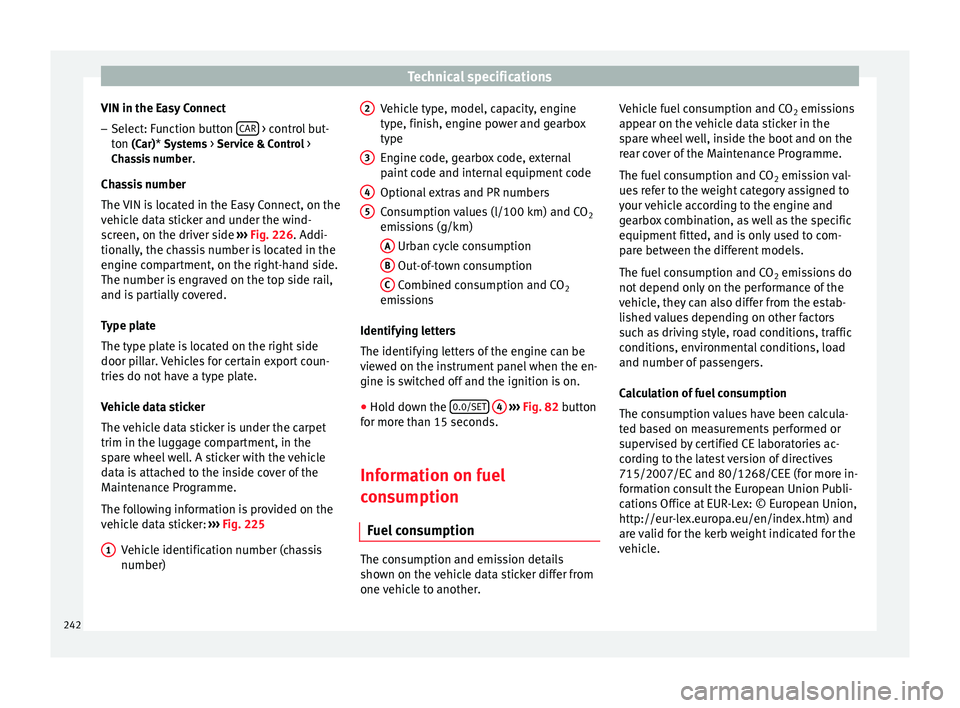
Technical specifications
VIN in the Easy Connect – Select: Function button CAR > control but-
ton (Car)* Systems > Service & Control >
Ch a
ssis number .
Chassis number
The VIN is located in the Easy Connect, on the
vehicle data sticker and under the wind-
screen, on the driver side ››› Fig. 226. Addi-
tional
ly, the chassis number is located in the
engine compartment, on the right-hand side.
The number is engraved on the top side rail,
and is partially covered.
Type plate
The type plate is located on the right side
door pillar. Vehicles for certain export coun-
tries do not have a type plate.
Vehicle data sticker
The vehicle data sticker is under the carpet
trim in the luggage compartment, in the
spare wheel well. A sticker with the vehicle
data is attached to the inside cover of the
Maintenance Programme.
The following information is provided on the
vehicle data sticker: ››› Fig. 225
Vehicle identification number (chassis
number)
1 Vehicle type, model, capacity, engine
type, finish, engine power and gearbox
type
Engine code, gearbox code, external
paint code and internal equipment code
Optional extras and PR numbers
Consumption values (l/100 km) and CO
2
emissions (g/km)
A Urban cycle consumption
B Out-of-town consumption
C Combined consumption and CO
2
emissions
Identifying letters
The identifying letters of the engine can be
viewed on the instrument panel when the en-
gine is switched off and the ignition is on.
● Hold down the 0.0/SET
4
››› Fig. 82 button
for more than 15 seconds.
Information on fuel
consumption
Fuel consumption The consumption and emission details
shown on the vehicle data sticker differ from
one vehicle to another.2 3
4
5 Vehicle fuel consumption and CO
2 emissions
appear on the vehicle data sticker in the
spare wheel well, inside the boot and on the
rear cover of the Maintenance Programme.
The fuel consumption and CO 2 emission val-
ues refer to the weight category assigned to
your vehicle according to the engine and
gearbox combination, as well as the specific
equipment fitted, and is only used to com-
pare between the different models.
The fuel consumption and CO 2 emissions do
not depend only on the performance of the
vehicle, they can also differ from the estab-
lished values depending on other factors
such as driving style, road conditions, traffic
conditions, environmental conditions, load
and number of passengers.
Calculation of fuel consumption
The consumption values have been calcula-
ted based on measurements performed or
supervised by certified CE laboratories ac-
cording to the latest version of directives
715/2007/EC and 80/1268/CEE (for more in-
formation consult the European Union Publi-
cations Office at EUR-Lex: © European Union,
http://eur-lex.europa.eu/en/index.htm) and
are valid for the kerb weight indicated for the
vehicle.
242
Page 245 of 284

Technical specifications
Note
In practice, and considering all the factors
mentioned here, consumption values can dif-
fer from those calculated in the current Euro-
pean regulations. Weights
Kerb weight refers to the basic model with a
fuel tank filled to 90% capacity and without
optional extras. The figure quoted includes
75 kg to allow for the weight of the driver.
Special versions, optional equipment fittings
or retro-fitting accessories will increase the
weight of the vehicle
››› .
WARNING
● Please note that the centre of gravity may
shift when transporting heavy objects; this
may affect vehicle handling and lead to an ac-
cident. Always adjust your speed and driving
style to suit road conditions and require-
ments.
● Never exceed the gross axle weight rating
or the gross vehicle weight rating. If the per-
missible axle load or the permissible total
weight is exceeded, the driving characteris-
tics of the vehicle may change, which could
lead to accidents, injuries and damage to the
vehicle. Towing a trailer
Trailer weights Trailer weight
The trailer weights and drawbar loads ap-
proved are selected in intensive trials accord-
ing to precisely defined criteria. The ap-
proved trailer weights apply to vehicles in the
EU and generally for maximum speeds of 80
km/h (100 km/h in c
er
tain circumstances).
The figures may be different in other coun-
tries. All data in the official vehicle documen-
tation takes precedence over these data at all
times ››› .
Drawbar loads
The maximum
permitted drawbar load on the
b
all joint of the towing bracket must not ex-
ceed
80 kg.
In the interest of road safety, we recommend
that you always tow approaching the maxi-
mum drawbar load. The response of the trail-
er on the road will be poor, if the drawbar
load is too small.
If the maximum permissible drawbar load
cannot be met (e.g. with small, empty and
light-weight single axle trailers or tandem
axle trailers with a wheelbase of less than 1
metre), a minimum of 4% of the actual trailer
weight is legally required for the drawbar
load. WARNING
● For safety reasons, do not exceed the 80
km/h (50 mph) limit. This is also valid in
countries where higher speeds are permitted.
● Never exceed the maximum trailer weights
or the drawbar load. If the permissible axle
load or the permissible total weight is excee-
ded, the driving characteristics of the vehicle
may change, leading to accidents, injuries
and damage to the vehicle. Wheels
Tyre pressure, snow chains, wheel
bolts Tyre pressures
The sticker with the tyre pressure values can
be found on the inside of the fuel tank flap.
The tyre pressure values given there are for
cold
tyres. The slightly raised pressures of
w arm ty
res must not be reduced. ››› Snow chains
Snow chains may be fitted only to the front
wheels, and only for the following tyres:
»
243
Technical specifications
Advice
Operation
Safety
The essentials
Page 246 of 284

Technical specifications195/65 R15Chains with links of maximum 15 mm
205/55 R16Chains with links of maximum 15 mm
205/50 R17Chains with links of maximum 15 mm
225/45 R17Chains with links of maximum 9 mm
225/40 R18Chains with links of maximum 9 mm
225/35 R19Chains with links of maximum 7 mm
205/55 R17Snow chains are not permitted
225/45 R18Snow chains are not permitted
Wheel bolts
After the wheels have been changed, the
tightening torque
of the wheel bolts should
be c hec
ked as soon as possible with a torque
wrench ››› . The tightening torque for steel
and alloy wheels is 120 Nm. WARNING
● Check the tyre pressure at least once per
month. Checking the tyre pressure is very im-
portant. If the tyre pressure is too high or too
low, there is an increased danger of accidents
- particularly at high speeds.
● If the tightening torque of the wheel bolts
is too low, they could loosen while the vehi-
cle is in motion. Risk of accident! If the tight-
ening torque is too high, the wheel bolts and
threads can be damaged. Note
We recommend that you ask your Technical
Service for information about appropriate
wheel, tyre and snow chain size. 244
Page 255 of 284

Technical specifications
Petrol engine 1.8 TSI 132 kW (180 hp) All-wheel drivePower output in kW (PS) at rpmMaximum torque (Nm at rpm)No. of cylinders/displacement (cm 3
)Fuel
132 (180)/4,500-6,200280/1,350-4,5004/1,798Super 95 RON/Normal 91 RON a)
a)
Slight power loss.
PerformanceLEON ST
X-PERIENCE 4WD
Top speed (km/h)221 (V&VI)
Acceleration from 0-80 km/h (seconds)4.9
Acceleration from 0-100 km/h (seconds)7.2
Weights (in kg)
Gross vehicle weight2,010
Weight in running order (with driver)1,486
Gross front axle weight1010
Gross rear axle weight1050
Permitted roof load75
Maximum trailer weights (in kg)
Trailer without brakes750
Trailer with brakes, gradients up to 8%2,000
Trailer with brakes, gradients up to 12%2,000 253
Technical specifications
Advice
Operation
Safety
The essentials
Page 261 of 284

Technical specifications
Diesel engine 1.6 77 kW (105 HP) All-Wheel DrivePower output in kW (PS) at rpmMaximum torque (Nm at rpm)No. of cylinders/displacement (cm 3
)Fuel
77 (105)/3,000-4,000250/1,750-2,7504/1,598Diesel according to standard EN 590, min.
51 CN
PerformanceLEON ST
manual gearbox
Top speed (km/h)187 (VI)
Acceleration from 0-80 km/h (seconds)7.5
Acceleration from 0-100 km/h (seconds)12
Weights (in kg)
Gross vehicle weight1,980
Weight in running order (with driver)1,455
Gross front axle weight1,010
Gross rear axle weight1,020
Permitted roof load75
Maximum trailer weights (in kg)
Trailer without brakes720
Trailer with brakes, gradients up to 8%1,900
Trailer with brakes, gradients up to 12%1,700 259
Technical specifications
Advice
Operation
Safety
The essentials
Page 263 of 284
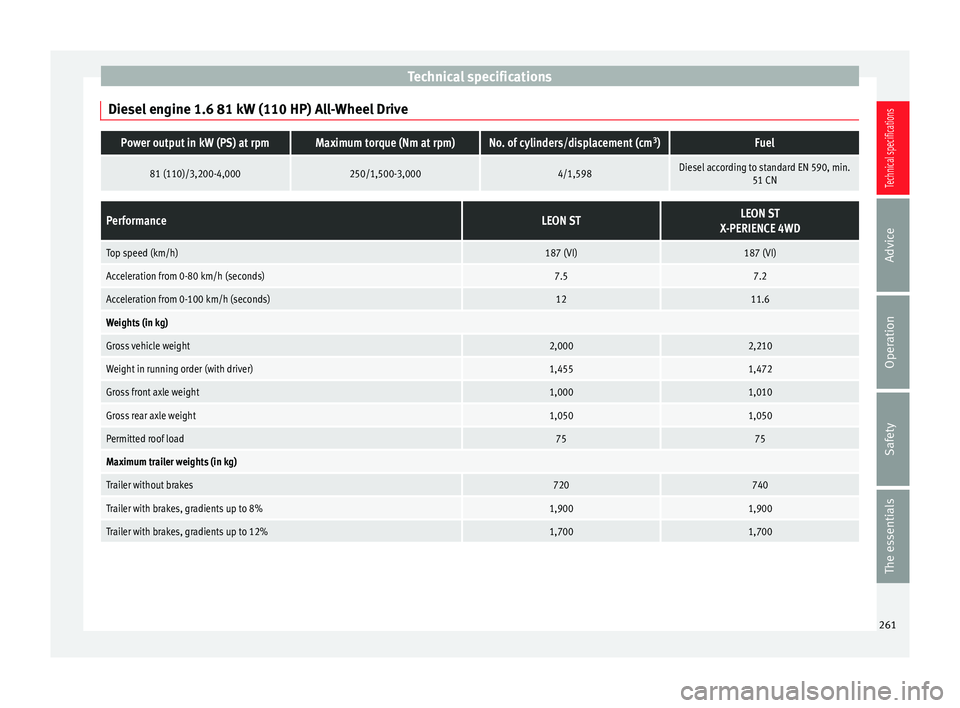
Technical specifications
Diesel engine 1.6 81 kW (110 HP) All-Wheel DrivePower output in kW (PS) at rpmMaximum torque (Nm at rpm)No. of cylinders/displacement (cm 3
)Fuel
81 (110)/3,200-4,000250/1,500-3,0004/1,598Diesel according to standard EN 590, min.
51 CN
PerformanceLEON STLEON ST
X-PERIENCE 4WD
Top speed (km/h)187 (VI)187 (VI)
Acceleration from 0-80 km/h (seconds)7.57.2
Acceleration from 0-100 km/h (seconds)1211.6
Weights (in kg)
Gross vehicle weight2,0002,210
Weight in running order (with driver)1,4551,472
Gross front axle weight1,0001,010
Gross rear axle weight1,0501,050
Permitted roof load7575
Maximum trailer weights (in kg)
Trailer without brakes720740
Trailer with brakes, gradients up to 8%1,9001,900
Trailer with brakes, gradients up to 12%1,7001,700 261
Technical specifications
Advice
Operation
Safety
The essentials
Page 267 of 284
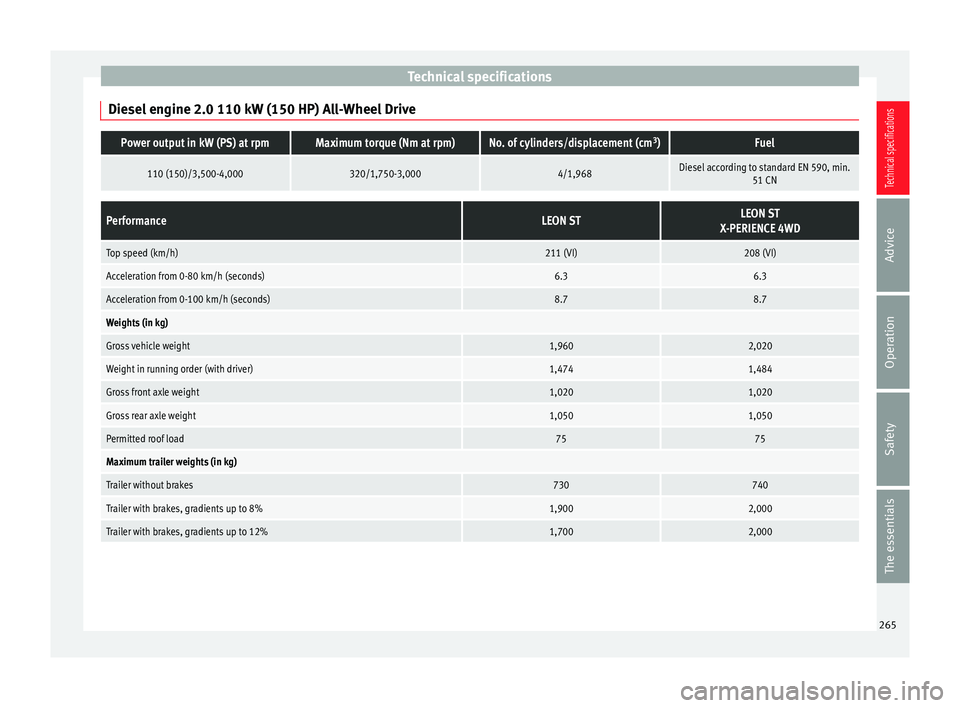
Technical specifications
Diesel engine 2.0 110 kW (150 HP) All-Wheel DrivePower output in kW (PS) at rpmMaximum torque (Nm at rpm)No. of cylinders/displacement (cm 3
)Fuel
110 (150)/3,500-4,000320/1,750-3,0004/1,968Diesel according to standard EN 590, min.
51 CN
PerformanceLEON STLEON ST
X-PERIENCE 4WD
Top speed (km/h)211 (VI)208 (VI)
Acceleration from 0-80 km/h (seconds)6.36.3
Acceleration from 0-100 km/h (seconds)8.78.7
Weights (in kg)
Gross vehicle weight1,9602,020
Weight in running order (with driver)1,4741,484
Gross front axle weight1,0201,020
Gross rear axle weight1,0501,050
Permitted roof load7575
Maximum trailer weights (in kg)
Trailer without brakes730740
Trailer with brakes, gradients up to 8%1,9002,000
Trailer with brakes, gradients up to 12%1,7002,000 265
Technical specifications
Advice
Operation
Safety
The essentials