fuel consumption Seat Leon SC 2014 User Guide
[x] Cancel search | Manufacturer: SEAT, Model Year: 2014, Model line: Leon SC, Model: Seat Leon SC 2014Pages: 284, PDF Size: 5.85 MB
Page 199 of 284
Checking and refilling levels
Liquefied natural gas (LNG) is the result of
heavy cooling of natural gas. Therefore its
volume is considerably reduced compared
with compressed natural gas (CNG). In vehi-
cles with a natural gas engine, liquefied nat-
ural gas cannot be directly refilled, as the gas
would expand excessively in the vehicle gas
tank.
Therefore, vehicles with a natural gas engine
must only be refuelled using compressed
natural gas ››› .
Natural gas quality and consumption
Natural gas is divided into the groups H and
L depending on its quality.
Gas type H has a superior heating power and
inferior nitrogen and carbon dioxide content
than type L. The higher the heating power of
the natural gas, the lower the consumption
will be.
However, the heating power and the propor-
tion of nitrogen and carbon dioxide can fluc-
tuate within the quality groups. Therefore, ve-
hicle consumption can also vary when using
a single type of gas only.
The engine management automatically
adapts to the natural gas used according to
its quality. Therefore, different quality gases
can be mixed in the tank, without the need
for comprehensive draining before applying a
different quality gas. Updated information relating to natural gas
quality is displayed on the instrument panel
››› page 72 .
Nat ur
al gas and safety
If you can smell gas or suspect that there is a
leak ››› :
● Stop the vehicle immediately.
● Switch the ignition off.
● Open the doors to appropriately ventilate
the vehicle.
● Extinguish cigarettes immediately.
● Move away from the vehicle or switch off
objects that may cause sparks or a fire.
● If you continue to smell gas, do not contin-
ue driving!
● Seek specialist assistance. Have the fault
repaired. WARNING
Failure to act when you can smell gas in the
vehicle or when refuelling can cause serious
injuries.
● Carry out the necessary operations.
● Leave the danger zone.
● If necessary, warn the emergency services. WARNING
The vehicle is not prepared to use liquefied
natural gas (LNG) and this fuel must not be
added under any circumstances. Liquefied
natural gas can cause the natural gas tank to
explode, resulting in serious injury. Note
Have the natural gas system checked regular-
ly by a specialised workshop, according to
the Maintenance Programme. 197
Technical specifications
Advice
Operation
Safety
The essentials
Page 211 of 284
Wheels
Depending on the vehicle, tyre pressure can
be adjusted (“comfort” tyre pressure) to in-
crease driving comfort. When driving with
comfort tyre pressure fuel consumption may
increase slightly.
The tyre pressure must be adjusted according
to the load the vehicle is carrying. If the vehi-
cle is going to carry the maximum load, the
tyre pressure should be increased to maxi-
mum value indicated on the sticker on the in-
side of the fuel tank flap.
Do not forget the spare wheel when checking
the tyre pressures: Keep this spare wheel in-
flated to the highest pressure required for the
road wheels.
In the case of a minimised temporary spare
wheel (125/70 R16 or 125/70 R18) inflate to
a pressure of 4.2 bar as indicated on the tyre
pressure label on the fuel tank flap.
Driving style
Fast cornering, heavy acceleration and hard
braking (squealing tyres) all increase tyre
wear.
Wheel balance
The wheels on new vehicles are balanced.
However, certain circumstances may lead to
imbalance (run-out), which is detected as vi-
brations in the steering wheel. Unbalanced wheels should be rebalanced, as
they otherwise cause excessive wear on
steering, suspension and tyres. A wheel must
also be rebalanced when a new tyre is fitted
or if a tyre is repaired.
Incorrect wheel alignment
Incorrect wheel alignment causes excessive
tyre wear, impairing the safety of the vehicle.
If you notice excessive tyre wear, you should
check wheel alignment at a SEAT Official
Service.
WARNING
● Always adapt the tyre pressure accordingly
when the vehicle load changes.
● A tyre with low air pressure has to flex a lot
more when the vehicle is heavily loaded or at
high speeds, therefore causing overheating
to occur. Under these conditions, the tyre
bead may be released or the tyre may burst.
Risk of accident! For the sake of the environment
Under-inflated tyres will increase fuel con-
sumption. Wear indicators
Fig. 177
Tyre tread: tread wear indicators Tread wear indicators indicate if a tyre is
worn.
The original tyres on your vehicle have
1.6 mm high “tread wear indicators” running
across the tread. Depending on the manufac-
turer, there will be 6 to 8 of them spaced at
equal distances around the tyre. Markings on
the tyre sidewall (for instance the letters
“TWI” or a triangle) indicate the positions of
the tread wear indicators.
The minimum tread depth required by law is
1.6 mm (measured in the tread grooves next
to the tread wear indicators). (Different fig-
ures may apply in other countries.)
»
209Technical specifications
Advice
Operation
Safety
The essentials
Page 214 of 284
Advice
securely and that the brake system functions
correctly.
The wheel bolts must be clean and turn easi-
ly.
A special adapter is required to turn the anti-
theft wheel bolts* ››› page 218.
Tyre monitoring systems Introduction WARNING
Unsuitable handling of the wheels and tyres
may lead to sudden tyre pressure losses, to
tread separation or even to a blow-out.
● Check tyre pressures regularly and ensure
they are maintained at the pressures indica-
ted. Tyre pressure that is too low could cause
overheating, resulting in tread detachment or
even burst tyres.
● Tyre pressure should be that indicated on
the label when the tyres are cold at all times
››› page 243.
● Re
gularly check the cold inflation pressure
of the tyres. If necessary, change the tyre
pressure of the vehicle tyres while they are
cold.
● Regularly check your tyres for damage and
wear. ●
Never exceed the maximum permitted
speed or loads specified for the type of tyre
fitted on your vehicle. For the sake of the environment
Under-inflated tyres lead to increased fuel
consumption and tyre wear. Note
● Driving for the first time with new tyres at a
high speed can cause them to slightly ex-
pand, which could then produce an air pres-
sure warning.
● Only replace used tyres with those author-
ised by SEAT for the corresponding type vehi-
cle.
● Do not only rely on the tyre monitoring sys-
tem. Regularly check your tyres to ensure
that the tyre pressure is correct and that the
tyres are not damaged due to puncture, cuts,
tears and impacts/dents. Remove objects
from the tyres only when they have not
pierced the tyres. Tyre monitor indicator warning lamp
If a light appears
The pressure in one or more tyres has
clearly reduced in comparison to the
tyre pressure set by the driver or the
tyre has structural damage.
Additionally, an audible warning can be heard and a text
message can be seen on the instrument panel display.
Stop the vehicle!
Reduce speed immediately! Stop
the vehicle safely as soon as possible. Avoid sudden
manoeuvres and braking! Check all tyres and pressures.
Replace any damaged tyres. If flashing
System malfunction
The control lamp flashes for approximately one minute
and then lights up permanently.
If tyre pressure is correct, switch the ignition off and on
again. If the control lamp remains lit up, the tyre moni-
toring indicator can be calibrated. Have the system
checked by a specialised workshop.
Several warning and control lamps light up
for a few seconds when the ignition is switch-
ed on while the function is verified. They will
switch off after a few seconds.
WARNING
When the tyres are inflated at different pres-
sures or at a pressure that is too low then a
tyre may be damaged resulting in a loss of 212
Page 218 of 284
Advice
Only use winter tyres of the correct type ap-
proved for your vehicle. The sizes of these
tyres are specified in the vehicle's docu-
ments (e.g. EC Certificate of Conformity or
COC 1)
). The vehicle documentation varies de-
pending on the country of residence. See al-
so ››› page 210 .
W int
er tyres lose a great deal of their proper-
ties when the tread
is worn down to a depth
of 4 mm.
The performance of winter tyres is also se-
verely impaired by ageing, even if the tread is
still much deeper than 4 mm.
Winter tyres are subject to the following max-
imum speed limits according to speed rating
code l
etter: ›››
Speed rating
code letter
››› page 210Maximum speed limit
Q160 km/h
S180 km/h
T190 km/h
H210 km/h
V240 km/h (150 mph)
(note restrictions)
W270 km/h
Speed rating
code letter
››› page 210Maximum speed limit
Y300 km/h Vehicles capable of exceeding these speeds
must have an appropriate
sticker attached so
that it is visible to the driver. Suitable stickers
are available from the SEAT Official Service
and specialised workshop. Please note the
regulations to this effect in your country.
“All-weather” tyres can also be used instead
of winter tyres.
Using winter tyres with V-rating
Please note that the generally applicable
240 km/h (150 mph) speed rating for winter
tyres with the letter V is subject to technical
restrictions; the maximum permissible
speed for your vehicle may be significantly
lower . The maximum speed limit for these
ty r
es depends directly on the maximum axle
weights for your car and on the listed weight
rating of the tyres being used.
It is best to contact a SEAT Official Service to
check the maximum speed which is permissi-
ble for the V-rated tyres fitted on your car on
the basis of this information. WARNING
Exceeding the maximum speed permitted for
the winter tyres fitted on your car can cause
tyre failure, resulting in a loss of control of
the vehicle – risk of accident. For the sake of the environment
Summer tyres should be fitted again as soon
as possible after the winter period; they give
better handling on roads which are free of
snow and ice. Summer tyres perform with
less rolling noise, tyre wear and – most im-
portant – reduce fuel consumption. Snow chains
–
Snow chains can be used on the front
wheels only.
– Check that they are correctly seated after
driving for a few yards; correct the position
if necessary. Always take the manufacturer
assembly instructions into account.
– Keep your speed below 50 km/h.
– If there is a danger of being trapped de-
spite having mounted the chains, it is best
to disable the driving wheels (ASR) in the
ESC ›››
page 145, Switching on/off the ESC
and ASR . 1)
COC = certificate of conformity.
216
Page 243 of 284
Technical specifications
Technical specifications
Technical specifications Important The information in the vehicle documentation
always takes precedence over the informa-
tion in this Instruction Manual.
All technical specifications provided in this
documentation are valid for the standard
model in Spain. The vehicle data card inclu-
ded in the Maintenance Programme or the
vehicle registration documents shows which
engine is installed in the vehicle.
The figures may be different depending
whether additional equipment is fitted, for
different models, for special vehicles and for
other countries.
Abbreviations used in the Technical
Specifications sectionAb-
brevia- tionMeaning
kWKilowatt, engine power measurement.
PSPferdestärke (horsepower), formerly used to
denote engine power.
rpmRevolutions per minute - engine speed.
NmNewton metres, unit of engine torque.
litresper
100 kmFuel consumption in litres per 100 km (70
miles).
g/kmCarbon dioxide emissions in grams per km
(mile) travelled.
CO 2Carbon dioxide
CNCetane number, indication of the diesel com-
bustion power.
RONResearch octane number, indication of the
knock resistance of petrol. Vehicle identification data
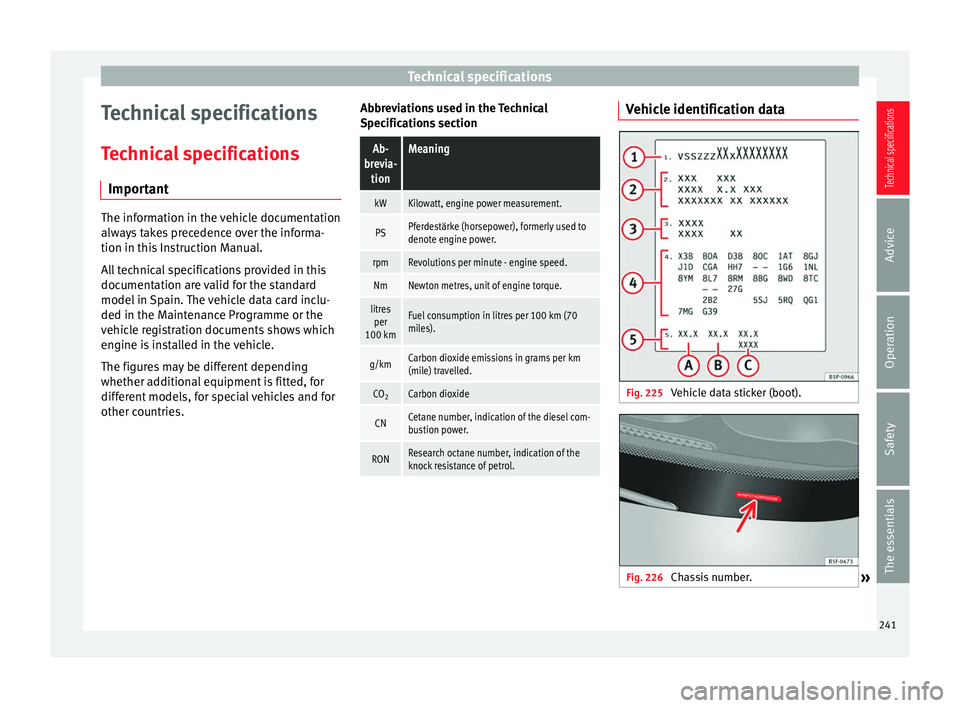
Fig. 225
Vehicle data sticker (boot). Fig. 226
Chassis number.
» 241
Technical specifications
Advice
Operation
Safety
The essentials
Page 244 of 284
Technical specifications
VIN in the Easy Connect – Select: Function button CAR > control but-
ton (Car)* Systems > Service & Control >
Ch a
ssis number .
Chassis number
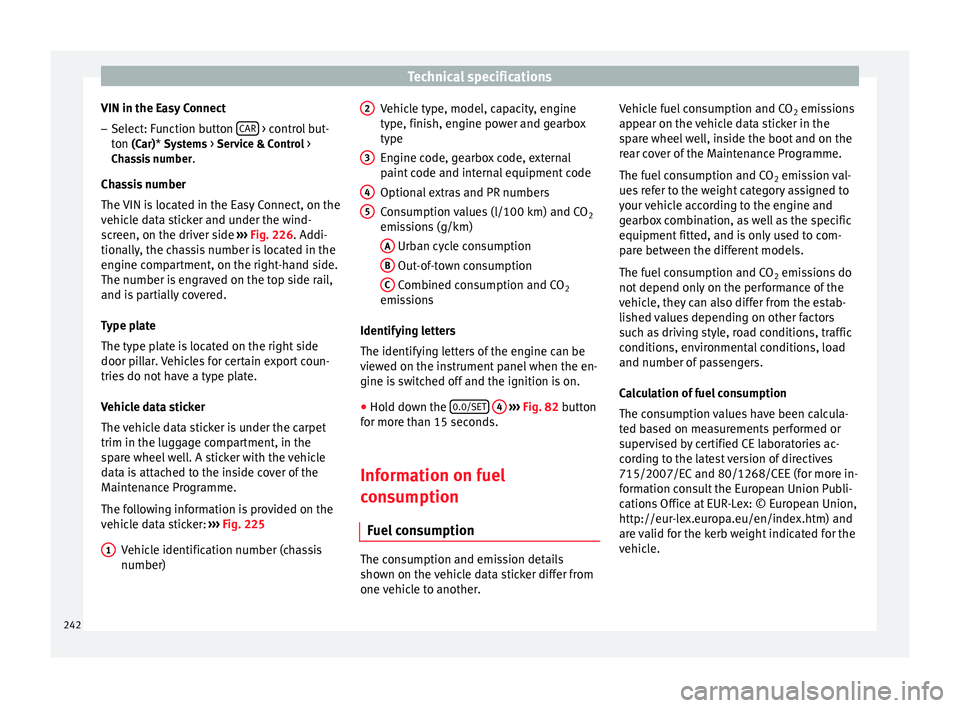
The VIN is located in the Easy Connect, on the
vehicle data sticker and under the wind-
screen, on the driver side ››› Fig. 226. Addi-
tional
ly, the chassis number is located in the
engine compartment, on the right-hand side.
The number is engraved on the top side rail,
and is partially covered.
Type plate
The type plate is located on the right side
door pillar. Vehicles for certain export coun-
tries do not have a type plate.
Vehicle data sticker
The vehicle data sticker is under the carpet
trim in the luggage compartment, in the
spare wheel well. A sticker with the vehicle
data is attached to the inside cover of the
Maintenance Programme.
The following information is provided on the
vehicle data sticker: ››› Fig. 225
Vehicle identification number (chassis
number)
1 Vehicle type, model, capacity, engine
type, finish, engine power and gearbox
type
Engine code, gearbox code, external
paint code and internal equipment code
Optional extras and PR numbers
Consumption values (l/100 km) and CO
2
emissions (g/km)
A Urban cycle consumption
B Out-of-town consumption
C Combined consumption and CO
2
emissions
Identifying letters
The identifying letters of the engine can be
viewed on the instrument panel when the en-
gine is switched off and the ignition is on.
● Hold down the 0.0/SET
4
››› Fig. 82 button
for more than 15 seconds.
Information on fuel
consumption
Fuel consumption The consumption and emission details
shown on the vehicle data sticker differ from
one vehicle to another.2 3
4
5 Vehicle fuel consumption and CO
2 emissions
appear on the vehicle data sticker in the
spare wheel well, inside the boot and on the
rear cover of the Maintenance Programme.
The fuel consumption and CO 2 emission val-
ues refer to the weight category assigned to
your vehicle according to the engine and
gearbox combination, as well as the specific
equipment fitted, and is only used to com-
pare between the different models.
The fuel consumption and CO 2 emissions do
not depend only on the performance of the
vehicle, they can also differ from the estab-
lished values depending on other factors
such as driving style, road conditions, traffic
conditions, environmental conditions, load
and number of passengers.
Calculation of fuel consumption
The consumption values have been calcula-
ted based on measurements performed or
supervised by certified CE laboratories ac-
cording to the latest version of directives
715/2007/EC and 80/1268/CEE (for more in-
formation consult the European Union Publi-
cations Office at EUR-Lex: © European Union,
http://eur-lex.europa.eu/en/index.htm) and
are valid for the kerb weight indicated for the
vehicle.
242
Page 245 of 284
Technical specifications
Note
In practice, and considering all the factors
mentioned here, consumption values can dif-
fer from those calculated in the current Euro-
pean regulations. Weights
Kerb weight refers to the basic model with a
fuel tank filled to 90% capacity and without
optional extras. The figure quoted includes
75 kg to allow for the weight of the driver.
Special versions, optional equipment fittings
or retro-fitting accessories will increase the
weight of the vehicle
››› .
WARNING
● Please note that the centre of gravity may
shift when transporting heavy objects; this
may affect vehicle handling and lead to an ac-
cident. Always adjust your speed and driving
style to suit road conditions and require-
ments.
● Never exceed the gross axle weight rating
or the gross vehicle weight rating. If the per-
missible axle load or the permissible total
weight is exceeded, the driving characteris-
tics of the vehicle may change, which could
lead to accidents, injuries and damage to the
vehicle. Towing a trailer
Trailer weights Trailer weight
The trailer weights and drawbar loads ap-
proved are selected in intensive trials accord-
ing to precisely defined criteria. The ap-
proved trailer weights apply to vehicles in the
EU and generally for maximum speeds of 80
km/h (100 km/h in c
er
tain circumstances).
The figures may be different in other coun-
tries. All data in the official vehicle documen-
tation takes precedence over these data at all
times ››› .
Drawbar loads
The maximum
permitted drawbar load on the
b
all joint of the towing bracket must not ex-
ceed
80 kg.
In the interest of road safety, we recommend
that you always tow approaching the maxi-
mum drawbar load. The response of the trail-
er on the road will be poor, if the drawbar
load is too small.
If the maximum permissible drawbar load
cannot be met (e.g. with small, empty and
light-weight single axle trailers or tandem
axle trailers with a wheelbase of less than 1
metre), a minimum of 4% of the actual trailer
weight is legally required for the drawbar
load. WARNING
● For safety reasons, do not exceed the 80
km/h (50 mph) limit. This is also valid in
countries where higher speeds are permitted.
● Never exceed the maximum trailer weights
or the drawbar load. If the permissible axle
load or the permissible total weight is excee-
ded, the driving characteristics of the vehicle
may change, leading to accidents, injuries
and damage to the vehicle. Wheels
Tyre pressure, snow chains, wheel
bolts Tyre pressures
The sticker with the tyre pressure values can
be found on the inside of the fuel tank flap.
The tyre pressure values given there are for
cold
tyres. The slightly raised pressures of
w arm ty
res must not be reduced. ››› Snow chains
Snow chains may be fitted only to the front
wheels, and only for the following tyres:
»
243
Technical specifications
Advice
Operation
Safety
The essentials
Page 274 of 284
Index
Engine coolant . . . . . . . . . . . . . . . . . . . . . . . . . . . 203 G 12 plus-plus . . . . . . . . . . . . . . . . . . . . . . . . . 203
G 13 . . . . . . . . . . . . . . . . . . . . . . . . . . . . . . . . . . 203
Specifications . . . . . . . . . . . . . . . . . . . . . . . . . . 203
Engine fault control lamp . . . . . . . . . . . . . . . . . . . . . . . . . . . . 71
Engine management control lamp . . . . . . . . . . . . . . . . . . . . . . . . . . . . 71
Engine oil . . . . . . . . . . . . . . . . . . . . . . . . . . . . . . . 200 Changing . . . . . . . . . . . . . . . . . . . . . . . . . . . . . . 202
Checking oil level . . . . . . . . . . . . . . . . . . . . . . . 201
Consumption . . . . . . . . . . . . . . . . . . . . . . . . . . 201
Engine oil dipstick . . . . . . . . . . . . . . . . . . . . . . 201
Inspection service . . . . . . . . . . . . . . . . . . . . . . 200
Longlife inspection service . . . . . . . . . . . . . . . 200
Oil properties . . . . . . . . . . . . . . . . . . . . . . . . . . 201
Replace . . . . . . . . . . . . . . . . . . . . . . . . . . . . . . . 200
Service intervals . . . . . . . . . . . . . . . . . . . . . . . . 200
Specifications . . . . . . . . . . . . . . . . . . . . . . . . . . 200
Temperature display . . . . . . . . . . . . . . . . . . . . . . 77
Topping up . . . . . . . . . . . . . . . . . . . . . . . . . . . . 202
Environment Ecological driving . . . . . . . . . . . . . . . . . . . . . . . 142
Environmental friendliness . . . . . . . . . . . . . . . 140
Environmental tip Leaks . . . . . . . . . . . . . . . . . . . . . . . . . . . . . . . . . 199
Environmental tips Filling the tank . . . . . . . . . . . . . . . . . . . . . . . . . 194
Refuelling . . . . . . . . . . . . . . . . . . . . . . . . . . . . . 193
Environment warning . . . . . . . . . . . . . . . . . . . . . . 174
Equipment . . . . . . . . . . . . . . . . . . . . . . . . . . . . . . 113
ESC Electronic stability control . . . . . . . . . . . . . . . . 143
Multi-collision brake . . . . . . . . . . . . . . . . . . . . . 144
Sport Mode . . . . . . . . . . . . . . . . . . . . . . . . . . . . 145
Ethanol (fuel) . . . . . . . . . . . . . . . . . . . . . . . . . . . . 195 Exhaust gas filtration system
Catalytic converter . . . . . . . . . . . . . . . . . . . . . . 141
Exhaust tail pipe: Cleaning . . . . . . . . . . . . . . . . . 186
Extending the luggage compartment . . . . . . . . . . . . . . . . 109
Exterior lighting Changing a bulb . . . . . . . . . . . . . . . . . . . . . . . . 233
Exterior mirrors adjusting . . . . . . . . . . . . . . . . . . . . . . . . . . . . . . 104
Adjusting . . . . . . . . . . . . . . . . . . . . . . . . . . . . . . . 13
Exterior view . . . . . . . . . . . . . . . . . . . . . . . . . . . . . . . 5
F Fastening rings . . . . . . . . . . . . . . . . . . . . . . . . . . . 119
Fault in the gearbox (warning lamp) . . . . . . . . . . 139
Faults Panoramic sliding sunroof . . . . . . . . . . . . . . . . . 93
Faults in the gearbox (warning lamps) . . . . . . . . 139
Faulty bulbs Changing a bulb . . . . . . . . . . . . . . . . . . . . . . . . 233
Filling the fuel tank . . . . . . . . . . . . . . . . . . . . . . . 193
Floor mats . . . . . . . . . . . . . . . . . . . . . . . . . . . . . . . . 42
Fog light . . . . . . . . . . . . . . . . . . . . . . . . . . . . . . . . . 97
Folding down the back seats . . . . . . . . . . . . . . . . 109
Folding table . . . . . . . . . . . . . . . . . . . . . . . . . . . . . 111
Four wheel drive . . . . . . . . . . . . . . . . . . . . . . . . . . 191
Front airbags . . . . . . . . . . . . . . . . . . . . . . . . . . . . . 50
Front armrest . . . . . . . . . . . . . . . . . . . . . . . . . . . . 108
Front Assist City Emergency braking function . . . . . . . . . . . 165
malfunction . . . . . . . . . . . . . . . . . . . . . . . . . . . . 162
on-screen messages . . . . . . . . . . . . . . . . . . . . 162
operating . . . . . . . . . . . . . . . . . . . . . . . . . . . . . . 163
radar sensor . . . . . . . . . . . . . . . . . . . . . . . . . . . 163
switching off temporarily . . . . . . . . . . . . . . . . . 164
system limitations . . . . . . . . . . . . . . . . . . . . . . 164
see also Front Assist Monitoring system . . . . . 161 Fr
ont Assist monitoring system
malfunction . . . . . . . . . . . . . . . . . . . . . . . . . . . . 162
on-screen messages . . . . . . . . . . . . . . . . . . . . 162
operating . . . . . . . . . . . . . . . . . . . . . . . . . . . . . . 163
Front Assist Monitoring system . . . . . . . . . . . . . . 161 City Emergency braking function . . . . . . . . . . . 165
radar sensor . . . . . . . . . . . . . . . . . . . . . . . . . . . 163
Front Assist Monitoring System switching off temporarily . . . . . . . . . . . . . . . . . 164
system limitations . . . . . . . . . . . . . . . . . . . . . . 164
Front head restraints . . . . . . . . . . . . . . . . . . . . . . . 41
Front headrests . . . . . . . . . . . . . . . . . . . . . . . . . . . 41
Front passenger front airbag Deactivating . . . . . . . . . . . . . . . . . . . . . . . . . . . . 11
Front seats Manually adjusting . . . . . . . . . . . . . . . . . . . . . . . 12
Fuel . . . . . . . . . . . . . . . . . . . . . . . . . . . . . . . . 31, 195 Consumption . . . . . . . . . . . . . . . . . . . . . . . . . . 241
diesel . . . . . . . . . . . . . . . . . . . . . . . . . . . . . . . . . 196
Ethanol . . . . . . . . . . . . . . . . . . . . . . . . . . . . . . . 195
Fuel gauge . . . . . . . . . . . . . . . . . . . . . . . . . . . . . 70
natural gas . . . . . . . . . . . . . . . . . . . . . . . . . . . . 196
Fuel consumption . . . . . . . . . . . . . . . . . . . . . . . . . 242
Fuel tank cap Opening and closing . . . . . . . . . . . . . . . . . . . . . 31
Fuel tank flap Opening and closing . . . . . . . . . . . . . . . . . . . . . 31
Full-LED headlights . . . . . . . . . . . . . . . . . . . . . . . 233
Fuses . . . . . . . . . . . . . . . . . . . . . . . . . . . . . . . 33, 231 Fuse box . . . . . . . . . . . . . . . . . . . . . . . . . . . . . . 232
Identifying blown fuses . . . . . . . . . . . . . . . . . . 233
Identifying by colours . . . . . . . . . . . . . . . . . . . . 232
Preparation before replacing . . . . . . . . . . . . . . 233
Replacement . . . . . . . . . . . . . . . . . . . . . . . . . . . 233
272