warning Seat Mii 2012 Owner's manual
[x] Cancel search | Manufacturer: SEAT, Model Year: 2012, Model line: Mii, Model: Seat Mii 2012Pages: 308, PDF Size: 4.13 MB
Page 165 of 308

163
Driver assistance systems
These are the basic operation conditions: doors closed, brake pedal press-
ed down and vehicle in neutral. The system gets activated on engaging
gear.
After removing your foot from the brake pedal, the braking force is main-
tained for a few seconds to prevent the vehicle from moving backward when
putting into gear. This short space of time is enough to start the vehicle
with ease.
This system also works when reversing uphill.
WARNING
● If you do not start the vehicle immediately after taking your foot off
the brake pedal, the vehicle may start to roll back under certain condi-
tions. Depress the brake pedal or use the hand brake immediately.
● If the engine stalls, depress the brake pedal or use the hand brake
immediately.
● When following a line of traffic uphill, if you want to prevent the vehi-
cle from rolling back accidentally when starting off, hold the brake pedal
down for a few seconds before starting off.
Note
The Official Service or a specialist workshop can tell you if your vehicle is
equipped with this system.
Vehicle diagramPrior to a journey...While drivingCare, cleaning and mainte-
nanceIf and whenTechnical Data
Page 166 of 308

164Air control
Air control
Heating, Ventilation and Air conditioning
system Introduction
Dust and pollen filter
The dust and pollen filter with its activated charcoal cartridge serves as a
barrier against impurities in the interior ambient air.
For the air conditioner to work with maximum efficiency, the dust and pollen
filter must be replaced at the intervals specified in the Maintenance Pro-
gramme.
If the filter loses efficiency prematurely due to use in areas with very high
levels of air pollution, the filter must be changed more frequently than sta-
ted in the Service Schedule.
Additional information and warnings:
● SEAT information system ⇒ page 22
● Windscreen wash system ⇒ page 91
● Caring for and cleaning the vehicle exterior ⇒ page 197
WARNING
Reduced visibility through the windows increases the risk of serious acci-
dents.
● Ensure that all windows are free of ice and snow and that they are not
fogged up preventing a clear view of everything outside.
WARNING (Continued)
● The maximum heat output required to defrost windows as quickly as
possible is only available when the engine has reached its normal run-
ning temperature. Only drive when you have good visibility.
● Always ensure that you use the heating system, ventilation, air condi-
tioner and the heated rear window to maintain good visibility.
● Never leave the air recirculation on for a long period of time. If the
cooling system mode is switched off and air recirculation mode switched
on, the windows can mist over very quickly, considerably limiting visibili-
ty.
● Switch air recirculation mode off when it is not required.
WARNING
Stuffy or used air will increase fatigue and reduce driver concentration
possibly resulting in a serious accident.
● Never leave the air fan turned off or use the air recirculation for long
periods of time; the air inside the interior will not be refreshed.
CAUTION
● Switch the air conditioner off if you think it may be broken. This will
avoid additional damage. Have the air conditioner checked by a Specialised
workshop.
● Repairs to the climate air conditioner specialist knowledge and special
tools. SEAT recommends visiting a Technical Service.
Page 169 of 308
167
Air control
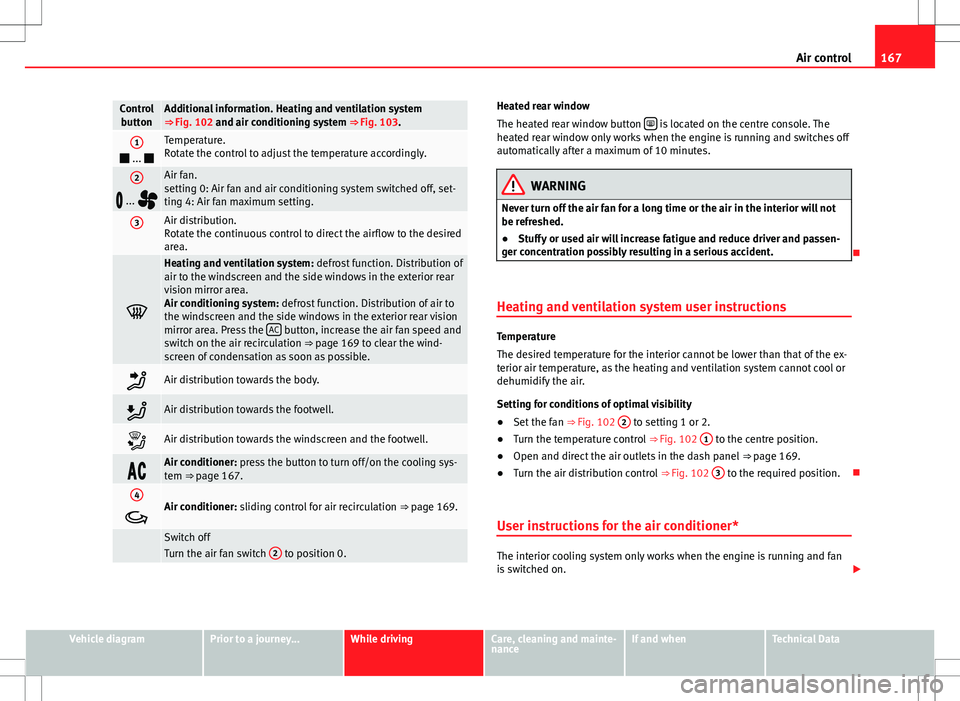
Control
buttonAdditional information. Heating and ventilation system
⇒ Fig. 102 and air conditioning system ⇒ Fig. 103.
1 ...
Temperature.
Rotate the control to adjust the temperature accordingly.
2
...
Air fan.
setting 0: Air fan and air conditioning system switched off, set-
ting 4: Air fan maximum setting.
3Air distribution.
Rotate the continuous control to direct the airflow to the desired
area.
Heating and ventilation system: defrost function. Distribution of
air to the windscreen and the side windows in the exterior rear
vision mirror area.
Air conditioning system: defrost function. Distribution of air to
the windscreen and the side windows in the exterior rear vision
mirror area. Press the AC
button, increase the air fan speed and
switch on the air recirculation ⇒ page 169 to clear the wind-
screen of condensation as soon as possible.
Air distribution towards the body.
Air distribution towards the footwell.
Air distribution towards the windscreen and the footwell.
Air conditioner: press the button to turn off/on the cooling sys-
tem ⇒ page 167.
4
Air conditioner: sliding control for air recirculation ⇒ page 169.
Switch off
Turn the air fan switch 2 to position 0.
Heated rear window
The heated rear window button is located on the centre console. The
heated rear window only works when the engine is running and switches off
automatically after a maximum of 10 minutes.
WARNING
Never turn off the air fan for a long time or the air in the interior will not
be refreshed.
● Stuffy or used air will increase fatigue and reduce driver and passen-
ger concentration possibly resulting in a serious accident.
Heating and ventilation system user instructions
Temperature
The desired temperature for the interior cannot be lower than that of the ex-
terior air temperature, as the heating and ventilation system cannot cool or
dehumidify the air.
Setting for conditions of optimal visibility
● Set the fan ⇒ Fig. 102 2
to setting 1 or 2.
● Turn the temperature control ⇒ Fig. 102 1 to the centre position.
● Open and direct the air outlets in the dash panel ⇒ page 169.
● Turn the air distribution control ⇒ Fig. 102 3
to the required position.
User instructions for the air conditioner*
The interior cooling system only works when the engine is running and fan
is switched on.
Vehicle diagramPrior to a journey...While drivingCare, cleaning and mainte-
nanceIf and whenTechnical Data
Page 172 of 308

170Air control
WARNING
Stuffy or used air will increase fatigue and reduce driver concentration
possibly resulting in a serious accident.
● Never use recirculation mode for long periods as it does not refresh
the air inside the vehicle.
● If the cooling system mode is switched off and air recirculation mode
switched on, the windows can mist over very quickly, considerably limit-
ing visibility.
● Switch air recirculation mode off when it is not required.
CAUTION
Do not smoke when the air recirculation is activated. The smoke taken in
could lie on the cooling system vaporiser and on the dust and pollen filter,
leading to a permanently unpleasant smell.
Page 173 of 308

171
At the filling station
At the filling station Refuelling
Introduction
The fuel tank plug is on the rear right of the vehicle.
Additional information and warnings:
● Exterior detail ⇒ page 6
● Fuel ⇒ page 177
● Working in the engine compartment ⇒ page 180
WARNING
Refuelling or handling fuel carelessly can cause an explosion or fire re-
sulting in serious burns and injuries.
● Always make sure that you correctly close the fuel tank flap to avoid
evaporation and fuel spillage.
● Fuels are highly explosive and inflammable substances that can
cause serious burns and injuries.
● Fuel could leak out or be spilt if the engine is not switched off or if the
filler fuel nozzle is not fully inserted into the tank filler mouth when refu-
elling. This could lead to a fire, explosion and severe injuries.
● When refuelling, turn off the engine and turn off the ignition for safe-
ty reasons.
● Always turn off mobile telephones, radio system apparatus and other
radio wave emitting equipment before refuelling. Electromagnetic waves
could cause sparks and lead to a fire.
WARNING (Continued)
● Never enter the vehicle while refuelling. If it is absolutely necessary
to enter the vehicle, close the door and touch a metal surface before
touching the filler nozzle again. This will prevent the generation of static
electricity. Sparks could cause a fire when refuelling.
● Never handle fuel close to open flames, sparks or objects with slow
combustion (e.g. cigarettes).
● Avoid static electricity and electro-magnetic radiation when refuel-
ling.
● Observe the safety regulations of the service station.
● Never spill fuel on the vehicle or in the luggage compartment.
WARNING
For safety reasons, SEAT does not recommend carrying a spare fuel canis-
ter in the vehicle. Fuel could be spilled and catch fire, above all in case of
an accident and this applies to a full container as well as empty contain-
ers. This could lead to explosions, fires and injuries.
● Observe the following if you exceptionally have to carry fuel in a can-
ister:
–Never place a fuel container, to fill it, inside the vehicle or on the
vehicle, for example, in the luggage compartment. Filling in these cir-
cumstances could create an electrostatic charge and spark that could
ignite fuel fumes.
– Always place the canister on the ground to fill it.
– Insert the fuel nozzle into the mouth of the canister as far as possi-
ble.
Vehicle diagramPrior to a journey...While drivingCare, cleaning and mainte-
nanceIf and whenTechnical Data
Page 174 of 308

172At the filling station
WARNING (Continued)
– If you are using a metal fuel canister, the nozzle must always touch
the canister while it is being filled to avoid static electricity.
– Follow the legal requirements for the use, storage and transport of
spare fuel canisters.
– Insure that the fuel container complies with manufacturing stand-
ards, for example, ANSI or ASTM F852-86.
CAUTION
● Always remove any fuel spilled anywhere on the vehicle to avoid dam-
age to the wheel housing, the tyre and vehicle paintwork.
● Refuelling a petrol engine with diesel can cause serious engine and fuel
system damage; the resulting malfunctions are not covered by the SEAT
warranty. If you refuel with the wrong type of fuel, never start the engine.
This applies to even the smallest amount of the wrong fuel. You should ob-
tain professional assistance. With the engine running, the composition of
the wrong fuel could significantly damage the fuel system and the engine
itself.
For the sake of the environment
Fuels can contaminate the environment. Collect any spilt service fluids and
allow a professional to dispose of them. Control lamps and fuel gauge
Fig. 105 On the instru-
ment panel: fuel gauge
for petrol
Fig. 106 On the instru-
ment panel: fuel gauge
for petrol
The fuel gauge can vary depending on the vehicle equipment ⇒ Fig. 105
or ⇒ Fig. 106.
Page 175 of 308

173
At the filling station
lights upGauge position
⇒ Fig. 105Possible cause ⇒ Solution
a)Red mark (ar-
row)The fuel tank is almost
empty.
The reserve tank is being
used ⇒ page 290.Refuel as soon as
possible ⇒ .
–The vehicle is running in
natural gas operating
mode.–
a)This only applies to vehicles with the fuel gauge on the instrument panel ⇒ Fig. 105.
flashes
for about 10 sec- ondsState of the barsPossible cause ⇒ Solution
and
the seg-
ments re-
maining a)Reserve zone
(four small seg- ments)The fuel tank is almost
empty.
The reserve tank is being
used ⇒ page 290.Refuel as soon as
possible ⇒ .
–The vehicle is running in
natural gas operating
mode.–
a)This only applies to vehicles with the fuel gauge on the instrument panel display.
Several warning and control lamps light up for a few seconds when the igni-
tion is switched on while a test of the function is being carried out. They will
switch off after a few seconds.
In natural gas engines
The warning lamp lights up when both fuel types (petrol and natural gas)
have reached reserve level.
The warning lamp lights up when the vehicle is running in natural gas op-
erating mode. The warning lamp
switches off when the natural gas is exhausted. The
engine changes to operate with petrol.
Problem: If the vehicle is left parked for a long time immediately after refuel-
ling, the gas level indicator does not accurately indicate the same level
shown after refuelling when the vehicle is started up again. This is not due
to a leak in the system, but to a drop in pressure in the gas tank for techni-
cal reasons after a cooling phase immediately after refuelling.
WARNING
Driving with insufficient fuel reserve could result in the vehicle breaking
down in traffic and a serious accident.
● If the fuel level is too low then the fuel supply to the engine can be-
come irregular especially on slopes.
● If the engine “is choked” or stalls due to lack of or irregularity of the
fuel supply, the power steering as well as all of the driver assistance sys-
tems including braking assistance will stop working.
● Always refuel when there is only one quarter of the fuel tank left to
avoid running out of fuel.
CAUTION
● Always pay attention to any lit lamps and to the corresponding descrip-
tions and instructions to avoid damage to the vehicle.
● Never run the fuel tank completely dry. An irregular fuel supply may lead
to ignition faults and unburnt fuel could enter the exhaust system. This
could damage the catalytic converter.
Note
The arrow next to the fuel pump symbol on the instrument panel ⇒ Fig. 105
indicates the side of the vehicle on which the fuel tank plug is located.
Vehicle diagramPrior to a journey...While drivingCare, cleaning and mainte-
nanceIf and whenTechnical Data
Page 176 of 308

174At the filling station
Refuelling with petrol
Fig. 107 Open fuel tank
flap with tank plug at-
tached to the holder
Before refuelling, always turn off the engine, the ignition, mobile tele-
phones, auxiliary heating and keep them off during refuelling.
Opening the fuel tank flap
● The fuel tank plug is at the rear of the vehicle on the right.
● Pull the rear zone of the fuel tank flap to open.
● Unfold the key shaft if necessary
⇒ page 28.
● Insert the vehicle key into the lock cylinder of the fuel tank plug and turn
the key in an anticlockwise direction.
● Take out the fuel tank plug by turning it in an anticlockwise direction
and rest it on the upper part of the fuel tank flap ⇒ Fig. 107.
Refuelling
The correct petrol type for the vehicle is located on a sticker inside the fuel
tank flap ⇒ page 177. ●
If the automatic filler nozzle is operated correctly, it will switch itself off
as soon as the fuel tank is full ⇒
.
● Do not continue to refuel if it is turned off! Otherwise, this will fill the ex-
pansion chamber and fuel may leak out if the ambient conditions are warm.
Closing the fuel tank flap
● Screw on the fuel tank filler plug in a clockwise direction until it is fully
inserted with a click.
● Insert the vehicle key into the lock cylinder of the fuel tank plug, turn the
key in a clockwise direction and remove the key.
● Press the tank flap until it clicks into place. The fuel tank flap must be
flush with the body contour.
WARNING
Do not continue refuelling once the fuel nozzle has switched itself off.
The fuel tank may be filled too much. As a result, fuel may spurt out and
spill. This could lead to a fire, explosion and severe injuries.
CAUTION
● Always remove any fuel spilled anywhere on the vehicle to avoid dam-
age to the wheel housing, the tyre and vehicle paintwork.
For the sake of the environment
Fuels can contaminate the environment. Collect any spilt service fluids and
allow a professional to dispose of them.
Page 177 of 308

175
At the filling station
Refuelling with natural gas
Fig. 108 Tank flap open:
gas filler mouth 1, filler
mouth retainer 2
Before refuelling, the engine and the ignition, mobile telephone and heat-
ing must be switched off separately
⇒ .
It is also essential to carefully read the instructions for the natural gas
pump.
The vehicle is not prepared for refuelling with liquefied natural gas (LNG)
⇒
. Before refuelling with natural gas, make sure to add the appropriate
type of fuel.
Opening the fuel tank cap
The natural gas filler mouth is behind the fuel tank cap, next to the petrol
filler mouth.
● Unlock the vehicle with the key or with the central locking button situ-
ated on the driver door ⇒ page 36.
● Press on the rear area of the flap and open it. Refuelling
Problem: If the ambient temperature is very high, the natural gas pump pro-
tection against overheating disconnects this automatically.
●
Remove the plug from the gas filler mouth ⇒ Fig. 108 1
.
● Connect the pump filling nozzle to the gas filler mouth.
● The fuel tank will be full when the pump compressor automatically cuts
the supply.
● If you wish to finish refuelling in advance, press the button on the pump
to stop the flow.
Closing the fuel tank flap
● Check that the gas filler mouth retainer 2
is not trapped with the filler
nozzle. If necessary, place it in the filler mouth again.
● Insert the plug in the filler mouth.
● Close the tank flap. Make sure you hear it click into place.
WARNING
Natural gas is a highly explosive, easily flammable substance. Incorrect
handling of the natural gas can cause accidents serious burns and other
injuries.
● Before refuelling with natural gas, the filling mouth must be correctly
engaged. If you can smell gas, stop refuelling immediately.
WARNING
The vehicle is not prepared to use liquefied natural gas (LNG) and this
fuel must not be added under any circumstances. Liquefied natural gas
can cause the natural gas tank to explode resulting in serious injury.
Vehicle diagramPrior to a journey...While drivingCare, cleaning and mainte-
nanceIf and whenTechnical Data
Page 179 of 308

177
At the filling station
Fuel
Introduction
You will find a factory-fitted sticker containing information on the type of
fuel for your vehicle on the inside of the fuel tank flap.
Additional information and warnings:
● ⇒ Booklet Maintenance Programme
● Refuelling ⇒ page 171
● Electronic power control and exhaust gases purification system
⇒ page 236
WARNING
Refuelling or handling fuel carelessly can cause an explosion or fire re-
sulting in serious burns and injuries.
● Fuel is a highly explosive, easily flammable substance.
● Observe current safety instructions and local regulations concerning
the handling of fuel.
Types of fuel
The type of fuel to use when refilling will depend on the vehicle's engine.
You will find a factory-fitted sticker containing information on the type of
fuel for your vehicle on the inside of the fuel tank flap.
SEAT recommends the use of sulphur-free or low sulphur fuel to reduce con-
sumption and prevent engine damage.
Possible types of fuelAlternative namesFurther information
91a)
RONNormal petrol, normal unlea-
ded petrol
⇒ page 17795 a)
RONPremium unleaded petrol (95
RON)
98 a)
RONPremium unleaded petrol (98
RON)
a) RON = Regulation Octane Number
Petrol
Petrol types
Vehicles with petrol engines must refuel using unleaded petrol according to
European norm EN 228 ⇒
.
Petrol types are categorised according to their octane number (e.g. 91, 95,
98 or 99 RON (RON = “Research Octane Number”). You may use petrol with
a high octane number than the one recommended for your engine. Howev-
er, this has no advantage in terms of fuel consumption and engine power.
SEAT recommends refuelling with a low sulphur content or sulphur-free fuel
to reduce fuel consumption for petrol engines.
Petrol additives
The quality of the fuel influences running behaviour, performance and serv-
ice life of the engine. Therefore, it is recommended to refuel with good qual-
ity petrol containing the corresponding petrol additives. These additives will
help to prevent corrosion, keep the fuel system clean and prevent deposits
from building up in the engine.
If good quality petrol with additives are not available or engine problems
arise, the necessary additives must be added when refuelling ⇒
.
Vehicle diagramPrior to a journey...While drivingCare, cleaning and mainte-
nanceIf and whenTechnical Data