ABS Seat Mii 2012 User Guide
[x] Cancel search | Manufacturer: SEAT, Model Year: 2012, Model line: Mii, Model: Seat Mii 2012Pages: 308, PDF Size: 4.13 MB
Page 142 of 308

140Starting, changing gears, parking
The ABS, BAS, ASR and EDL systems are incorporated into the ESC*. The
ESC* is always on 1)
.
Anti-lock brake system (ABS)
ABS can prevent the wheels from locking during braking until just before
the vehicle stops thus helping the driver to steer the vehicle and maintain
control. This means that, even during full braking, the risk of skidding is re-
duced:
● Press and hold the brake pedal fully. Do not remove your foot from the
brake pedal or reduce braking force!
● Do not “pump” the brake pedal, or reduce braking force!
● Maintain vehicle direction when braking fully with the brake pedal.
● When the brake pedal is released or when the brake force is reduced,
ABS is turned off.
ABS control can be observed by vibration of the brake pedal and noise. You
should never expect the ABS to reduce the braking distance under any cir-
cumstances. Braking distances will increase when driving on gravel, recent
snow or on icy and slippery ground.
Brake assist system (BAS)
The brake assist system may reduce the required braking distance. The
brake assist system boosts the braking force if you press the brake pedal
quickly in an emergency. As a result, the braking pressure increases rapidly,
the braking force is multiplied and the braking distance is reduced. This en-
ables the ABS to be activated more quickly and efficiently.
¡Do not lift your foot off the brake pedal! When the brake pedal is released
or when the brake force is reduced, braking assist automatically turns off
the brake servo. Traction control system (ASR) or Traction Control (TC)
In the event of wheelspin, the traction control system ASR or TC reduces the
engine torque to match the amount of grip available. The ASR or TC makes
some situations easier, for example, when starting, accelerating or going
uphill, even in unfavourable road conditions.
Electronic differential lock system (EDL)
EDL is available when driving in straight lines under normal conditions.
When the EDL detects wheelspin, it brakes the spinning wheel and directs
the power to the other driven wheel. To prevent the disc brake of the braked
wheel from overheating, the EDL cuts out automatically if subjected to ex-
cessive loads. The EDL will switch on again automatically when the brake
has cooled down.
WARNING
Driving at high speed on icy, slippery wet ground can result in loss of ve-
hicle control and serious injury to the driver and passengers.
● Adjust your speed and driving style to visibility, road, traffic and
weather conditions. Even though the braking assist systems, ABS, BAS,
EDL, ASR, TC and ESC*, provide more security, do not take unnecessary
risks while driving.
● Braking assist systems can not overcome the laws of physics. Even
with ESC* and other systems, slippery and wet roads will always be dan-
gerous.
● Driving to quickly on wet ground can result in the wheels losing con-
tact with the ground in an effect known as “aquaplaning”. Without ad-
herence, it is impossible to brake, steer or control the vehicle.
● Braking assist systems cannot avoid accidents if, for example, the
driver does not respect safety distances or drives to quickly in difficult
conditions.
1)
According to version
Page 143 of 308

141
Starting, changing gears, parking
WARNING (Continued)
● Even though braking assist systems are extremely effective and help
control the vehicle in difficult situations, remember that the vehicle sta-
bility depends on tyre grip.
● When accelerating on a slippery surface, for example on ice and
snow, press the accelerator carefully. The wheels can still slip even with
braking assist systems resulting in loss of vehicle control.
WARNING
The effectiveness of the ESC* can be considerably reduced if other com-
ponents and systems affecting driving dynamics are not maintained or
are not functioning correctly. This includes, among others, brakes, tyres
and other systems already mentioned.
● Remember that changing and fitting other components to the vehicle
can affect operation of the ABS, BAS, ASR TC, EDL and ESC*.
● Changes to the vehicle suspension or using unapproved wheel/tyre
combinations can affect operation of the ABS, BAS, ASR, TC, EDL and
ESC* and their effectiveness.
● Likewise, the effectiveness of ESC* depends on the use of suitable
tyres ⇒ page 210.
Note
To ensure that the ESC*, ASR and TC work properly, all four wheels must be
fitted with identical tyres. Any differences in the rolling radius of the tyres
can cause the system to reduce engine power when this is not desired.
Note
If a malfunction should occur in the ABS, the ESC*, ASR, TC and EDL will al-
so be affected.
Note
Noises may be heard while any of the above systems are operating.
Brake fluid
Fig. 91 In the engine
compartment: brake fluid
reservoir, lid
In the course of time, the brake fluid absorbs water from the ambient air. If
there is too much water contained in the brake fluid, the brake system could
be damaged. In addition, the boiling point of the brake fluid is significantly
lowered. When the brake fluid contains too much water and the brakes are
subject to considerable forces, bubbles of water vapour can form in the sys-
tem. These bubbles of water vapour can significantly reduce braking power,
notably increasing braking distance, and could even result in the total fail-
ure of the brake system. Ensuring that the brake system is always function-
ing correctly is essential for your own safety and the safety of other road
users ⇒
.
Brake fluid specifications
SEAT have developed a special brake fluid optimised for the brake systems
of their vehicles. To ensure the optimum working of the brake system, SEAT
Vehicle diagramPrior to a journey...While drivingCare, cleaning and mainte-
nanceIf and whenTechnical Data
Page 173 of 308

171
At the filling station
At the filling station Refuelling
Introduction
The fuel tank plug is on the rear right of the vehicle.
Additional information and warnings:
● Exterior detail ⇒ page 6
● Fuel ⇒ page 177
● Working in the engine compartment ⇒ page 180
WARNING
Refuelling or handling fuel carelessly can cause an explosion or fire re-
sulting in serious burns and injuries.
● Always make sure that you correctly close the fuel tank flap to avoid
evaporation and fuel spillage.
● Fuels are highly explosive and inflammable substances that can
cause serious burns and injuries.
● Fuel could leak out or be spilt if the engine is not switched off or if the
filler fuel nozzle is not fully inserted into the tank filler mouth when refu-
elling. This could lead to a fire, explosion and severe injuries.
● When refuelling, turn off the engine and turn off the ignition for safe-
ty reasons.
● Always turn off mobile telephones, radio system apparatus and other
radio wave emitting equipment before refuelling. Electromagnetic waves
could cause sparks and lead to a fire.
WARNING (Continued)
● Never enter the vehicle while refuelling. If it is absolutely necessary
to enter the vehicle, close the door and touch a metal surface before
touching the filler nozzle again. This will prevent the generation of static
electricity. Sparks could cause a fire when refuelling.
● Never handle fuel close to open flames, sparks or objects with slow
combustion (e.g. cigarettes).
● Avoid static electricity and electro-magnetic radiation when refuel-
ling.
● Observe the safety regulations of the service station.
● Never spill fuel on the vehicle or in the luggage compartment.
WARNING
For safety reasons, SEAT does not recommend carrying a spare fuel canis-
ter in the vehicle. Fuel could be spilled and catch fire, above all in case of
an accident and this applies to a full container as well as empty contain-
ers. This could lead to explosions, fires and injuries.
● Observe the following if you exceptionally have to carry fuel in a can-
ister:
–Never place a fuel container, to fill it, inside the vehicle or on the
vehicle, for example, in the luggage compartment. Filling in these cir-
cumstances could create an electrostatic charge and spark that could
ignite fuel fumes.
– Always place the canister on the ground to fill it.
– Insert the fuel nozzle into the mouth of the canister as far as possi-
ble.
Vehicle diagramPrior to a journey...While drivingCare, cleaning and mainte-
nanceIf and whenTechnical Data
Page 196 of 308

194In the engine compartment
Warning lamp
lights
upPossible causeSolution
Faulty generator.
Contact a Specialised workshop.
Have the electrical system
checked.
Disconnect any unnecessary
electrical consumers. The gener-
ator does not charge the battery
while the vehicle is in motion.
Several warning and control lamps light up for a few seconds when the igni-
tion is switched on while a test of the function is being carried out. They will
switch off after a few seconds.
WARNING
If the warning lamps are ignored, the vehicle may stall in traffic, or may
cause accidents and severe injuries.
● Never ignore the warning lamps.
● Stop the vehicle safely as soon as possible.
CAUTION
Failure to heed the warning lamps when they appear may result in faults in
the vehicle. Checking the electrolyte level of the vehicle battery
Fig. 115 In the engine
compartment: Remove
the cover from the vehi-
cle's battery
The battery's electrolyte level should be checked regularly in high-mileage
vehicles, in hot countries and in older batteries. Other batteries do not re-
quire maintenance.
Vehicles fitted with the Start-Stop system are equipped with special batter-
ies. For technical reasons, the electrolyte level cannot be checked in these
batteries.
Preparations
● Prepare the vehicle for work in the engine compartment
⇒ page 180
● Open the bonnet
⇒ page 180.
● Press on the tabs
⇒ Fig. 115 (arrows) in the direction of the arrows and
lift the battery cover up.
Checking the battery electrolyte level
● Make sure there is sufficient lighting to clearly recognise the colours.
Never use open flames or sparklers as a light source.
● Depending on the level of acid, the Magic eye on the top of the battery
will change colour.
Page 209 of 308
207
Vehicle care and maintenance
Type of stainCleaning the vehicleWater-based stains ,
e.g. coffee or fruit
juice.– Use a sponge and wipe with a solution of water
and wool wash.
– Dry with a dry, absorbent cloth.
Persistent stains ,
e.g. chocolate or
make-up.– Apply a washing paste a)
directly to the stain and
allow it to work.
– Apply clean water using a sponge or damp cloth to
remove the cleaning product deposits.
– Dry with a dry absorbent cloth.
Grease-based
stains, e.g. oil or lip-
stick.– Apply neutral soap or cleaning paste a)
and allow it
to work.
– Remove dissolved grease or colour particles with
an absorbent cloth.
– Then apply clean water. Take care not to soak the
upholstery.
a) Bile soap can be used as a cleaning paste.
CAUTION
Brushes should only be used to clean the mats and floor mat! Other surfa-
ces may be damaged if a brush is used.
CAUTION
Do not use steam cleaning equipment, as the dirt becomes more encrusted
in the material when steam is applied.
CAUTION
Never use brushes for cleaning damp material as they could damage the
surface. Cleaning storage compartments, drinks holders and
ashtray
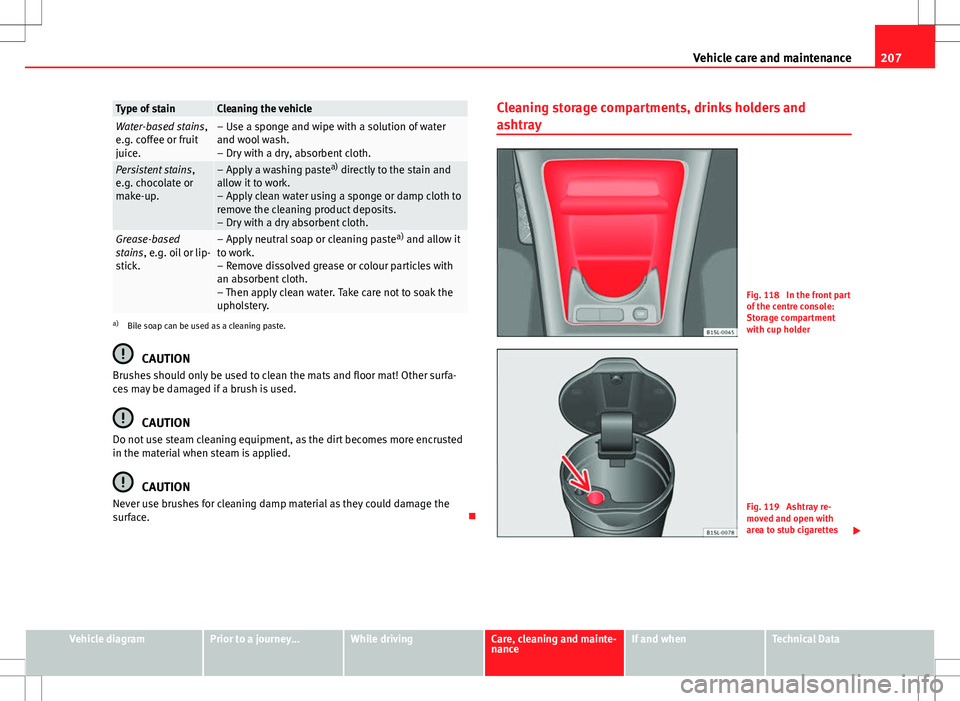
Fig. 118 In the front part
of the centre console:
Storage compartment
with cup holder
Fig. 119 Ashtray re-
moved and open with
area to stub cigarettes
Vehicle diagramPrior to a journey...While drivingCare, cleaning and mainte-
nanceIf and whenTechnical Data
Page 264 of 308

262Practical information
Vehicle fuses
Fig. 147 Below the driv-
er side dash panel: fuse
box cover
Fig. 148 In the engine
compartment: fuse box
cover
Only replace fuses with a fuse of the same amperage (same colour and
markings) and size. Identifying fuses situated below the driver-side dash panel by colours
ColourAmp ratingPurple3Light brown5Brown7,5Red10Blue15Yellow20White or transparent25Green30Orange40
Opening and closing the fuse box situated below the dash panel
●
Opening: press the unlock button ⇒ Fig. 147 1 until it is possible to
open the cover.
● Fold the cover down.
● Closing: fold the cover up in the opposite direction to the arrow until it
clicks into the locking lever 1
.
Opening the engine compartment fuse box
● Open the bonnet ⇒ page 180.
● Press the attachment tabs in the direction indicated by the arrow (thin
arrows) to release the fuse box cover ⇒ Fig. 148.
● Then lift the cover out.
● To fit the cover, place it on the fuse box. Push the attachment tabs
down, in the opposite direction indicated by the arrow until they click audi-
bly into place.
Page 268 of 308

266Practical information
Replacing the bulbs in the headlights
Fig. 150 In the engine compartment: Rear view of the
front left headlight with rubber cover: A dipped beam
and main beam headlights, B side lights and daytime
driving lights and C turn signal
There is no need to remove the headlight to replace bulbs.
Complete operations only in the sequence given:
⇒ Fig. 150ABCDipped beam and main beam headlightsSide light and daytime driving lightTurn signals (front)1.Always take the checklist into account and take the necessary actions ⇒ page 265.2.Open the bonnet ⇒ page 180.
3.
Remove the bulb connector H4. Remove
the rubber cover using the tabs.
Turn the bulb holder in an anticlockwise direction as far as it will go and remove it, along with the bulb, pulling backwards.Press the retaining clip D downwards in
the direction of the arrow, and unclip side- ways and remove it.
4.Remove the bulb from the holder. If necessary, press the lock on the bulb holder.5.Replace the faulty bulb by a new identical bulb.
Page 272 of 308
270Practical information
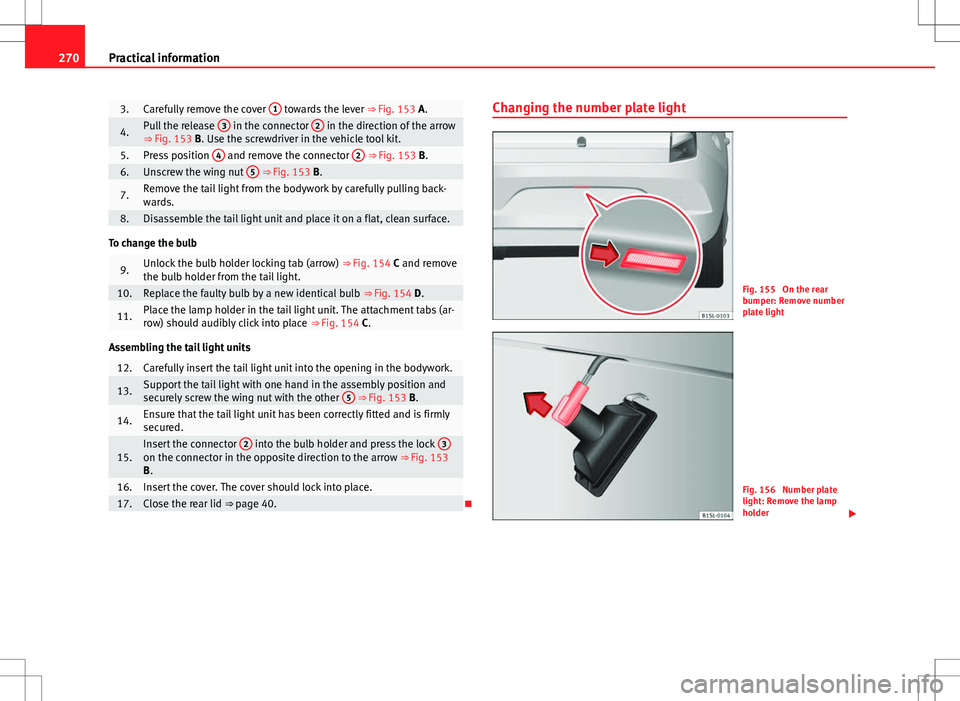
3.Carefully remove the cover 1 towards the lever
⇒ Fig. 153 A.
4.Pull the release 3 in the connector 2 in the direction of the arrow
⇒ Fig. 153 B. Use the screwdriver in the vehicle tool kit.
5.Press position 4 and remove the connector 2 ⇒ Fig. 153 B.6.Unscrew the wing nut 5 ⇒ Fig. 153 B.
7.Remove the tail light from the bodywork by carefully pulling back-
wards.
8.Disassemble the tail light unit and place it on a flat, clean surface.
To change the bulb
9.Unlock the bulb holder locking tab (arrow)
⇒ Fig. 154 C and remove
the bulb holder from the tail light.
10.Replace the faulty bulb by a new identical bulb ⇒ Fig. 154 D.
11.Place the lamp holder in the tail light unit. The attachment tabs (ar-
row) should audibly click into place ⇒ Fig. 154 C.
Assembling the tail light units
12.Carefully insert the tail light unit into the opening in the bodywork.
13.Support the tail light with one hand in the assembly position and
securely screw the wing nut with the other 5 ⇒ Fig. 153 B.
14.Ensure that the tail light unit has been correctly fitted and is firmly
secured.
15.Insert the connector 2 into the bulb holder and press the lock 3on the connector in the opposite direction to the arrow ⇒ Fig. 153
B.
16.Insert the cover. The cover should lock into place.17.Close the rear lid ⇒ page 40.Changing the number plate light
Fig. 155 On the rear
bumper: Remove number
plate light
Fig. 156 Number plate
light: Remove the lamp
holder
Page 279 of 308
277
Practical information
Instructions for tow starting
In general, the vehicle should not be started by towing. Jump-starting is
much more preferable ⇒ page 273.
For technical reasons, the following vehicles can not be tow started:
● Vehicles with an automatic gearbox.
● If the vehicle battery is flat, it is possible that the engine control unit
does not operate correctly.
However, if your vehicle must absolutely be tow-started (manual gearbox):
● Engage the 2nd or 3rd gear.
● Keep the clutch pressed down.
● Switch on the ignition and the hazard warning lights.
● Release the clutch when both vehicles are moving.
● As soon as the engine starts, press the clutch and move the gear lever
into neutral. This helps to prevent a collision with the towing vehicle.
CAUTION
When tow-starting, fuel could enter the catalytic converter and damage it.
Notes on towing
Tow rope or tow bar
When towing, the tow bar is the safest and vehicle friendly way. You should
only use a tow rope if you do not have a tow bar.
A tow rope should be slightly elastic to avoid damage to both vehicles. It is
advisable to use a tow rope made of synthetic fibre or similarly elastic mate-
rial. Only secure the tow rope or tow bar to the tow ring or specially designed
fitting.
Towing vehicles with an automatic gearbox
Note the following for a towed vehicle:
●
Make sure the gear selector lever is in the N position.
● Do not drive faster than 50 km/h (30 mph) when towing a vehicle.
● Do not tow further than 50 km (30 miles).
● If a breakdown truck is used, the vehicle must be towed with the front
wheels raised.
Situations in which the vehicle should not be towed
In the following cases, the vehicle should not be towed but transported on a
trailer or special vehicle:
● If the vehicle gearbox does not contain lubricant due to a fault.
● If the battery is flat as the steering cannot be unlocked, as a result, the
electronic steering lock and electronic parking brake cannot be disengaged.
● If the vehicle to be towed has an automatic gearbox and the distance to
be covered is greater than 50 km (30 miles).
Note
The vehicle can only be towed if the steering lock electronic gearbox lock is
deactivated. If the vehicle has no power supply or there is an electric system
fault, the engine must be started using jump leads to deactivate the steer-
ing column electronic gearbox lock.
Vehicle diagramPrior to a journey...While drivingCare, cleaning and mainte-
nanceIf and whenTechnical Data
Page 280 of 308
278Practical information
Fitting the front tow ring
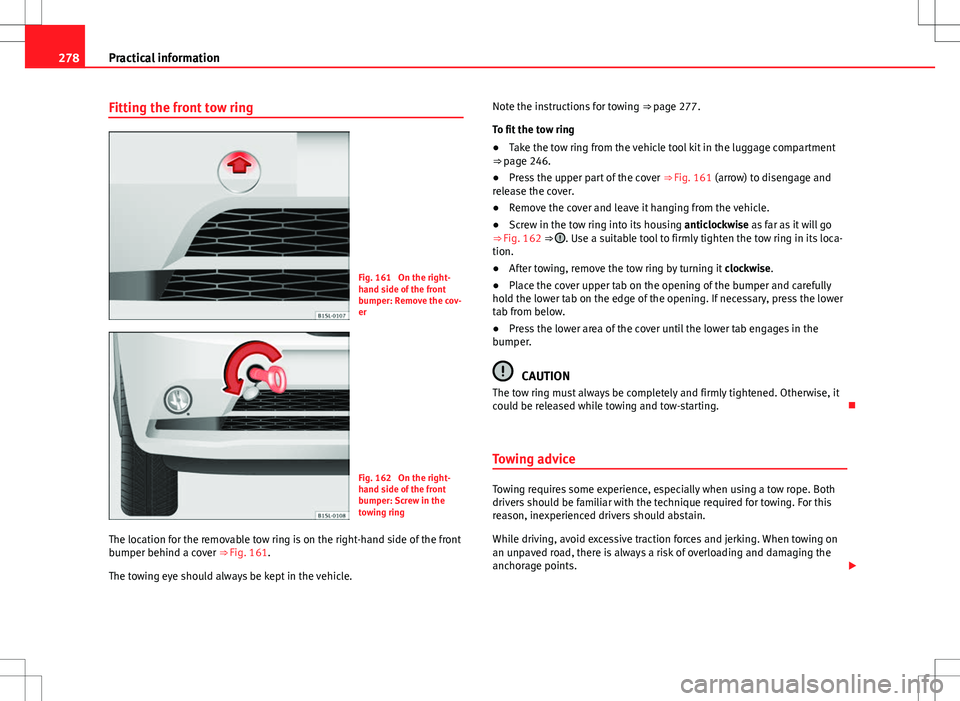
Fig. 161 On the right-
hand side of the front
bumper: Remove the cov-
er
Fig. 162 On the right-
hand side of the front
bumper: Screw in the
towing ring
The location for the removable tow ring is on the right-hand side of the front
bumper behind a cover ⇒ Fig. 161.
The towing eye should always be kept in the vehicle. Note the instructions for towing
⇒ page 277.
To fit the tow ring
● Take the tow ring from the vehicle tool kit in the luggage compartment
⇒ page 246.
● Press the upper part of the cover ⇒ Fig. 161 (arrow) to disengage and
release the cover.
● Remove the cover and leave it hanging from the vehicle.
● Screw in the tow ring into its housing anticlockwise as far as it will go
⇒ Fig. 162 ⇒
. Use a suitable tool to firmly tighten the tow ring in its loca-
tion.
● After towing, remove the tow ring by turning it clockwise.
● Place the cover upper tab on the opening of the bumper and carefully
hold the lower tab on the edge of the opening. If necessary, press the lower
tab from below.
● Press the lower area of the cover until the lower tab engages in the
bumper.
CAUTION
The tow ring must always be completely and firmly tightened. Otherwise, it
could be released while towing and tow-starting.
Towing advice
Towing requires some experience, especially when using a tow rope. Both
drivers should be familiar with the technique required for towing. For this
reason, inexperienced drivers should abstain.
While driving, avoid excessive traction forces and jerking. When towing on
an unpaved road, there is always a risk of overloading and damaging the
anchorage points.