warning Seat Mii 2014 Owner's manual
[x] Cancel search | Manufacturer: SEAT, Model Year: 2014, Model line: Mii, Model: Seat Mii 2014Pages: 219, PDF Size: 4.19 MB
Page 165 of 219
Wheels and tyres
CAUTION
● Take care not to tilt the manometer when
placing it on the valve. Otherwise, the valve
may be damaged.
● If tyre valves are not protected by caps, or if
the caps are not screwed on correctly, they
may become damaged. Check that the caps
are identical to the standard caps and have
been correctly tightened. For the sake of the environment
Under-inflated tyres will increase fuel con-
sumption. Tread depth and wear indicators
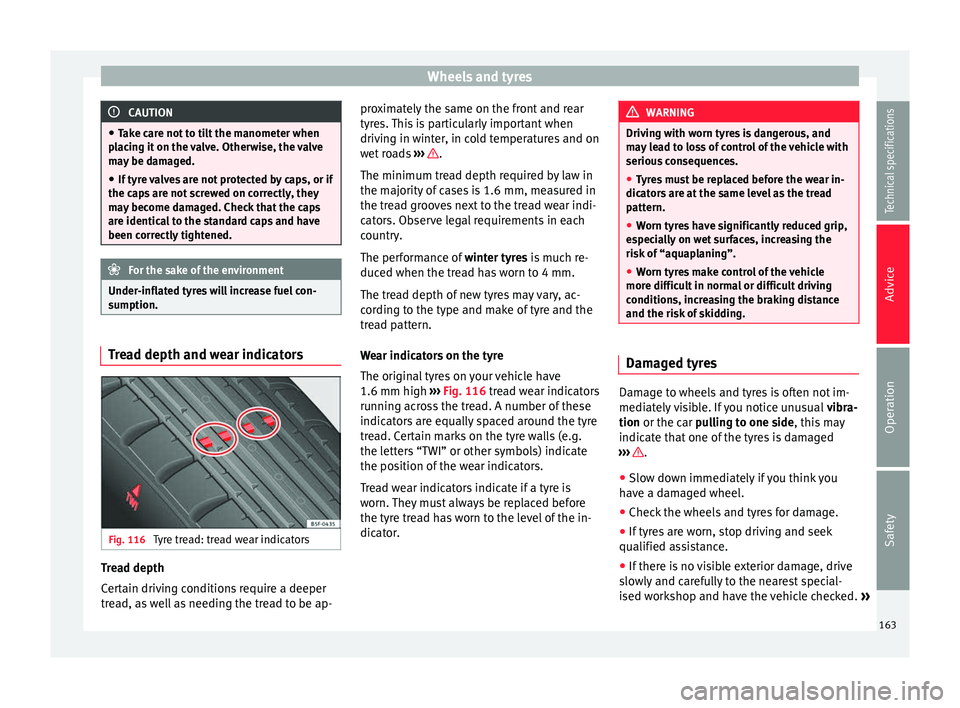
Fig. 116
Tyre tread: tread wear indicators Tread depth
Certain driving conditions require a deeper
tread, as well as needing the tread to be ap- proximately the same on the front and rear
tyres. This is particularly important when
driving in winter, in cold temperatures and on
wet roads
››› .
The minimum tread depth required by law in
the majority of cases is 1.6 mm, measured in
the tread grooves next to the tread wear indi-
cators. Observe legal requirements in each
country.
The performance of winter tyres is much re-
duced when the tread has worn to 4 mm.
The tread depth of new tyres may vary, ac-
cording to the type and make of tyre and the
tread pattern.
Wear indicators on the tyre
The original tyres on your vehicle have
1.6 mm high ››› Fig. 116 tread wear indicators
ru nnin
g across the tread. A number of these
indicators are equally spaced around the tyre
tread. Certain marks on the tyre walls (e.g.
the letters “TWI” or other symbols) indicate
the position of the wear indicators.
Tread wear indicators indicate if a tyre is
worn. They must always be replaced before
the tyre tread has worn to the level of the in-
dicator. WARNING
Driving with worn tyres is dangerous, and
may lead to loss of control of the vehicle with
serious consequences.
● Tyres must be replaced before the wear in-
dicators are at the same level as the tread
pattern.
● Worn tyres have significantly reduced grip,
especially on wet surfaces, increasing the
risk of “aquaplaning”.
● Worn tyres make control of the vehicle
more difficult in normal or difficult driving
conditions, increasing the braking distance
and the risk of skidding. Damaged tyres
Damage to wheels and tyres is often not im-
mediately visible. If you notice unusual
vibra-
tion or the car
pulling to one side
, this may
indicate that one of the tyres is damaged
››› .
● Slow down immediately if you think you
have a damaged wheel.
● Check the wheels and tyres for damage.
● If tyres are worn, stop driving and seek
qualified assistance.
● If there is no visible exterior damage, drive
slowly and carefully to the nearest special-
ised workshop and have the vehicle checked. »
163
Technical specifications
Advice
Operation
Safety
Page 166 of 219

Advice
Foreign bodies in the tyre
● Do not remove foreign bodies if they have
penetrated through the tyre wall!
● You should obtain professional assistance
immediately.
Wear of tyres
The wear of tyres depends on a number of
factors, for example:
● Driving style.
● Unbalanced wheels.
● Running gear settings.
Driving style : Driving round bends quickly or
sudden acceleration or braking speed accel-
erates tyre wear. When the driving style is
normal, if the tyres wear too quickly, have the
running gear settings checked at a special-
ised workshop.
Wheel run-out : The wheels on new vehicles
ar e b
alanced. However, certain circumstan-
ces may lead to imbalance (run-out), which is
detected as vibrations in the steering wheel.
Run-out leads to wear of the steering and
suspension. In the event of run out, the
wheels should be balanced again. When a
new wheel is fitted, it should be balanced
again.
Running gear settings : an incorrectly posi-
tioned running gear increases the wear of
tyres and affects your safety while driving. If tyres wear too quickly, have the wheel align-
ment checked at a specialised workshop. WARNING
If you notice unusual vibration or the car pulls
to one side while driving, this may indicate
that one of the tyres is damaged.
● Reduce speed immediately and stop, while
observing the highway code.
● Check the wheels and tyres for damage.
● Never carry on driving on worn tyres or
wheels. Request qualified assistance immedi-
ately.
● If there is no visible exterior damage, drive
slowly and carefully to the nearest special-
ised workshop and have the vehicle checked. Tyre monitoring system*
Fig. 117
Centre console: tyre monitor system
button The tyre control lamp compares wheel revolu-
tions and with it, the wheel diameter of each
wheel using the ESC. If the diameter of a
wheel changes, the tyre control lamp
lights up. The wheel diameter changes when:
● Tyre pressure is insufficient.
● The tyre structure is damaged.
● The vehicle is unbalanced because of a
load.
● The wheels of one axle are under more
pressure (for example, driving with a trailer or
on steep slopes).
● The vehicle is fitted with snow chains.
● The temporary spare wheel is fitted.
● The wheel on one axle is changed.
Tyre pressure adjustment
On adjusting tyre pressure or changing one
or more wheels, the ››› Fig. 117 button must
be k ept
pressed down, with the ignition on,
until an acoustic signal is heard.
If the wheels are under excessive load (for ex-
ample, driving with a trailer or heavy load),
the tyre pressure must be increased to the
recommended value for a full load (see the
sticker on the inside of the fuel flap). If the
tyre monitor system button is pressed down,
the new tyre pressures are confirmed.
164
Page 167 of 219
Wheels and tyres
The tyre pressure control lamp lights up
If the ty
re pressure of a wheel is much lower
than the value set by the driver, then the tyre
pressure control lamp ››› will light up.
WARNING
● When the tyre pressure control lamp lights
up, reduce speed immediately and avoid any
sudden turning or braking manoeuvre. Stop
when possible, and check the tyre pressure
and status.
● The driver is responsible for maintaining
correct tyre pressures. For this reason, tyre
pressure must be regularly checked.
● Under certain circumstances (e.g. when
driving in a sporty manner, in winter condi-
tions or on a dirt track) the tyre control lamp
may light up belatedly or may function incor-
rectly. Note
If the battery is disconnected, the yellow
warning lamp lights up after turning the
ignition on.
This should turn off after a brief
journey. Spare wheel or temporary spare
wheel*
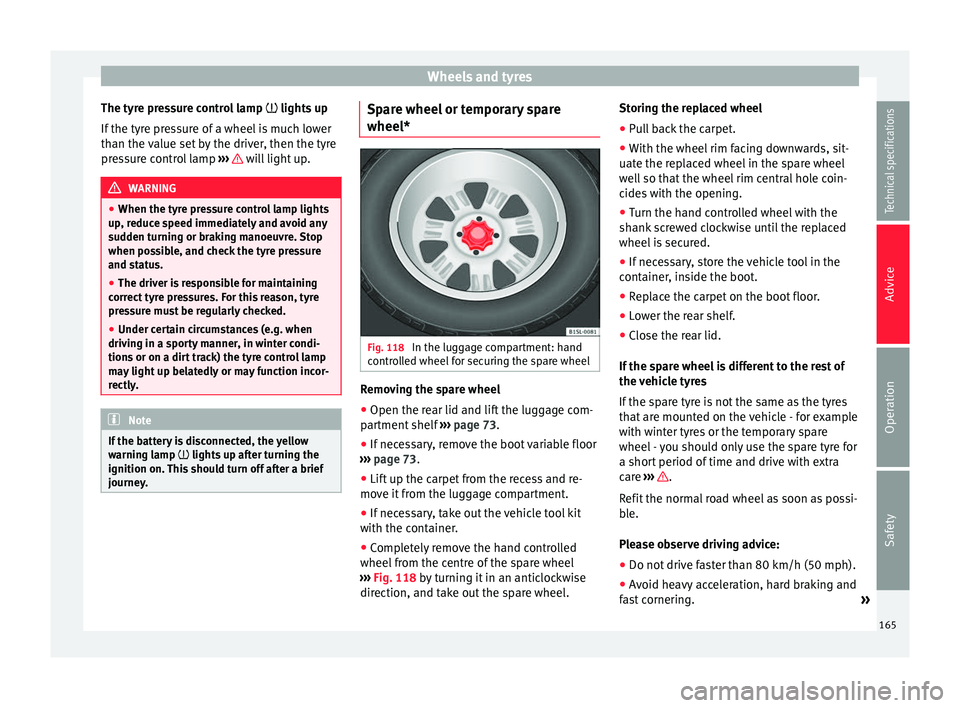
Fig. 118
In the luggage compartment: hand
controlled wheel for securing the spare wheel Removing the spare wheel
● Open the rear lid and lift the luggage com-
partment shelf ››› page 73 .
● If nec
essary, remove the boot variable floor
››› page 73.
● Lift
up the carpet from the recess and re-
move it from the luggage compartment.
● If necessary, take out the vehicle tool kit
with the container.
● Completely remove the hand controlled
wheel from the centre of the spare wheel
››› Fig. 118 by turning it in an anticlockwise
direction, and t
ake out the spare wheel. Storing the replaced wheel
● Pull back the carpet.
● With the wheel rim facing downwards, sit-
uate the replaced wheel in the spare wheel
well so that the wheel rim central hole coin-
cides with the opening.
● Turn the hand controlled wheel with the
shank screwed clockwise until the replaced
wheel is secured.
● If necessary, store the vehicle tool in the
container, inside the boot.
● Replace the carpet on the boot floor.
● Lower the rear shelf.
● Close the rear lid.
If the spare wheel is different to the rest of
the vehicle tyres
If the spare tyre is not the same as the tyres
that are mounted on the vehicle - for example
with winter tyres or the temporary spare
wheel - you should only use the spare tyre for
a short period of time and drive with extra
care ››› .
Refit the normal road wheel as soon as possi-
ble.
Please observe driving advice:
● Do not drive faster than 80 km/h (50 mph).
● Avoid heavy acceleration, hard braking and
fast cornering. »
165
Technical specifications
Advice
Operation
Safety
Page 168 of 219

Advice
● Snow chains on the temporary spare wheel
are not permitted ››› page 169 .
● Af t
er mounting the spare wheel or the tem-
porary spare wheel, check the tyre pressure
as soon as possible ››› page 162.
It is advisable to check the spare wheel or
temporary spare wheel tyre pressure when
checking the rest of the vehicle wheels at
least once a month. The spare wheel should
have the highest pressure allowed for the ve-
hicle ››› page 162. The sticker situated on the
temporary spare wheel shows the tyre pres-
sure. WARNING
Incorrect handling of the spare wheel or the
temporary spare wheel can cause loss of ve- hicle control, producing collisions or other
serious accidents and injury.
●
Never use the spare wheel or the temporary
spare wheel if it is damaged or worn to the
wear indicator.
● In some vehicles the spare wheel is smaller
than the original tyres. This can be seen on a
sticker showing the text “80 km/h” and
“50 mph”. This text indicates the maximum
velocity permitted for this type of tyre.
● Never drive faster than 80 km/h (50 mph).
Avoid powerful acceleration, hard braking
and taking corners at high speed.
● Never drive more than 200 km with a tem-
porary spare wheel fitted to the drive axle.
● Replace the temporary spare wheel for a
normal wheel as soon as possible. The com-
pact temporary spare wheel is only intended
for temporary use over short distances. ●
The temporary spare wheel must always be
secured with the factory supplied wheel
bolts.
● You should never use more than one tem-
porary spare wheel.
● After mounting the temporary spare wheel,
check the tyre pressure as soon as possible
››› page 162.
● Sno w c
hains on the temporary spare wheel
are not permitted. Note
Wherever possible, secure the spare wheel,
temporary spare wheel or the replaced wheel
safely in the luggage compartment. In vehi-
cles with anti-puncture kit, it is not possible
to secure the defective wheel. 166
Page 172 of 219

AdviceTyre sizeWheel rim
165/70 R145 J x 14 offset of 35175/65 R14
SEAT recommends you ask a technical serv-
ice for further information on wheel, tyre and
chain sizes.
Wherever possible use fine-link chains meas-
uring less than 15 mm including the lock.
Remove wheel hub covers and trim rings be-
fore fitting snow chains
››› . The wheel bolts
should be covered with caps for safety rea-
sons. These are available from technical serv-
ices.
Temporary spare wheel
For technical reasons, snow chains must not
be used on the compact temporary spare
wheel ›››
page 165.
If it is necessary to fit chains with the tempo-
rary spare wheel in use, install the wheel on
the rear axle in the event of a fault in a front
wheel. Then, fit the rear wheel that is free, in-
stead of the damaged front wheel. In this sit-
uation, observe the rotating direction of the
wheels. SEAT recommends attaching the
snow chains before fitting the wheel. WARNING
The use of unsuitable or incorrectly fitted
chains could lead to serious accidents and
damage.
● Always the appropriate snow chains.
● Observe the fitting instructions provided by
the snow chain manufacturer.
● Never exceed the maximum permitted
speeds when driving with snow chains. CAUTION
● Remove the snow chains to drive on roads
without snow. Otherwise they will impair ve-
hicle handling, damage the tyres and wear
out very quickly.
● Wheel rims may be damaged or scratched if
the chains come into direct contact with
them. SEAT recommends the use of covered
snow chains. Note
Snow chains are available in different sizes
according to the vehicle type. Emergencies
In case of emergency First aid kit, warning triangle and fire
extinguishers* Fig. 120
In the luggage compartment: stor-
age compartment for the warning triangle Warning triangle
In some vehicle equipment it is possible to
store the warning triangle model shown in a
storage compartment of the luggage com-
partment
››› Fig. 120 .
Fir s
t-aid kit
The first aid kit must comply with legal re-
quirements. Check the expiry date of the con-
tents of the first aid kit.
170
Page 173 of 219

Emergencies
Fire extinguisher
A fire extinguisher can be stored in a holder
in the passenger seat footwell.
The fire extinguisher must conform to legal
requirements, be ready for use and be
checked regularly. Check the certification
seal on the extinguisher. WARNING
Loose objects in the vehicle interior can be vi-
olently thrown in case of a sudden manoeu-
vre or braking and especially in accidents
causing serious injury.
● Secure or store fire extinguishers, first aid
kit, reflective vests and warning triangle se-
curely in the vehicle. Protecting yourself and securing the
vehicle
Fig. 121
Dash panel: Button for switching the
hazard lights warning system on and off. Always fulfil legal requirements for securing a
broken down vehicle. In a number of coun-
tries it is now obligatory, for example, to turn
on the hazard warning lights and use a re-
flective safety vest
››› page 170.
For your own safety and that of other passen-
gers, the following points should be ob-
served in the order given:
Park the vehicle a safe distance from
traffic and on suitable ground ››› .
Turn on the hazard warning lights with
the button
››› Fig. 121.
Apply the handbrake firmly ››› page 89.
Put the gearbox lever in neutral or the
selector lever in position N ››› page 93.
1.
2.
3.
4. Switch off the engine and remove the
key from the ignition.
Have all occupants leave the vehicle and
move to safety, for example behind a
guard rail.
When leaving the vehicle, take all keys
with you.
Place an emergency warning triangle to
indicate the position of your vehicle to
other road users.
Allow the engine to cool and check if a
specialist is required.
When being towed with the hazard warning
lights on, a change in direction or traffic lane
can be indicated as usual using the turn sig-
nal lever. The hazard lights will be interrup-
ted temporarily.
Examples of when to use the hazard warning
lights:
● If the vehicles ahead suddenly slow down
or reach the end of a traffic jam, to warn the
vehicles behind.
● In case of an emergency.
● If the vehicle breaks down.
● When tow-starting or towing.
Always comply with the applicable laws re-
garding the use of hazard warning lights.
If the hazard warning lights are not working,
you must use an alternative method of »
5.
6.
7.
8.
9.
171Technical specifications
Advice
Operation
Safety
Page 174 of 219
Advice
drawing attention to your vehicle. This meth-
od must comply with traffic legislation. WARNING
A faulty vehicle in traffic represents a risk of
accident for the driver and for other road
users.
● Stop the vehicle safely as soon as possible.
Park the vehicle a safe distance from sur-
rounding traffic to lock all the doors in case of
an emergency. Turn on the hazard warning
lights to warn other road users.
● Never leave children or disabled people
alone in the vehicle if the doors are to be
locked. In case of an emergency, passengers
will be trapped inside the vehicle. Individuals
locked in the vehicle can be exposed to very
high or very low temperatures. WARNING
The components of the exhaust system reach
very high temperatures. This could cause a
fire and considerable damage.
● Always park your vehicle so that no part of
the exhaust system can come in contact with
flammable materials (such as dried grass or
fuel). Note
● The vehicle battery will discharge and run
down if the hazard warning lights remain on
for too long (even with the ignition turned
off). ●
For some vehicles, the brake lights will
blink when braking suddenly at speeds of ap-
proximately 80 km/h (50 mph) to alert vehi-
cles to the rear. If braking continues, the haz-
ard warning lights system will automatically
be turned on at a speed of less than approxi-
mately 10 km/h (6 mph). The brake lights re-
main lit. Upon accelerating, the hazard warn-
ing lights will be automatically turned off. Vehicle tool kit*
Introduction When securing the vehicle in case of a break-
down, please note the legal requirements for
each country.
Vehicle tool kit
For vehicles with a factory-fitted spare wheel
or temporary spare wheel, in addition to win-
ter wheels, the luggage compartment may
contain additional vehicle tools
››› page 172. WARNING
When the vehicle tool kit, tire mobility set
and spare wheel are loose in the interior they
can be violently thrown in case of a sudden
manoeuvre or braking and especially in acci-
dents, causing serious injury.
● Ensure that the vehicle tool kit, the tire mo-
bility set and the spare wheel or temporary spare wheel are safely secured in the luggage
compartment.
WARNING
Unsuitable or damaged vehicle tools can
cause injury or accidents.
● Never work with inappropriate or damaged
tools. Location
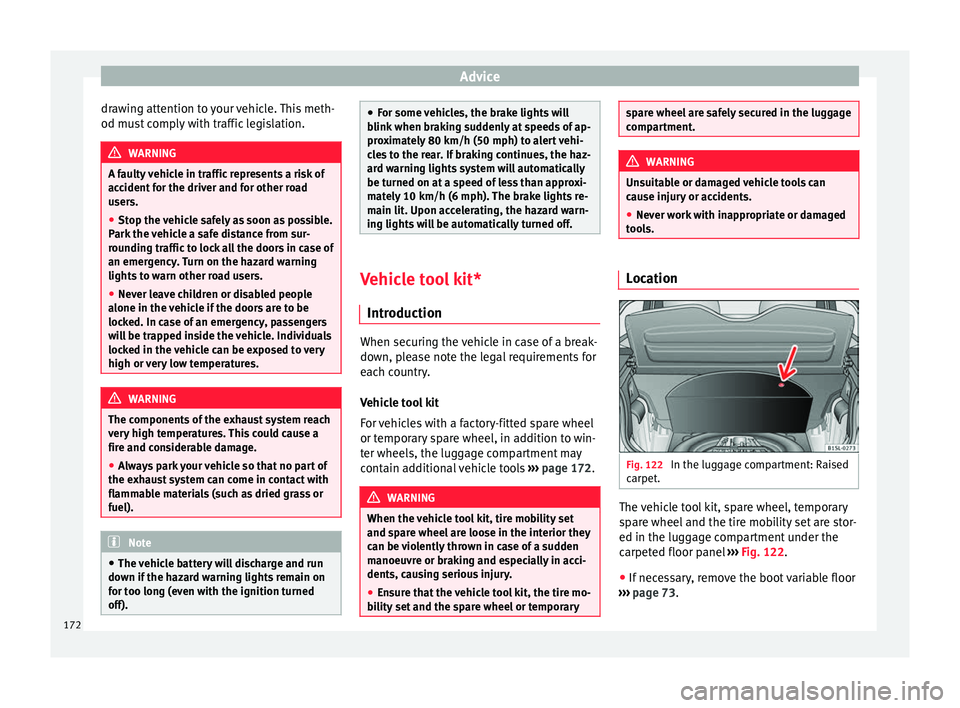
Fig. 122
In the luggage compartment: Raised
carpet. The vehicle tool kit, spare wheel, temporary
spare wheel and the tire mobility set are stor-
ed in the luggage compartment under the
carpeted floor panel
›››
Fig. 122 .
● If nec
essary, remove the boot variable floor
››› page 73.
172
Page 176 of 219

Advice
Changing a wheel Introduction Some vehicle versions and models do not
have a factory-fitted jack or box spanner. In
this case, we recommend consulting a Speci-
alised workshop to change the wheel.
You should only change the wheels yourself if
the vehicle is parked in a safe place, you are
familiar with the procedure and safety stand-
ards and you have all the necessary tools!
Otherwise, you should seek professional as-
sistance.
WARNING
Changing a wheel can be dangerous, espe-
cially on the hard shoulder. Please observe
the following rules to minimise the risk of in-
jury:
● Stop the vehicle safely as soon as possible.
Park at a safe distance from surrounding traf-
fic to change a wheel.
● When changing a wheel, keep all passen-
gers, and particularly children, a safe dis-
tance away from the work area.
● Turn on the hazard warning lights to warn
other road users.
● Ensure the ground on which you park is flat
and solid. If necessary, support the jack on a
wide solid base. ●
If you are changing a wheel yourself, you
should be familiar with the required proce-
dure. Otherwise, you should seek professio-
nal assistance.
● Only use suitable tools that are not dam-
aged when changing a wheel.
● Always stop the engine, apply the hand-
brake lever firmly and place the selector lever
in position P, or engage a gear for a manual
gearbox to reduce the risk of the vehicle mov-
ing accidentally.
● Have the tightening torque of the wheel
bolts checked as soon as possible with a reli-
able torque wrench. WARNING
If the wheel trims are not appropriate or not
fitted correctly, they could cause major acci-
dents or damage.
● Incorrectly mounted wheel trims may come
off while driving and endanger other road
users.
● Damaged trims must never be mounted on
the wheels.
● Always ensure that the brake ventilation
and cooling is not cut off or blocked. This is
also valid if hubcaps are fitted later. If there
is not enough air, you may require signifi-
cantly longer braking distances. CAUTION
Remove and remount wheel trims taking care
to avoid damage to the vehicle. Hubcaps
Fig. 124
Remove the hubcap of the steel
wheel trim In order to access the wheel bolts, first re-
move the hubcap.
Removing and fitting the hubcap
● To remove , take the vehicle tool kit wire
hook and att
ach it to the edge of the wheel
trim ››› Fig. 124
.
● Remove the trim by pulling it in the direc-
tion of the arrow.
● To replace the hubcap , press the hubcap
against the trim until it clicks into place.
174
Page 178 of 219
Advice
If the wheel bolt is very tight, you may be
able to loosen it by pushing down on the end
of the wheel brace carefully with your foot.
Hold on to the vehicle for support and take
care not to slip.
Loosening wheel bolts
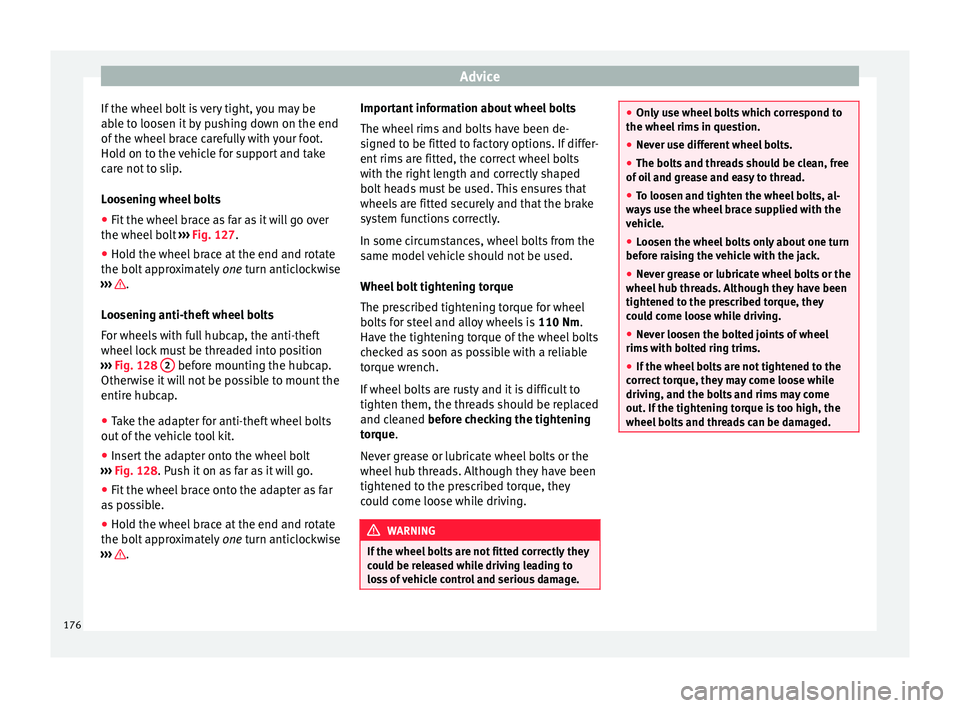
● Fit the wheel brace as far as it will go over
the wheel bolt ››› Fig. 127 .
● Ho l
d the wheel brace at the end and rotate
the bolt approximately one turn anticlockwise
››
› .
Loosening anti-theft wheel bolts
For wheels with full hubcap, the anti-theft
wheel lock must be threaded into position
››› Fig. 128 2 before mounting the hubcap.
Otherwise it will not be possible to mount the
entire hubcap.
● Take the adapter for anti-theft wheel bolts
out of the vehicle tool kit.
● Insert the adapter onto the wheel bolt
››› Fig. 128 . Push it on as far as it will go.
● Fit the wheel
brace onto the adapter as far
as possible.
● Hold the wheel brace at the end and rotate
the bolt approximately one turn anticlockwise
››
› . Important information about wheel bolts
The wheel rims and bolts have been de-
signed to be fitted to factory options. If differ-
ent rims are fitted, the correct wheel bolts
with the right length and correctly shaped
bolt heads must be used. This ensures that
wheels are fitted securely and that the brake
system functions correctly.
In some circumstances, wheel bolts from the
same model vehicle should not be used.
Wheel bolt tightening torque
The prescribed tightening torque for wheel
bolts for steel and alloy wheels is
110 Nm
.
Hav e the tight
ening torque of the wheel bolts
checked as soon as possible with a reliable
torque wrench.
If wheel bolts are rusty and it is difficult to
tighten them, the threads should be replaced
and cleaned before checking the tightening
tor
que.
Never grease or lubricate wheel bolts or the
wheel hub threads. Although they have been
tightened to the prescribed torque, they
could come loose while driving. WARNING
If the wheel bolts are not fitted correctly they
could be released while driving leading to
loss of vehicle control and serious damage. ●
Only use wheel bolts which correspond to
the wheel rims in question.
● Never use different wheel bolts.
● The bolts and threads should be clean, free
of oil and grease and easy to thread.
● To loosen and tighten the wheel bolts, al-
ways use the wheel brace supplied with the
vehicle.
● Loosen the wheel bolts only about one turn
before raising the vehicle with the jack.
● Never grease or lubricate wheel bolts or the
wheel hub threads. Although they have been
tightened to the prescribed torque, they
could come loose while driving.
● Never loosen the bolted joints of wheel
rims with bolted ring trims.
● If the wheel bolts are not tightened to the
correct torque, they may come loose while
driving, and the bolts and rims may come
out. If the tightening torque is too high, the
wheel bolts and threads can be damaged. 176
Page 179 of 219

Emergencies
Raising the vehicle with the jack Fig. 129
Jack position points Fig. 130
Jack mounted on the left rear part of
the vehicle The jack may be applied only at the jacking
points shown (marks on chassis)
››› Fig. 129 .
A lw
ays the relevant jacking point for the
wheel to be changed ››› .
Raise the vehicle using only the designated
jacking points. WARNING
If the vehicle is not correctly raised, it could
fall off the jack causing serious injury. Please
observe the following rules to minimise the
risk of injury:
● You should only use a jack approved by
SEAT for your vehicle. Other jacks, even those
approved for other SEAT models, might slip
out of place.
● The ground should be firm and flat. If the
ground is sloped or soft then the vehicle
could slip and fall off the jack. If necessary,
support the jack on a wide solid base.
● If the ground is slippery, such as tiles,
place a non-slip surface (a floor mat, for in-
stance) beneath the jack to avoid slipping.
● Only fit the jack at the prescribed jacking
points. The claw of the jack should grip the
reinforcement nerve on the underbody
››› Fig. 130.
● You shou
ld never place a body limb such as
an arm or leg under a raised vehicle that is
solely supported by the jack.
● If you have to work underneath the vehicle,
you must use suitable stands additionally to
support the vehicle, there is a risk of acci-
dent!.
● Never raise the vehicle if it is tilting to one
side or the engine is running.
● Never start the engine when the vehicle is
raised. The vehicle may come loose from the
jack due to the engine vibrations. 177
Technical specifications
Advice
Operation
Safety