oil Seat Mii 2014 User Guide
[x] Cancel search | Manufacturer: SEAT, Model Year: 2014, Model line: Mii, Model: Seat Mii 2014Pages: 219, PDF Size: 4.19 MB
Page 121 of 219
Care and maintenance
consumables should be changed at a speci-
alised workshop. Technical services are per-
manently informed of any modifications. WARNING
The incorrect use or handling of fluids or con-
sumables may result in accident, serious in-
jury, burns or intoxication.
● Therefore, fluids must always be stored
closed in their original container.
● Never store fluids in empty food containers
or bottles as other people may accidentally
drink the fluid.
● Keep all fluids and consumables out of
reach of children.
● Read and observe the information and
warnings given on the fluid containers.
● Only work in the open air or in well-ventila-
ted zones, when using products which give
off harmful vapours.
● Never use fuel, turpentine, engine oil, ace-
tone or any other volatile liquid in the main-
tenance of the vehicle. These are toxic and
highly flammable. They could lead to fire or
explosions! CAUTION
● Only use appropriate fluids. Do not confuse
fluids as this can cause serious malfunctions
or engine damage.
● Accessories and other components moun-
ted in front of the air inlet reduce the cooling effect of the coolant. If the engine is running
under great strain in high outside tempera-
tures, it could overheat.
For the sake of the environment
Leaking fluids could pollute the environment.
Collect any spilt fluids in suitable containers
and dispose of them in accordance with legis-
lation and with respect for the environment. Repairs and technical changes
When performing repairs and technical mod-
ifications, SEAT's directives must be ob-
served!
›
›› Unauthorised modifications to the electronic
components or software in the vehicle may
cause malfunctions. Due to the way the elec-
tronic components are linked together in net-
works, other indirect systems may be affec-
ted by the faults. This may significantly affect
the vehicle's performance, increase compo-
nent wear and could mean that the vehicle
registration documents are no longer valid.
Your SEAT Official Service cannot be held lia-
ble for any damage caused by technical mod-
ifications or repairs performed incorrectly.
The SEAT Official Service does not accept lia-
bility for damage resulting from technical
modifications or repairs performed incorrect-ly; neither is the SEAT warranty valid in these
cases.
SEAT recommends you have any technical
modifications or repairs performed at a SEAT
Official Service and that you use
genuine
SEAT spare parts ®
.
Vehicles with special accessories and
equipment
The manufacturers of additional equipment
guarantee that the equipment complies with
applicable laws and regulations with respect
to the environment, in particular Directives
2000/53/CE and 2003/11/CE. The first direc-
tive governs the disposal of end-of-life vehi-
cles while the second refers to the restric-
tions on the marketing and use of certain
dangerous substances and preparations.
The vehicle owner should keep the documen-
tation for the additional equipment safely
and hand it over to the scrap yard at the end
of the vehicle's service life. This ensures that
any additional equipment mounted in end-of-
life vehicles is correctly disposed of with re-
spect for the environment. WARNING
Repairs or modifications which are not per-
formed correctly may result in damage or er-
rors in the vehicle operation, affecting the ef-
fectiveness of the driver assist systems. This
could result in serious accident. » 119Technical specifications
Advice
Operation
Safety
Page 127 of 219

Care and maintenance
Jacking points for raising vehicle Fig. 96
Front jacking points for raising vehicle
with lifting platform or jack Fig. 97
Rear jacking points for raising vehicle
with lifting platform or jack Always use the jacking points indicated in
the figures
››› Fig. 96 and
›
›› Fig. 97 when
raising the vehicle. If the vehicle is not lifted
at these points, it could be seriously dam-
aged ››› or lead to serious injury
››› .The vehicle should not be lifted using lifting
platforms with lift pads containing fluid.
When raising a vehicle using a platform or
jack, a series of precautionary measures are
required. Do not raise the vehicle with a lift-
ing platform or jack unless you have received
training in how to do so and know how to do
so safely.
Notes on raising the vehicle with a jack
››› page 174
. WARNING
The improper use of the lifting platform or
the jack when raising the vehicle may result
in accidents or serious injury.
● Before raising the vehicle, please observe
the manufacturer's instructions for the plat-
form or jack, and the legal requirements,
where applicable.
● There should not be anyone inside the ve-
hicle when it is being raised or once it is in
the air.
● Only use the jacking points indicated in the
figures ››› Fig. 96 and ››› Fig. 97
when raising
the v
ehicle. If the vehicle is not lifted at the
indicated points, it may fall from the platform
while the engine or gearbox is being dis-
mounted, for example.
● The jacking points should be centrally
aligned and firmly positioned on the platform
support plates. ●
Never start the engine when the vehicle is
raised! The vehicle may fall from the platform
due to the engine vibrations.
● If it is necessary to work underneath the ve-
hicle while it is raised, you should check that
the supporting stands have an adequate load
capacity.
● Never climb onto the lifting platform.
● Always make sure that the weight of the ve-
hicle does not exceed the lifting platform
load capacity. CAUTION
● Never raise the vehicle at the engine oil
sump, the gearbox or the rear or front axles.
● Always use an intermediate rubber support
to prevent damage to the vehicle underbody. Check that the arms of the lifting platform are
able to move with obstruction.
● The arms should not come into contact with
the side running boards or other parts of the
vehicle. Care and cleaning the vehicle
exterior
Introduction Regular maintenance and washing help to
maintain the value
of the vehicle. This may
»
125
Technical specifications
Advice
Operation
Safety
Page 128 of 219

Advice
also be one of the requirements for acknowl-
edging warranty claims in the event of body-
work corrosion or paint defects.
Products suitable for the care of your vehicle
are available at any technical service. WARNING
Car-care products may be toxic and hazard-
ous. If car care products are not suitable or
are used inappropriately, this could result in
accident, serious injury, burns or intoxica-
tion.
● Car care products must always be stored in
the original container which should be kept
closed.
● Observe information provided by the manu-
facturer.
● To prevent confusion, never store car care
products in empty food cans, bottles or other
containers.
● Keep all care products out of reach of chil-
dren.
● Harmful vapours may be produced when us-
ing car care products. Therefore, care prod-
ucts should only be used in well-ventilated
spaces or in the open air.
● Never use fuel, turpentine, engine oil, ace-
tone or any other volatile liquid to wash,
clean or care for the vehicle. These are toxic
and highly flammable. WARNING
Inappropriate care and cleaning of vehicle
components may effect the vehicle safety
equipment, increasing the risk of severe in-
jury.
● Vehicle components should only be
cleaned and maintained in accordance with
the manufacturer's instructions.
● Only use approved or recommended care
products. CAUTION
Cleaning products which contain solvents will
damage the material. For the sake of the environment
Only wash the vehicle in areas allocated for
this purpose, to prevent dirty water which
may be contaminated by oil, grease or fuel,
from entering the drains. In some places,
even washing it outside the planned areas is
banned. For the sake of the environment
Where possible, always use products which
respect the environment. For the sake of the environment
The remains of car care products should not
be disposed of with ordinary household waste. Observe information provided by the
manufacturer.
Washing the vehicle
The longer substances such as insects, bird
droppings, resinous tree sap, road dirt, in-
dustrial deposits, tar, soot or road salt and
other aggressive materials remain on the ve-
hicle, the more damage they do to the paint-
work. High temperatures (for instance due to
strong sunlight) further intensify the corro-
sive effect. The vehicle
undercarriage should
also be thoroughly washed at regular inter-
vals.
Automatic car washes
Always observe the instructions provided at
the automatic car wash. The standard pre-
cautionary measures prior to entering the car
wash should be taken to avoid damage to
the vehicle (close all windows, fold in exterior
mirrors). If the vehicle is fitted with additional
components (spoiler, roof-rack, aerial, etc.),
check with the car wash supervisor whether
these can enter the car wash ››› .
The vehicle paintwork is so durable that the
vehicle can normally be washed without
problems in an automatic car wash tunnel.
However, wear and damage to the paintwork
will depend on the type of car wash used.
126
Page 130 of 219
Advice
and from the parking distance warning sys-
tem sensors. The sensors of the parking dis-
tance warning system are situated on the rear
bumper ››› .
Do not use a nozzle that sprays the water out
in a direct stream
or one th
at has a rotating
jet for forcing off dirt ››› .
WARNING
The incorrect use of high pressure cleaning
equipment could result in permanent dam-
age, visible or invisible, to the tyres or other
materials. This could result in a serious acci-
dent.
● Ensure there is a suitable distance between
the nozzle and the tyres.
● Never wash tyres with a concentrated jet or
so-called “dirt blasters”. Even at large spray-
ing distances and short cleaning times, you
may damage the tyres. WARNING
After the vehicle has been washed, the brak-
ing effect will be reduced (and the braking
distance increased) due to moisture (and ice
in winter) on the brakes.
● “Dry the brakes and remove ice” by braking
carefully. Ensure that you are not endanger-
ing other road-users or breaking traffic regu-
lations in the process. CAUTION
● The temperature of the water must not be
above +60 °C (+140 °F).
● To avoid damage to the paintwork, do not
wash the vehicle in full sun.
● To ensure that the system functions well,
the sensors located on the bumper must be
kept clean and free from ice. When cleaning
with pressure hoses and steam cleaners, the
sensors should be sprayed only briefly. A dis-
tance of 10 cm between the sensors and the
steam / hose nozzle must be observed.
● Do not use a high pressure cleaner to re-
move ice or snow from windows
● Washing the vehicle in low temperatures:
When washing the vehicle with a hose, do
not direct water into the lock cylinders or the
gaps around the doors or roof. Locks and
seals could freeze! Cleaning windows and exterior
mirrors
Cleaning windows and exterior mirrors
Spray windows and exterior windows with a
standard window cleaner containing alcohol.
Dry the windows with a clean chamois leath-
er or a lint-free cloth. The chamois leathers
used on painted surfaces are not suitable for
cleaning windows because they are soiledwith wax deposits which could smear the
windows.
Use window cleaner or a silicone remover to
clean rubber, oil, grease and silicone depos-
its off
››› .
Removing wax deposits
Automatic car washes and certain car care
products may leave wax deposits on the win-
dows. These deposits can only be removed
with a special product or cleaning cloths. If
wax deposits are left on the windscreen and
the rear window, the blades can scratch the
glass. SEAT recommends you wipe the wax
deposits off the windscreen and the rear win-
dow with a soft cloth each time after you
have washed the vehicle.
A window cleaning detergent which helps to
dissolve the wax may be added to the wind-
screen washer fluid to prevent the wiper
blades from scratching the windscreen.
Please ensure you add the cleaning product
in the correct proportions. Products for re-
moving grease do not eliminate the wax de-
posits ››› .
Special cleaning products or window cloths
are available at any technical service. To re-
move wax deposits, SEAT recommends the
following products:
128
Page 133 of 219
Care and maintenance
Cleaning the engine compartment The engine compartment of any motor vehi-
cle is a potentially hazardous area
››› page 143.
The en gine c
ompartment should only be
cleaned by qualified personnel. If it is not
correctly cleaned, the anti-corrosion coating
and consequently electrical components may
be damaged. Moreover, water may filter di-
rectly into the vehicle interior through the wa-
ter chamber ››› .
If the engine compartment is very dirty, al-
ways take the vehicle to a specialised work-
shop for professional cleaning. SEAT recom-
mends taking your car in for technical serv-
ice.
Water box
The water box is in the engine compartment,
between the windscreen and the engine, and
beneath a perforated cover. Air is taken in
through the water box from outside to the ve-
hicle interior via the heating and air condi-
tioner.
Leaves and other loose objects should be
regularly cleaned away from the water box ei-
ther by hand or with a vacuum. WARNING
When working on the engine or in the engine
compartment, there is a risk of injury, burns,
accident or fire.
● Before starting work, please ensure you are
familiar with the required procedure and the
safety precautions ››› page 143.
● SEAT recommends getting a specialised
workshop to do these jobs. CAUTION
If water is manually poured into the water box
(e.g. using a high pressure cleaning appli-
ance), this could cause significant damage to
the vehicle. For the sake of the environment
Only wash the engine compartment in areas
allocated for this purpose, to prevent dirty
water which may be contaminated by oil,
grease or fuel, from entering the drains. In
some places, even washing this compartment
outside planned areas for this purpose is
banned. Caring for and cleaning the
vehicle interior
Introduction The dye from many items of modern clothing
(e.g. dark jeans) is not always colour-fast.
Seat upholstery (material and leather), espe-
cially when light-coloured, may visibly discol-
our if the dye comes out of clothing (even
when used correctly). This is not an uphols-
tery defect but indicates that the dye in the
item of clothing is not sufficiently colour-fast.
WARNING
Car-care products may be toxic and hazard-
ous. If car care products are not suitable or
are used inappropriately, this could result in
accident, serious injury, burns or intoxica-
tion.
● Car care products must always be stored in
the original container which should be kept
closed.
● Observe information provided by the manu-
facturer.
● To prevent confusion, never store car care
products in empty food cans, bottles or other
containers.
● Keep all care products out of reach of chil-
dren. » 131
Technical specifications
Advice
Operation
Safety
Page 134 of 219
Advice
●
Harmful vapours may be produced when us-
ing car care products. Therefore, care prod-
ucts should only be used in well-ventilated
spaces or in the open air.
● Never use fuel, turpentine, engine oil, ace-
tone or any other volatile liquid to wash,
clean or care for the vehicle. These are toxic
and highly flammable. WARNING
Inappropriate care and cleaning of vehicle
components may effect the vehicle safety
equipment, increasing the risk of severe in-
jury.
● Vehicle components should only be
cleaned and maintained in accordance with
the manufacturer's instructions.
● Only use approved or recommended care
products. CAUTION
● Cleaning products which contain solvents
will damage the material.
● To avoid damage, stubborn stains should
be removed by a specialised workshop. Note
Suitable vehicle care products are available
from your technical service. Treating your upholstery
To treat and maintain your seat upholstery,
keep the following in mind
››› :
● Before entering the vehicle, close any Vel-
cro fasteners that might snag on the uphols-
tery or trim fabric. Any open Velcro fasteners
may damage the trim or upholstery fabrics.
● To prevent damage, avoid direct contact
between sharp decorative objects and the
upholstery and trim fabrics. Decorative ob-
jects include zips, rivets and rhinestones on
clothing and belts.
● From time to time, clean the dust that gath-
ers in the perforations, folds and seams so
that the surfaces of the seats are not dam-
aged by its abrasive effect.
● Make sure clothes are colour-fast to avoid
them running and staining the upholstery.
This is especially important if the upholstery
is light in colour. CAUTION
If the instructions for upholstery and trim
care are not followed, they may deteriorate
and discolour. Note
SEAT recommends you take the vehicle to a
Specialised workshop to treat any stains on
the upholstery caused by the discolouration
of clothing. Padding and fabric trim cleaning
Normal cleaning
●
Before applying cleaning products, please
read the instructions for handling and the
warnings shown on the container.
● The upholstery, textile covers, and carpet
should be regularly vacuumed (with vacuum
brush).
● We recommend that you use a soft sponge
or lint-free, micro-fibre cloth for normal clean-
ing ››› .
General superficial dirt on upholstery and
textile covers can be cleaned with a normal
foam cleaning product.
If the upholstery and the material trims are
very dirty, we recommend you have them
cleaned by a specialist cleaning form.
Cleaning stains
It may be necessary to clean the whole sur-
face and not only the stain itself. Especially if
the surface has been dirtied through normal
use. Otherwise, the stained area may be-
come lighter than the rest of the surface after
treatment.
132
Page 135 of 219

Care and maintenanceType of
stainCleaning the vehicle
Water-based
stains, e.g.
coffee or fruit
juice.– Use a sponge and wipe with a solu-
tion of water and wool wash.
– Dry with a dry, absorbent cloth.
Persistent
stains, e.g.
chocolate or
make-up.– Apply a washing paste
a)
directly to
the stain and allow it to work.
– Apply clean water using a sponge or
damp cloth to remove the cleaning
product deposits.
– Dry with a dry absorbent cloth.
Grease-based
stains, e.g. oil
or lipstick.– Apply neutral soap or cleaning
paste a)
and allow it to work.
– Remove dissolved grease or colour
particles with an absorbent cloth.
– Then apply clean water. Take care not
to soak the upholstery.
a) Bile soap can be used as a cleaning paste. CAUTION
● Brushes should only be used to clean the
mats and floor mat! Other surfaces may be
damaged if a brush is used.
● Do not use steam cleaning equipment, as
the dirt becomes more encrusted in the mate-
rial when steam is applied.
● Never use brushes for cleaning damp mate-
rial as they could damage the surface. Cleaning storage compartments,
drinks holders and ashtray
Fig. 98
In the front part of the centre console:
Storage compartment with cup holder. Fig. 99
Ashtray removed and open with area
to stub cigarettes Cleaning storage compartments and drinks
holders
● Use a clean, damp, lint-free cloth to clean
parts.
● If this does not provide satisfactory results,
we recommend using a special solvent-free
plastic cleaning product.
Cleaning the ashtray
● Extract the ashtray and empty it.
● Clean the ashtray with a dishcloth.
Use a toothpick or similar to remove ash from
the area where cigarettes are stubbed out
››› Fig. 99 .
C ar
e and cleaning of plastic parts,
wooden trim and the instrument
panel ●
Use a clean, damp, lint-free cloth to clean
parts.
● Clean plastic parts (inside and outside the
vehicle) and the dash panel with a special
solvent-free product for the care and clean-
in g of
plastic, approved by SEAT ››› .
● Wash wooden trims
w
ith a mi
ld soap and
water solution.
● Clean the Portable Navigation System hous-
ing (Supplied by SEAT) with a dry cloth only.
»
133
Technical specifications
Advice
Operation
Safety
Page 147 of 219
Checking and refilling levels
parts of the engine. Before any work, re-
move ties and jewellery (necklaces, etc),
tie long hair back and tie all items of
loose clothing to your body to make sure
that they cannot be trapped by engine
components.
– Take extreme caution when operating the
accelerator and remain attentive. The ve-
hicle could move, even if the handbrake
is applied.
● Always make sure you have not left any ob-
jects, such as cleaning cloths and tools, in
the engine compartment. If any object is left
in the engine compartment, this could cause
malfunctions, engine faults and even a fire. WARNING
Refill liquids and certain materials can catch
fire easily in the engine compartment, caus-
ing a fire and serious injury!
● Never smoke.
● Never work close to places exposed to
flames or sparks.
● Never pour service fluids over the engine.
These fluid may ignite hot engine parts and
cause injuries.
● If it is necessary to work on the fuel system
or the electrical system, please follow the in-
structions below:
–Always disconnect the vehicle battery.
– Never work close to heaters, heat sources
or places exposed to flames or sparks. ●
Always keep a recently serviced and per-
fectly working fire extinguisher close by.
● Never cover the engine with additional in-
sulating materials such as a blanket. Risk of
fire! CAUTION
When refilling or changing service liquids,
ensure that you put the liquids into the right
tank. Making a mistake when refilling could
cause serious malfunctions and damage the
engine! For the sake of the environment
Service fluids leaks are harmful to the envi-
ronment. For this reason you should make
regular checks on the ground underneath
your vehicle. Take the vehicle to a specialised
workshop to be checked if you see stains, oil
or other fluids on the ground. Collect any
spilt service fluids and allow a professional to
dispose of them. Opening and closing the bonnet
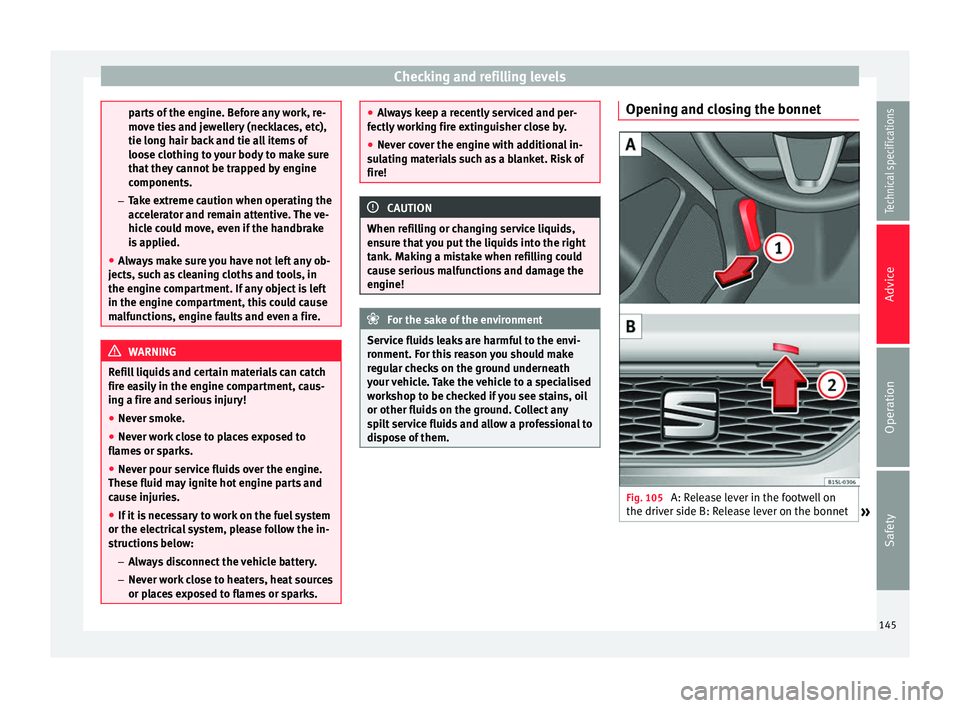
Fig. 105
A: Release lever in the footwell on
the driver side B: Release lever on the bonnet » 145Technical specifications
Advice
Operation
Safety
Page 148 of 219

Advice
Fig. 106
C: Bonnet securing rod in the bon-
net. D: Bonnet supported by the bonnet se-
curing rod Opening the bonnet
● Before opening the bonnet, make sure that
the windscreen wiper arms are in place
against the windscreen ››› .
● Pull the release lever 1 in the direction of
the arrow ›››
Fig. 105
A. The bonnet is re- leased from the lock carrier by a spring mech-
anism
››› .
● Lift the bonnet up slightly while pressing
the release lever 2
B
in the direction of the
arr
ow to completely open the bonnet.
● Take out the bonnet support rod from its
clip in the direction of the arrow 3
C
and
p
lace it in the corresponding open position
4
D
(arrow).
C
losing the bonnet
● Slightly lift the bonnet ››› .
● Take out the bonnet support rod from the
opening catch 4
D
and insert it into its clip
3
C
in the opening catch.
● L
et the bonnet fall from a height of 30 cm
into its clip; Do not
apply pressure!
If the bonnet is not correctly closed, open it
once again and close it correctly.
The bonnet is correctly closed when it is flush
with the corresponding parts on the body-
work. WARNING
If the bonnet is not correctly closed, it could
suddenly open while driving leaving the driv-
er without visibility. This could result in a se-
rious accident.
● After closing the bonnet, always check that
it is properly secured by the locking mecha-
nism in the lock carrier piece. The bonnet must be flush with the surrounding body pan-
els.
●
While driving, if you notice that the bonnet
is not correctly closed then stop immediately
and close it correctly.
● Only open and close the bonnet when there
is nobody within its range. CAUTION
● To avoid damage to the bonnet and to the
windscreen wiper arms, only open it when
the windscreen wipers are in place against
the windscreen.
● Before driving, always lower the wiper
arms. Engine oil
Introduction WARNING
Incorrectly handling engine oil can cause in-
jury and serious burns.
● Always protect your eyes when handling
engine oil.
● Oil is toxic and must be kept out of the
reach of children.
● Engine oil should only be kept in its origi-
nal packaging; the same goes for used oil un-
til it is disposed of. 146
Page 149 of 219

Checking and refilling levels
●
Never store engine oil in empty food con-
tainers or bottles as other people may acci-
dentally drink it.
● Regular contact with engine oil can be bad
for the skin. If you come into contact with en-
gine oil, wash your skin with soap and water.
● With the engine running, the engine oil
gets extremely hot and can cause severe skin
burns. Always wait until the engine has fully
cooled. For the sake of the environment
Similar to the other service liquids, spilled
engine oil can be bad for the environment.
Collect these liquids in suitable containers
and dispose of them while respecting the en-
vironment. Warning and control lampsFlashesPossible
causeSolution
Engine oil
pressure too
low.
Stop the vehicle!
Switch off the engine. Check
the engine oil level, and if
necessary, refill with
››› page 148.
engine oil - If the warning in-
dicator flashes although the
oil level is correct, do not
continue driving or leave the
engine running. Otherwise,
the engine could be dam-
aged. Seek specialist assis-
tance. WARNING
Observe the safety warnings ››› in Control
and warning lamps on page 40. Engine oil specifications
Replacement engine oil must strictly comply
with the specifications.
The correct oil must be used to ensure the
correct operation and long service life of the
engine. The engine comes with a high-quality
multigrade oil that can generally be used all
year round.Only use an engine oil that complies to SEAT
standards whenever possible
››› . Only refill
engine oil using approved engine oil in ac-
cordance with the corresponding VW stand-
ard ( ››› table on page 147 ). All oils indicated
ar e synthetic multigrade oils .
Engine oils are being continuously further
developed. Technical services are constantly
updated with any modifications. SEAT there-
fore recommends that you have the engine
oil changed by a technical service.
Engines
Specifications of en- gine oil with a serv- ice dependent on
time/distance travel- led
44 kW - 55 kW Petrol en-ginesVW 504 00, VW 502 00
Natural gas engineVW 502 00 CAUTION
● Only use engine oils whose specifications
are expressly approved by SEAT. The use of
any other type of oil could cause engine dam-
age!
● No additives should be used with engine
oil. Any damage caused by the use of such
additives would not be covered by the factory
warranty. 147
Technical specifications
Advice
Operation
Safety